
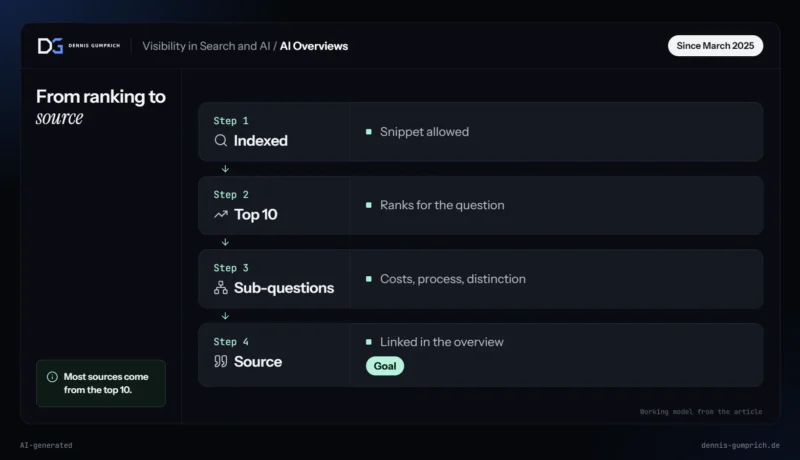

Google AI Overviews are AI-generated summaries above the search results with links to sources. They have been available in Germany since March 26, 2025, and in many other markets before that. Google selects the sources using the same ranking systems as in classic search, which is why pages in the top 10 have the best chances. You do not need any special markup. What matters is maintaining the pages that already rank for questions with an overview and measuring your presence with the generative AI report in Search Console.
What are Google AI Overviews?
AI Overviews are summaries that Google creates with generative AI and shows above the organic results. They answer a question directly and link to the pages the answer is based on. Google only shows them when its systems consider them helpful.
Google launched AI Overviews in the US in May 2024 and has since rolled them out to many countries and languages. In Germany they have been available since March 26, 2025, in German and English. At launch, only signed-in users aged 18 and over saw them. Since October 8, 2025, there has also been AI Mode in Germany, a separate search view for longer questions and follow-up questions. According to Google, both are built on the same foundations.
How often overviews appear depends heavily on the topic. An analysis by the Pew Research Center found an AI summary in around 18 percent of the Google searches of 900 US adults in March 2025. For your own topics, it is best to measure this yourself.
How does Google choose the sources for AI Overviews?
Through the same ranking and quality systems as in classic search, complemented by query fan-out: in the background, Google runs several related searches on subtopics and selects suitable pages. The prerequisite is that a page is indexed and allowed to show a snippet.
According to Google's documentation, there are no other technical requirements. No special markup, no dedicated file, no AI-specific formatting. According to an earlier analysis by the SEO tool provider Ahrefs, 76 percent of the pages cited in AI Overviews come from the top 10 of classic search. The way into the overview therefore usually leads through a good ranking.
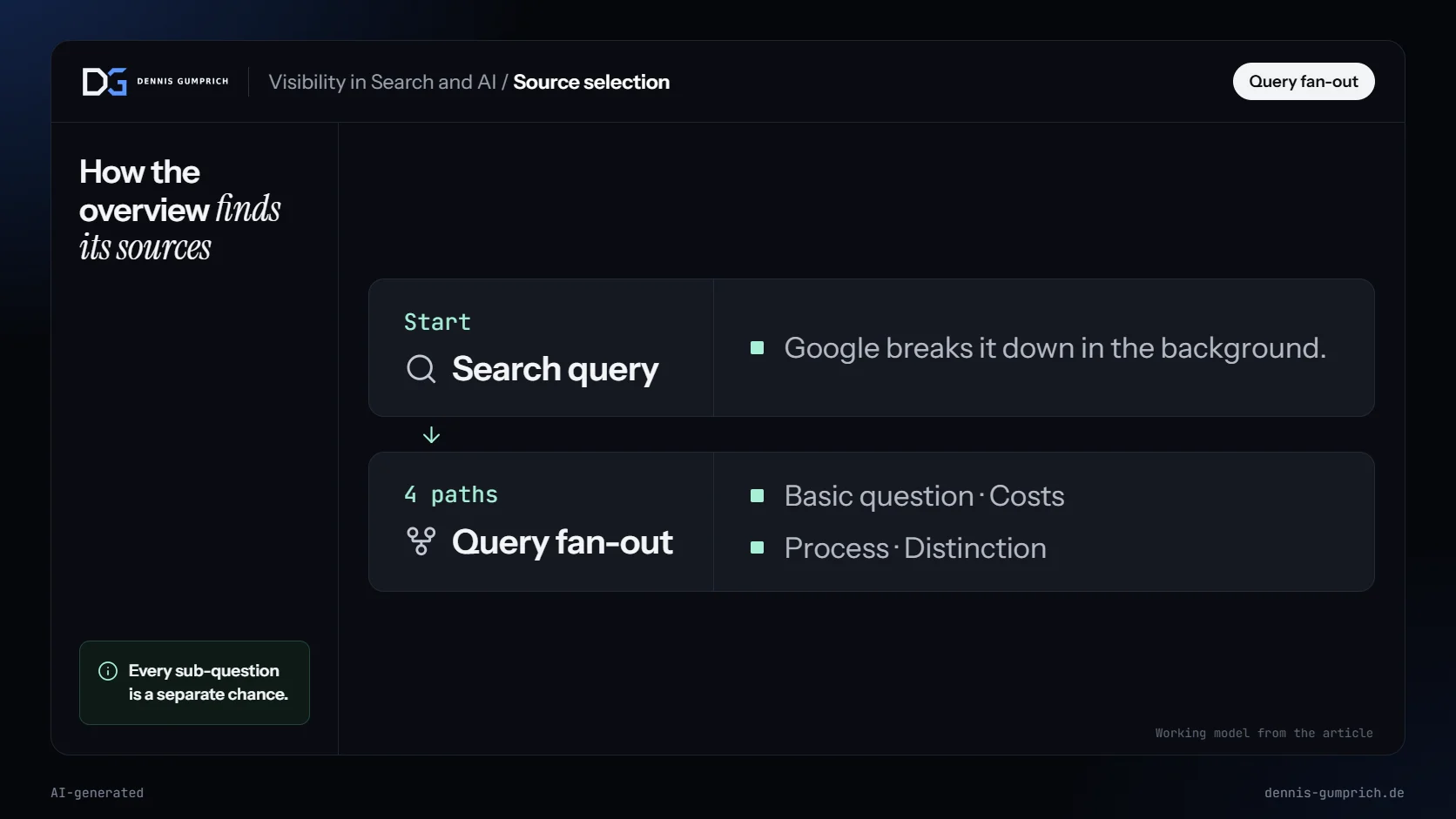
That a page ranks in fourth place and is still not linked is therefore not a contradiction. Google assembles the overview from answers to several sub-questions. If you answer the basic question well but say nothing about costs, process or distinction, you cover fewer sub-questions than a page that contains all of it. How fan-out and source selection work as a whole is explained in GEO (generative engine optimization).
What do AI Overviews mean for your clicks?
Fewer clicks on the results list when an overview appears. In the Pew analysis, users clicked on a result in 8 percent of searches with an AI summary and in 15 percent without one. Links within the summary itself received around 1 percent of clicks.
The data comes from the browsing behavior of 900 adults in the US in March 2025 and covers almost 69,000 searches. After a search with a summary, 26 percent ended their session, compared with 16 percent without a summary. Google counters that clicks from results pages with overviews are of higher quality because visitors stay longer. Both can be true: fewer, but more targeted visits.
For your reporting, this means that clicks alone underestimate the impact. If you are named in the overview, you are seen, even without a visit. Which metrics capture this is described in visibility without clicks.
Which pages should you maintain first for AI Overviews?
Pages that already rank in the top 10 for search queries where an overview appears. That is where the distance to becoming a source is shortest. New content only pays off after that.
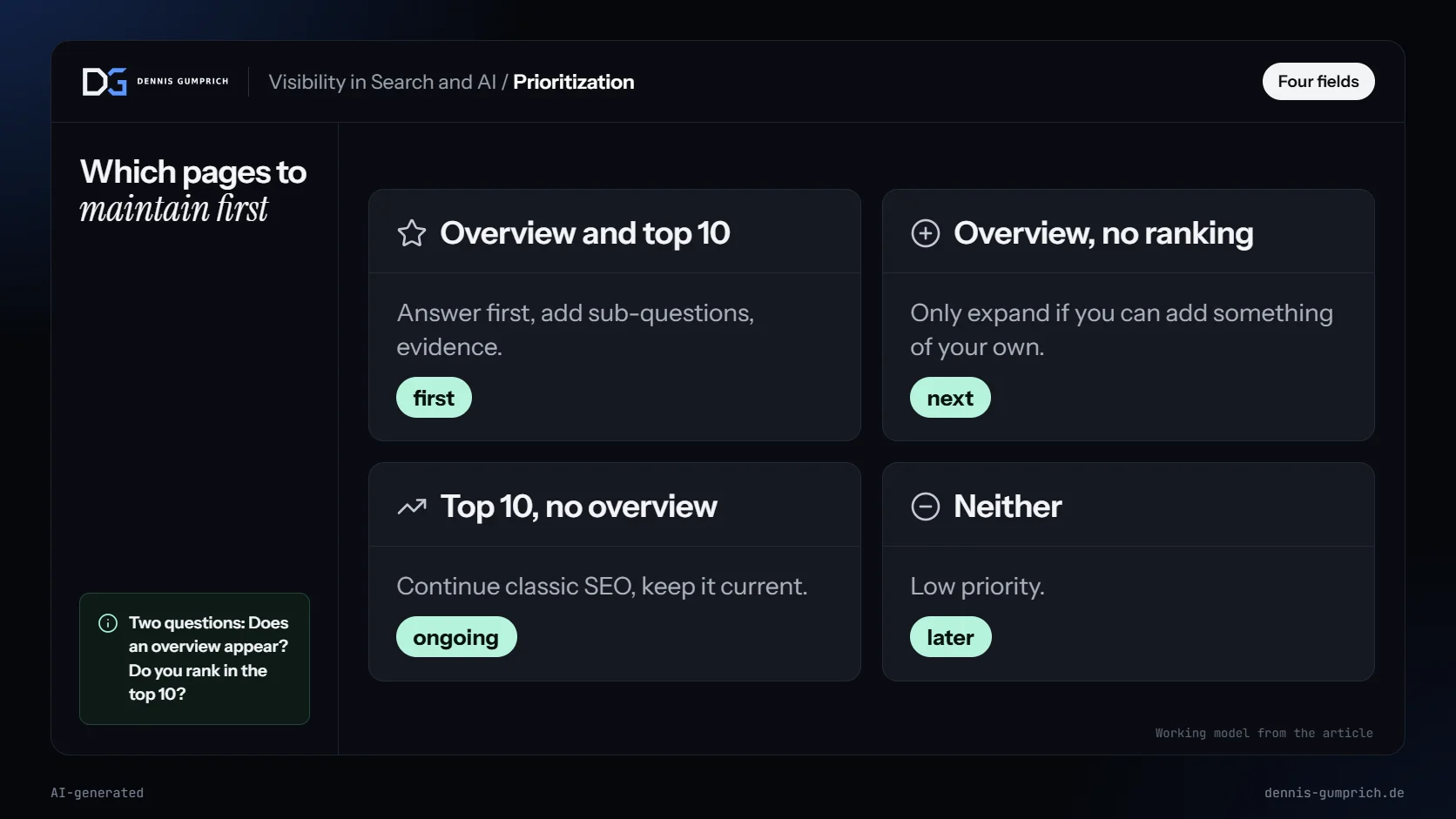
Sort your most important search queries by two questions: Does an overview appear? Does your page rank in the top 10? This results in four fields with clear priorities.
| Field | Situation | Action |
|---|---|---|
| 1 | Overview appears, you rank in the top 10 | Revise first: answer first, add sub-questions, evidence |
| 2 | Overview appears, you do not rank | Check whether you can contribute something of your own, then expand in a targeted way |
| 3 | No overview, you rank in the top 10 | Continue classic SEO, keep the page current |
| 4 | No overview, you do not rank | Low priority |
When revising pages in field 1, three questions help: Does the first sentence of each section answer its heading? Does the page cover the sub-questions that appear in the overview? Is there a figure, an example or an experience that other sources do not have? Google describes such content as non-interchangeable and prefers it to texts that only repeat general knowledge.
How do you measure your presence in AI Overviews?
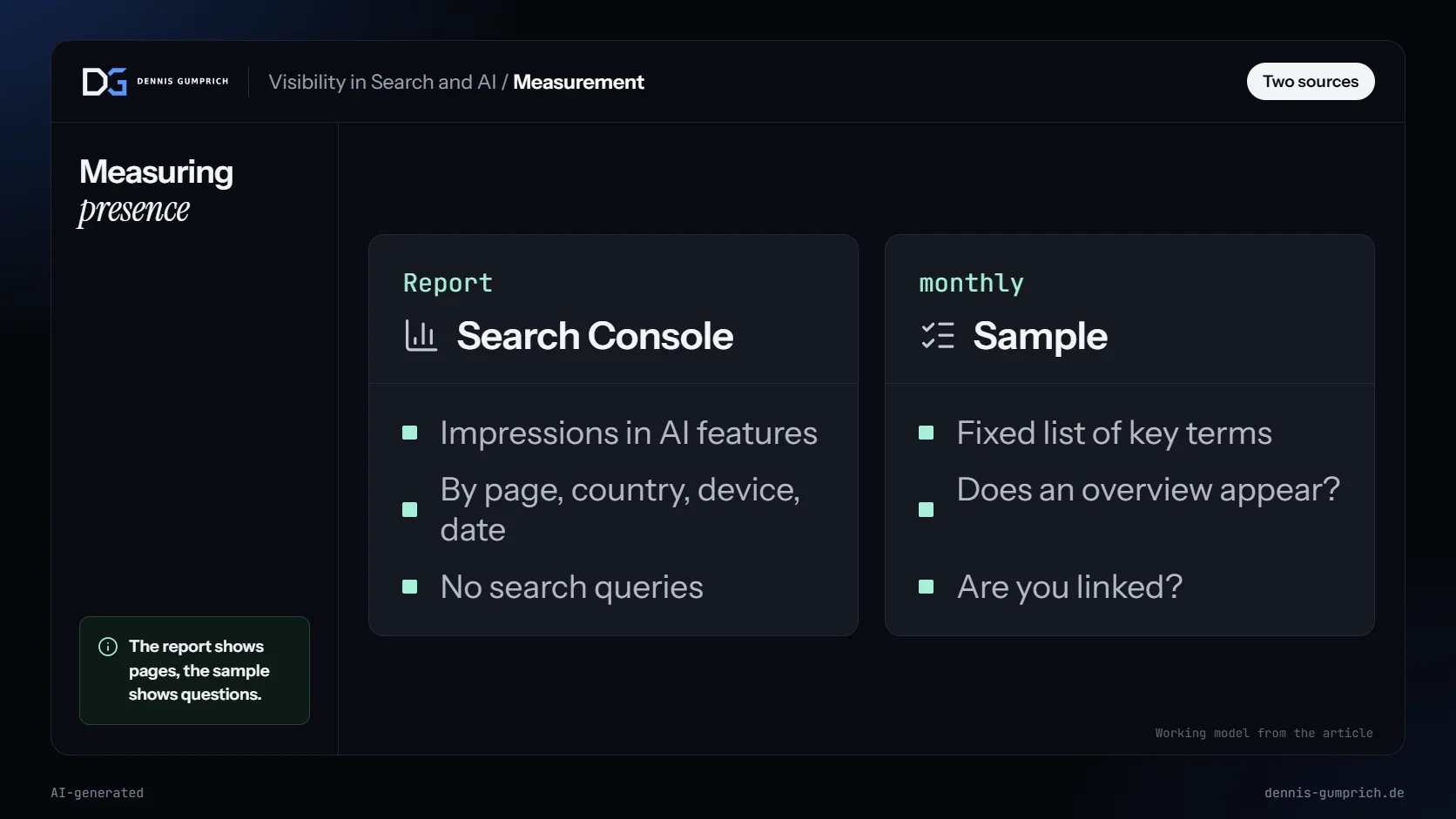
With the report on performance in generative AI features in Google Search Console. It shows impressions in AI Overviews and AI Mode by page, country, device and date. Clicks from these features continue to count toward the Web search type in the general performance report.
Google announced the report in June 2026 and has been rolling it out gradually to more websites. It does not show search queries. You therefore check which questions trigger an overview and whether you are linked in it with a sample of your most important search queries, monthly and always with the same terms. What the report shows in detail and how to evaluate it is covered in visibility without clicks, and which tools make the sample easier in measuring AI visibility.
This is what the monitoring looks like for contentbird, the provider I work for: for questions such as "Which software combines editorial planning, content creation and performance analysis?", contentbird appears in the AI Overviews in first position, with a positive tone.
At the companies I work with, AI Overviews have now become an explicit goal, for example at a group of staffing companies. So far, the teams do not have reliable figures on clicks or inquiries for this.

Can you exclude your content from AI Overviews?
Yes, but only together with regular snippets. Google controls display in AI Overviews through the same directives as in Search: nosnippet, data-nosnippet, max-snippet and noindex. There is no separate opt-out for the overviews alone.
For most companies, an exclusion is therefore not a good idea: if you block the overview, you also lose the preview in the results list. data-nosnippet can make sense for individual passages, for example prices that change frequently. According to Google, Google-Extended affects training and use in other Google systems, not display in Search. Changes to these controls can take days to months, depending on how often your pages are crawled.
Five mistakes when dealing with AI Overviews
- Optimizing new pages instead of existing onesPages in the top 10 have the best chances. New pages first have to rank.
- Looking for markup or special filesGoogle explicitly names no additional requirements. The lever is the content.
- Only answering the main questionOverviews are assembled from sub-questions. Pages that also answer costs, process and distinction are linked more often.
- Treating falling clicks as failureWith an overview, fewer people click. Check impressions in AI features and mentions before you remove content.
- Blocking snippets across the boardAn exclusion also affects the regular preview. Use data-nosnippet for individual passages at most.
Self-check: Do you have AI Overviews under control?
Tick everything that applies to you.
a short note on Google's AI Overviews:
For many search queries, Google shows an AI summary and links to a few sources. These sources mostly come from the top 10 of regular search. When an overview appears, significantly fewer people click on the results list.
I suggest we first revise the pages that already rank well and where an overview appears. In parallel, we add impressions in AI features from Search Console to our reporting, so that we do not measure visibility by clicks alone.
Conclusion: The way into the overview leads through well-maintained pages
AI Overviews are not a separate channel with their own rules. Google selects the sources through its familiar ranking systems and breaks questions into sub-questions. If you revise your existing top 10 pages so that they answer these sub-questions clearly and with evidence, you have the best chance of being linked. Measure with the generative AI report and a fixed sample, not by clicks alone.
Frequently asked questions
What are AI Overviews on Google?
AI Overviews are summaries that Google creates with generative AI and shows above the search results. They answer a question directly and link to the sources they are based on.
Since when have AI Overviews been available?
Google launched AI Overviews in the US in May 2024 and then expanded them to many countries. In Germany they have been available since March 26, 2025, in German and English. AI Mode as a separate search view has been available in Germany since October 8, 2025.
How does my website get into AI Overviews?
The page must be indexed and allowed to show a snippet. After that, the quality of the answer decides. Pages that already rank in the top 10 and answer the sub-questions of a topic clearly and with evidence have the best chances.
Can I turn off AI Overviews for my website?
Only together with regular snippets, via nosnippet, data-nosnippet, max-snippet or noindex. There is no separate opt-out for the overviews alone. For most companies, an exclusion costs more visibility than it protects.
Where can I see whether my pages appear in AI Overviews?
In Google Search Console, in the report on performance in generative AI features. It shows impressions by page, country, device and date, but no search queries. Complement it with a monthly sample of your most important search terms.
Where does your content process lose time today?
In 30 minutes, we look together at where unnecessary coordination, manual tasks, tool switching or repetitive content work cost you time today.
If you want to know which of your pages have the best chance of appearing in AI Overviews, we sort your most important search queries by priority together.
Analyze your content process in 30 minutes Free of charge. You take away concrete starting points you can use internally right away.
Dennis Gumprich
Dennis helps marketing and communication teams fit generative AI into existing content processes without undermining quality, brand voice and approvals. Focus areas: content operations, AI governance and tool selection in mid-sized companies and corporations.
Transparency note: Dennis works for contentbird, a provider of AI-powered content software. Product mentions are marked in the article. More about Dennis (in German) · LinkedIn
Read more
Sources
- Hema Budaraju, Google: AI Overviews launch in Germany and other countries (in German), blog post of March 26, 2025: launch in Germany in German and English, initially for signed-in users aged 18 and over, shown only when helpful. Retrieved November 7, 2026.
- Google Search Central: AI features and your website, documentation, as of December 10, 2025: query fan-out, indexing and snippet eligibility as prerequisites, no additional requirements, clicks in the Web search type, control via nosnippet, data-nosnippet, max-snippet and noindex, Google-Extended for other Google systems, changes taking effect after days to months. Retrieved November 7, 2026.
- Google Search Central: Optimizing your website for generative AI features on Google Search, guide, as of July 10, 2026: ranking and quality systems as the basis, non-interchangeable content, report on performance in generative AI features. Retrieved November 7, 2026.
- Athena Chapekis, Anna Lieb, Pew Research Center: Google users are less likely to click on links when an AI summary appears in the results, analysis of July 22, 2025, 900 US adults, March 2025, 68,879 searches: click rate of 8 percent with and 15 percent without a summary, 1 percent of clicks on links within the summary, session end 26 versus 16 percent, summary in around 18 percent of searches. Retrieved November 7, 2026.
- Louise Linehan, Xibeijia Guan, Ahrefs: Only 12% of AI Cited URLs Rank in Google's Top 10 for the Original Prompt, analysis of August 11, 2025, referring to an earlier Ahrefs analysis according to which 76 percent of the pages cited in AI Overviews come from the top 10. Vendor analysis by an SEO tool provider. Retrieved November 7, 2026.
- PinMeTo: Google Search Console Generative AI Reports, article from 2026 based on Google's announcement of June 3, 2026: impressions in generative AI features by page, country, device and date, no search queries, gradual rollout. Retrieved November 7, 2026.
How this article was created
This article was created with the help of AI. Structure, research and draft wording were developed with AI support. Expert assessment, fact-checking and the final version are the responsibility of Dennis Gumprich. The English version was translated with AI and reviewed. Read the original German version.
How reliable are the statements?
Launch dates and technical statements come from Google publications. The click data comes from a US analysis by the Pew Research Center with data from March 2025. The top 10 share comes from a vendor analysis. The details on the Search Console report are based on a summary of Google's announcement. The prioritization fields and the list of mistakes are working models from consulting practice.


