

That is how much the visibility of content in generated answers increased through targeted changes, measured on the GEO-bench test set of the research paper that coined the term GEO.Source: Aggarwal et al., KDD 2024
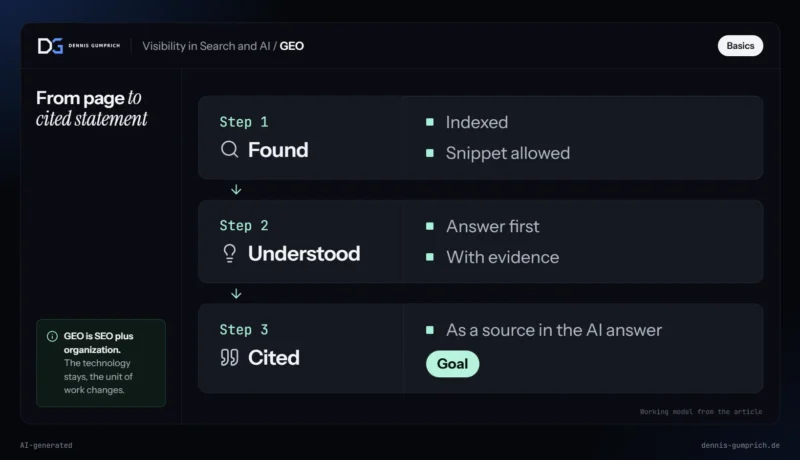
GEO (generative engine optimization) means creating and maintaining content so that AI search systems such as Google AI Overviews, AI Mode, ChatGPT or Perplexity find it, understand it and cite it as a source. Technically, GEO builds on SEO. Google itself writes that optimizing for generative AI search is still SEO. What is new is mainly the organization: which questions you cover, who provides verifiable statements, who approves them and how you measure mentions instead of just clicks.
What is generative engine optimization (GEO)?
Generative engine optimization, or GEO for short, is the work of getting your content into the answers of generative search systems: linked as a source, named as a brand or reflected in the reasoning. The goal is no longer just a position in a list of results, but a place in the answer itself.
The term comes from research. A team led by Pranjal Aggarwal introduced it in November 2023 in a paper that was accepted at the KDD conference in 2024. The researchers built their own test set called GEO-bench and showed that targeted changes to content can increase its visibility in generated answers by up to 40 percent. How strongly a change worked depended clearly on the subject area.
Since then, GEO has become an umbrella term. In search behavior it shows up as "GEO SEO" and "GEO optimization", because many teams want to know what is actually new and what they already know from search engine optimization. Related terms are answer engine optimization (AEO) and LLM optimization.
How do AI search systems choose their sources?
AI search systems break a question into several sub-questions, look for suitable pages for each of them and assemble an answer with source references. Your page therefore has to provide the best available answer to at least one sub-question, and it has to be technically discoverable.
Google describes this process for AI Overviews and AI Mode as "query fan-out": in the background, the system runs several related searches across subtopics and data sources and can therefore show more and more diverse links. The prerequisite is that a page is indexed and eligible to appear in Search with a snippet. According to Google, there are no additional technical requirements.
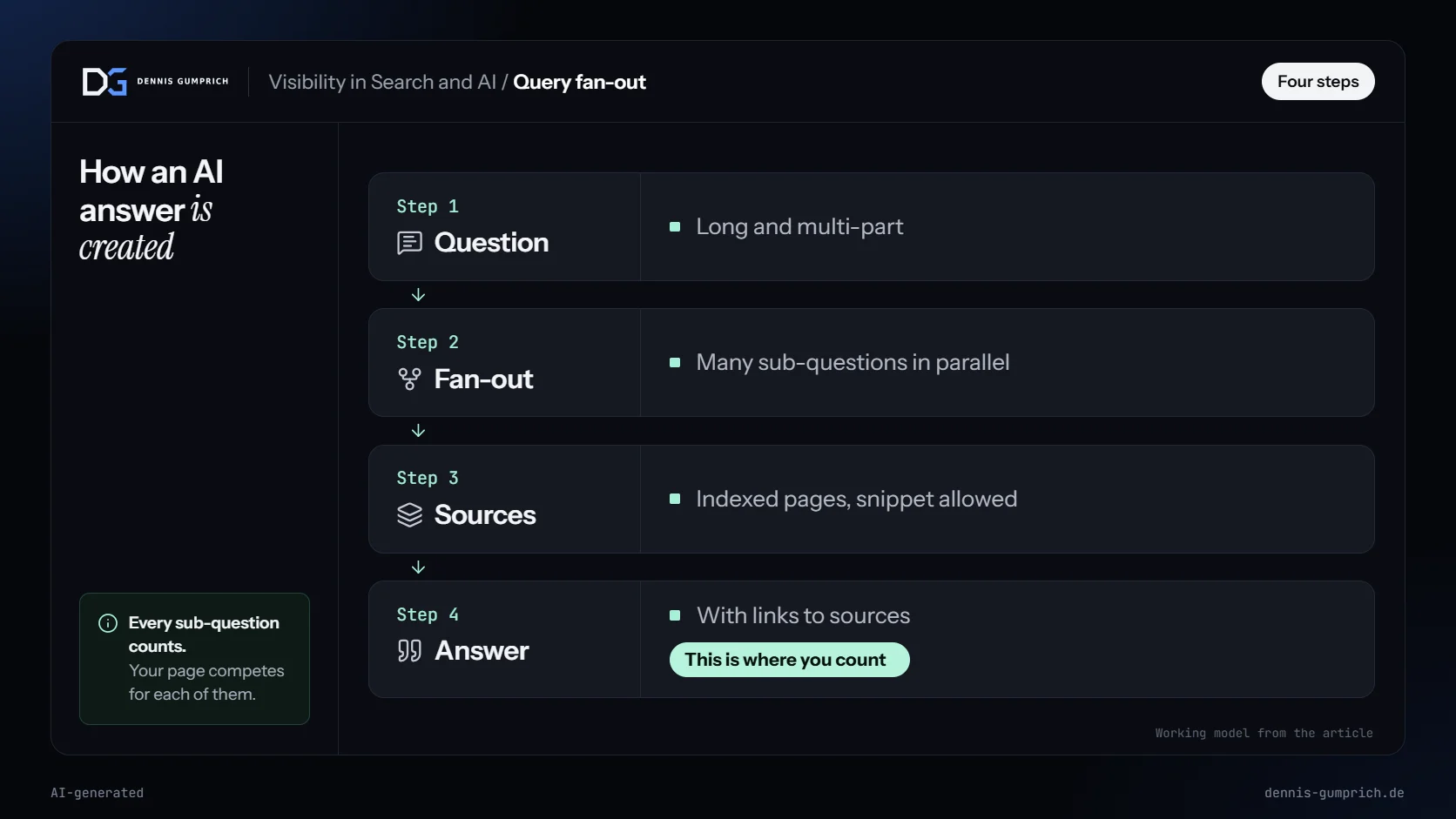
For your work, this means a page does not only compete for the main keyword, but for many sub-questions. If you clearly answer the basic question, the distinction from related topics, the costs, the process and the typical mistakes, you will be used more often than a page that only targets the main keyword. AI Mode has been available in Germany, Austria and Switzerland since October 8, 2025. Google reports that questions asked there are two to three times longer than typical searches.
GEO became a topic of its own at the companies I work with at the end of 2025. Two triggers keep coming up: a website relaunch explicitly aimed at AI search, for example at a measurement services provider with three subsidiaries, and a figure from a Statista study: 85 percent feel the impact of AI in their daily content work, but only 15 percent have a strategy for AI visibility.
What is different about GEO compared to SEO?
The technology is largely the same, the unit of work changes. SEO optimizes pages for positions. GEO optimizes statements so that a system adopts them and attributes them to a source. That raises different questions for briefing, approval and measurement.
Google put it clearly in its guide "Optimizing your website for generative AI features on Google Search": optimizing for generative AI search is optimizing for the search experience and therefore still SEO. For Google, crawlability, indexing, clean structure and helpful content apply as before. For ChatGPT, Perplexity or Copilot there is no comparably detailed guidance, but the basics are similar: what is not found and not understood is not cited.
| Question | SEO | GEO |
|---|---|---|
| Goal | Position in the results list | Mention or link in the AI answer |
| Unit of work | Page and search term | Statement, evidence and sub-question |
| Competition | Ten organic positions | A few sources per answer |
| Main metric | Clicks and rankings | Presence, mention rate and citation rate |
| People involved | SEO and editorial team | Plus subject matter experts and PR |
The last point is the one most often underestimated. Because AI systems adopt statements, those statements have to be factually correct and backed by evidence. That brings subject matter experts into the process earlier than in classic SEO.
Which levers do content teams have in GEO?
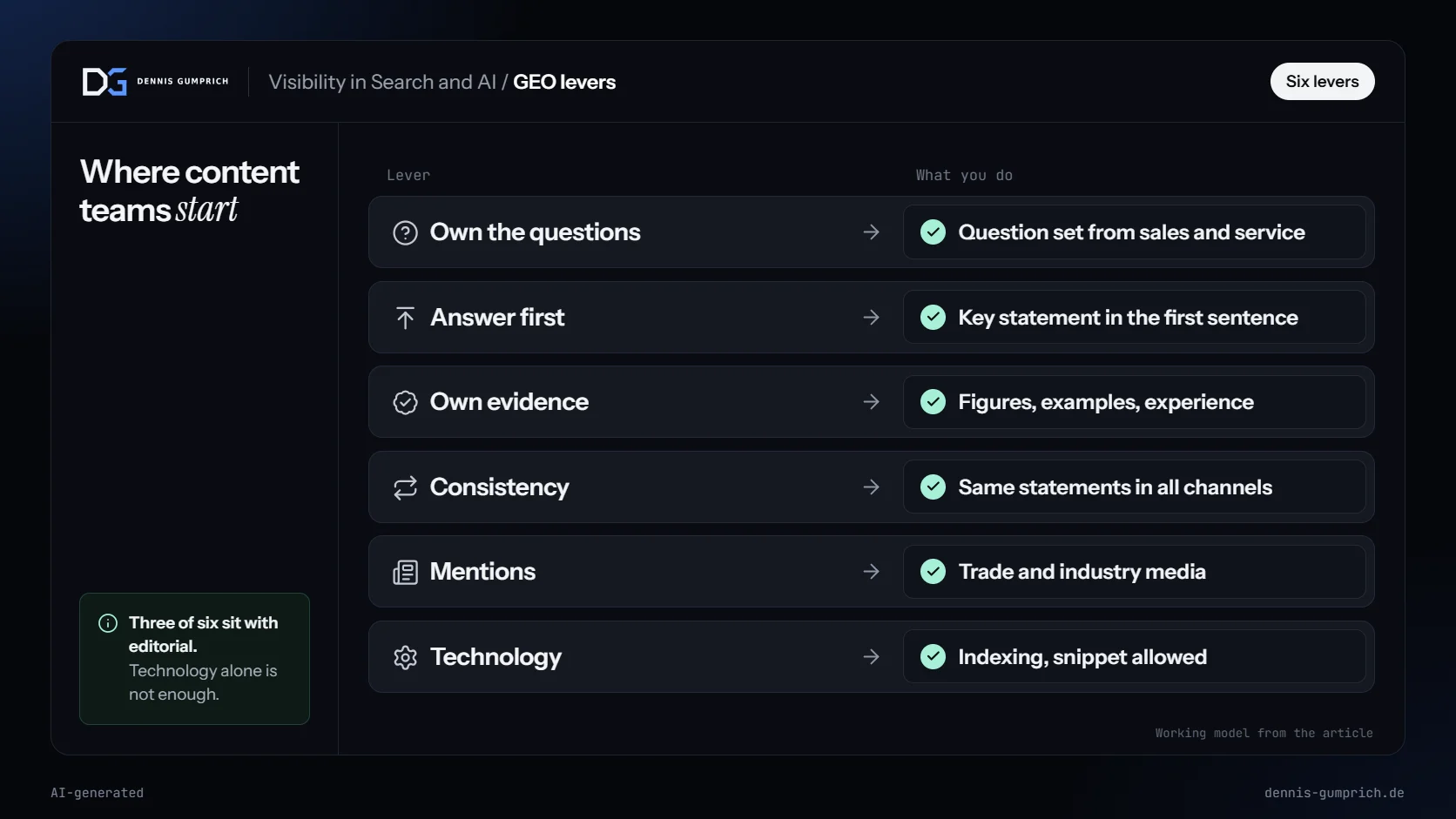
Six levers account for most of the impact: covering the right questions, putting the answer first, providing your own evidence, keeping statements current and consistent everywhere, getting mentioned in trade media and securing the technical basics. The first three sit directly with the editorial team.
- Lever 1Own the questionsCollect the questions that prospects ask your sales team and customers ask your service team. These are the sub-questions for which AI systems look for sources. A question set of 30 to 50 questions is enough to start.
- Lever 2Answer firstAnswer each question in the first sentence of the section, then add reasoning and limitations. That way, the key statement can be adopted without detours.
- Lever 3Your own evidenceGoogle distinguishes interchangeable content based on general knowledge from content with first-hand experience and expertise. Figures from projects, examples and clear assessments make you the source rather than a copy.
- Lever 4Current and consistentMake the same statements on your website, in brochures, press releases and profiles. Contradictions between your own sources make you look unreliable.
- Lever 5Mentions in trade mediaWhat independent sources write about you feeds into AI answers. According to Google, bought or artificially created mentions do little to help.
- Lever 6Technical basicsPages must be indexable and allowed to show a snippet. If you block content with nosnippet, you also exclude it from AI Overviews.
Who is responsible for GEO in a company?
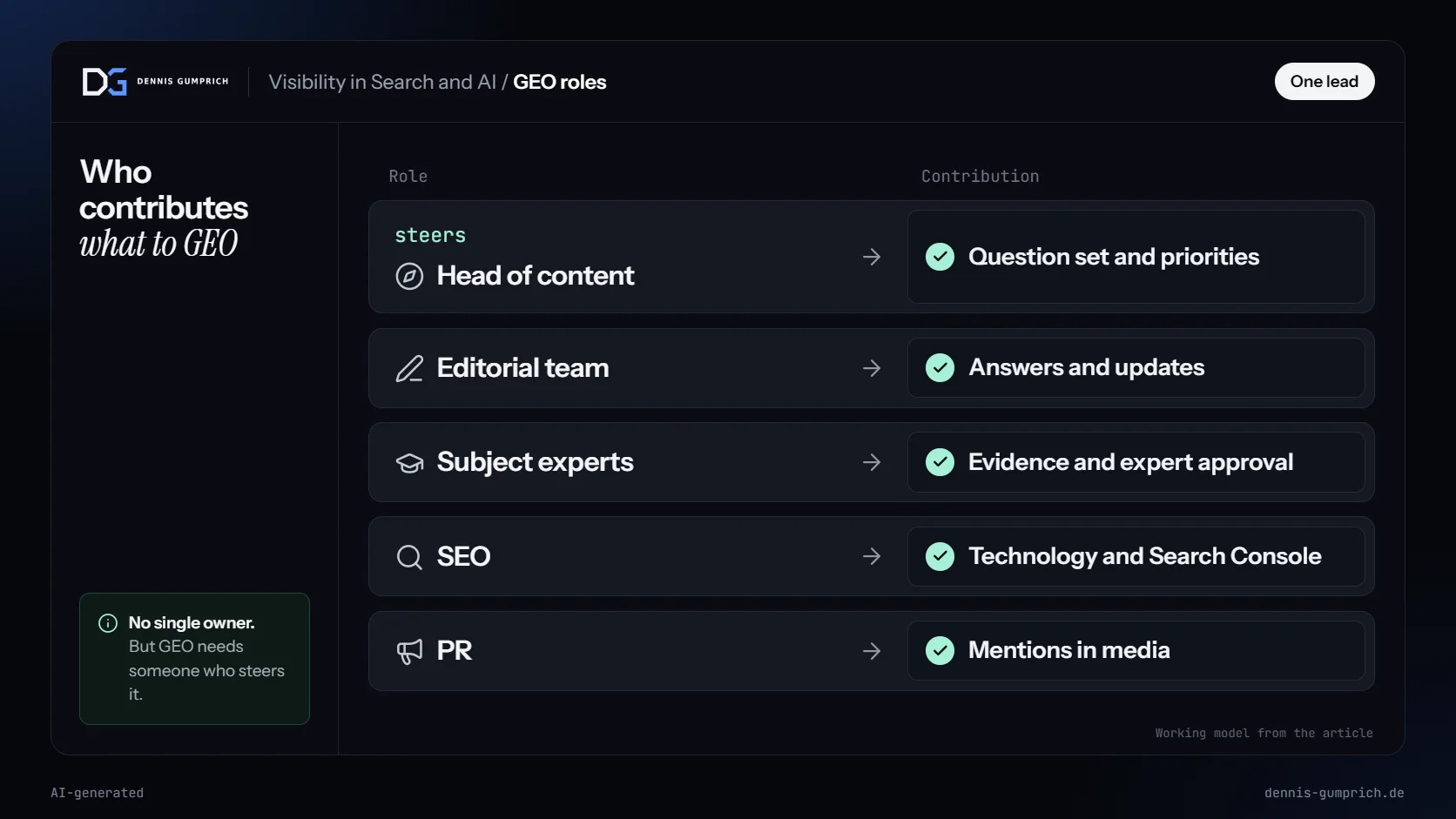
GEO has no single owner, but it needs one person to steer it. What works well is to place the lead with the head of content or the editorial lead and to involve SEO, subject matter experts and PR with clearly defined contributions.
The reason: most GEO levers concern content and evidence, not technology. If GEO lands with SEO alone, it stops at indexing and structure. If it lands with the editorial team alone, expertise and measurement are missing. A clear role model prevents both.
| Role | Contribution | Rhythm |
|---|---|---|
| Head of content or editorial lead | Question set, priorities, steering | Monthly |
| Editorial team | Answers, structure, updates | Ongoing |
| Subject matter experts | Data, examples, expert approval | Per piece of content |
| SEO | Indexing, technology, Search Console | Monthly |
| PR | Mentions in trade and industry media | Per occasion |
| Head of marketing | Goals, budget, reporting to management | Quarterly |
GEO belongs where website content is owned, not isolated in SEO. An international supplier I work with has already created a dedicated "Web/GEO" role in its communications team.
How do you embed GEO in your content process?
Not as a project, but as a checkpoint in every step: in topic scoring, in the briefing, in the review before approval and in the monthly evaluation. Then GEO becomes the standard instead of running alongside day-to-day business.
In topic scoring, each question from the question set gets a weight. The briefing states the key statement in one sentence, along with the evidence and the person who provides it. Before approval, the editorial team checks whether each sub-question is answered in the first sentence and whether every figure has a source. Subject matter experts then only approve statements, not entire texts, which noticeably shortens approval.
The order matters: first the question set, then the content. If you start the other way round, you optimize texts for questions nobody asks.
How do you measure the success of GEO?
Through presence, mentions and follow-up signals rather than clicks alone. For Google, Search Console provides its own report on performance in generative AI features. For ChatGPT, Perplexity and other systems, you use a fixed question set to measure how often your brand is mentioned and linked.
Three metrics are enough to start: the share of your impressions in AI features, the mention rate in the question set and the citation rate, meaning how often a link to you appears in the answers.
Be careful with vendor promises: Google writes in its own guide that no third-party tool has access to its internal ranking or AI systems. Tools measure results from the outside, they cannot see inside.
What does GEO not achieve?
Special AI files, chopped-up texts and a dedicated "AI writing style" do nothing for Google Search, according to Google itself. Artificially created mentions do little to help either. What works is content with real substance and solid SEO basics.
In its guide, Google explicitly calls several common recommendations unnecessary: an llms.txt file neither helps nor hurts visibility in Google Search. Content does not need to be broken into small chunks. There is no need for a special writing style for AI systems, and structured data is not required for generative search, although it remains useful for rich results.
For teams, this is good news. The effort shifts from tricks to substance: less formatting based on rumors, more verifiable statements with experience behind them.
The misconception I encounter most often: GEO is seen as a pure monitoring topic, separate from the content process. A specialist publisher expected a pure GEO session but did not want to change anything about its own content production. Measuring alone, however, does not change a single AI answer.
Five mistakes when introducing GEO
- Buying GEO as a package without a question setWithout your own list of the questions your customers ask, every agency optimizes blindly. The question set is your job, not a service provider's.
- Rewriting everythingMost existing pages can be revised. A key statement at the start of a section and a piece of evidence change more than a new article.
- Looking only at clicksIf you measure GEO by clicks, you often see declines even though mentions are rising. Make presence and mentions your main metrics.
- Asking subject matter experts too lateStatements that AI systems adopt have to be correct. Gather evidence in the briefing, not during approval.
- Reacting to single queriesA single answer in ChatGPT says little, because answers fluctuate. Evaluate rates across many queries and several months.
Self-check: Are you ready for AI search?
Tick everything that applies to you.
a short note on GEO, meaning visibility in AI answers:
Google itself says that optimizing for AI search is still SEO. What is new is that AI systems adopt individual statements. Those statements have to be factually correct, backed by evidence and answer our customers' questions.
I suggest we do not buy an external GEO package before we have clarified three things: a list of our customers' most important questions, clear responsibility within the team and a way to measure how often we are mentioned in AI answers.
As a first step, I would collect 30 questions with sales and service and measure for one month where we stand today.
Conclusion: GEO is SEO plus organization
Generative engine optimization is less a new discipline than a new unit of work. AI systems adopt statements, not pages. If you know your customers' questions, put every answer first, provide your own evidence and involve subject matter experts early, you will be cited more often. The technical basics remain those of search engine optimization.
Start with the question set and a measurement of where you stand. Both take a few days and show which pages to revise first.
Frequently asked questions
What is GEO in simple terms?
GEO stands for generative engine optimization. It covers everything that helps AI search systems such as Google AI Overviews, AI Mode, ChatGPT or Perplexity use your content as a source and mention your brand in their answers.
What does GEO SEO mean?
"GEO SEO" describes the combination of both disciplines. SEO makes sure pages are found and indexed. GEO makes sure their statements are adopted in AI answers. Google itself still classifies optimization for its AI features as SEO. The term has nothing to do with geo-targeting, meaning targeting by region.
Is GEO the same as AEO?
The terms overlap heavily and are often used interchangeably. AEO, answer engine optimization, dates back to the era of featured snippets and voice assistants and emphasizes the direct answer. GEO emphasizes generative systems that assemble answers from several sources.
Do we need an agency for GEO?
Not necessarily. Only your team can provide the question set, key statements, evidence and approval. An agency can help with technology, measurement and media mentions. Check offers for whether they work with your question set and measure rates across many queries.
How quickly does GEO work?
Revised pages first have to be recrawled, and AI answers vary from query to query. Evaluate progress quarterly and across many queries, not based on individual tests.
Where does your content process lose time today?
In 30 minutes, we look together at where unnecessary coordination, manual tasks, tool switching or repetitive content work cost you time today.
If you are starting with GEO, we go through your most important customer questions together and clarify who in your team takes on which part.
Analyze your content process in 30 minutes Free of charge. You take away concrete starting points you can use internally right away.
Dennis Gumprich
Dennis helps marketing and communication teams fit generative AI into existing content processes without undermining quality, brand voice and approvals. Focus areas: content operations, AI governance and tool selection in mid-sized companies and corporations.
Transparency note: Dennis works for contentbird, a provider of AI-powered content software. Product mentions are marked in the article. More about Dennis (in German) · LinkedIn
Read more
Sources
- Pranjal Aggarwal, Vishvak Murahari, Tanmay Rajpurohit, Ashwin Kalyan, Karthik Narasimhan, Ameet Deshpande: GEO: Generative Engine Optimization, paper, first version November 16, 2023, accepted at KDD 2024: introduction of the term, GEO-bench test set, visibility increase of up to 40 percent in generated answers, effect varying by subject area. Retrieved November 7, 2026.
- Google Search Central: Optimizing your website for generative AI features on Google Search, guide, as of July 10, 2026: optimizing for generative AI search is still SEO, no llms.txt or special files needed, no chunking of content, no special writing style, structured data not required, distinction between interchangeable and non-interchangeable content, notes on artificial mentions and third-party tools. Retrieved November 7, 2026.
- Google Search Central: AI features and your website, documentation, as of December 10, 2025: query fan-out in AI Overviews and AI Mode, indexing and snippet eligibility as prerequisites, control via nosnippet, max-snippet and noindex. Retrieved November 7, 2026.
- Hema Budaraju, Google: AI Mode launches in Germany, Austria and Switzerland (in German), blog post of October 8, 2025: launch of AI Mode in the DACH region, questions two to three times longer than typical searches, breaking questions into subtopics. Retrieved November 7, 2026.
How this article was created
This article was created with the help of AI. Structure, research and draft wording were developed with AI support, and the English version was translated with AI. Expert assessment, fact-checking and the final version are the responsibility of Dennis Gumprich. Read the original German version.
How reliable are the statements?
The term and the study result come from the paper cited above, the statements about Google from the official Google Search Central documentation. No comparably detailed guidance is available for ChatGPT, Perplexity and Copilot. The levers, the role model and the list of mistakes are working models from consulting practice with marketing and communication teams in 2026, not measured data.


