

If you argue with license costs in the management meeting, you negotiate about price instead of benefit.
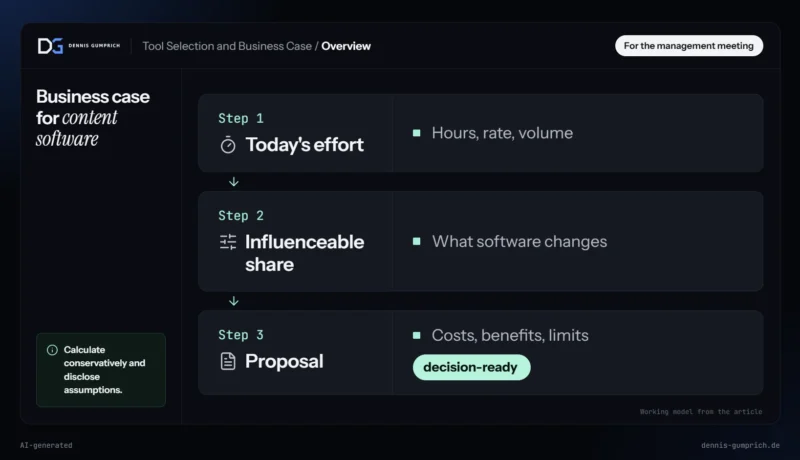
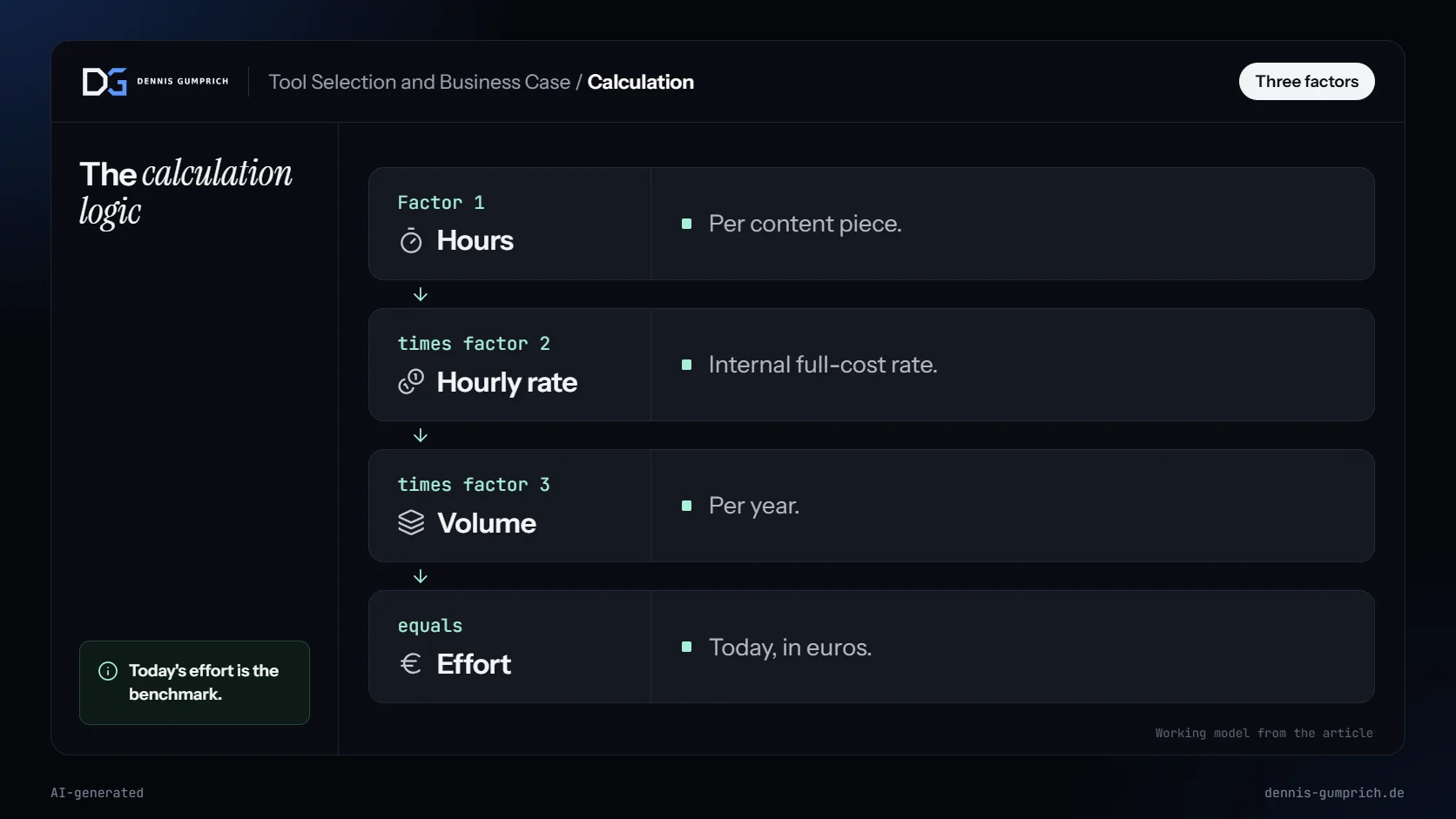
A business case for content software does not compare license costs with a savings target. It compares today's coordination effort with the future one. For that, you need three numbers: hours per content piece, the internal hourly rate and the volume per year. Everything else is decoration.
How to collect the three numbers and turn them into a template for the management meeting is shown in the following sections. First, the most common mistake: the conversation about price.
Why comparing prices is the wrong conversation
If you go into the meeting with a license total, you have already put the topic on the cost side. Your manager then compares a new expense with a state that seemingly costs nothing. This comparison always goes against you, because today's effort never shows up as an invoice.
The effort is there nonetheless. It sits in coordination loops, in files copied back and forth between tools, in time spent searching for content that already existed, and in duplicate work because two people work on the same topic. It just doesn't appear in any budget, because it is paid through salaries that run anyway.
Your task in the business case is therefore not to promise savings. It is to make the invisible effort visible. Only when both sides of the calculation are stated in euros does an expense become a decision.
Which numbers does a business case for content software need?
Three values from your own operations: the hours per content piece from briefing to publication, including all coordination; the internal hourly rate on a full-cost basis; and the annual volume across all channels. You don't need a market study for this.
The first number is the hardest, because it is almost never recorded. The fastest way: take the last five published articles and reconstruct with the people involved how many hours actually went into them. Explicitly ask about waiting times, follow-up questions and correction loops. That is exactly where the difference between perceived and actual effort lies. How the effort is typically distributed across the individual steps is covered in Nine hours per article: where the time really goes.
Calculate with ranges instead of point values. Six to nine hours per article is a statement that holds up in a meeting. Exactly 7.4 hours invites a discussion about the decimal place and distracts from the core.
The number that is missing most often is the baseline measurement. Several of my contacts need a business case for management, but have never measured how long a piece of content actually takes today.
Which hourly rate do you calculate with?
With the internal full-cost rate, not salary divided by hours. Your controlling department has this value. Depending on the calculation method, two variants can easily differ by thirty percent, so disclose the variant you chose instead of hiding it in the result.
Of the three basic numbers, the internal hourly rate generates the most questions, even though it is the easiest to obtain. The reason is the range: depending on the calculation method, two values can easily differ by thirty percent.
Three variants are common. Gross salary divided by working hours is the lowest value and leaves out ancillary costs. The full-cost rate includes employer contributions, workplace, equipment and a share of overheads. The internal charge rate that some companies apply to internal services is often even higher.
For a business case, the full-cost rate is the right choice, specifically the official one from your controlling department. Not because it is the highest, but because it is not negotiable. As soon as you calculate it yourself, the conversation shifts to the method instead of the result.
If your controlling department doesn't provide a value, calculate with a conservative assumption and clearly mark it as such. Note which components are included. In practice, a deliberately low assumption often leads to someone supplying the correct value.
One last point on presentation: don't state the hourly rate in isolation. A number without context looks high. The same number next to the volume and the effort per content piece looks like a calculation step, and that's exactly what it is.
What does the status quo cost you in euros?
Multiply hours per article by the internal hourly rate by the annual volume. With seven hours, a full-cost rate of 75 euros and 240 articles, that is 126,000 euros of production effort per year. What matters is not this total, but the share that goes into coordination, tool switching and rework instead of content work.
The following calculation example shows the logic. Insert your own values; the figures here are a working model, not measured values.
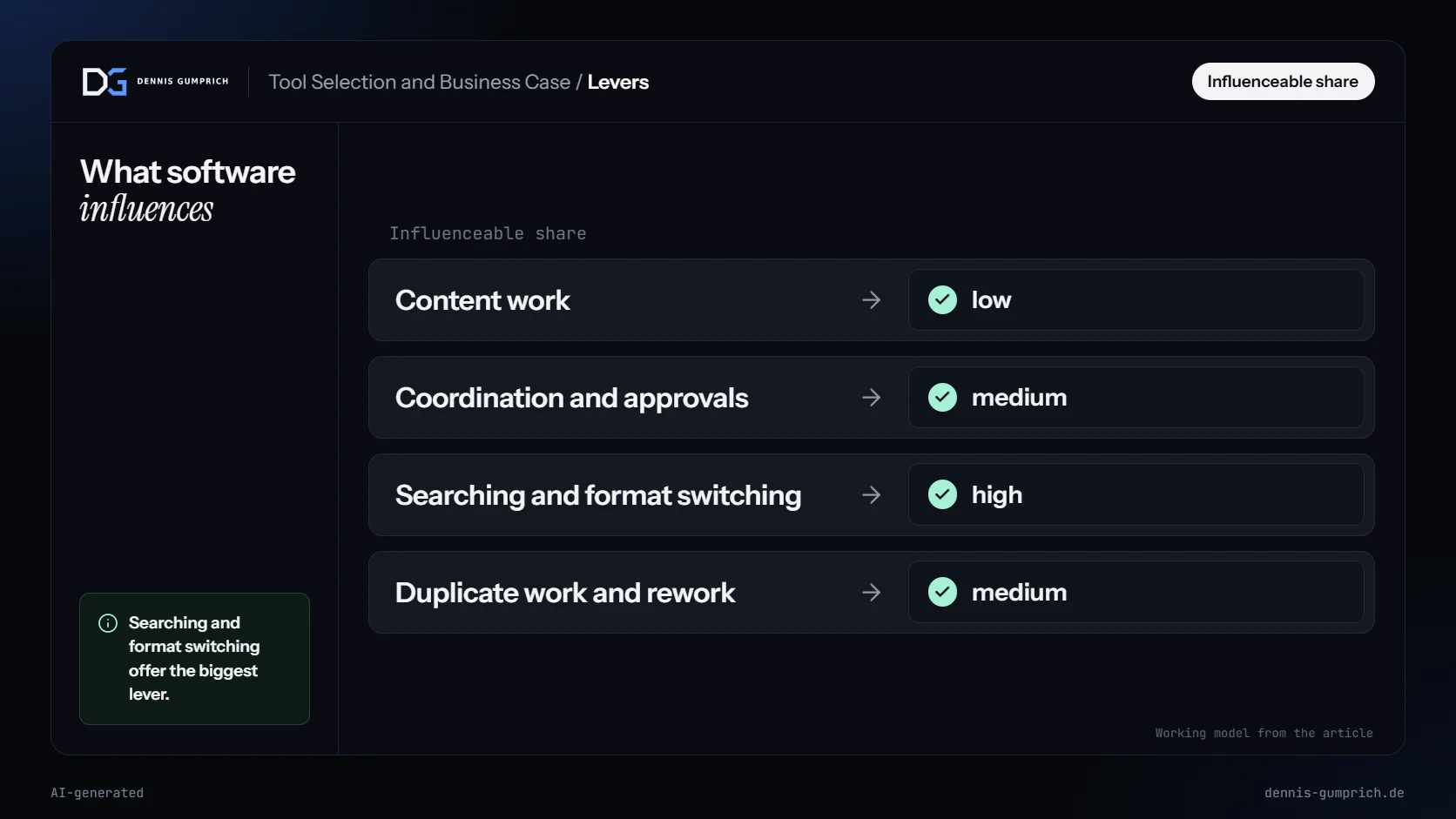
This results in an annual production effort of 126,000 euros. That is not yet an argument, just the starting figure. It gets interesting with the question of which share of it goes into coordination instead of content work.
| Activity | Share today | Influenceable | Effect per year |
|---|---|---|---|
| Content work: research, writing, editing | 3.5 h | low | remains |
| Coordination and approvals | 1.8 h | medium | up to €32,400 |
| Searching, copying, format switching between tools | 1.2 h | high | up to €21,600 |
| Duplicate work and rework | 0.5 h | medium | up to €9,000 |
Content work is deliberately listed as unchanged in the table. If you promise that software will halve the writing, you will lose the discussion at the latest at the first review. The influenceable part is coordination, tool switching and duplicate work. That is less spectacular, but it holds up.
The one page you present
The business case is a calculation; the document you present is something else. If you present the full derivation, you lose attention to details. One page is enough, and it has a fixed order.
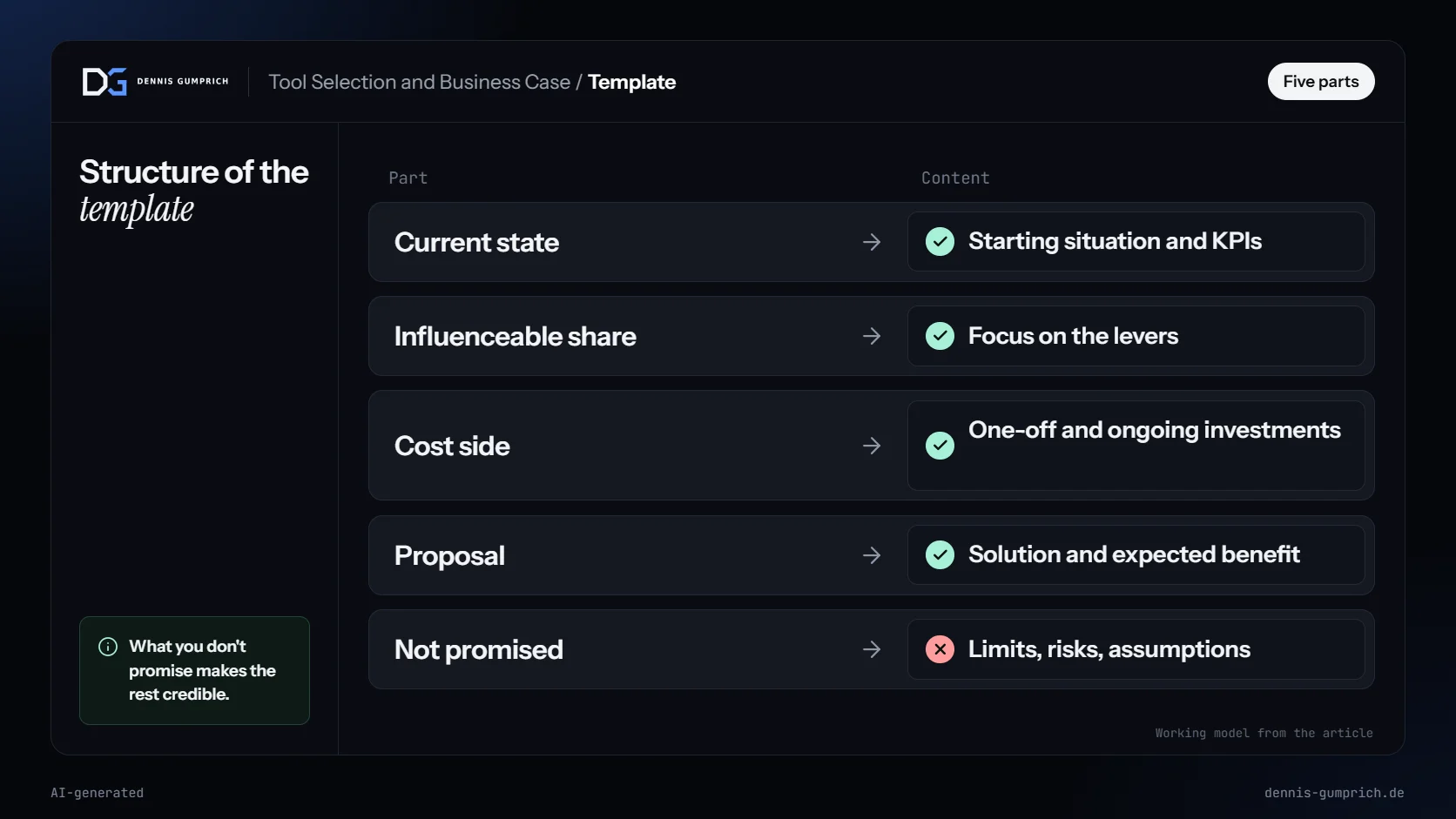
At the top is the current state in one number, with a half-sentence on the collection method. Below that, the breakdown of which share is influenceable and which is not. Then the cost side, complete, including implementation effort. Then the proposal in one sentence. At the very bottom, what you explicitly do not promise.
The last point is unusual and has the strongest effect. A document that names what it will not deliver is read differently from one that only lists advantages. It saves the other side the task of looking for weaknesses.
Everything else belongs in the appendix: the individual reconstructions, the derivation of the hourly rate, the volume basis. These documents are rarely read but still have to exist. Their function is to be available immediately on request.
A practical note on form: write the document so that it works without you. In most cases it gets passed on, and you are not sitting next to it when it is read. Every abbreviation and every internal term that needs explaining is a risk at this point.
If the vendor comparison is also to be put on the table alongside the numbers, the free evaluation matrix for content software with an integrated decision template helps.
What should you not promise management?
Headcount reduction. Hardly any marketing team gets smaller after introducing software. It produces more or it produces better. If you write staff savings into the business case, you either get approval for the wrong reason or lose credibility later.
A concrete increase in revenue. The path from a more efficient editorial process to an additional deal is too long to attribute seriously. Leave it out instead of claiming it.
An immediate effect. Between signing the contract and noticeable relief lie implementation, data migration and getting used to it. Plan this phase openly instead of hiding it.
Five mistakes that topple the business case
- Listing only license costsOnboarding, internal implementation effort and training belong on the cost side. If these items appear later, the whole calculation looks embellished.
- Leaving the status quo uncalculatedWithout a counter-calculation, a new expense stands against seemingly zero. You always lose this calculation.
- Arguing with vendor figuresValues from vendor material are worthless in an internal conversation as soon as someone asks where they come from. Your own numbers are smaller and carry further.
- Calculating too preciselyDecimal places create a false precision that invites a detailed discussion. Ranges are more robust and more convincing.
- Presenting the business case aloneWhoever put the numbers together should not be the only one defending them. Bring IT, controlling or a second specialist department on board beforehand.
Five steps to a business case ready for presentation
- Week 1Reconstruct the effortGo through five completed content pieces with the people involved. Explicitly record waiting times and correction loops.
- Week 1Obtain the hourly rateGet the full-cost rate from controlling, don't estimate it yourself. An official figure ends the discussion about the basis.
- Week 2Prove the volumeTake the annual volume from the editorial plan, channel statistics or approval logs. Estimated volumes are the most common point of attack.
- Week 2Compare both sidesThe cost side complete, the benefit side conservative. Better to state the lower end of the range than the upper.
- Week 3Put it on one pageOne page, three numbers, one proposal. Everything else belongs in the appendix, not in the conversation.
Which arguments convince management to buy a content marketing tool?
Four arguments, in this order: freed-up capacity in hours and euros, less risk through traceable approvals and controlled AI use, measurable impact instead of perceived productivity, and the gap to the market. Features don't belong in this conversation. Management decides on capacity, risk and results.
The fourth argument can be backed up with figures. In the 2026 B2B trends report by the Content Marketing Institute and MarketingProfs, 95 percent of the B2B marketers surveyed say their organization uses AI applications. At the same time, only 59 percent rate their marketing as at least somewhat effective, and 39 percent name limited resources as one of their biggest challenges. Using AI is therefore no longer an advantage. The difference arises where AI is integrated into a managed process.
For the German market, two current studies show the same picture. In the bvik study "B2B-Marketing-Budgets 2026", the marketing budget of the 115 B2B marketers surveyed, mostly from industry, rose on average by only 2.1 percent compared with the previous year. The Bitkom study "Marketing im digitalen Wandel" 2026 puts the marketing budget in the digital industry at a stable average of 4.1 percent of revenue. At the same time, 54 percent of companies there name cost pressure as an internal challenge and 43 percent a rising need for resources for content creation. More budget is therefore not the realistic scenario. Your business case has to show how you achieve more with the existing budget.
| Argument | Number you bring |
|---|---|
| Capacity | Hours per article today, multiplied by articles per year and hourly rate |
| Risk | Share of content without documented approval, number of unapproved AI tools in the team |
| Impact | Key KPI per communication goal with a baseline |
| Market | External benchmarks such as the Content Marketing Institute's B2B trends report, the 2026 Bitkom study or the bvik budget study |
Three arguments convince management most: cutting agency costs, consolidating tools and saving time, for example a multichannel campaign in one week instead of three. AI is a means to an end here, not the argument.
Is a content workflow platform worthwhile for a marketing team in a mid-sized company?
Usually from three to five regular participants, approvals across department boundaries and more than ten pieces of content per month. Below that, a well-managed spreadsheet with a clear approval route is almost always more economical. Above that, the calculation above decides: if the freed-up capacity clearly exceeds the license and implementation costs in the first year, the platform is worthwhile even without further arguments. Realistic values per process step are in What does a content workflow tool really save?
A second question is typical for mid-sized companies: whether a platform replaces several point solutions that are paid for and maintained in parallel today. How to count these handovers is covered in Point solutions or platform, and you can run the calculation with your own values in the ROI calculator (in German).
Which objections come up in the conversation with management?
A business case is rarely accepted in silence. Four objections come up regularly, and all four can be prepared for. If you already answer them in the document, you won't lose the conversation to a discussion about method.
| Objection | What's behind it | Solid answer |
|---|---|---|
| The hours are estimated | Doubts about the basis | Reconstruction from five real cases, people interviewed individually, result as a range |
| The time is spent anyway | Staff costs keep running | True. The question is what it is used for, not whether it is spent |
| So we'll save staff | Misunderstanding of the direction | No. Capacity shifts from coordination to content; that is stated explicitly in the document |
| Other areas need things too | A distribution question, not a factual one | Disclose the calculation and offer a comparison instead of defending |
The second objection is the most important, because it is factually correct. Staff costs keep running regardless of how efficiently people work. If you deny that, you lose credibility. If you confirm it and shift the question, you win the discussion: it is not about saving, but about how existing capacity is used.
Address this point actively in your document before it comes up as an objection. A business case that names its own limits looks more robust than one that only lists advantages.
What you plan to do with the time gained
The most common gap in business cases is not the calculation, but the answer to the question of what happens afterwards. If coordination effort drops by a fifth, where does that time go?
Without an answer, the impression remains that it is about convenience. With a concrete answer, an efficiency calculation becomes a plan. Three uses are common and should be named.
First, more output at the same quality, such as additional formats or channels that have been left undone so far. Second, higher quality at the same volume, such as more research, closer coordination with specialist departments, more thorough review. Third, work that currently doesn't happen at all, typically analyzing and updating existing content.
Commit to one direction, not all three. A business case that promises more volume, better quality and new tasks at the same time looks arbitrary. If you name and justify one direction, you can also prove it later.
Self-check: is your business case ready for presentation?
Tick everything that applies to you.
a short note on our request for content software:
We calculated today's effort instead of just looking at the quoted price. The basis is five completed content pieces, the official internal hourly rate and our documented annual volume.
The influenceable share is not in writing, but in coordination, tool switching and duplicate work. We can reduce this part with a shared working environment. Content work remains unchanged; we deliberately make no promise there.
I suggest that we cross-check the calculation together with controlling before we talk about vendors. If the order of magnitude holds, we make the decision on a solid basis.
How do you measure success after implementation?
A business case does not end with the decision. If you don't agree on a review, you will be asked about it later, usually at the worst possible moment and without preparation.
So define in the document when and by what it will be measured. The sensible time is not directly after implementation, but after about six months. Before that, the implementation effort overshadows any improvement, and a review that is too early reliably shows a worse picture than the starting point.
Measure with the same method as at the start, i.e. by reconstructing five completed content pieces. A different method makes the comparison worthless, even if it were more precise. So during the first data collection, note not only the result but also how you went about it. Which KPIs are suitable besides hours is shown in Making content production measurable.
Expect the improvement to be unevenly distributed. Typically, the effort for derivatives and searching drops significantly, while coordination and approval give way little, because they have organizational causes. This breakdown is exactly the useful insight, not the total. There, you are better off starting with the approval processes themselves.
If the numbers fall short of expectations, say so openly and look for the cause in the breakdown. In most cases it lies in a process step that has remained unchanged. An open interim report with a concrete next measure looks much better internally than an embellished one.
Conclusion: the calculation decides, not the price
The business case is not a sales document, but a basis for decision-making. If it is calculated conservatively, it holds up even if you ultimately decide against a purchase. That is exactly what makes it valuable internally: it answers the question of whether the effort is worthwhile, not the question of whether someone likes an offer. A first calculation with your own numbers is provided by the ROI calculator for content operations (in German), including a business case PDF for the conversation with management. How to prove after implementation that the investment pays off is shown in Proving content impact: reporting and business case for communications.
Frequently asked questions
How precise does the effort figure have to be?
A solid range is enough. What matters is that it comes from your operations and that you can explain how it came about. A traceable estimate from five real cases is stronger than an exact number of unknown origin.
What if our controlling department doesn't provide an hourly rate?
Then calculate with a conservative assumption and mark it as such. State the assumption openly in the document and ask for correction. In practice, controlling supplies the figure at the latest when an assumption that is too low is on the table.
Should we include several vendors in the business case?
No. The business case answers the question of whether a solution pays off at all. Vendor selection is a separate step afterwards. Mixing the two leads to discussing features before the fundamental question is settled.
How do we handle the implementation effort?
As a separate item on the cost side, with a realistic time estimate. Data migration, setup and getting used to it tie up internal capacity. If you disclose this effort openly, you won't be criticized for it in the later review.
From what team size is the calculation worthwhile at all?
The calculation is worthwhile regardless of team size, because it gives you clarity even if the answer is no. What matters for the result is less the number of people than the number of people involved per content piece. The more approvals, the larger the influenceable share. Those who read along and approve therefore also belong in the license calculation, as the requirements catalog for newsroom software shows.
Should we calculate several scenarios?
One conservative scenario is enough. If you present three variants, you shift the decision to the other side and at the same time provide a target for the most optimistic variant. Calculate with the lower end of your range and say so explicitly.
How do we handle agency costs in the calculation?
As a separate item alongside internal hours, because they are assessed differently. It is important not to overlook the internal effort that arises despite the agency: briefing, coordination, approval and publication remain with you.
What if the decision is negative despite a good calculation?
Then ask for the reason and record it. Often it is not an objection on the merits, but timing or another budget priority. Both are a reason to present again at a set time, not for a new calculation.
Where does your content process lose time today?
In 30 minutes, we look together at where unnecessary coordination, manual tasks, tool switching or repetitive content work cost you time today.
You get a concrete assessment of which tasks you can simplify, automate or organize better, and where AI and tools actually help instead of adding complexity.
Analyze your content process in 30 minutes Free of charge. You take away concrete starting points you can use internally right away.
Dennis Gumprich
Dennis helps marketing and communication teams fit generative AI into existing content processes without undermining quality, brand voice and approvals. Focus areas: content operations, AI governance and tool selection in mid-sized companies and corporations.
Transparency note: Dennis works for contentbird, a provider of AI-powered content software. Product mentions are marked in the article. More about Dennis (in German) · LinkedIn
Read more
Sources
- Content Marketing Institute and MarketingProfs: B2B Content and Marketing Trends: Insights for 2026, study summary of October 8, 2025, 1,015 B2B marketers, mostly from North America, survey June 24 to August 14, 2025: 95 percent use AI applications, 59 percent rate their work as at least somewhat effective, 39 percent name limited resources among the biggest challenges. Accessed October 31, 2026.
- Bitkom: Marketing im digitalen Wandel: Zwischen Effizienz, Automatisierung & Wettbewerb. Lagebild der Marketingpraxis in deutschen Unternehmen 2026 (in German), study 2026, DOI 10.64022/2026-marketing, licensed under CC BY 4.0, online survey of 180 companies in the digital industry from the Bitkom network, calendar weeks 44 to 50 of 2025, not representative: marketing budget averaging 4.1 percent of revenue, 54 percent each name cost pressure and the automation of marketing processes as internal challenges, 43 percent a rising need for resources for content creation. Accessed October 31, 2026.
- Bundesverband Industrie Kommunikation (bvik): bvik study "B2B-Marketing-Budgets 2026" (in German), results page of September 3, 2026, survey of 115 B2B marketers, mostly heads of marketing from industry, time series since 2011: total marketing budget 2026 on average 2.1 percent above the previous year. Association study with a small sample. Accessed October 31, 2026.
How this article was created
This article was created with the help of AI. Structure, research and draft wording were developed with AI support. Professional assessment, review of the statements and the final version are the responsibility of Dennis Gumprich. The English version was translated with AI and reviewed. Read the original German version.
How reliable are the statements?
Documented are the study figures from the Content Marketing Institute and MarketingProfs on AI use, effectiveness and resources, the Bitkom figures on budget share, cost pressure and resource needs for content (non-representative survey of 180 companies in the digital industry) and the bvik figure on budget development in 2026 (115 B2B marketers, mostly from industry). All calculation examples in this article are explicitly marked as working models and are not measured values. They serve to make the calculation logic comprehensible. For your own decision, use only values from your operations. Thresholds such as three to five participants and ten pieces of content per month, the difference of around thirty percent between hourly rate variants and the review point after about six months are experience values from consulting practice. As of October 31, 2026.


