
The best software is rarely the one with the most features. Good weighted scoring shows which solution meets your most important requirements and makes the decision traceable for everyone involved.
Weighted scoring compares several alternatives using weighted criteria. For software selection, this means: check must criteria in advance, weight five to eight evaluation criteria, score each solution on the same scale and add up weight times points to the overall score. Cost does not belong in the matrix but next to it as total cost. Finally, a sensitivity analysis shows whether the result holds even if you change the weights slightly.
How the method works, which criteria count for content software and what a complete example with three vendors looks like is shown in the following sections. First, the question of what weighted scoring actually is.
What is weighted scoring?
Weighted scoring, also known as utility analysis or a weighted decision matrix, is a method for comparing several alternatives against several criteria that cannot be expressed in money. Each criterion receives a weight, and each alternative is scored with points per criterion. Weight times points gives the partial score, and the sum of all partial scores gives the overall score. The alternative with the highest score meets the requirements best.
In German-speaking countries, the method is known as Nutzwertanalyse and goes back to Christof Zangemeister, who described it for systems engineering in 1970. Today it is used wherever decisions depend on several factors: for location decisions, in project management and especially often for selecting software.
For software selection, weighted scoring has a particular advantage. It forces the team to define what really matters before the first demos. Without this definition, the solution with the most impressive presentation often wins, not the one with the greatest benefit in daily work. Weighted scoring therefore complements the requirements specification: the specification describes the requirements, weighted scoring evaluates how well the vendors meet them.
How does weighted scoring for software selection work?
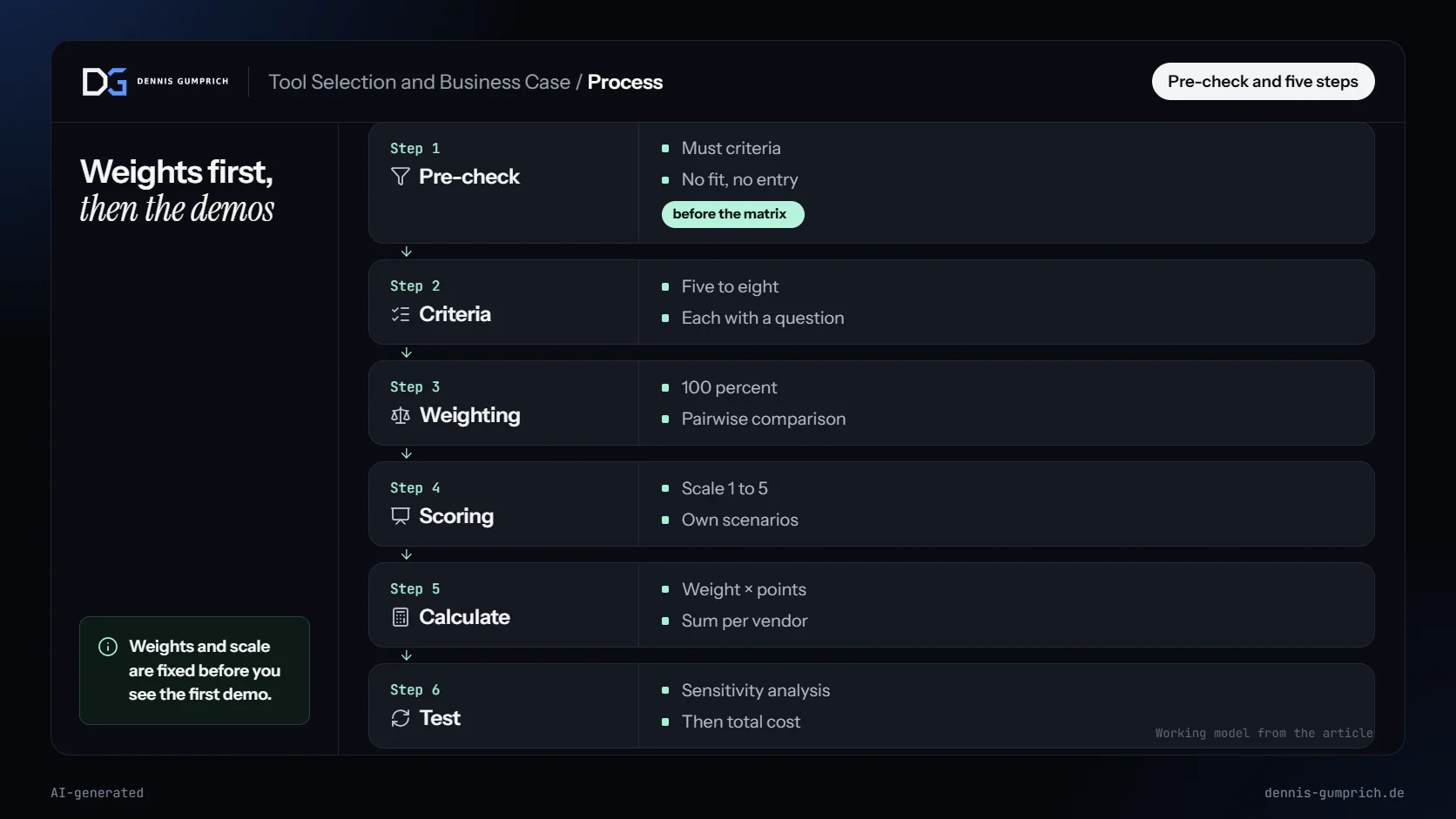
In five steps after a pre-check: clarify must criteria, define evaluation criteria, weight the criteria, score the solutions, calculate the score and validate the result with a sensitivity analysis. You set weights and scale before you see the first demo.
- Check must criteria in advance. Whatever a solution absolutely must meet, such as a data processing agreement, hosting in the EU or a connection to your CMS, does not belong in the scoring but before it. A solution that fails a must criterion is out. Which points IT and data protection typically check is shown in the AI tool approval checklist.
- Define evaluation criteria. Choose five to eight criteria that reflect your goals and do not overlap. Each criterion needs a guiding question so that everyone scores the same thing.
- Weight the criteria. Distribute 100 percent across the criteria. The most important criterion gets the highest weight. A pairwise comparison, in which you compare each criterion with every other one, helps.
- Score the solutions. Score each solution per criterion on the same scale, for example from 1 to 5. The basis is demos with your own scenarios, trial access and reference calls, not brochures.
- Calculate and validate the score. Multiply weight and points, add up the partial scores and use a sensitivity analysis to check whether the ranking remains stable if you change weights slightly.
Only then does cost come into play. You compare each solution's score with its total cost over the term and decide on that basis.
Which criteria belong in weighted scoring for content software?
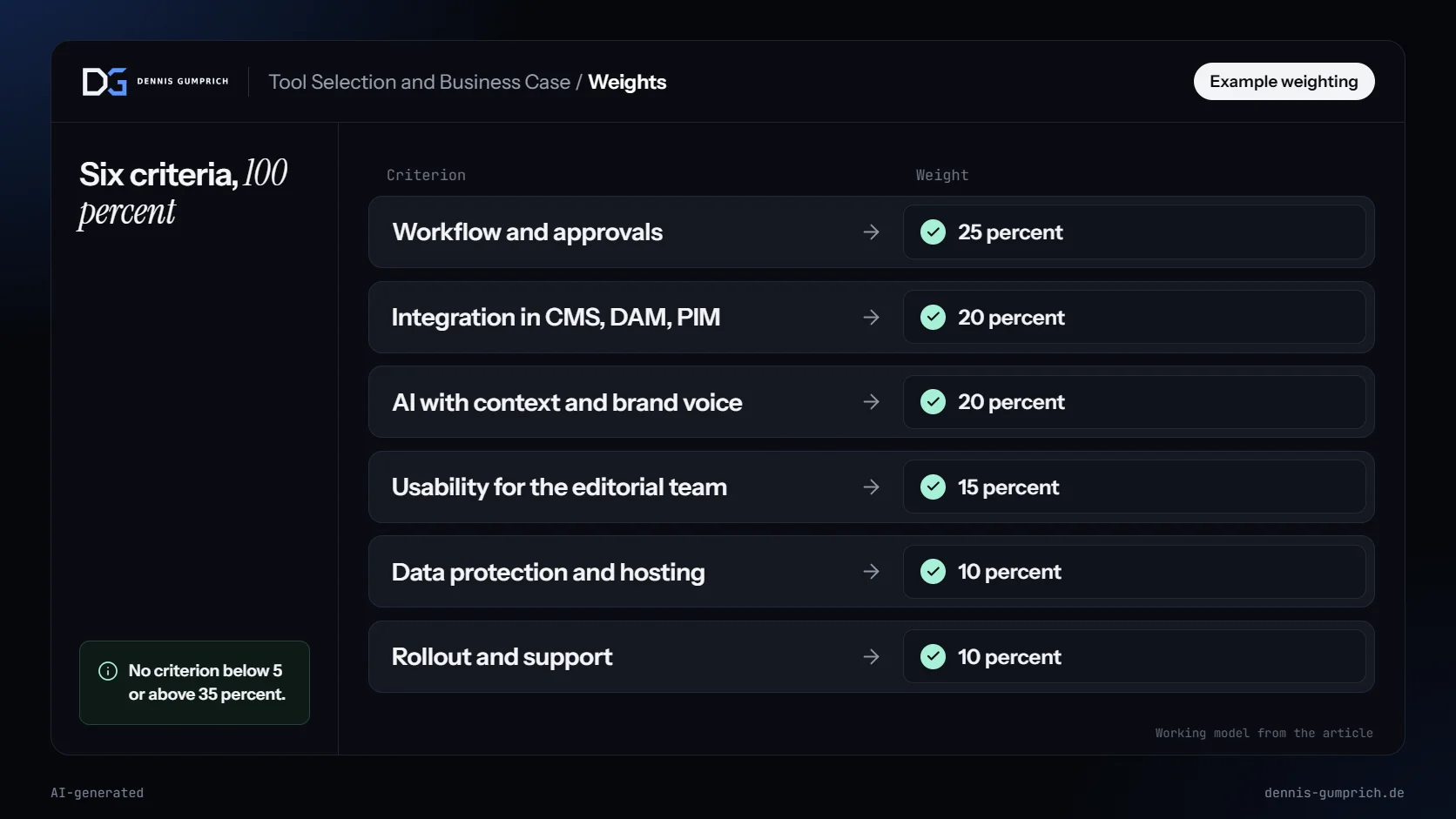
Criteria that determine the benefit in daily work: workflow and approvals, integration into existing systems, AI features with access to your context, usability for the editorial team, data protection and hosting, and rollout and support. Which of them get the highest weight depends on your goals.
| Criterion | Guiding question for scoring | Weight in the example |
|---|---|---|
| Workflow and approvals | Does the solution map our process from planning to approval, with roles, status and deadlines? | 25% |
| Integration in CMS, DAM and PIM | Does content reach our channels without copying, and can product data and images from the leading systems be used? | 20% |
| AI with context and brand voice | Does the AI draw on our brand voice, target groups and approved facts instead of delivering generic texts? | 20% |
| Usability for the editorial team | Can occasional users from departments cope without training? | 15% |
| Data protection and hosting | How well are permissions, logs and data storage handled beyond the minimum requirements? | 10% |
| Rollout and support | How quickly are we operational, and how reachable is the vendor? | 10% |
Two notes from practice. First: data protection appears twice here, as a must criterion in the pre-check and as an evaluation criterion. That is not a contradiction. The pre-check clarifies whether a solution is an option at all. The scoring distinguishes how good it is beyond the mandatory requirements. Second: phrase criteria so that they can be checked in a demo. "Modern" or "flexible" cannot be scored, "approval by the legal department without an email loop" can. More criteria are collected in the guide to selecting content marketing software.
How do you weight the criteria correctly?
You distribute 100 percent across the criteria before you see any offers. The most reliable way is a pairwise comparison: each criterion is compared with every other one, and the more important one gets a point. The shares of all points give the weights.
With six criteria, that is 15 comparisons, done in half an hour. The pairwise comparison has a side effect that is often more important than the result: it makes visible where marketing, IT and departments have different priorities. This discussion belongs at the start of the project, not in the week before the decision.
Three rules keep the weighting robust:
- No criterion below 5 percent. Anything that counts so little does not change the result and can be deleted.
- No criterion above 35 percent. Otherwise a single criterion decides on its own, and you do not need weighted scoring.
- Document the weights in advance. Adjusting weights after the demos makes the result fit instead of determining it.
Weighted scoring example: three content platforms compared
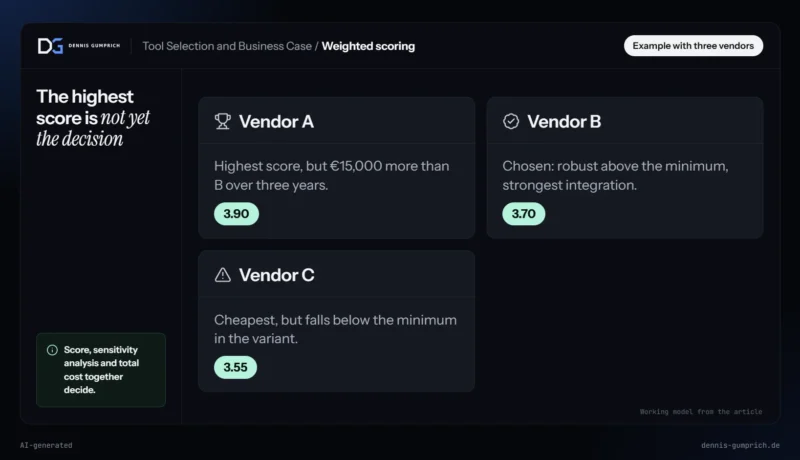
In the example, a marketing team compares three fictional content platforms A, B and C on a scale from 1 to 5. Vendor A achieves the highest score of 3.90, vendor B reaches 3.70, vendor C 3.55. Only the sensitivity analysis and a look at the total cost show which solution is the best choice.
The scoring is based on demos with three of the team's own scenarios, a two-week trial access and one reference call each. The head of marketing, an editor, IT and a person from a department scored, and the points are averaged.
| Criterion | Weight | A | B | C |
|---|---|---|---|---|
| Workflow and approvals | 25% | 4 | 3 | 5 |
| Integration in CMS, DAM and PIM | 20% | 3 | 5 | 2 |
| AI with context and brand voice | 20% | 5 | 3 | 3 |
| Usability for the editorial team | 15% | 4 | 3 | 4 |
| Data protection and hosting | 10% | 4 | 5 | 3 |
| Rollout and support | 10% | 3 | 4 | 4 |
| Score | 100% | 3.90 | 3.70 | 3.55 |
This is how vendor A's score is calculated: 0.25 × 4 + 0.20 × 3 + 0.20 × 5 + 0.15 × 4 + 0.10 × 4 + 0.10 × 3 = 1.00 + 0.60 + 1.00 + 0.60 + 0.40 + 0.30 = 3.90. The general formula is: score = sum of weight times points across all criteria.
Sensitivity analysis: does the result hold?
Weights are estimates. That is why you check whether the ranking changes if you shift a weight plausibly. In the example, IT argues that integration is at least as important as workflow. The team calculates a second variant: integration 25 instead of 20 percent, usability 10 instead of 15 percent.
| Vendor | Original weighting | Integration variant | Minimum score of 3.5 reached? |
|---|---|---|---|
| A | 3.90 | 3.85 | yes, in both variants |
| B | 3.70 | 3.80 | yes, in both variants |
| C | 3.55 | 3.45 | no, just below in the variant |
In the variant, A and B are only 0.05 points apart. C falls below the minimum score that the team set at 3.5 in advance. The result for C therefore depends heavily on how integration is weighted and is thus uncertain.
Bringing score and cost together
Now cost comes in, as total cost of ownership (TCO) over three years including rollout, licenses, operation and internal working time:
| Vendor | Score | Total cost over 3 years | Assessment |
|---|---|---|---|
| A | 3.90 | €75,000 | Highest score, but €15,000 more expensive than B with almost the same benefit in the variant |
| B | 3.70 | €60,000 | Stable above the minimum, strongest integration |
| C | 3.55 | €48,000 | Inexpensive, but the result is not robust |
The team chooses B. Weighted scoring alone would have recommended A, a pure price comparison C. Only the combination of score, sensitivity analysis and total cost leads to a decision that withstands critical questions from management and procurement. How to turn this into a complete business case is described in the guide Calculating the business case for content software.
Weighted scoring does not make a decision. It makes the assumptions visible on which a decision is based. That is exactly what makes it valuable: anyone who later asks why you chose a solution gets a traceable calculation, not an opinion.
Why does cost not belong in weighted scoring?
Because cost can be measured in money and loses its meaning on a points scale. If price is a weighted criterion in the matrix, a cheap solution can compensate for weak features. It is better to determine the score without cost and then compare it with the total cost.
Many templates still list price as a criterion with a weight of 20 or 30 percent. That has two disadvantages. First, a license price is translated into points, even though the difference between two offers is known much more precisely in euros. Second, this translation almost always leaves out the costs that are not in the offer: rollout, integration, internal working time and later switching costs. Considered separately, benefit and cost remain clear, and the conversation with procurement becomes easier.
Five mistakes that make weighted scoring worthless
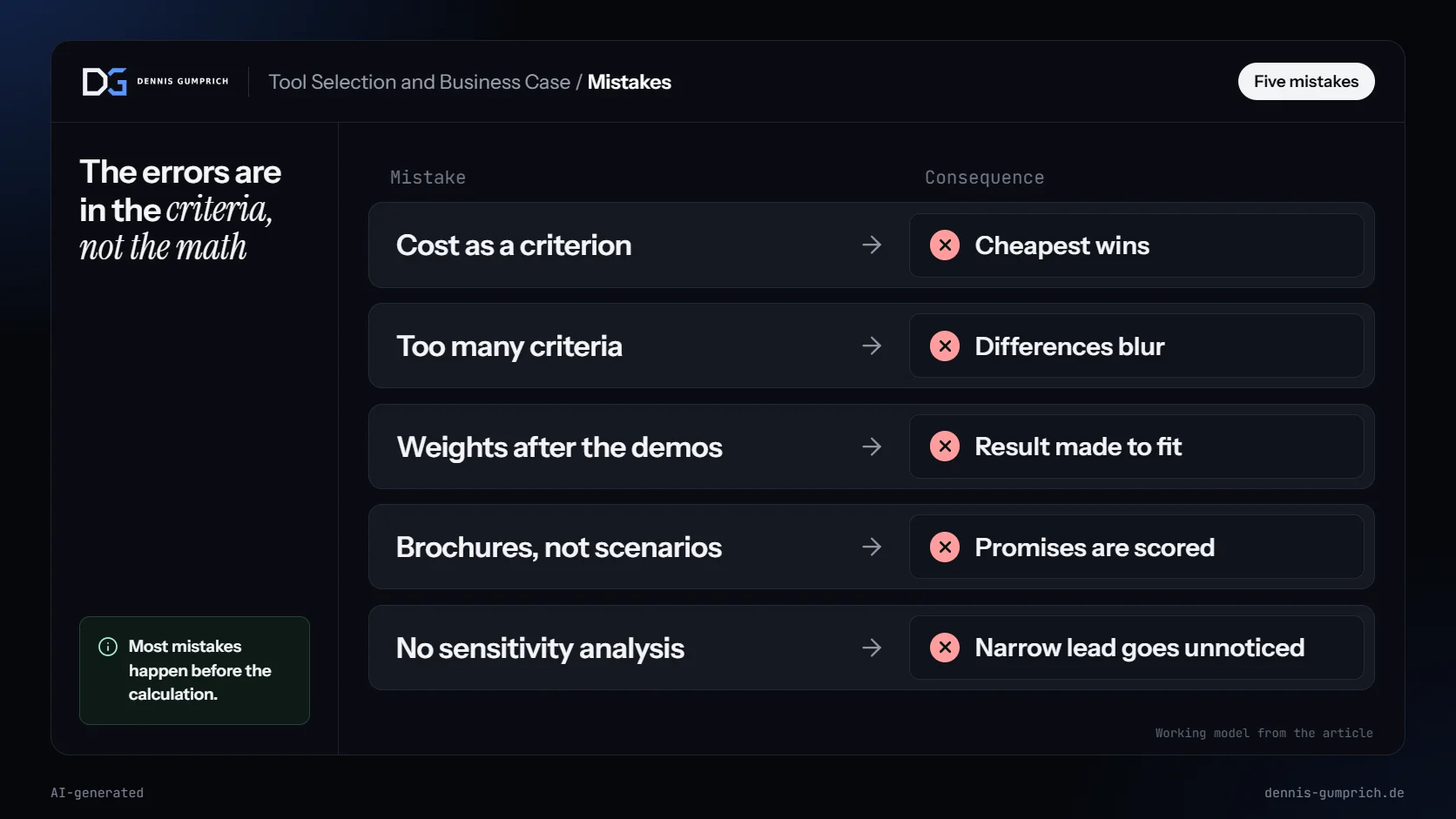
- Scoring cost as a criterionThe cheapest solution wins, even though it only weakly meets important requirements.
- Too many criteriaWith 20 criteria or more, the differences blur and what matters loses weight.
- Setting weights after the demosAdjusting weights once you know the vendors makes the result fit.
- Scoring brochures instead of your own scenariosWithout your own test cases, you score promises, not daily work in your team.
- Skipping the sensitivity analysisA narrow lead can depend on the chance of a weighting and then goes unnoticed.
Self-check: is your weighted scoring robust?
Tick everything that applies to you.
A short summary of how we are selecting the new content software:
We compare the vendors with weighted scoring. First we check must criteria such as data protection and connection to our CMS. Then we score the remaining solutions against six weighted criteria that we set before the demos.
We look at cost separately as total cost over three years, including rollout and internal working time. A sensitivity analysis shows whether the result is stable. We will present the decision paper with score, total cost and recommendation before the contract negotiations.
Template for your weighted scoring
You do not have to build the matrix yourself. The free evaluation matrix for content software contains 40 weighted criteria, logic for must criteria, demo scenarios and a calculation of total cost over three years. Delete the criteria that do not count for you and adjust the weights in a pairwise comparison. If you want to describe the requirements in parallel, the requirements specification template helps.
Conclusion: weight first, then score, then calculate
Weighted scoring is not a feat of arithmetic but a method against gut decisions. Its value arises before the calculation: in selecting a few clear criteria and in weights that are fixed before the vendors present themselves. If you look at cost separately as total cost and validate the result with a sensitivity analysis, you get a decision that holds up in the team, with management and with procurement. Then comes the practical test: how to trial a solution in daily work without being misled by a short test is shown in the guide Pilot and rollout.
Frequently asked questions
How do you calculate the weighted score?
For each criterion, multiply the weight by the points awarded to get the partial score. The sum of all partial scores is the overall score. With weights in percent and a scale from 1 to 5, the score lies between 1 and 5.
Which scoring scale makes sense?
For software selection, a scale from 1 to 5 has proven itself. It is fine enough to show differences and coarse enough for evaluators to agree. Describe what each level means, for example 1 for "barely meets" and 5 for "fully meets without a workaround".
How many criteria should weighted scoring have?
Five to eight evaluation criteria are enough in most cases. Detailed requirements can be scored as sub-points of a criterion. With significantly more criteria, the weight of each one drops so much that important differences hardly matter anymore.
Weighted scoring or cost-benefit analysis: what is the difference?
Cost-benefit analysis expresses benefit and cost in money. Weighted scoring uses points to evaluate benefits that are hard to express in money, such as usability or quality of approvals. In software selection the two complement each other: weighted scoring evaluates the benefit, the total cost calculation the cost.
Who should score the solutions?
At least three perspectives: those responsible for the result, the future main users and IT. Score independently first and then discuss large deviations. These deviations in particular show where a solution is experienced very differently depending on the role.
Is there a weighted scoring template in Excel?
Yes. The free evaluation matrix for content software is built as an Excel file and contains weighted criteria, logic for must criteria and a total cost calculation.
Where does your content process lose time today?
In 30 minutes, we look together at where unnecessary coordination, manual tasks, tool switching or repetitive content work cost you time today.
You get a concrete assessment of which tasks you can simplify, automate or organize better, and where AI and tools actually help instead of adding complexity.
Analyze your content process in 30 minutes Free of charge. You take away concrete starting points you can use internally right away.
Dennis Gumprich
Dennis helps marketing and communication teams fit generative AI into existing content processes without undermining quality, brand voice and approvals. Focus areas: content operations, AI governance and tool selection in mid-sized companies and corporations.
Transparency note: Dennis works for contentbird, a provider of AI-powered content software. Product mentions are marked in the article. More about Dennis (in German) · LinkedIn
Read more
Sources
- Christof Zangemeister: Nutzwertanalyse in der Systemtechnik. Eine Methodik zur multidimensionalen Bewertung und Auswahl von Projektalternativen (in German). Munich 1970.
- Munich Business School: BWL-Lexikon: Nutzwertanalyse (in German), definition and procedure. Accessed November 19, 2026.
How this article was created
This article was created with the help of AI. Structure, research and draft wording were developed with AI support. Professional assessment, review of the statements and the final version are the responsibility of Dennis Gumprich. The English version was translated with AI and reviewed. Read the original German version.
How reliable are the statements?
The method and formula correspond to the common standard procedure for weighted scoring (Nutzwertanalyse). Criteria, weights, points and costs in the example are fictional and serve as illustration. The weighting rules, the list of mistakes and the self-check are working models from consulting practice, not results of a study. Transparency note: I work for contentbird.