

The article is live. Two hours later, a colleague from sales writes: the certification mentioned in the third paragraph? We don't actually have it.
Nobody invented it. It was simply in the draft, sounded plausible, fit the rest, and three people read the text without anyone noticing. That is exactly the problem: hallucinations don't look like mistakes.
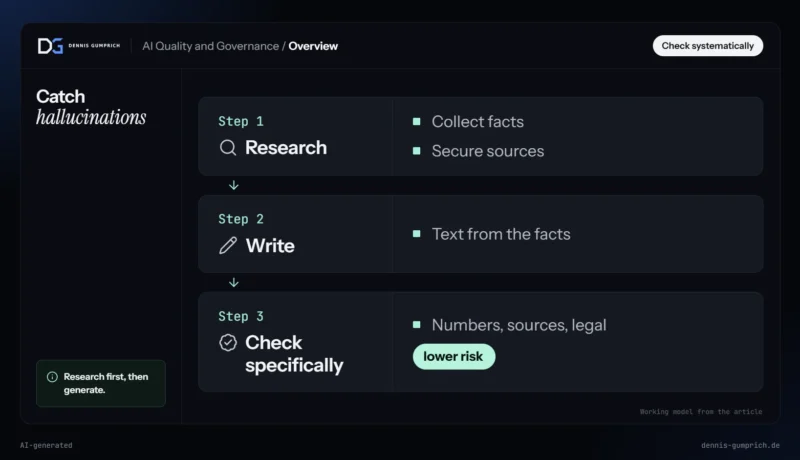
Hallucinations can't be prevented by better models, only by process. Three levels work: only allow verifiable statements, carry sources along in the draft, and before approval check the fact-bearing sentences specifically instead of the whole text. How to also find gaps that make a draft useless for AI search is shown in From AI draft to citable text. The effort is a few minutes per article.
Why hallucinations are especially dangerous in marketing
A language model produces the most likely next piece of text, not the true statement. In most cases the two coincide, because likely phrasings in well-documented topics are also correct. That is exactly why the impression of reliability arises.
It gets critical where a statement is specific but rare: years, certifications, market shares, study names, legal sections, product details. In flowing text, such details look completely unremarkable because they are embedded in linguistically correct sentences.
In marketing, there is an additional problem: your texts go out to the public and contain statements about your own company. An invented certification is not a style error, it is potentially a misleading claim. Checking therefore has to be a fixed step, not a matter of attention.
What types of AI hallucinations do you encounter in marketing?
Four types: invented evidence, meaning studies and reports that don't exist in that form, usually with a plausible publisher and year. False company claims derived from similar companies. Outdated facts, correct at training time and outdated since. And overstretched generalizations from individual cases.
Invented evidence
Studies, surveys or reports that don't exist in that form, often with a plausible publisher and year.
Recognizable by: a source is named but not linked.
False company claims
Statements about your company that were derived from similar companies.
Recognizable by: sounds like your standard, but is documented nowhere.
Outdated facts
Correct at training time, outdated since. Especially with legal situations and product versions.
Recognizable by: no time reference in the sentence.
Overstretched generalization
A single case becomes a rule, a tendency becomes a number.
Recognizable by: phrases like as a rule, mostly, significantly more.
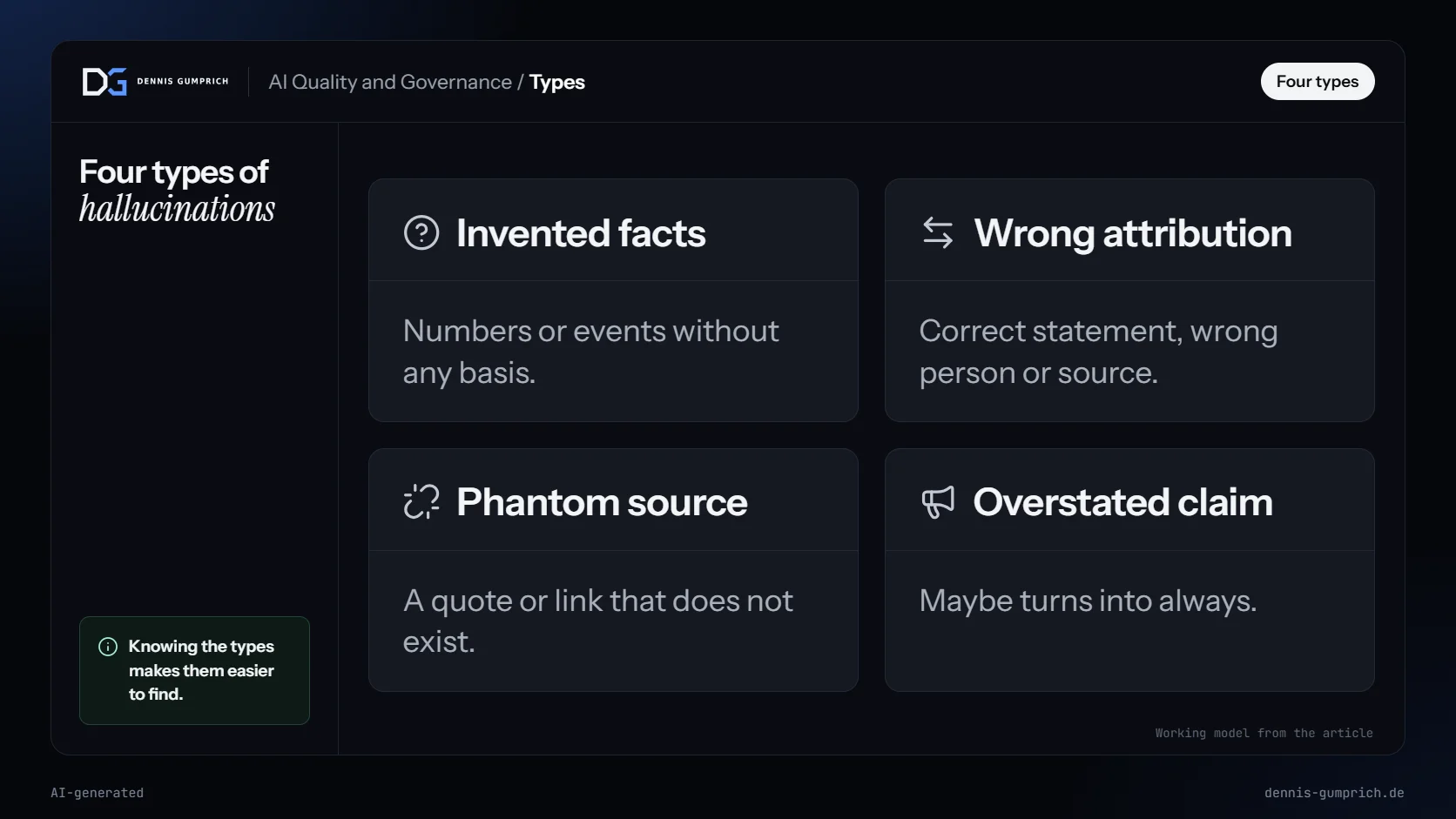
Type 2 is the most expensive, because externally it reads like a commitment. Type 3 is the most common, because it occurs even when everything else runs cleanly.
What are examples of AI hallucinations?
Two publicly documented cases show what happens when invented information goes out unchecked. In both rulings, it is not the model that is liable in the end, but the organization that used it.
- Invented court decisions: In Mata v. Avianca, lawyers filed a brief in 2023 citing rulings that ChatGPT had invented, including case numbers and quotes. The federal court in New York imposed sanctions on the lawyers in June 2023.
- Invented refund policy: Air Canada's chatbot told a customer about a bereavement refund policy that did not exist in that form. The Civil Resolution Tribunal in British Columbia ruled in February 2024 that the airline is responsible for the information its chatbot provides.
In marketing, the consequences are usually quieter but similar: a false claim reads externally like a commitment from your company. Typical examples from marketing texts:
| Typical example | Type of hallucination | How to recognize it |
|---|---|---|
| "According to a 2024 study, 73 percent of mid-sized companies already use AI." | Invented evidence | Study, publisher or number cannot be found |
| "Our platform is ISO 27001 certified," although the certificate is missing | False company claim | The claim is missing from the company fact sheet |
| A price, feature or legal situation that was true a year ago | Outdated claim | No retrieval date, source older than the training data |
| A quote attributed to a real person | Invented evidence | No location in the original, only a loose paraphrase |
The same rule catches all four examples: every number, every company claim and every quote needs a documented source before approval.
Why the error rate never drops to zero
A language model chooses the most likely next piece of text. In doing so, it does not distinguish between a statement it can support and one that merely fits the pattern well. Both are produced the same way.
The US National Institute of Standards and Technology (NIST) lists this property as its own risk category in its risk profile for generative AI (NIST AI 600-1): confabulation, meaning confidently stated but false content. NIST describes it as a natural consequence of how generative models are built, since they reproduce the statistical distribution of their training data. Outputs can even include invented reasoning and citations that seem to support the answer.
This leads to something that matters more for process design than any choice of model: the confidence with which a text is written says nothing about its accuracy. An invented study name sounds just as natural as a correct year. People usually take confident wording as a sign of reliability, and that very signal does not work here.
Newer models reduce the frequency noticeably, especially for well-known topics. But they do not change the foundation. If you build your quality assurance on the hope that the next model will be reliable enough, you don't have a safeguard, you have a hope.
In practice, this means one simple rule: treat every fact-bearing statement as unchecked until it has been checked, regardless of how confidently it is worded. This is exactly why marking in the draft is so effective. It replaces a judgment with a label.
Where do hallucinations occur most often?
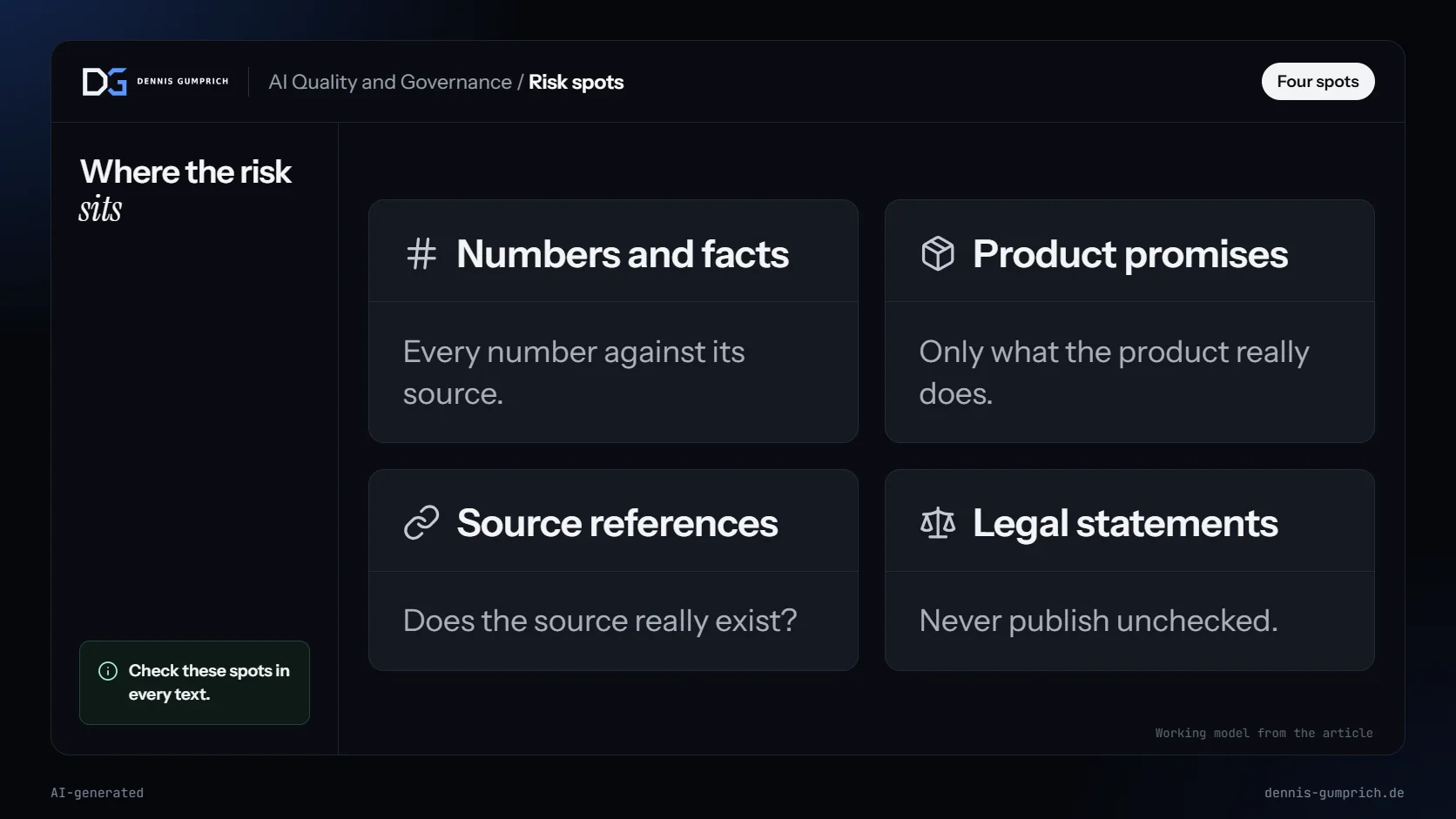
Not evenly across the text, but in three places: in statements about your company, because the model doesn't know you and extrapolates from similar companies. In concrete numbers with source references, because source references are a text pattern and get generated along with the rest. And in legal and regulatory statements.
The error frequency is not evenly distributed across a text. If you know the risk spots, you check in a more targeted and faster way.
| Place in the text | Risk | Reason |
|---|---|---|
| Statements about your company | high | The model doesn't know you and extrapolates from similar companies |
| Concrete numbers with source references | high | Source references are a text pattern and get generated too |
| Legal and regulatory statements | high | The law changes, the training data is older |
| Product names and feature scope | high | Changes frequently, including for third-party products |
| General explanations of concepts | low | Well documented and described many times |
| Structure, transitions, wording | very low | Contains no factual statement |
The last two rows explain why using AI is worthwhile despite the risk. Most of a text consists of structure and wording, and hardly any errors arise there. The risk is concentrated in a few sentences that can be marked and checked specifically.
A note on the first row: statements about your own company are the most expensive errors and at the same time the easiest to avoid. They disappear almost completely as soon as a fact sheet with verified information is in the context. For environmental and sustainability claims, the fact sheet alone is not enough, since separate evidence requirements apply there. What they are is covered in EmpCo Directive: what the EU rules for green claims mean from 2026.
The most effective lever: enforce verifiable statements
Most hallucinations arise because the instruction asks for a statement the model cannot support. If you ask for convincing arguments with numbers, you get numbers. Whether they are correct was not part of the request. How to make your use of AI transparent to the outside world is covered in AI labeling: how to arrive at a robust practice.
Write a convincing section on why our solution saves time. Include concrete numbers.
Write a section on why our solution saves time. Use only information from the attached material. If a number is missing, write PLACEHOLDER instead of an estimate.
The placeholder is the decisive part. It makes the gap visible instead of filling it. A text with three placeholders is inconvenient, but correct. A text without placeholders is convenient and has to be checked in full.
A second lever with great impact: have the origin written in square brackets after every fact-bearing statement. Either the location in your material or the note unverified. This turns checking from a search into working through a list.
How do research and text generation differ?
When deriving from attached material, the model stays bound to the text. It summarizes, reshapes, shortens. Inventions are rarer, but not ruled out, because the task contains no gap. When writing freely on a topic, every missing piece of information gets filled in. If you research first, you move error prevention to the start of the process.
One distinction lowers the risk more than any review routine: whether a model works from existing material or writes freely.
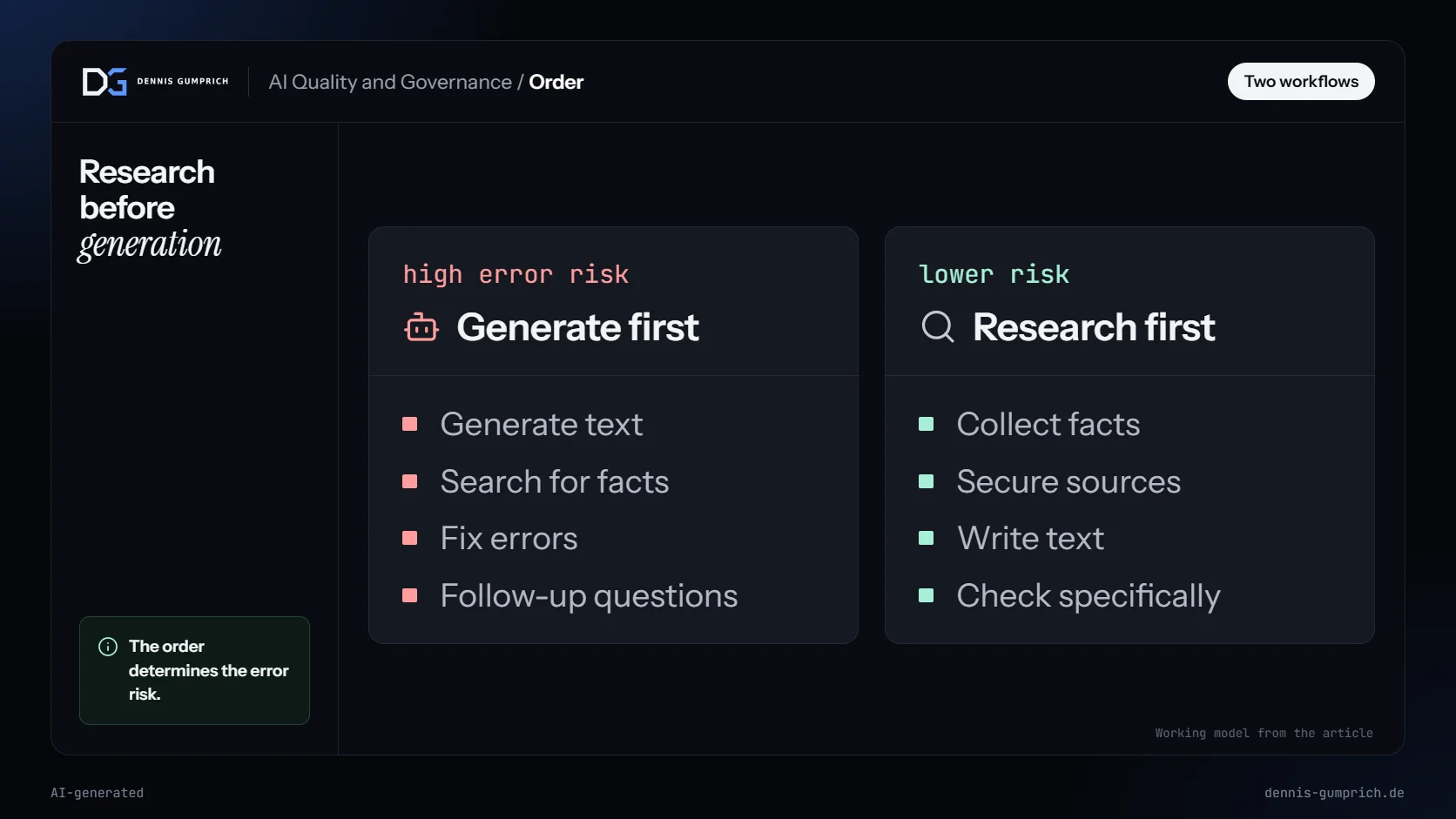
When deriving from an attached text, the model stays bound to the material. It summarizes, reshapes, shortens. Inventions are rarer here, but not ruled out, because the task contains no gap that would need to be filled. When writing freely on a topic, the exact opposite is true: every missing piece of information is filled in plausibly.
This results in a practical order for the workflow. Gather the material first, then write. An article built from a fact sheet, expert notes and two verified sources has far fewer risk spots than one generated from a topic and then backed up with evidence afterwards.
It also explains why channel adaptations from an approved article are so reliable. All facts have already been checked, and the model only works on form and length. That is exactly why this step belongs after approval organizationally, not before it.
If you implement only one measure from this article, make it this one: shift AI use from free generation to deriving from verified material. That reduces the source of errors instead of checking for them afterwards.
What does fact-checking cost per article?
With 12 to 18 fact-bearing statements in a medium-length professional article: 4 to 7 minutes if the origin is carried along in the draft, and 25 to 40 minutes without origin notes, because every statement then has to be researched again. Without marking, you check either everything or nothing, and in practice usually nothing.
Working model for illustration, not measured values. Insert your own values.
The difference does not come from more thorough checking, but from it being clear what needs to be checked. Without marking, you check either everything or nothing. In practice it usually ends up being nothing, because there is no time.
What to do if a false claim has already been published?
First assess the scope. An outdated year in a blog post is something different from a false product statement in a sales document or an inadmissible advertising claim. You correct the first two; the third must be reported to the legal department immediately. Then correct with a note: a silent change looks worse when it is discovered.
Despite checks, something will occasionally slip through. How you handle it determines your credibility more than the fact that it happened.
The first step is assessing the scope. An outdated year in a blog post is something different from a false statement about your product in a sales document or an inadmissible advertising claim. You correct the first two; the third must be reported to the legal department immediately.
The second step is the correction with a note. A silent change looks worse when discovered than the original error. A short note on what was corrected and when costs two sentences and creates trust instead of suspicion. For content that has already been passed on, an active message to the recipients is part of it.
The third step is the most important and is usually skipped: the correct information goes into the fact sheet. Without this step, the same false claim will reappear in a few weeks, because the cause remains unchanged.
Don't look for the guilty person. Hallucinations arise systematically, not through carelessness. A team in which errors lead to blame will stop reporting the next one, and that is exactly when it gets expensive.
The checklist before every approval
| Category | What to check specifically | Who checks |
|---|---|---|
| Company claims | Certifications, customer numbers, locations, awards | Specialist department or corporate communications |
| Numbers and shares | Every percentage, every absolute number, every time period | Person with access to the source data |
| Third-party evidence | Existence of the source, year, actual statement | Editorial team |
| Legal statements | Validity, date of application, jurisdiction | Legal department |
| Product information | Feature scope, availability, names | Product owners |
The practical benefit of this split lies in responsibility. An editorial team cannot confirm a certification, and a legal department should not be polishing wording. When every category has an address, approval takes less time, not more.
Two frameworks support this split. In its profile, NIST recommends verifying sources and citations in AI outputs (action MS-2.5-003) and having humans review generated content where models are demonstrably weak (MG-3.2-008). In its guidance on using generative AI content, Google explicitly names title elements, meta descriptions, structured data and alt text as places to check manually for accuracy before publishing. So add these fields as a separate row in your checklist.
What belongs in a fact sheet?
Four areas, starting with company information such as founding year, locations and certifications. But don't start with a collection, start with your last ten texts: every piece of information someone had to look up or that was flagged during approval makes up the first version.
The fact sheet is the single most effective building block against false claims and at the same time the fastest to create. It answers the question a model would otherwise fill with a plausible guess.
Don't start with a collection, start with your last ten texts. Note every piece of information someone had to look up or ask about, and every one that was flagged during approval. This list is your first version and already covers most of the recurring risk spots.
Four areas belong in it: company information such as founding year, locations and certifications. Product information with official names and feature scope, explicitly including what is not included. Permitted claims, meaning which effect and comparison statements are approved. And your own numbers, each with a date and origin.
The last point determines how long it stays valid. A number without a date will at some point be used in a text where it is no longer correct. With a date, everyone immediately sees whether it still holds.
Keep the sheet deliberately short. An overloaded collection won't be maintained, and unmaintained verified information is more dangerous than none at all, because it is adopted unchecked. Include what actually appears in texts, not what might theoretically be relevant.
You can transfer the approval route with fact-checking, and the rule for what happens with a published false claim, directly into the free template for an AI policy in marketing.
Five mistakes in dealing with hallucinations
- Waiting for a better modelThe error rate drops with newer models, it does not disappear. A process that relies on zero errors has no safeguard.
- Wanting to check the whole textA full check is too expensive and therefore gets skipped. A targeted check of fact-bearing sentences actually happens.
- Looking for sources afterwardsIf you only look for evidence in the finished text, you usually find something similar and adopt it. That turns a hallucination into a poorly supported statement.
- Leaving the check to the authorWhoever wrote a text reads over their own assumptions. Fact-checking needs a second pair of eyes.
- No marking in the draftWithout marking, the finished text no longer shows which statement comes from your material and which the model added.
Five steps to reliable texts
- Before writingProvide materialA fact sheet with your verified information: numbers, certifications, product names, standard wording. Without this sheet, every model invents the gaps.
- While writingPlaceholder instead of estimateThe instruction explicitly states that missing information is marked as a placeholder.
- While writingCarry the origin alongEvery fact-bearing statement is followed by its location or the note unverified.
- Before approvalCheck specificallyOnly the marked passages, distributed by responsibility. Leave the rest to the editorial team.
- After publicationMaintain the fact sheetEvery false claim found is added to the fact sheet as correct information. That way the error rate drops with every article.
Self-check: how high is your risk?
Tick everything that applies to you.
a short proposal on how we handle AI text drafts:
From now on, we no longer check the entire text, but specifically the fact-bearing statements. To do this, we mark the origin after every number, year, certification and legal statement while writing. If verified information is missing, we write PLACEHOLDER instead of an estimate.
We distribute the checks by responsibility: company claims to the specialist department, legal statements to the legal department, third-party evidence to the editorial team.
Effort: a few minutes per article. Benefit: we notice before publication, not after, when a claim is not supported.
Conclusion: secure the process, not the model
Hallucinations are not a temporary problem that the next model generation will solve. They are the flip side of language models producing plausible texts rather than true ones. If you accept that and build in the review step firmly, you can use AI in marketing with a clear conscience. If you wait for the problem to go away, you keep publishing unchecked in the meantime. The matching checklist for this review step is provided by the review criteria for AI texts.
Frequently asked questions
Isn't it enough to ask the model for sources?
No. Source references can themselves be hallucinated, precisely because they follow a recurring text pattern. A named source is a task to check, not evidence. Ask for locations in your own material, which can be verified.
Does it help to have several models check each other?
To a limited extent. Two models can produce the same plausible false claim because they follow similar patterns. The cross-check is useful for contradictions in the reasoning, but for fact-checking it does not replace a source.
What belongs in a fact sheet?
Everything that regularly appears in texts and could be wrong: company figures, founding year, locations, certifications, product names and feature scope, approved statements about effect and benefit, and wording that may not be used for legal reasons.
How do we deal with outdated legal information?
With a time reference in the sentence and a review date in the article. Phrases like currently or at present without a date become useless after a few months. If you carry a date along, you can update specifically later instead of rechecking everything.
Does every AI text have to be labeled?
That depends on the purpose and the applicable law, and it is assessed differently for text content than for synthetic images or audio. Clarify the framework that applies to you with your legal department before you define a uniform practice.
Can a second model take over fact-checking?
As a source of hints, to a limited extent; as the decision, no. Two models can produce the same plausible false claim because they follow similar patterns. The cross-check is useful for contradictions within a text, not for the question of whether a claim is true.
What about tools that provide sources?
They improve traceability considerably, because you can open the location. Still check whether the named source actually supports the statement. In practice, the source is often real, but the statement derived from it is exaggerated.
How do we handle numbers from vendor material?
Like any other third-party source: check origin, year and survey method. Vendor numbers without a stated method don't belong in your texts, because you can't defend them if in doubt. A smaller number of your own is worth more in a conversation.
Why does our marketing AI deliver inaccurate results?
Usually it lacks reliable context. Language models fill gaps with plausible wording when facts, current product data or sources are missing. What helps is a maintained knowledge base with approved facts, clear rules on which sources apply, and a fact check before every approval.
How do AI hallucinations affect a brand's reputation?
False numbers, invented quotes or outdated product information in published texts undermine trust, often faster than a correction can follow. Advertising claims can also have legal consequences. That is why fact-checking is one of the mandatory steps before every publication, no matter how confident a text sounds.
Where does your content process lose time today?
In 30 minutes, we look together at where unnecessary coordination, manual tasks, tool switching or repetitive content work cost you time today.
You get a concrete assessment of which tasks you can simplify, automate or organize better, and where AI and tools actually help instead of adding complexity.
Analyze your content process in 30 minutes Free of charge. You take away concrete starting points you can use internally right away.
Dennis Gumprich
Dennis helps marketing and communication teams fit generative AI into existing content processes without undermining quality, brand voice and approvals. Focus areas: content operations, AI governance and tool selection in mid-sized companies and corporations.
Transparency note: Dennis works for contentbird, a provider of AI-powered content software. Product mentions are marked in the article. More about Dennis (in German) · LinkedIn
Read more
Sources
- US District Court for the Southern District of New York: Mata v. Avianca, Inc., No. 22-cv-1461 (PKC), Document 54, sanctions order of June 22, 2023. Accessed November 26, 2026.
- Civil Resolution Tribunal British Columbia: Moffatt v. Air Canada, 2024 BCCRT 149, decision of February 14, 2024. Accessed November 26, 2026.
- OpenAI: Why language models hallucinate, research post of September 5, 2025 (Kalai, Nachum, Vempala, Zhang et al.): pretraining without true/false labels, errors mainly with rare individual facts, evaluation methods reward guessing over abstaining; newer models hallucinate less often, but still do. Accessed October 31, 2026.
- German Federal Ministry of Justice: Section 5 UWG (German Act against Unfair Competition), misleading commercial practices, statutory text; para. 2 no. 3 names, among other things, the qualifications, status, approval and awards of the trader. Accessed October 31, 2026.
- William H. Walters, Esther Isabelle Wilder: Fabrication and errors in the bibliographic citations generated by ChatGPT, Scientific Reports 13, article 14045, 2023: 55 percent of the references cited by GPT-3.5 and 18 percent of those cited by GPT-4 were fabricated. Accessed October 31, 2026.
- European Parliament and Council: Directive (EU) 2024/825 on empowering consumers for the green transition (EmpCo), February 28, 2024, applicable from September 27, 2026; Annex I prohibits, among other things, generic environmental claims without evidence and sustainability labels without a certification scheme. Accessed October 31, 2026.
- Manveer Singh Tamber et al.: Benchmarking LLM Faithfulness in RAG with Evolving Leaderboards, EMNLP 2025 Industry Track, November 2025: language models add unsupported or contradictory information even when material is provided. Accessed October 31, 2026.
- National Institute of Standards and Technology (NIST): Artificial Intelligence Risk Management Framework: Generative Artificial Intelligence Profile (NIST AI 600-1), July 26, 2024, Chloe Autio, Reva Schwartz, Jesse Dunietz et al., voluntary US framework for the AI RMF 1.0: confabulation as its own risk category (section 2.2), actions MS-2.5-003 (verify sources and citations) and MG-3.2-008 (human review of generated content). Accessed October 31, 2026.
- Google Search Central: Guidance on using generative AI content, documentation, as of October 7, 2026: hallucinations as a consequence of word prediction, manual review before publication also for title elements, meta descriptions, structured data and alt text. Accessed October 31, 2026.
How this article was created
This article was created with the help of AI. Structure, research and draft wording were developed with AI support. Professional assessment, review of the statements and the final version are the responsibility of Dennis Gumprich. The English version was translated with AI and reviewed. Read the original German version.
How reliable are the statements?
Documented are how language models work and their remaining tendency to err (OpenAI), the unfair competition law assessment of false claims about approvals and awards (Section 5 UWG), the tendency to fabricate references (Walters and Wilder), the EmpCo requirements for environmental claims, the finding that working from provided material does not rule out inventions either (Tamber et al.), the classification of confabulation as a risk category including recommended review actions (NIST AI 600-1, voluntary US framework) and the recommendation to also check metadata before publication (Google). The four types of hallucination, the risk assessment per text spot, the checklist and the review times and quantities mentioned are working models from consulting practice, not measured values. They serve to make the order of magnitude of the effort comprehensible. As of October 31, 2026. Legal note: this article does not replace legal advice. Your legal department clarifies whether and to what extent labeling obligations apply to your content.


