
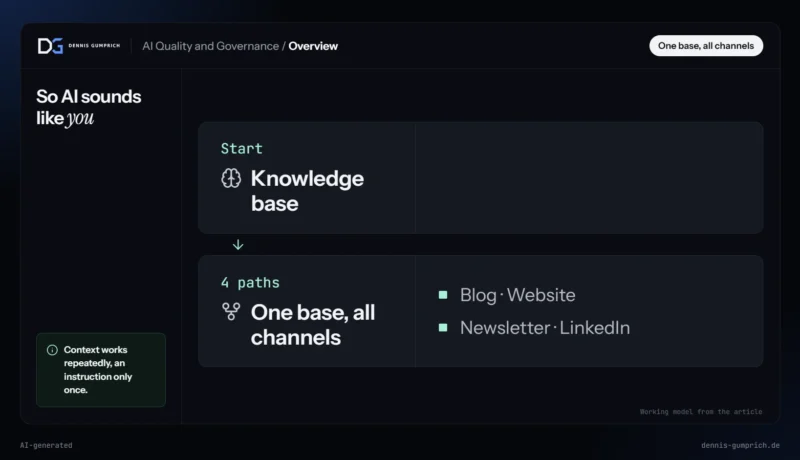

A knowledge base is the collection of verified information about your company, your products and your target groups that is accessed every time a text is created. It answers the question of what is true. Your brand voice, by contrast, answers how you sound. Only both together produce texts that fit you and hold up in substance.
Why better instructions do not solve the problem
The usual reaction to incorrect information is: we need to phrase things more precisely. That helps in individual cases and does not scale. If you write every product detail into the instruction, you are basically writing the text yourself, just more laboriously.
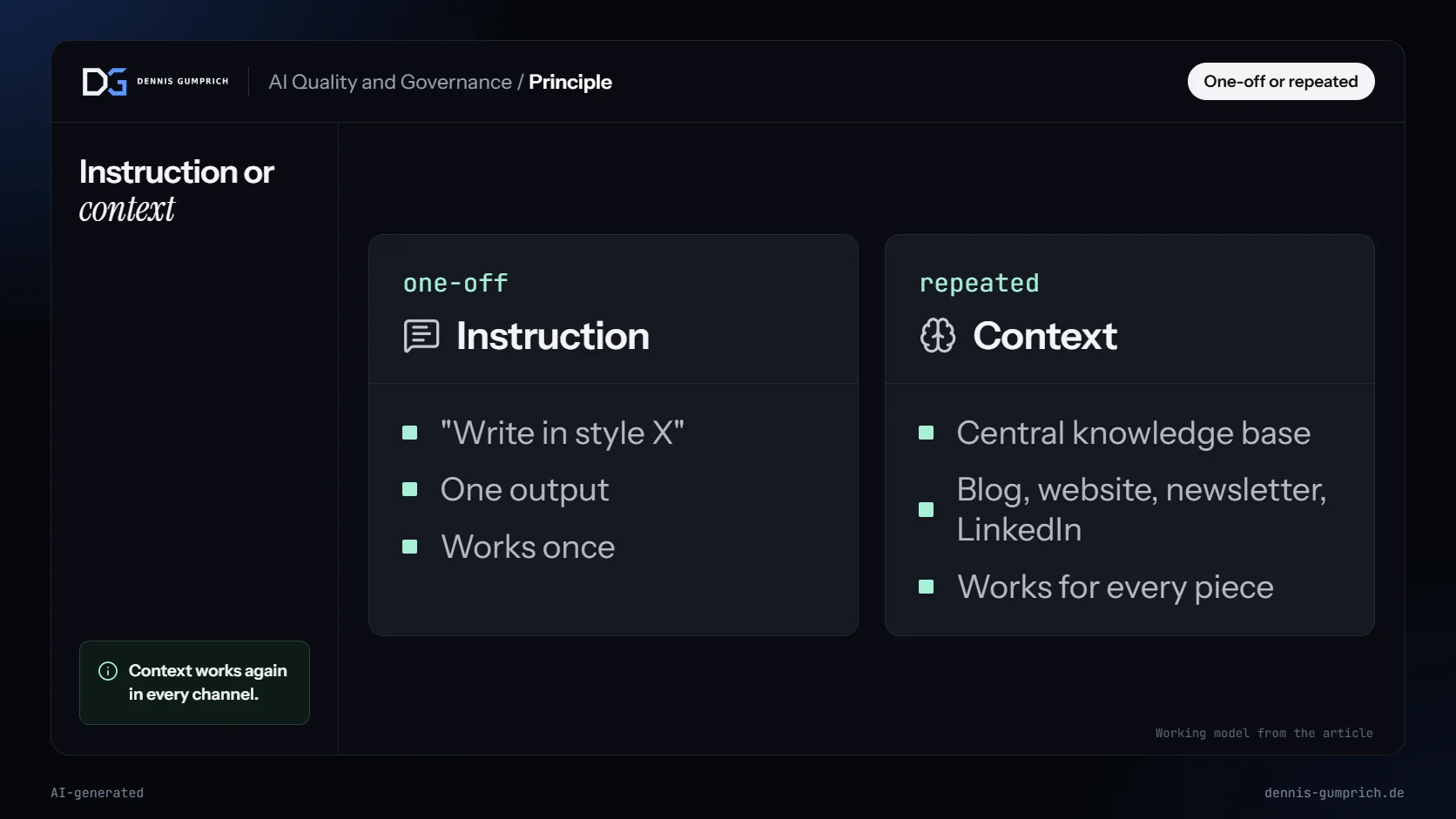
The structural difference lies between instruction and context. An instruction applies to one task and then ceases to exist. Context is stored and works for every task, regardless of who triggers it and how well that person phrases things. That is exactly why teams with maintained context get better results than teams with better wording.
The authors of the Anthropic Economic Index report: Uneven geographic and enterprise AI adoption from September 2025 reach a similar assessment for enterprise use. For complex applications, they suggest that a lack of access to context and well-prepared data holds things back more than model performance. This is a model provider's interpretation of usage data, not a proven causal link. For your planning, it still means: before you switch models, check whether the context it receives is right.
There is also a distribution effect. Instructions live in individual people's heads. When the colleague with the good approach is on holiday, output quality drops immediately. Stored context works the same for everyone, including people who have no interest in the topic at all.
In practice, this means: when the same incorrect statement appears for the second time, the right response is not a better instruction but an entry in the knowledge base. Every issue fixed this way reappears far less often. The kinds of incorrect statements that typically arise are covered in Catching hallucinations in marketing texts systematically.
What belongs in an AI knowledge base?
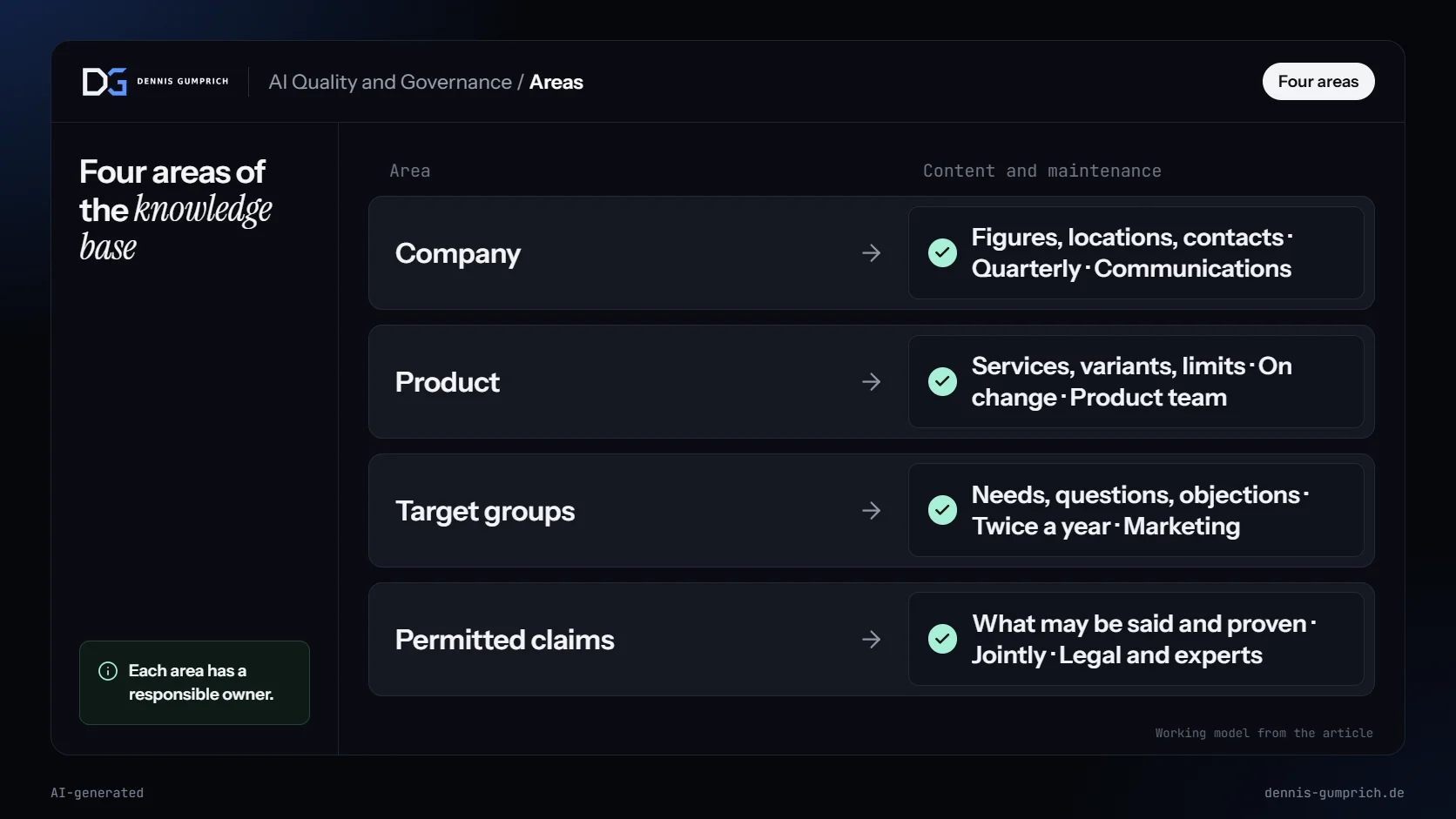
Verified, approved information in clearly separated areas: company details such as founding year, locations, certifications and reference customers with approval status. Products and services, including what is explicitly not included. Target groups and occasions, along with the objections that come up regularly. Company details have the fastest effect, because they are the information most often filled in incorrectly.
Company details
Founding year, locations, headcount, certifications, awards, reference customers with approval status.
Works immediately: This information is most often filled in incorrectly.
Products and services
Scope of functions, official names, pricing model, what is explicitly not included, planned extensions with status.
Works immediately: Prevents invented features and false promises.
Target groups and occasions
Who buys, who has a say, what the triggers are, which objections come up regularly and how you answer them.
Works in the medium term: Makes texts concrete instead of generic.
Permitted claims
Which effect claims are proven and approved, which comparisons are permitted, which phrases the legal department has ruled out. For environmental claims, the stored evidence also belongs here; the requirements are described in EmpCo Directive: what the EU rules on green claims mean from 2026.
Critical if missing: This is where the most expensive mistakes happen.
A fifth area is often forgotten and is particularly valuable: your own figures with origin and date. Not the figure alone, but the figure with a date and source. Without these additions, it will eventually turn up in a text where it is no longer correct.
What explicitly does not belong in it?
Customers' personal data, unpublished prices, internal strategy papers, contract details and anything without approval. The yardstick is simple: include what you would also hand a new colleague on their first day. Because whatever sits in the knowledge base can end up in a text.
A knowledge base quickly becomes a dumping ground for everything. That is a problem for two reasons: it becomes unusable, and it becomes a risk.
Verified, approved information that may appear in texts. Everything you would also hand a new colleague on their first day.
Customers' personal data, unpublished prices, internal strategy papers, contract details, anything without approval.
The second point concerns not only data protection but also practice. Whatever sits in the knowledge base can end up in a text. That is its purpose. So adding something is a deliberate approval decision, not a filing question.
Before filling it, define who may add content and which information needs approval. If the knowledge base is processed by external services, clarify with your data protection officer beforehand which types of content are permitted. This clarification takes much less time when it happens up front.
Keeping it current is the real problem
Building a knowledge base takes a few days. Keeping it current determines whether it is still worth anything after a year. An outdated knowledge base is more dangerous than none at all, because its information is adopted without being checked.
| Content | Changes | Maintenance interval | Owner |
|---|---|---|---|
| Company details | rarely | annually | Corporate communications |
| Scope of functions and names | often | with every release | Product owners |
| Prices and terms | moderately | quarterly | Sales |
| Permitted claims | rarely, but with consequences | annually and as needed | Legal department |
| Own figures | annually | marked with a date | Marketing |
The fourth column is the decisive one. A knowledge base without named owners is maintained by no one, because it belongs to everyone. Distribute responsibility by subject area, not to one central person who cannot judge whether a product detail is still correct anyway.
How much depends on maintained information is also shown by the Generative AI Profile (NIST AI 600-1) of the US National Institute of Standards and Technology. It recommends checking AI output for accuracy against reference data, through a combination of human oversight and automated evaluation (action MP-2.3-001). Your knowledge base is exactly this reference, both when writing and when reviewing. An outdated entry therefore makes both steps unreliable, and the responsible role per area is not a formality. One caveat: it is a voluntary framework from the US.
How do you start small with a knowledge base?
The most common reason a knowledge base never comes into being is its planned scope. If you want to collect everything, you never start. The entry point that works is much smaller: take your last ten texts and note every piece of information someone had to look up or ask about. This list is your first version.
The second approach is the error side. Collect every incorrect statement that appeared in a draft over recent months. Each of them becomes an entry with the correct information. This way, the knowledge base solves real problems from the start rather than hypothetical ones. How to provide the same context in a single prompt is covered in ChatGPT for SEO and content marketing.
Who should maintain the knowledge base?
Shared by subject area, not centrally by one person and not by nobody. A central editor cannot judge whether a feature name is still correct after the last release or whether an effect claim is still approved. They can only ask, and at some point they stop doing so.
The question of ownership decides whether a knowledge base is still correct after a year. In practice, most fail because of one of two variants: either nobody is responsible, or a single person is responsible for everything.
The first case is obvious, the second is underestimated. A central editor cannot judge whether a feature name is still correct after the last release or whether an effect claim is still approved. They can only ask, and at some point they stop doing so.
What works is shared responsibility by subject area with a coordinating role. Product owners keep feature information current, sales handles prices and terms, the legal department handles permitted claims. Marketing coordinates, sends reminders and maintains its own figures. What matters is that each role is responsible only for its own area, not for the completeness of the whole.
A practical addition: note for each entry when it was last confirmed. Not when it was changed, but when someone last confirmed it is still correct. This makes it immediately visible which parts have aged without being checked.
Five mistakes when building it
- Wanting to collect everythingA complete knowledge base is never finished and is therefore never used. Four areas and two days of effort are enough to get started.
- Information without a dateA figure without a point in time will eventually be used in a text where it is no longer correct. The date is part of the information.
- Central maintenanceA single person cannot judge whether a product detail or a legal statement is still current. Distribute responsibility by subject area.
- Including confidential materialWhatever sits in the knowledge base can end up in a text. Adding something is an approval decision.
- Correcting errors one by oneIf you correct the same incorrect statement three times in texts instead of storing it once in the knowledge base, you are permanently fighting the same problem.
Five steps to a usable knowledge base
- Day 1Identify what people look upGo through your last ten texts and note every piece of information someone had to ask about or search for. That is the raw list.
- Day 1Add incorrect statementsInclude every known incorrect statement from recent months with the correct version.
- Day 2Obtain approvalsHave product owners confirm product information and the legal department confirm effect claims. No approval, no entry.
- Day 3Bring it to where the work happensTo the place where texts are created, not into a separate document. What has to be searched for does not get used.
- From week 2Anchor maintenanceOne responsible role and one interval per area. Plus the rule: every incorrect statement found is entered immediately.
The fifth step contains the actual mechanism. When every incorrect statement discovered becomes an entry, the error rate drops with every piece. The knowledge base then becomes complete not through a project but through ongoing operations. How this fits into the overall production process is described in Brand-compliant AI content: the guide for marketing leaders.
Self-check: how robust is your context?
Tick everything that applies to you.
A proposal for how we permanently stop incorrect information in text drafts:
The problem will not be solved by better wording in individual cases. What is missing is stored context: verified information on the company, product, target groups and permitted claims that is accessed every time a text is created.
We start small: from the last ten texts, we collect every piece of information someone had to look up, plus every known incorrect statement with the correct version. We have product owners confirm product information and the legal department confirm effect claims.
Effort: two to three days to set it up. After that, one responsible role per area for maintenance. We explicitly do not include confidential content or personal data.
Conclusion: context is the investment, instructions are the effort
If you invest in instructions, you invest in one task. If you invest in context, you invest in every future task. The difference does not show with the first text but with the fiftieth, and especially when a new person joins the team or an experienced one is absent. In content operations, this knowledge base is a building block of its own that people and AI access alike. This applies all the more to AI agents: they only work as well as the context they can access. More on this in AI agents in the content team.
Frequently asked questions
How is this different from brand voice?
Brand voice answers how you sound: form of address, sentence structure, permitted stylistic devices. The knowledge base answers what is true: information, figures, scope of functions. Both belong in the same place but should be kept separate in content, because different people are responsible for them.
In what format should we set it up?
What matters is not the format but the point of access. As long as the context is available where texts are created, a structured file works just as well as a platform feature. Avoid several parallel versions, that is the most common mistake.
How extensive should it be?
As concise as possible. An overloaded knowledge base makes maintenance harder and means outdated entries go unnoticed. Include what actually appears in texts, not what might theoretically be relevant.
May we include customer data?
Personal data does not belong in it. Reference customers only with documented approval and in the approved form. If the knowledge base is processed by external services, clarify the permitted types of content with your data protection officer beforehand.
How do we know it is working?
By the number of questions and the objections raised during approval. When the same information is no longer asked about and the same incorrect statement no longer appears, it is working. This is measurable without introducing a KPI.
Where does your content process lose time today?
In 30 minutes, we look together at where unnecessary coordination, manual tasks, tool switching or repetitive content work cost you time today.
You get a concrete assessment of which tasks you can simplify, automate or organize better, and where AI and tools actually help instead of adding complexity.
Analyze your content process in 30 minutes Free of charge. You take away concrete starting points you can use internally right away.
Dennis Gumprich
Dennis helps marketing and communication teams fit generative AI into existing content processes without undermining quality, brand voice and approvals. Focus areas: content operations, AI governance and tool selection in mid-sized companies and corporations.
Transparency note: Dennis works for contentbird, a provider of AI-powered content software. Product mentions are marked in the article. More about Dennis (in German) · LinkedIn
Read more
Sources
- OpenAI: Why language models hallucinate, research post from September 5, 2025 (Kalai, Nachum, Vempala, Zhang et al.): language models fill missing knowledge with plausible guesses because training and evaluation reward guessing over restraint. Accessed October 31, 2026.
- Patrick Lewis et al.: Retrieval-Augmented Generation for Knowledge-Intensive NLP Tasks, arXiv, May 2020, revised April 2021: models with access to stored knowledge generate more specific and more factually accurate text than models without this access. Accessed October 31, 2026.
- European Parliament and Council: Directive (EU) 2024/825 on empowering consumers for the green transition (EmpCo), February 28, 2024, applicable from September 27, 2026; generic environmental claims are only permitted with evidence. Accessed October 31, 2026.
- Anthropic: Anthropic Economic Index report: Uneven geographic and enterprise AI adoption, research report from September 15, 2025: the authors suggest that for complex enterprise deployments, a lack of access to context and well-prepared data holds things back more than model performance. Interpretation in a vendor source, not a causal finding. Accessed October 31, 2026.
- National Institute of Standards and Technology (NIST): Artificial Intelligence Risk Management Framework: Generative Artificial Intelligence Profile (NIST AI 600-1), July 26, 2024, Chloe Autio, Reva Schwartz, Jesse Dunietz et al., companion profile to the voluntary AI RMF 1.0: action MP-2.3-001, checking the accuracy of generated content against reference data through a combination of human oversight and automated evaluation. Voluntary framework from the US. Accessed October 31, 2026.
How this article was created
This article was created with the help of AI. Structure, research and draft wording were developed with AI support. Professional assessment, review of the statements and the final version are the responsibility of Dennis Gumprich. The English version was translated with AI and reviewed. Read the original German version.
How reliable are the statements?
Evidence exists for the tendency of language models to fill in missing information plausibly (OpenAI), the higher factual accuracy of texts based on stored knowledge (Lewis et al.) and the evidence requirement for environmental claims (EmpCo), as well as the assessment that missing context holds back complex enterprise deployments more than model performance (Anthropic, interpretation in a vendor source) and the recommendation to check AI output against reference data (NIST AI 600-1, voluntary framework from the US). The division into areas, the maintenance intervals and the effort figures, such as two to three days for the initial setup, are explicitly marked as working models from consulting practice and are not an industry standard. As of October 31, 2026. Legal note: this article does not replace legal or data protection advice. Which content you may process in a knowledge base, especially when using external services, should be clarified with your data protection officer.


