
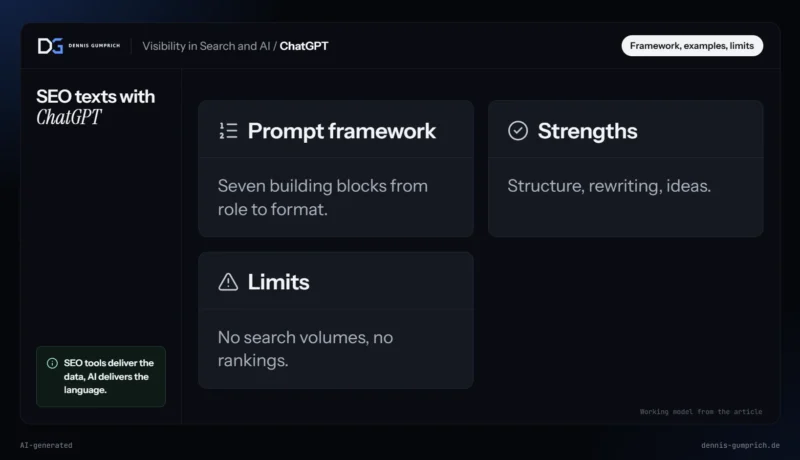

The prompt is the new briefing. Write it carelessly and you get careless texts.
Whether SEO texts written with ChatGPT are any good depends less on the model than on the context you provide. If you specify role, context, goal, task, example and format, you get usable drafts. If you only name a topic, you get the average of all texts on that topic. That is not a weakness of the model, but a gap in the briefing.
Two questions, two articles: this article is about how to write better SEO texts with ChatGPT and which SEO tasks the model can take on. If you want to know how your content appears in ChatGPT itself, often searched for as "SEO for ChatGPT", the answer is in SEO for ChatGPT: how content gets cited in AI answers.
Why do AI texts sound generic?
In practice, there are almost always the same three causes, and none of them lies with the model.
- No context. The model does not know who you are, who you are writing for and what you have already published. Without this information, it averages over everything it knows about the topic.
- No example. "Write professionally" is not an instruction, but a wish. A real text of yours as a template changes the result more than any description of tone.
- One step instead of several. If you ask for research, outline and full text in one prompt, you get mediocrity in all three.
The good news: all three causes can be fixed in half an hour.
How do you build a prompt that delivers usable texts?
With a framework of seven points that starts with the role: not "you are an expert", but specifically function, field and target group. The context follows. Not every point is necessary for every task, but the more important the result, the more complete the briefing should be. The framework works regardless of the model because it relies on complete information.
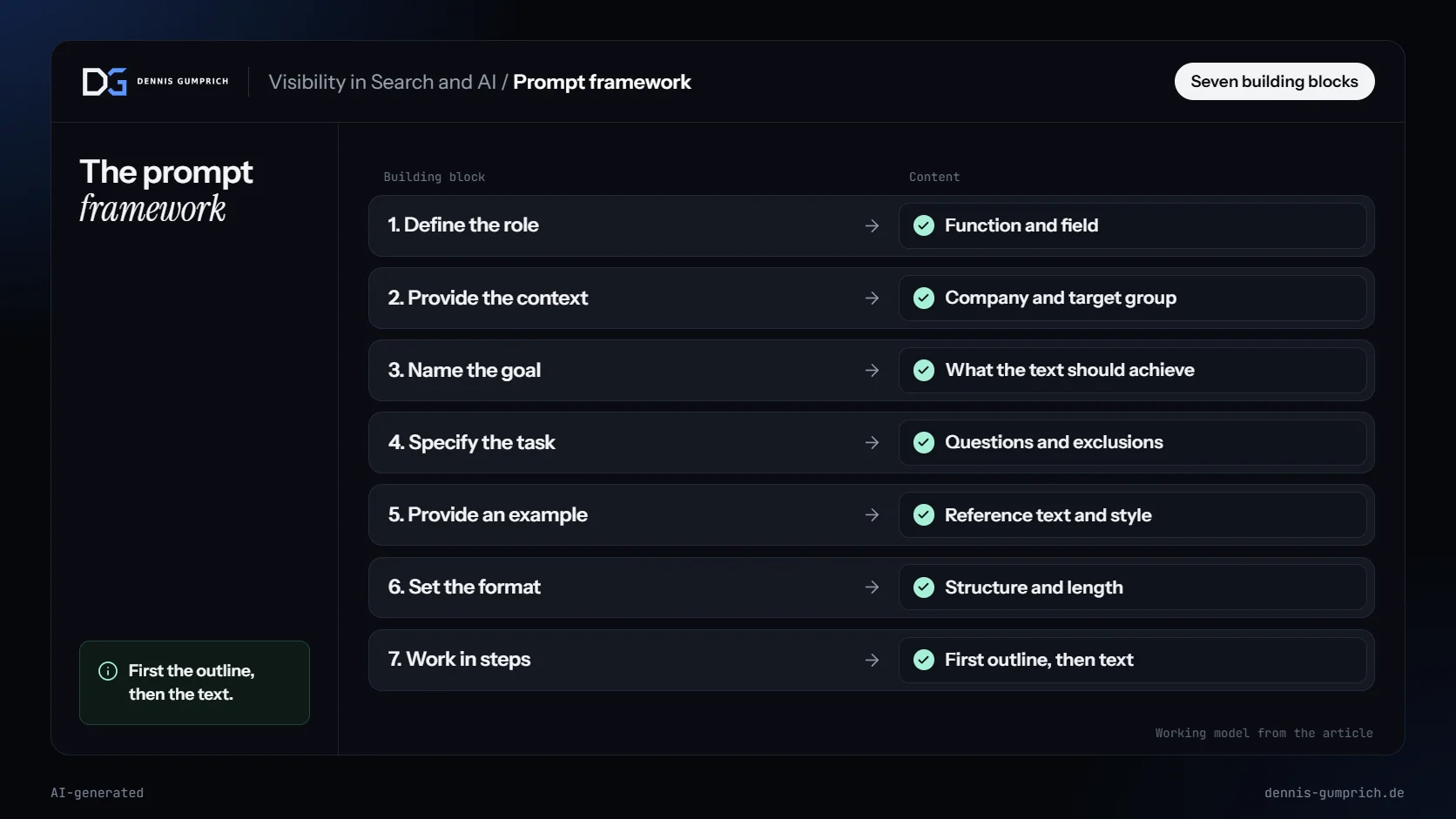
- Point 1Define the roleIn which function should the model work? Not "you are an expert", but specifically: "You are a specialist editor for technical B2B content in mechanical engineering and write for purchasing managers."
- Point 2Provide the contextWho is your company, what do you sell, who reads this? The more precise the target group, the fewer platitudes. "Marketing managers in mid-sized companies" is better than "companies", and "Head of Marketing in manufacturing companies with 200 to 2,000 employees" is much better.
- Point 3Name the goalWhat should the text achieve? Visibility for a specific keyword, trust with a specific role, or a concrete action? A text without a goal becomes pleasing instead of effective.
- Point 4Specify the taskExplain the task the way you would explain it to a new colleague on their first day. Which aspects belong in it, which explicitly do not, which questions should the text answer?
- Point 5Provide an exampleThe most effective single lever. Attach one of your successful texts and say what is good about it: sentence length, structure, handling of technical terms. Two examples work better than a long style description.
- Point 6Set the formatOutline with subheadings, bullet points, table or running text? Length in words, not characters. Without a format, you spend the time you saved on restructuring.
- Point 7Work in stepsFirst the outline, check, correct. Then section by section. The effort feels higher but is lower, because you catch mistakes early instead of in the finished text.
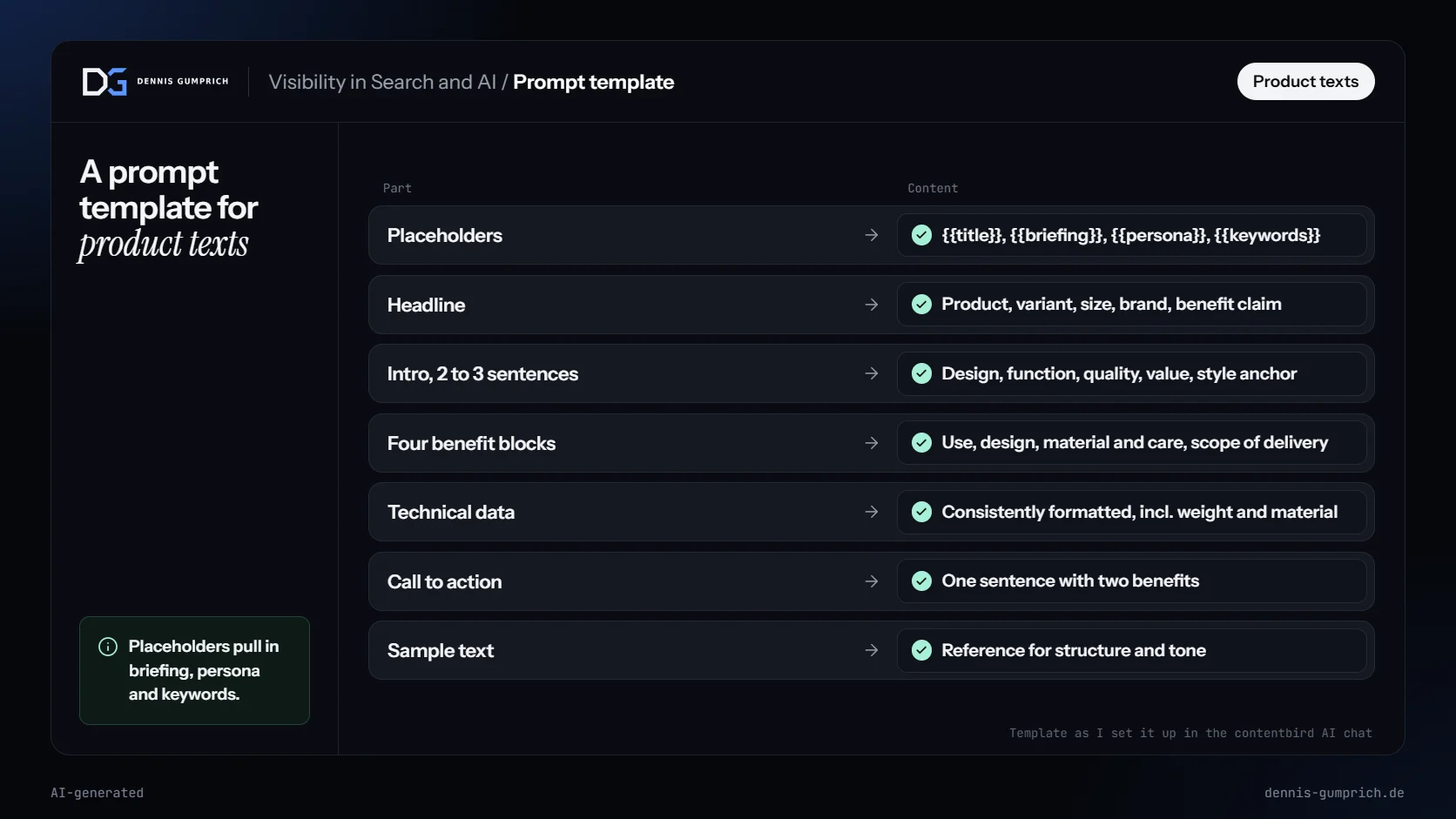
"Write me an SEO blog post about editorial planning, about 1,000 words, professional tone."
"You are a specialist editor for content operations and write for Head of Marketing roles in manufacturing companies with 200 to 2,000 employees. Goal: visibility for the search query 'editorial calendar Excel limits' and trust among readers who are preparing a budget. The text should answer three questions: how do you recognize the tipping point, what does the status quo cost, when does Excel remain sensible. Do not cover: tool comparisons. Follow the structure and sentence length of the attached sample text. First deliver only the outline with subheadings."
Three prompt examples for typical SEO tasks
The framework also applies to smaller SEO tasks. Three examples you can use directly:
- Example 1Write a meta description"Write three variants of a meta description for the attached article. Search query: [keyword]. Each variant has 140 to 155 characters, names a concrete benefit and uses no superlatives. State the character count for each variant. Do not use figures that are not in the text."
- Example 2Check search intent"Here are the subheadings of the five top-ranking articles for the search query [keyword]: [inserted]. Which questions do all five answer, which only some, which none? Output the result as a table. Do not evaluate quality, only coverage."
- Example 3Tailor a section to a search question"Revise the following section so that the first two sentences answer the question [question] directly. Keep all facts and do not add new ones. Shorten to a maximum of 120 words and mark every statement that needs a source with [CHECK SOURCE]."
Instant or Thinking: what changes when prompting?
For drafts and rewrites, the fast mode is usually enough; for comparisons and analyses, the thinking mode is worth it. The prompt framework stays the same in both cases, only the weighting of the points shifts. In ChatGPT, you choose between Instant for fast answers, Thinking with several reasoning levels and Pro for particularly difficult tasks. Instant can automatically use more thinking time for complex requests. The model names behind them change every few months, but the division of labor remains.
For the thinking mode, OpenAI recommends in its guide to reasoning models keeping instructions simple and direct, avoiding prompts like "think step by step", separating different parts of the input with section markers and describing the goal very concretely. Examples are not a mandatory component there; the recommendation is to test without an example first. For the framework above, this means:
| Task | Mode | What you adjust in the prompt |
|---|---|---|
| Draft, rewrite, meta description | Instant | Use the full framework, provide a sample text for tone and sentence length |
| Outline for an expert article | Instant or Thinking | Name goal, questions and exclusions precisely, outline and full text in separate prompts |
| Compare coverage of the top-ranking pages | Thinking | Separate material with section markers, state the output format and success criterion, do not prescribe how to think |
| Review an existing article with Search Console data | Thinking | Attach data as a table, have every conclusion backed by the corresponding data row |
The point "work in steps" from the framework does not contradict this. It means separate work steps with your review in between, that is, first the outline, then the sections. What OpenAI advises against for the thinking mode is something else: prescribing in the prompt how the model should think internally. For tone and sentence length, a sample text of your own remains the most effective tool even in thinking mode, because style is hard to describe.
How do you write SEO texts with ChatGPT?
SEO texts with ChatGPT are created in five steps, and the model takes on only two of them. You define the search query and search intent based on data, ChatGPT takes on outline and wording, and review and snippet stay with you. This division of labor is exactly the difference between a text that can rank and an interchangeable one.
- Step 1Define the search query with dataChoose the search query based on search volume and your own Search Console, not on a ChatGPT suggestion. The model knows neither volumes nor your current positions.
- Step 2Clarify search intentGive ChatGPT the subheadings of the top-ranking pages and have it compare coverage, as in example 2. This shows you which questions the text must answer and where you can contribute something of your own.
- Step 3Outline with the 7-point frameworkBriefing according to the framework above, and the result is only the outline. Each H2 answers a concrete question, and the search query appears in the first heading and the first paragraph.
- Step 4Write section by sectionEach section starts with a direct answer in two sentences and is understandable on its own. This helps readers, Google and AI search alike.
- Step 5Check, link, write the snippetVerify facts, add internal links to suitable articles, draft title and meta description with example 1 and choose the strongest variant. Only then does the text go live.
A common misconception is controlling keyword density via the prompt. If you specify "use the keyword five times", you get texts that sound exactly like that. What matters is that the text fully answers the questions behind the search query. Which criteria apply before publication is described in the checklist for AI texts.
The same applies to length. In its guide "Creating helpful, reliable, people-first content", Google explicitly lists writing to a supposedly preferred word count among the warning signs. According to Google, no such word count exists. The same list includes mass production, mere summarizing, topics picked up only because of a trend and artificially updated dates. So use the length in the briefing as guidance for the scope of the answers, not as a target the text must reach. One limitation: this is a Google platform guideline, not an analysis with its own data.
- Never as a one-prompt solution, but in separate steps. First, a research agent creates the briefing and first draft from fixed sources: studies, keyword data and questions from prompt monitoring. Then I set the focus keyword, a separate SEO agent revises, and after that the GEO check and the expert review run. I most recently set this up for a manufacturer of dietary supplements.
- One data package per text. An Excel file with 60 URLs makes the model unsure which row applies. A briefing with a few named fields delivers more reliable texts: focus keyword, secondary keywords, semantic terms, questions and brands.
What else can you use ChatGPT for in SEO?
For ten recurring SEO tasks where you provide the data and the model sorts, words or compares. The rule from the suitability table further down applies here too: figures come from Search Console or an SEO tool, and ChatGPT only works with what you give it.
| Use | What you provide | What to watch out for |
|---|---|---|
| 1. Title tags in variants | Article, search query, titles of the five top-ranking pages | Have the character count output, search query first, no promise the text does not keep |
| 2. Meta descriptions | Article and search query | See example 1, no figures that are not in the text |
| 3. Snippet analysis with few clicks | Title, meta description, position and click-through rate from Search Console, titles of neighboring results | A good position with a very low click-through rate points more to a weak snippet than to a weak text |
| 4. Answering questions from Search Console | Export of the search queries for a page | Only include questions that fit the article. What needs its own answer becomes its own article |
| 5. Reviewing an existing article | Text plus search queries with impressions and position | Have search queries without a matching section marked. Whether you add or rewrite is your decision |
| 6. Keyword clusters by search intent | Keyword list with search volume from your SEO tool | Cluster by the question behind it, not by word similarity. Never let the model estimate volume |
| 7. Internal linking | List of your URLs with titles, plus the new article | Have link targets and anchor texts suggested, check every URL before adding it, because models can invent addresses |
| 8. Drafting structured data | Page content and desired type, for example Article | Only mark up what is visible on the page, and check with Google's Rich Results Test |
| 9. Alt texts for images | Image and its purpose in the article | Describe the image content, do not stack keywords |
| 10. Mapping redirects for a relaunch | Old and new URL lists with titles | Suggestion as a table, spot-check mappings. Without a suitable target, better leave it open than redirect to the homepage |
In practice, uses 3 to 5 bring the most because they are based on your own data and reveal gaps no competitor knows about. For structured data, Google explicitly requires that it accurately reflects the content of the page and does not mark up content invisible to readers. How to set up a relaunch as a content process is described in Website relaunch: clarify the content process first, then the CMS.
Where does ChatGPT help in the SEO process, and where not?
A language model is a text tool, not a data tool. This distinction spares you most disappointments.
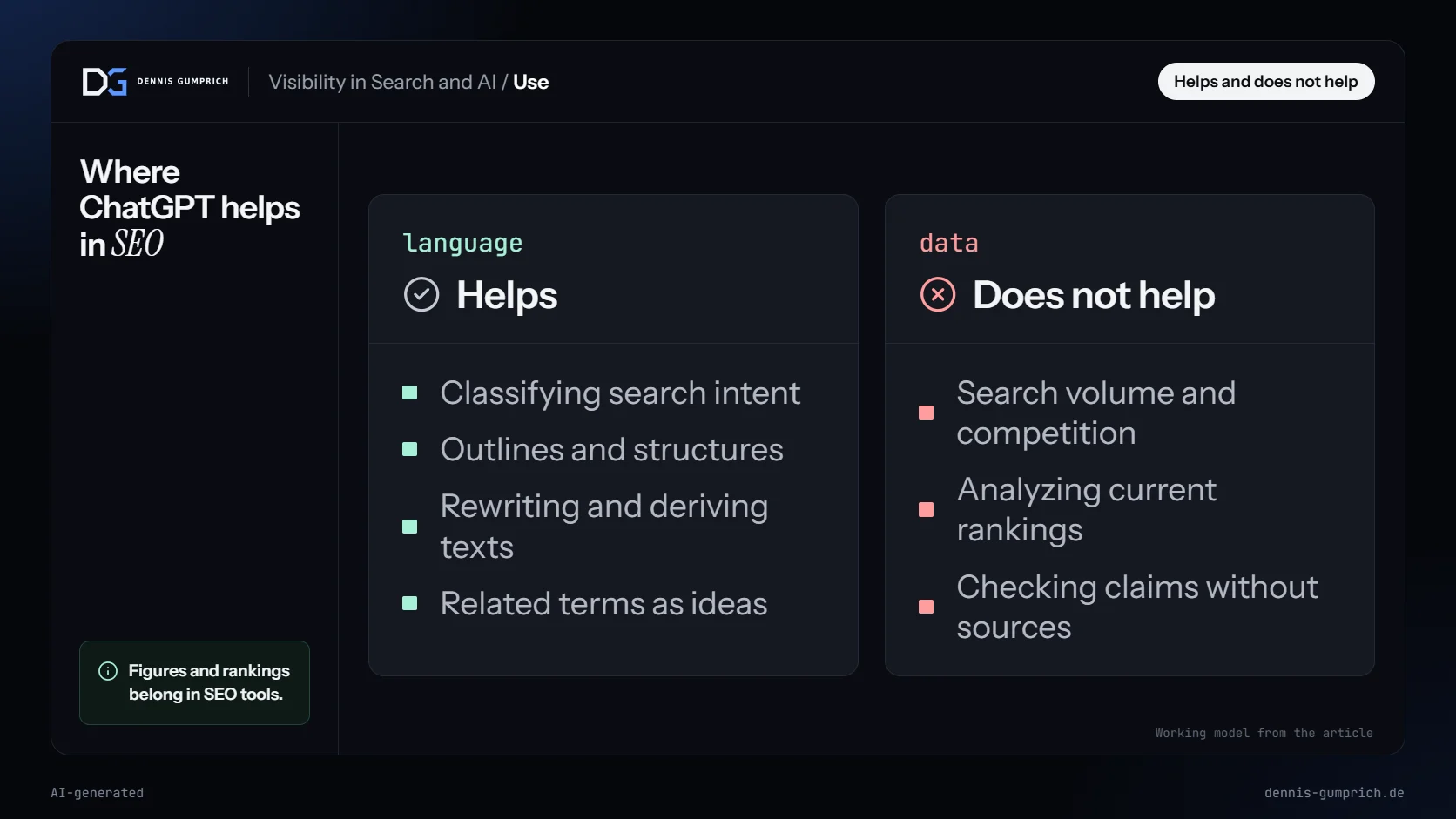
| Task | Suitability | Reason |
|---|---|---|
| Classifying the search intent behind a keyword | good | A linguistic interpretation task, not a data question |
| Drafting outlines and text structures | good | Pattern work, which models are strong at |
| Rewriting, shortening, deriving existing texts for channels | good | The facts are fixed, it is about form |
| Collecting semantically related terms | usable | Fine as a list of ideas, prioritization needs data |
| Search volume and competitive data | unsuitable | For this you need an SEO tool with its own database |
| Current rankings and competitive analyses | unsuitable | Unreliable for systematic analyses even with web search |
| Verifiable expert claims without sources provided | unsuitable | Risk of invention. Provide sources or check every claim |
Self-check: how solid is your setup?
Tick what applies to how you currently work with AI texts.
- With facts. The model invents brands, dimensions, materials, standards and product features when they are missing. If a piece of information is missing, the section has to go.
- With mandatory terms. In a real test, only a quarter to a third of the specified semantic terms made it into the text, and the brands were missing completely. That is why I compare against the briefing list after every generation.
- With keyword placement. The strongest AI signal in texts: keywords pasted raw from the spreadsheet, such as "white trousers women elegant", instead of shaped grammatically like "elegant white trousers for women".
Taking visibility in AI search systems into account
Since AI-generated answers have become widespread in search engines and assistants, the question has shifted. It is no longer only about appearing in a list of results, but about being cited in a generated answer. How an AI draft becomes a citable text is described in From AI draft to citable text.
What helps is largely the same as good expert writing, but with a different emphasis:
- Self-contained answer paragraphs. A section should be understandable even when read in isolation. Avoid back-references like "as described above".
- Clear subject-predicate statements. "An editorial calendar in Excel works for up to about three people planning" is citable. "It depends" is not.
- Figures with time period and origin. A figure without a date and source is more likely to be ignored than adopted.
- Tables for comparisons. Structured comparisons are reproduced correctly more reliably than running text.
- Definitions early in the text. If you explain a term before using it, you are more likely to be used as a source for that term.
Note: how exactly individual systems select sources is not publicly documented and changes constantly. The points above are derived from how generative answer systems work, not confirmed ranking factors. In detail: Visible in ChatGPT, Perplexity and AI Overviews. How to anchor these rules in the team is shown in Embedding GEO in the content process.
Prompt template: expert article, step 1 of 2 (outline)
Role: You are a specialist editor for [subject area] and write for [specific role] in [industry, company size].
Context: We are [company], we [offering in one sentence]. Our readers typically face the following problem: [problem in your own words].
Goal of the text: [visibility for search query X / trust with role Y / preparation of an internal decision].
Task: The article should answer these three questions: [question 1], [question 2], [question 3]. Explicitly do not cover: [exclusion].
Example: Follow the structure, sentence length and handling of technical terms in the attached text. What is good about it: [two to three concrete points].
Format: Outline with H2 and H3 headings. Each heading must answer a question or make a statement, no one-word headings. Target length of the later text: [number] words.
Important: In this step, deliver only the outline. Do not invent figures, studies or quotes. Where you think a source is needed, mark the spot with [CHECK SOURCE].
Five mistakes when working with ChatGPT
- Adopting figures and studies uncheckedLanguage models produce plausible details even if they do not exist. Every figure, every quote and every source reference must be verified before it is published.
- Uploading company data to unvetted accountsCustomer lists, strategy papers or draft contracts in a privately created account are a data protection issue. Clarify the contractual situation and training use before uploading sensitive content.
- Publishing the first draftAn AI draft is a working basis, not a finished text. The value lies in starting with a rough structure instead of an empty document.
- Not sharing promptsIf everyone uses their own wording, the team has no learning curve. Create a shared collection, even if it is just a shared document.
- Blaming the model for poor qualityBefore switching to another tool, check context, example and sequence of steps. In most cases, that is where the cause lies.
Transparency note: I work as a Senior Consultant at contentbird, a provider of AI-assisted content software. Platforms of this kind let you store brand voice, personas and reference texts centrally, so the context does not have to be provided again in every prompt. For small teams, a shared prompt collection is often enough. The decision criteria are in the article on content marketing software for teams.
When ChatGPT is not the right tool
For content with legal or medical implications, where every wording has to be checked, the correction effort is often higher than the time gained. The same applies to very short texts, where the briefing takes longer than the writing.
Also unsuitable: anything based on your own non-public knowledge. A case report, a positioning or a strategic assessment cannot be generated, only worded after you have thought it through yourself.
Conclusion: the bottleneck is the briefing
Models keep getting better, but they will not learn to guess what you do not tell them. If you provide context, an example and a sequence of steps, you get usable drafts. If you name a topic, you get an average text. This rule applies today and will still apply at the next model change. Which market shifts are emerging alongside this is described in The AI opportunity for marketing and communications teams 2027.
Frequently asked questions
What does ChatGPT SEO mean?
The term has two meanings. Usually it means using ChatGPT for SEO tasks, such as briefings, outlines, drafts and meta data. That is what this article is about. The second meaning is SEO for ChatGPT, that is, how your content appears as a source in ChatGPT answers. There is a separate article on that: SEO for ChatGPT: how content gets cited in AI answers.
Does Google penalize content created with AI?
According to Google's publicly available quality guidelines, what matters is not how content is created, but its quality and usefulness. Content mass-produced primarily for search engines without independent added value is problematic. A carefully created expert article in which AI was a tool in the process does not fall into this category. Check the current status of the guidelines, as they are adjusted regularly.
Specifically, the spam policies for Google web search cover "scaled content abuse" regardless of how the content is created. As examples, Google names large numbers of AI-generated pages without added value and automatically rewritten or translated third-party content. If you use a prompt framework to generate dozens of nearly identical pages without added value of their own, you are in exactly this territory. So before every series, check what each individual page contributes.
Do we have to label AI content?
That depends on the content and the legal framework. The EU AI Act provides transparency obligations for certain AI-generated content, especially synthetic image, audio and video content. For editorial texts, the situation is more nuanced. Clarify the status that applies to you with your legal department before setting an internal rule.
Which model should we use?
For most editorial tasks, the difference between the leading models is smaller than the difference between a good and a bad prompt. More relevant than the choice of model are the contractual situation, data protection and whether your inputs are used for training. In ChatGPT, this means in practice: Instant for drafts and rewrites, Thinking for comparisons and analyses of data you provide.
How much time does AI realistically save?
This cannot be quantified seriously across the board, because it depends heavily on the type of text, the quality of the briefing and the review effort. The number only becomes robust when you measure it yourself: measure the pure processing time before and after for five comparable texts. Include the review time, otherwise you are making the savings look better than they are.
Which content do ChatGPT Search and other AI searches prefer to cite?
Self-contained answer paragraphs, tables, current dates and clearly recognizable authorship are easy to adopt. How to make content citable in a targeted way is shown in SEO for ChatGPT: how content gets cited in AI answers.
What role does competitor analysis play in content marketing?
It shows which questions on a topic are already answered well and where the gaps are. From this follows whether a new article can contribute something of its own or only repeat what is known. ChatGPT helps compare outlines and arguments if you provide the content, see example 2 above. The model does not reliably deliver search volume, rankings and competitive strength. That data comes from Search Console or an SEO tool.
How does your own brand become visible in AI chats without a large budget?
Mainly through mentions in sources that AI systems trust, and through your own content that clearly answers your target group's questions. The individual levers are described in SEO for ChatGPT.
Which prompt formula delivers precise marketing texts from ChatGPT?
A fixed formula of six building blocks: role, context, goal, task, example and format, supplemented by working in steps. The example has the strongest effect. A reference text of your own with two or three sentences on what is good about it changes the result more than any style description. The complete formula with a template is above in the section on the 7-point framework.
What belongs in an SEO text briefing for ChatGPT?
Search query, search intent, target group, the three to five questions the text has to answer, exclusions, desired structure and length, and a reference text. Search volume and competitive data also belong in the briefing, but they come from Search Console or an SEO tool, not from ChatGPT itself.
A better prompt saves minutes, a clean content process saves considerably more. What that means for your team and your volume can be calculated with the ROI calculator (in German), including a PDF for budget approval.
Where does your content process lose time today?
In 30 minutes, we look together at where unnecessary coordination, manual tasks, tool switching or repetitive content work cost you time today.
You get a concrete assessment of which tasks you can simplify, automate or organize better, and where AI and tools actually help instead of adding complexity.
Analyze your content process in 30 minutes Free of charge. You take away concrete starting points you can use internally right away.
Dennis Gumprich
Dennis helps marketing and communication teams fit generative AI into existing content processes without undermining quality, brand voice and approvals. Focus areas: content operations, AI governance and tool selection in mid-sized companies and corporations.
Transparency note: Dennis works for contentbird, a provider of AI-powered content software. Product mentions are marked in the article. More about Dennis (in German) · LinkedIn
Read more
Sources
- Anthropic: Prompt engineering documentation, section Use examples effectively, vendor documentation: examples as one of the most reliable ways to steer format, tone and structure. Accessed October 31, 2026.
- Google Search Central: Google Search's Guidance on Using Generative AI Content on Your Website, documentation, last updated October 1, 2026: using AI is permitted, mass-produced pages without added value fall under the spam policy on scaled content abuse, AI content must be manually fact-checked before publication. Accessed October 31, 2026.
- European Parliament and Council: Regulation (EU) 2024/1689 on artificial intelligence (AI Act), Article 50 on transparency obligations, applicable since August 2, 2026. Accessed October 31, 2026.
- OpenAI: Overview of OpenAI Crawlers, documentation: OAI-SearchBot for search in ChatGPT, GPTBot for model training, both controllable separately. Accessed October 31, 2026.
- Google Search Central: AI features and your website, documentation, last updated December 10, 2025: no additional requirements or special optimizations for AI Overviews and AI Mode, the usual SEO fundamentals apply. Accessed October 31, 2026.
- Google Search Central: Creating helpful, reliable, people-first content, documentation, as of October 7, 2026: warning signs such as mass production, mere summarizing, topics only because of trends, artificially updated dates and writing to a supposedly preferred word count, which according to Google does not exist. Platform guideline without its own data. Accessed October 31, 2026.
- Google Search Central: Spam policies for Google web search, documentation, as of September 2, 2026: scaled content abuse regardless of how content is created, with examples of AI for many pages without added value and automated rewriting or translation of third-party content. Platform guideline without its own data. Accessed October 31, 2026.
- OpenAI: GPT-5.5 in ChatGPT, help article: choice between Instant, Thinking with several reasoning levels and Pro; Instant can automatically use more thinking time for complex requests. Accessed November 1, 2026.
- OpenAI: Reasoning best practices, developer documentation: keep prompts for reasoning models simple and direct, avoid chain-of-thought instructions, use section markers, test without examples first, describe the goal concretely. Vendor documentation without its own measurement data.
- Google Search Central: General structured data guidelines, documentation, last updated September 16, 2026: structured data must accurately represent page content, content not visible to readers must not be marked up. Accessed November 1, 2026.
How this article was created
This article was created with the help of AI. Structure, research and draft wording were developed with AI support. Professional assessment, review of the statements and the final version are the responsibility of Dennis Gumprich. The English version was translated with AI and reviewed. Read the original German version.
How reliable are the statements?
Evidence exists for the effect of examples in prompts (Anthropic), Google's position on AI-assisted content and fact-checking, the transparency obligations under Article 50 of the AI Act, the function of the OpenAI crawlers and Google's classification of optimizing for AI features as ordinary search engine optimization, as well as Google's warning signs including the clarification that there is no preferred word count, and the spam policy on scaled content abuse (both platform guidelines without their own data). Evidence also exists for the modes in ChatGPT (OpenAI help), OpenAI's recommendations for prompting reasoning models (vendor documentation) and Google's guidelines for structured data. The 7-point framework, the suitability table, the prompt examples, the assignment of tasks to Instant or Thinking, the ten SEO uses and the notes on citability in AI search are working models and derivations from consulting practice, not confirmed ranking factors and not measured values. Update history: originally published February 10, 2025; fully revised August 5, 2026; supplemented October 4, October 11, October 30, October 31 and November 1, 2026. Next review planned for February 2027. Status: November 1, 2026.


