

of the surveyed companies in the German digital industry count AI among the trends with the greatest influence on budget decisions through the end of 2027.Source: Bitkom, Marketing im digitalen Wandel (in German), not representative
2026 was the year AI became routine in marketing without impact improving to the same degree. Most teams use AI, only a small share benefits measurably. The bottleneck is not the language models but the space between model and team: missing connected knowledge, AI in individual silos instead of in the process, and quality assurance that does not grow with output. For 2027 the recommendation is therefore: move away from individual experiments towards AI infrastructure. Teams that build it pull two ROI levers at once, less effort per piece and more impact through long tail, frequency and personalization. This is a leadership task, not a tool decision.
What did 2026 show about AI in marketing?
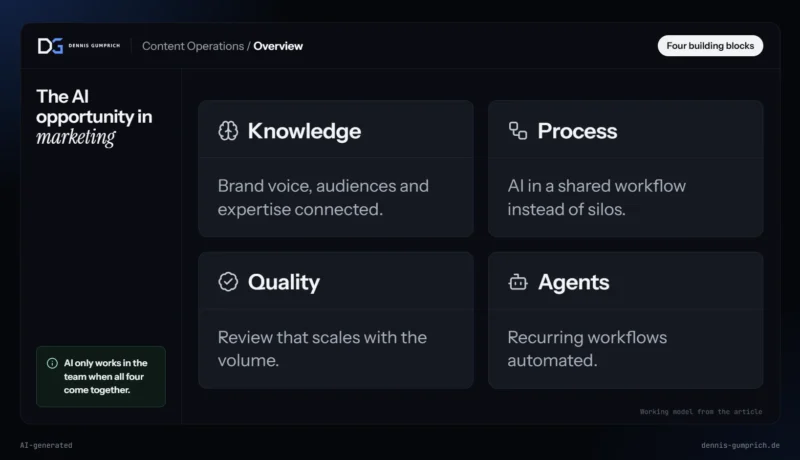
That usage and impact are two different things. AI has arrived in the daily work of most marketing and communication teams, but team results have rarely improved to the same degree. Five insights shaped the year, and all of them point in the same direction: the difference is not made in the model but in the foundation.
The fifth point in particular is often underestimated. How you arrive at a robust practice for labeling AI content and what has applied across the EU since September 27, 2026 under the EmpCo Directive on environmental claims is covered in separate articles. For 2027 planning, one consequence matters most: review rules belong in the process, not in the heads of individual people.
What do executive boards expect from marketing in 2027?
More impact with the same resources. Channels, content volumes and expectations are growing, teams are not. At the same time, the ROI expectation on marketing is rising: better results with the same resources, the same results with fewer resources, or external budgets that get scrutinized for efficiency.
I hear this situation almost every week in conversations with marketing and communication teams. The number of touchpoints keeps growing: website, shop, newsletter, LinkedIn, trade press, plus markets and languages. Every new channel gets added, none gets dropped. The budget for additional headcount rarely comes along.
This tension creates three challenges that occur together in almost every team:
These three are connected. Teams working in fragmented processes use AI wherever it happens to fit: in the chat window, for a single text, for a quick translation. That saves the individual time but changes neither the quality nor the impact of the team. This is why AI stays stuck in the experiment even though it is used every day. Usage has long been there. What is missing is the step from use by individuals to use in the process.
A survey by Bitkom, the German digital industry association, fits this reading. In the study "Marketing im digitalen Wandel" (in German), 74 percent of the 180 surveyed companies in the digital industry count AI among the trends with the greatest influence on budget and investment decisions through the end of 2027, and 84 percent among the trends with the greatest influence on marketing in Germany (multiple answers possible). At the same time, 54 percent each cite cost pressure and the automation of marketing processes as internal challenges, 35 percent a missing AI strategy and 34 percent insufficient integration of AI. The survey is not representative and covers companies in Germany only. For your budget round this means: expect AI to be on the agenda, and above all prepare the answer to how you will embed it in your workflows.
Where does the content process break today?
At four points almost every team knows: planning without a central place, approvals in silos, AI without shared quality control and existing content that is not reused. Each of these breaking points costs time. Together they prevent AI from having an effect beyond the single text.
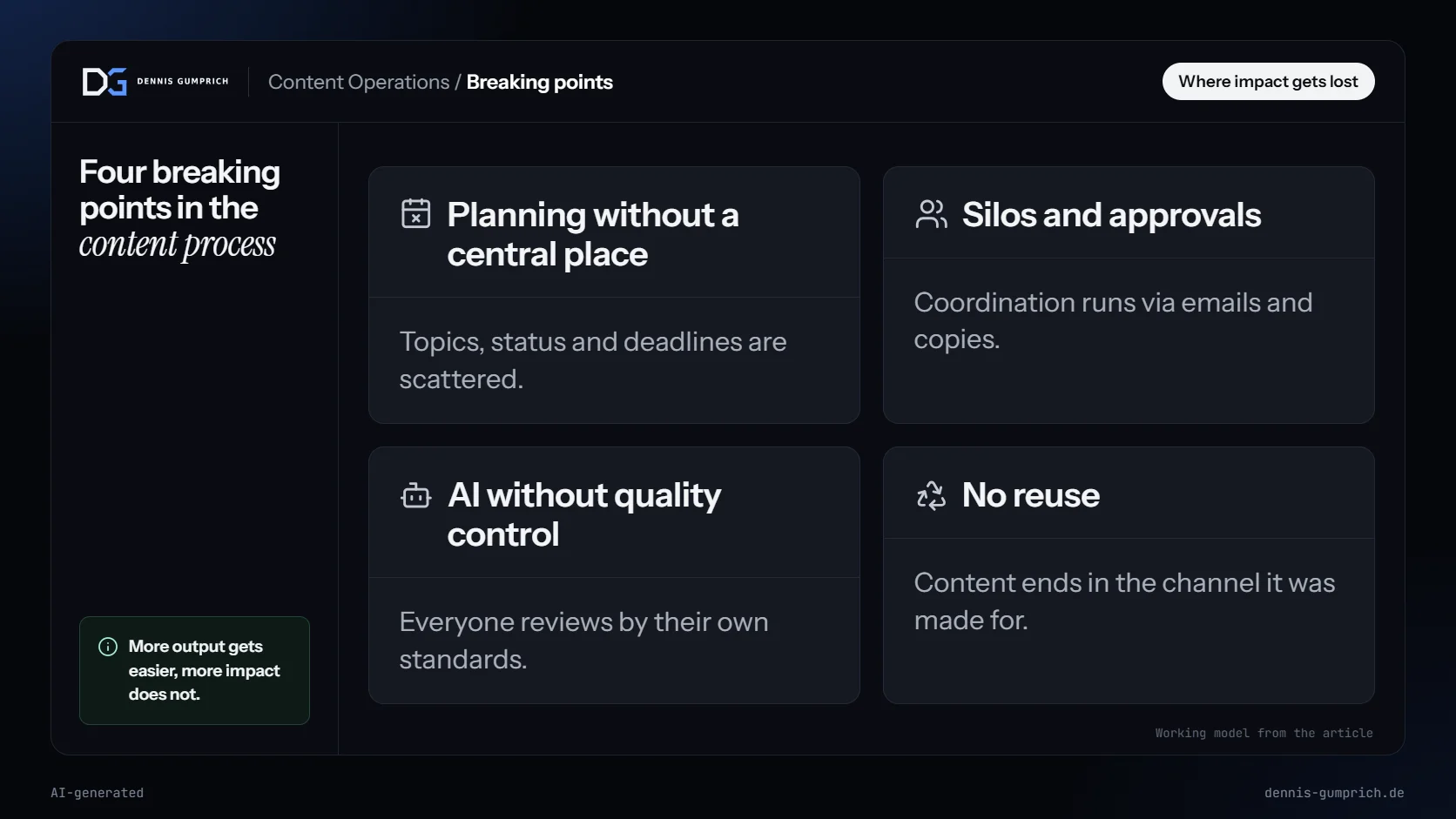
| Breaking point | What happens day to day |
|---|---|
| Editorial plan in Excel, no central place | Several versions, status by asking around, briefings in emails and folders |
| Silos and confusing approvals | Coordination by email, unclear responsibilities, waiting for subject matter experts and legal |
| Everyone uses AI differently, no quality control | Personal prompts, inconsistent brand voice, correction loops in review |
| Existing content is not reused | Good content disappears after first publication, knowledge gets worked out again and again |
None of these breaking points is new. What is new is that AI makes them more expensive. When producing a draft drops from three hours to twenty minutes, the bottleneck shifts entirely to planning, coordination and review. A team that used to coordinate ten pieces a month is now supposed to coordinate thirty, with the same emails and the same spreadsheet. That does not work.
Two of these breaking points have their own articles: why content planning in Excel hits its limits and how to shorten approval processes without giving up diligence.
Why is AI in marketing an ROI opportunity and not a cost-cutting program?
Because AI does not just lower the cost per piece, it makes initiatives economically viable that used to fail for lack of people. Marketing has always been measured by its ROI. What is new is how much ROI is now possible. Treating AI only as a cost-cutting program uses the smaller half of the opportunity.
Every marketing team knows three examples, and so far they have almost always failed at the same point: there simply was nobody to deliver them on a lasting basis.
| Initiative | Why it failed so far | What becomes possible now |
|---|---|---|
| Long tail | Pages for specific questions, variants and niches never had priority, there was no time for the volume | Capture unused demand: many specific pieces based on verified knowledge |
| Frequency | Serving touchpoints in all channels on an ongoing basis failed due to capacity and coordination | Continuous presence, because all channel versions come from one briefing |
| Personalization | Newsletters and landing pages per audience were too costly to produce and approve | Variants per persona and industry, with measurably higher conversion than the one-size-fits-all version |
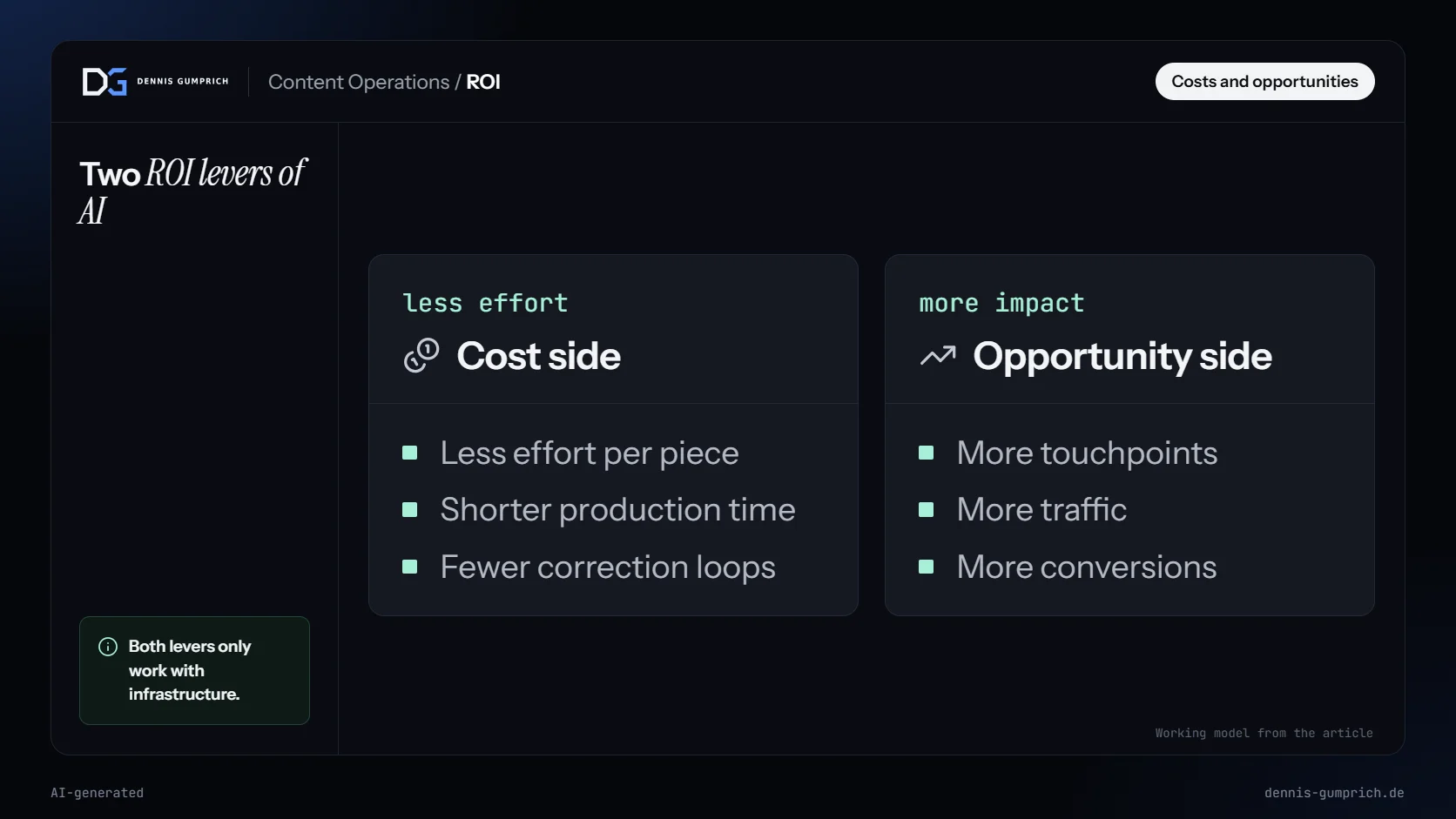
This results in two ROI levers that you should look at separately, because they are argued and measured differently:
In practice, almost always only the first lever gets calculated. That is understandable, because savings are easier to prove than additional revenue. But it leads to a false expectation: AI is bought as an efficiency project and measured after six months by how many hours were saved. How to translate both levers into a robust business case is described in Calculating the business case for content software.
A survey by the AI vendor Anthropic also suggests that the benefit of AI lies more in speed and scope than in savings. In the Anthropic Economic Index report "Cadences" from June 2026, large majorities of respondents report gains: 86 percent in speed, 82 percent in scope and 69 percent in quality. Only 27 percent cite savings on services they would otherwise have had to buy. The figures are self-reported, not representative and come from a vendor source analyzing the use of Claude. So include the second lever from the start instead of measuring AI mainly by saved external services, which only about a quarter of respondents mention.
What does the McKinsey 2026 study show about AI in marketing?
That budgets are growing, but only a small share of companies benefits. According to McKinsey State of Marketing Europe 2026 with 500 respondents, 72 percent are increasing their marketing budget relative to revenue, only 1 percent is cutting. At the same time, only 6 percent count as AI-ready, meaning mature in their use of generative AI. This group reports an average efficiency gain of 22 percent, the laggards barely any.
The study also shows where the additional money goes. AI-powered marketing comes first, classic content and creative production only far behind:
| Investment area | Share of respondents |
|---|---|
| Generative AI in marketing | 50 % |
| ROI measurement | 42 % |
| Consumer insights | 38 % |
| Digital media | 36 % |
| Content and creative production | 28 % |
More interesting than the budget split is the question why so few companies are AI-ready. The respondents' answer is clear, and it has little to do with the models:
| Bottleneck | Mentions |
|---|---|
| Technical infrastructure | 81 % of laggards |
| Adoption and scaling in the team | 65 % of laggards |
| Strategy for generative AI | 47 % of leaders |
| Operating model | 37 % of leaders |
Budget is not at the top in either group. That contradicts the common impression that AI in marketing fails because of money. It fails at the question of how knowledge, systems and workflows are connected so that AI works in the daily routine of the whole team. The gap between a 22 percent efficiency gain among leaders and a barely measurable gain among laggards is not a difference in tools but in foundations.
If the models are good enough, where is the bottleneck?
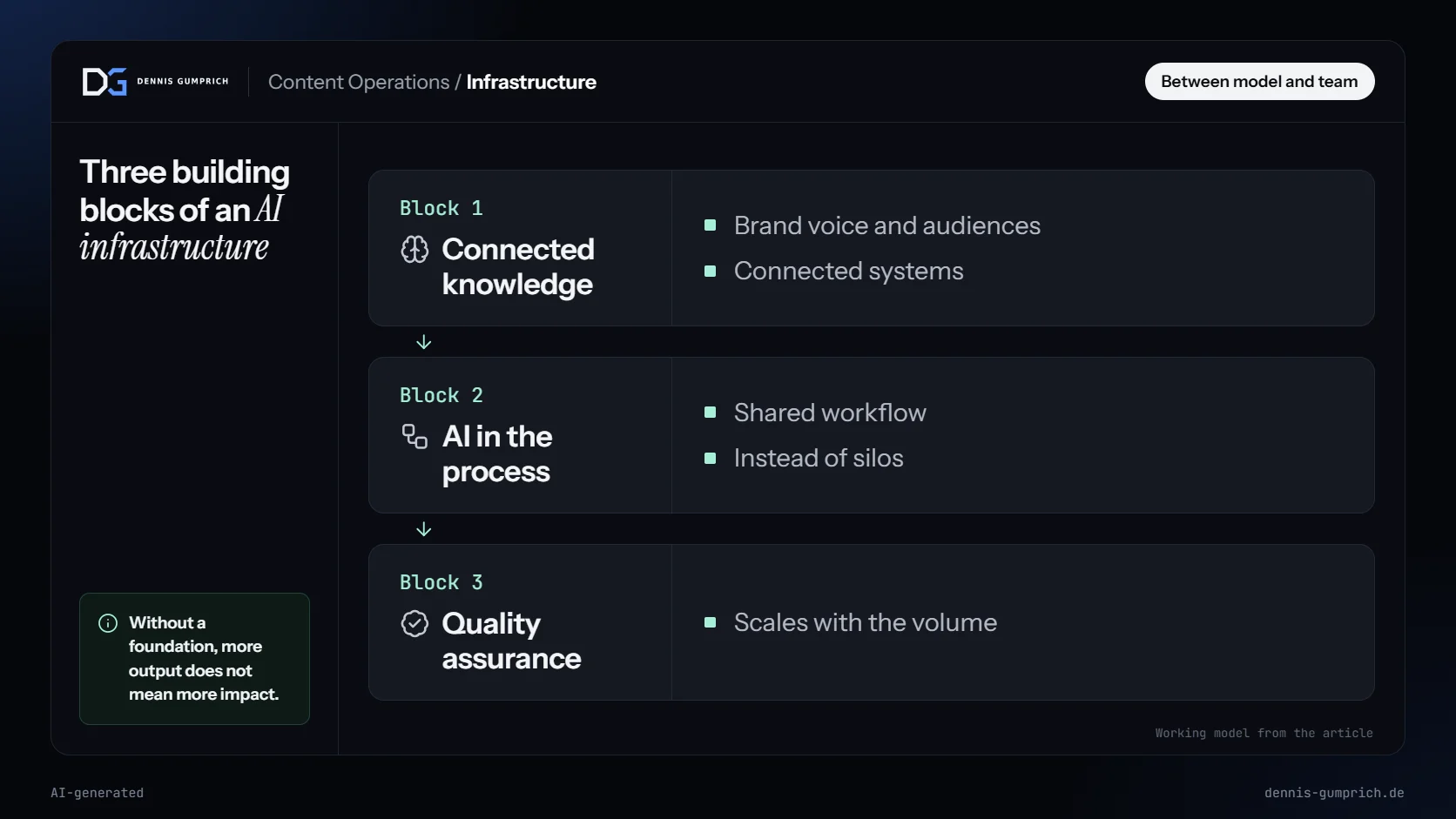
Between model and team. The infrastructure in between is missing: connected knowledge and connected systems, AI in a shared process instead of individual silos, and quality assurance that scales with the volume. Without these three building blocks, more output gets easier, but more impact does not.
This diagnosis shifts the discussion. Many teams are still waiting for the next model that will finally deliver on-brand texts. Experience shows something else: a current language model without context delivers generic texts, the same model with maintained brand voice, audience profiles and expertise delivers drafts that are ready for approval after a few corrections. The difference is not in the model but in what you give it.
The three missing building blocks in detail:
- Connected knowledge and systemsBrand voice, personas, product knowledge and approval rules are scattered across documents, heads and tools. The AI knows none of it until you store it centrally and machine-readably and connect the relevant systems.
- AI in the process instead of silosEveryone has their own chat and their own prompts. Results get copied, not handed over. As long as AI does not work where planning, briefing and approval happen, every gain stays individual.
- Efficient quality assuranceMore drafts mean more review effort. When review runs manually and by gut feeling, it becomes the new bottleneck and eats up the time saved in production.
Licenses for everyone, personal prompts, texts copied into Word and the CMS. Every draft starts without brand knowledge. Review depends on one person. Result: more output, same impact, more correction loops.
A shared knowledge base, AI in the planning and approval process, automatic checks against brand voice and strategy. Every draft starts with context. Result: less effort per piece and room for long tail, frequency and personalization.
How to prepare knowledge so that an AI can work with it is covered in Building a knowledge base: the context AI really needs. The options for connecting existing systems are described in MCP or API: how to connect your data.
Why is this a leadership task and not a tool decision?
Because nobody builds the infrastructure on the side. The editorial team produces, IT maintains systems, marketing management steers campaigns. The connection between knowledge, process and AI falls between responsibilities. It only comes about when leadership explicitly makes it their job.
For marketing decision-makers this means a change of role: from steering campaigns to building infrastructure. This is not an additional project alongside daily business but a shift in what leadership pays attention to. Three shifts are at the core:
| So far | In future | How you recognize it |
|---|---|---|
| Steering campaigns | Making knowledge usable for AI | Brand voice, personas and expertise are maintained centrally and flow into every draft |
| Leading teams | Leading an integrated process | Planning, production, approval and publishing run in one place instead of emails, spreadsheets and chats |
| Owning output | Owning frictionless quality assurance | Review criteria are defined and apply automatically, approvals run without follow-up questions |
The difference from classic tool selection is decisive. A tool decision answers the question of what you work with. The infrastructure question answers how knowledge, roles and review rules come together. Choosing the tool first and then looking for the process gets you another island. Clarifying first which knowledge must flow into every piece and who approves what lets you judge tools by whether they reflect these requirements.
Which four stages do content teams go through on the way to agents?
Four stages that differ in the share of human work: from the fully manual team through individual AI use and AI infrastructure to agents that handle recurring workflows on their own. At every stage, the human remains responsible for the decision. Most teams today are at stage two.
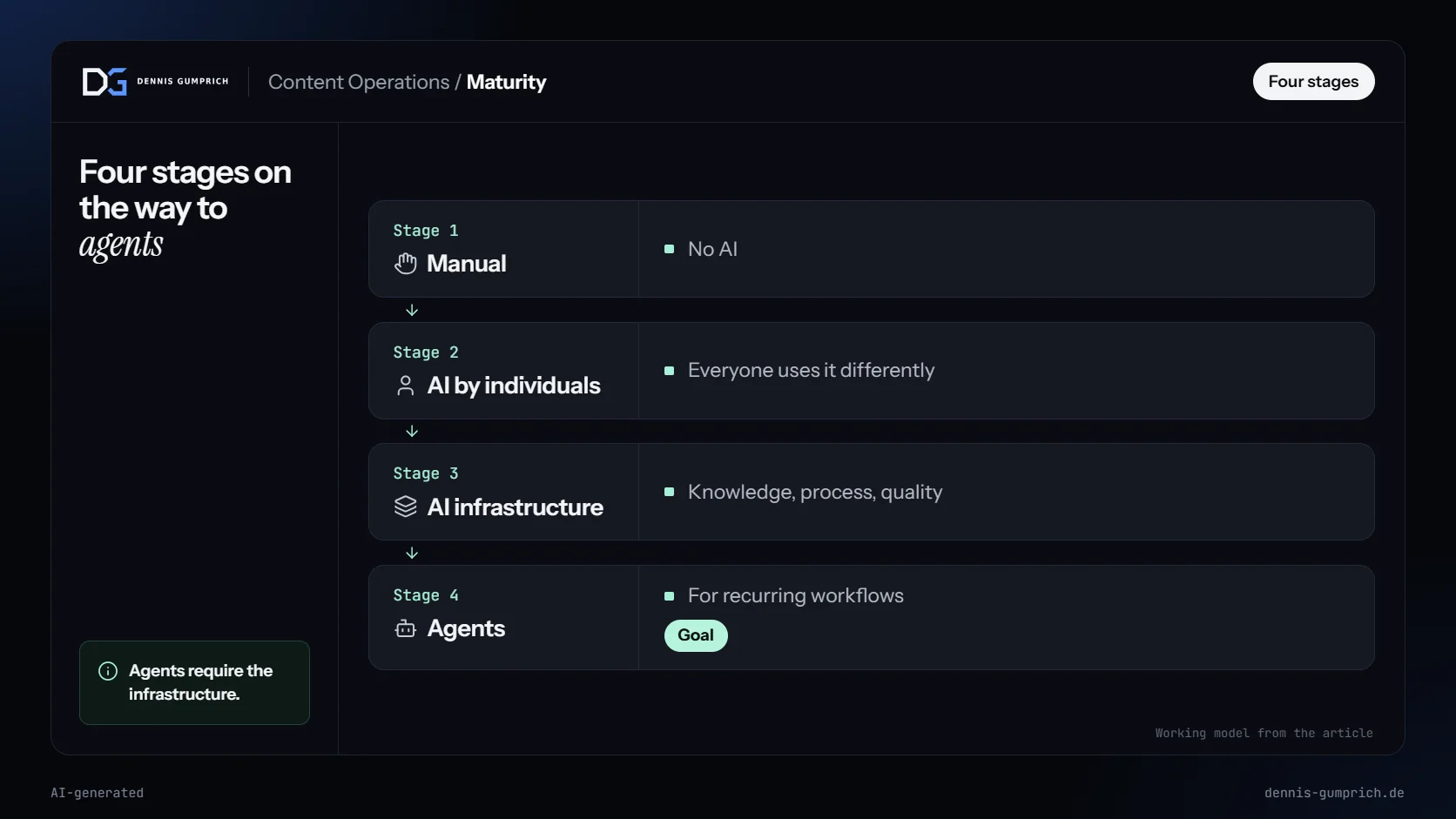
- Stage 1Human: 100 percent manualResearch, writing, translating, coordinating and publishing are done by hand. Quality depends on individual people, volume on team size.
- Stage 2AI: around 75 percent humanIndividuals use AI for drafts and translations. Time savings for the individual, but without shared context, without shared review and without effect on the team process.
- Stage 3AI infrastructure: around 50 percent humanKnowledge is stored centrally, AI works in the process, checks run automatically. This is where most of the ROI comes from, because both levers work at the same time.
- Stage 4Agents: around 20 percent human, the human decidesAgents take over recurring workflows from the source to the reviewed draft. People set goals, review results and approve.
The decisive point: stage four cannot be skipped. Agents without a knowledge base and without defined review rules automate exactly what already does not work at stage two, only faster. Anyone talking about agents today should therefore first ask whether stage three is in place. The percentages are reference values, not measurements for a specific team. They show the direction, not the target for every single task. What such a development looks like in one continuous example is shown in The 5 phases of AI transformation.
What "the human decides" means in concrete terms is especially important for communication teams. Statements about the company, figures, legally relevant wording and everything that touches reputation stay under human responsibility. Agents prepare, people sign off. What AI agents reliably take over today is described in AI agents in the content team. How to draw this line in daily work is covered in the pillar article Content operations with AI: from experiment to process.
How do roles change in a team of 10 to 20 people?
Teams do not necessarily get smaller, but the focus shifts from production to steering. The editorial team writes fewer raw texts and reviews more, marketing operations searches less for data and connects more systems, leadership chases fewer approvals and makes strategy binding.
| Role | Less | More |
|---|---|---|
| Editorial | Writing raw texts, translating, adapting formats | Briefing, reviewing, sharpening topics |
| Marketing operations and analytics | Searching for data, building reports manually | Making knowledge usable, connecting systems |
| Leadership | Chasing approvals, asking for status | Making strategy enforceable, resolving bottlenecks, automating routines |
For communication within the team, this point matters more than any technology. Announcing AI as a way to cut staff gets you resistance and hidden use. Showing that routine work goes away and more demanding tasks come in gets you cooperation. In the conversations I have, fear of losing one's own relevance is one of the most common reasons why AI stays at stage two. The competence teams really need for this is described in AI know-how in online marketing.
The shift needs clear responsibilities. Who maintains the knowledge base? Who defines review criteria? Who decides which workflows get automated? How to answer these questions in a role model is covered in the article on the four roles in the content team.
What does a content operating system that makes AI effective look like?
It consists of five layers that build on each other: organization, strategy and brand knowledge, topic planning, operational management and the individual content pieces. AI works on every layer, but only as well as the layers above it are maintained. The second layer decides on brand fit.
A simple order applies: people first. Then data and processes. Then AI. In three steps: connect, build, scale. The five layers show what needs to be connected and built:
| Layer | Content | Role for AI |
|---|---|---|
| 1 Organization | Projects, roles, integrations, templates, workflows | Defines who may do what and which systems are connected |
| 2 Strategy, brand voice, knowledge | Personas, goals, tone of voice, customer journey | Decides on the brand fit of every draft |
| 3 Topic planning | Main topics, subtopics, stories | Sets direction and context, prevents one-off pieces without strategy |
| 4 Operational management | Campaigns, editorial calendar, approvals, analytics | Makes status, responsibility and impact visible |
| 5 Content pieces | Channels, formats, editor, publishing | This is where output is created, fed by all layers above |
Most teams today invest almost exclusively in layer five: better prompts, faster drafts, new formats. Layers one to four remain scattered across spreadsheets, folders and heads. That explains why AI texts often seem correct but interchangeable. They lack what should sit on layer two. How to store your brand voice so that it applies in every draft is covered in a separate article.
The content treasure most teams do not use
An underestimated part of the second layer is the knowledge that already exists in the company but never flows into content. You could call it the content treasure of a company:
- Sales conversations and transcripts with the real questions and objections of prospects
- Support tickets that show where customers get stuck
- Product knowledge and data sheets
- Expertise in the team that rarely gets written down
- Existing articles and assets that disappear after first publication
- Webinars and presentations with ready-made lines of argument
From these sources comes content that achieves three things generic AI texts do not: visibility, because it answers questions that are actually asked; trust, because it contains your own experience and your own figures; and conversions, because it speaks the language of the audience. This applies especially to visibility in AI search, because original data and experience are among the strongest reasons a source gets cited.
One campaign, one briefing, all channels: where exactly does the ROI come from?
From coordination, not from writing. A single campaign with five channels and three markets results in 15 content pieces. With three approval stages, that becomes 45 coordination rounds. Brief once, approve once and then scale across all channels, and you save most of these rounds.
The following calculation is deliberately simple, because in almost every company with several markets it works out this way or similarly:
AI significantly reduces the effort for the 15 versions. The 45 coordination rounds remain, however, as long as every version runs through the same stages individually. The real lever is therefore to brief the core messages once, approve them once and derive the channel versions from them. Brand voice, expertise, approval rules, roles and channel requirements are always stored, so the derived versions do not need fundamental review again. AI stays under control because it works within these guidelines and not beside them.
Productivity gains then come from six places every team knows from its own daily work:
- no generic AI output, because every draft starts with brand knowledge
- fewer correction loops, because review criteria apply before approval
- no coordination by email, because status and comments are attached to the content
- no duplicate work, because existing content is found and reused
- less translation effort, because markets are served from one approved version
- fewer status questions, because progress is visible to everyone
The path from source to on-brand content always follows the same sequence: connect the source, generate a briefing, create a draft, check quality. Whether the source is a sales conversation, a product data sheet or a webinar makes no difference to the sequence. Exactly this repeatability later makes it suitable for agents.
What results can decision-makers expect?
Six that can be translated into numbers: shorter time to market, better predictability, protected reputation, higher budget efficiency, easier scaling and better accountability. The key is to define before the start how you will measure each result, so that the ROI is provable after six months and not just felt.
| Result | What changes | Possible metric |
|---|---|---|
| Shorter time to market | Days instead of weeks from idea to publication | Lead time per piece and per campaign |
| Better predictability | Workflows no longer depend on individual people | Share of on-time publications, resilience during vacation and sick leave |
| Protected reputation | Same rules for everyone, including agencies | Corrections after publication, returns from legal and brand |
| Higher budget efficiency | Less external effort for routine work | Cost per published piece, share of external budgets |
| Easier scaling | New brands, markets and channels without new headcount | Pieces per person, number of channels and markets served |
| Better accountability | Effort and impact per campaign visible | Effort and result per campaign in the same report |
The last row is the most important for budget discussions. If you can show for every campaign how much effort it cost and what it achieved, you negotiate budgets differently. The McKinsey figures show that ROI measurement is an investment priority at 42 percent of companies. Bringing this measurement with you gives you a head start in the next budget round. How such reporting is set up is described in Proving content impact: reporting and business case for communications.
Which recommendations apply for 2027?
Seven recommendations that build on each other: plan ROI across both levers, store brand knowledge centrally, bring planning and approval together, automate checks, unlock existing knowledge, brief once and publish everywhere, and only then use agents for recurring workflows. The order matters more than the speed.
- Recommendation 1Plan ROI across both leversDo not plan AI as a cost-cutting program but with a cost side and an opportunity side. Collect baseline values for lead time, cost per piece and impact per campaign now, so that at the end of 2027 you can prove what has changed.
- Recommendation 2Store brand knowledge centrallyBrand voice, personas, goals and product knowledge belong in a shared knowledge base that every AI draft accesses. This is the biggest single lever against generic texts.
- Recommendation 3Bring planning and approval into one placeOut of scattered spreadsheets and email threads. Only when status, responsibility and comments are attached to the content can AI work in the process.
- Recommendation 4Automate checks before approvalDefine what every piece is checked against: brand voice, strategy, audience, labeling and legally sensitive statements. What can be checked by rules is checked by the machine, what needs judgment by a human.
- Recommendation 5Unlock existing knowledgeSales conversations, support requests, product data and existing content are the best source for content that is not interchangeable. Connect the two or three most important sources.
- Recommendation 6Brief once, publish everywhereAlign and approve a campaign's core messages once, derive channel and market versions from them. This is where the biggest time saving lies, because coordination rounds disappear.
- Recommendation 7Use agents in a targeted wayChoose one recurring workflow, for example from a sales conversation to a reviewed draft, and automate it with an agent. Only once recommendations two to six are in place, and always with human approval.
Not every team has to fully implement all seven recommendations in 2027. Teams that manage the first four are already at stage three and have reached the part where most of the ROI comes from.
How do you get started with implementation for 2027?
Ideally still this year and in the order described: people first, then data and processes, then AI. In concrete terms, start with an inventory and clear responsibilities, then connect knowledge and workflows, and only after that roll out checks and automation. A first campaign serves as proof.
- Weeks 1 to 2Inventory and responsibilityWhere does your process break? Which of the four breaking points costs the most? Who owns the knowledge base, review criteria and automation? Without named people, everything else remains a side project.
- Weeks 3 to 6ConnectStore brand voice, personas, goals and product knowledge centrally. Bring the editorial plan into one place. Connect the two or three most important sources from the content treasure, for example sales conversations or product data.
- Weeks 7 to 10BuildDefine review criteria before approval and automate them. Simplify approval paths for campaigns: brief once, approve once, derive channel versions. Run one real campaign completely through this workflow.
- Weeks 11 to 13Prepare to scaleEvaluate the results of the pilot campaign against the metrics from the table above. Choose the first recurring workflow suitable for an agent. Update the business case for the budget round.
The most common mistake in this phase is starting with step three. Checks and automation without maintained knowledge create frustration, because they check generic results generically. Starting with the inventory also tells you which investment has the biggest effect.
Five mistakes on the way from AI license to AI infrastructure
- Selling AI as a pure cost-cutting programCalculating only the cost side means being measured by saved hours after six months and giving away the bigger lever on the opportunity side.
- Handing out licenses and hoping for adoptionIndividual use brings time savings for individuals but no impact in the team. Without shared context and process, AI stays at stage two.
- Delegating the infrastructure to ITIT can connect systems but cannot decide which knowledge belongs in every piece and who approves what. That is the job of marketing leadership.
- Introducing agents before the foundationWithout a knowledge base and review rules, agents only automate the existing chaos, and faster.
- Starting without metricsWithout defining beforehand how success is measured, you only have impressions instead of numbers in the next budget round.
When is it still too early for an AI content infrastructure?
When you publish only a few pieces a month in one channel, when basic questions about audience and positioning are still open, or when nobody has time to build and maintain the knowledge base. In these cases, individual AI use with good templates is the more fitting step.
An infrastructure pays off where volume, channels, markets or stakeholders drive coordination effort. A team of three with one blog does not need a content operating system with five layers. A team of twelve with five channels, three markets and an agency loses noticeable time and budget every month without this infrastructure.
It also takes time to build, especially in the first weeks. Storing brand voice and personas properly is content work that no software takes off your hands. Anyone who avoids this work will not achieve the results described in this article with any platform.
Disclosure
I work for contentbird. The platform maps the infrastructure described here with six AI building blocks: an AI knowledge base as the memory for brand voice and knowledge, an AI chat as the interface, AI-assisted creation for drafts, AI checks against strategy, topic, persona, human tone, GEO and your own guidelines, an MCP marketplace for connecting further systems, and content agents for automating recurring workflows. In projects, the basic setup with knowledge base, topic planning, imported editorial plan, defined audiences and first content pieces is usually in place after around four weeks. That is an experience value, not a promise for every team. The content work on brand voice and audiences stays with you.
Self-check: what stage is your content team at?
Tick everything that applies to you.
A short assessment of AI in marketing for our 2027 planning:
We already use AI every day, but each person on their own. That saves individuals time but changes neither the quality nor the impact of the team. According to McKinsey State of Marketing Europe 2026, only 6 percent of companies count as AI-ready. They report an average efficiency gain of 22 percent, the laggards barely any. The laggards' most common bottleneck is not budget but technical infrastructure.
Proposal: we build the foundation within 90 days. Store brand voice and audiences centrally, bring planning and approvals into one place, define review criteria before approval and run one real campaign on the principle "brief once, approve once, all channels".
We will measure lead time, cost per piece and impact per campaign, so that we can argue with proven numbers in the budget round.
Conclusion: 2026 brought usage, 2027 has to bring impact
The AI opportunity for marketing and communication teams is real, and it is bigger than the saving per text. Long tail, frequency and personalization become economically viable when AI does not run beside the process but within it. The models are good enough for this. What is missing is the foundation of connected knowledge, a shared process and quality assurance that grows with the volume.
Nobody builds this foundation on the side. It comes about when marketing decision-makers make it their job and keep to the order: people first, then data and processes, then AI. In short: AI makes content cheaper. Marketing's job is to make AI effective. That takes the infrastructure in between.
Frequently asked questions
What are the most important AI trends in marketing for 2027?
Fewer new models than new ways of working. AI moves from the chat window into the process, gets connected to CMS and other systems via standards such as MCP, takes over first recurring workflows through agents and is safeguarded by automatic checks. Add to that accountability: budgets flow where effort and impact per campaign can be proven.
What does AI-ready mean in marketing?
AI-ready marketing teams are those where AI is not just used by individuals but anchored in knowledge, systems and workflows. According to McKinsey State of Marketing Europe 2026, this applies to 6 percent of companies. This group reports an average efficiency gain of 22 percent, the laggards barely any.
How can the ROI of AI in marketing be measured?
Through two separate levers. On the cost side, you measure lead time, correction loops and cost per published piece. How to collect these values without time tracking is shown in Making content production measurable. On the opportunity side, you measure additional touchpoints, traffic and conversions from content that would not have been created without AI. Define the metrics before the start and collect a baseline.
Will AI make content teams smaller?
Not necessarily. In teams of 10 to 20 people, the focus mainly shifts from production to steering: fewer raw texts, translations and status requests, more briefing, review, system maintenance and strategic work. Many teams use the time gained for content that was never produced before.
When are content agents worthwhile?
When knowledge base, process and review criteria are in place and there are recurring workflows that always run the same way, for example from a sales conversation to a reviewed draft. Without this foundation, agents only automate the existing chaos. The human stays responsible for goals and approvals in every case.
Is building an AI content infrastructure an IT project?
Only to a small extent. IT connects systems and clarifies security and data protection. Which knowledge belongs in every piece, how approvals run and which review criteria apply is decided by marketing or communications leadership. That is why it is a leadership task and not just a tool decision.
Where do we start if we have little time?
With two things that cost little and work immediately. First: store brand voice, audiences and goals centrally, so that every AI draft starts with context. Second: name the breaking point that costs you the most time today, usually planning in spreadsheets or approvals by email. Everything else builds on that.
Where does your content process lose time today?
In 30 minutes, we look together at where unnecessary coordination, manual tasks, tool switching or repetitive content work cost you time today.
You get a concrete assessment of which tasks you can simplify, automate or organize better, and where AI and tools actually help instead of adding complexity.
Analyze your content process in 30 minutes Free of charge. You take away concrete starting points you can use internally right away.
Dennis Gumprich
Dennis helps marketing and communication teams fit generative AI into existing content processes without undermining quality, brand voice and approvals. Focus areas: content operations, AI governance and tool selection in mid-sized companies and corporations.
Transparency note: Dennis works for contentbird, a provider of AI-powered content software. Product mentions are marked in the article. More about Dennis (in German) · LinkedIn
Read more
Sources
- McKinsey & Company: Past forward: The modern rethinking of marketing's core (State of Marketing Europe 2026), report from November 20, 2025 with linked full text as PDF, 500 marketing leaders in Germany, France, the UK, Italy and Spain: budget plans, share of mature users of generative AI, efficiency gains (Exhibit 15), investment areas (Exhibit 11) and bottlenecks by leaders and laggards (Exhibit 17). Accessed October 31, 2026.
- Anthropic: Introducing the Model Context Protocol, announcement from November 25, 2024: open standard for connecting AI applications to data sources and business systems. Accessed October 31, 2026.
- European Commission: Code of Practice on Transparency of AI-Generated Content, FAQ, as of June 10, 2026: transparency obligations under Article 50 of the AI Act from August 2, 2026, transition period until December 2, 2026 for systems placed on the market before. Accessed October 31, 2026.
- Official Journal of the EU: Directive (EU) 2024/825 of February 28, 2024 (EmpCo Directive), Article 4: application of national transposition measures from September 27, 2026. Accessed October 31, 2026.
- Bitkom: Marketing im digitalen Wandel: Zwischen Effizienz, Automatisierung & Wettbewerb. Lagebild der Marketingpraxis in deutschen Unternehmen 2026 (in German), study by the German digital industry association (DOI 10.64022/2026-marketing, license CC BY 4.0), online survey of 180 digital industry companies from the Bitkom network, calendar weeks 44 to 50 of 2025: 74 percent count AI among the trends with the greatest influence on budget and investment decisions through the end of 2027, 84 percent among the trends with the greatest influence on marketing in Germany (multiple answers possible), internal challenges including 54 percent each for cost pressure and automation of marketing processes, 35 percent missing AI strategy, 34 percent insufficient integration of AI. Not representative. Accessed October 31, 2026.
- Anthropic: Anthropic Economic Index report: Cadences, report from June 26, 2026, including a user survey: gains in speed 86 percent, scope 82 percent, quality 69 percent, savings on otherwise purchased services 27 percent. Self-reported, not representative, vendor source relating to the use of Claude. Accessed October 31, 2026.
How this article was created
This article was created with the help of AI. Structure, research and draft wording were developed with AI support. Professional assessment, review of the statements and the final version are the responsibility of Dennis Gumprich. The English version was translated with AI and reviewed. Read the original German version.
How reliable are the statements?
The figures on budgets, investment areas, AI maturity, efficiency gains and bottlenecks are backed by the McKinsey State of Marketing Europe 2026 study with 500 respondents, the description of MCP by the Anthropic announcement, the start of labeling obligations by the European Commission, the application date of the EmpCo Directive by the directive text, the expectations about the influence of AI on budgets and the internal challenges by the 2026 Bitkom study (non-representative survey of 180 digital industry companies in Germany), and the self-reported gains from AI use by the Anthropic Economic Index (self-reported, vendor source). The review, recommendations, challenges, breaking points, stage model with its percentages, role change, calculation example on channels and coordination rounds, timeline and metrics are assessments and working models from consulting practice, not collected measurements. As of October 31, 2026.


