

Your management comes back from a trade fair and says: "We urgently need to do something with AI." Your marketing team consists of two people who are currently writing the post-fair newsletter and coordinating the catalog for next quarter.
Nobody in the room can say what "do something" means in concrete terms, who should do it and how you will know in six months whether it worked.
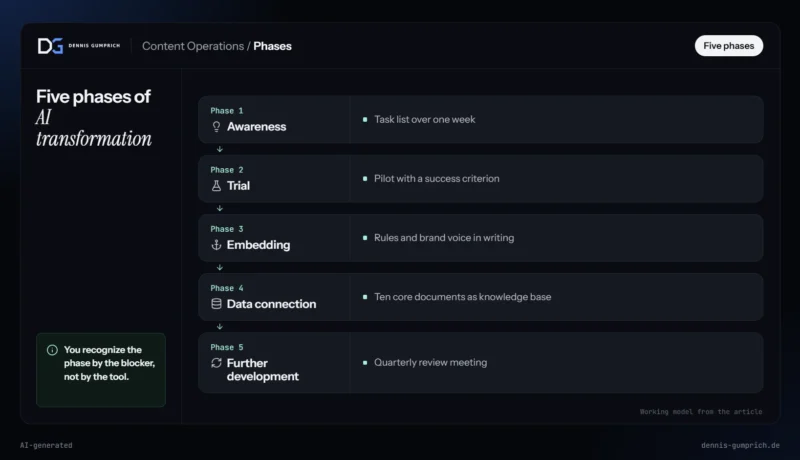
Introducing AI in marketing runs through five phases: awareness, trial, embedding, data connection and further development. Each phase has its own typical blocker. If you skip a phase, you usually fall back to it. The most important step is therefore not the most ambitious one, but the next one. Which market shifts set the framework for this is described in The AI opportunity for marketing and communications teams 2027.
This article uses one continuous example: the fictional Machinery Ltd., an engineering company with 120 employees, two people in marketing and a focus on trade fairs, print and personal customer contact. All details of this company are invented and serve as an illustration. They are not a case report and deliberately contain no invented result figures.
Phase 1: How do you create awareness in the team?
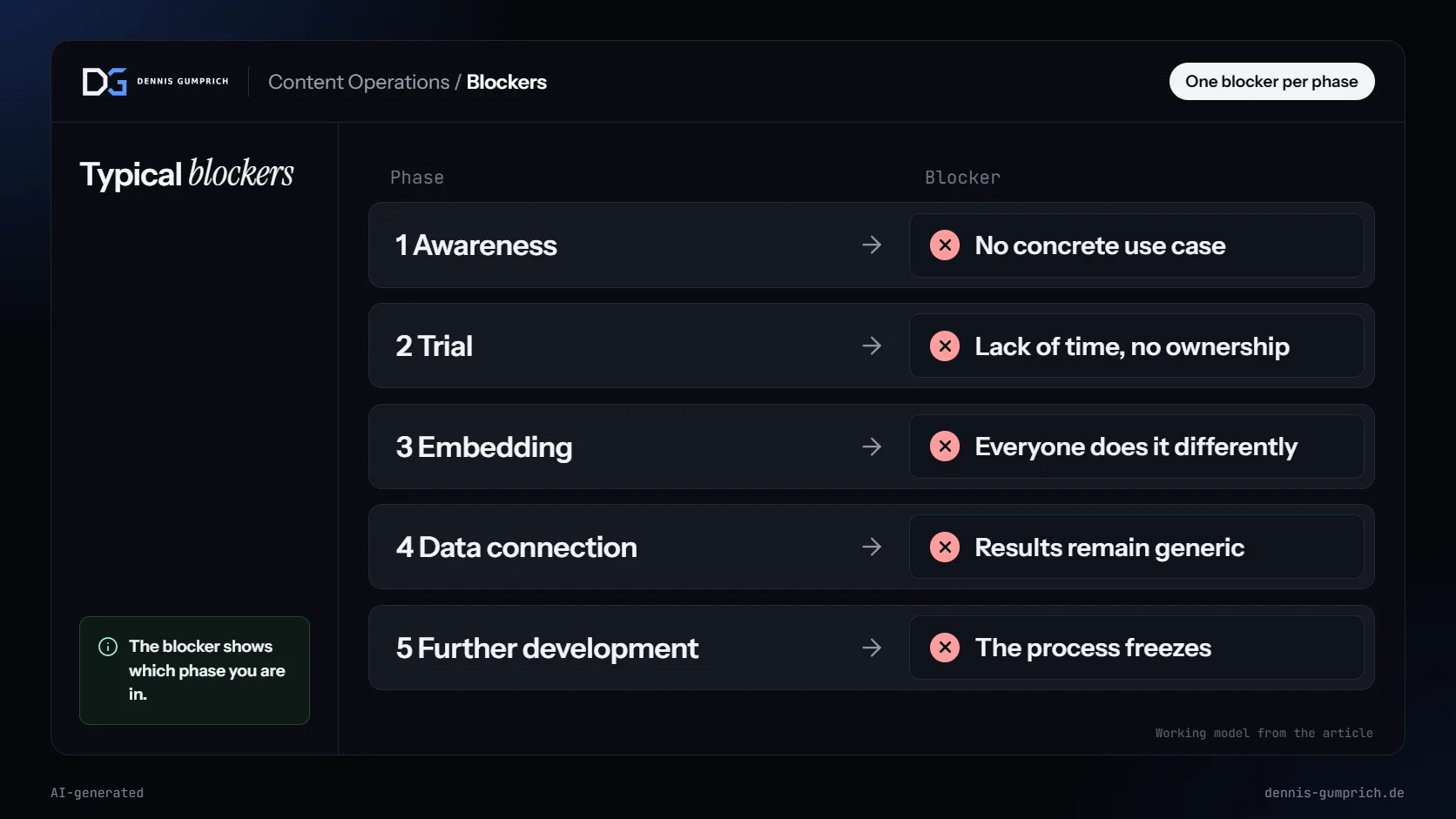
The typical blocker: AI is seen as a topic for corporations with their own data team. At the same time, expectations circulate that no tool can fulfill. Both lead to the same result: nothing happens. The same applies to the labeling question: waiting is not a decision. How to arrive at one is described in AI labeling: how to arrive at a robust practice.
At Machinery Ltd., this shows in meetings where AI is discussed, but nobody can name a concrete task it is supposed to solve.
The first sensible step is therefore not a tool selection, but a task list. For one week, collect every activity in marketing that is recurring, text-heavy and not very creative. Adapting product descriptions, varying trade fair invitations, summarizing minutes, translating catalog content. This list is your starting point. How to brief these tasks so that usable results come out is described in ChatGPT for SEO and content marketing.
That such tasks in particular are an obvious starting point is shown by an older association finding. In the "Digitalization level 2023" study (in German) by bvik, the German association for industrial communication, 42 percent of the 191 companies surveyed said they used AI in marketing, most often for content creation and translation. This is a historical value from 2023 and does not describe today's situation. But it shows what AI in marketing was already used for most often back then: recurring text work. For your task list, this means: product descriptions and translations belong at the very top.
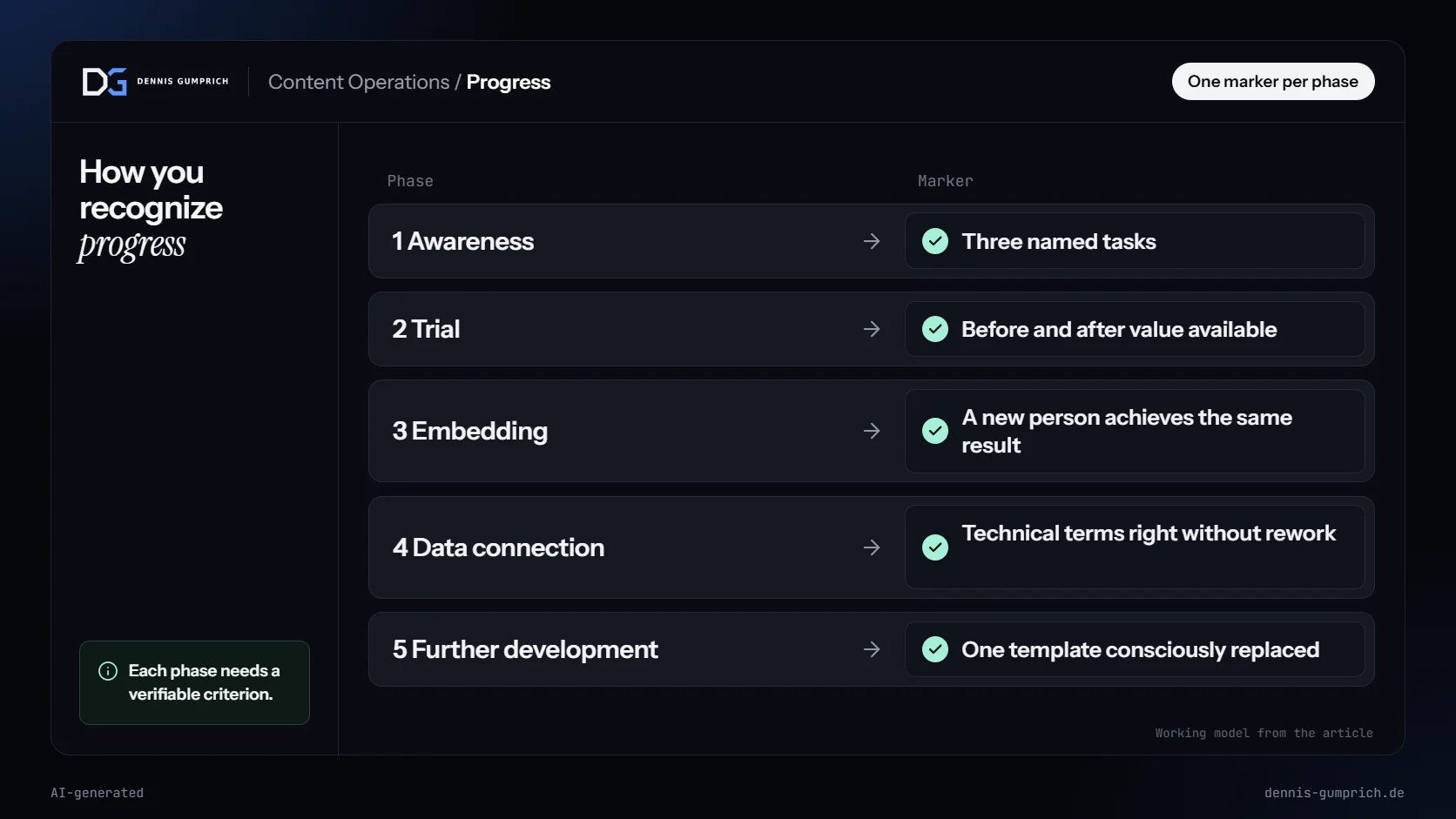
How you know you have moved on: you can name three concrete tasks where you want to try AI and explain why these in particular.
Phase 2: How do you trial AI on a small scale?
The typical blocker: after a workshop, nothing happens. Day-to-day business eats up the time, and nobody feels responsible.
The first sensible step is a pilot with a clear end point. Not "let's test AI", but: one task, one person, four weeks, one defined result. At Machinery Ltd., that could be: product descriptions for the twelve best-selling machines, one person responsible, the result evaluated together at the end.
What matters is that you define in advance what success means. Sensible measures are processing time per text including corrections, the number of correction loops and the team's assessment of technical quality on a simple scale.
How you know you have moved on: you have a before and after value for at least one task and can say where AI helped and where it did not.
Common mistake at this point: the time saving is calculated without the review effort. If a text is created in five minutes instead of thirty but needs forty minutes of correction, you have gained nothing. Always include the review time.
Phase 3: How do you embed AI in everyday work?
The typical blocker: after the first successes, each person uses their own tool in their own way. Different tones, scattered prompts and, in the worst case, a tool landscape IT knows nothing about.
The first sensible step is to define three things, each in writing:
- Where AI is used and where not. Example: drafts yes, published technical specifications no.
- Who approves. Every AI-assisted text needs a named human approval before it goes out.
- What your brand voice looks like. Two pages are enough: tone, forbidden phrases, two reference texts.
Add a shared prompt collection. A shared document is enough to start with. The purpose is not perfection, but that knowledge does not disappear in individual chat histories.
That these definitions are still missing in many companies is described in the bvik trend barometer for industrial communication 2026 (in German). According to the online survey of 282 participants, AI shapes all relevant B2B marketing trends, while many companies lack clear rules for using AI. Prof. Dr. Seon-Su Kim, who provides scientific support for the study, sees a remarkable gap between vision and implementation overall. The sample is small and from Germany, but the direction matches phase 3 exactly. For you, this means: the three written definitions are not a formality, but exactly the step where many teams get stuck.
How you know you have moved on: a new colleague could produce the same results as the existing team after half a day of onboarding.
Phase 4: Which data do you need to connect?
The typical blocker: results remain generic because the tool does not know your company. At the same time, the relevant information is scattered across catalogs, quotes, service reports and people's heads.
The first sensible step is more modest than the term data strategy suggests. Collect the ten documents that best reflect your expertise: technical data sheets, a good quote, the most frequent customer questions, your positioning. These ten documents are your knowledge base. Everything else comes later.
From here on, the data protection question becomes relevant. As soon as personal data comes into play, such as customer lists or service requests, you need a data processing agreement under Article 28 of the General Data Protection Regulation and an entry in the record of processing activities under Article 30. Involve data protection here, not later.
How you know you have moved on: the results use your technical terms correctly, and you need to do less follow-up research than at the beginning.
Phase 5: What do you keep developing?
The typical blocker: the process runs, but nobody asks anymore whether it is still the right one. Models change, tools change, and your templates stay the way they were two years ago.
The first sensible step is a fixed meeting. One hour once a quarter: what no longer works, what is new, which template needs revising. That sounds trivial and is the difference between a living process and a frozen solution.
How you know you have moved on: in the last six months, you have consciously discarded and replaced at least one template.
Which phase of AI transformation are you in?
You can tell by your current blocker, not by the tool you use. If a concrete use case is missing, you are in phase one. If it fails due to lack of time and missing ownership, in phase two. The following grid names the next step for each phase and the marker by which you recognize progress.
| Phase | Blocker | Next step | Marker of progress |
|---|---|---|---|
| 1 Awareness | No concrete use case | Task list over one week | Three named tasks |
| 2 Trial | Lack of time, no ownership | Pilot with end point and success criterion | Before and after value available |
| 3 Embedding | Everyone does it differently | Usage rules, approval, brand voice in writing | A new person achieves the same result |
| 4 Data connection | Results remain generic | Ten core documents as knowledge base | Technical terms right without rework |
| 5 Further development | The process freezes | Quarterly review meeting | At least one template consciously replaced |
Self-check: which phase are you in?
Tick what is already in place for you. The assessment appears immediately.
Subject: AI in marketing, proposal for a step-by-step approach
On the subject of AI in marketing, I propose an approach in manageable steps instead of one big project.
Step 1, one week: we record all recurring, text-heavy tasks in marketing and select three of them.
Step 2, four weeks: a pilot with one of these tasks. One responsible person, one defined success criterion. We measure processing time including corrections, the number of correction loops and technical quality from the team's point of view.
Step 3, afterwards: if the pilot holds up, we record three things in writing: where AI is used and where not, who approves, and what our brand voice looks like. Only then does the question of software arise.
Total effort in the first six weeks: an estimated half day per week for one person. We will involve data protection from step 3, as soon as our own company documents come into play.
What we avoid this way: a tool decision without a basis and uncontrolled use via private accounts.
Five mistakes that delay the transformation
- Starting with the tool selectionSoftware without a defined use case is bought, used briefly and then forgotten. The use case comes first.
- Starting several pilots at onceThree parallel attempts mean half attention three times over. One after the other is faster, even if it feels slower.
- Claiming success without a baselineWithout a before figure, every statement about time savings remains open to attack. And you lack the argument at the next budget discussion.
- Not including review timeThe most common calculation error. Faster drafts with higher correction effort are no gain.
- Involving data protection only at the endIf you notice in phase 4 that your knowledge base contains personal data and there is no contract, you lose weeks. Register the project early.
Transparency note: I work as a Senior Consultant at contentbird, a provider of AI-assisted content software. From phase 3 onwards, many teams face the question of a shared system in which brand voice, knowledge base and approvals are held centrally. Whether and when this pays off depends on your team size. The criteria are in the article on content marketing software for teams.
When this model does not fit
If your marketing consists of one person who decides everything anyway, phase 3 and the written definitions are disproportionate. Then two notes are enough: what you use AI for and what you never upload.
Getting started also makes little sense if your foundations are missing. Without a defined target group, positioning and topic planning, AI only speeds up the production of content that reaches nobody. These foundations do not come from technology.
And finally: if an ERP or CRM rollout is running in parallel, postpone the start. Otherwise you tie up capacity that is missing elsewhere.
Conclusion: the next phase counts, not the last one
Machinery Ltd. is invented, the sequence is not. Teams that make fast progress rarely differ in budget or affinity for technology. They differ in that they complete one phase after another instead of discussing phase 5 while still in phase 1.
Frequently asked questions
How long do the five phases take?
That depends heavily on team size and attention, less on technology. Six to eight weeks are realistic for phases 1 and 2 together if one person can invest half a day per week. Phase 3 typically takes one to two months because alignment is needed. Phases 4 and 5 are not completed projects, but ongoing work.
Do we need external consulting for this?
Usually not for phases 1 and 2. The task list and a first pilot can be implemented internally. External support pays off more in phase 3, when it comes to usage rules, approval paths and alignment with IT and data protection, because experience with comparable cases saves time there.
What about employees who are skeptical?
Skepticism is usually productive in phase 2 because it leads to a closer look. It becomes a problem when it remains unspoken. Deliberately include skeptical people in the pilot and let them evaluate the result. A person who has measured it themselves argues with numbers afterwards instead of feelings.
When do we need an AI policy?
By phase 3 at the latest, that is, as soon as several people use AI regularly. A first version does not have to be extensive. Two pages with areas of use, approval requirement, handling of personal data and labeling rules are enough to start. Clarify the legal requirements with your legal department.
Where does your content process lose time today?
In 30 minutes, we look together at where unnecessary coordination, manual tasks, tool switching or repetitive content work cost you time today.
You get a concrete assessment of which tasks you can simplify, automate or organize better, and where AI and tools actually help instead of adding complexity.
Analyze your content process in 30 minutes Free of charge. You take away concrete starting points you can use internally right away.
Dennis Gumprich
Dennis helps marketing and communication teams fit generative AI into existing content processes without undermining quality, brand voice and approvals. Focus areas: content operations, AI governance and tool selection in mid-sized companies and corporations.
Transparency note: Dennis works for contentbird, a provider of AI-powered content software. Product mentions are marked in the article. More about Dennis (in German) · LinkedIn
Read more
Sources
- European Commission: Code of Practice on Transparency of AI-Generated Content, FAQ, as of June 10, 2026: labeling obligations under Article 50 of the AI Act apply from August 2, 2026, among other things for deepfakes and AI-generated texts on matters of public interest. Accessed October 31, 2026.
- Official Journal of the EU: Regulation (EU) 2016/679 (General Data Protection Regulation) of April 27, 2016, Article 28: processing by a processor on the basis of a contract. Accessed October 31, 2026.
- Official Journal of the EU: Regulation (EU) 2016/679 (General Data Protection Regulation) of April 27, 2016, Article 30: records of processing activities. Accessed October 31, 2026.
- bvik, the German association for industrial communication: bvik-Studie Digitalisierungsgrad 2023 (in German), results page of the 2023 survey of 191 companies: 42 percent used AI in marketing, most often for content creation and translation, around 85 percent use marketing technologies. Historical value from 2023, association survey. Accessed October 31, 2026.
- bvik: Trendbarometer Industriekommunikation 2026 (in German), press release of January 13, 2026, online survey of 282 participants in October and November 2025, preceded by a workshop with 32 decision makers, with scientific support from Prof. Dr. Seon-Su Kim: AI shapes all relevant B2B marketing trends, many companies lack clear rules for using AI, according to Prof. Dr. Seon-Su Kim a remarkable gap between vision and implementation overall. Association survey with a small sample. Accessed October 31, 2026.
How this article was created
This article was created with the help of AI. Structure, research and draft wording were developed with AI support. Professional assessment, review of the statements and the final version are the responsibility of Dennis Gumprich. The English version was translated with AI and reviewed. Read the original German version.
How reliable are the statements?
Evidence exists for the start of the labeling obligations from the European Commission, for the data processing agreement and the record of processing activities from Articles 28 and 30 of the General Data Protection Regulation, for the prevalence of AI in marketing with a focus on content creation and translation from the bvik study Digitalization level 2023 (historical value from 2023, Germany) and for missing rules for AI use from the bvik trend barometer for industrial communication 2026 (association survey with a small sample, Germany). Machinery Ltd. is an invented company; all details on size, team and approach serve only as an illustration and do not describe a real case. The phase model, the blockers, markers, time frames per phase and the estimated effort are working models from consulting practice, not measured values and not an industry standard. Update history: originally published December 27, 2024; fully revised August 5, 2026, when the invented result figures of the example company were removed; supplemented on October 31, 2026 with the bvik evidence. Next review planned for February 2027. Status: October 31, 2026.


