

A colleague needs twelve product texts by tomorrow morning. Your approval process for new software takes three weeks on average. So she opens an account with an AI writing tool, pays 29 euros a month on her own credit card and uploads the product database. At 7:10 pm the texts are done.
She did nothing wrong. She solved your problem. Only now nobody in the company knows that your product data sits on a server you have no contract for.
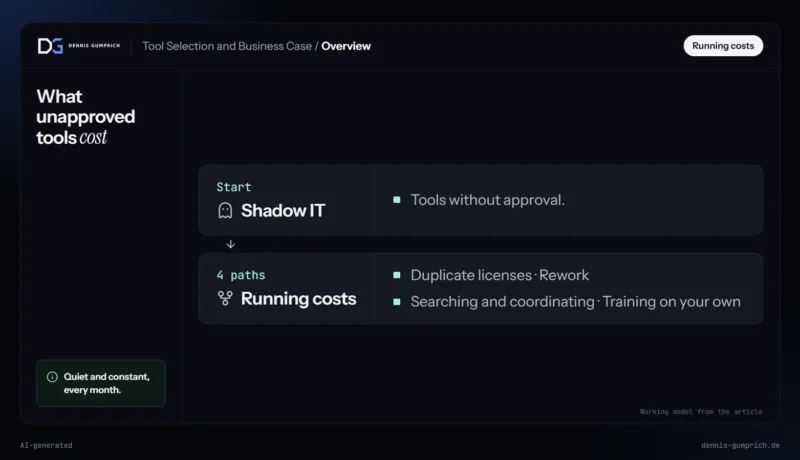
Shadow IT in marketing is software a team uses on its own without IT, data protection or procurement knowing about it. It almost always arises from time pressure, not negligence. The risk lies less in the individual tool than in the fact that nobody knows which data flows where and who is liable if something goes wrong. How to check an AI tool before using it is shown in GDPR-compliant content marketing software.
Why does shadow IT arise in marketing?
Shadow IT is not a discipline problem. It is a symptom of a gap between demand and approval speed.
In marketing, this gap is especially large because three factors come together: the need is short-term, the tools are ready in minutes, and the entry costs are below every procurement threshold. If your IT needs three weeks for an approval and an AI tool runs in three minutes, the question answers itself. How to speed up approval instead of bypassing it is covered in Involving IT and data protection early.
Since generative AI arrived in everyday work, the pattern has intensified. A writing assistant, an image generator, a transcription service, a translation tool: each one seems harmless. Taken together, they form an infrastructure that nobody has documented.
That clear rules are often simply missing is shown by the Trendbarometer Industriekommunikation 2026 by bvik, the German association for industrial communication. According to the survey of 282 participants, AI shapes all relevant B2B marketing trends, while many companies lack clear rules for using AI. Prof. Dr. Seon-Su Kim, who supervised the survey scientifically, sees a remarkable gap between vision and implementation overall. One starting point is the NIST Generative AI Profile (NIST AI 600-1), a voluntary US framework: it recommends transparent policies on which use is permitted. For you, this means: a short written rule on which data may go into which AI tools is the simplest first step to turn individual decisions into a traceable framework.
The four most common triggers
- Approval processes without a deadline. A process without a committed processing time gets bypassed as soon as deadline pressure rises.
- Familiar tools from previous jobs. Nobody questions a program that already ran in their last job.
- Distributed work. When working from home, a tool decision feels private, even though company data is flowing.
- External partners. Agencies and freelancers bring their own tool landscape. Their accounts don't appear in any internal overview.
Which shadow IT risks are real?
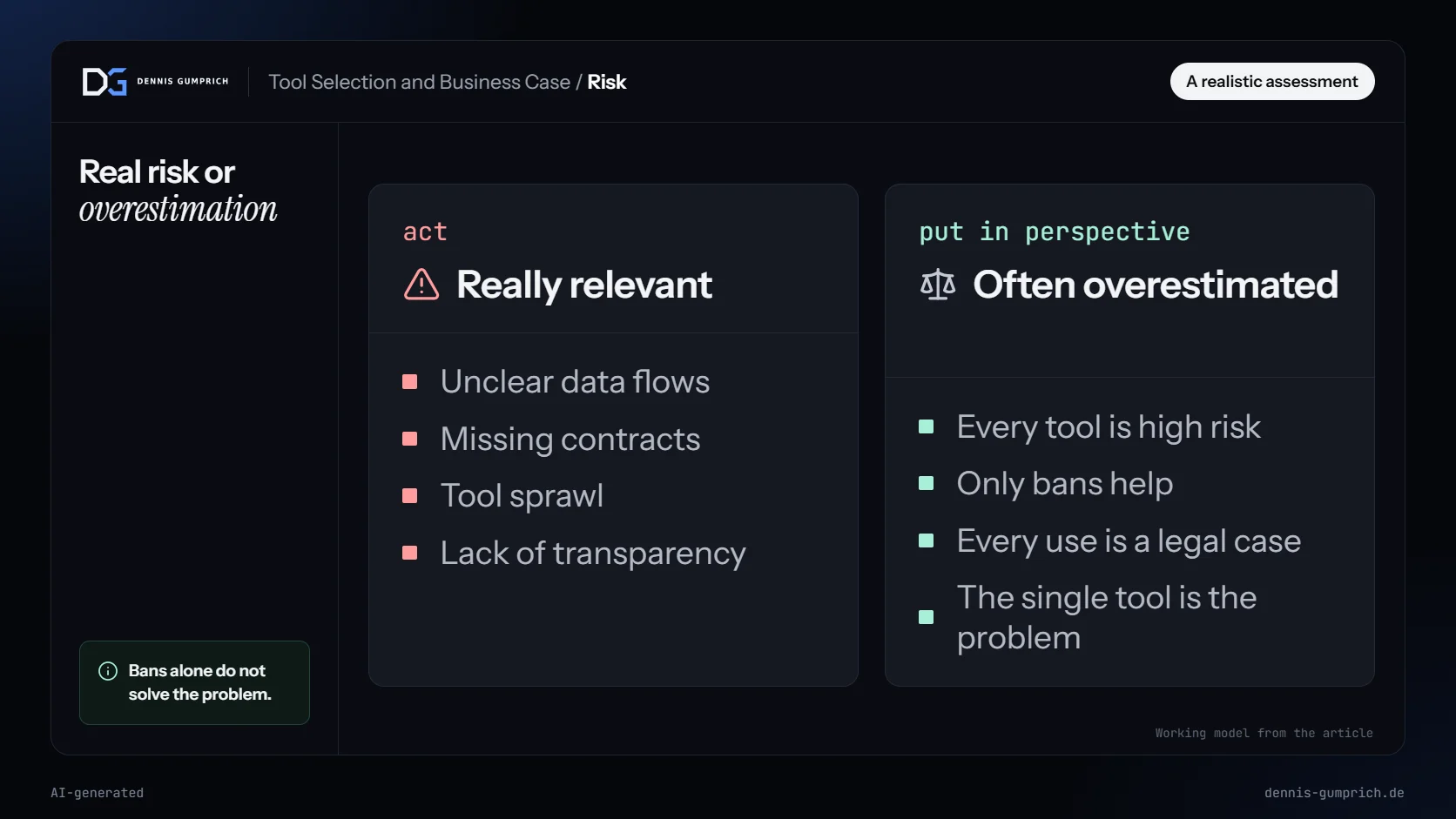
That depends on which data the tool sees. If it only processes publicly available content without a login using company data, the risk is low, and tolerating and recording it is enough. As soon as internal or personal content goes in, the risk rises significantly. The real danger usually lies in the lack of transparency, not in the tool itself.
Not every unapproved tool is dangerous. A differentiated assessment helps you more than a blanket ban that nobody follows anyway.
| Situation | Risk | Sensible response |
|---|---|---|
| Tool only processes publicly available content, no login with company data | low | Tolerate, but record |
| Internal, non-personal content such as product data or strategy papers | medium | Check the contractual situation, then transfer or replace |
| Personal data such as customer lists, applications, employee photos | high | Stop immediately, involve the data protection officer |
| Tool demonstrably trains on your inputs | high | Stop immediately, document the inputs |
| Tool generates published content without labeling | medium to high | Check labeling obligations |
The legal dimension is not theoretical. Under Article 83(5) of the General Data Protection Regulation, serious violations can lead to fines of up to 20 million euros or up to 4 percent of worldwide annual turnover, whichever is higher. In practice, however, another point is more relevant than the upper limit: without an entry in the record of processing activities, your company cannot prove during an audit that it knows where its data is.
Timing note: With the EU AI Act (Regulation 2024/1689), transparency obligations apply to AI-generated content. They have been applicable since August 2, 2026. For machine-readable marking by systems that were already on the market before, amending Regulation (EU) 2026/1744 grants a transition period until December 2, 2026. Check the status that applies to you with your legal department before you build internal policies on it.
You don't have to reinvent a short written rule on which data may go into which tools: the free template for an AI policy in marketing contains a data traffic light and a list of approved tools.
What does shadow IT cost before anything happens?
Continuously and invisibly, because knowledge and data become scattered. As a starting value: three hours per person per week for searching, asking around and duplicate maintenance, extrapolated to 46 working weeks. You can validate this calculation in an hour by asking three colleagues about their actual effort. Where the time per article really goes is shown in the analysis Nine hours per article.
The damage rarely comes from an incident. It arises continuously and invisibly, because knowledge and data become scattered.
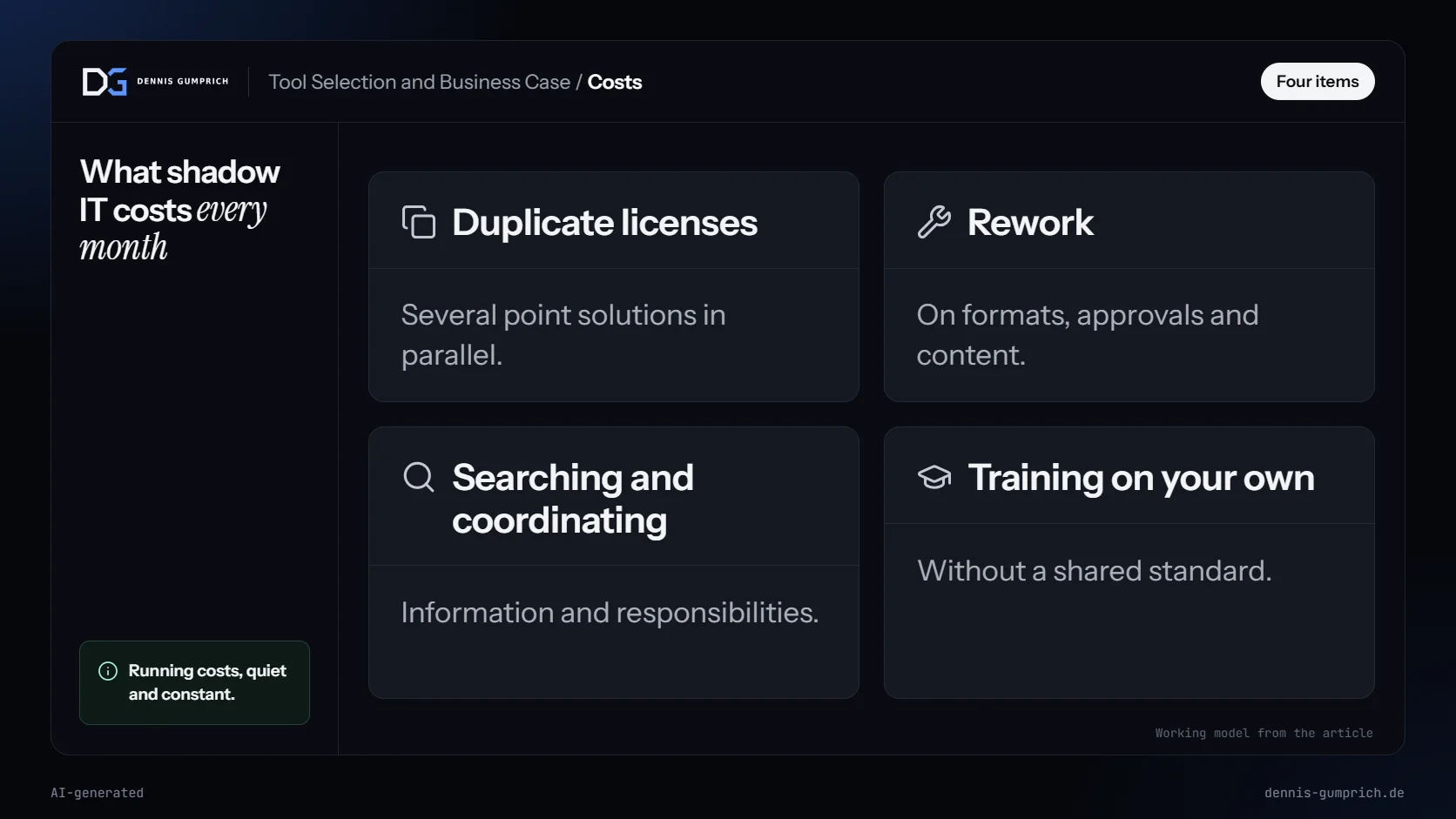
The following calculation is a working model, not a study. You can validate it with your own team in an hour by asking three colleagues how much time per week goes into searching, asking around and duplicate maintenance.
On top of that come three effects that are harder to quantify, but everyone on the team knows them:
- Knowledge leaves the company with the person. When a colleague quits, access to her tool goes with her. Prompts, templates and archive are gone.
- Approvals are not traceable. Who signed off on which text? With scattered tools, this cannot be reconstructed afterwards.
- The brand voice frays. Five people with five AI tools produce five tones. Your target group notices.
Self-check: how much shadow IT do you have?
Tick everything that applies to you. The assessment appears immediately.
Tool inventory in five steps
The most practical way in is not a policy, but an inventory. It takes two to three weeks and gives you the basis for every further decision.
- Promise amnesty, then askAnnounce a survey without sanctions. Without this promise, you get incomplete answers. Ask for the tool name, purpose, costs, types of data uploaded and number of users.
- Evaluate payment channelsCredit card statements, expense receipts and single sign-on logs complement the self-reporting. You won't find free accounts this way, so step one remains the more important one.
- Classify by riskUse the grid above. The result is a list with three piles: tolerate, transfer, stop. Make this classification together with data protection, not alone in marketing.
- Name an alternative for every stopA ban without a replacement shifts use to private devices. Every stopped tool needs an approved alternative or a committed date on the same day.
- Shorten the approval routeThe real lever. Define a tool category with simplified review and a binding response time of five working days. That removes the incentive to bypass the process.
Subject: Inventory of marketing tools, proposal for a joint approach
marketing is probably using several tools that were not approved through the official route. This is not a reproach to the team, but a consequence of our current approval times.
- Risk: we currently cannot prove which company data sits in which external services.
- Legal framework: Article 83(5) GDPR provides for fines of up to 20 million euros or 4 percent of worldwide annual turnover for serious violations.
- Ongoing effort from scattered tools: an estimated 3 hours per person per week, extrapolated to about 138 hours per person per year.
Proposal: we carry out a sanction-free tool inventory over two weeks and, together with data protection, sort the results into tolerate, transfer and stop. In parallel, we check whether we can introduce a simplified approval for marketing software with a five-working-day response time.
Effort for the inventory: less than an hour per person.
For tools you want to keep, the free AI tool approval checklist helps you approve them properly after the fact with IT, data protection and the works council.
Five mistakes that make things worse
- A blanket ban without an alternativeUse doesn't disappear, it just becomes less visible. Private devices and accounts are harder to control than what you had before.
- Communicating the inventory as a control measureIf people fear sanctions, they report nothing. Without amnesty, you get a list that looks complete and isn't.
- Only looking for paid toolsThe riskiest cases are often free accounts with a private email address. They don't appear in any statement.
- Leaving out external partnersAgencies and freelancers work with your content in their systems. Clarify contractually which services they may use.
- Introducing a platform without clarifying the processIf responsibilities and approvals remain unclear, the next shadow IT will quickly appear next to the new platform.
When is a central platform the right answer?
After the inventory, the question usually comes up whether a shared platform should replace the scattered point solutions. There is no blanket answer, but it can be decided by three criteria. The detailed decision aid is in the article Point solutions or platform.
A platform is worthwhile if several people work on the same content, if approvals run across department boundaries, and if you use AI regularly and need to ensure brand voice and traceability. The core benefit then lies not in individual features, but in planning, creation, approval and storage using the same data.
A platform is not worthwhile if your bottleneck lies in strategy or a lack of people. Software does not solve a capacity problem. And if an AI assistant is already approved in the company, it is worth taking a sober look first at whether Copilot is enough for marketing.
Transparency note: I work as a Senior Consultant at contentbird, a Berlin-based provider of AI-powered content software. Such a platform brings planning, creation, approval and storage together in one place and lets you store brand voice and knowledge sources centrally. Whether that is the right answer for you depends on your setup. In any case, compare several providers and involve IT and data protection before the decision, not after.
When this approach doesn't fit
A formal tool inventory is disproportionate if your marketing consists of one or two people and you use the same three tools anyway. In that case, a short written list that you agree on once with management is enough.
It is also the wrong first step if a larger IT changeover is underway, such as an ERP or CRM rollout. Then you tie up capacity that is needed elsewhere, and your results will be outdated in six months. In that case, wait for the rollout and set a concrete date for it.
Conclusion: the tools aren't the problem, invisibility is
Shadow IT does not disappear through stricter rules. It disappears when the official route is faster than the unofficial one. Everything else is treating symptoms.
Frequently asked questions
What is shadow IT in marketing?
Software that a team uses on its own without IT, data protection or procurement knowing about it. Typical examples are AI writing assistants, planning tools and image generators. What matters is not the price, but that no review of data flow and contractual situation has taken place.
Is shadow IT always a GDPR violation?
No. A violation only arises when personal data is processed without a legal basis, without a data processing agreement or without an entry in the record of processing activities. A tool that only receives publicly available product data is assessed differently in legal terms than one into which customer lists are uploaded.
How do I find out which tools my team uses?
The fastest way is an open survey in the team without threatening sanctions, complemented by an evaluation of credit card statements and single sign-on logs. Purely technical detection only finds paid tools. Free accounts and private accounts don't show up there.
Should shadow IT be banned?
A ban without an alternative usually shifts use to private devices and accounts. A fast approval route with a clear deadline plus a small list of pre-approved tools is more effective.
Where does your content process lose time today?
In 30 minutes, we look together at where unnecessary coordination, manual tasks, tool switching or repetitive content work cost you time today.
You get a concrete assessment of which tasks you can simplify, automate or organize better, and where AI and tools actually help instead of adding complexity.
Analyze your content process in 30 minutes Free of charge. You take away concrete starting points you can use internally right away.
Dennis Gumprich
Dennis helps marketing and communication teams fit generative AI into existing content processes without undermining quality, brand voice and approvals. Focus areas: content operations, AI governance and tool selection in mid-sized companies and corporations.
Transparency note: Dennis works for contentbird, a provider of AI-powered content software. The product mention is marked in the article. More about Dennis (in German) · LinkedIn
Read more
Sources
- European Union: Regulation (EU) 2016/679 (General Data Protection Regulation), Official Journal L 119 of May 4, 2016, Article 83: paragraph 5 provides for fines of up to 20 million euros or 4 percent of worldwide annual turnover, whichever is higher, for violations of, among other things, the processing principles, lawfulness and third-country transfers. For obligations under Articles 25 to 39, such as processing on behalf and the record of processing activities, paragraph 4 sets a framework of up to 10 million euros or 2 percent. Accessed October 31, 2026.
- European Union: Regulation (EU) 2016/679 (General Data Protection Regulation), Article 30 on the record of processing activities and Article 28 on the data processing agreement. Accessed October 31, 2026.
- European Union: Regulation (EU) 2024/1689 (AI Act), Official Journal of July 12, 2024, Article 50 on transparency obligations for AI-generated content, applicable since August 2, 2026. Accessed October 31, 2026.
- Cooley: Digital AI Omnibus Delays Key Deadlines, Introduces New Rules, law firm article on Regulation (EU) 2026/1744, published in the Official Journal on July 24, 2026: Article 50 remains at August 2, 2026; for machine-readable marking under Article 50(2), a transition period until December 2, 2026 applies to systems already on the market. Accessed October 31, 2026.
- bvik: Trendbarometer Industriekommunikation 2026, press release of January 13, 2026 (in German), online survey of 282 participants in October and November 2025, preceded by a workshop with 32 managers, scientifically supervised by Prof. Dr. Seon-Su Kim: AI shapes all relevant B2B marketing trends, many companies lack clear rules for AI use, according to Prof. Dr. Seon-Su Kim a remarkable gap between vision and implementation overall. Association survey, figures from the press release. Accessed October 31, 2026.
- National Institute of Standards and Technology (NIST): Artificial Intelligence Risk Management Framework: Generative Artificial Intelligence Profile (NIST AI 600-1), publication of July 26, 2024, Chloe Autio, Reva Schwartz, Jesse Dunietz et al., companion document to the voluntary AI RMF 1.0 of January 2023: actions GV-1.4-002 and GV-3.2-003 call for transparent policies on permitted use, GV-6.1-009 extends procurement due diligence to intellectual property, data protection and security, including for solutions with embedded AI. Voluntary US framework without legal force in the EU. Accessed October 31, 2026.
How this article was created
This article was created with the help of AI. Structure, research and draft wording were developed with AI support. Professional assessment, selection of sources, review of the statements and the final version are the responsibility of Dennis Gumprich. The calculation examples are explicitly marked as working models and are not measured values. The English version was translated with AI and reviewed. Read the original German version.
How reliable are the statements?
Documented are the fine frameworks under Article 83 GDPR, the obligations regarding the record of processing activities and the data processing agreement under Articles 30 and 28 GDPR, and the start of application and transition period of the transparency obligations under Article 50 of the AI Act, as well as the finding that many companies lack AI rules (bvik Trendbarometer Industriekommunikation 2026, association survey) and the recommendation of transparent policies on permitted use (NIST AI 600-1, voluntary US framework). The assessment grid, the triggers of shadow IT, the five-step tool inventory, the five-working-day response time and the classification into tolerate, transfer and stop are working models from consulting practice, not measured values. The opening scene with a 29-euro monthly fee and three weeks of approval time is a case example. Three hours per person per week, 46 working weeks and an hourly rate of 60 euros are a calculation example. As of October 31, 2026. Legal note: this article does not replace legal advice. Your data protection officers and legal department are responsible for assessing your specific case.


