
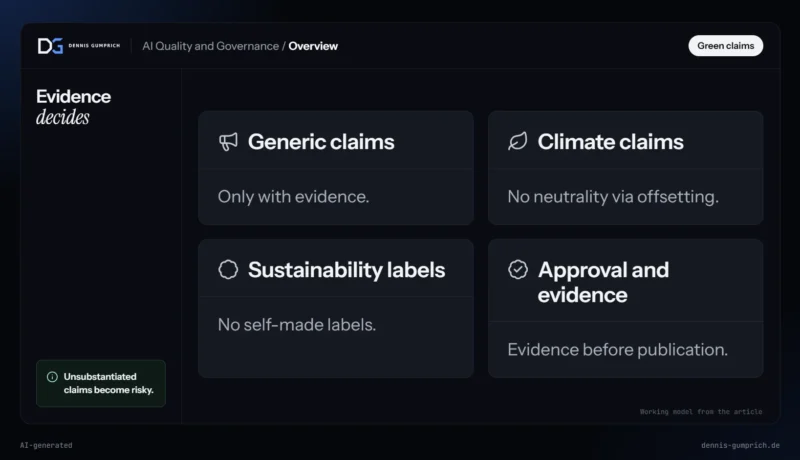

Under the EmpCo Directive, environmental claims rarely fail because of the wording, but because of missing evidence.
The EmpCo Directive is Directive (EU) 2024/825. It amends the Unfair Commercial Practices Directive and the Consumer Rights Directive and has applied across the EU since September 27, 2026, without a general transition period. The three rules that apply most often in everyday marketing: generic environmental claims such as green, ecological or sustainable are prohibited without evidence. Product-related climate claims based on offsetting are not permitted under any circumstances. Sustainability labels are only permitted if they are established by public authorities or based on a certification scheme. The practical core of the change is not text work, but a chain of evidence: every claim needs a clear reference object, a findable proof and a named approval.
The following sections show how to build such a chain of evidence. First, the content of the directive itself.
What does the EmpCo Directive regulate?
The EmpCo Directive regulates which environmental claims toward consumers are permitted. Generic claims such as green, eco or sustainable need evidence or a specification on the same medium. Climate neutrality claims are only permitted with real reduction across the life cycle, not via offsetting. In addition, there are requirements for sustainability labels, future claims, comparisons and new mandatory information on durability and reparability.
Before turning to implementation, here are the rules in the most compact form that is still robust. This table is suitable as a basis for a short internal briefing.
| Rule | What it requires | Typical everyday mistake |
|---|---|---|
| Generic environmental claims | Only with proof of recognized excellent environmental performance or with a clear specification on the same medium. | Green, eco or sustainable as a product range label without explanation next to it. |
| Climate claims | Product-related neutrality claims only with real reduction across the life cycle, not via offsetting. | Climate neutral on the packaging, covered by certificates outside the value chain. |
| Sustainability labels | Only labels established by public authorities or based on a certification scheme. | Own green badge in the shop filter or a leaf icon that looks like a label. |
| Reference object | A claim may only go as far as its evidence: product, component, packaging or company. | Made from recycled material, although only the packaging is meant. |
| Future claims | Only with a public implementation plan, measurable interim targets, resources and external verification. | Climate neutral by 2035 as a pure brand claim without a roadmap behind it. |
| Comparisons | Method, products compared, suppliers and updates must be disclosed. | Up to 40 percent fewer emissions than comparable products, without saying what was compared. |
| Legal requirements as a feature | Legal obligations must not be presented as a special feature of your own offer. | Free from substance X, although X is banned for the entire product category anyway. |
| Durability and repair | New mandatory information on legal guarantee, commercial durability guarantee, software updates and reparability. | Data is in the PIM but is not delivered to all channels. |
Since when has the EmpCo Directive applied?
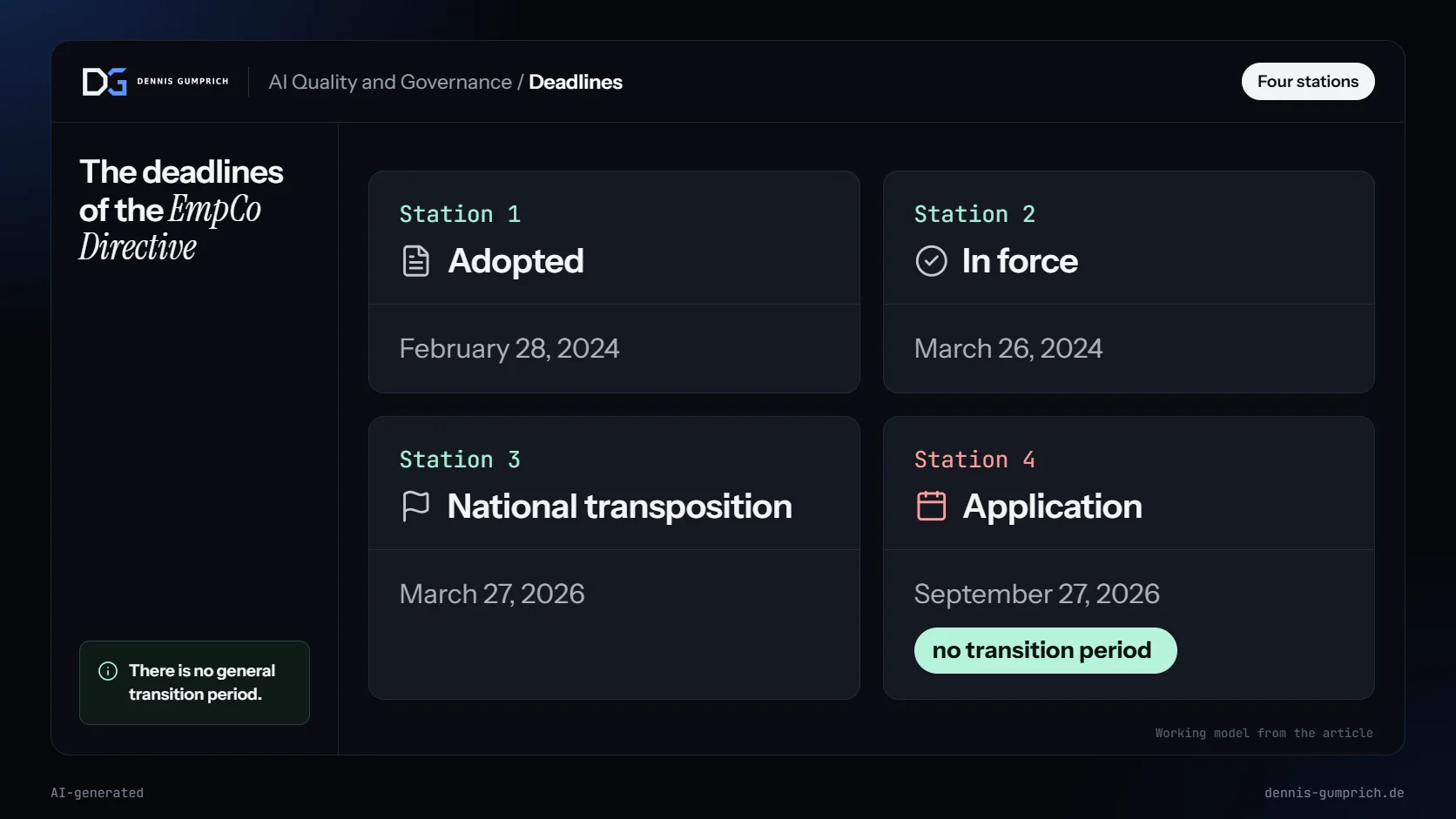
Member states had to adopt national measures by March 27, 2026. They have applied since September 27, 2026. There is no general transition period for existing materials. For goods already on the market, the European Commission points to suitable means such as notices or stickers.
If you did not finish by the deadline, you should now prioritize differently than before. Before the deadline, the rule was: packaging and print first, because they have the longest lead time. Now the rule is: first everything that is visible online and can be corrected quickly. What this means concretely in the first weeks is described in the section "After the deadline" further down.
Which companies does the EmpCo Directive apply to?
To everyone who communicates commercially with consumers in the EU, regardless of industry, revenue and number of employees. There are no thresholds as with reporting obligations. Companies without an EU headquarters are also covered if their communication is aimed at consumers in the internal market. This also applies to environmental claims in marketplace listings: the trader who uses them is responsible.
Pure B2B communication is not directly covered by the wording. In practice, the separation is rarely clean, because product texts, data sheets and campaign modules are used in both worlds. If you reuse content across channels, you are better off with one uniform standard of evidence than with two review worlds.
How is the EmpCo Directive implemented nationally?
Each member state has transposed the directive into its own law on unfair commercial practices and consumer contracts. The wording of the prohibitions is largely harmonized, because the directive adds them to the EU-wide blacklist of practices that are unfair in all circumstances. Enforcement, sanctions and case law, however, differ from country to country. Germany is a useful example of how this works in practice.
Germany transposed the requirements in February 2026 with two laws that have applied since September 27, 2026: the Third Act amending the Act against Unfair Competition (UWG) and the Act amending consumer contract and insurance contract law. Environmental claims thus end up in the UWG and its annex, the blacklist of practices prohibited in all circumstances.
| Area | Requirement of the EmpCo Directive | Transposition in Germany |
|---|---|---|
| Environmental claims and sustainability labels | Amendment of the Unfair Commercial Practices Directive | Third Act amending the UWG: prohibitions in the UWG and its annex, the blacklist |
| Durability, reparability, software updates | Amendment of the Consumer Rights Directive | Act amending consumer contract and insurance contract law |
| Fines | Framework of the Unfair Commercial Practices Directive | Up to four percent of annual turnover under Section 19 UWG, limited to coordinated enforcement of widespread infringements |
| Everyday enforcement | Each member state decides | Warning letters and injunctions by competitors and associations entitled to sue under the UWG |
The practical consequence in Germany: the most likely first contact with EmpCo is not an authority, but a warning letter from a competitor or association. It does not hit the legal department, but a landing page, a product text or an ad. In other member states, enforcement may rely more on consumer protection authorities. If you communicate internationally, you should manage claims centrally and review them locally, because interpretation and sanction levels differ by member state.
You can find the wording of the directive in the Official Journal of the EU: Directive (EU) 2024/825 as a PDF on EUR-Lex, available in all official EU languages. For your marketing in a specific country, however, the national law in force since September 27, 2026 is decisive, because warning letters, injunctions and fines are based on it. Use the national prohibitions as your working basis and the directive for interpretation.
After the deadline: what counts in the first weeks
Since September 27, 2026, it is no longer about preparation, but about damage control and routine. Four things now take priority: stop risky terms in all online channels, define an emergency path for warning letters and complaints, secure materials in circulation with notices or stickers, and commit agencies and specialist departments to the additional review step.
Environmental claims on websites, in shops, marketplace listings and ads can be found with a simple search, including by competitors, associations and authorities. Anything still labeled climate neutral, sustainable or environmentally friendly without explanation is therefore the biggest short-term risk, regardless of how much printed material is still in the warehouse.
- Week 1Stop high-risk terms onlineSignal word search across website, shop, marketplace listings, ads and social media. Remove or specify offset-based climate claims and generic terms without explanation first. Completeness comes afterwards; speed takes priority now.
- Week 1Define an emergency path for complaintsWho receives a letter, who assesses it legally, who finds every place where the contested claim still appears within 48 hours? Without a claim list, the third point is hardly feasible.
- Weeks 2 to 4Secure material in circulationFor packaging, print and point-of-sale material already on the market, the European Commission names notices or stickers as suitable means. Reprints and new editions only go into production with reviewed claims.
- From week 2Make the review step mandatoryNo new content with an environmental claim without the additional step from the roadmap further down. This explicitly also applies to agencies, social media teams and specialist departments that publish themselves. Briefings and templates are adjusted accordingly.
How to deal with a specific warning letter or complaint belongs in the hands of a specialist lawyer. What you can influence yourself is your ability to deliver: knowing where each claim appears, which proof supports it and who approved it.
Which environmental claims have been prohibited since September 2026?
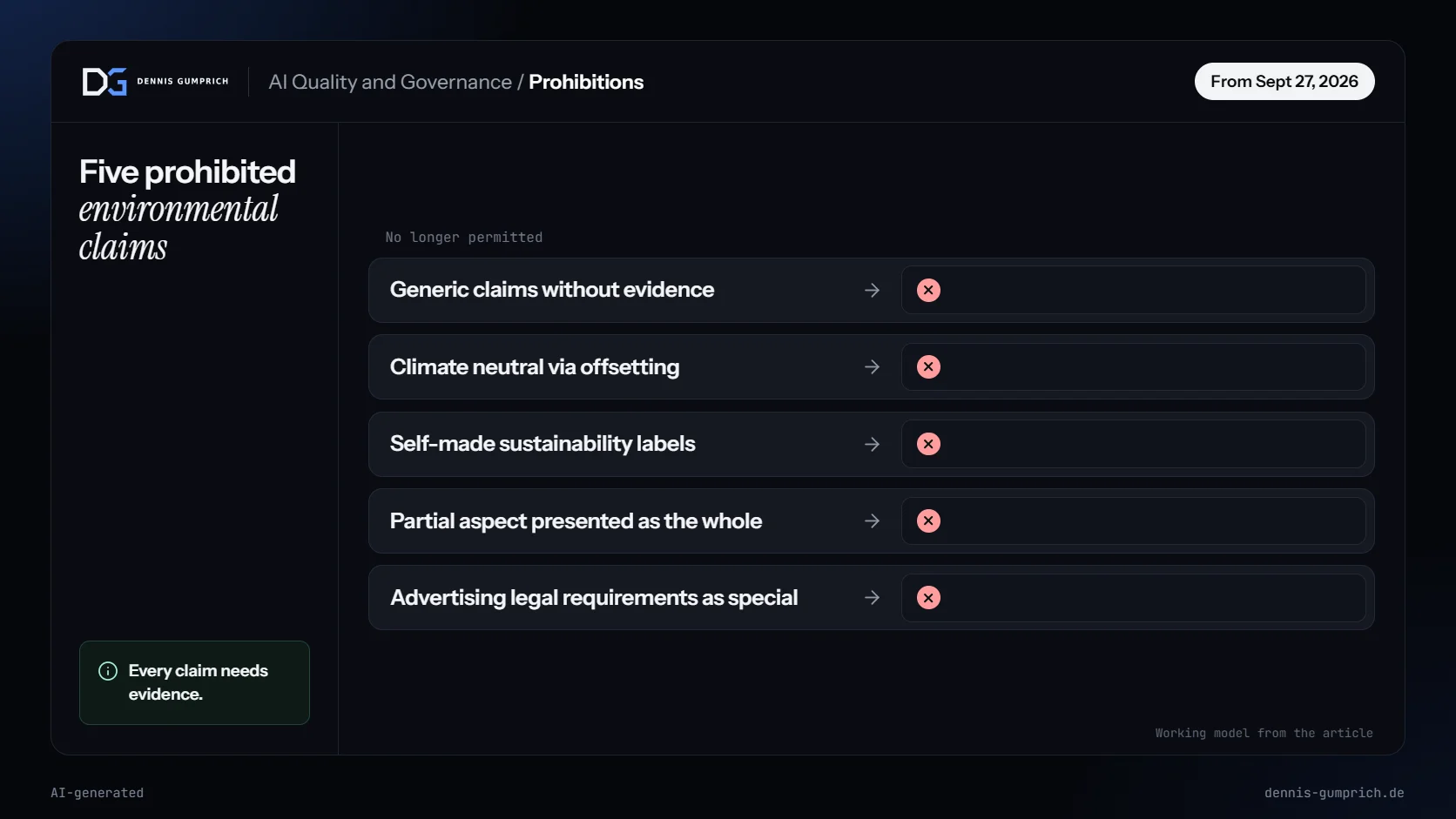
Not permitted without case-by-case review are product-related climate neutrality claims based on offsetting and generic environmental claims such as green, eco, sustainable or environmentally friendly without evidence. Claims such as recyclable or plastic-free remain conditionally permitted, provided the reference object and share are clear. Future claims such as climate neutral by 2030 require a published implementation plan with external verification.
The fastest way into your own inventory is a search list. Take the following terms, search with them in CMS, PIM, shop system, newsletter tool and print files, and mark every hit. Search in every language you publish in. This does not replace an assessment, but it produces a realistic volume estimate within a few hours.
| Signal terms | Risk rating | What you do with them |
|---|---|---|
| climate neutral, CO2 neutral, climate positive, carbon offset, climate-friendly, reduced carbon footprint | High. Not permitted without case-by-case review if product-related and based on offsetting. | Stop and replace immediately. Check whether there is real reduction across the life cycle. |
| green, eco, sustainable, environmentally friendly, eco-friendly, nature-friendly, biodegradable, bio-based | High. Generic environmental claim, prohibited without evidence or specification. | Specify or delete. The specification must be on the same medium. |
| recyclable, made from recycled material, plastic-free, compostable, resource-saving | Medium. Permitted if reference object and share are clear. | Check the reference: product, component or packaging. Add share and method. |
| net zero by, climate neutral by 2030, 100 percent sustainable by 2035 | High. Future claim with strict requirements. | Only use if implementation plan, interim targets and external verification are published. |
| environmentally conscious, responsible, fair, animal-welfare friendly, conscious | Medium to high. Mixes environmental and social features; environmental labels do not support the claim. | Break down into concrete, verifiable individual claims. |
| free from, without added, does without | Medium. Risk of advertising legal obligations or irrelevant benefits. | Check whether the substance is banned for the category anyway or unrelated to the product. |
| up to X percent better, more environmentally friendly than, compared to conventional | Medium. Comparative claim with disclosure obligation. | Add method, comparison object, suppliers and update status. |
| leaf icons, globes, water drops, green and brown color schemes, badges that look like labels | Medium to high. Images and graphics explicitly count as environmental claims. | Include visuals in the same review as texts. |
The operational ground rule: the more generic the term, the greater the need for explanation. And the explanation must be where the claim is, not two clicks away.
Generic environmental claims: the specification rule
An environmental claim is not considered generic if the specification is given clearly and prominently on the same medium. This is the most important lever of all, because it turns a prohibited claim into a permitted one without you having to give up the statement.
Environmentally friendly packaging
This packaging consists of 85 percent recycled material. The share refers to the cardboard box, determined according to [method].
Climate-friendly production
Since [year], 100 percent of the energy used in our plant in [location] has come from renewable sources.
The scope is important here: if only the plant in [location] runs on renewable energy, the claim must not be stretched to the entire company. The evidence defines the limit of the claim, not the space available on the packaging.
Recognized excellent environmental performance includes in particular the EU Ecolabel, officially recognized national EN ISO 14024 type I ecolabels such as the German Blue Angel or the Nordic Swan, and top environmental performance under other Union law, such as the highest efficiency class of the energy label. Watch the fit: energy efficient can be substantiated via the energy label, biodegradable usually not via the EU Ecolabel. And terms such as sustainable or responsible cannot be based on an ecolabel alone, because they imply social features too.
Climate neutral: the clean alternative
Product-related claims of neutral, reduced or positive climate impact are not permitted if they are based on offsetting outside the value chain. They remain permitted only with real reduction across the product's life cycle.
However, the directive explicitly states: communicating investments in climate protection projects remains possible. The trick is to present them not as a product feature, but as a corporate activity.
This product is climate neutral through offsetting.
We have calculated the emissions of this product according to [method] and additionally invest in [project]. You can find the calculation and project selection at [link].
Note the distinction: the prohibition is worded in relation to products. Company-related climate claims are not covered by it, but remain subject to the general ban on misleading practices and, if they refer to the future, to the strict requirements for future claims. If you merely shift the claim from the product to the company, you have moved the problem, not solved it.
Sustainability labels: the triple check
Labels established by public authorities or based on a certification scheme are permitted. Such a scheme must be open to all companies on non-discriminatory terms, develop its requirements with experts, provide procedures for non-compliance including withdrawal of the label, and have compliance monitored by an independent third party.
A compliant label can still be used incorrectly. So check in three stages:
- Stage 1, the scheme: is the label established by public authorities or based on a certification scheme? Are the criteria publicly available?
- Stage 2, the use: does the certification cover exactly what you use the label for? Does it apply to this product, this batch, this period?
- Stage 3, the surroundings: what is next to it? A permitted label combined with a generic claim and green imagery can still mislead when viewed as a whole.
Company-owned labels, green badges in the shop filter and icons that look like labels are no longer tenable. This also applies to range markings and category badges. Anything that looks like a label is treated legally like a label.
Reference object: the rule against shortening
An environmental claim about the entire product or the entire business is prohibited if it actually only concerns one aspect. The standard example: a product is marketed as made from recycled material although only the packaging is meant.
This practice has the highest hit rate in existing content, because it rarely arises on purpose, but through shortening when content is cut for a channel. The product manager writes precisely with reference to the packaging, the reference is dropped in the social post, and a correct partial claim becomes an impermissible overall claim.
Practical rule for every shortening: when a claim is shortened, the reference object must be kept. What gets dropped first is almost always exactly the part that made the claim permissible.
Legal requirements and irrelevant benefits
Prohibited is, first, presenting requirements imposed by law on all products in the category as a special feature of your own offer. And second, advertising benefits that are irrelevant and do not result from a feature of the product. The directive's examples are bottled water as gluten-free and sheets of paper as plastic-free. In practice, this affects many packaging badges that exist mainly because there was still space on the front.
Images, icons and colors are environmental claims too
The directive's concept of an environmental claim explicitly includes representations through text, images, graphic elements or symbols such as labels, brand names, company names or product names. A green leaf icon can therefore have the same legal effect as the word environmentally friendly. What is assessed is not the individual sentence, but the overall impression.
In practice, this means: design belongs in the same review as text. Three points that should be asked specifically in the review:
- Does the imagery suggest an environmental effect that is not substantiated? Nature motifs, globes, water drops, leaves, green and brown color schemes.
- Does a graphic element look like a label without being one? Round badges, wreath or stamp shapes, check marks in circles.
- Does the effect only arise from the combination? A permitted individual claim plus green design plus a nature image can claim more as a whole than any element on its own.
This is the point where many approval processes fail structurally: the text goes through legal review, the layout does not. If you implement only one process change, then this one: the claim review takes place on the finished layout, not on the text document.
When are future environmental claims still permitted?
Claims about future environmental performance are not prohibited, but subject to strict conditions. A future claim is no longer a brand claim, it is the publication of a plan. Only when all six points are met is the claim ready to be communicated:
- The target is formulated clearly, objectively and measurably, not as an ambition.
- There is a detailed and realistic implementation plan with time-bound interim targets.
- Resources and funds are specifically allocated to the plan.
- Responsibilities for implementation are named. This is a practical recommendation; the directive does not explicitly require it.
- An independent external expert regularly verifies progress.
- The plan and the verification results are publicly available and findable for consumers.
This results in an uncomfortable order for campaign planning: first the plan, then the campaign. In practice, it has proven useful to link every future promise to a permanently accessible evidence page with target, interim targets, methodology, progress and verification result. This page is not optional; it is part of the conditions for the claim to be permitted.
Durability, reparability, software: the new mandatory information
Green claims dominate the public discussion. The second part of the directive often affects product communication and shop data more, because it is not text work but data maintenance. This information must be available before the contract is concluded:
| Mandatory information | Where the data comes from | Where it must be delivered |
|---|---|---|
| Notice of the legal guarantee of conformity (harmonized notice) | EU requirement, design via implementing act of the Commission | Product page, store, checkout |
| Commercial durability guarantee of more than two years (harmonized label) | Manufacturer information, if provided | Packaging, shelf, directly next to the product image in the shop |
| Minimum period for software updates | Manufacturer or provider of digital content | Product detail page, data sheet |
| Reparability score or alternatively repair information | Manufacturer, PIM, spare parts system | Product detail page, retailer feeds |
| Environmentally friendly delivery options, if available | Logistics and shop configuration | Checkout |
These are not text modules, but data fields. They come from the PIM, manufacturer information and product management and must be delivered consistently across channels. If you maintain such fields manually today, you have been doing so at a much higher frequency since September 2026. How to cleanly define such handovers between specialist departments and marketing is described in Handovers between marketing and specialist departments without friction.
Also new on the blacklist: withholding information about negative effects of software updates, presenting an update as necessary although it only improves functions, falsely claiming a certain durability, presenting a product as repairable although it is not, or prompting consumers to replace consumables earlier than necessary.
What penalties apply for breaches of the EmpCo Directive?
EmpCo does not set its own sanctions, but uses the framework of the Unfair Commercial Practices Directive. For widespread infringements with a Union dimension, fines of up to four percent of annual turnover in the member states concerned are possible. In Germany, for example, this is regulated in Section 19 UWG and limited to coordinated enforcement actions of the European consumer protection authorities, and for intentional or grossly negligent infringements, skimming off profits under Section 10 UWG is added.
In Germany, the more realistic entry point is competition law: warning letter, injunction claim, contractual penalty, preliminary injunction. Other member states rely more heavily on consumer protection authorities. Either way, the actual damage rarely comes from the sum of money, but from recalling print material, stopping running campaigns and tying up internal capacity. Added to this is reputational damage, which takes effect regardless of the outcome of proceedings.
How do the EmpCo Directive and the Green Claims Directive differ?
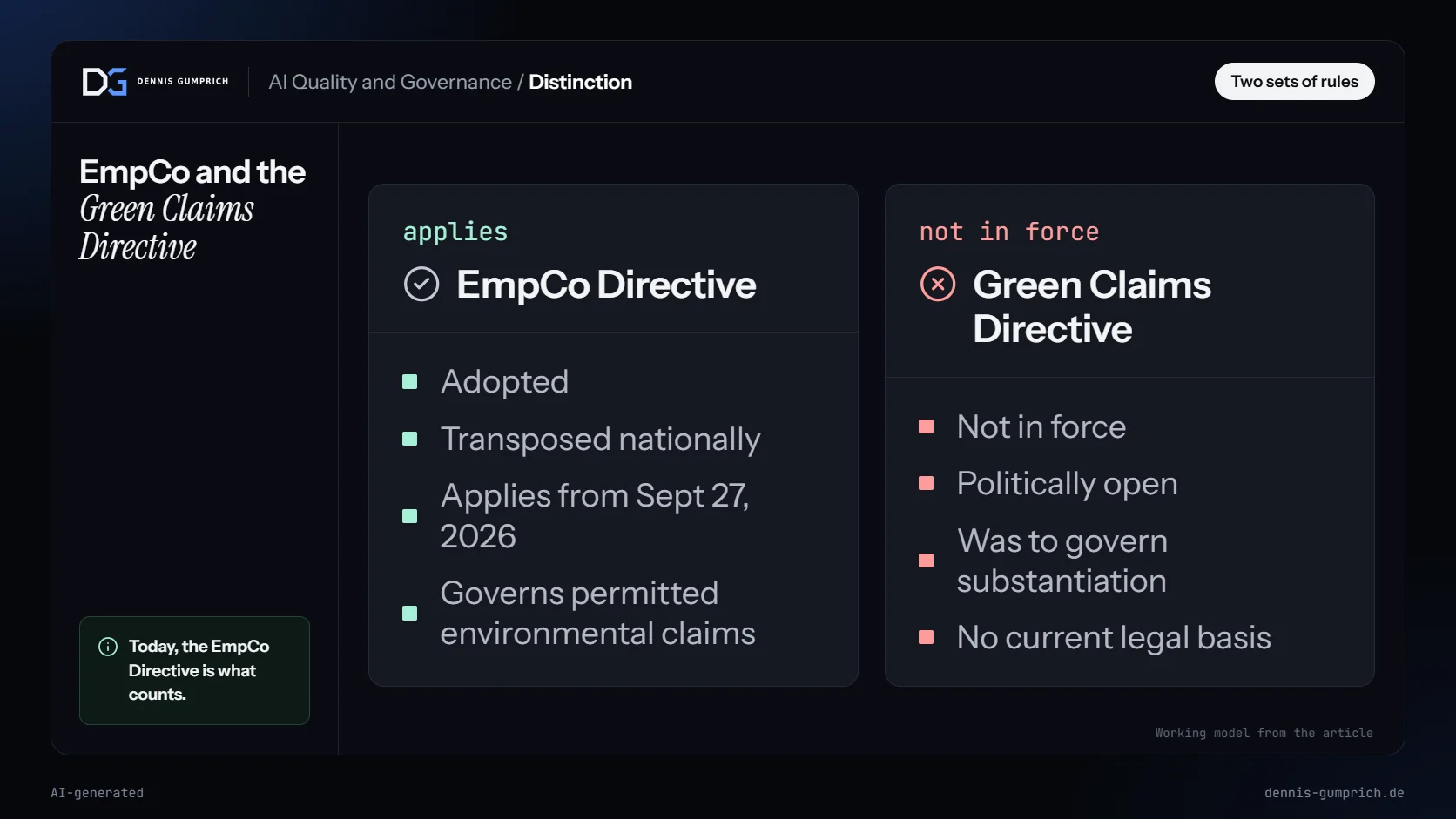
The two sets of rules are regularly confused. EmpCo regulates which environmental claims toward consumers are permitted. The Green Claims Directive was intended to additionally regulate how permitted claims must be substantiated and verified.
The status is decisive for planning: EmpCo has been transposed nationally and has applied since September 27, 2026. The Green Claims Directive is not in force: in June 2025, the EU Commission announced its intention to withdraw the proposal, and negotiations have been on hold since then. The proposal has not been formally withdrawn, and the European Parliament lists the procedure as blocked. Whether and in what form it will continue is open. If you align your roadmap with the Green Claims Directive, you are planning past the applicable law. Conversely, if you set up substantiation properly now, you are prepared for a later tightening without having to work twice.
Self-check: how robust are your environmental claims today?
These six points do not check whether you know the directive, but whether you can deliver when it matters. Tick everything that applies to you.
The implementation roadmap in four steps
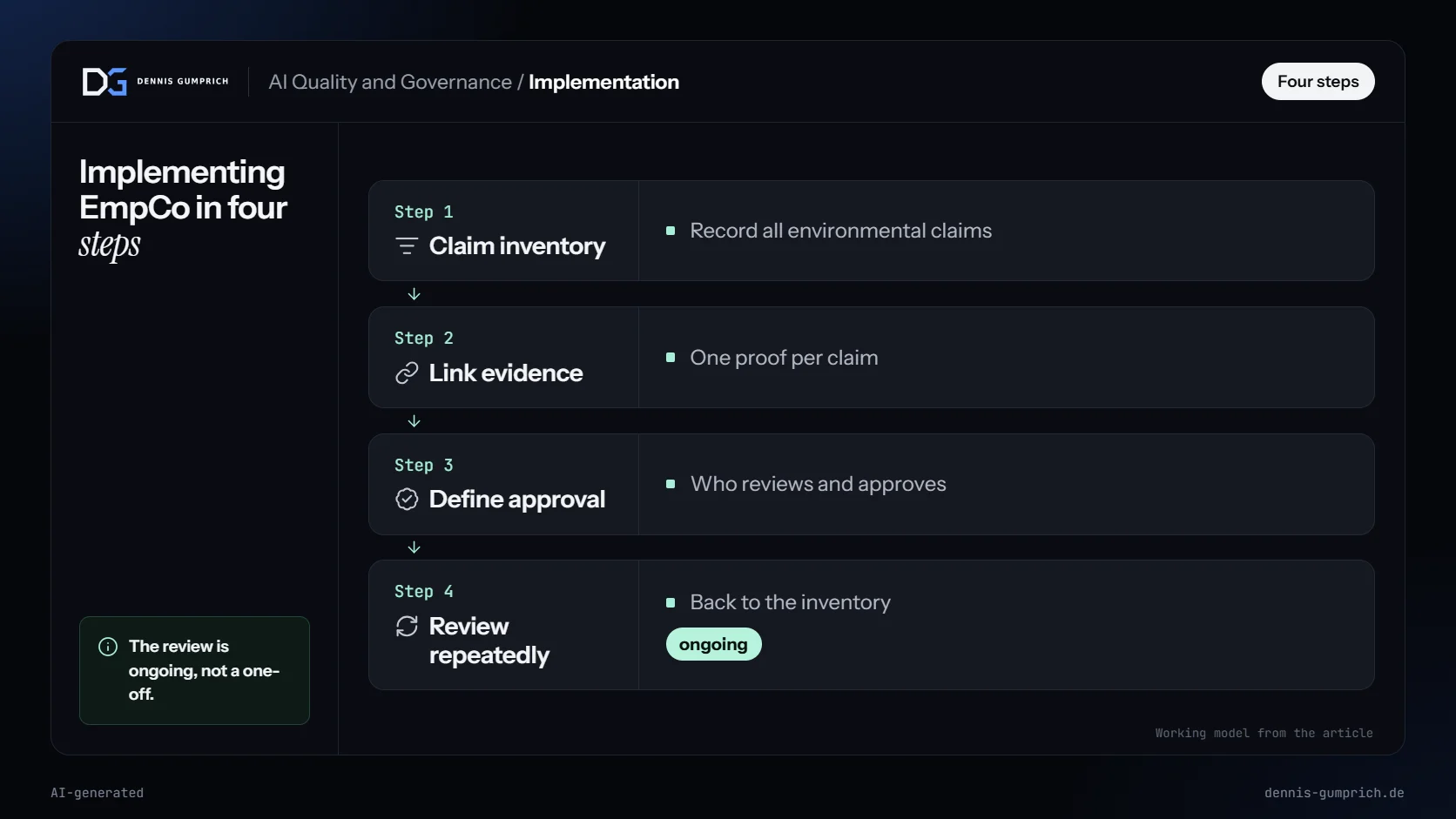
EmpCo could be treated as a legal project, with an opinion at the beginning and an approval list at the end. That does not hold, because environmental claims arise continuously, spread across teams, agencies and channels. What works is an operating model with four steps.
Step 1: claim inventory, across all channels
At the beginning comes the most uncomfortable insight of almost every project: nobody knows how many environmental claims are in circulation. Work through the following list; it is sorted by the effort of a later correction. What is at the top has the longest lead time. For corrections after the deadline, the reverse order applies: what is online is adjusted first, because it is quickest and easiest to find.
- Packaging, product labels and inserts
- Point-of-sale material, catalogs, trade fair advertising and print ads
- Product data feeds and retailer texts, including marketplace listings
- Product detail and category pages in your own shop
- Website, sustainability pages and landing pages
- Social media, newsletters and ads
- Press and corporate communications, proposal and presentation templates
- Imagery, icons, labels and seals in all channels named
- QR code target pages and linked evidence pages
The methodical approach for such an inventory is described in Content inventory: what you have before you plan something new.
Step 2: create a claim file for each claim
A list of locations is not enough. Every relevant claim needs a documented record. These fourteen fields have proven to be a robust minimum structure and can be mapped in any spreadsheet, editorial system or DAM:
| Block | Fields | Why it does not work without them |
|---|---|---|
| Context | Exact wording, channel and place of use, reference level (product, packaging, component, company), claim type (specific, generic, future, label, comparison) | Without the reference level, you cannot judge whether the claim goes too far. |
| Evidence | Source of proof with location, method or standard, responsible department, validity date | Without a location, the proof cannot be found when it matters. |
| Approval | Legal review with date, approving person, next review date | Without a review date, the file quietly becomes outdated. |
| Use | Permitted variants, prohibited variants, necessary explanation at the place of use | Prevents every channel from inventing its own wording. |
| Design | Permitted icon and image surroundings, label surroundings, legibility and placement, mobile display | The overall impression decides, not the individual sentence. |
The most common finding is not that evidence is missing, but that nobody can find it. The certificate is in quality management, the life cycle assessment with product management, the supplier declaration in purchasing. As long as the link between claim and proof only exists in people's heads, your communication is not audit-proof.
GS1 Germany starts exactly here and recommends linking certification and sustainability data to products (GTIN) or company units (GLN) via unique identifiers and making further information accessible via two-dimensional barcodes such as the GS1 Digital Link. The basic idea also applies without GS1 standards: an environmental claim needs a clear link to its proof and a permanently accessible place where this proof can be viewed.
What belongs on a good evidence page: a specific explanation of the claim, the reference object (product, packaging, location or period), method or standard, date of the last update, evidence or certificate information, understandable consumer information and a way to ask questions. And: the target page does not replace the explanation at the place of the claim.
Step 3: make one of four decisions for each claim
After the inventory comes the assessment. To prevent it from turning into endless discussion, give each claim exactly one of four decisions. No maybe, no later, but a documented assignment with a deadline and an owner.
| Decision | When it fits | Next step |
|---|---|---|
| Keep | Specific, substantiated, understandable and sufficiently explained at the place of use. | Add to the claim library, set a review date. |
| Specify | Usable in principle, but needs a clearer limitation or explanation. | New wording with reference object and method, then approval. |
| Postpone | Evidence, target page or technical data are still missing. | Remove from current materials until clarified, name owner and deadline. |
| Delete | Too vague, not verifiable, suggests too much or legally too risky. | Find replacement wording or remove without replacement. |
Seven questions help with the classification, in this order: is it an environmental claim at all? Is it generic or specific? What does it refer to? Is it comparative? Is it reinforced by imagery? Is there a label or a label-like element? Is there robust evidence?
Step 4: build a claim library and approval process
The most important lasting lever is a central library of approved sustainability claims. Not every social post, product page and package should have to reword environmental claims from scratch. The library contains approved wordings, permitted areas of use, necessary explanations, prohibited variants, evidence documents, owner, review date, channel notes, translation variants and design notes.
This includes an approval process with defined checkpoints. The reflex of many organizations is: more approvals for everything. The result is loops that slow everything down and still do not make it safer. More effective is a two-way split: content without environmental claims runs through the standard process, content with environmental claims through a defined additional step.
The additional step has nine stations, three of which are usually missing in everyday work: the evidence check, the channel-specific adaptation and the assessment of the overall impression on the layout.
- Claim idea
- Expert review
- Evidence check
- Legal review
- Channel-specific adaptation
- Design and overall impression assessment
- Approval with documentation
- Publication
- Monitoring and review
The guiding question for the whole process is: who may approve which environmental claim in which channel? As long as this question has no written answer, whoever happens to have time decides when in doubt. Why longer approval chains do not automatically deliver better results is described in Approval processes: why three weeks are normal and how to halve them.
Finally, you need a rhythm. A claim inventory in spring is incomplete again by autumn. Set a quarterly rhythm for existing content, continuous review for new production and a defined correction path with deadline, responsibility and follow-up check. Without this path, the best review only produces lists. How to assess the maturity of your processes is shown in the self-check on process maturity for content teams.
How you measure progress
EmpCo implementation is a project without a clear end if nobody defines how progress becomes visible. These eight KPIs are enough for a monthly status picture and can be collected without additional tooling.
| KPI | What it shows | Target direction |
|---|---|---|
| Inventory coverage | Share of claims reviewed across all relevant channels | Complete as quickly as possible |
| Evidence rate | Share of claims with stored, findable proof | Rising |
| Explanation rate | Share of claims with sufficient explanation directly at the place of use | Rising |
| Share of specific claims | Ratio of specific to generic claims in existing content | Rising |
| Risk claims reduced | Number of vague claims deleted or specified | Rising, then phasing out |
| Review currency | Share of claims with a valid review date and next date | Permanently high |
| Reuse rate | Share of publications using modules from the claim library | Rising |
| Correction loops per claim | Effort in the approval process and quality of preparatory work | Falling |
Two of these KPIs are early indicators and deserve special attention: the reuse rate shows whether the claim library is accepted in everyday work or merely exists. And the number of correction loops per claim shows whether the preparatory work is right or whether the approval process is systematically used as a repair shop.
Where AI-assisted review helps and where it does not
First the limitation, because it is more important than the possibilities: no language model makes a robust legal assessment, and no software replaces the legal review of a claim. The legal classification stays with people who have the appropriate qualifications.
One level below, the leverage is great, at three concrete points:
- Detection. Existing content can be searched systematically for signal words and claim patterns, including wording your signal word list does not contain. This is the step that eats up the most person-hours without support.
- Pre-check. A reusable review instruction mirrors every new text against a fixed set of criteria and marks where a claim is generic rather than specific, where the reference object remains unclear and where evidence is missing.
- Consistency. If the signal word list, approved wordings and explanation modules are stored in a central knowledge base, everyone involved works from the same version instead of different versions of a PDF.
In the platform I work with, such review steps can be stored as reusable instructions and scheduled as recurring tasks, so that a review of existing content does not depend on someone remembering it. The benefit does not come from the AI itself, but from repeatability: a review defined once runs the same way regardless of who wrote the text. What language models cannot do here is described in Review criteria for AI texts: the checklist before approval.
For context: an automated pre-check is a filter, not an approval decision. It reduces the amount a person has to look at. The decision whether a claim holds up remains a documented human decision.
Conclusion: the seven levers in brief
The EmpCo Directive is not a ban on communicating sustainability, but a shift in the burden of proof. Whoever can provide evidence may continue to communicate, and more precisely and credibly than before. If you take one list from this article, then this one:
- Inventory all environmental claims, online channels first, then packaging and print.
- Replace vague terms with specific, verifiable claims with a clear reference object.
- Link evidence directly to claims and store it so it can be found permanently.
- Assess imagery, icons and label surroundings in the same review as the text.
- Only use future promises with a published implementation plan and external verification.
- Remove offsetting claims from product communication and present them as a corporate activity.
- Build a central claim library with a clear approval process and review rhythm.
The most important change of perspective: the real task is not rewriting texts, but creating a traceable link between claim, proof and responsibility. Once this link is in place, rewriting is diligent work. If it is missing, every linguistic correction only shifts the risk.
Frequently asked questions about the EmpCo Directive
How is the EmpCo Directive implemented in the member states?
Each member state has transposed it into its own law on unfair commercial practices and consumer contracts. Germany, for example, used the Third Act amending the Act against Unfair Competition (UWG) and the Act amending consumer contract and insurance contract law, both passed in February 2026 and applied since September 27, 2026. Check the national law of every country you communicate in.
Where can I find the EmpCo Directive as a PDF?
In the Official Journal of the EU on EUR-Lex as Directive (EU) 2024/825, available in all official EU languages. In practice, the national law in its current version is decisive in each country.
What exactly is the EmpCo Directive?
EmpCo stands for Empowering Consumers for the Green Transition. It refers to Directive (EU) 2024/825, which amends the Unfair Commercial Practices Directive (2005/29/EC) and the Consumer Rights Directive (2011/83/EU). It prohibits misleading and unsubstantiated environmental claims toward consumers, sets requirements for sustainability labels and introduces new information obligations on durability, reparability and software updates.
Since when has the EmpCo Directive applied, and is there a transition period?
The rules have applied across the EU since September 27, 2026. Member states had to adopt national measures by March 27, 2026. The directive does not provide a general transition period for existing materials. For goods already on the market, the European Commission points out that suitable measures must be taken, such as notices or stickers.
How do we rewrite a generic claim to comply with EmpCo?
Following the pattern: what exactly, how much, referring to what, according to which method. Instead of environmentally friendly packaging: this packaging consists of 85 percent recycled material, the share refers to the cardboard box and was determined according to [method]. What matters is that the specification appears clearly and prominently on the same medium. An asterisk with a reference to a subpage is usually not enough. And the claim may only go as far as its evidence: what applies to the packaging does not apply to the product.
Which environmental claims have been prohibited since September 2026?
Not permitted under any circumstances are: generic environmental claims such as green, ecological or environmentally friendly without proof of recognized excellent environmental performance, environmental claims about the entire product that only concern one aspect, product-related climate claims based on offsetting outside the value chain, sustainability labels without a certification scheme or public establishment, and presenting legal obligations as a special feature of your own offer.
Is the advertising claim climate neutral still allowed?
Not for products if it is based on offsetting outside the value chain. Such claims remain permitted only with real reduction across the product's life cycle. The prohibition is worded in relation to products. Company-related claims are not covered by it, but remain subject to the ban on misleading practices and, if they refer to the future, to the strict requirements for future claims. A practical approach: communicate climate protection investments not as a product feature, but as a corporate activity, with method, calculation and project details.
Do images, icons and colors also count as environmental claims?
Yes. The directive explicitly covers representations through text, images, graphic elements or symbols such as labels, brand names and product names. Leaf icons, nature motifs, green and brown color schemes and badges that look like labels can have the same effect as text. What is assessed is the overall impression, not the individual sentence. Practical consequence: the claim review must take place on the finished layout, not on the text document.
Which sustainability labels may we continue to use?
Labels established by public authorities or based on a certification scheme are permitted. Such a scheme must be open to all companies on non-discriminatory terms, develop its requirements with experts, provide procedures for non-compliance including withdrawal of the label, and have compliance monitored by an independent third party. Check in three stages: the scheme, the specific use and the surroundings of accompanying text and design. Company-owned labels and graphics that look like labels are no longer tenable.
What are the consequences of breaching the EmpCo Directive?
The sanctions framework comes from the Unfair Commercial Practices Directive. For widespread infringements with a Union dimension, fines of up to four percent of annual turnover in the member states concerned are possible. How enforcement works in everyday practice depends on the country: in Germany, the most likely route is competition law with warning letters, injunctions and preliminary injunctions; in other member states, consumer protection authorities play a larger role.
Does EmpCo also apply to companies outside the EU and to B2B?
It applies to everyone who communicates commercially with consumers in the EU, regardless of where the company is based. The target audience is decisive. Environmental claims in marketplace listings are also covered; the trader who uses them is responsible. Pure B2B communication is not directly covered by the wording, but in practice the separation is rarely clean. If you reuse content across channels, you are better off with one uniform standard of evidence than with two review worlds.
What is the difference between EmpCo and the Green Claims Directive?
EmpCo regulates which environmental claims toward consumers are permitted. The Green Claims Directive was intended to additionally regulate how permitted claims must be substantiated and verified in advance. The status is decisive: EmpCo has been transposed nationally and has applied since September 27, 2026. The Green Claims Directive is not in force: in June 2025, the EU Commission announced its intention to withdraw the proposal, and negotiations have been on hold since then. The proposal has not been formally withdrawn, and the European Parliament lists the procedure as blocked. Whether and in what form it will continue is open. For planning, only EmpCo is therefore decisive.
How do we get started if we have not prepared anything yet?
With a signal word search across all systems where texts are stored: CMS, PIM, shop, newsletter tool, print files, in every language you publish in. This produces a volume estimate within a few hours. Then create a claim file for each hit with wording, location, reference object, evidence and owner, and make one of four decisions: keep, specify, postpone or delete. Because the rules already apply, prioritize by visibility: first website, shop, marketplaces, ads and social media, then data feeds, and finally packaging and print material, for which notices or stickers are an interim solution.
Where does your content process lose time today?
In 30 minutes, we look together at where unnecessary coordination, manual tasks, tool switching or repetitive content work cost you time today.
You get a concrete assessment of which tasks you can simplify, automate or organize better, and where AI and tools actually help instead of adding complexity.
Analyze your content process in 30 minutes Free of charge. You take away concrete starting points you can use internally right away.
Dennis Gumprich
Dennis helps marketing and communication teams fit generative AI into existing content processes without undermining quality, brand voice and approvals. Focus areas: content operations, AI governance and tool selection in mid-sized companies and corporations.
Transparency note: Dennis works for contentbird, a provider of AI-powered content software. Product mentions are marked in the article. More about Dennis (in German) · LinkedIn
Read more
Sources
- European Parliament and Council: Directive (EU) 2024/825 of February 28, 2024 amending Directives 2005/29/EC and 2011/83/EU, Official Journal of the European Union on EUR-Lex. Used among others: Article 2 (definitions of environmental claim, certification scheme and recognized excellent environmental performance), Article 4 (transposition by March 27, 2026, application from September 27, 2026) and recitals 5, 9, 10 and 12. Accessed October 31, 2026.
- European Commission, Directorate-General for Justice and Consumers: Questions & Answers on Directive (EU) 2024/825, version September 2026, not legally binding: no transition period, stickers or additional information at the point of sale for existing stock, limitation to B2C practices. Accessed October 31, 2026.
- myclimate: Was ist die EmpCo-Richtlinie? (What is the EmpCo Directive?, in German), FAQ, last updated September 15, 2026, supplementary context on offsetting claims and on companies outside the EU. Accessed October 31, 2026.
- German Federal Law Gazette: Third Act amending the Act against Unfair Competition (in German) of February 12, 2026, BGBl. 2026 I No. 43, and Act amending consumer contract and insurance contract law and treatment contract law (in German) of February 3, 2026, BGBl. 2026 I No. 28. Cited as an example of national transposition. Accessed October 31, 2026.
- German Environment Agency (Umweltbundesamt): Neue Regeln zum Schutz vor Greenwashing (New rules to protect against greenwashing, in German), article of September 25, 2026, on transposition in Germany with two laws and on the distinction between product-related and company-related climate claims. Accessed October 31, 2026.
- German Act against Unfair Competition: Annex to Section 3(3) UWG (numbers 2a and 4a to 4c on sustainability labels, generic environmental claims, partial aspects and offsetting), Section 10 UWG skimming off profits and Section 19 UWG fines, gesetze-im-internet.de (in German). Accessed October 31, 2026.
- European Parliament: Legislative Train: Substantiating and communicating green claims, as of September 20, 2026: procedure blocked, Commission announced its intention to withdraw on June 20, 2025, listed as pending in the 2026 work programme. Accessed October 31, 2026.
- GS1 Germany: Wie gelingt Nachhaltigkeitskommunikation gemäß EmpCo? (How does sustainability communication under EmpCo succeed?, in German), topic page referring to the application recommendation "EmpCo in practice". Basis for linking evidence via GTIN and GLN and providing it via GS1 Digital Link. According to GS1 Germany, the content is not legally binding and does not replace an individual review. Accessed October 31, 2026.
How this article was created
This article was created with the help of AI. Structure, research and draft wording were developed with AI support. Professional assessment, review of the statements and the final version are the responsibility of Dennis Gumprich. The English version was translated with AI and reviewed. Read the original German version.
How reliable are the statements?
Evidence exists for the deadlines, definitions and prohibitions from the text of the directive and, as an example of national transposition, from the annex of the German UWG, for the transposition in Germany from the Federal Law Gazette and the German Environment Agency, for the handling of existing stock and the limitation to B2C from the European Commission Q&A, for the German sanctions framework from Sections 10 and 19 UWG and for the procedural status of the Green Claims Directive from the European Parliament. Transposition and enforcement in other member states were not examined individually. The four-step roadmap, the claim file, the signal word list, the KPIs and the wording examples are explicitly marked as a working model from consulting practice. They are not an industry standard and not measured values. The percentages in the example wordings are placeholders. The illustrations were created with AI support. Update history: revised October 4, 2026 to reflect the law applicable since September 27, 2026; sources checked and supplemented on October 31, 2026. Status: October 31, 2026. Legal note: this article gives a practical overview from the perspective of content and marketing work. It is not legal advice and does not replace a legal review in the individual case. The wording examples are structural templates, not approved claims. Assessing specific environmental claims, labels and packaging designs requires review by a specialist lawyer in the relevant country.


