
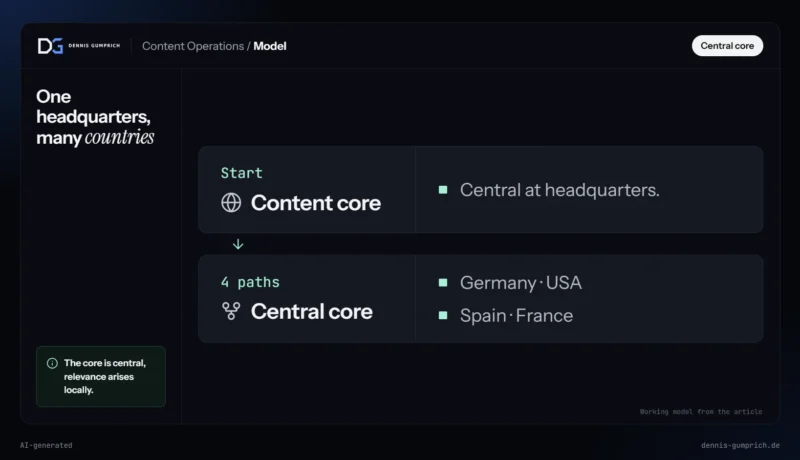

In March, headquarters finished the campaign package for the new product line: expert article, social posts, images, press text, all approved. It went out by email to fourteen sales subsidiaries.
Now it is June. The Spanish subsidiary published its own translation in May, with the product image of the previous version. The colleagues in Thailand did not use the package and made their own posts because the examples did not fit the local market. Colombia is asking for the press text that was attached in March. And when management asks in how many countries the campaign ran, headquarters can only guess.
Creating centrally and delivering locally works when three things are clear: what is fixed in the core and what the countries may adapt, where the core and the country versions are kept together, and how the countries report back what they did with it. Localizing is more than translating. With stored country profiles, AI can deliver the local first version, so small country teams review instead of rewriting. The core is approved once centrally; in the country, only the adaptation is checked.
What does it mean to create content centrally and deliver it locally?
Headquarters develops the content core of a communication: core message, verified facts, approved statements, images and templates for the channels. The countries, subsidiaries or locations adapt this core to their market, that is, language, examples, product range, law and channels, and publish it. In technical terms, this is called the hub-and-spoke model.
The image comes from the spoked wheel. Headquarters sits in the hub, and the spokes lead to the countries. The idea is strikingly simple: what applies everywhere is done well once. What differs locally is decided locally. Each side does what it does best.
In practice, the model looks similar in very different organizations. A machinery manufacturer with one headquarters and fifteen sales subsidiaries worldwide. A chemicals company that sells in more than eighty countries and has one marketing manager per region. An industrial company with a website in seventeen languages. An association with a head office and nine regions. A platform that provides content for hundreds of car dealers. They all face the same question: how much do we prescribe, and how much do we leave to the local units?
Which organizational forms exist between central and decentralized?
Four basic forms: fully central, hub and spoke, federated and fully decentralized. They differ in who creates content and who may adapt it. Most internationally active mid-sized companies work according to hub and spoke, often without calling it that.
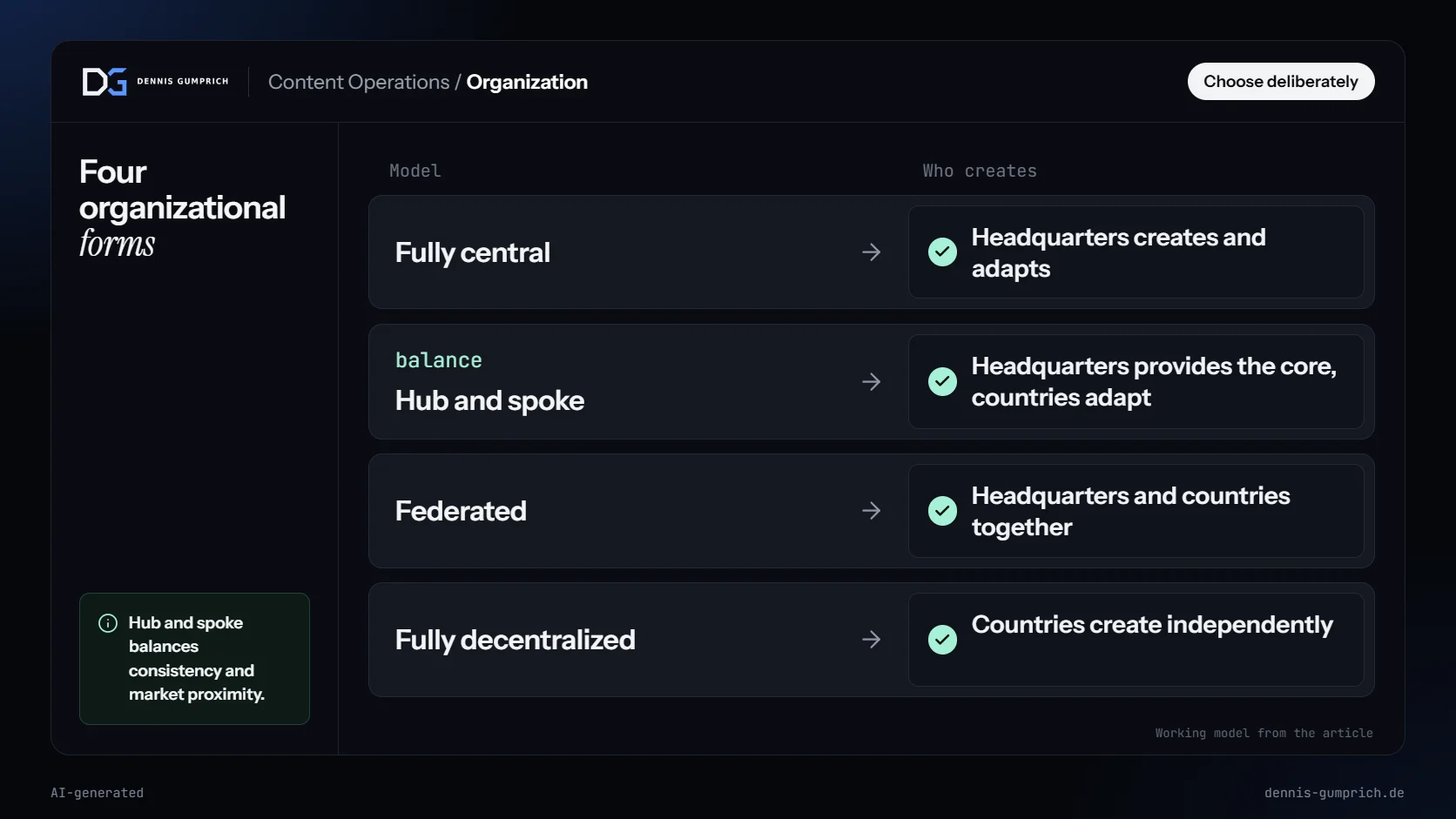
| Form | Who creates | Who adapts | Strength | Risk |
|---|---|---|---|---|
| Fully central | Headquarters | Headquarters, translated | uniform brand | misses local markets |
| Hub and spoke | Headquarters the core | Countries within a defined framework | balance of consistency and proximity | unclear framework, unused packages |
| Federated | Headquarters and countries as equals | each themselves | high local relevance | duplicate work, brand deviation |
| Fully decentralized | Countries | Countries | maximum market proximity | no common line |
No form is right in principle. A manufacturer with a globally identical product and small country teams comes close to the central form. A group with independent national subsidiaries, different product ranges and large local marketing departments tends to work in a federated way. The problem does not arise from the choice of form, but from the fact that it was not chosen explicitly. Then headquarters has a hub-and-spoke model in mind, and the countries live a federated one.
A special feature of many mid-sized companies is markets without their own subsidiary that are served via distribution partners. These partners are not spokes in the actual sense, because they are neither subject to instructions nor have their own marketing capacity. They need finished, localized content that they can use with as little adaptation as possible. Treating them in the same process as your own subsidiaries overwhelms them.
Where does the model fail in practice?
In six recurring places: content is distributed by email instead of in a shared place, it is translated instead of localized, feedback is missing, brand guardrails are unclear, country teams have no capacity for adaptation, and approvals run twice.
- Distribution by emailThe package goes out as an attachment and is therefore a copy from day one. Every later correction from headquarters no longer reliably reaches the countries, and nobody knows which version is used where.
- Translation instead of localizationThe text is translated literally, while examples, units of measurement, product range and reference customers remain those of the headquarters country. The result is correct and still unsuitable for the local market.
- No feedbackHeadquarters does not find out whether and how a package was used. This removes the basis for improving packages or allocating resources sensibly.
- Unclear guardrailsWithout defined limits, countries also change statements that should be fixed for legal or brand-strategic reasons, or they do not dare to make any adaptation at all.
- Missing capacity on siteMany country teams consist of one person with sales duties. A package that first has to be adapted laboriously is left lying around.
- Double approvalsThe core is approved centrally and checked again in full in the country, instead of only checking the adaptations. Weeks pass before it is published locally.
The most revealing figure is rarely reach, but the usage rate: how many countries actually published a central package, and how many of them within four weeks? If you do not know this figure today, that is already the most important finding.
What belongs in the central core?
Everything that must apply equally in every country: the core message, approved statements and facts, images with cleared rights, templates for the channels, brand voice rules and a short briefing for the countries. What matters is defining for each element whether it is fixed, adaptable or free.
The distinction between fixed, adaptable and free is the most important tool in the whole model. It answers in advance the question that is otherwise asked anew in every single alignment: may we change this?
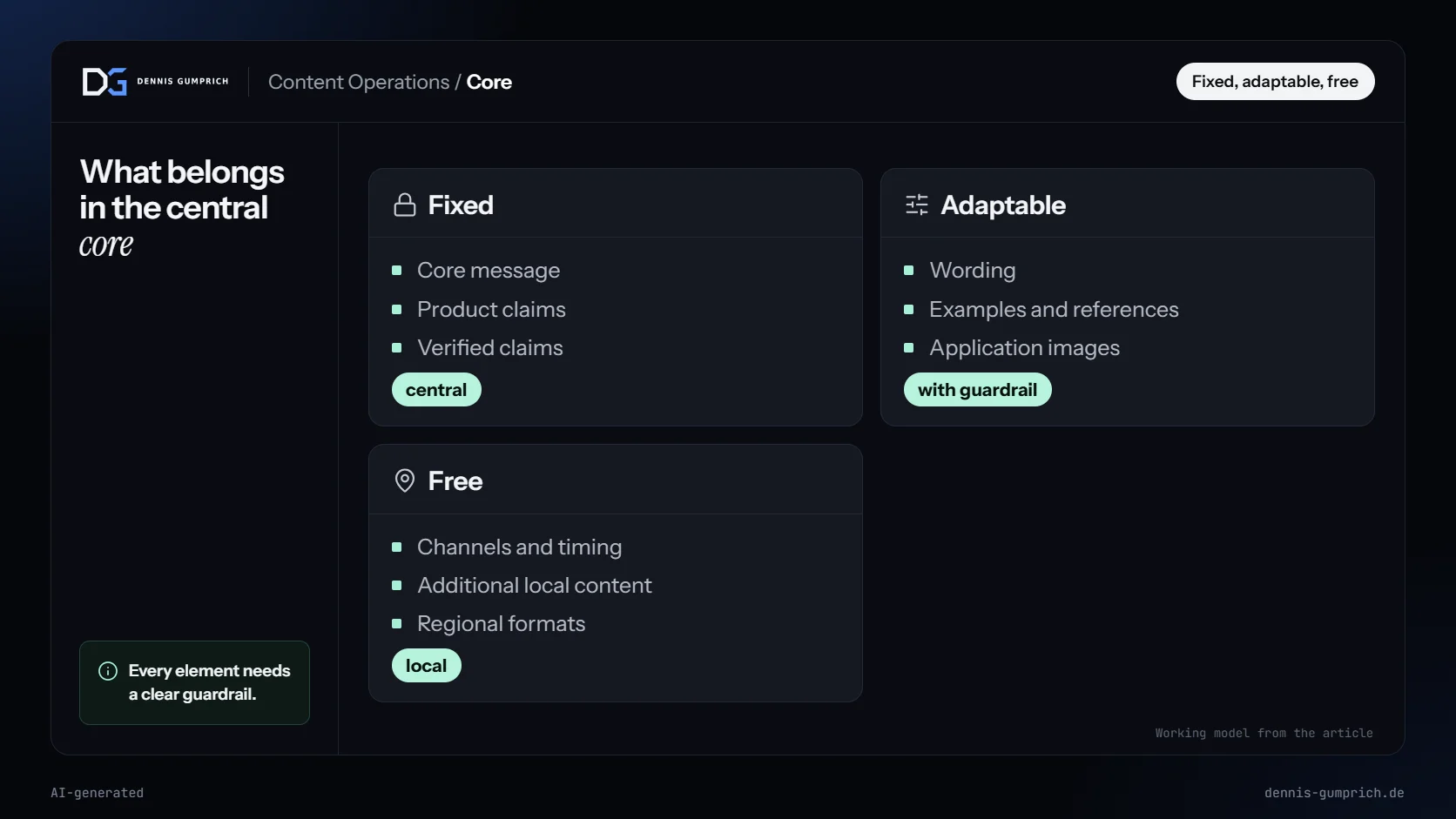
| Element | Fixed | Adaptable | Free |
|---|---|---|---|
| Core message | statement | wording | |
| Product claims and performance values | yes | ||
| Legally reviewed claims | yes, only locally extendable | ||
| Examples and use cases | yes | ||
| Reference customers | yes, local ones preferred | ||
| Images | product images | application images | |
| Channel selection and timing | yes | ||
| Additional local content | yes, within the brand framework |
If you fill in this table once for your own content, you usually find that headquarters has so far defined either too much or too little. Too much if countries do not dare to swap an example and therefore leave the package unused. Too little if performance values or legally reviewed statements are reworded locally until they are no longer correct.
The briefing for the countries should be short. Half a page is enough: what it is about, why now, what is fixed, what should be adapted, by when, and whom to contact with questions. Longer briefings are simply not read in one-person country teams.
Localizing instead of translating: what really changes per country
Besides the language, form of address and tone change, as do examples and references, product range and availability, units of measurement and standards, legal requirements, channels, imagery and timing. A translation only covers the first point.
| Area | Example |
|---|---|
| Form of address and tone | formal or informal address (such as vous or tu, Sie or du), formality, directness of statements |
| Examples and references | local customers, well-known applications, regional industries |
| Product range and availability | variants not available in the country, different delivery times |
| Units of measurement and standards | metric or imperial, national standards and certificates |
| Legal requirements | advertising claims, environmental claims, health claims, mandatory notices |
| Channels | which networks, trade media and formats are relevant in the country |
| Imagery | people, settings, cultural codes |
| Timing | public holidays, trade fairs, holiday periods, fiscal year |
This list explains why central packages so often remain unused. For a country manager who also supports sales on the side, adapting a package to all these points is a task of several hours. If she does not have this time, she would rather write a short post of her own that fits than use a central package that does not.
How do you translate marketing content quickly for different markets?
With a division of labor by content type: machine translation with a stored glossary for running text, transcreation by people for claims, headlines and campaign messages, and a review in the country that only looks at terms, local examples and legal notices. Translation does not become fast through the tool, but through reusing the glossary and approved wording instead of creating them anew each time. The five-step process with glossary and review rules is described in Translating marketing content for other markets.
| Content type | Method | Review in the country |
|---|---|---|
| Expert article, product description, FAQ | Machine translation with glossary and translation memory | Technical terms, units of measurement, availability |
| Social media post from approved core | AI derivation based on the country profile | Tone, form of address, local examples |
| Claim, headline, campaign message | Transcreation by native speakers | Effect and ambiguity in the market |
| Legal texts, regulated statements | Specialist translation | Legal approval in the country |
Two building blocks save the most time. The glossary defines what product names, technical terms and brand terms are called in each language and which are not translated. The translation memory stores sentences that have already been approved, so recurring passages do not have to be reviewed again. For websites, the technical side also belongs here: language versions are linked via hreflang annotations so that Google can show users the right language or country version. The link must be reciprocal: if two pages do not refer to each other, Google ignores the annotations.
Google draws a line not at the technology, but at the added value. The "Spam policies for Google web search", as of September 2, 2026, treat "scaled content abuse" regardless of how the content is created. As examples, Google names, among others, large numbers of AI-generated pages without added value and the automated translation of third-party content. This example concerns third-party content, not your own. But the guideline behind it, mass without added value, can be applied to country pages. For you, this means: only create a country version when it adds something of its own for the market, such as local examples, availability or contacts. One limitation: this is a platform guideline that Google interprets itself.
Country profiles: how AI delivers the local first version
A country profile records what applies to a country: language, form of address, tone, preferred and prohibited terms, active channels, product range, legal notices and contacts. With this profile, AI can create a localized first version from the central core. The country team reviews and adds, instead of rewriting.
This is the biggest lever AI offers for international communication, and it is often underestimated. The obvious use is machine translation, which has long been good. The real gain arises when AI does not just translate, but takes into account the points from the table above, because they are stored for each country.
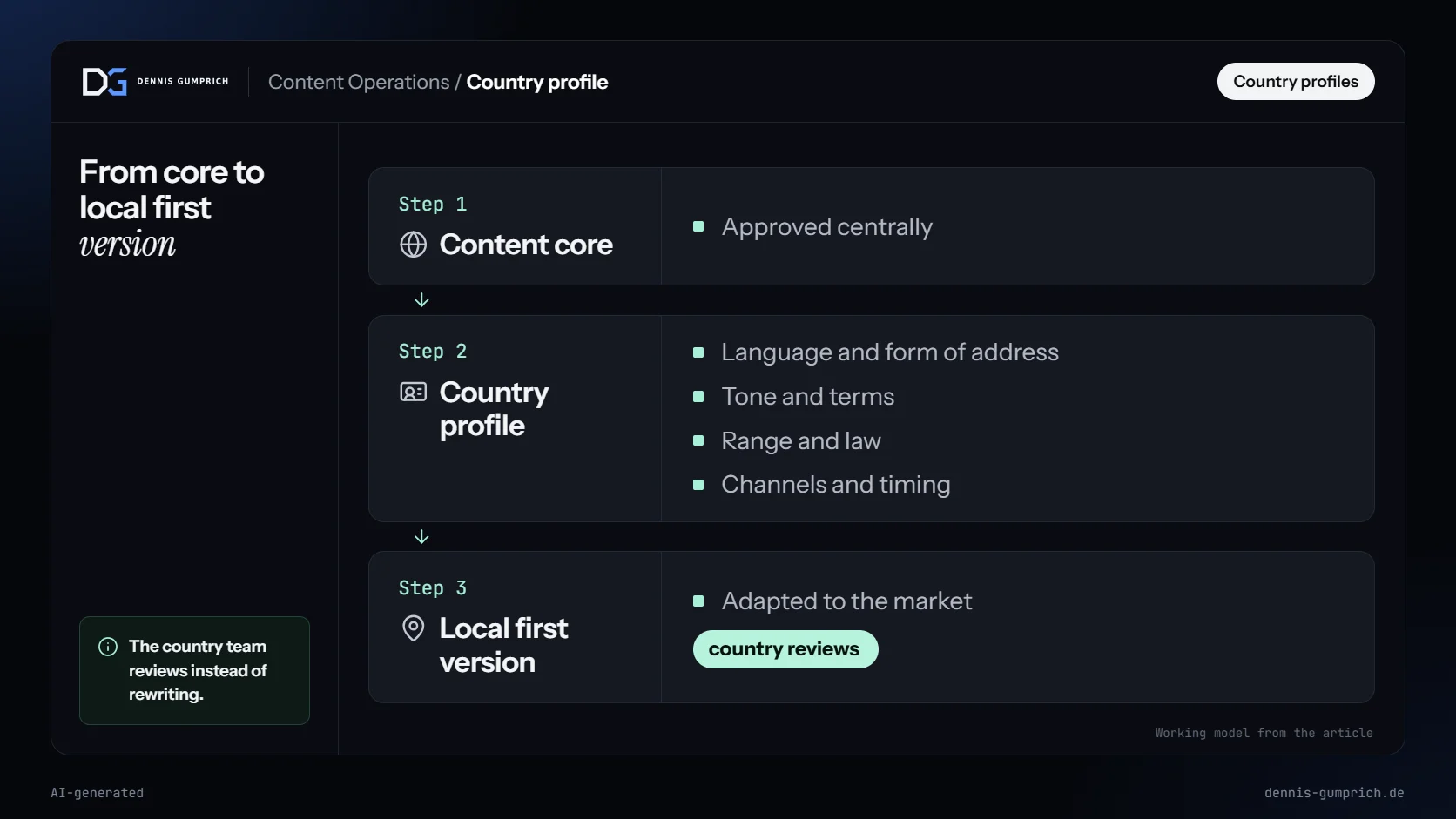
The core is translated into Spanish. The examples refer to customers in the headquarters country, the variant with a 400-volt connection is mentioned although it is not offered there, and the tone is as formal as in the original.
The first version uses the stored form of address, replaces the example with an application from the local market, leaves out the unavailable variant and adds the local mandatory notice. The country team reviews in twenty minutes instead of writing for two hours.
This fundamentally shifts the work on site. Small country teams are no longer asked to create content or adapt it laboriously, but to review an almost finished version that already speaks their language. That is the task they are needed for: they know the market and can judge whether something works there. AI takes over the wording work they lack the time for.
A country profile is not created all at once. Start with what country teams correct most often today. These corrections are the best rules, and they can be read out of the last ten adapted pieces of content in an hour. How to store brand voice in principle so that AI can apply it is described in Storing brand voice.
How do you organize approvals across countries?
In two stages: the core is approved once centrally in terms of content, brand and law. In the country, only what was adapted is checked, that is, language, local examples and local legal questions. Checking the core again in full in the country doubles the lead time without increasing quality.
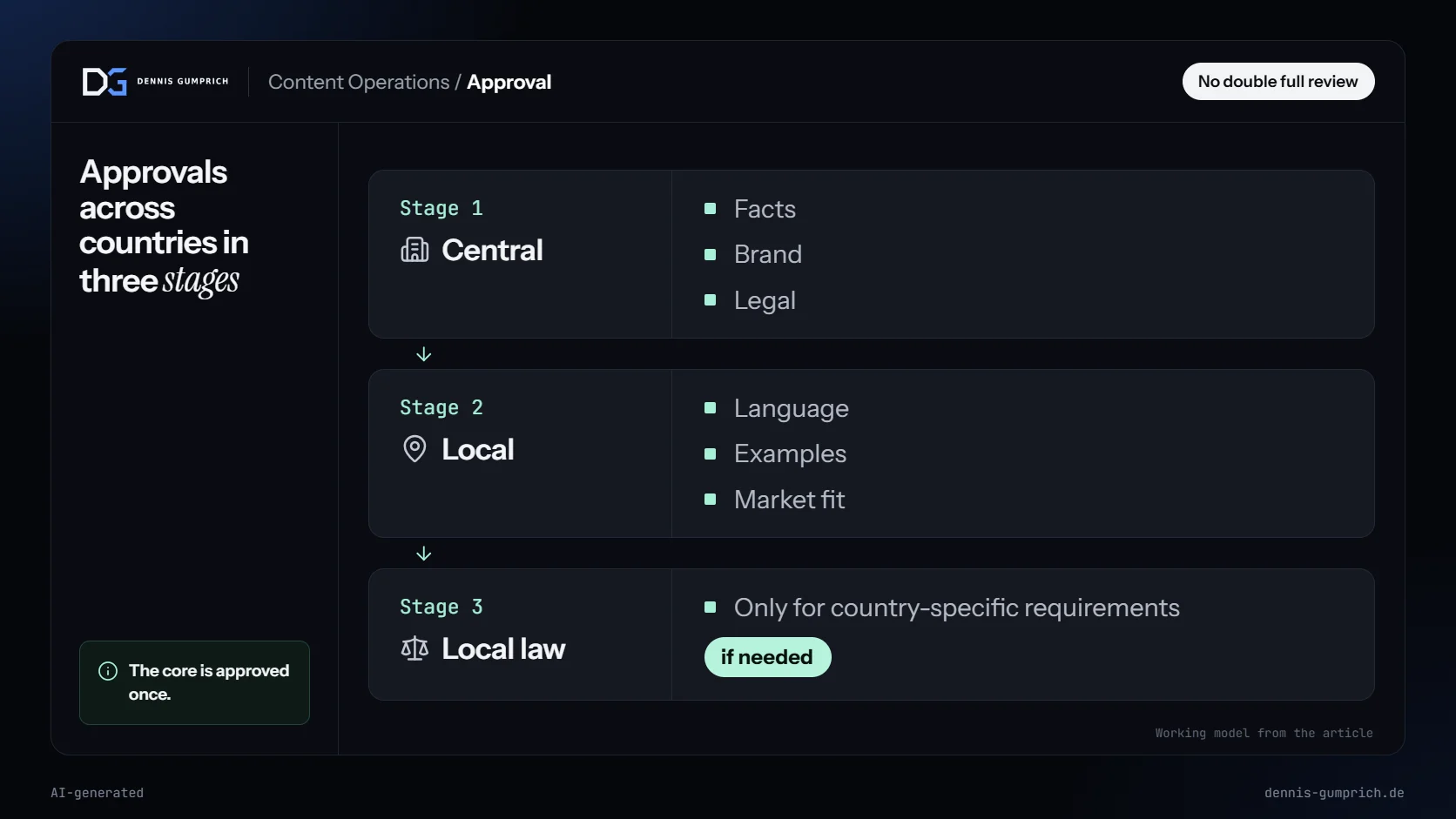
- Stage 1Central approval of the coreContent, brand, legal. Once, with a deadline and clear responsibility. After that, the core counts as approved for all countries.
- Stage 2Local review of the adaptationThe country team checks language and local fit. Only the adapted parts are checked; the fixed elements are already approved and must not be changed.
- Stage 3Local legal review where necessaryOnly for content with country-specific legal questions, such as health or environmental claims. Which content types this applies to is defined once, not discussed per piece of content.
For this separation to work, fixed elements must actually be fixed in the tool, or changes to them must become visible. Otherwise, the countries rely on the core being approved, and headquarters relies on nobody having changed it. Both are only true if this is technically secured. More on approvals with fixed deadlines in the article Shortening approval processes.
An often overlooked point is people who only read along. In international organizations, many people want to see what is happening in other countries without editing themselves: the managing directors of the subsidiaries, product management, sales. Planning a full license for each of these people makes the model unnecessarily expensive. Excluding them creates email distribution lists and copies. An observer access without editing rights solves both.
Who does what? Roles between headquarters and countries
| Role | Responsible for | Decides |
|---|---|---|
| Content lead at headquarters | Core, packages, schedule, country profiles | What is fixed and what is adaptable |
| Brand owner | Brand voice, imagery, guardrails | Whether an adaptation is within the brand framework |
| Country manager | Local version, channels, feedback | Whether and how a package runs in the country |
| Expert approval | Accuracy of the core | Whether the core is approved |
| Local legal review | Country-specific legal questions | Whether local statements are permitted |
The most important role in this table is the third, and in many companies it is not explicitly assigned. If nobody in the country is responsible for ensuring that central packages are reviewed and published, it happens by chance. The role does not have to be a full-time job, but it needs a name and a deadline. How roles and decision rights are regulated in principle is described in the article on the corporate newsroom, whose management logic transfers well to international structures.
Transparency: who delivered what?
For each package, each country reports one of three states: adopted, adopted with adaptations or not used, in the last case with a one-sentence reason. Added to this is the link to the publication. With this information, usage, speed and impact per topic can be evaluated across all countries.
The reason for unused packages is the most valuable information in the entire model. It shows which topics have no relevance in which markets, which formats do not fit and where the framework was set too narrowly. A headquarters that collects this feedback over a year can improve its packages in a targeted way and concentrate its capacity on the topics that actually work internationally.
For the feedback to work, it must be a by-product of the work, not additional effort. If country versions are created in the same environment as the core, the status is automatically visible. If they are supposed to be reported back by email, it stops happening after the third package. This is the same mechanism that makes planning spreadsheets go out of date.
Managing several brands: what sits centrally and what each brand decides itself
You manage several brands like several countries, with one difference: for countries, language is the biggest adaptation; for brands, it is the voice. Process, platform, shared facts and the topics that affect all brands sit centrally. Each brand decides itself on brand voice, channels, imagery and brand-related approval. So that the voices do not blur, each brand needs its own brand profile, especially for AI.
The same logic as for countries applies wherever brands are the spokes: in a holding company with several brands, in an association with member organizations and companies, in a company with independent product brands. Everywhere there are topics that affect everyone, and senders who have to sound different.
How closely the brands are linked determines the setup
Following the model by David Aaker and Erich Joachimsthaler, brand management distinguishes between a branded house under which all offerings appear, brands that appear independently and are endorsed by the corporate brand, and a house of independent brands. For content management, this determines how much you can share.
| Brand architecture | What you share | What stays separate |
|---|---|---|
| Branded house: one sender, several offerings | Brand voice, topic plan, channels, imagery | Subject focus and contacts per offering |
| Endorsed brands: own brand, company as sender in the background | Process, platform, fact base, cross-cutting topics such as corporate news | Brand voice, channels, imagery |
| Independent brands in a portfolio | Process, platform, role model, legal and compliance requirements | Almost everything content-related: topics, voice, channels, approvals |
The brand matrix: what sits centrally, what per brand
| Building block | Central | Per brand |
|---|---|---|
| Process and status | One process with the same statuses for all brands | Additional review steps where a brand needs them, for example for regulated products |
| Topic plan | Cross-cutting topics with a shared core | Brand-specific topics and priorities |
| Fact base | Company facts, key figures, approved statements | Product knowledge of the brand |
| Brand voice and AI context | Shared basic rules, for example on form of address, labeling and taboo topics | Own brand profile with tone, terms and sample texts |
| Approval | Expert approval of the shared core | Brand approval of the respective version |
| Channels and accounts | Company-wide channels such as newsroom or careers page | Brand channels with their own responsibility |
| Evaluation | Per topic across all brands | Per brand and channel |
Separate voices, for AI too
A topic told factually for the corporate brand and personally for a consumer brand needs a shared core and separate brand profiles. If these profiles are not cleanly separated, the voices blend, especially as soon as AI writes along. Separate projects per brand with their own brand voice and shared access to the core are therefore the basic prerequisite.
A simple test shows whether the separation holds: have the AI write the same topic for two brands and show both versions without sender to three colleagues. If they cannot assign the versions to the brands, the brand profiles are too general. How a robust profile is structured is described in Storing brand voice.
Roles and rights between headquarters and brands
Headquarters is responsible for process, platform, the shared core and the shared basic rules. Each brand has one person who decides on brand voice and brand approval. Brand teams see the shared core and the versions of the other brands, but only edit their own. This prevents a brand from accidentally publishing in another brand's voice, while still making visible what the others have made from the same topic.
Where the shared basic rules end and brand freedom begins is a core question of your content operations. Define it in writing before the first cross-brand campaign starts, otherwise it will be renegotiated in every approval.
How do you manage content projects for several brands and countries?
With a fixed structure on three levels: brand, country, topic. The core of a topic sits centrally once and is derived from there into countries and brands, instead of being created anew in each unit. Each unit has its own profile with language, tone and channels, and each derivation has its own status. This way, headquarters sees in one place which country has adopted, adapted or discarded which package.
Three rules keep the structure stable. First: access rights follow the structure; countries see the core and only edit their version. Second: templates and images sit centrally and are linked, not copied. Third: feedback from the countries is part of the process and not a voluntary extra task. Without it, headquarters does not know which content actually lands in the markets.
How do you introduce the model?
In six steps: take stock, define core and guardrails, create country profiles for two to three pilot countries, take a pilot topic through all pilot countries, evaluate the feedback and only then expand to all countries.
- Step 1Take stockWho creates what today, in which country, with which tool? Which central packages were there last year, and how many were used? The answers are usually sobering and therefore the best basis.
- Step 2Define core and guardrailsFill in the fixed, adaptable and free table for your most important content types and align it with brand, legal and two country managers.
- Step 3Country profiles for pilot countriesTwo to three countries of different size and language. The profiles are created from the most frequent corrections of recent months.
- Step 4One pilot topicA real topic with a real date, from the core via the local first version to publication in all pilot countries, in a shared environment.
- Step 5EvaluateUsage rate, time to live, effort per country and the assessment of the country teams. What took work off their hands, what created additional work?
- Step 6ExpandOnly when the pilot topic ran faster and with less effort in all pilot countries than before. Further countries come in groups, not all at once.
The fourth step should not take place with the most important topic of the year. Choose a topic of medium importance where a delay does no harm but real publications are created. A pilot with test content does not show what happens in everyday work. More on the structure of such pilots in the article Pilot and rollout.
A note about myself
I work for contentbird. There, countries or brands can be mapped as separate projects with their own brand voice, with shared access to central topics, workflows for central and local approval, observer access without license costs and AI-assisted localization. Finished country versions can be handed over via MCP directly into the respective CMS, even if countries use different systems. The idea of this article, namely that country teams review instead of rewriting, is exactly the scenario we implement most often in projects with internationally organized companies.
Five mistakes in the introduction
- All countries at onceIf you start with fifteen countries, you spend the first months on alignment instead of learning. Start with two to three.
- Not involving the countriesA model designed at headquarters and communicated to the countries is experienced there as control. Bring in two country managers from the start.
- Fixing everythingGuardrails that are too tight lead countries to ignore packages and make their own content. The opposite of the goal.
- Treating partners like subsidiariesDistribution partners without marketing capacity need finished content, not adaptation assignments.
- Starting without feedbackIf you do not know what happens in the countries, you can neither improve the model nor justify it.
When does the model not fit?
If your countries essentially run different businesses, with their own products and their own target groups, or if you only serve a second language without an independent market. In the first case, a federated structure is more suitable; in the second, a good translation is enough.
Hub and spoke depends on there being a shared core that makes sense in all countries. If the national subsidiaries are effectively independent companies with their own positioning, a central core would be an artificial bracket. Here it makes more sense to organize a shared brand basis and an exchange of good content, instead of distributing packages.
Conversely, a company that also offers its website in English, without its own sales structure abroad, does not need a spoke model. A clean translation process with a glossary is enough here.
Self-check: how well does your model hold up between headquarters and countries?
Tick everything that applies to you.
A quick assessment of how we manage content across countries:
We create content centrally and distribute it to the countries. How much of it is actually published locally, how quickly and in which version, we do not reliably know today. The most common reasons for unused packages are missing capacity on site, content that does not fit the local market and unclear rules about what may be adapted.
Proposal: we define for each content type what is fixed, adaptable and free, store profiles with language, tone, product range and legal notices for two to three pilot countries and have local first versions created from them. The country teams review instead of rewriting. The core is approved once centrally.
After one pilot topic, we measure usage rate and time to local publication and decide on expansion.
Conclusion: headquarters delivers the core, the countries the proximity
Creating centrally and delivering locally is not a compromise between uniformity and market proximity, but a division of labor in which both sides do what they do best. It rarely fails because of the idea, but because of three practical gaps: unclear guardrails, scattered copies instead of one shared place and missing feedback.
AI changes the model at a decisive point. It takes the wording work off the countries' hands, for which they lack the time, and leaves them the task for which they are irreplaceable: judging whether something works in their market. This turns the package sitting in the inbox into a country version that only needs to be reviewed.
Frequently asked questions
How do we manage several brands without the brand voices blurring?
With a shared core and separate brand profiles. Facts, process and cross-cutting topics sit centrally; brand voice, sample texts and approval sit per brand. The AI only accesses each brand's own profile. An assignment test shows whether this holds: if colleagues can recognize without sender which version belongs to which brand, the profiles are sharp enough.
Isn't machine translation enough?
For the language yes, for the market no. Examples, product range, units of measurement, legal notices and tone remain unchanged with a pure translation. Only with stored country profiles is a version created that the country team only has to review.
How much freedom should the countries get?
As much as possible for examples, channels and timing, as little as necessary for product claims and legally reviewed claims. The fixed, adaptable and free table helps define this per content type. If countries often leave packages unused, the framework is usually too narrow.
What about countries that use a different CMS?
That is the rule in organically grown structures. What matters is that core and country versions are created in a shared working environment. The handover to the respective CMS can then differ per country. How this works without copy and paste is described in the article The last mile into the CMS.
How do we deal with distribution partners without their own marketing department?
As a separate group. They get finished, localized content for direct use, ideally with simple access without editing rights. Adaptation assignments overwhelm them and result in nothing being published at all.
Who should maintain the country profiles?
The country managers, with support from headquarters. They know the rules of their market best. Headquarters makes sure the profiles are complete and up to date and do not contradict the brand voice. An annual review is enough in most cases.
How do we convince the countries of the new model?
By demonstrably taking work off their hands. A pilot in which a country team reviews an almost finished country version in twenty minutes instead of adapting it for two hours is more convincing than any presentation. Involve two country managers from the start so that the model is not perceived as control by headquarters.
How do I organize content processes for several international locations?
With a central core and clear leeway for the countries. Headquarters is responsible for messages, approved modules and brand rules; the countries adapt examples, form of address and dates and approve locally. What matters is one shared source for all content and a workflow that shows which country version is at which stage.
Which software supports alignment between headquarters and regional marketing teams?
A content platform in which central templates, country versions and approvals are kept in one place. Make sure that countries can derive content from central modules, that roles and rights can be set per country and that translations with a glossary run within the process. Further criteria are collected in the evaluation matrix for content software (in German).
Where does your content process lose time today?
In 30 minutes, we look together at where unnecessary coordination, manual tasks, tool switching or repetitive content work cost you time today.
You get a concrete assessment of which tasks you can simplify, automate or organize better, and where AI and tools actually help instead of adding complexity.
Analyze your content process in 30 minutes Free of charge. You take away concrete starting points you can use internally right away.
Dennis Gumprich
Dennis helps marketing and communication teams fit generative AI into existing content processes without undermining quality, brand voice and approvals. Focus areas: content operations, AI governance and tool selection in mid-sized companies and corporations.
Transparency note: Dennis works for contentbird, a provider of AI-powered content software. Product mentions are marked in the article. More about Dennis (in German) · LinkedIn
Read more
Sources
- Jeremiah Owyang, Altimeter Group: Framework and Matrix: The Five Ways Companies Organize for Social Business, blog post of April 15, 2010: organizational models from centralized via coordinated to hub and spoke, in which business units work semi-autonomously and are connected to a central group. Originating in social media organizational design. Accessed October 31, 2026.
- DeepL: Glossary, product page: glossaries define how technical terms, product and brand names are translated, ensuring consistent terminology. Accessed October 31, 2026.
- Google Search Central: Tell Google about localized versions of your page, documentation, as of September 21, 2026: hreflang helps Google direct users to the right language or regional version, reciprocal references are mandatory, implementation via HTML, HTTP header or sitemap. Accessed October 31, 2026.
- Google Search Central: Spam policies for Google web search, documentation, as of September 2, 2026: scaled content abuse regardless of how content is created, examples include using AI for many pages without added value and automated rewriting or translation of third-party content. Platform guideline without its own data. Accessed October 31, 2026.
- David A. Aaker, Erich Joachimsthaler: The Brand Relationship Spectrum: The Key to the Brand Architecture Challenge, California Management Review, volume 42, issue 4, 2000: spectrum of brand architecture from the branded house via sub-brands and endorsed brands to the house of brands. Accessed November 1, 2026.
How this article was created
This article was created with the help of AI. Structure, research and draft wording were developed with AI support. Professional assessment, review of the statements and the final version are the responsibility of Dennis Gumprich. The English version was translated with AI and reviewed. Read the original German version.
How reliable are the statements?
Evidence exists for the term hub and spoke from the Altimeter organizational model, for the function of glossaries in machine translation using DeepL as an example, for how hreflang works from the Google documentation and for the classification of mass-produced pages without added value as scaled content abuse in the Google spam policies (platform guideline; applying it to your own country pages is the author's own interpretation). Evidence also exists for the distinction of brand architectures according to Aaker and Joachimsthaler. The organizational forms, the division into fixed, adaptable and free, the time frames, the application to content management, the brand matrix and the assignment test are working models from conversations with internationally organized marketing and communications teams and from consulting practice. The company constellations mentioned are anonymized and describe typical patterns, not individual cases. Update history: supplemented on November 1, 2026 with the section on managing several brands. Status: November 1, 2026.


