
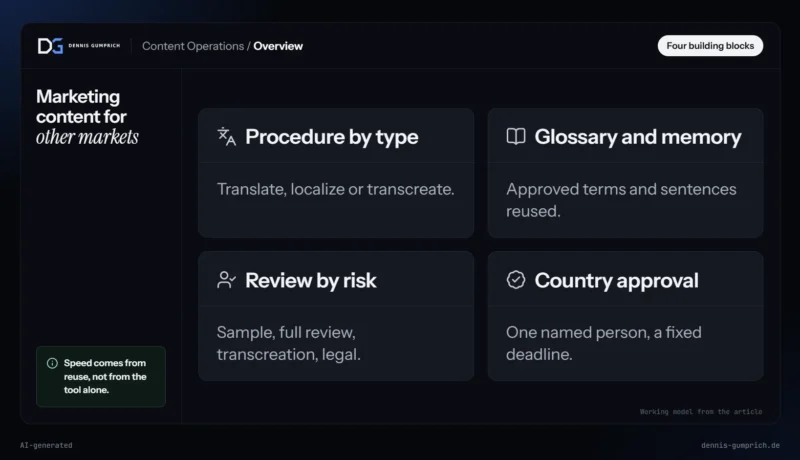

You translate marketing content quickly when you do not treat every text the same. Expert texts and product data run through machine translation with a glossary and translation memory, and a native speaker reviews them by fixed rules. Claims, campaigns and humor are transcreated, legal statements get subject matter approval. Speed comes from reused terms and clear country approvals, not from the translation tool alone.
What makes translations for several markets fast?
A fixed workflow that specifies the right procedure and the right review depth for each content type. Machine translation delivers the first draft in minutes. Time is lost afterwards: on terms that are discussed anew every time, on texts that should not be translated at all but rewritten, and on country approvals without deadlines.
The tools have long been in use in many teams. In the Trendmonitor Interne Kommunikation 2026 by Staffbase and SCM, a survey of 431 internal communications professionals, 72.4 percent of AI users name translation programs such as DeepL, the second most common use after text AI. What is missing is rarely the tool, but the process around it: who decides when a machine version is enough? Where are the approved terms? Who reviews in the country, and by when?
This use is not new. Back in the study "Digitalisierungsgrad 2023" (in German) by bvik, the German association for B2B marketing, 42 percent of the 191 companies surveyed used AI in marketing, most frequently for content creation and translation. If translation was already among the most common applications in 2023, it is all the more worthwhile to define the process around it now instead of waiting for the next tool. One caveat: this is a historical value from 2023 from an association survey with a small sample.
This article describes the practical translation and localization process. How to set up headquarters and countries in principle, meaning who delivers the core, who may adapt and how feedback works, is covered in One headquarters, many countries: create content centrally, deliver locally. The two articles complement each other: there the governance model, here the work on the individual language version.
When is a translation enough, and when do you need transcreation?
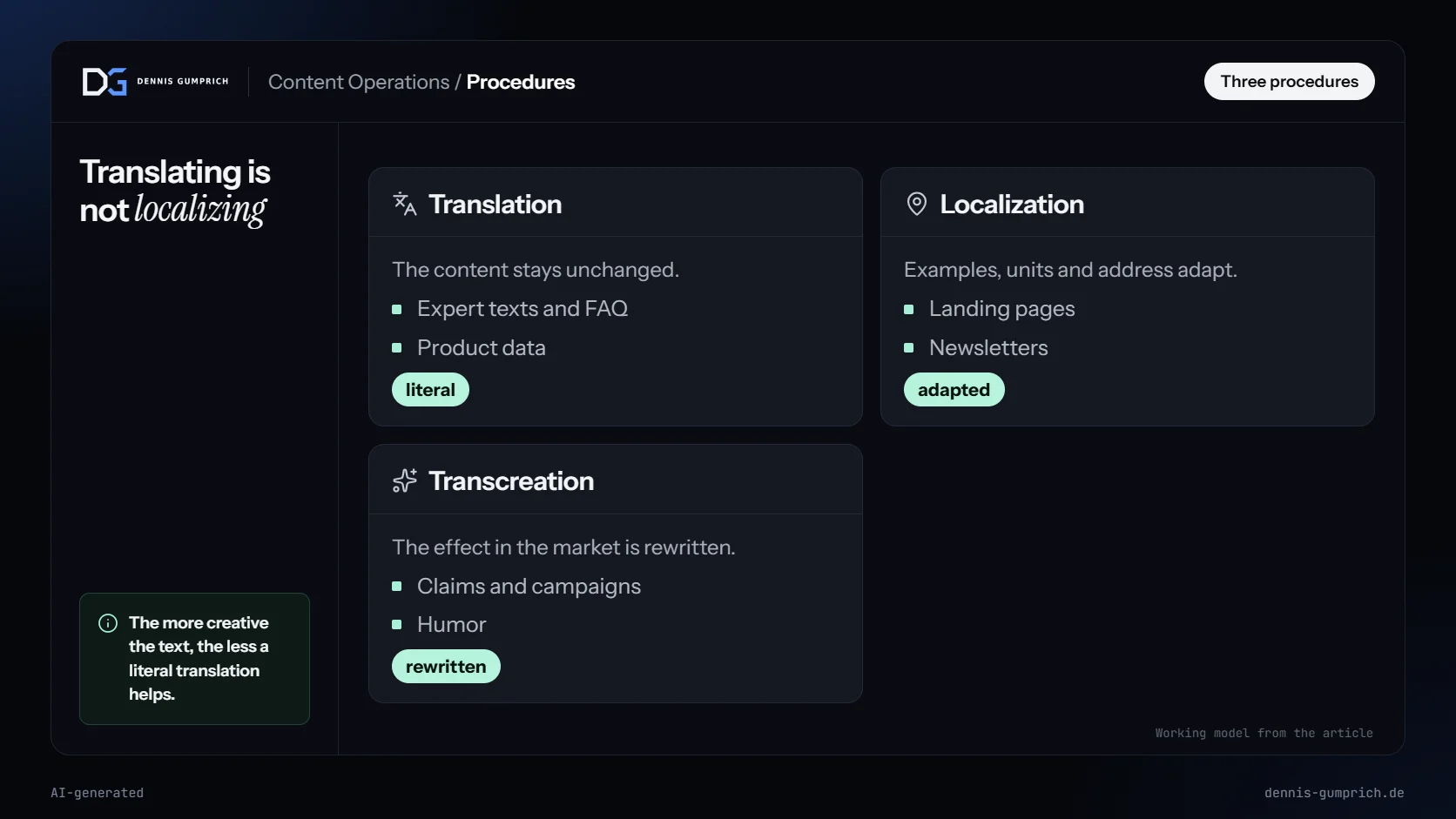
A translation is enough when the content is supposed to do the same in every market and lives on facts: expert articles, product data, help texts, FAQ. You need localization as soon as examples, units, prices or form of address have to fit the market. Transcreation is necessary when a text lives on wordplay, rhythm, humor or cultural allusion, meaning claims, headlines and campaign messages.
The three procedures differ in their brief, not only in effort. For translation the brief is: render the same content correctly in another language. For localization: adapt the text so that it feels natural in the target market. For transcreation: achieve the same effect in the target market, even if that requires different words, images or arguments. A transcreated claim can be so far from the original that a back-translation shows hardly any similarity. That is not a mistake but the purpose.
| Content type | Procedure | Why |
|---|---|---|
| Product data, technical descriptions, help texts | Translation | Facts, fixed terms, high repetition |
| Expert article, white paper, FAQ | Translation with localization of examples | The argument carries, examples and sources are often country-specific |
| Landing page, newsletter, social media post | Localization | Form of address, offer, dates and availability differ per market |
| Claim, headline, ad, campaign idea | Transcreation | Effect depends on language, sound and cultural reference |
| Guarantees, prices, health or environmental claims | Specialist translation with legal review in the country | Legal requirements differ per country |
For planning this means: define the procedure in the briefing, not only when the translation comes back. A campaign package usually consists of parts with different procedures. The body text of the landing page can be machine-translated and localized, headline and claim go into transcreation in parallel. Sending the whole package through a translation tool only pushes the work back into the correction loop.
What belongs in a glossary, and what is a translation memory for?
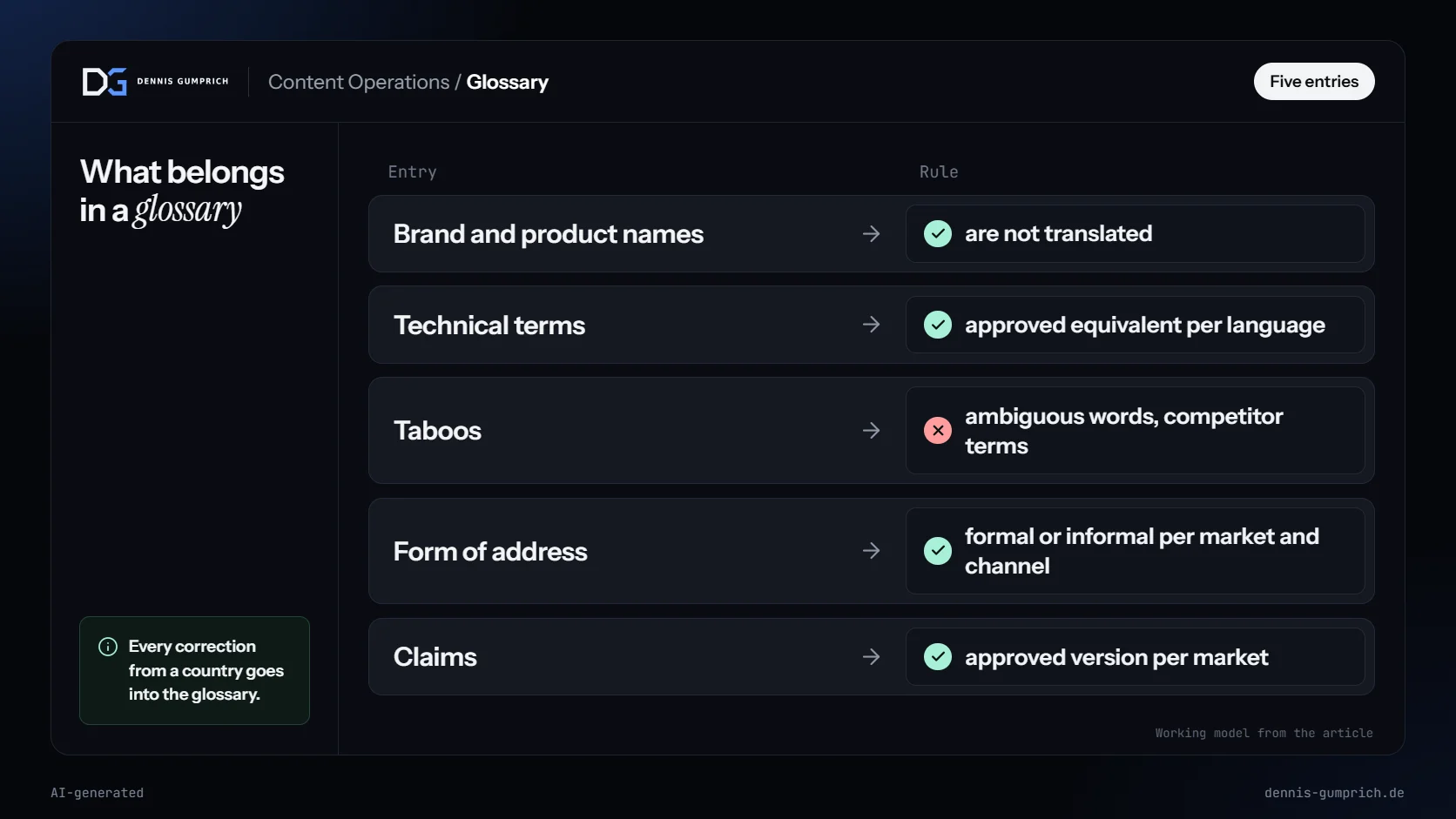
The glossary defines what individual terms are called in each language: product and brand names, technical terms, taboo words and the approved version of your claims. The translation memory stores whole sentences that have already been translated and approved and suggests them again when they recur. Together they ensure that you reuse approved wording instead of aligning it anew every time.
A glossary for marketing is not a dictionary. It only contains terms where a decision exists. These include names that must not be translated, technical terms with several possible equivalents, and words you deliberately avoid, for example because they are understood differently in the target market or because a competitor uses them as a brand. For each entry you need the approved equivalent, a short justification and the person who set it.
Machine translation services can apply such a glossary directly. DeepL describes its glossaries as a way to control how technical terms as well as brand and product language are translated, and stresses that they are more than search and replace: the defined terms are adapted grammatically to the respective sentence. Glossaries can be created for different language pairs. For the Pro Advanced and Ultimate plans, DeepL additionally offers a generator that creates glossary suggestions from existing sentence pairs in TMX or TSV format. Check the features for your plan directly with the vendor, they change constantly.
The translation memory shows its strength with highly repetitive content: product data, text blocks in newsletters, legal notices, teasers for recurring formats. Every approved translation becomes the template for the next. For this to work, the corrected version from the country has to flow back into the memory. If it stays in an email or a local document, the country corrects the same sentence again next time.
Glossary and brand voice belong together. If you store your tone, terms and wording rules for the AI anyway, add the language versions. How to go about it is covered in Storing brand voice, and how to give the AI further context on products and markets in Building a knowledge base.
How do you define the tone per market?
In writing, per market and channel, before the first translation is created. The most important single decision is the form of address: formal or informal. It shapes every sentence and can only be changed later with a lot of effort. Make it together with the country, not alone at headquarters, because that is where the feel for the audience's expectations lies.
Many languages distinguish forms of address, such as Sie and du in German, vous and tu in French or u and je in Dutch; English does not. This leads to a typical mistake: a German original with formal address is translated via an English intermediate version into French or Dutch, and the form of address comes out at random. So translate directly from the original wherever possible and specify the desired form of address.
Common tools support this too. DeepL offers a setting for formal or informal translation for selected target languages. According to DeepL support, these include German, French, Italian, Dutch, Polish, Portuguese, Russian and Spanish, and for Japanese there is a separate distinction between polite and plain tone. The setting determines the pronouns and the words that depend on them in the translation. It is available in the Pro applications and can be set via a parameter in the API.
Form of address defined per market and channel, two to three example sentences per language as reference, setting stored in the translation tool, deviations only with the country's justification.
Form of address switches between landing page and newsletter, translation runs via English, everyone in the country corrects by their own feeling, the result sounds different in every channel.
Tone involves more than the form of address: sentence length, directness, use of superlatives, use of humor. A sentence like "We are number one" can sound confident in one market and dubious in another, and comparative advertising is not regulated the same way everywhere. Record these points as short brand rules per language. They are just as useful for the people in the country as for the AI writing the first draft.
How does a translation process run in five steps?
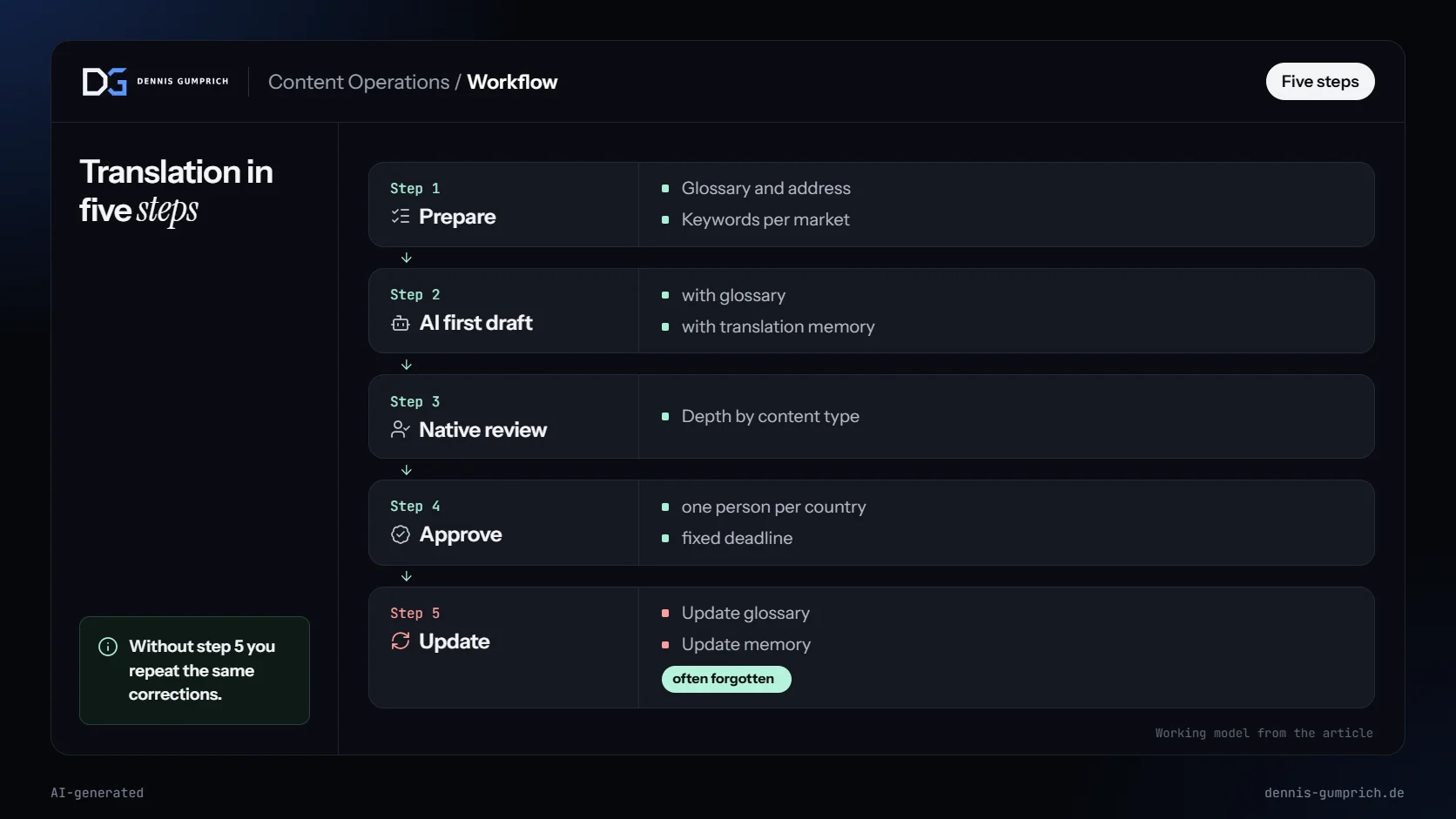
From the approved original through preparation, machine first draft, native-speaker review and country approval to maintaining glossary and memory. The fifth step is the one most often left out and costs the most time, because without it every correction comes up again with the next text.
- Step 1PrepareThe original is approved in terms of content. The procedure is defined per part, the glossary is up to date, the form of address per market is set, and for search-relevant content the search terms per market are available.
- Step 2Create the first draftMachine translation with stored glossary, memory and formality setting. Claims and headlines go into transcreation in parallel.
- Step 3Native-speaker reviewA person whose native language is the target language reviews by fixed rules, with a depth that depends on the content type. Corrections are made in the text, not as a note in an email.
- Step 4Approve in the countryOne named person per country approves, with a fixed deadline. Without feedback by the deadline, the reviewed version counts as approved, provided no legal review is pending.
- Step 5UpdateNew or changed terms go into the glossary, approved sentences into the memory. Recurring corrections become a rule in the brand voice.
One detail decides the speed of step 1: translate only once the original is approved. Every change to the original after translation has begun creates follow-up work in every language, and with five markets one correction quickly becomes half a week of coordination. If a deadline forces earlier translation, mark the parts that may still change and translate them last.
How do you combine AI translation with native-speaker review?
By setting review depth by content type and risk, instead of reviewing every text equally thoroughly or equally superficially. Product data with a maintained glossary needs a sample check, expert articles a full language review, claims transcreation and legal statements subject matter approval in the country. That way you use the scarce time of native-speaker reviewers where it prevents the most errors.
Reviewing a machine version is a different task from translating. The reviewer does not read sentence by sentence against the original but checks specifically the places where machine translation typically goes wrong: ambiguous terms, numbers and units, negations, form of address, proper names and statements that are regulated differently in the country. So give them a short checklist instead of the brief "please have a quick look over it".
| Review level | Typical content | What is checked | Who reviews |
|---|---|---|---|
| Sample check | Product data, help texts, recurring text blocks | Glossary terms, numbers, units, selected sentences | Native speaker in the team or in the country |
| Full language review | Expert article, newsletter, landing page body text | Clarity, tone, form of address, examples, flow | Native speaker with subject knowledge |
| Transcreation | Claim, headline, ad, campaign idea | Effect, ambiguity, cultural references, length in the layout | Native copywriter or agency in the market |
| Subject matter and legal review | Guarantees, prices, health or environmental claims | Admissibility of the statement in the country, mandatory information | Subject matter or legal department in the country |
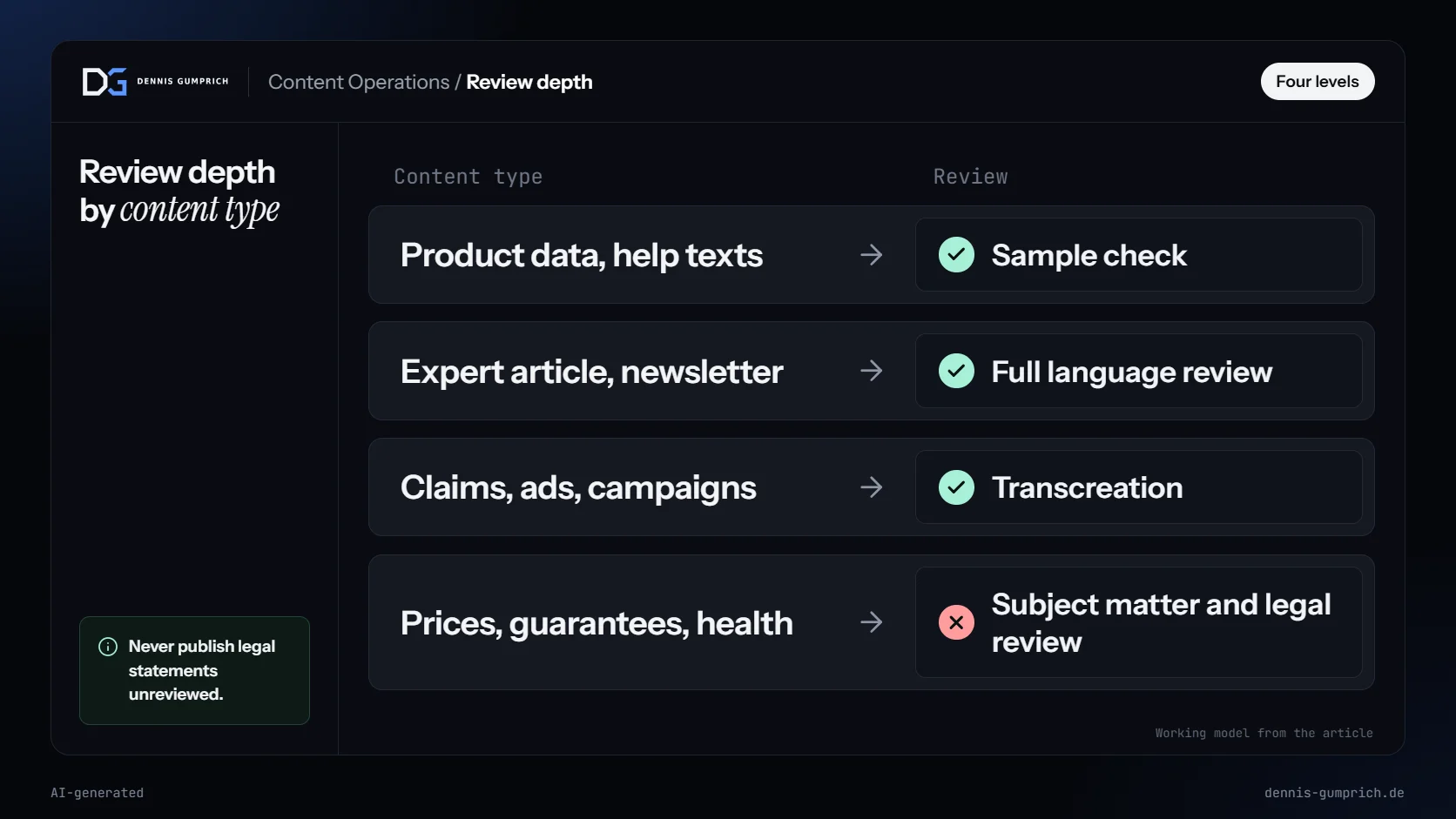
For reviewing AI texts in your own market there are already proven criteria: facts, sources, brand voice, clarity. They apply equally to language versions and can be extended by glossary, form of address and the legal situation in the country. A template for this is offered in Review criteria for AI texts.
Check not only the language but also the layout. Translated texts are often longer or shorter than the original. Buttons, subject lines, ad titles and social media previews have fixed character limits. A headline that fits in the source language can be cut off in another. So include the character limits in the transcreation brief.
How do you organize approval by the countries?
With one named person per country, a fixed deadline and a clear rule on what the country decides. The country approves language, tone and market fit, not again the content that has already been approved at headquarters. Without this distinction, country approval becomes a second content review and doubles the cycle time.
Slow approvals are not a special problem of international teams. In Cision's Inside PR 2026 study, 53 percent of the PR professionals surveyed cite slow approval processes as a structural obstacle. Every additional market adds another approval point, and the slowest market sets the pace of the campaign.
Three rules help. First: the deadline is set before sending and agreed with the country, not imposed. Second: corrections are made directly in the text and with a reason, so that they can be taken into the glossary or brand voice. Third: for content without legal statements, the reviewed version counts as approved once the deadline has passed. Countries that regularly do not respond usually lack capacity, and that is a question of roles, not discipline. How to shorten approvals overall is described in Approval processes: why three weeks is normal and how to halve it, and how to distribute responsibilities cleanly in Who does what in the content team.
What does multilingual SEO involve?
Separate keyword research per market, a separate URL per language version and clean labeling of language versions for search engines. Translated search terms are rarely the terms people actually search for in the target market. Simply translating the focus keyword from the source language may mean optimizing for a term nobody in the country types in.
Research per market belongs in step 1, before translation. The person in the country usually knows the customers' language, the usual SEO tools with country data deliver the search volume. The terms found go into the briefing for the language version and, if they prove themselves, into the glossary. The same applies to the questions people ask in AI search: they differ per market, and if you want to appear in ChatGPT, Perplexity or the AI Overviews of a country, you need that country's questions. How to build this into the process is covered in Anchoring GEO in the content process.
For the technical side, Google has published clear guidance. Google recommends using a separate URL for each language version instead of switching the language via cookies or browser settings, and using one language per page for content and navigation. Google advises against adapting content based on IP address. With hreflang you tell Google which pages are language or regional versions of the same content. The key points from the documentation:
- hreflang can be specified in three ways: as a link element in the HTML, in the HTTP header or in the XML sitemap. From Google's perspective, the three ways are equivalent.
- Every language version must list itself and all other language versions.
- Language codes follow ISO 639-1, region codes ISO 3166-1 Alpha 2.
- With x-default you mark a page for users whose language setting matches none of your versions.
- Google uses neither hreflang nor the HTML lang attribute to detect the language of a page.
- Localized versions are only considered duplicates if the main content remains untranslated.
The last point matters for marketing teams. A page whose navigation is translated but whose main content stays in the source language is not a separate language version for Google. Conversely, hreflang is a hint about relationships, not a guarantee of rankings. Whether a language version is found is decided, as in the home market, by content, search terms and quality.
A second limit is set by Google's spam policies for Google web search, as of September 2, 2026. There, Google assesses scaled content abuse regardless of how the content was created and names as examples, among others, large numbers of AI-generated pages without added value and the automated rewording or translation of other people's content. For your language versions this means: translate content you hold the rights to, and give every version the review this article provides per content type. One caveat: this is a platform policy that Google interprets itself.
How much time and budget does such a process cost?
That depends less on the number of words than on the mix of content types and on how much you reuse. A process with glossary, memory and review rules shifts the effort: away from repeatedly correcting the same terms, towards transcreation and legal review in the few places where they are needed. A robust business case only comes from your own numbers.
Calculate in three blocks. The first block is the first draft: with machine translation, that is mainly license costs and little processing effort per text. The second block is review: time of native speakers, staggered by review level. The third block is transcreation and legal review, which you usually buy externally or in the countries. Add a block many forget: wait time. A campaign waiting two weeks for one country's approval costs no translation fee, but reach and predictability.
| Building block | Assumption in the example | Result per month |
|---|---|---|
| Content and markets | 12 pieces, 3 target markets | 36 language versions |
| Sample check | 20 versions, 15 minutes each | 5 hours |
| Full language review | 12 versions, 60 minutes each | 12 hours |
| Transcreation | 4 claims or headlines, 2 hours each | 8 hours |
| Total review and transcreation | excluding licenses and legal review | 25 hours |
The value of the example lies not in the total but in the comparison. Calculate the same month once the way you work today, with all correction loops and queries, and once with fixed review levels. The difference is your lever. The ROI calculator (in German) lets you translate such time values into a business case with your own hourly rates, and Calculating the business case for content software shows which items belong in it.
Five mistakes when translating marketing content
- Sending everything through the same procedureClaims and campaigns are machine-translated like product data. Correcting them afterwards takes longer than transcreating from the start.
- Translating without a glossaryProduct names get translated, technical terms change from text to text, and every country corrects the same words again and again.
- Going via an intermediate languageTranslating via English loses the form of address and nuances. Translate directly from the original wherever possible.
- Using the country as a second content approvalWithout a clear distinction, every country discusses the content anew. Country approval covers language, tone and market fit.
- Translating keywords instead of researching themThe literal translation of a search term is rarely the term people search for in the target market. Research per market.
Disclosure
I work for contentbird, a content platform that, among other things, connects DeepL translation directly to the content. For the process described here, the tool plays a minor role: procedure per content type, glossary, review rules and country approval work with any translation service that supports glossaries and formality settings.
Self-check: how robust is your translation process?
Tick everything that applies to you.
A short assessment of why our language versions take longer than planned:
Machine translation is fast. We lose time afterwards: terms are corrected anew in every country, claims are translated instead of rewritten for the market, and country approvals have no fixed deadline.
Proposal: we define procedure and review depth per content type, build a shared glossary with the countries, name one person per country with an approval deadline and feed every correction back into glossary and translation memory.
We measure the effect by the cycle time from the approved original to the published language version, before and after three months.
Conclusion: translation becomes fast through reuse, not through the tool
Machine translation has made the first draft fast and cheap. The time marketing teams lose on language versions lies in the steps after that: in repeatedly correcting the same terms, in claims translated instead of transcreated, in country approvals without deadlines and in search terms nobody in the target market types in. Defining the procedure per content type, maintaining glossary and memory and staggering review depth by risk wins this time back. Translation and localization then become part of your content operations and stop being a downstream one-off step.
Start small: a glossary with the twenty most important terms, one form-of-address rule per market and a table of which content type gets which procedure. That is enough to see where the time goes with the next campaign package. How this work fits into the interplay of headquarters and countries is described in Create content centrally, deliver locally.
Frequently asked questions
Is machine translation good enough for marketing texts?
For expert texts, product data and help texts, with a maintained glossary it usually delivers a usable first draft that a native speaker reviews. For claims, headlines and campaigns that live on wordplay or cultural reference, it is not enough. There it does not replace transcreation.
What is the difference between a glossary and a translation memory?
The glossary governs individual terms: what a product name, a technical term or a claim is called in each language. The translation memory stores whole, already approved sentences and suggests them again when they recur. The glossary ensures consistent terms, the memory less rework on recurring texts.
Do we need a separate URL for each language?
Google recommends separate URLs for each language version instead of switching the language via cookies or browser settings. Whether you use country domains, subdomains or subdirectories is a trade-off between effort and signal. What matters is that every version references itself and all other versions via hreflang.
May we publish AI-translated texts without review?
Technically yes, but it is only advisable for low-risk content with a maintained glossary, and even there with sample checks. Statements on prices, guarantees, health or the environment always belong in a subject matter review in the country, because legal requirements differ per market.
Who should transcreate claims and campaigns?
Someone who can write copy in the target language and knows the market, in your own country team or at an agency in the market. Give them a brief with goal, audience, core message, character limits and the reasons why the original is worded the way it is. A plain translation template is not enough for this.
Where does your content process lose time today?
In 30 minutes, we look together at where unnecessary coordination, manual tasks, tool switching or repetitive content work cost you time today.
You get a concrete assessment of which tasks you can simplify, automate or organize better, and where AI and tools actually help instead of adding complexity.
Analyze your content process in 30 minutes Free of charge. You take away concrete starting points you can use internally right away.
Dennis Gumprich
Dennis helps marketing and communication teams fit generative AI into existing content processes without undermining quality, brand voice and approvals. Focus areas: content operations, AI governance and tool selection in mid-sized companies and corporations.
Transparency note: Dennis works for contentbird, a provider of AI-powered content software. Product mentions are marked in the article. More about Dennis (in German) · LinkedIn
Read more
Sources
- Staffbase and SCM: Trendmonitor Interne Kommunikation 2026, 431 internal communications professionals and managers, survey June to July 2025. Accessed October 31, 2026: insights.staffbase.com (in German)
- DeepL: Glossary, translate your terminology consistently, at scale. Accessed October 31, 2026: deepl.com/en/features/glossary
- DeepL Support: help article on the setting for formal and informal tone. Accessed October 31, 2026: support.deepl.com/hc/en-us/articles/4406432463762
- Google Search Central: Tell Google about localized versions of your page, as of September 21, 2026. Accessed October 31, 2026: developers.google.com/search/docs/specialty/international/localized-versions
- Google Search Central: Managing multi-regional and multilingual sites, as of December 10, 2025. Accessed October 31, 2026: developers.google.com/search/docs/specialty/international/managing-multi-regional-sites
- Cision: Inside PR 2026, almost 600 PR professionals in the US and the UK, press release from January 6, 2026. Accessed October 31, 2026: prnewswire.com (in German)
- bvik: bvik-Studie Digitalisierungsgrad 2023: Ergebnisse (in German), results page of the German B2B marketing association's survey of 191 companies, 2023: 42 percent used AI in marketing, most frequently for content creation and translation. Historical value from 2023, association survey with a small sample. Accessed October 31, 2026.
- Google Search Central: Spam policies for Google web search, documentation, as of September 2, 2026: section on scaled content abuse, which applies regardless of how content is created; examples named include many AI-generated pages without added value and the automated rewording or translation of other people's content. Platform policy, not a survey. Accessed October 31, 2026.
How this article was created
This article was created with the help of AI. Structure, research and draft wording were developed with AI support. Professional assessment, review of the statements and the final version are the responsibility of Dennis Gumprich. The English version was translated with AI and reviewed. Read the original German version.
How reliable are the statements?
Backed by sources are the figures from the Trendmonitor Interne Kommunikation and the Cision study, the feature details on DeepL according to its own description and Google's guidance on language versions and hreflang, each as of October 31, 2026. Also backed are translation as a frequent AI application in marketing as early as 2023 (bvik study Digitalisierungsgrad 2023, historical value from 2023, 191 companies) and the automated translation of other people's content as an example of scaled content abuse (Google's spam policies, platform policy). Vendors' features and plans may change. The mapping of procedures to content types, the review levels, the five-step workflow and the calculation example are working models from consulting practice, not collected measurements.


