
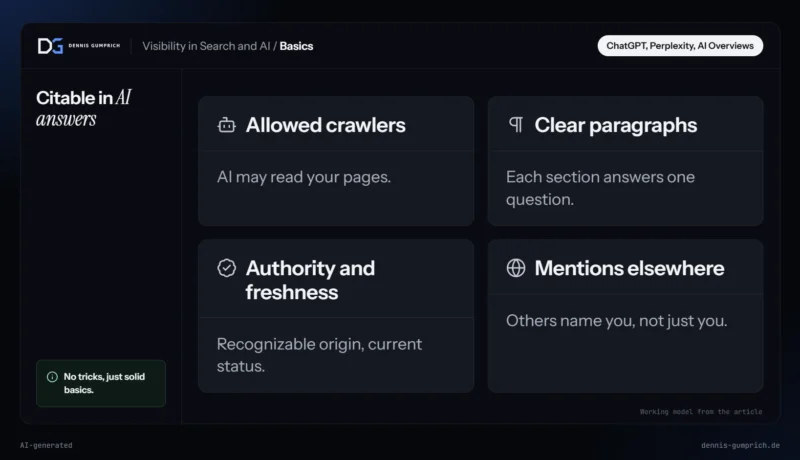

There is no trick that gets you into ChatGPT. There is only content that is worth citing.
Visibility in ChatGPT, Perplexity and Google's AI Overviews largely follows the same rules as classic search engine optimization. Google explicitly names no additional requirements for its AI features. Four things are decisive: the AI providers' search crawlers are allowed to fetch your pages, your content answers questions in self-contained paragraphs, authorship and freshness are recognizable, and people write about you outside your own website as well.
This article works through these four points in order. They follow directly from how AI search finds and selects its sources.
How does AI search choose its sources?
AI search answers a question by first retrieving suitable pages from a search index and then summarizing their content into an answer. What is not in the index or may not be read by the crawler cannot be cited. That is the most important difference from a language model's training knowledge: training is a snapshot of the past, while search accesses the current state of your website.
Google describes its own AI features in Search just as soberly: a page must be indexed and eligible to be shown with a snippet. According to Google, no special optimizations or new file formats are needed. How exactly the individual systems weight sources, however, is not published by any provider.
Which technical prerequisites apply?
The most important one: the right crawlers must be allowed to fetch your pages. Most providers distinguish between a crawler for search and one for model training. Anyone who mixes them up accidentally locks themselves out of the answers or releases content for training that they wanted to protect.
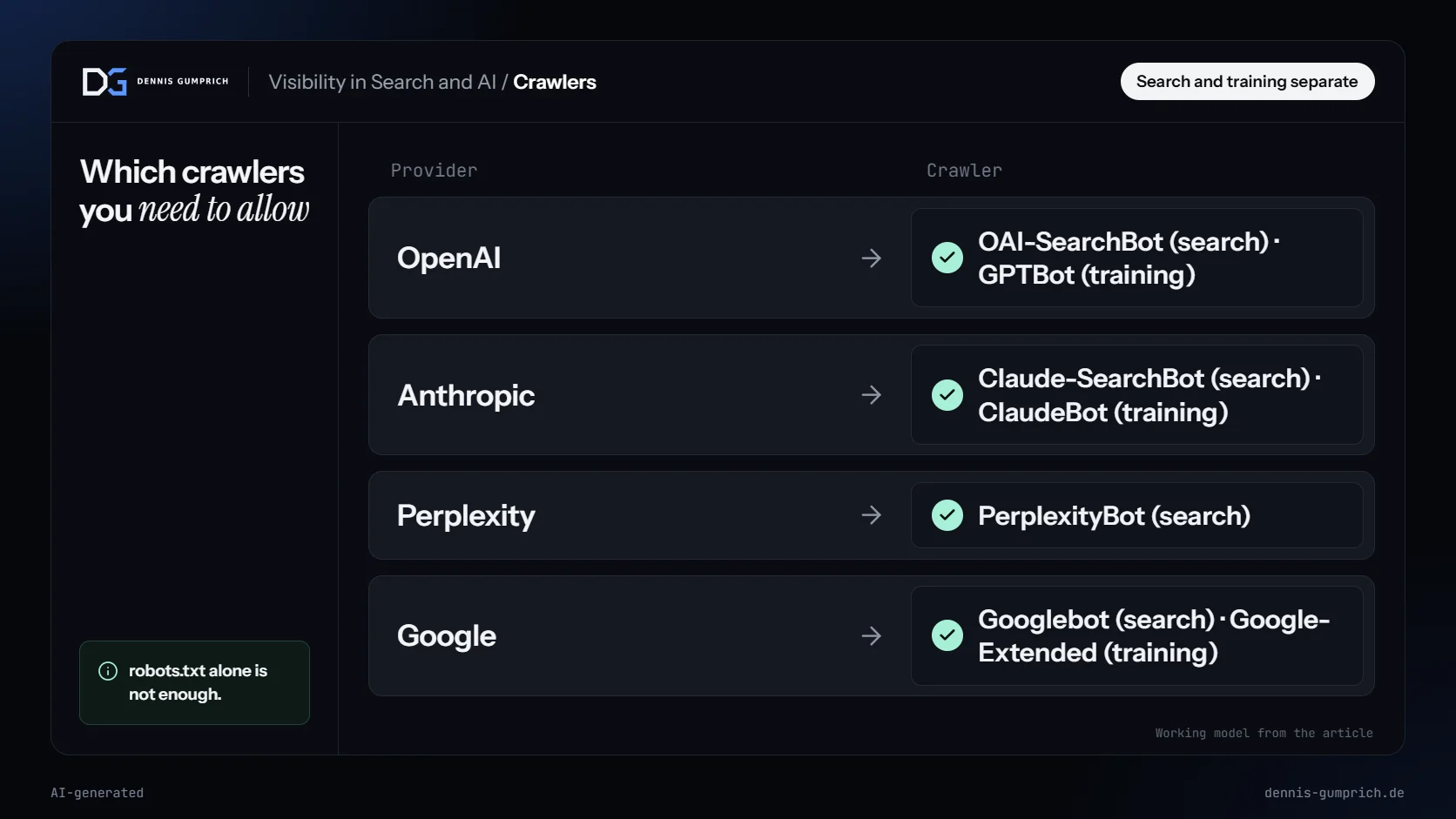
| Provider | Crawler for search and answers | Crawler for model training |
|---|---|---|
| OpenAI (ChatGPT) | OAI-SearchBot. Pages that block it don't appear in ChatGPT search answers | GPTBot |
| Anthropic (Claude) | Claude-SearchBot | ClaudeBot |
| Perplexity | PerplexityBot | According to the provider, no training with this crawler |
| Google (AI Overviews, AI Mode) | Googlebot, as for normal search | Google-Extended controls use for Gemini, not inclusion in Search |
Three further points belong in every check:
- Bot protection in the CDN or firewall. Some security and CDN services now block AI crawlers by default. Then an open robots.txt doesn't help, because the request is rejected beforehand.
- Content in the delivered HTML. Many AI crawlers don't execute JavaScript. What is only loaded in the browser, they don't see.
- Snippet controls. According to Google, directives such as nosnippet or max-snippet also apply to the AI features of Google Search. Restricting snippets also restricts citations.
An llms.txt file is not one of the prerequisites. Google writes explicitly that no new machine-readable files are needed for its own AI features.
What makes a paragraph citable?
A paragraph is adopted when it answers a question completely, even without the rest of the page. That is the same quality that makes it easy for people to read. Five characteristics help concretely:
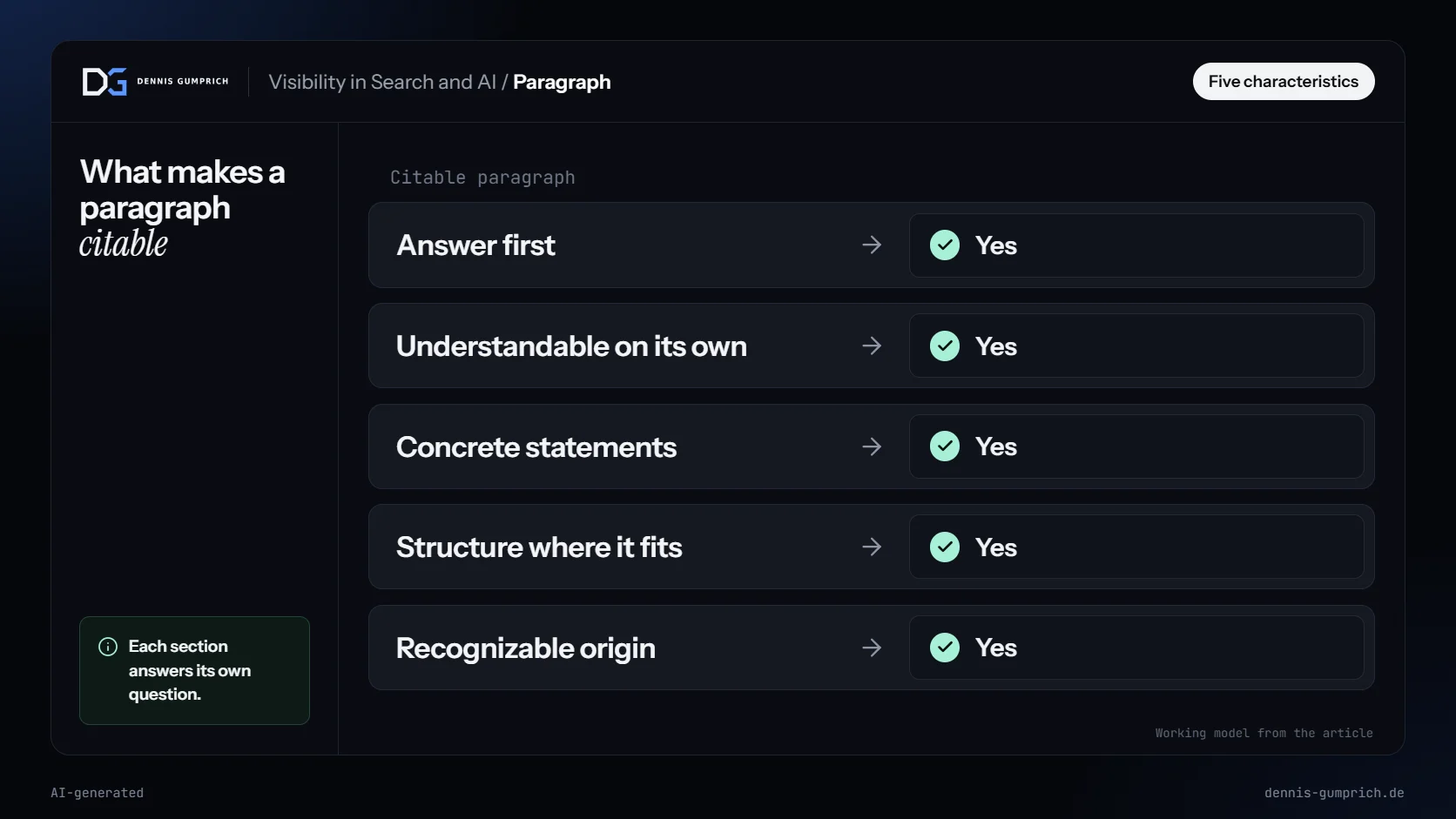
- Characteristic 1Answer firstThe first two sentences of a section answer the question in the heading. Reasoning and caveats follow afterwards.
- Characteristic 2Understandable on its ownNo back-references such as "as described above". The term in question appears in the paragraph itself.
- Characteristic 3Concrete statementsFigures with time period and source, definitions in the pattern "X is …", clear conditions instead of "it depends".
- Characteristic 4Structure where it fits the contentTables for comparisons, numbered lists for processes, headings as questions your audience actually asks.
- Characteristic 5Recognizable originAuthor with role, publication and update date, source references for third-party figures.
"As already hinted above, the topic is complex and depends on many factors. Many companies underestimate it, and it's worth taking a closer look."
"In many teams, a content marketing approval takes three weeks, even though the actual review takes less than an hour. The difference is waiting time between stages. Fixed deadlines per stage shorten it without shortening the review."
Common mistake at this point: chopping texts into small pieces just for AI. Google writes that content does not need to be split up specifically for this. Well-structured expert text is enough, as long as each section answers its own question.
Data from German-speaking countries supports these characteristics. In an analysis published in October 2026, SISTRIX evaluated around 96,000 URLs from the second quarter of 2026 (in German), comparing cited with non-cited pages from the same domain. For pages with a table of contents and jump links, the factor for a citation in ChatGPT, AI Mode or AI Overviews was 1.7, for tables with a header row 1.5 and for an author box with a photo 1.4. A factor of 1.0 means no difference. An llms.txt showed no measurable effect. These are correlations, not proven causes, and SISTRIX itself sells AI visibility tools. The direction is still recognizable: structure that helps people read goes hand in hand with more citations.
Why does what others write about you count?
Because AI answers rarely summarize just one source. When an assistant recommends vendors or explains a term, it relies on several pages describing a topic. Anyone who only talks about themselves on their own website is underrepresented in this picture.
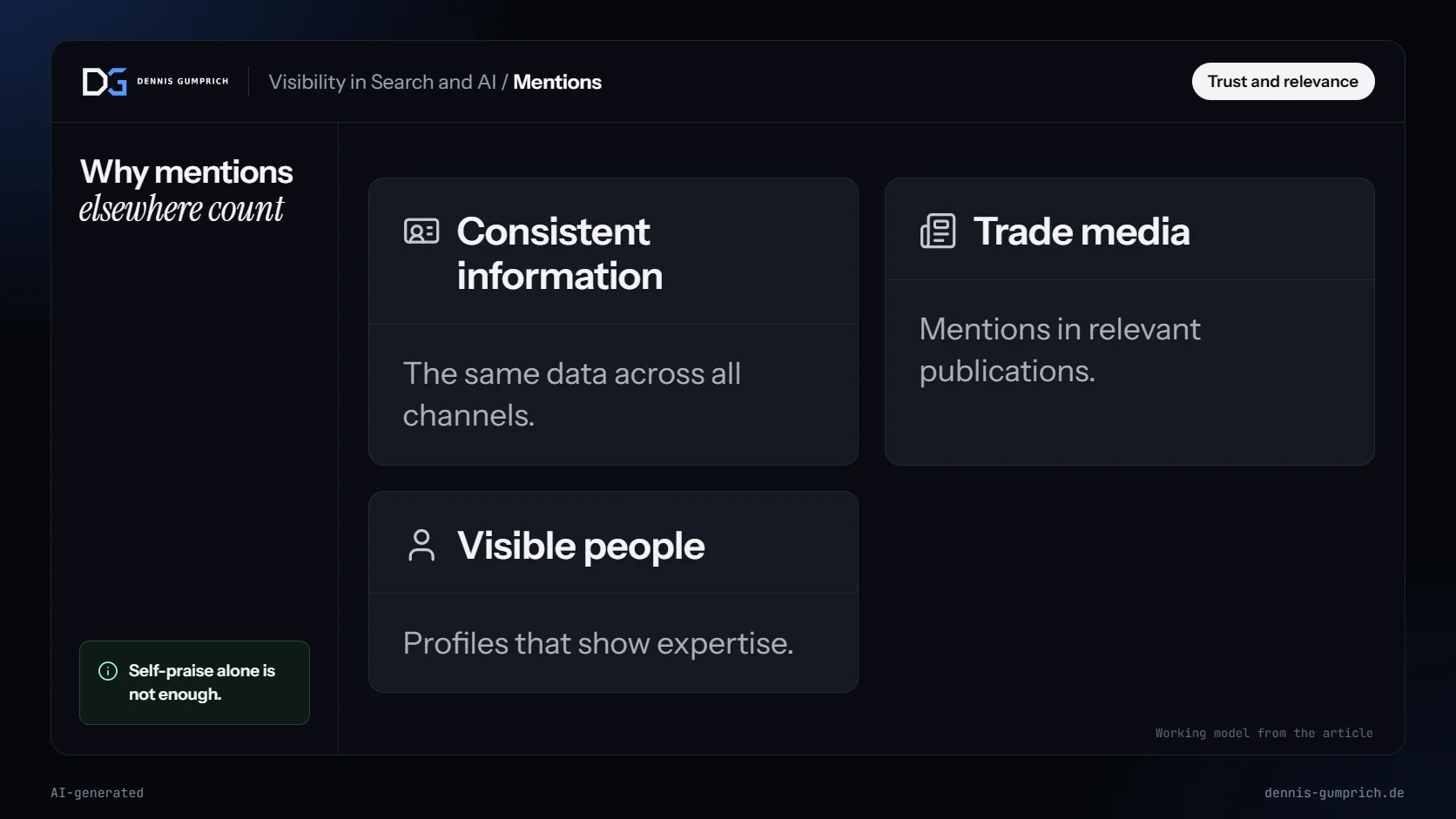
- Consistent information. Name, offering and audience should be described the same way on your website, LinkedIn profile, industry directories and partner pages. Contradictory information makes clear attribution harder.
- Mentions in trade media. Guest articles, interviews and quotes in articles in your industry make you visible as a source on a topic.
- People, not just brands. Experts with a recognizable profile who regularly publish on a topic strengthen the credibility of the content they are involved in.
How do you measure visibility in AI answers?
With three simple sources that you can use without additional budget:
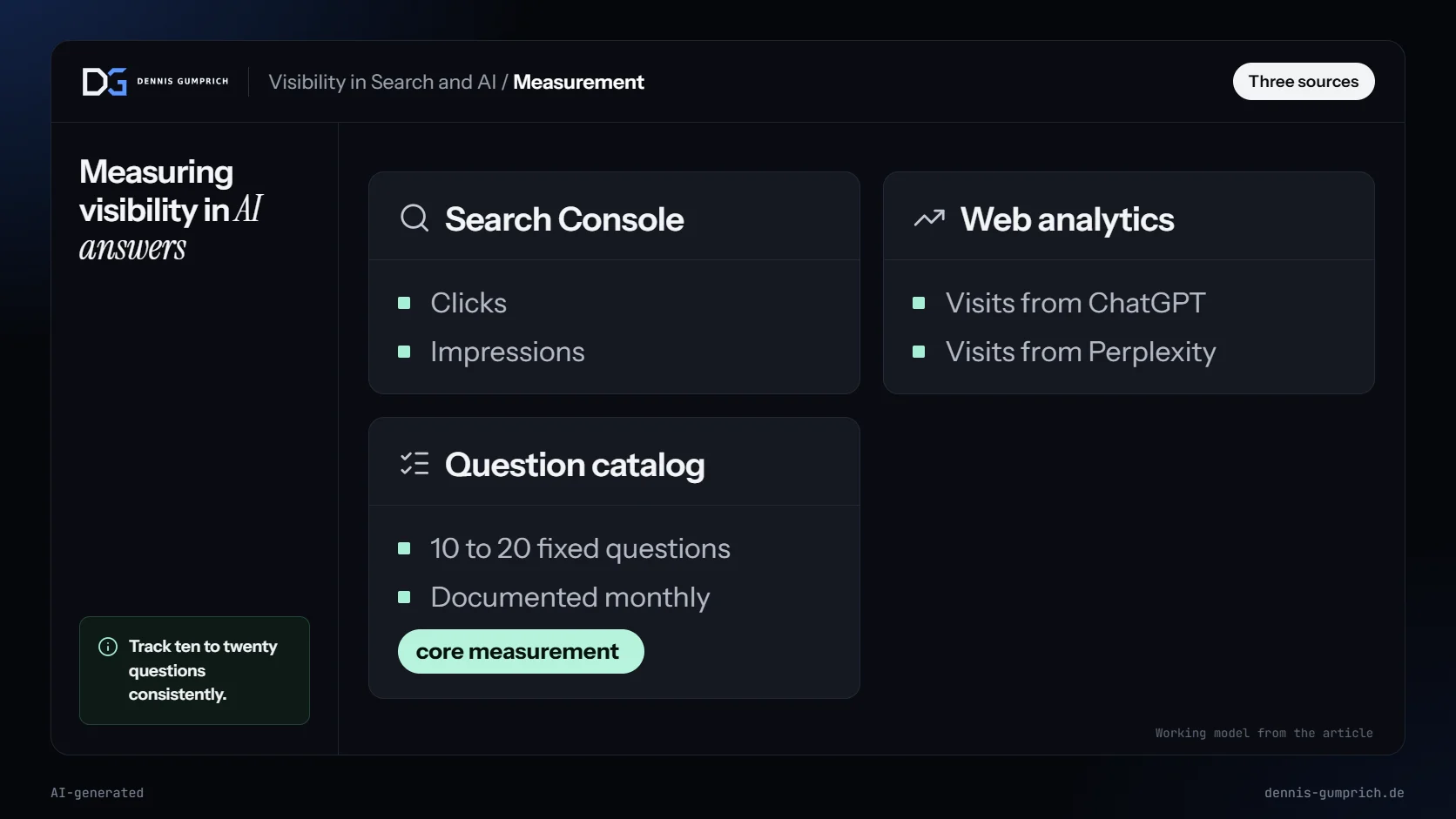
| Source | What it shows | Limit |
|---|---|---|
| Google Search Console | Clicks and impressions from AI Overviews and AI Mode, included in the "Web" search type. Since August 2026, also a dedicated report with impressions in generative AI features | Clicks from AI features not reported separately from normal search |
| Web analytics | Visits with the source chatgpt.com, perplexity.ai or other assistants | Only clicks, no mentions without a click |
| Fixed question catalog | Whether and how you appear in answers to 10 to 20 typical questions from your audience | Answers vary, so document monthly and with a date |
When it comes to the size of the question catalog, it is worth looking at the statistics. A SISTRIX analysis of 10,826 daily measurement series (in German) shows how much individual answers vary: 70 percent of the brands named for a question appear on fewer than one in five days. With 20 questions, the typical deviation is around 9.5 percentage points; an accuracy of 5 points requires about 70 questions. A fixed catalog of around 20 questions therefore only allows a rough assessment (±10 points). For changes, SISTRIX recommends comparing weekly averages for a fixed set; ±5 points requires around 70 questions. Also pay attention to who selects the questions: according to the same analysis, self-selected questions make your own brand look better than it stands in the market.
Which metrics belong in reporting is shown in Measuring visibility without clicks. When a tool pays off and how to build a fixed prompt set is described in Measuring AI visibility: tools and prompt sets.
Five mistakes when optimizing for AI search
- Blocking the wrong crawlerGPTBot is blocked to prevent training, and OAI-SearchBot along with it. Or the other way round. Check each crawler individually.
- Relying on shortcutsllms.txt, special formats or specially rewritten AI versions of pages don't replace good content. Google explicitly names additional files and special optimizations for its own AI features as unnecessary.
- Leaving outdated content in placeFigures without a date and articles without an update note lose out to current sources. Plan fixed review dates for your most important pages, for example as part of a content inventory.
- Only maintaining your own websiteWithout mentions elsewhere, there is no external confirmation.
- Starting without a baselineIf you don't document which answers you appear in before making changes, you cannot prove any effect later.
Self-check: Is your content ready to be cited by AI?
Tick everything that applies to you.
Conclusion: Good SEO, followed through consistently
Visibility in AI answers is not a separate discipline with its own tricks. It rewards what also works in classic search: technically accessible pages, clear answers, recognizable experts and a presence that goes beyond your own website. The difference lies in consistency. A vague paragraph costs a few clicks in the results list. In an AI answer, it doesn't appear at all. So that updates, review dates and responsibilities don't depend on one-off actions, they belong in a fixed process, meaning in your Content Operations. How to anchor these rules in the team, from topic planning through the brief to the review before approval, is shown in the article Embedding GEO in the content process.
Frequently asked questions
What does SEO for ChatGPT mean?
SEO for ChatGPT means preparing content so that ChatGPT and other AI search systems find it, understand it and name it as a source in their answers. It builds on classic search engine optimization and adds citable answer paragraphs, clear evidence and mentions in other sources. If you want to write texts with ChatGPT instead, the approach is described in Writing SEO texts with ChatGPT.
Do I need to write differently for ChatGPT than for Google?
No. What makes a section citable for ChatGPT also makes it good for readers and for Google: a direct answer, concrete statements and a clear structure. What differs is mainly the technical prerequisites, meaning which crawlers are allowed to fetch your pages. How to use ChatGPT yourself for SEO tasks is shown in the article ChatGPT for SEO and content marketing.
Does an llms.txt file do anything?
Not for the AI features of Google Search. Google writes that no new machine-readable files are needed for them. Whether other providers evaluate the file is not reliably documented. It does no harm, but it should not be a priority.
Can I prevent training on my content without disappearing from AI search?
Largely yes, because most providers separate search and training crawlers. For example, you can block GPTBot and ClaudeBot and allow OAI-SearchBot, Claude-SearchBot and PerplexityBot. Google-Extended controls use for Gemini without affecting inclusion in Google Search.
How quickly do changes take effect?
According to OpenAI, changes to robots.txt are taken into account within about 24 hours. It can take considerably longer until revised content is recrawled and used in answers. Expect weeks, not days, and measure monthly.
Is classic SEO enough to become visible in ChatGPT?
It is the foundation, but not everything. ChatGPT Search draws on web content, so well-indexed and substantively strong pages have better chances. In addition, it matters whether individual sections answer a question on their own, whether the OAI-SearchBot crawler is allowed and whether your brand is mentioned consistently outside your own website as well.
How do I get my company mentioned in ChatGPT answers?
By having your content answer your audience's questions directly and having other credible sources write about you. This includes pages that give the answer in the first paragraph, your own data and examples, clear information about your offering and company, and mentions in trade media and on comparison portals. There is no guarantee, but you can measure whether you are named, for example with the AI visibility check.
Which content formats are preferably cited in ChatGPT?
Formats that answer a question clearly and verifiably: guides with clear subheadings, definitions, comparisons in tables, step-by-step instructions and pages with your own figures. What matters is less the format than the structure: answer first, then reasoning and evidence. Long texts without clear structure are harder to use as a source.
Which tools can track citations in ChatGPT?
There are specialized monitoring tools that regularly query defined prompts in ChatGPT, Perplexity and Google and evaluate mentions and cited sources. To start, a fixed prompt set that you check by hand monthly is enough. Which criteria matter in the selection is described in the article Measuring AI visibility.
Where does your content process lose time today?
In 30 minutes, we look together at where unnecessary coordination, manual tasks, tool switching or repetitive content work cost you time today.
You get a concrete assessment of which tasks you can simplify, automate or organize better, and where AI and tools actually help instead of adding complexity.
Analyze your content process in 30 minutes Free of charge. You take away concrete starting points you can use internally right away.
Dennis Gumprich
Dennis helps marketing and communication teams fit generative AI into existing content processes without undermining quality, brand voice and approvals. Focus areas: content operations, AI governance and tool selection in mid-sized companies and corporations.
Transparency note: Dennis works for contentbird, a provider of AI-powered content software. This article deliberately names no products. More about Dennis (in German) · LinkedIn
Read more
Sources
- Google Search Central: AI features and your website, documentation, as of December 10, 2025: no additional requirements for AI Overviews and AI Mode, indexing and snippet eligibility as prerequisites, effect of snippet controls, no new machine-readable files, data in the "Web" search type in Search Console. Accessed October 31, 2026.
- OpenAI: Overview of OpenAI Crawlers, documentation: OAI-SearchBot for search, GPTBot for model training, robots.txt changes implemented after about 24 hours. Accessed October 31, 2026.
- Anthropic: Does Anthropic crawl data from the web, and how can site owners block the crawler?, help article, as of April 7, 2026: ClaudeBot for training data, Claude-SearchBot and Claude-User for search and user requests. Accessed October 31, 2026.
- Perplexity: Perplexity Crawlers, documentation: PerplexityBot for search results, according to the provider not for training foundation models. Accessed October 31, 2026.
- Google: List of Google's common crawlers, documentation, as of October 30, 2026: Google-Extended affects neither inclusion in Google Search nor ranking. Accessed October 31, 2026.
- Cloudflare: Cloudflare Just Changed How AI Crawlers Scrape the Internet-at-Large, press release of July 1, 2025: blocking AI crawlers without permission as the default. Accessed October 31, 2026.
- Vercel: The rise of the AI crawler, analysis of December 17, 2024: none of the major AI crawlers examined executed JavaScript, with the exception of Gemini via the Googlebot infrastructure. Accessed October 31, 2026.
- Google Search Central: Optimizing your website for generative AI features on Google Search, guide, as of July 10, 2026: no need to split content into small pieces, no dedicated AI text files or Markdown versions. Accessed October 31, 2026.
- Google Search Console Help: Generative AI performance report, help article: impressions in AI Overviews and AI Mode, available for all websites worldwide since August 31, 2026. Accessed October 31, 2026.
- SISTRIX, Johannes Beus and Julia Weißbach: GEO-Mythen im Datencheck: Was 96.418 URLs über AI-Citations verraten (in German), data analysis of October 22, 2026, 96,418 URLs from 17,380 domains in Germany, Austria and Switzerland, second quarter of 2026, ChatGPT, AI Mode and AI Overviews, comparison of cited and non-cited pages of the same domain: table of contents with jump links factor 1.7, table with header row 1.5, author box with photo 1.4, llms.txt without measurable effect. Correlations, not causes; analysis by a tool vendor. Accessed October 31, 2026.
- SISTRIX, Johannes Beus: Breite schlägt Wiederholung: Wie man AI-Sichtbarkeit verlässlich misst (in German), data analysis of October 27, 2026, 10,826 daily measurement series from ChatGPT, AI Overviews, AI Mode and Perplexity in eight countries: 70 percent of the brands named appear on fewer than one in five days, typical deviation of 9.5 percentage points with 20 prompts, around 70 prompts for 5 points. Analysis by a tool vendor, survey period not disclosed. Accessed October 31, 2026.
How this article was created
This article was created with the help of AI. Structure, research and draft wording were developed with AI support. Professional assessment, review of the statements and the final version are the responsibility of Dennis Gumprich. The English version was translated with AI and reviewed. Read the original German version.
How reliable are the statements?
Documented are the information on crawlers and training use by the documentation of OpenAI, Anthropic, Perplexity and Google, the statements on prerequisites, snippet controls, additional files and splitting content by the two Google documents, the default blocking of AI crawlers by the Cloudflare press release, the lack of JavaScript execution by the Vercel analysis and the measurement options in Search Console by Google's help. Information on crawlers and Google features is based on the providers' documentation and may change. How individual systems weight sources is not publicly documented. The characteristics of citable paragraphs, the recommendations on mentions outside your own website and the question catalog as a measurement source are derived from how the systems work and are working models from consulting practice, not confirmed ranking factors. The correlations between structural features and AI citations, as well as the variation of measurements in AI answers, are based on two data analyses by SISTRIX, a provider of AI visibility tools; they show correlations, not causes. As of October 31, 2026.


