
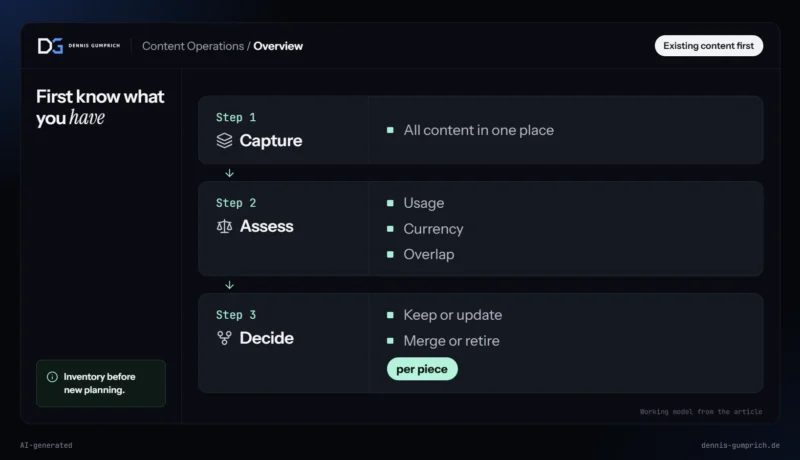

The cheapest new production is the one you do not need at all.
A content inventory answers three questions before planning: what already exists, what of it still works, and what of it is worth updating instead of producing anew. The effort is one to two days. The most common finding is that a considerable share of the planned topics already exists in usable form.
The following sections show how to carry out such an inventory in one to two days. First, the question of why it is done so rarely.
Why new production seems more attractive than updating
Planning new content feels more productive. A new piece is visible, it can be announced, and it clearly belongs to someone. An update is invisible, hard to talk about and feels like rework.
There is also a practical reason. To decide whether an existing piece should be revised, someone has to read and assess it. That takes time before anything has been created. A new piece, by contrast, starts immediately with visible work.
Economically, this leads to a harmful distortion. Updating a piece that already has visibility is as a rule cheaper and more effective than new production on the same topic. The existing piece has links, a history and in many cases already a position in search results.
The second damage comes from competition within your own content. When two of your own pieces cover the same topic, they compete with each other. You spend effort on taking visibility away from yourself.
Which decisions do you make in a content inventory?
Four, and only four: keep, update, merge or retire. There is no fifth option, otherwise half of the content stays undecided. Updating is usually the most economical choice, because existing visibility is preserved.
Keep
The content is correct, works and fits your current positioning. No action is needed.
Recognizable by: current traffic, no outdated information.
Update
The topic holds up, individual details are outdated or the structure no longer meets your standard.
Usually the most economical choice: existing visibility is preserved.
Merge
Several pieces cover the same topic. One becomes the main piece, the others are redirected to it.
Works twice: ends internal competition and strengthens the remaining piece.
Retire
The topic is outdated, concerns discontinued products or no longer fits your positioning.
Important: do not remove the URL without replacement, but redirect it or remove it from search.
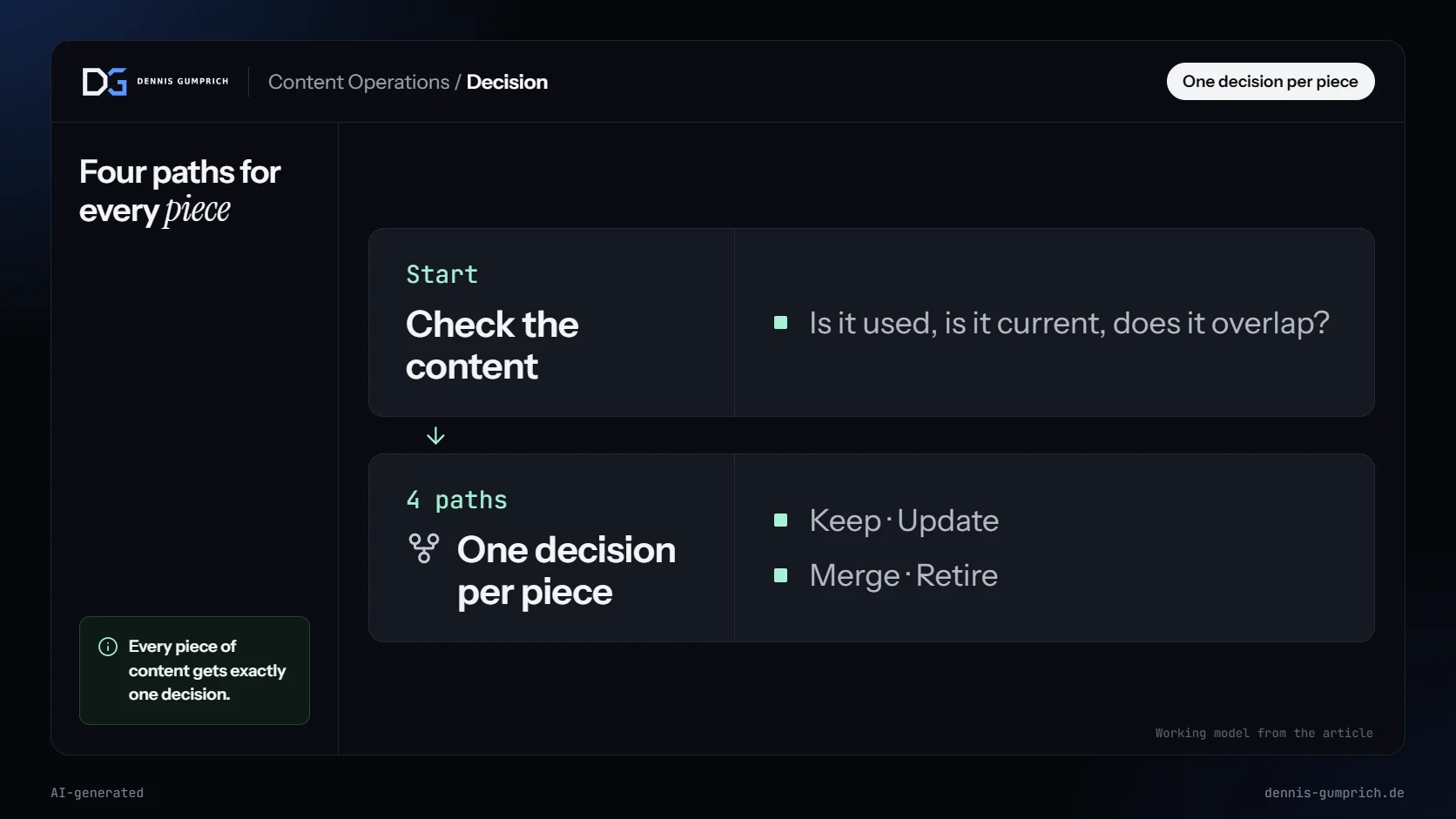
The third decision is made least often and has the biggest effect. Two mediocre pieces on one topic, once merged, almost always produce a better piece than either of them was on its own.
The same four decisions appear in Robert Weller's article "On the business value of content audits" (in German) under the acronym DUCK: delete, update, consolidate, keep. Weller separates the inventory, which records what is there, from the analysis, which assesses how good it is and why. As assessment grids he names ARA and ROT according to Bloomstein, and considers frequent small audits better than large infrequent ones. This is a consultant's assessment from 2022, not a study. For you, this means: if a complete pass seems too big, work through your content topic by topic in smaller stages.
Which data do you need for each piece?
An inventory fails when too much is recorded. Six data points per piece are enough to make all four decisions. Anything more increases the effort without improving the decision.
| Data point | What it is for | Where it comes from |
|---|---|---|
| Title and URL | Identification | Website or repository |
| Publication and last change | Age indicator | System |
| Topic in three words | Spotting duplicates | Manual, while reviewing |
| Traffic in the last year | Impact indicator | Analytics tool |
| Outdated information present | Need for updating | Manual, quick skim |
| Decision | Result of the inventory | Manual |
The third row is the real key. Only when every piece carries a topic in three words do duplicates become visible. Titles alone are not enough, because the same subject can appear under completely different headlines.
Do not record an assessment of quality. Good or bad leads to discussions and is not needed for the decision. The four decisions can be derived entirely from age, topic, traffic and outdated information.
Content inventory or content audit: what is the difference?
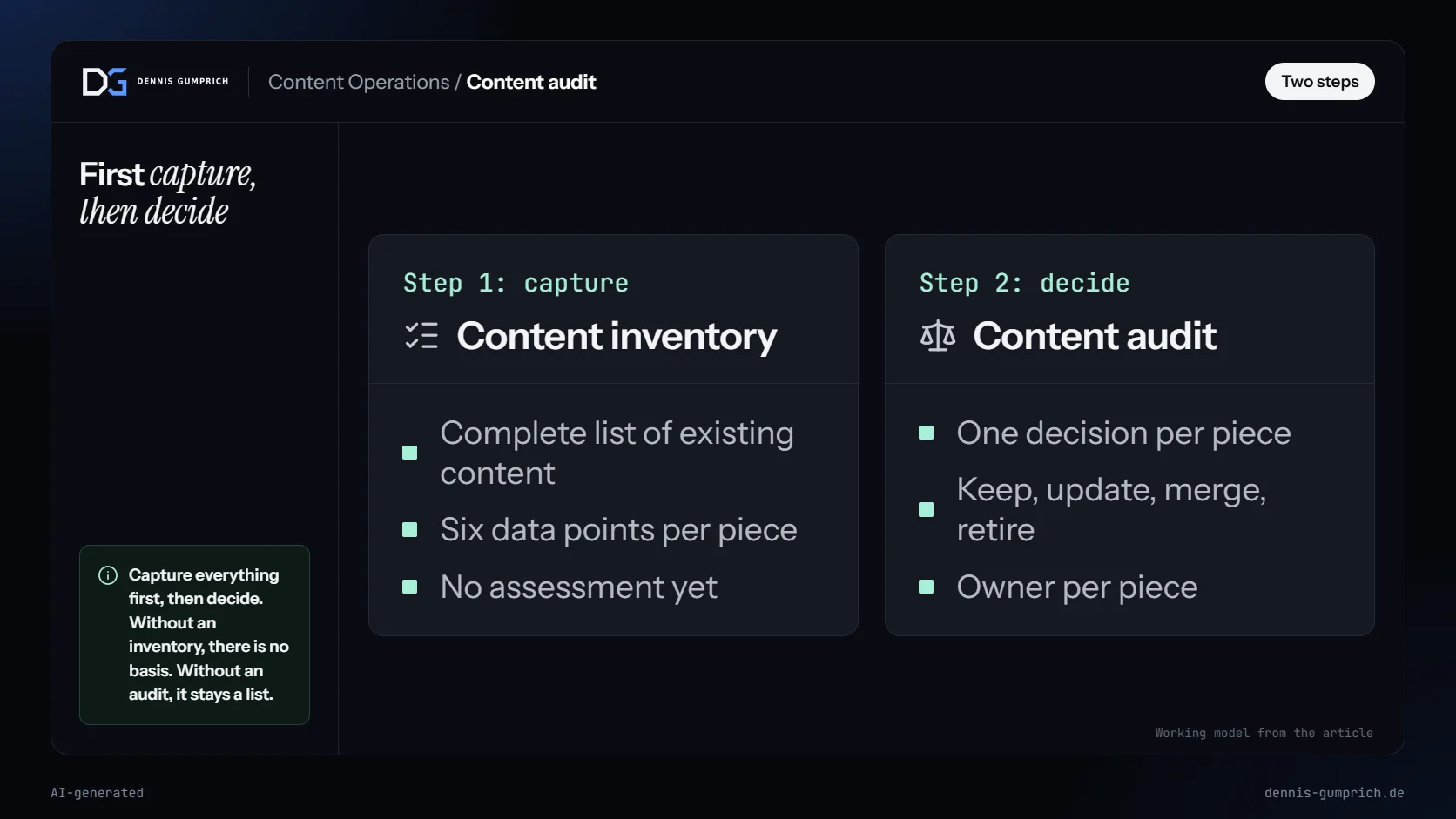
The inventory records what is there. The content audit assesses the existing content and ends with a decision per piece and an owner. That is also how the Nielsen Norman Group distinguishes them. In practice, both belong in one pass: without an inventory, the audit lacks a basis; without an audit, the inventory remains a list nobody uses.
The approach in this article covers both steps. The six data points per piece are the inventory, the four decisions are the audit. The order is decisive: capture everything first, then decide. Anyone who assesses while capturing ends up discussing individual texts and never finishes the content set.
What the inventory reveals about your planning
The obvious benefit is the decision per piece. The bigger benefit lies in the evaluation across all content, because it shows patterns that remain invisible in individual cases.
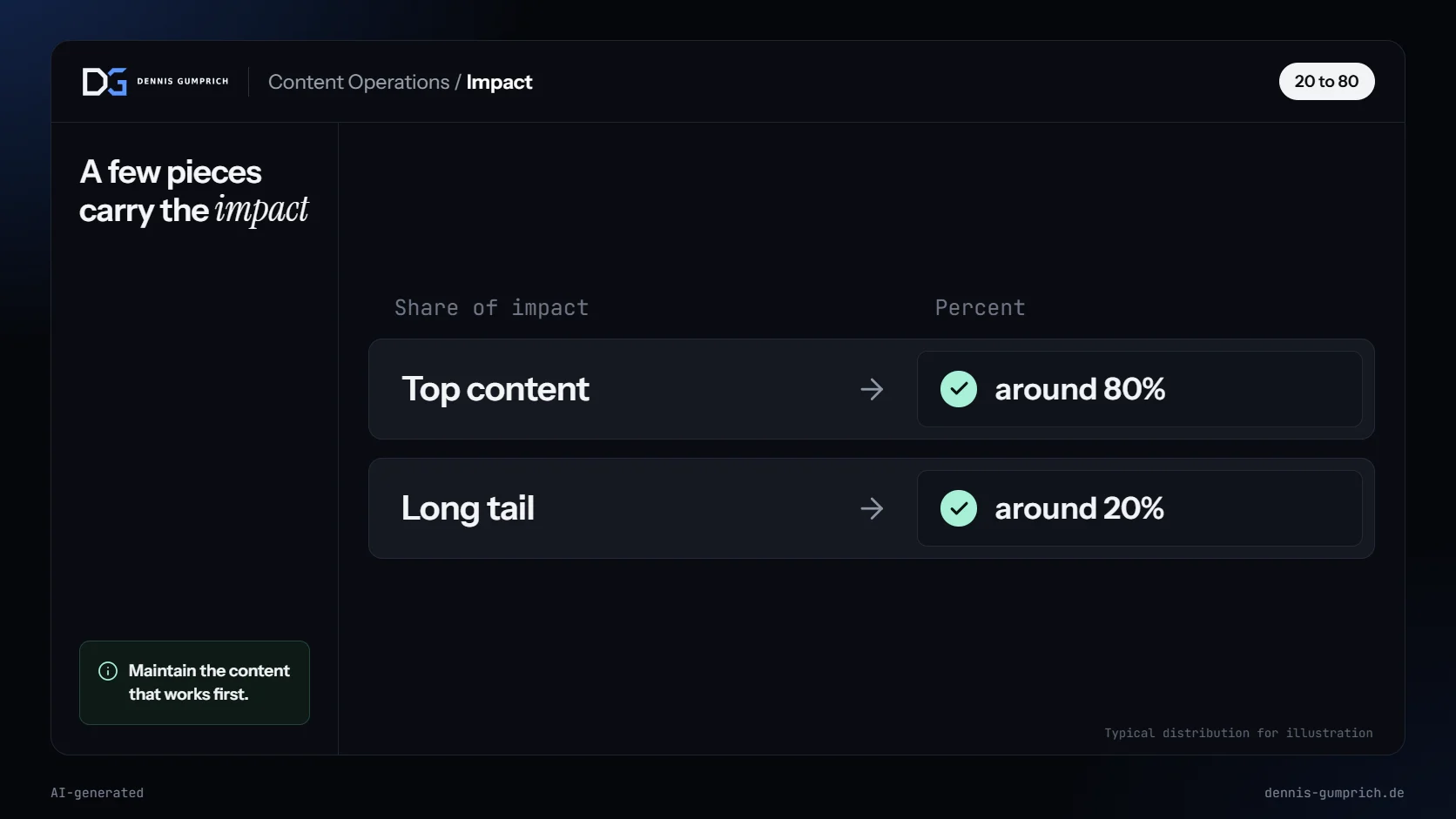
Pattern four changes priorities the most. If a small part of your content produces the bulk of the impact, maintaining exactly these pieces is more economical than any new production. This argument is regularly overlooked in planning rounds, because maintenance does not seem worth announcing. Which topics get priority afterwards is best decided with topic scoring.
Robert Weller describes the opponent of this maintenance in his article "Content decay: how to recognize and reverse the steady loss of value of your content" (in German): a gradual loss of value of existing content, recognizable by falling rankings, less traffic and fewer leads. His conclusion: when allocating resources, revising existing content belongs alongside producing new content. This too is a professional assessment from 2022, based on Search Console data from his own blog and not a broad survey. For your planning, this means: reserve fixed capacity for updating your strongest content before you distribute new topics.
The connection with AI use
Anyone using AI for text creation produces faster. Without an inventory, that mainly means one thing: you create duplicates of topics you have already covered faster. Speed thus amplifies an existing problem instead of solving it.
Conversely, an inventoried content set is the best basis for AI-supported work. Channel versions, summaries and updates can be reliably derived from a reviewed, current piece. Nothing can be derived from a confusing content set, because nobody knows which version applies.
When is an update worthwhile instead of a new piece?
When the structure and core statements are still correct and only figures, examples or legal information are outdated. Then revising is much faster than a new text, and existing visibility is preserved instead of two pieces competing for the same topic.
In practice, the decision between updating and new production is often made by feel. Three criteria make it decidable.
First, existing visibility. A piece that is already found brings a starting position that new production would first have to build up. This position is lost if you put a second piece on the same topic next to it, because both compete for the same visibility.
Second, the share that still holds up. If the structure and core statements are still correct and only figures, examples or legal information are outdated, revising is much faster than a new text. If, on the other hand, the basic assumptions are outdated, new production is cleaner, because a piece rewritten throughout is a new one anyway.
Third, the target group. If the target group has changed, an update helps little, because tone and examples no longer fit. This is the only case in which even a well-performing piece should be replaced rather than maintained.
A practical tip for revising: note in the piece what was changed and when. This builds trust with readers, helps you with the next inventory and shows that maintenance has taken place. Without this note, an updated piece looks older than it is.
Five mistakes in an inventory
- Recording too much dataAnyone who creates twelve columns will not get through the content. Six data points are enough for all four decisions.
- Assessing qualityGood or bad leads to discussions without a decision. Age, topic, traffic and outdated information are enough.
- Finishing without a decisionA list without actions is wasted time. One of the four decisions needs to be documented for each piece.
- Removing content without replacementA deleted URL creates error pages and destroys existing links. Redirect or remove from search.
- Doing it only onceWithout repetition, your content will be in the same state again after two years. An annual date is enough.
How do you carry out a content inventory in five steps?
Export the content from the system, add last year's traffic, give each piece a topic in three words, make one of the four decisions per piece and transfer updates with a deadline into the editorial plan. Only step three is real manual work.
- Step 1Compile the contentAll published content with URL and date in one list. Export it from the system instead of collecting it manually.
- Step 2Add trafficAssign figures from the last year. This column later decides on maintenance or retirement.
- Step 3Assign a topic in three wordsThe only truly manual step. Only this makes duplicates visible.
- Step 4Decide per pieceKeep, update, merge or retire. No fifth option, otherwise half stays open.
- Step 5Transfer into planningUpdates and merges go into the editorial plan, with a deadline and owner just like new productions.
The fifth step decides the benefit. An inventory whose results do not make it into the plan gets repeated the following year and shows the same findings. Treat updates as projects in their own right, with a deadline and a named person.
Self-check: do you know your content?
Tick everything that applies to you.
A proposal for the upcoming annual planning:
Before we define new topics, we would like to review our existing content once. Experience shows that some of the planned topics already exist in usable form, and updating an existing piece is cheaper and more effective than new production, because links and visibility are preserved.
For each piece we record six data points and make one of four decisions: keep, update, merge or retire. Effort: one to two days.
The result flows directly into the editorial plan. We treat updates like new productions, with a deadline and owner, otherwise they get left behind.
Conclusion: count first, then plan
Most editorial plans arise from ideas and requests, not from an inventory. That is exactly why they regularly contain topics that have already been covered. An inventory of one to two days noticeably changes planning, because it answers the question nobody else asks: do we really need this new? Together with the self-check on process maturity, the inventory is the first step in building content operations. Before a website relaunch, it also belongs at the start, as Website relaunch: clarify the content process first shows.
Frequently asked questions
What is a content audit?
A content audit is the assessment of your existing content with a clear decision per piece: keep, update, merge or retire. Its basis is a content inventory, that is, the complete list of existing content. For up to around 150 pieces, expect one to two days for both steps together.
From what size is it worthwhile?
From about 30 published pieces it becomes noticeably useful, because from that size nobody has a complete overview in their head anymore. For smaller content sets, a joint look at the list before annual planning is enough.
How do we handle content without traffic figures?
For example internal documents or sales material. Replace the column with a simple question to the people using it: is this used? A short survey in sales provides more reliable answers than any assumption.
What happens to retired content?
Do not delete it without replacement. Common approaches are a redirect to the thematically matching successor or removal from search while keeping the URL. Both preserve existing links and avoid error pages.
Who should carry out the inventory?
Capture can largely be automated. Assigning topics and making decisions belongs to the people who know the content. An external review spots duplicates later and makes poorer decisions.
How does this relate to a system migration?
Closely. A migration is the best time for an inventory, because you have to touch the content anyway. Combining the two saves an entire pass. How to plan the migration in concrete terms is described in Planning a migration: moving existing content into a new system.
Where does your content process lose time today?
In 30 minutes, we look together at where unnecessary coordination, manual tasks, tool switching or repetitive content work cost you time today.
You get a concrete assessment of which tasks you can simplify, automate or organize better, and where AI and tools actually help instead of adding complexity.
Analyze your content process in 30 minutes Free of charge. You take away concrete starting points you can use internally right away.
Dennis Gumprich
Dennis helps marketing and communication teams fit generative AI into existing content processes without undermining quality, brand voice and approvals. Focus areas: content operations, AI governance and tool selection in mid-sized companies and corporations.
Transparency note: Dennis works for contentbird, a provider of AI-powered content software. Product mentions are marked in the article. More about Dennis (in German) · LinkedIn
Read more
Sources
- Anna Kaley, Nielsen Norman Group: Content Inventory and Auditing 101, article from September 27, 2020: inventory as a complete list of existing content, audit as an assessment with a decision per piece (keep, update, remove) and ownership. Accessed October 31, 2026.
- Google Search Central: Redirects and Google Search, documentation, as of April 14, 2026: permanent server-side redirect when removing or merging pages. Accessed October 31, 2026.
- Google Search Central: Block Search indexing with noindex, documentation, as of December 10, 2025: removing an accessible page from search results. Accessed October 31, 2026.
- Google Search Central: Influence your byline dates in Google Search, documentation: visible update date with a label such as "Last updated". Accessed October 31, 2026.
- Robert Weller (toushenne.de): Über den Business Value von Content Audits (in German), article from September 9, 2022: distinction between inventory (what is there) and analysis (how good, why), triggers including relaunch, migration or CMS change, rebranding, localization and change of owners, assessment grids ARA and ROT according to Bloomstein, implementation according to DUCK (delete, update, consolidate, keep), frequent small audits better than large infrequent ones. Article by an independent consultant who names contentbird as a project reference. Accessed October 31, 2026.
- Robert Weller (toushenne.de): Content Decay (in German), article from December 1, 2022: gradual loss of value of content through falling rankings, traffic and leads; when allocating resources, revising existing content belongs alongside producing new content; examples from Search Console data of his own blog. Article by an independent consultant who names contentbird as a project reference. Accessed October 31, 2026.
How this article was created
This article was created with the help of AI. Structure, research and draft wording were developed with AI support. Professional assessment, review of the statements and the final version are the responsibility of Dennis Gumprich. The English version was translated with AI and reviewed. Read the original German version.
How reliable are the statements?
Evidence exists for the method of inventory and audit with a decision per piece (Nielsen Norman Group) and the recommendations on redirects, removal from search and a visible update date (Google Search Central), as well as the separation of inventory and analysis with the ARA, ROT and DUCK grids and the gradual loss of value through content decay (Robert Weller, articles by a consultant from 2022, no broad data collection). The four decisions, the six data points and the effort figures are explicitly marked as working models and are not measured values. The statements that a considerable share of planned topics already exists, that a few pieces carry most of the traffic and that updating is usually cheaper than new production are experience values from consulting practice. As of October 31, 2026.


