
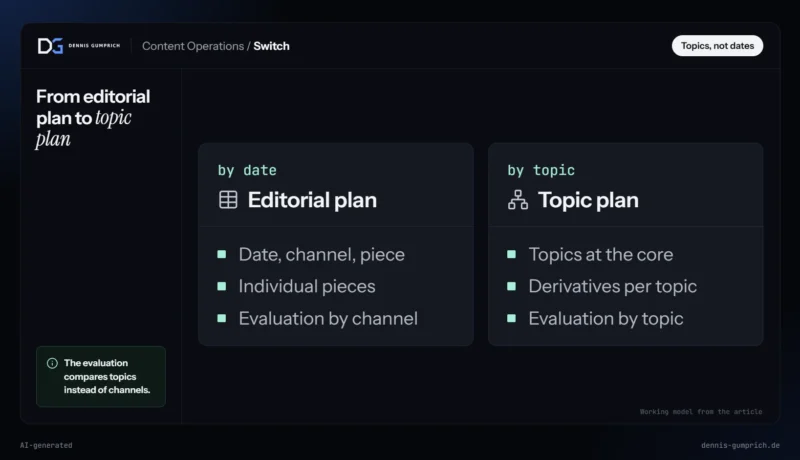

An editorial plan answers what appears when and where. A topic plan answers what you are talking about and why. The switch does not need a new tool but a different sorting logic: not channel and date come first, but the topic. Channels become derivatives of it. The real gain only shows in the evaluation, because you can then measure per topic instead of per channel.
This article is about switching the sorting logic from channel to topic. A template with all fields for the editorial plan itself can be found in Editorial plan: template and structure.
Why is an editorial plan no longer enough at some point?
Because it is a delivery plan. It is sorted by what appears when on which channel, and so it does not answer what you are talking about. The limit is not a question of the number of rows but of sorting logic: as soon as a subject appears on several channels in different formats, it falls apart into several independent rows in the plan.
For its original purpose, it still works well. As long as one person plans for two channels, it is perfectly adequate. Only with several channels and several people involved does the connection between publications exist solely in the head of the person who created them.
This leads to three effects you probably know. First, duplicated work, because nobody sees that two rows mean the same thing. Second, channel gaps, because nobody sees that an important topic only ran once. Third, and this is the most expensive effect, an evaluation that only compares channels. At the end of the year, you know that LinkedIn performed better than the newsletter. You do not know which topics carried the load. What reporting that evaluates topics instead of channels looks like is described in Proving content impact.
It is important to distinguish this from the tool: this is not a spreadsheet problem. A spreadsheet does reach its own limits at some point (where exactly is shown in Content planning in Excel), but you have the difficulty described here in any system that sorts by channel and date.
What is the difference between topic area, topic, story and content?
They differ in level of abstraction and lifespan. The topic area says what you want to stand for and lasts for years. The topic says what you are currently working on and lasts weeks to months. The story is the angle from which you tell it. The content is the individual publication that results from it.
Topic plan, content plan, editorial plan: different sources use these terms differently, sometimes as time horizons, sometimes as levels of abstraction. It is not worth arguing about, but it is worth agreeing on a definition in-house. This one has proven itself in corporate communications.
| Level | Answers | Lifespan | Example |
|---|---|---|---|
| Topic area | What do we want to stand for? | Years | Sustainable production |
| Topic | What are we working on right now? | Weeks to months | Switching the plant to circular materials |
| Story | From which angle do we tell it? | Days to weeks | How the shift leaders experienced the conversion |
| Content | In which form does it go out? | One date | Feature, short video, press release, intranet post |
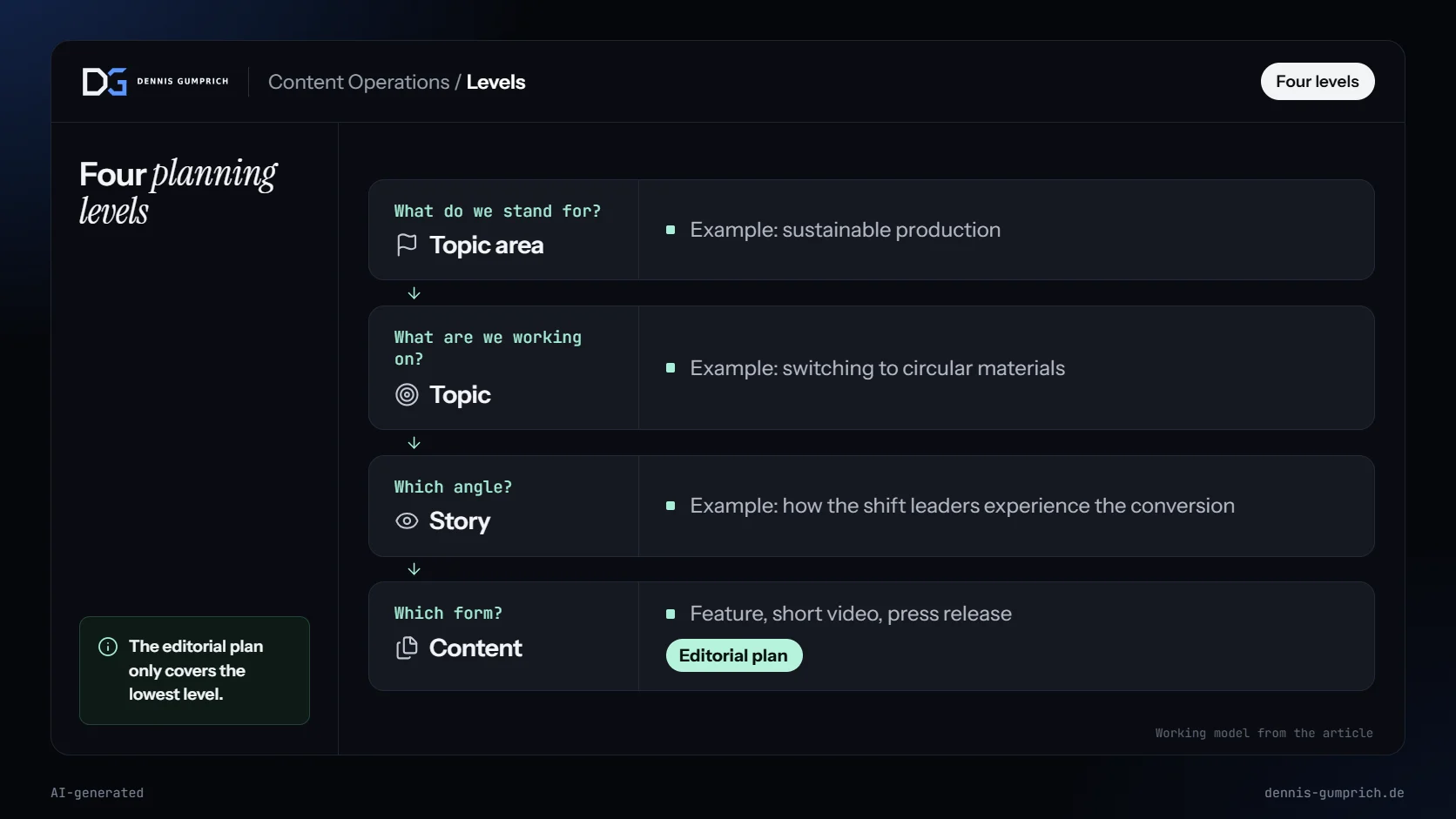
In this system, the editorial plan covers only the lowest level. It does not disappear either; it simply gets a level above it. Anyone who wants to replace it makes the switch unnecessarily big.
How does a topic plan differ from an editorial plan?
In the first column. In the editorial plan, it holds the date or channel; in the topic plan, the topic. Everything else follows from that: a row is then no longer one publication but one subject with several derivatives beneath it, and the channel changes from the ordering criterion to a property of the derivative.
How inconsistently the terms are used is shown by a look at the professional discussion. In his article "Topic plan, content plan, editorial plan" (in German) from March 2026, content strategy consultant Robert Weller distinguishes three levels: the topic plan as a strategic definition over years of what you stand for and what you deliberately leave out, the content plan as prioritization for three to six months, which also includes revisions and repurposing, and the editorial plan as operational planning for the next few weeks. The switch discussed here mainly concerns the two lower levels: the topic becomes the unit of order, the channel a property. If you also need a strategic level, Weller offers the matching separation.
| Editorial plan | Topic plan | |
|---|---|---|
| First column | Date or channel | Topic |
| One row is | one publication | one subject with several publications beneath it |
| The channel is | the ordering criterion | a property of the derivative |
| Approval is tied to | the individual piece | the topic, then only formally per derivative |
| You spot gaps | when a channel stays empty | when a topic has only one derivative |
| The evaluation compares | channels | topics, plus channels per topic |
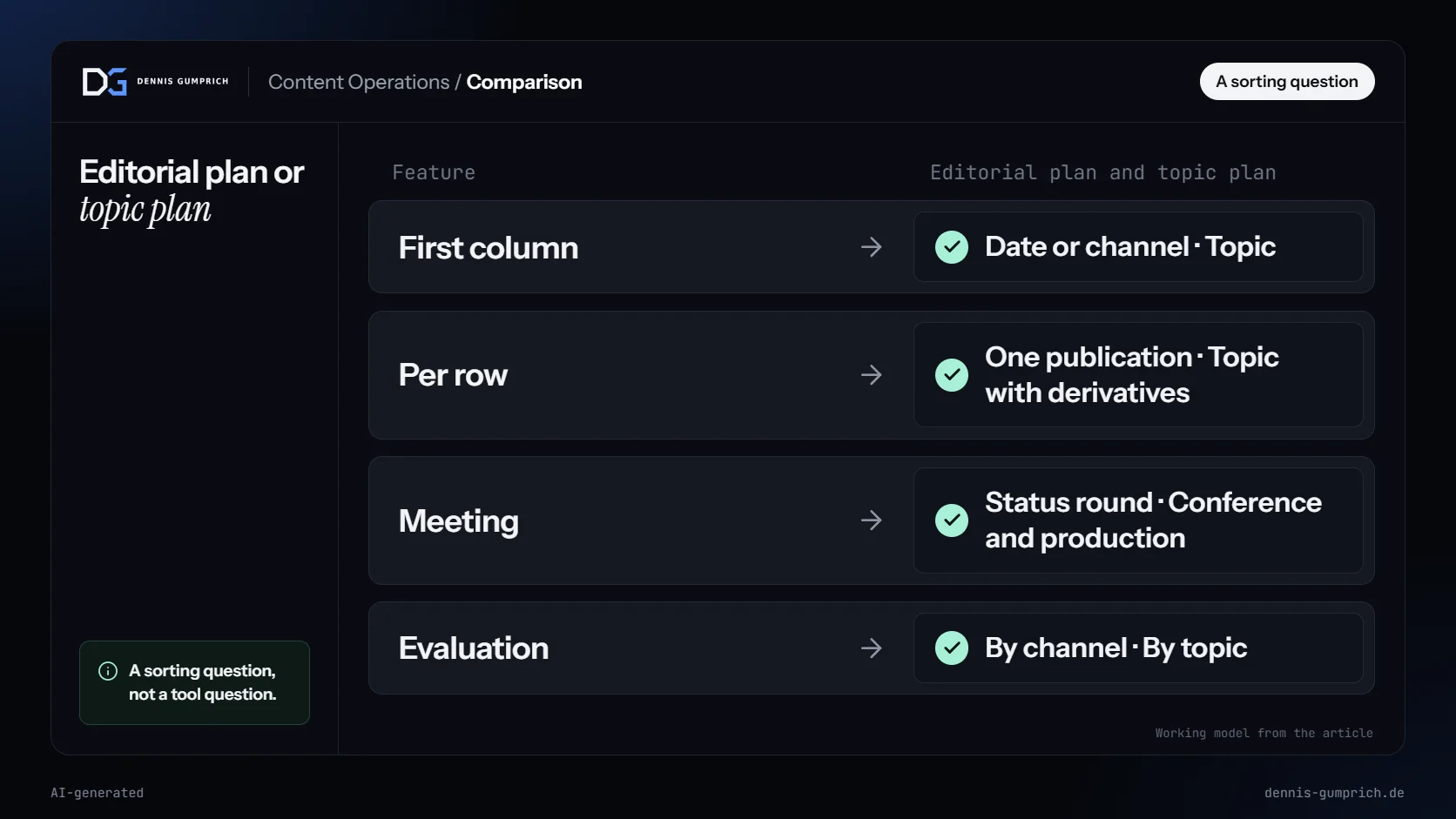
Subject-matter approval benefits in particular. When the specialist department approves a topic once in terms of content, the derivatives only need a formal check. In a channel-sorted plan, by contrast, every publication goes through the same content loop, which is one of the most common reasons for long approval times.
How widespread the gap is, is shown by the Corporate Newsroom Study 2026: in Swiss communications departments, topics are mostly planned by priority, but even newsrooms rarely use an elaborated steering instrument such as a topic house. The researchers see this as a key potential for professionalization.
How do you bring more structure to your marketing team's content planning?
With four agreements: three to five topic areas from which every topic must come, exactly one responsible person per topic, fixed criteria by which topics get into the plan, and a weekly conference that decides on topics instead of reporting on channels. Structure does not come from more columns, but from every row in the plan having a reason.
The third agreement is the most effective, because it shortens discussions: whoever brings in a topic answers the same three or four questions as everyone else. What such criteria look like is described in Topic scoring.
What changes in the conference
In a channel-sorted operation, the editorial meeting is a status round: every row is gone through, every person reports on their channel. That takes a long time and produces few decisions.
With a topic plan, the round splits into two meetings with different purposes. In the topic conference, you decide which topics run, with which priority and who owns them. In the production round, you agree which derivatives come out of them and when they appear.
This separation is the point at which the switch either takes hold or fails. If both questions stay in one meeting, experience shows the operational one wins: people talk about dates because they are pressing, and the topic decision is made on the side. How to make topics comparable instead of deciding by volume is described in the article on topic scoring.
What changes in the evaluation, and why that is the real gain
Channel-sorted planning only allows channel-based evaluation. You can say which channel brought reach, but not which topic. That means exactly the information you need for the next planning round is missing.
As soon as publications are tied to a topic, their results can be aggregated. You then see that one topic carried across five derivatives, while another produced hardly any response despite more effort. This is the feedback loop without which any planning remains a collection of guesses, and it is the reason the switch is worthwhile at all.
Expect this evaluation to become meaningful only after two to three quarters. Before that, you have too few completed topics for a comparison.
How do you switch from an editorial plan to a topic plan?
In five steps and without a cut-off date: define topic areas, group the existing plan backwards by topic, add a topic column instead of replacing anything, then split the conference and finally switch the evaluation.
The most common mistake is a cut-off date on which everything changes. That does not work, because ongoing operations do not stop. This sequence works without interruption.
- Step 1Define topic areasThree to six areas you want to stand for, plus a deliberate list of what you do not stand for. Without this second list, the first becomes arbitrary.
- Step 2Group the existing plan backwardsTake the last three months and assign each row to a topic. This takes one to two hours and immediately shows how many publications belong to no topic.
- Step 3Add a topic column, do not replaceThe editorial plan initially stays as it is and only gets an additional column. From this moment on, you can produce both views without anyone having to relearn.
- Step 4Split the conferenceOnly when the topic column is filled do you separate the topic decision and production coordination into two meetings. This order matters, otherwise the new round discusses empty fields.
- Step 5Switch the evaluationOnly at the end. Report per topic and show channels beneath it. From here on, the switch sustains itself, because the results justify the next topic selection.
What you take with you from the old plan
A grown editorial plan contains knowledge you should not throw away. Three things are worth taking over: the channel conventions, that is, which format works how on which channel; the realistic lead times per format; and the list of recurring fixed dates such as annual results, trade fairs or deadlines.
These three components belong at the production level and remain useful there unchanged. Only the level above is switched.
If you keep running an editorial plan in Excel for day-to-day work, the free editorial plan template 2027 already includes fields for briefing, core message and approval.
When is a topic plan not worthwhile?
In three constellations: when two of you plan and run two channels, when your publications are mostly one-off occasions with no connection, and when it is unclear who decides on topics. In all three cases, the switch creates effort without benefit.
When two of you plan and run two channels, the editorial plan is enough, because the connection between publications stays in view anyway.
The same applies when your publications are mostly one-off occasions without connection, such as pure product announcements or event notices. A topic plan presupposes that there actually are overarching subjects.
And if it is currently unclear who decides on topics, a new plan will not solve that. Then the question of ownership comes first, and for that it is worth looking at the steering model behind it.
What does a topic plan bring for the use of AI?
It provides the reference point without which AI derivatives are created out of nothing. Because in a topic plan all publications are tied to a topic with stored core message, verified information, target group and approval status, the AI works with context instead of an empty prompt. The difference in the result does not depend on the model but on this structure.
This point is usually overlooked and is gaining weight right now. If you use AI for derivatives, that is, to create further formats from existing content, you need a reference point. A channel-sorted plan does not provide one, because every row stands on its own.
In a topic plan, this reference point exists: all derivatives are tied to a topic with stored core message, verified information, target group and approval status. This allows a derivative to be created with context rather than out of nothing. The difference in the result is clear, and it does not depend on the model but on the structure you set up beforehand. The same structure helps with visibility in AI search: how to anchor your target group's questions in the topic plan is described in Embedding GEO in the content process.
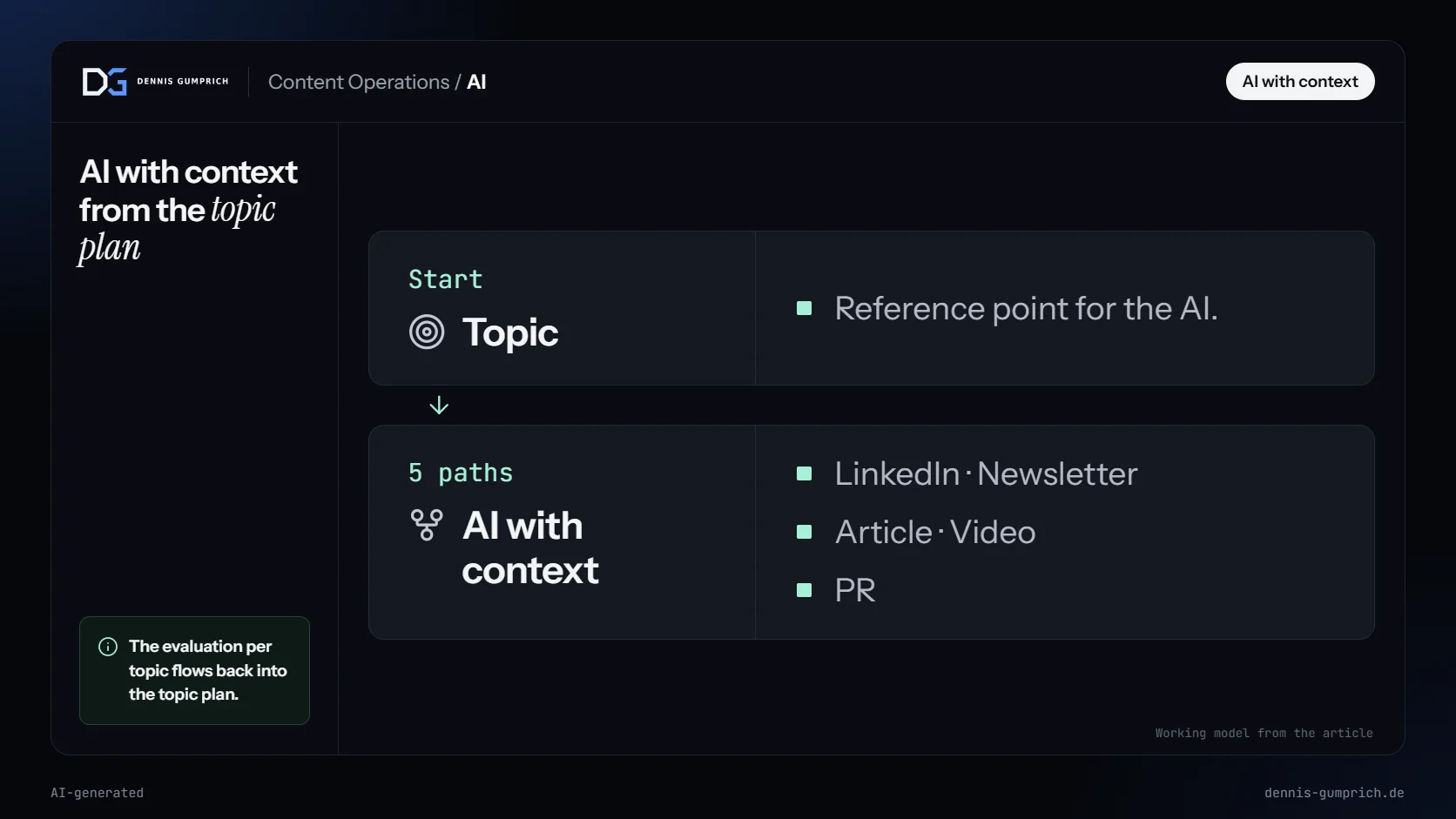
So if you plan to use AI beyond individual text drafts, you should put your planning structure in order first. How to store this context is described in the article on the knowledge base.
Which tools help with strategic topic planning and content production?
Three groups covering different parts: research tools provide topics and search data, spreadsheets and databases hold the topic plan, and content platforms connect topic plan, production and evaluation. For the strategic level, what matters is that the topic is an object of its own in the tool, to which all publications are tied, and not just a column.
| Group | Typical tools | Contribution to the topic plan |
|---|---|---|
| Research | Semrush, Ahrefs, Sistrix, AI visibility analyses | Questions, search volume, gaps compared with competitors |
| Spreadsheet or database | Excel, Airtable, Notion | Topic column, scoring, simple evaluation |
| Content platform | contentbird* | Topic as an object with production, approval and evaluation |
The middle group is enough to start. A platform becomes worthwhile as soon as you want to evaluate topics across several channels and months, because exactly this connection between topic and impact can only be established in a spreadsheet with a lot of manual work.
Five mistakes when switching
- Abolishing the editorial planThe production level is still needed. The topic plan goes above it; it replaces nothing.
- Starting with a cut-off dateOngoing operations do not stop. Add a topic column first and split the meetings afterwards.
- Too many topic areasFrom around eight areas onward, nobody assigns reliably anymore, and the grouping loses its purpose.
- Treating topics like campaignsA topic does not end with the last post. It stays open until the evaluation is available, otherwise the feedback loop fails again.
- Not switching the evaluationAnyone who keeps reporting per channel has borne the effort of the switch without reaping its benefit.
Self-check: do you need a topic plan?
Tick everything that applies to you.
A short assessment of our planning:
Our editorial plan is sorted by channel and date. That works for delivery, but breaks every subject into several independent rows. The result: duplicated work, unnoticed gaps and an evaluation that can only compare channels, not topics.
Proposal: we add a topic level above the existing plan instead of replacing it. In concrete terms, that means three to six topic areas, an additional topic column and then separating the topic decision from production coordination into two meetings. No cut-off date, no change of tool.
The benefit shows in the evaluation: we can then report which topics carried the load, not just which channel. That is the basis for the next planning round. In addition, the topic level is the precondition for using AI sensibly for derivatives, because that requires a reference point in terms of content.
Conclusion: it is a sorting question, not a tool question
The switch from editorial plan to topic plan seems bigger than it is. It is not about a new system, nor about giving up the existing plan. It is about which information comes first.
If you sort by channel, you plan delivery. If you sort by topic, you plan communication and can evaluate it afterwards. The difference costs one additional column and one split meeting. The topic plan is the planning building block in content operations and works best when topic selection and roles have been clarified beforehand.
Frequently asked questions
Do we need a new tool for this?
Not to start with. An additional topic column can be added to any spreadsheet, and the split conference is a calendar question. A system becomes useful as soon as derivatives should stay permanently tied to the topic and you want to evaluate per topic without compiling it by hand every time.
How many topic areas make sense?
Three to six. Fewer is usually too coarse to distinguish, more leads to inconsistent assignment. More important than the number is the counter-list: define explicitly what you do not stand for. Without this boundary, every topic fits somewhere in the end.
What happens to content that belongs to no topic?
It always exists, and it is not automatically bad. Mandatory publications, event notices or short-term reactions continue through the production level. It only becomes conspicuous when this share is permanently above about half. Then either the topic areas are cut too narrowly or you are working mostly reactively.
How long does the switch take?
The structure is in place within a few weeks: define topic areas, group the last three months backwards, add the column. It takes two to three quarters until the evaluation per topic is robust, because before that there are too few completed topics for a comparison.
What distinguishes the topic plan from topic scoring?
The topic plan is the structure, topic scoring is the selection method within it. First you need a level on which topics exist as topics at all. Then comes the question of which criteria you use to decide between them.
Our specialist departments deliver irregularly. Does a topic plan help?
Indirectly yes, because the request becomes more specific. Instead of individual text requests on changing dates, you ask once for subject-matter clarification of a topic and create the derivatives yourself. This significantly reduces the number of handovers, but does not solve a fundamental question of priorities between departments.
Where does your content process lose time today?
In 30 minutes, we look together at where unnecessary coordination, manual tasks, tool switching or repetitive content work cost you time today.
If you are currently thinking about switching your planning, we will look at your existing plan and group it by topic as an example. Afterwards you will see whether the step is worthwhile for your team.
Analyze your content process in 30 minutes Free of charge. You take away concrete starting points you can use internally right away.
Dennis Gumprich
Dennis helps marketing and communication teams fit generative AI into existing content processes without undermining quality, brand voice and approvals. Focus areas: content operations, AI governance and tool selection in mid-sized companies and corporations.
Transparency note: Dennis works for contentbird, a provider of AI-powered content software. Product mentions are marked in the article. More about Dennis (in German) · LinkedIn
Read more
Sources
- Guido Keel and Markus Niederhäuser, ZHAW Institute of Applied Media Studies: Corporate Newsrooms in der Schweiz (in German), final report June 2016, 96 organizations, 69 of them with a complete questionnaire: most communications departments are organized by target group and channel; with a newsroom, 72 percent work by topic, without one 44 percent. Accessed October 31, 2026.
- Brand & Retail Management Institute @ ISM and Mediamoss: Der Newsroom beginnt im Kopf (in German), press release from October 29, 2019, 172 communications and marketing managers from Germany, Austria and Switzerland: 55 percent see the shift away from channels toward topics; central instruments are a conference system and a topic plan; evaluation is mostly based on channel-specific metrics. Accessed October 31, 2026.
- Tobias Rohrbach, Diana Ingenhoff (Université de Fribourg), Mykola Makhortykh (University of Bern), Philipp Bachmann (Lucerne University of Applied Sciences): Ein Modell, viele Wege. Corporate Newsrooms in der Schweiz 2026 (Corporate Newsroom Study 2026), study report, supported by Newsroom Communication, Axpo, SBB and Innosuisse. Online survey of 216 communications managers in German- and French-speaking Switzerland, November and December 2025, self-assessments; topic orientation and topic house concept pp. 17 to 19, key takeaways p. 4. Accessed October 31, 2026.
- Robert Weller: Themenplan, Content-Plan, Redaktionsplan (in German), article on toushenne.de from March 12, 2026, based on Anthony's three-level model (1965): topic plan strategic over years, content plan tactical over about three to six months, editorial plan operational over a few weeks. Article by an independent consultant who names contentbird as a project reference. Accessed October 31, 2026.
How this article was created
This article was created with the help of AI. Structure, research and draft wording were developed with AI support. Professional assessment, review of the statements and the final version are the responsibility of Dennis Gumprich. The English version was translated with AI and reviewed. Read the original German version.
How reliable are the statements?
Evidence exists for the results of the Corporate Newsroom Study 2026 (self-assessments by 216 respondents in Switzerland), the widespread organization by channel rather than topic and the connection between newsroom structures and topic orientation (ZHAW), and the trend away from channels toward topics, the role of a conference system and topic plan and the mostly channel-based evaluation (ISM and Mediamoss). The level logic, the switching sequence and the orders of magnitude given are working models from consulting practice and not measured values. The terms topic plan, content plan and editorial plan are used inconsistently in the literature; the definition used here is one of several possible. The distinction into three planning levels comes from an article by Robert Weller and is presented as his classification. The classification of tool groups is not an assessment of individual products. As of October 31, 2026.


