

GEO rarely fails for lack of knowledge, but because of everyday work: briefs, approvals and maintenance that make no provision for it.
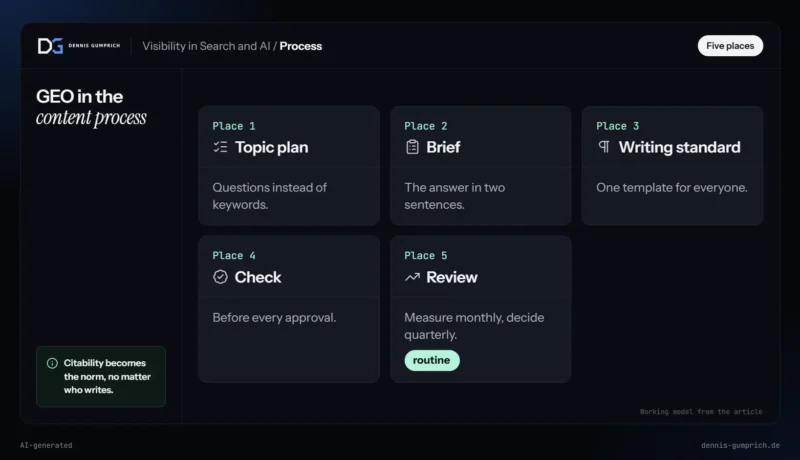
What makes content citable for ChatGPT, Perplexity and Google's AI Overviews is now well described. Where most teams fail is implementation in daily work. How to make a single AI draft citable before approval is shown in From AI draft to citable text. Generative Engine Optimization (GEO) only works when it is firmly anchored in five places in the content process: in topic planning, in the brief, in the writing standard, in the check before approval and in a fixed rhythm for existing content and measurement. Two one-off clarifications are added, with IT and with media relations. A 90-day plan turns this into routine instead of a project.
This article describes how to implement GEO in the team. What AI search considers when choosing its sources, which crawlers you need to allow and what makes a paragraph citable is covered in the basics article Visible in ChatGPT, Perplexity and AI Overviews: what makes content citable.
Why doesn't GEO take hold in most content teams?
Because it is treated as a knowledge topic and not as a process topic. A workshop changes what people know. Whether content changes, however, is decided in the brief, the writing template, the agency assignment and the approval. As long as GEO is not anchored there, it depends on who happens to be writing and how much time that person has.
Conversations with content teams show a clear gap: almost everyone feels the impact of AI on everyday content work, but only a few have a strategy for their own visibility in AI systems. This gap is rarely a knowledge gap. Almost always the same pattern appears: the basics are known, but nobody has decided who applies them when in the process.
An association survey shows this gap in industrial communications too. In the Trendbarometer Industriekommunikation 2026 (in German) by bvik, the German association for industrial communications, 86 percent of 282 participants consider optimization for AI search engines necessary. At the same time, many companies lack clear rules for using AI, and the academic adviser Prof. Dr. Seon-Su Kim sees a remarkable gap between vision and implementation overall. The online survey ran in October and November 2025, and the sample is modest. For you, this means: hardly any persuasion is needed anymore, but a clear decision on who applies GEO when in the process is.
Three effects reinforce the problem. First, GEO usually enters the company via the SEO team, who only write part of the content themselves. Second, visibility is often measured first and only worked on afterwards, so monitoring becomes a substitute for change. Third, GEO meets content that comes from many contributors: agencies, freelancers, subject matter experts, management. A standard only known to the SEO team doesn't reach this content.
Workshop, guideline in the team folder, monitoring dashboard. Whether content becomes citable depends on who writes it. After three months, two out of twelve pieces follow the pattern.
Questions are in the topic plan, answers in the brief, characteristics in the template, a check before every approval. Citability is the norm, no matter who writes.
Who is responsible for GEO in the team?
Everyone who plans, commissions, writes or approves content, but with different tasks. One person holds the standard together and is responsible for the question catalog and measurement. Editorial, agencies and subject matter experts apply the standard. IT and media relations make one-off or regular contributions outside day-to-day editorial work.
The most common misallocation is dumping GEO entirely on the SEO team. The SEO team can define the standard and measure the effect. Whoever writes and approves has to implement it. The following allocation has proven itself as a starting point.
| Role | Task in the GEO process | Rhythm |
|---|---|---|
| GEO responsibility (often SEO or content lead) | Maintain the standard, keep the question catalog, document measurement, prioritize the existing content list | ongoing, review monthly |
| Editorial | Phrase the answer in the brief, write to the template, run the check before approval | per piece |
| Agencies and freelancers | Deliver to the template, supply sources and evidence | per assignment |
| Subject matter experts | Deliver questions from sales and service, confirm figures and statements | quarterly and per approval |
| Media relations and social | Align expert articles, interviews and profiles with the topics in the question catalog | quarterly |
| IT and web team | Implement the crawler decision, technical check after relaunches and updates | once, then as needed |
How roles in the content team are fundamentally designed so that decisions don't fall between the cracks is described in the article on the four roles in the content team. For GEO, it is usually enough to extend an existing role with responsibility for standard and measurement. A dedicated position is rarely needed.
That GEO cuts across existing responsibilities is also the view of Olaf Kopp, co-founder of the agency Aufgesang. In his redefinition of Generative Engine Optimization from July 2026, he distinguishes three areas: LLM readability, meaning being cited as a source; brand context, meaning being named or recommended as a brand, even without a link; and agentic commerce. He distributes responsibility across SEO and content, PR, brand and communications, and product data and e-commerce. This is a conceptual classification from an agency perspective, not a survey. For your role model, it follows: the GEO responsibility holds the standard together, but you still explicitly plan in the contributions of media relations and product data.
Place 1: Topic planning with questions instead of keywords
The starting point for any GEO work is a catalog of the questions your audience actually asks. It comes from sales and customer service, not from the keyword tool, and it sits in the topic plan next to the topics, not in a separate document. Every topic is assigned at least one question it is meant to answer.
Keywords describe what people search for. Questions describe what they want to know. The difference sounds small but is decisive for AI search, because there, whole questions are asked and answers come back. If you derive your topic plan only from keywords, you plan pages. If you derive it from questions, you plan answers.
The best sources for the question catalog are in-house. Ask sales for the ten questions that come up most often in first meetings. Ask customer service for the most common pre-purchase inquiries. Analyze webinar questions and comments. After an hour, you usually have a list that is closer to your audience than any keyword research.
- Step 1Collect questionsTen questions each from sales, customer service and events, in the audience's words, not rephrased into jargon.
- Step 2CondenseMerge duplicates and reduce to ten to twenty core questions. These core questions are also your measurement catalog.
- Step 3Assign topicsEach core question gets a topic in the topic plan that answers it. Questions without a topic are your gaps; topics without a question are your candidates for sharpening.
- Step 4Add quarterlyNew questions from sales and service are added once a quarter. That keeps the catalog close to what prospects are currently thinking about.
This logic fits seamlessly with a topic plan in which topics, not channels, form the first column. How the switch from editorial calendar to topic plan works is described in From editorial calendar to topic plan.
Place 2: The brief starts with the answer
Every brief contains the question the content answers and the answer in at most two sentences. Add the evidence the answer is based on and the data of your own that the content should bring in. If you can't formulate these two sentences, you are not finished with the topic yet, and no writing standard will rescue the text afterwards.
This is the most effective single change in the entire process, and it costs almost nothing. Most briefs contain topic, audience, length, keywords and deadline. The answer is almost never there. It then emerges somewhere during writing, often in the last paragraph, and that is exactly where an AI system doesn't look for it.
| Field | Content | Why it counts |
|---|---|---|
| Core question | the question from the question catalog, in the audience's words | becomes the heading or opening |
| Answer in two sentences | the key message, phrased so that it can stand alone | becomes the answer paragraph at the start |
| Evidence | figures with source and time period, studies, own analyses | makes statements verifiable |
| Own data | what only you know: project values, analyses, experience | the reason to cite you in particular |
| Follow-up questions | two to four follow-up questions readers will have | become subheadings or FAQs |
| Expert approval | who confirms figures and statements | prevents corrections after writing |
The "answer in two sentences" field has a side effect that goes beyond GEO. It forces you to clarify before writing what the message actually is. In my experience, briefs with this field lead to fewer correction loops in approval, because subject matter experts confirm the key message early instead of discussing it on the finished text. How to make handovers to subject matter experts smoother overall is described in Handovers between marketing and subject matter experts.
Place 3: A writing standard that applies to everyone
The characteristics of citable paragraphs belong in a writing template that everyone uses: editorial, agencies, freelancers and subject matter experts. It is part of the agency brief, the template for expert articles and the specifications for AI-assisted drafts. Only then does citability no longer depend on who is writing.
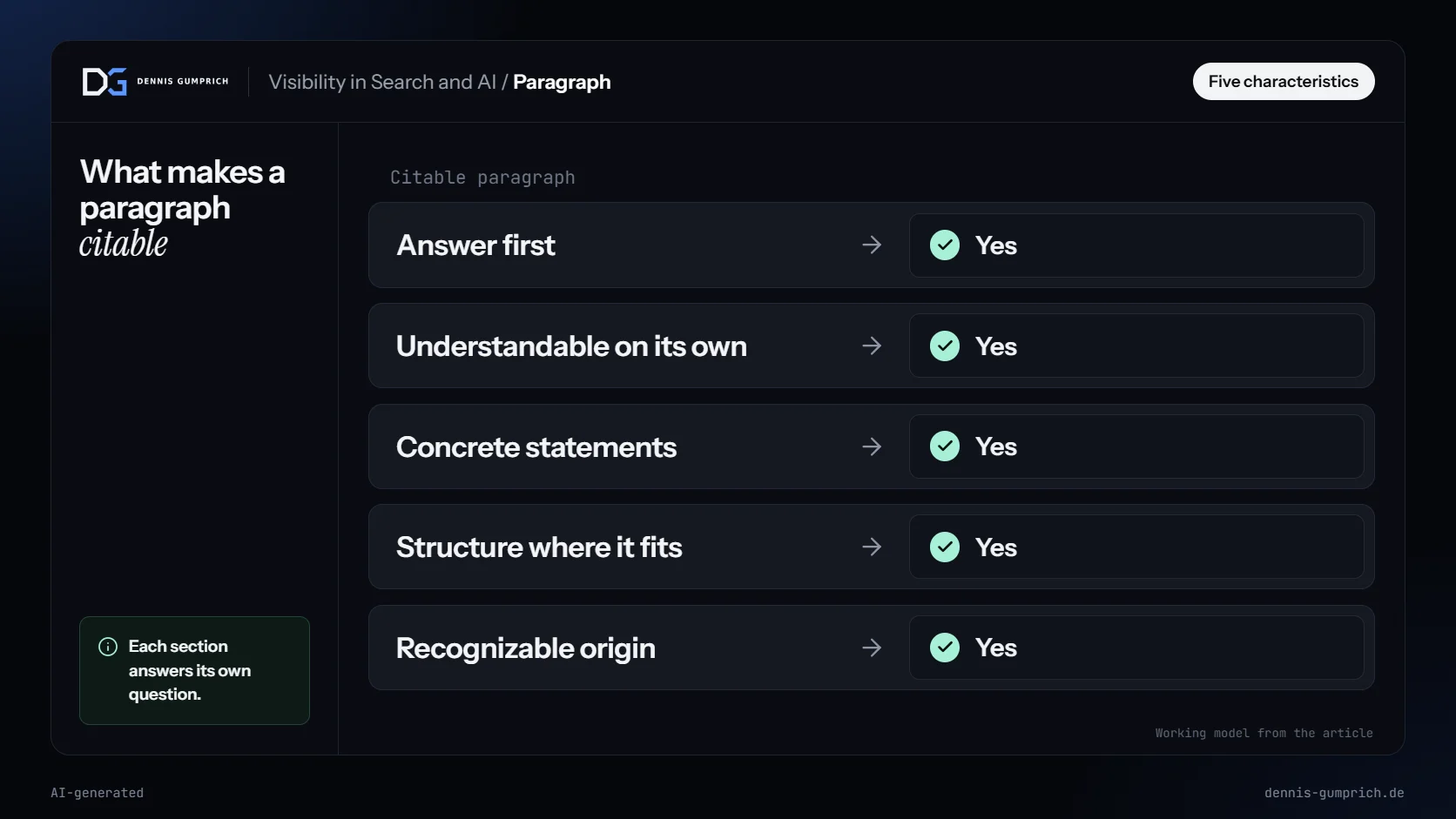
What the five characteristics mean in detail is described in the basics article. For implementation, what matters is where they are written down. A characteristic that only came up in a workshop is forgotten after three weeks. A characteristic that is a mandatory field in the template gets applied.
In practice, three building blocks prove effective. First, an article template in which every section starts with a marked answer paragraph, so authors can't skip it. Second, a section in the agency brief that describes the characteristics as acceptance criteria, not as recommendations. Third, stored rules for AI-assisted drafts, so that machine-generated first drafts also follow the standard. How to store such rules so that AI applies them reliably is described in Setting up brand voice.
| Place | Who uses it | How it appears there |
|---|---|---|
| Article template | Editorial | Answer paragraph as a marked mandatory field per section |
| Agency brief | Agencies and freelancers | Characteristics as acceptance criteria with an example |
| Template for expert articles | Subject matter experts | Simplified version with three guiding questions |
| AI specifications | Everyone using AI drafts | As a stored rule, not as a prompt in someone's head |
| Onboarding | New colleagues | One page with before-and-after examples |
For subject matter experts, a deliberately simplified version is worthwhile. Anyone who rarely writes doesn't need five characteristics, but three guiding questions: which question does your text answer? Is the answer in the first paragraph? Where does every figure come from? Whoever answers these three questions delivers a text the editorial team can finish with little effort.
Place 4: A check before every approval
Before content goes into approval, it is checked once against the writing standard: is the answer at the start, are the sections self-contained, are figures backed up, are authorship and date visible? The check takes a few minutes, distinguishes between must and could and applies to all content, wherever it comes from.
Without this check, the standard is a recommendation. With it, it becomes a rule. The difference shows above all with content from outside: an agency text that forgot the answer paragraph stands out in the check and goes back with a concrete note instead of being published unnoticed.
| Check point | Severity | Consequence if missing |
|---|---|---|
| Answer is in the first two sentences of the section | Must | back to the author |
| Every figure has source and time period | Must | back, or delete the figure |
| No back-references such as "as described above" | Should | editorial corrects it |
| Comparisons as tables, processes as lists | Should | editorial corrects it |
| Authorship and update date visible | Must | add before publication |
| At least one piece of own information or experience | Could | note for the next revision |
The split into must, should and could matters so that the check doesn't slow down the process. Only must points lead to a return. Editorial corrects should points itself; could points are noted. That keeps the check fast and still binding. How to build review criteria overall without lengthening approvals is described in the checklist before approval.
The check can be done manually as a checklist or automatically as a step in the workflow. Automated checks have the advantage that they are not forgotten and are equally strict for every piece of content. But they don't replace a person's look at whether the answer is technically correct.
Disclosure
I work for contentbird. It offers a GEO score that assesses texts while they are being created for how likely they are to be used as a source in AI answers, and suggests concrete improvements. In addition, custom AI checks can be stored as a fixed step before approval, such as exactly the check points from the table above. The idea behind it matches this article: visibility arises in writing and checking, not in the dashboard. The score is an assessment, not a guarantee of a citation.
Settle once: the crawler decision with IT
Which AI crawlers may fetch your website is not a task for the editorial team, but a one-off decision that marketing, IT and data protection make and document together. After that, it is checked again at every relaunch, CMS update and change of CDN provider, because that is where it is most often lost unnoticed.
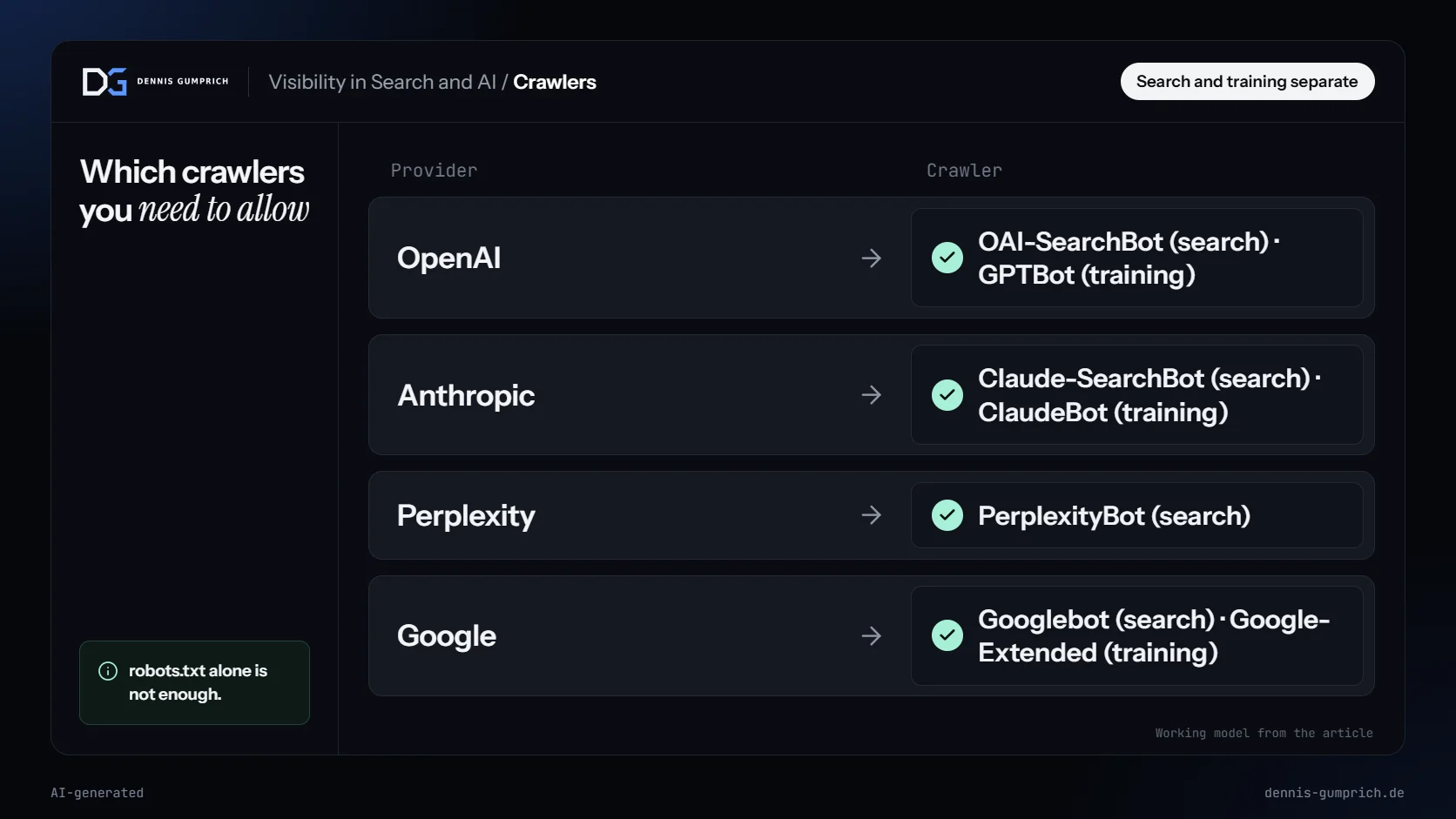
Which crawlers exist and which are responsible for search and which for training is listed in the basics article. For the process, something else counts: that the decision is made deliberately, recorded in writing and reviewed regularly. In many companies, the current setting is the result of a recommendation someone implemented two years ago, without anyone today knowing the reason.
- Step 1Assess the current stateIT checks robots.txt, bot protection in the CDN or firewall and whether content is in the HTML without JavaScript. The result is a short list of what is currently allowed and what is blocked.
- Step 2Define the goalMarketing and data protection decide together: visibility in AI search yes, use for training yes or no. Most companies allow search crawlers and decide on training deliberately case by case.
- Step 3Implement and documentIT implements the decision. Half a page records what applies, why, who decided and when the next review is due.
- Step 4Add it to checklistsThe check goes into the checklist for relaunches, CMS updates and changes of hosting or CDN provider. That way, the setting isn't lost at the next technical change.
How to involve IT and data protection early and without long loops on such questions is described in Involving IT and data protection early.
Align regularly: plan media relations and expert articles together
Mentions outside your own website don't happen by chance, but through media relations, guest articles, interviews and your experts' profiles. So that they support the topics in your question catalog, they belong in the same topic plan as the website content, with the same key messages and the same company information.
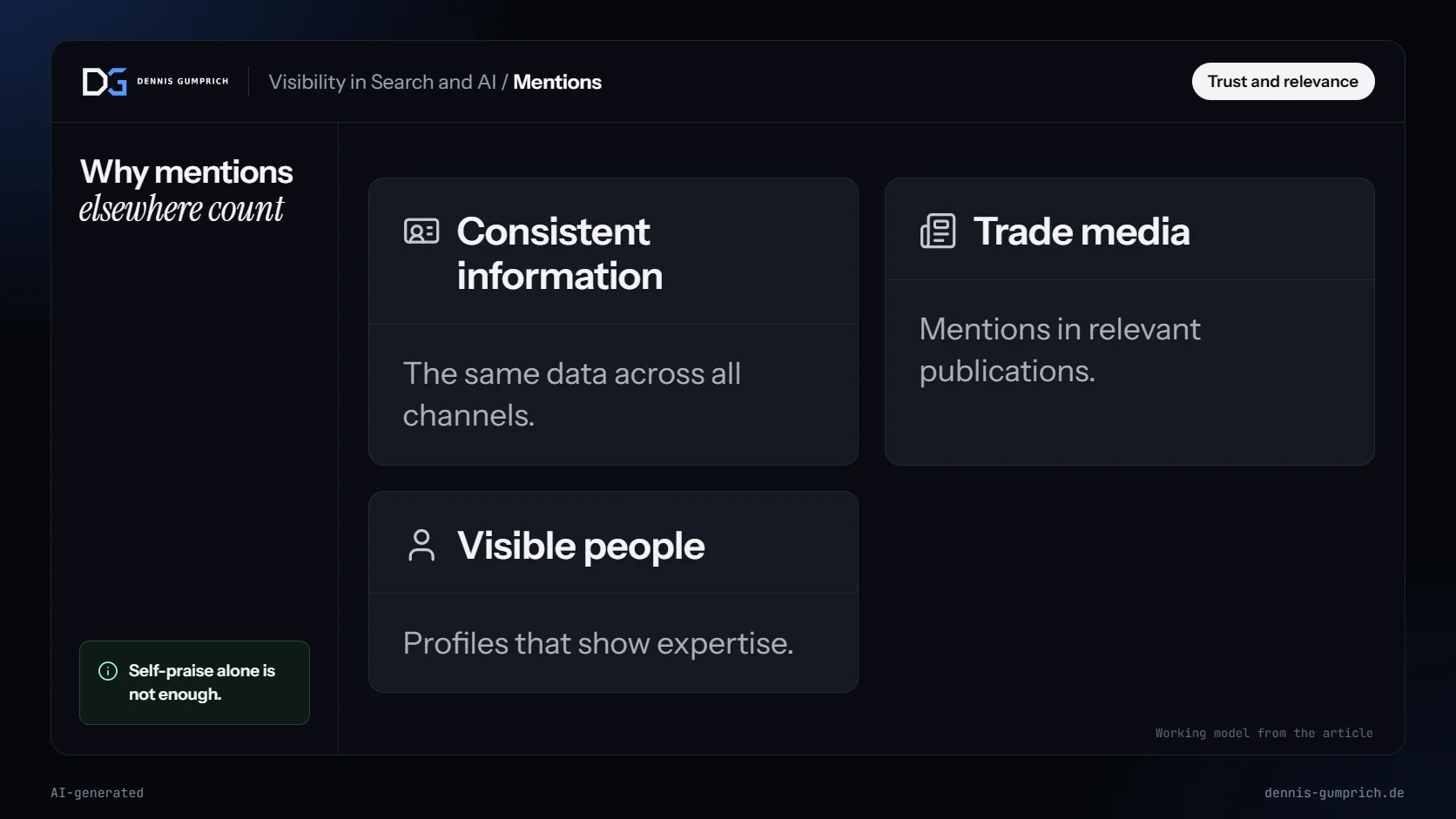
In many companies, website content and media relations run separately. The editorial team plans expert articles, the press office plans releases and interviews, and both talk about different topics with different wording. For AI search, that is wasted potential. When a trade publication quotes your expert on exactly the question your website also answers, both sources confirm each other.
Three measures are enough to connect the two. First, media relations adds the question catalog to its topic planning and aligns guest articles and interview offers with it. Second, there is a short, agreed description of company, offering and audience that is used the same way everywhere: on the website, in profiles, in industry directories, with partners. Third, two or three experts are defined who regularly and visibly publish on the core questions, on your own website and elsewhere.
The third point requires the most coordination, because it costs time from people outside marketing. It is still worth it, because content with a recognizable expert is more credible, for readers and AI systems alike. A realistic rhythm is one article per expert per quarter, prepared by the editorial team, checked by the expert.
Existing content before new production: the revision sprint
The fastest effect almost always lies in existing pages, not new ones. Take the ten to twenty pages that already answer your core questions best today and rework them to the writing standard within a fixed period. New content follows the standard anyway; old content only does if you deliberately work on it.
Pages that are already well indexed and linked often need only a few changes to become a candidate source: a clear answer paragraph, a shortened introduction, a table instead of a long comparison paragraph, an updated figure with a date. That costs one to two hours per page and works faster than a new article, which first has to be found and linked.
| Priority | Page characteristic | Typical intervention |
|---|---|---|
| 1 | answers a core question, has visitors, doesn't follow the standard | answer paragraph, shorten intro, back up figures |
| 2 | answers a core question, few visitors | additionally strengthen internal linking |
| 3 | has visitors, but no core question | assign a question or deliberately leave as is |
| 4 | outdated, no core question, few visitors | merge, redirect or archive |
A sprint of four to six weeks with a fixed scope has proven effective, for example two to four pages per week, in addition to ongoing work. After that, maintaining existing content moves into a permanent rhythm: pages on core questions are reviewed at least once a year and given a visible update date. How to review your existing content sensibly before the sprint is described in the article on the content inventory.
Your own data as an editorial routine
Your own data is the strongest reason to cite you in particular, because this information exists nowhere else. So that it is created regularly and not just occasionally, a small routine is needed: a list of data sources in-house, a responsible person and a fixed date each quarter on which an analysis becomes a piece of content.
Most companies are sitting on more publishable material than they think. Analyses from customer service, typical project durations, average values from quotes, results of internal tests, questions from webinars. The problem is rarely a lack of data, but that nobody has the task of turning it into content.
- Step 1Inventory data sourcesA list of all places in-house where figures regularly arise that could be relevant to your audience. One hour with sales, service and product management is enough.
- Step 2Clarify approval rulesWhat may be published in what form? Clarify once with management and data protection instead of discussing every figure anew.
- Step 3Set a quarterly dateOnce a quarter, an analysis becomes a piece of content, matching a core question from the catalog.
- Step 4Use it multiple timesThe same figure supports an expert article, press release, talk and social post. The more often it appears with the same source, the more strongly it becomes associated with you.
Measurement rhythm: document monthly, decide quarterly
Measure monthly, decide quarterly. Each month, the GEO responsibility documents whether and how you appear in answers to the core questions, together with Search Console and web analytics. Each quarter, the team decides on this basis which pages to revise, which topics to add and which questions to include.
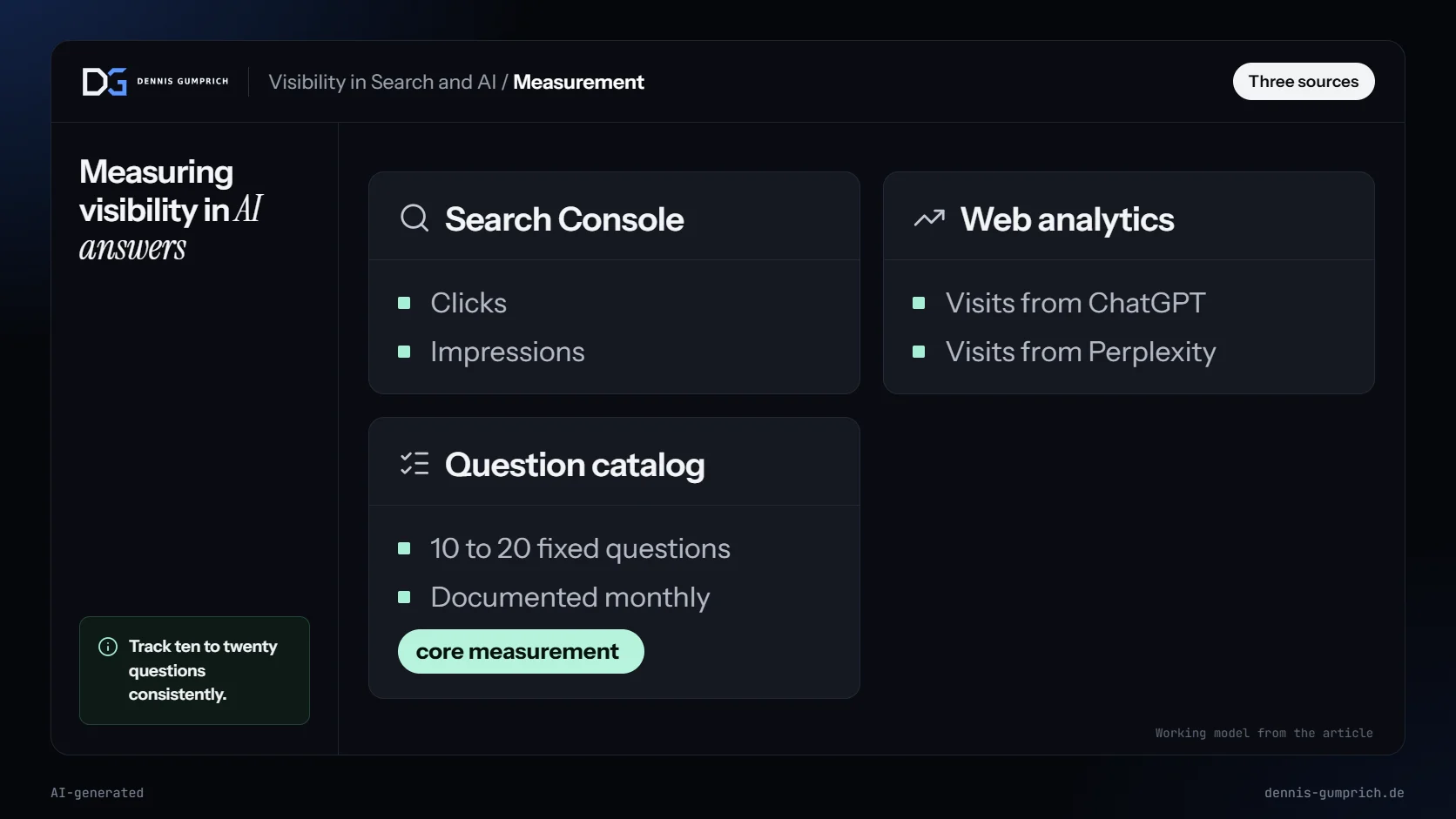
The separation between measuring and deciding is where many teams fail. If you measure monthly and react monthly, you chase fluctuations, because AI answers vary from query to query. If you only measure and never decide, you have a dashboard without consequences. A quarter is long enough to distinguish trends from chance and short enough to adjust course.
| Block | Duration | Result |
|---|---|---|
| Development per core question | 10 minutes | where you gained and where you lost |
| Who is cited instead? | 10 minutes | pointers to what others answer better |
| Adjust the existing content list | 10 minutes | the next pages for revision |
| Maintain the question catalog | 10 minutes | new questions from sales and service, outdated ones out |
| Record decisions | 5 minutes | tasks with names and dates in the topic plan |
The second block is the most revealing. If the same third-party source is regularly named for a core question, it is worth taking a close look at what it does differently. Usually the answer is simple: it answers the question more directly, gives a figure or is more up to date.
The 90-day plan for getting started
In three months, GEO can be turned from a knowledge topic into routine: in the first month, lay the foundations; in the second, revise existing content and introduce the standard; in the third, establish the rhythm and hold the first review. The effort is a few hours per week in addition to ongoing work.
- Weeks 1 to 2Responsibility and question catalogName the GEO responsibility, collect questions from sales and service, condense them into ten to twenty core questions, document the baseline.
- Weeks 3 to 4Technology and templatesMake the crawler decision with IT and data protection, add brief fields, adapt the article template and agency brief.
- Weeks 5 to 8Revision sprintRework ten to twenty existing pages by priority, introduce the check before approval for all new content.
- Weeks 9 to 10AlignmentAlign media relations with the question catalog, standardize the company description, define experts for core questions, inventory data sources.
- Weeks 11 to 12First reviewDocument the monthly measurement for the third time, hold the first quarterly review, define the next existing content list and topics.
Don't expect a sudden change in AI answers after 90 days. It often takes weeks until revised pages are picked up again and used. What should be in place after 90 days is the process: every new piece of content follows the standard, the most important existing content has been revised, and the team makes decisions based on its own measurements. The effect in the answers then shows in the second and third quarters. How to set up introductions like this as a pilot with clear criteria is described in Pilot and rollout.
Five mistakes in implementing it in the team
- Leaving GEO only with the SEO teamThe SEO team can define the standard; everyone who writes and approves has to implement it. Without agencies and subject matter experts, the standard only reaches part of the content.
- Starting with monitoringA dashboard without changed briefs and templates shows for three months that nothing is moving. Measurement belongs at the start, but not on its own.
- Only adapting new contentThe biggest and fastest lever lies in existing content. If you only produce new content, you wait unnecessarily long for an effect.
- Making the check too strictIf every should point leads to a return, approvals get longer and the team bypasses the check. Only must points lead back.
- Reacting monthly instead of deciding quarterlyAI answers vary. If you react immediately to every change, you get lost in individual cases and miss the trends.
When is the effort not yet worth it for you?
If your audience hardly researches before buying, if you publish fewer than two or three pieces of content a month or if basic processes such as briefing and approval haven't been defined at all yet. In the last case, GEO is a good reason to clarify these processes, but not the first step.
With very few publications, it is enough to apply the writing standard personally and revise existing content once. A role model, a question catalog with a quarterly review and an automated check only pay off when several people and external partners deliver content. And if it is currently still unclear who commissions content and who approves it, that question comes before everything else. How to build processes like this in general is described in AI Content Operations: turning AI experiments into a process.
Self-check: Is GEO anchored in your process?
Tick everything that applies to you.
a brief note on our visibility in AI search:
What makes content citable for ChatGPT, Perplexity and Google's AI Overviews is known. With us, though, it depends on who happens to be writing. Briefs, agency assignments and approvals look the same as before, so only a small share of our content follows the pattern.
Proposal: we anchor GEO in five places in the process, namely questions in the topic plan, the answer in the brief, a shared writing template, a short check before approval and a quarterly review. In addition, we clarify once with IT which AI crawlers may access our site, and we align media relations with the same core questions.
In 90 days, this becomes routine, with a few hours per week in addition to ongoing work. We expect the fastest effect from revising ten to twenty existing pages.
Conclusion: Knowledge only becomes visibility in the process
The rules for citable content are no longer a secret, and they differ little from what has always made good expert texts. The difference between teams that appear in AI answers and teams that don't therefore rarely lies in knowledge. It lies in whether this knowledge is written down where content is created: in the topic plan, the brief, the template, the check and the review.
Anyone who anchors GEO this way needs no campaign and no dedicated position. They need a responsible person, five fixed places in the process and the patience to assess the effect over quarters rather than weeks.
Frequently asked questions
Do we need a dedicated position for GEO?
In most teams, no. GEO is above all a requirement for briefing, writing and approval, and therefore belongs to everyone who creates content. An existing role, often in SEO or the content lead, additionally takes on standard, question catalog and measurement. After the introduction, this takes a few hours a month.
How do we get agencies to deliver to the standard?
By making the standard part of the assignment rather than just a recommendation. Describe the characteristics in the agency brief as acceptance criteria, include a before-and-after example and check every delivered text before approval. After two or three returns with concrete notes, most agencies deliver to the template on their own.
How many core questions make sense to start with?
Ten to twenty. Fewer represents your audience too roughly; more can't be documented properly every month. The catalog grows over time as sales and service deliver new questions every quarter. What matters is that the questions are phrased in the audience's words, not in your jargon.
Should we write new content first or revise existing content?
Existing content first. Pages that are already indexed and linked often only need an answer paragraph, a current figure and a table to become a candidate source. New content follows the standard from the introduction anyway. The revision sprint in weeks five to eight is usually the most effective part of the 90-day plan.
How do we combine GEO with AI-assisted writing?
By storing the rules of the writing standard as a fixed specification that applies to every AI draft, instead of having them in individual prompts. Your own data and technical statements still come from you. AI helps with structuring, checking and adapting. How to catch hallucinations in the process is described in a separate article.
How do we know after one quarter whether it's working?
From two kinds of numbers. Process numbers show whether the standard is taking hold: the share of new content that passes the check without being returned and the number of revised existing pages. Impact numbers show whether visibility is moving: mentions for the core questions and visits from AI assistants. After one quarter, the process numbers should be right; the impact numbers usually follow in the second and third.
What does a GEO process look like in concrete terms?
It consists of four recurring steps. First, a fixed catalog of the questions for which you want to appear in AI answers. Second, a writing standard with direct answer paragraphs, sources and dates. Third, checking this standard in approval. Fourth, monthly monitoring of whether and how you are cited in the common assistants. What matters is that these steps are built into existing processes instead of running alongside as a special project.
Where does your content process lose time today?
In 30 minutes, we look together at where unnecessary coordination, manual tasks, tool switching or repetitive content work cost you time today.
If you want to anchor GEO in the team, we go through your path from topic to approval and clarify where question catalog, answer in the brief and check have the biggest effect with the least effort.
Analyze your content process in 30 minutes Free of charge. You take away concrete starting points you can use internally right away.
Dennis Gumprich
Dennis helps marketing and communication teams fit generative AI into existing content processes without undermining quality, brand voice and approvals. Focus areas: content operations, AI governance and tool selection in mid-sized companies and corporations.
Transparency note: Dennis works for contentbird, a provider of AI-powered content software. Product mentions are marked in the article. More about Dennis (in German) · LinkedIn
Read more
Sources
- Google Search Central: Optimizing your website for generative AI features on Google Search, guide, as of July 10, 2026: according to Google, optimizing for generative AI search is still search engine optimization. Accessed October 31, 2026.
- Google Search Central: Creating helpful, reliable, people-first content, guide, as of October 5, 2026: recommendation to add accurate author information such as bylines. Accessed October 31, 2026.
- OpenAI: Overview of OpenAI Crawlers, documentation: separate crawlers for search (OAI-SearchBot) and model training (GPTBot). Accessed October 31, 2026.
- Cloudflare: Cloudflare Just Changed How AI Crawlers Scrape the Internet-at-Large, press release of July 1, 2025: blocking AI crawlers without permission as the default. Accessed October 31, 2026.
- Vercel: The rise of the AI crawler, analysis of December 17, 2024: the major AI crawlers examined did not execute JavaScript. Accessed October 31, 2026.
- Google Search Console Help: Generative AI performance report, help article: impressions in AI Overviews and AI Mode, available for all websites worldwide since August 31, 2026. Accessed October 31, 2026.
- Rand Fishkin, SparkToro: NEW Research: AIs are highly inconsistent when recommending brands or products, study of January 27, 2026, around 600 volunteers, 12 prompts, 2,961 answers from ChatGPT, Claude and Google: the same list of brands in fewer than one in 100 cases. Accessed October 31, 2026.
- bvik: Trendbarometer Industriekommunikation 2026 (in German), press release of January 13, 2026, online survey of 282 participants in October and November 2025 following a preparatory workshop with 32 leaders, with academic support from Prof. Dr. Seon-Su Kim: 86 percent consider optimization for AI search engines necessary, many companies lack clear rules for AI use, according to Kim a remarkable gap between vision and implementation overall. Association survey with a modest sample. Accessed October 31, 2026.
- Olaf Kopp, Kopp Online Marketing: What is Generative Engine Optimization (GEO)? A new definition and differentiation, article of July 30, 2026: GEO as the task of making content, brands and data findable, citable and actionable in AI answers, with the areas LLM readability, brand context and agentic commerce and responsibilities distributed across SEO and content, PR, brand and communications, and product data and e-commerce. Conceptual classification from the perspective of the agency Aufgesang, hardly backed by data. Accessed October 31, 2026.
How this article was created
This article was created with the help of AI. Structure, research and draft wording were developed with AI support. Professional assessment, review of the statements and the final version are the responsibility of Dennis Gumprich. The English version was translated with AI and reviewed. Read the original German version.
How reliable are the statements?
Documented are the classification of GEO as search engine optimization and the recommendation on author information by the Google guides, the separation of search and training crawlers by the OpenAI documentation, the default blocking in the CDN by the Cloudflare press release, the lack of JavaScript execution by the Vercel analysis, the measurement in Search Console by Google's help, the variation of AI answers between queries by the SparkToro study, the widespread view that optimization for AI search engines is necessary, the missing AI rules and the gap between vision and implementation by bvik's Trendbarometer Industriekommunikation 2026 (association survey with a modest sample), and the distribution of GEO responsibilities across SEO and content, communications and product data by Olaf Kopp's definition (conceptual classification from an agency perspective). The gap between noticeable AI impact and a missing visibility strategy, as well as the statement on how companies treat search and training crawlers, are observations from consulting practice. Role allocation, check points, prioritization and the 90-day plan are working models from consulting practice, not measured values. The selection logic of AI systems is not disclosed and changes constantly. As of October 31, 2026.


