
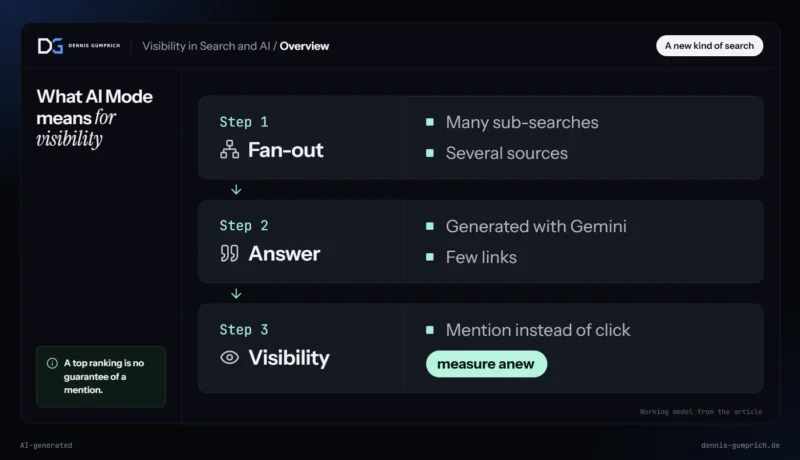

Google AI Mode is a separate area of Google Search in which an AI based on Gemini creates detailed answers with source links and allows follow-up questions. To do this, the system breaks a question down into many sub-searches and combines the results. AI Mode launched as an experiment in the US in March 2025 and has been available in Germany, Austria and Switzerland, along with more than 40 other countries, since October 8, 2025. Google says no special optimizations are needed for visibility: indexing, snippet eligibility and helpful, original content are enough. Studies, however, show significantly fewer clicks when AI answers appear. Companies should therefore measure visibility in AI answers alongside clicks and strengthen content with their own expertise and clear answers.
What is Google AI Mode?
AI Mode is a search mode in which Google answers queries with generative AI. It is designed for questions where users want to explore, weigh up or compare something. The answer is detailed, contains links to websites and can be explored further with follow-up questions.
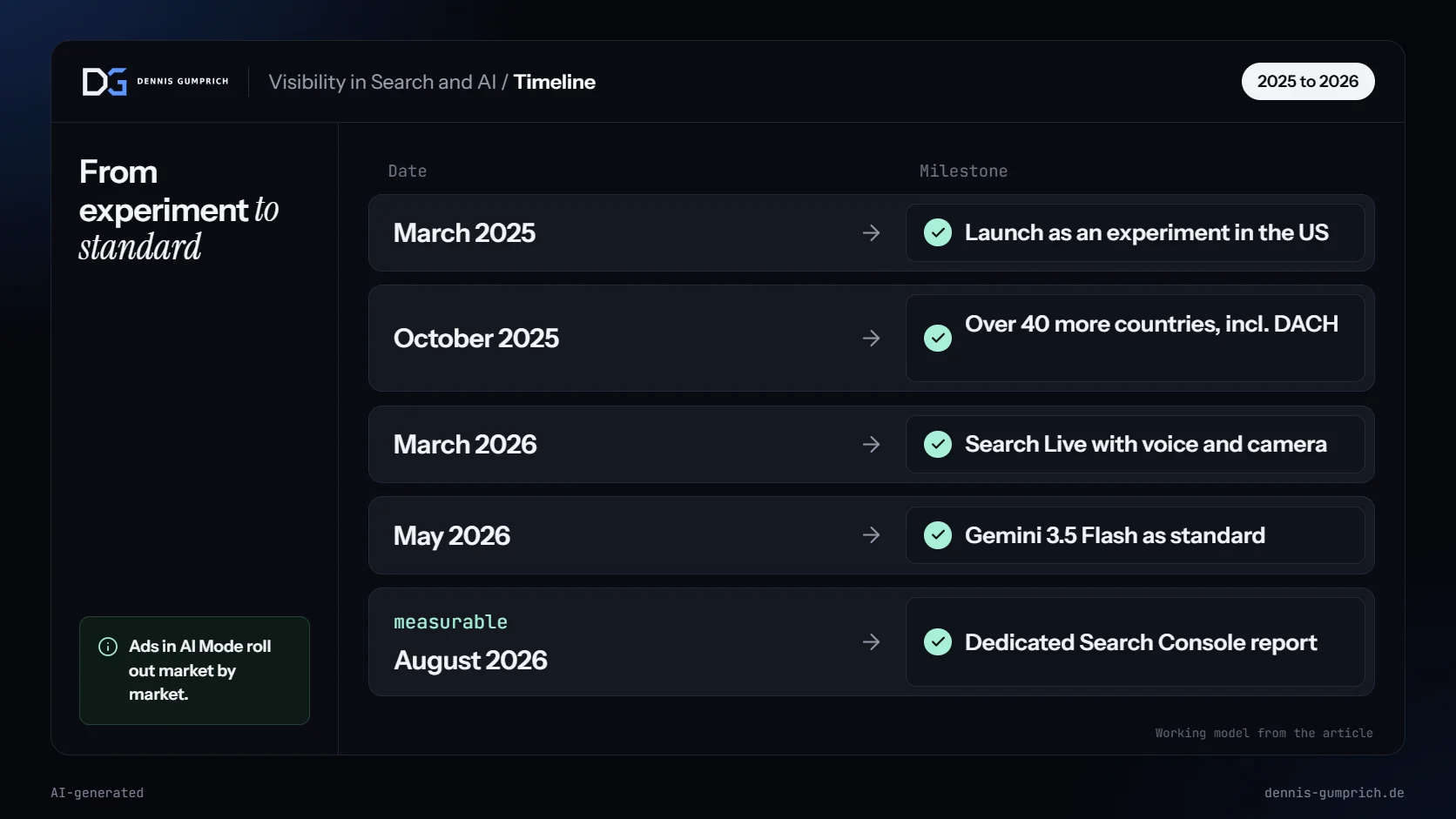
Google introduced AI Mode as an experiment in the US in March 2025. Since then, it has gradually become a permanent part of Search. According to Google, more than a billion people now use it every month, and since May 2026 the default model has been Gemini 3.5 Flash (Google, I/O 2026).
Important for context: AI Mode does not replace classic search. It complements it as a separate area that users open deliberately or enter from an AI Overview. Google describes the difference in its documentation AI features and your website as follows: AI Overviews summarize a topic within the results list, while AI Mode offers a detailed, conversational answer for more complex questions.
What does AI Mode look like, and how do you open it?
AI Mode appears as a separate "AI Mode" tab on the results page, as a tile in the Google app and directly via google.com/ai. The answer is a detailed text with paragraphs, lists or tables, with the sources alongside. Below it, users can ask follow-up questions.
According to Google's help page on AI Mode, there are several entry points:
- Tab on the results page: After a normal search, the "AI Mode" tab leads into the dialog.
- Google app: On Android and iOS, there is a dedicated tile for AI Mode.
- Direct access: google.com/ai opens the mode directly.
- From an AI Overview: Since May 2026, an AI Overview leads directly into a follow-up dialog in AI Mode.
Input is not limited to text. Users can speak, take a photo or upload one. With Search Live, available in Germany since March 2026 as well, a real-time conversation using voice and camera is also possible (Google, March 2026, in German). The official promotional video shows how Google envisions its use:
How does AI Mode work?
AI Mode uses a technique Google calls query fan-out: the question is broken down into many related sub-searches that run simultaneously across different subtopics and data sources. A Gemini model combines the results into one answer and links the sources.
At launch, Google described the approach like this: the system runs several related searches at the same time, across subtopics and different data sources, and brings the results together (Google, March 2025). As data sources, Google names web content, the Knowledge Graph, real-time information and shopping data. According to Search Central, fan-out means that answers link to a wider selection of websites than a classic results list.
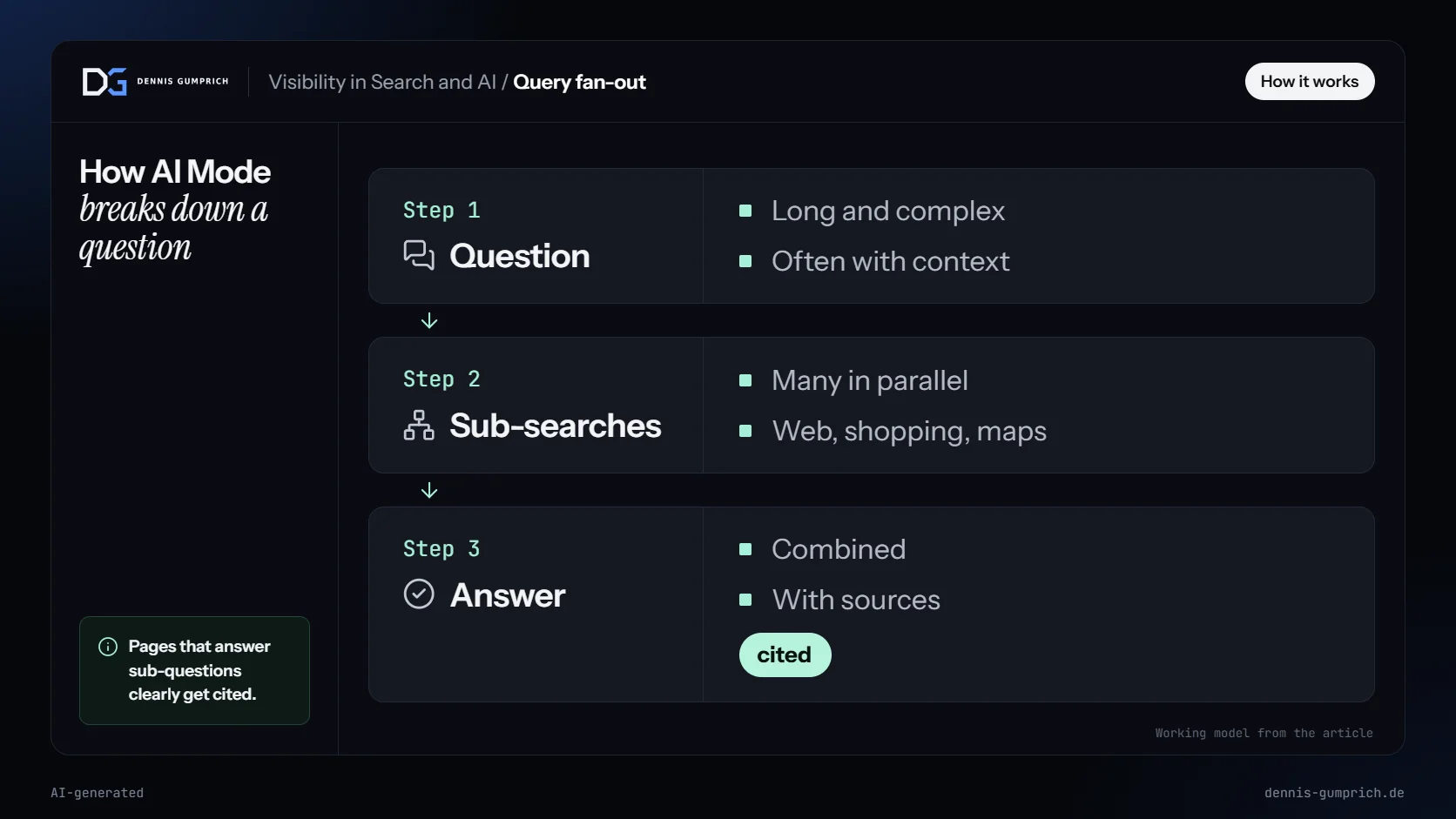
For companies, this has an important consequence: a page does not have to rank for the original question to be cited. It can make it into the answer via one of the sub-searches. Conversely, a good ranking for the main question does not guarantee a mention. Google Search Central explains the principle in a short video:
Since April 2025, AI Mode has also been multimodal. With an image query, Google Lens identifies the individual objects, Gemini grasps the entire scene, and the fan-out asks questions about both the whole image and individual objects (Google, April 2025). For manufacturers and retailers, this means product photos, image captions and alt texts also become an entry point into the answer.
What is the difference between AI Mode and AI Overviews?
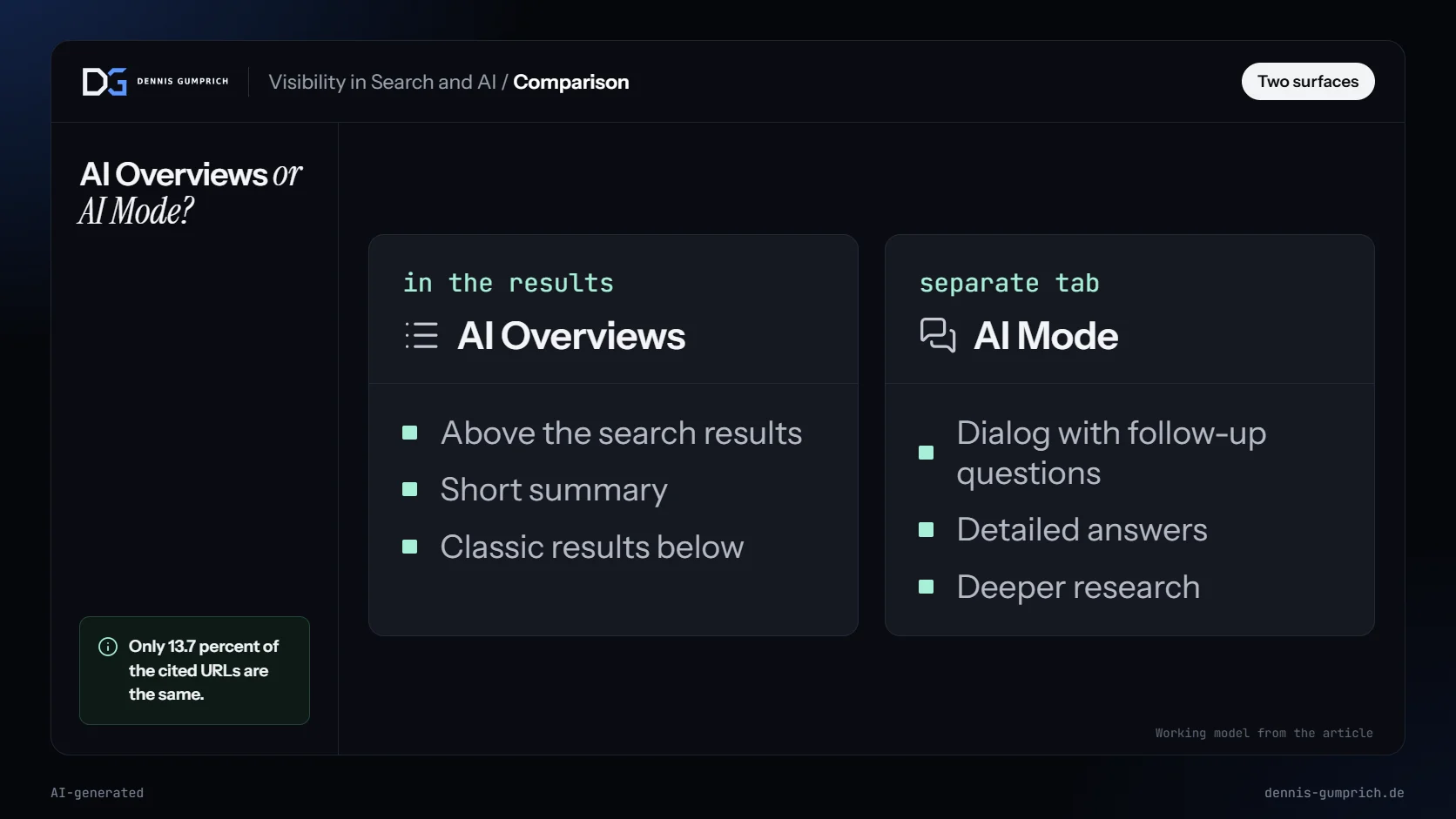
AI Overviews are AI summaries above the normal results and only appear for certain queries. AI Mode is a separate area for a dialog with detailed answers and follow-up questions. Both use similar technology but often cite different sources.
| Characteristic | AI Overviews | AI Mode |
|---|---|---|
| Location | Above the normal results | Separate tab or separate page |
| Trigger | Automatic, when the system sees added value | Deliberately by users or from an AI Overview |
| Answer | Compact summary | Detailed answer, often with tables and lists |
| Follow-up questions | Only by switching to AI Mode | Yes, as an ongoing dialog |
| Brands mentioned | 1.3 per answer on average | 3.3 per answer on average |
An Ahrefs analysis of several hundred thousand US search queries shows how differently the two surfaces cite: only 13.7 percent of the cited URLs match, even though the answers are around 86 percent similar in content. AI Mode also mentions significantly more brands and people (Ahrefs, December 2025). The study covers one month and the US market, but it shows a clear direction: appearing in AI Overviews does not automatically mean being visible in AI Mode, and vice versa. What makes content citable for both is described in Visible in ChatGPT, Perplexity and AI Overviews.
When did AI Mode launch outside the US?
On October 8, 2025, AI Mode launched in Germany, Austria and Switzerland, together with 36 more languages and over 40 more countries. In Switzerland, it is available in German, French and Italian. Before that, it was available to all users in the US from May 2025.
| Date | Event |
|---|---|
| March 5, 2025 | Introduced as an experiment in the US (Google) |
| April 7, 2025 | Image search with Lens in AI Mode (Google) |
| May 20, 2025 | Rollout to all users in the US (Engadget) |
| October 8, 2025 | Launch in Germany, Austria, Switzerland and over 40 more countries (Google, in German) |
| March 26, 2026 | Search Live with voice and camera also in Germany, Austria and Switzerland (Google, in German) |
| May 20, 2026 | Gemini 3.5 Flash as default model, connection of AI Overviews and AI Mode (Google) |
| August 31, 2026 | Generative AI report and opt-out option in Search Console for all websites (Google) |
| October 28, 2026 | Ads in AI Mode in more markets (Google) |
Some features are so far only available in the US or only for subscribers, such as agents that book or shop on behalf of users. Google is constantly expanding the range of features. Before making decisions, check which features are actually active in your markets.
What does AI Mode mean for clicks and traffic?
Fewer clicks per search, but new visibility in answers. Studies show that users click on results less often when an AI answer appears. At the same time, AI answers mention brands and sources that would be further down the classic list. The data on AI Mode itself is still thin.
The most reliable figures so far concern the related AI Overviews. The Pew Research Center analyzed the browsing behavior of 900 adults in the US. When an AI summary appeared, users clicked on a result in 8 percent of visits, compared with 15 percent without a summary. Links within the summary were clicked in only 1 percent of visits (Pew Research Center, July 2025).
For AI Mode, there are first indications. An iPullRank analysis based on Similarweb data found that fewer than about three percent of searches in AI Mode led to a click on an external website. The authors themselves speak of early signals (iPullRank, September 2025). A SparkToro study reported by Search Engine Land shows that around 68 percent of Google searches in the US ended without a click in early 2026. Only a small share of searches switched to AI Mode (Search Engine Land, 2026).
Putting the figures in context: All studies cited refer to the US, use different methods and in some cases panel data without the Google app. They show a direction, not reliable values for your market. Your own data from Search Console is more reliable.
For communication and marketing teams, the main consequence is a different measurement logic: if part of the impact happens without a click, visits are no longer sufficient as a measure of success. How to capture visibility in answers is described in Visibility without clicks.
What does Google say about optimizing for AI Mode?
Google is clear: there are no additional requirements and no special optimizations for AI Mode. A page must be indexed and eligible to be shown with a snippet. Everything else is good search engine optimization with helpful, original content.
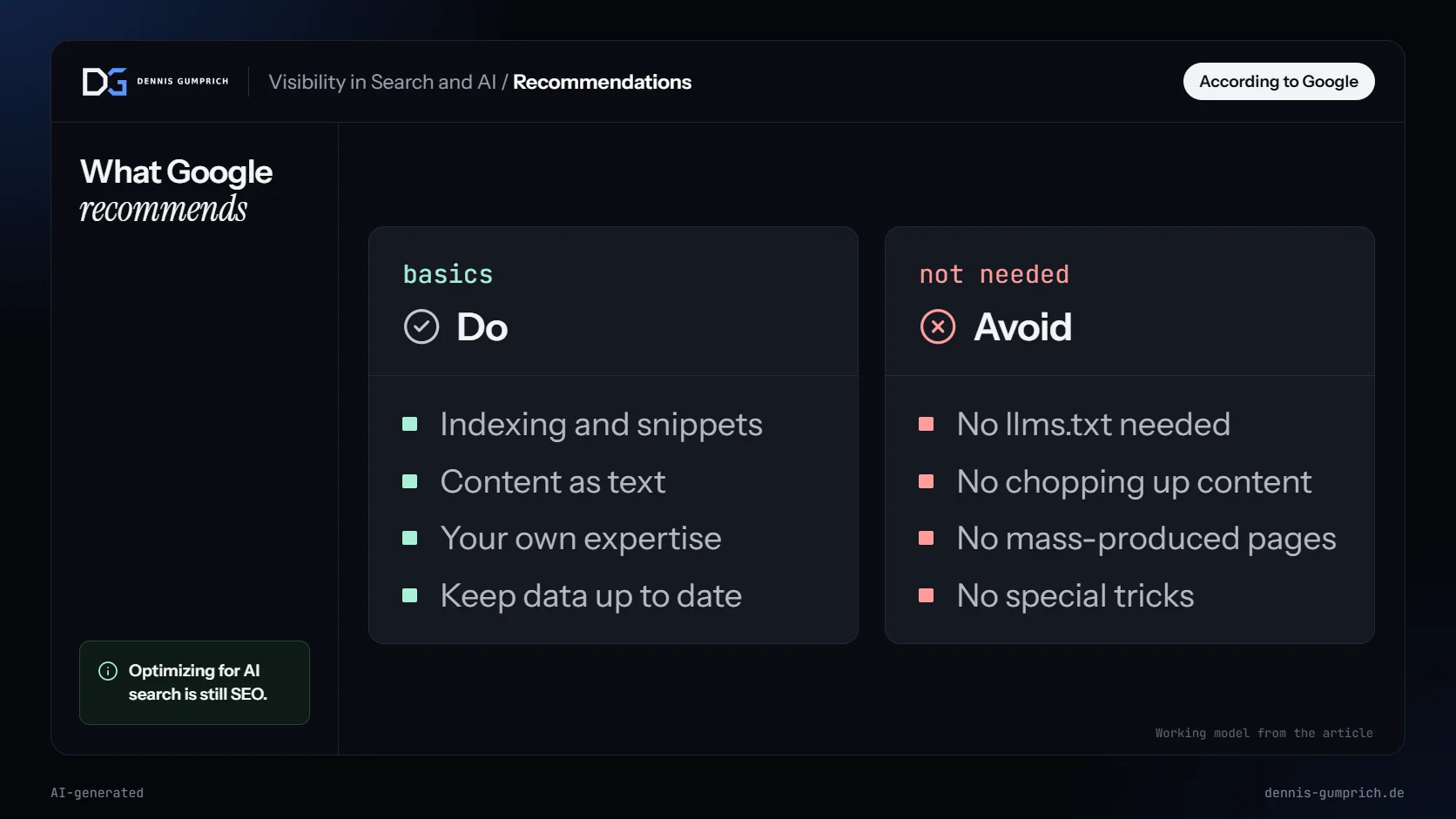
In the documentation AI features and your website, Google names the basics: allow crawling, make content findable through internal links, provide important information as text, use structured data only where it matches the visible content, and keep Merchant Center and your Business Profile up to date. In the guide to optimizing for generative AI features from July 2026, Google is even clearer:
- It is still SEO: From Google's perspective, optimizing for generative AI features is part of normal search engine optimization.
- First-hand experience: Your own data, experience and expertise count more than interchangeable standard content.
- No mass-produced pages: Many pages created only for AI answers are considered scaled spam.
- No artificial chopping up: Content does not need to be broken into small blocks to be cited.
- No llms.txt needed: Google Search itself does not use such files.
- Structured data optional: It is not required for AI features, but still useful for rich results.
These statements are consistent with Google's general SEO Starter Guide: helpful, reliable content for people, clear structure, descriptive titles and links. If you master these basics, you are well prepared for AI Mode. If you rely on tricks, you are more likely to suffer disadvantages.
How can you control the use of your own content?
Website owners can limit how much of their content appears in AI answers. The same controls apply as for snippets: nosnippet, data-nosnippet, max-snippet and noindex. Since August 2026, there has also been a switch in Search Console that excludes a website entirely from AI Overviews and AI Mode. According to Google, this is not a ranking signal for the rest of Search, but excluded content receives neither impressions nor visits in the AI features (Google, 2026). For most companies that want to be found, an exclusion is therefore not a sensible option.
How do you measure visibility in AI Mode?
With the generative AI features report in Search Console, available for all websites since August 2026. It shows impressions from AI Overviews and AI Mode by page, country and device. It does not yet report clicks separately. A regular look at selected questions is a useful addition.
According to Search Console Help, appearances in AI features are generally included in the Performance report under the Web search type. The new report makes them visible separately. For the first time, this makes it possible to track with Google's own data which pages appear in AI answers. For a complete picture, three levels are recommended:
- Impressions in AI features: Which pages appear, and how does their share develop over time?
- Spot checks of important questions: Regularly check ten to twenty questions your audience asks in AI Mode. Are you named? Who is named instead?
- Business impact: Inquiries, brand searches and direct visits. Companies named in AI answers are searched for directly more often.
Specialized AI visibility monitoring tools can automate the spot checks. When choosing one, check which models, countries and how many questions are included, and make sure results are averaged over repetitions, because AI answers vary. How to connect reporting and the business case for management is described in Proving content impact.
What should companies do now?
Check the basics, strengthen content with your own expertise, give clear answers to real questions, maintain product data and your Business Profile, and extend measurement to include AI visibility. There are no special tricks for AI Mode.
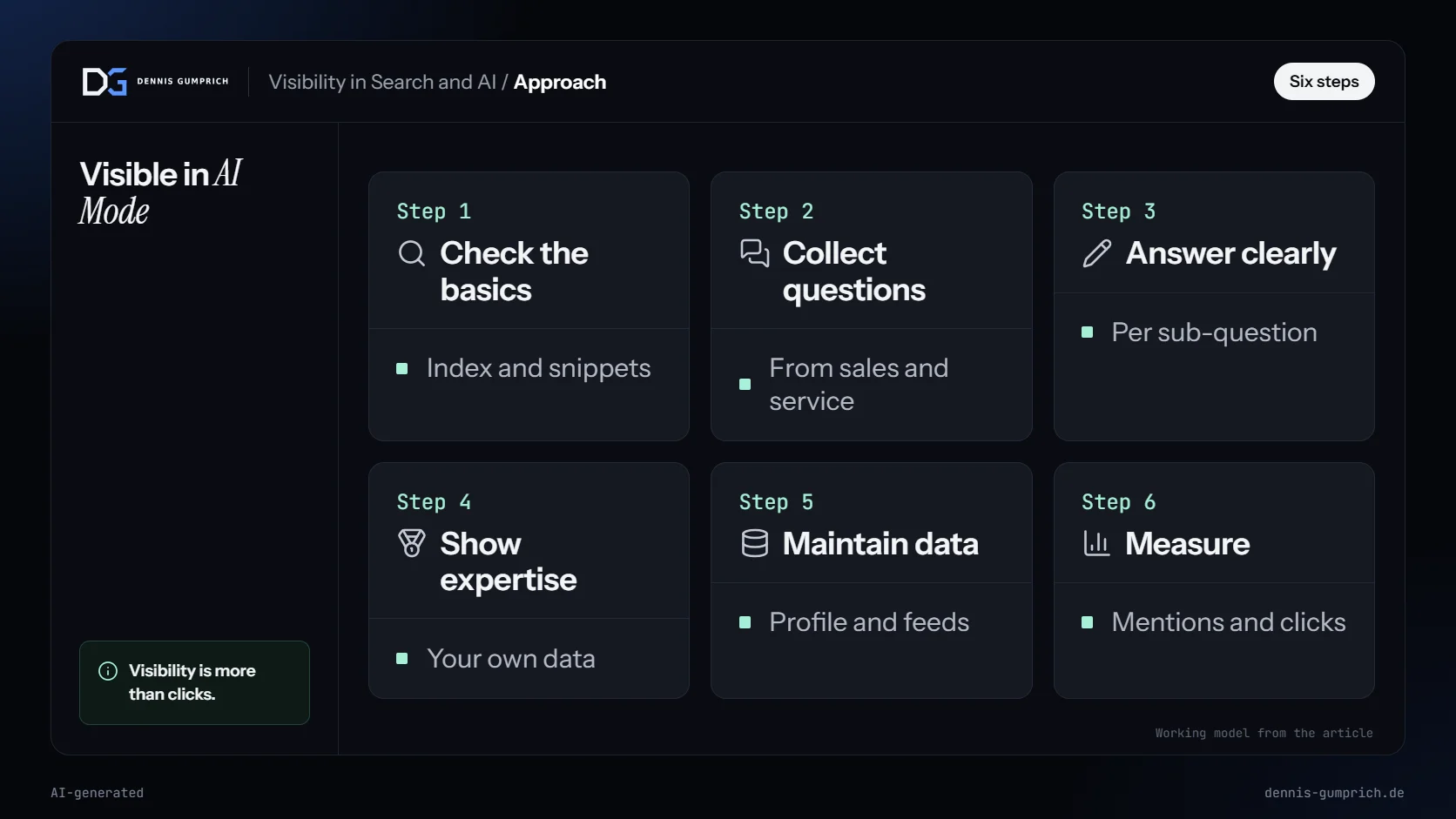
- Step 1Check the technical basicsAre your important pages indexed, and are they eligible to be shown with a snippet? Is any content delivery network blocking Googlebot? This check costs little and decides whether you are in the running at all.
- Step 2Collect your audience's questionsWhich questions do customers ask in sales, in service, in search? These questions are the starting points for sub-searches in the fan-out. Personas with concrete questions provide a good basis.
- Step 3Give clear answersAnswer every important question directly at the start of a section and go deeper afterwards. This helps readers and makes passages citable without artificially chopping up content.
- Step 4Show your own expertiseYour own data, experience, examples and clear assessments set you apart from interchangeable content. That is exactly what Google prefers, according to its own guide.
- Step 5Maintain product data and profileMerchant Center, Business Profile and structured product data are sources for answers. Otherwise, outdated information ends up in the AI answer.
- Step 6Extend measurementAdd impressions in AI features, spot checks of important questions and brand searches to clicks. Report this to management before they ask about falling clicks.
The process behind it matters more than any single measure. When citable answers, source references and your own data are a fixed part of every brief, AI visibility becomes standard rather than a project. How to achieve this is described in Embedding GEO in the content process. How to turn an AI draft into a citable text is covered in From AI draft to citable text.
Is there advertising in AI Mode?
Yes, in a growing number of markets. Google shows ads in AI Mode in the US, Canada, Australia, India and Singapore, among others. They have been announced for the UK, Brazil and Mexico. Germany, Austria and Switzerland are not yet included.
According to Google in October 2026, labeled ads, sponsored product listings and, in the US, ads in follow-up questions appear. For companies in markets without ads in AI Mode, this is something to watch for now. If you advertise internationally, keep an eye on developments, because the balance between paid and organic visibility in AI answers is being reshuffled.
What misconceptions are there about AI Mode?
Many recommendations circulate around AI Mode that Google itself does not support. Five misconceptions come up particularly often.
- "We need an llms.txt"Google explicitly says that Google Search does not use such files. Other providers may evaluate them, but for AI Mode they do nothing.
- "We need to break content into small blocks"According to Google, no artificial chopping up is necessary. Clear sections with a direct answer help readers and are enough.
- "More pages, more mentions"Mass-produced pages for AI answers are considered scaled spam. Fewer but better pieces of content with your own expertise have a stronger effect.
- "If you rank first, you will be cited"Because of fan-out, AI Mode often cites pages that are relevant to sub-questions. A top ranking helps, but it is no guarantee.
- "We keep measuring only clicks"When answers are delivered without a click, pure click figures miss part of the impact. Add impressions in AI features to your measurement.
Self-check: How well prepared are you for AI Mode?
Tick everything that applies to you.
a brief note on Google AI Mode:
Google Search now has an AI Mode in many countries. It answers questions in detail using generative AI and names sources and providers. Studies show that users click less often when AI answers appear. Part of our visibility therefore happens without a visit to our website.
Google says no special optimizations are needed. What matters is helpful content with our own expertise, clear answers to our customers' questions and up-to-date product and company data.
I suggest we regularly check our ten most important customer questions in AI Mode and add the new Search Console report to our reporting. That way we can see whether and how we appear in AI answers.
Conclusion: AI Mode rewards substance, not tricks
Google AI Mode changes how people search and how companies are found. Answers are built from many sub-searches, name several providers and lead to clicks less often. Google itself recommends no special tricks, but the basics of good search engine optimization: indexable pages, helpful content with first-hand experience, clear answers and well-maintained data.
For communication and marketing teams, this mainly means: plan content around your audience's questions, make expertise visible and stop measuring success in clicks alone. If you embed this as a fixed part of your content process, you are well prepared for AI Mode and whatever comes next.
Frequently asked questions
What is Google AI Mode?
An area of Google Search in which an AI based on Gemini creates detailed answers with source links. Users can ask follow-up questions and search by text, voice, photo or camera.
In which countries is AI Mode available?
AI Mode started in the US and has been available in Germany, Austria, Switzerland and more than 40 other countries since October 8, 2025. Individual features, such as booking agents or ads in AI Mode, are so far only available in certain markets.
How do I turn on AI Mode?
Via the "AI Mode" tab on the results page, the tile in the Google app or directly via google.com/ai. No separate activation is needed for the basic features. For some features, such as a saved history, you need a Google account.
Do I need to optimize my website for AI Mode?
Not separately, according to Google. Your pages must be indexed and eligible to appear with a snippet. Helpful content with your own expertise, clear answers and well-maintained data are the best preparation.
Can I turn off AI Mode for my website?
Yes. Since August 2026, Search Console has had an option to exclude a website from AI Overviews and AI Mode. Controls such as nosnippet and max-snippet also apply. An exclusion, however, means that your content neither appears there nor brings visits.
How can I see whether my content appears in AI Mode?
In the generative AI features report in Search Console, which shows impressions from AI Overviews and AI Mode. In addition, you can check important questions yourself regularly or use specialized tools.
Where does your content process lose time today?
In 30 minutes, we look together at where unnecessary coordination, manual tasks, tool switching or repetitive content work cost you time today.
If you want to know how visible your content is in AI Mode, we go through your audience's most important questions and check where you are named and where you are not.
Analyze your content process in 30 minutes Free of charge. You take away concrete starting points you can use internally right away.
Dennis Gumprich
Dennis helps marketing and communication teams fit generative AI into existing content processes without undermining quality, brand voice and approvals. Focus areas: content operations, AI governance and tool selection in mid-sized companies and corporations.
Transparency note: Dennis works for contentbird, a provider of AI-powered content software. Product mentions are marked in the article. More about Dennis (in German) · LinkedIn
Read more
Sources
- Google (Robby Stein): Expanding AI Overviews and introducing AI Mode, March 5, 2025. blog.google/products-and-platforms/products/search/ai-mode-search/. Accessed November 7, 2026.
- Google: Bringing multimodal search to AI Mode, April 7, 2025. blog.google/products/search/ai-mode-multimodal-search/. Accessed November 7, 2026.
- Engadget: Google is rolling out AI Mode to everyone in the US, May 20, 2025. engadget.com. Accessed November 7, 2026.
- Google (Hema Budaraju): AI Mode launches in Germany, Austria and Switzerland (in German), October 8, 2025. blog.google/intl/de-de/produkte/suchen-entdecken/ki-modus-startet-in-dach/. Accessed November 7, 2026.
- Google (Liza Ma): Search Live comes to Germany, Austria and Switzerland (in German), March 26, 2026. blog.google/intl/de-de/produkte/suchen-entdecken/search-live-kommt-nach-dach/. Accessed November 7, 2026.
- Google: 100 things we announced at I/O 2026, May 20, 2026. blog.google/innovation-and-ai/technology/ai/google-io-2026-all-our-announcements/. Accessed November 7, 2026.
- Google (Mrinalini Loew): New opportunities, control and insights for website owners, June and August 2026. blog.google/products-and-platforms/products/search/new-controls-website-owners/. Accessed November 7, 2026.
- Google (Shashi Thakur): Ads in AI Mode expand to new markets, October 28, 2026. blog.google/products/ads-commerce/ads-in-ai-mode-global/. Accessed November 7, 2026.
- Google Search Central: AI features and your website. developers.google.com/search/docs/appearance/ai-features. Accessed November 7, 2026.
- Google Search Central: Optimizing your website for generative AI features on Google Search, July 2026. developers.google.com/search/docs/fundamentals/ai-optimization-guide. Accessed November 7, 2026.
- Google Search Central: SEO Starter Guide. developers.google.com/search/docs/fundamentals/seo-starter-guide. Accessed November 7, 2026.
- Google Help: AI Mode in Google Search. support.google.com/websearch/answer/16011537. Accessed November 7, 2026.
- Search Console Help: Generative AI features report. support.google.com/webmasters/answer/16984139. Accessed November 7, 2026.
- Pew Research Center: Google users are less likely to click on links when an AI summary appears in the results, July 22, 2025. pewresearch.org. Accessed November 7, 2026.
- iPullRank: Early referral data from AI Mode, September 26, 2025. ipullrank.com/early-referral-data-ai-mode. Accessed November 7, 2026.
- Search Engine Land (Danny Goodwin): Google zero-click searches 2026 study (SparkToro), 2026. searchengineland.com/google-zero-click-searches-2026-study-479717. Accessed November 7, 2026.
- Ahrefs: Are AI Mode and AI Overviews just different versions of the same answer?, December 15, 2025. ahrefs.com/blog/ai-overviews-vs-ai-mode. Accessed November 7, 2026.
How this article was created
This article was created with the help of AI. Structure and draft wording were developed with AI support. Professional assessment, review of the statements and the final version are the responsibility of Dennis Gumprich. The English version was translated with AI and reviewed. Read the original German version.
How reliable are the statements?
Information on features, timeline, availability and recommendations is based on the Google sources cited, as of November 7, 2026. Google is constantly expanding AI Mode, and individual details may change. The click studies refer to the US and different periods and show tendencies, not universally valid values. The recommendations for companies are an assessment from consulting practice.


