
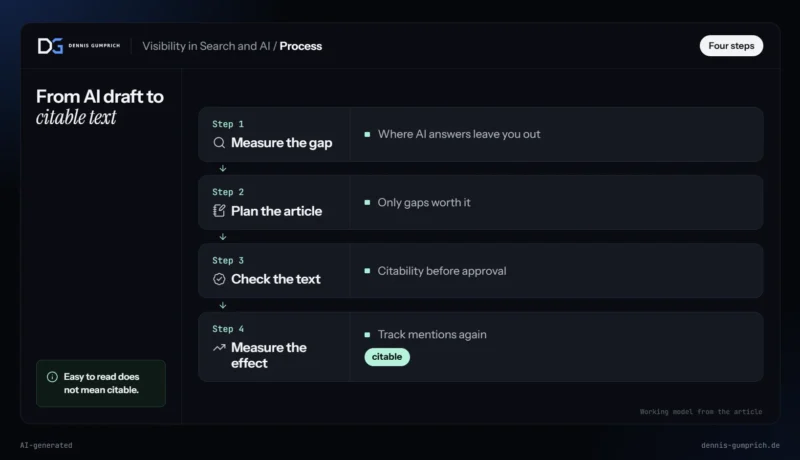

AI provides the form. What turns a text into a source has to come from your team.
AI drafts rarely fail in ChatGPT, Perplexity and Google's AI Overviews because of the language, but because of the evidence. AI now reliably delivers structure, readability and a direct answer. Experience, your own figures, sources and recognizable authorship only come from your team. The path to a citable text has four steps: measure the gap in AI answers, select the right gap for an article, check the text with a GEO score before approval and measure again after publication.
This article describes the work on an individual text: from the gap in AI answers to the review before approval. What AI search fundamentally considers when choosing its sources is covered in the basics article Visible in ChatGPT, Perplexity and AI Overviews. How to anchor GEO permanently in the team is described in Embedding GEO in the content process.
Why are AI drafts cited so rarely?
Because a language model summarizes what already exists. It writes clearly, structures neatly and answers the question. What it cannot do: report on your projects, name your figures or cite a source it doesn't know. The result is a text that says the same as ten other pages on the same question, and texts like that have no place in an AI answer.
In classic search, an interchangeable text costs a few positions. In an AI answer, it doesn't appear at all, because the system selects only a few from many similar sources. It then reaches for the pages that contribute something the others don't have: a documented case, your own analysis, a clearly named expert.
Research supports that exactly these elements count. The study that coined the term Generative Engine Optimization tested various changes to texts and measured how visible the texts were in generative answers afterwards. Added quotations, statistics and source references increased visibility by up to around 40 percent. Keyword stuffing, by contrast, worsened the result.1
Clear structure, direct answer, short sentences. A hypothetical example, no sources, no author, no date. In content, identical to the pages already being cited.
The same structure, complemented by a real practical case, your own figures with a time period, linked primary sources and an author line with role and update date. It says something you can only find here.
How do you find the questions where you are missing?
With a fixed catalog of questions your audience asks AI assistants, without your brand name. Have these questions answered regularly in ChatGPT, Gemini, Perplexity and AI Overviews and record whether you are named, in what position and whether one of your pages is linked as a source. Sorted by mentions, your gaps are at the top.
Leaving out the brand name is crucial. Anyone who asks about your brand already knows you, and the answer almost always describes you. What is interesting are the questions from people who are just getting oriented: which solution suits us? How do other teams approach it? What do I need to watch out for? These are the questions where the shortlist is formed, and where it is decided whether you are considered at all.
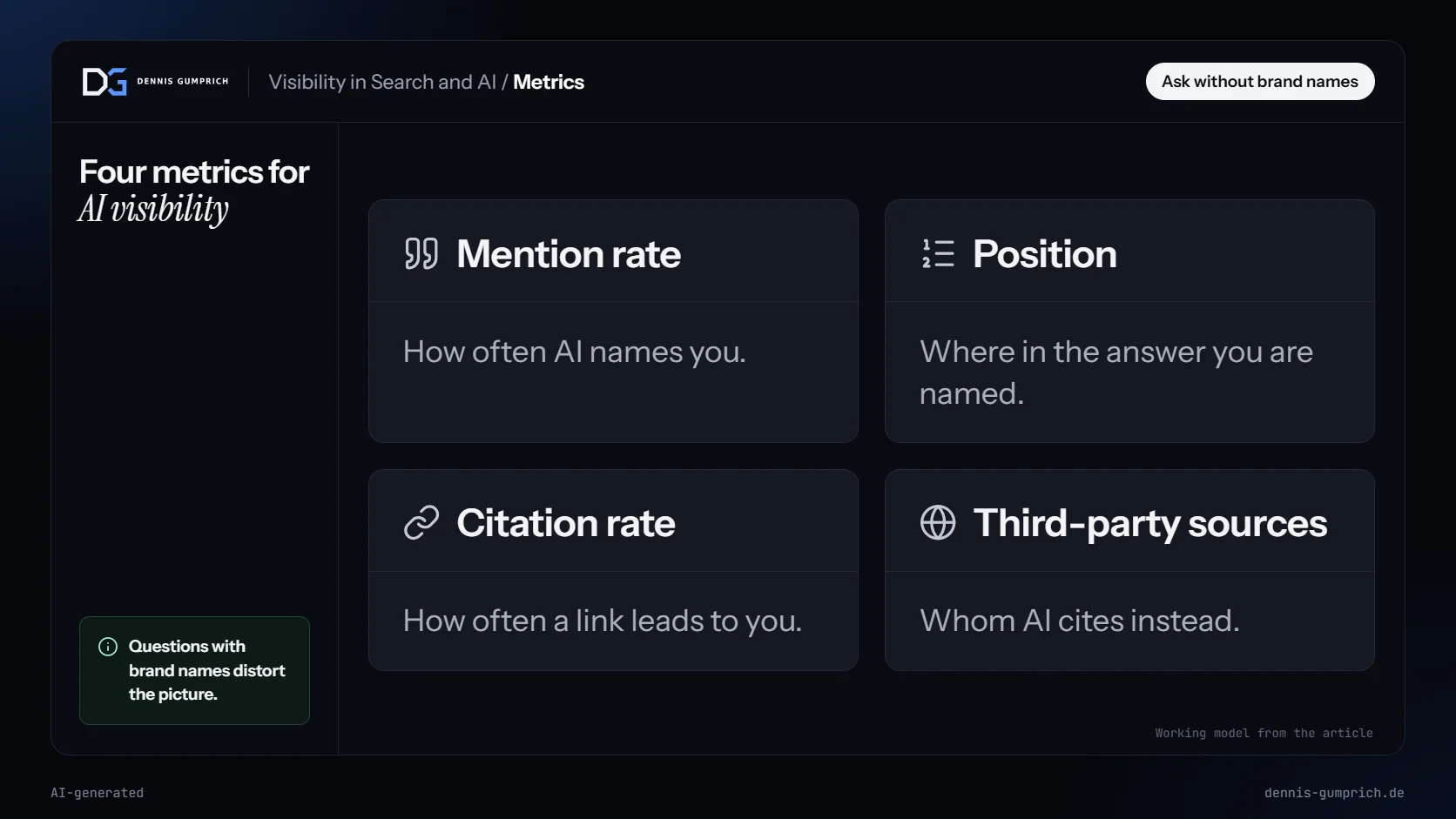
| Metric | What it shows | What you derive from it |
|---|---|---|
| Mention rate | Share of answers in which your brand appears | low: suitable content for the questions is missing, not just optimization |
| Average position | where you are named, when you are named | good with a low rate: you are valued, but found too rarely |
| Citation rate | Share of answers that link one of your pages as a source | this is where visibility turns into traffic; low: your pages are not the best source |
| Third-party sources | which pages AI draws on instead | format, depth and evidence density you must at least match |
The combination of mention rate and position is more revealing than either number alone. A low rate with a good position means: when AI finds you, it recommends you near the top. The problem is then not your relevance, but the number of questions for which you provide a suitable answer. The lever lies in new or revised content, not in fine-tuning existing top spots.
- Step 1Collect questionsTwenty to forty questions from sales conversations, customer service, webinars and tenders, in your audience's words and without your brand name.
- Step 2Record a baselineAsk each question once in the common assistants or have them queried automatically. For each question, note: named yes or no, position, own page cited, which third-party sources are cited.
- Step 3Sort by mentionsQuestions with zero or almost zero mentions go to the top. That is your gap list.
- Step 4Look at third-party sourcesFor the top questions, check which pages are cited instead and what they have in common: format, length, evidence, authorship.
Which gap is worth its own article?
Not every one. A gap is worth its own article when four conditions come together: you practically don't appear for the question, the question is close to your offering, you know the format AI cites there, and you have your own substance on the question. Without substance, you write the eleventh interchangeable text on the topic.
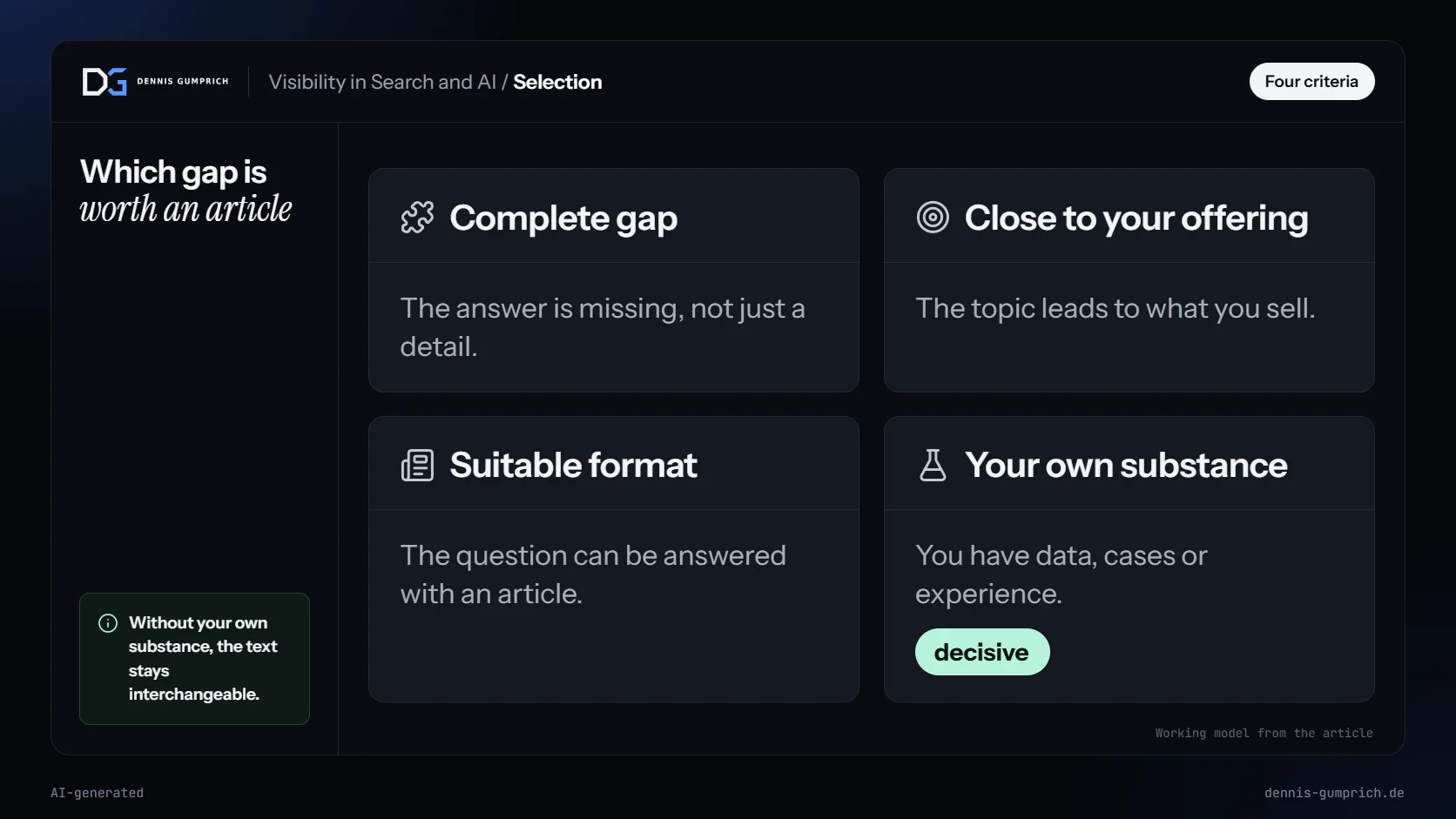
| Criterion | Check question | How you recognize it |
|---|---|---|
| Complete gap | Do we appear for this question? | no or almost no mentions in all measured answers |
| Close to the offering | Does the question lead to what we sell? | sales hears the question in the first meeting or shortly before the decision |
| Suitable format | What kind of page does AI cite here? | the third-party sources are guides, comparisons or instructions |
| Your own substance | Do we have something on this that nobody else has? | project values, customer cases, own tests, solid experience in the team |
The second criterion is often underestimated. A mention for a general knowledge question brings reach. A mention for a question prospects ask shortly before a decision brings conversations. If you have little capacity, start with the gaps sales knows from its conversations.
The fourth criterion is the hardest. Anyone who has no experience of their own, no figures and no documented case on a question can write a good text, but not a better one than the sources already cited. In this case, it pays to create substance first, for example through a small analysis or a conversation with customers, and plan the article afterwards.
How does AI help with the selection without guessing?
By accessing your measurement data instead of answering from general knowledge. An AI assistant connected to your AI visibility measurement can analyze the gap list, apply the criteria and suggest an article with reasoning. Always check whether the recommendation is based on your figures.
You recognize a good recommendation by three things. It names the concrete question from your catalog. It names the number of answers in which you are missing and the sources cited instead. And it explains why the chosen format suits the question. If one of these is missing, the assistant guessed. Many assistants now show which data they retrieved. A quick look at it replaces a long discussion about the quality of the recommendation.
The recommendation then becomes the brief, and the question from the catalog, in your audience's words, belongs in the brief. It is later the benchmark for the review. Which other fields a brief for citable content needs is described in the article on GEO in the content process.
What does a GEO score measure?
A GEO score assesses how well an AI can understand a text, classify it and adopt it as a source. GEO stands for Generative Engine Optimization. The score is made up of sub-scores, for example for the direct answer, the citability of individual sentences, topic coverage and trust signals. The sub-scores are meaningful, not the overall number.
The individual tools weight differently and name their sub-scores differently. The following eight areas appear in most assessments because they derive from how AI search works. For AI Overviews and AI Mode, for example, Google describes a process called "query fan-out": the system issues several related searches on subtopics and draws on additional pages for them.2 A text that answers more of these sub-questions has more opportunities to be found.
| Sub-score | What is behind it | Check question for your team |
|---|---|---|
| Direct answer | AI systems adopt individual sections; the answer must come at the start | Does the first sentence answer the question without having to read on? |
| Citability | AI only uses excerpts; statements must hold true without the rest of the page | Does the sentence stay correct when taken out of context? |
| Topic coverage | AI search breaks questions down into sub-questions | Does the text also answer the questions that come next? |
| Entities | Technical terms and concepts through which AI classifies a topic | Do the central terms appear, and are they explained? |
| E-E-A-T | Google's term for experience, expertise, authoritativeness and trustworthiness | Is it clear who is writing, what the statements are based on and when they were checked? |
| Information gain | what the text contributes that other sources don't have | Is there something here you can only find with us? |
| Fact density | proven figures and named sources instead of general claims | Does every important statement have a source, a test or a date? |
| Readability | Sentence length and comprehensibility | Does someone without prior knowledge understand the text on first reading? |
It is also important what the measurement is against. A good GEO score assesses a text against a concrete user question. If the tool detects the question automatically, it often deviates slightly from the question in your catalog. So set it manually to exactly the question where you are missing. Then the score measures whether the text closes your gap, not whether it answers some related question.
Disclosure
I work for contentbird. It offers a GEO score that assesses texts directly in the editor against a concrete user question, shows the sub-scores individually and suggests improvements with effort and expected impact. AI visibility measurement tracks mentions, position and citations for a catalog of questions without brand names compared with competitors, and the AI chat can access this measurement data. The example values for the AI draft below come from a live check in a product masterclass. The score is an assessment, not a guarantee of a citation.
How do you read a GEO score correctly?
Through the pattern of the sub-scores, not the overall number. A 55 can mean that a text is well written but lacks evidence, or that it has evidence but is hard to access. Both require completely different work. Anyone who only looks at the overall number knows that something is missing, but not who in the team has to deliver it.
AI drafts almost always show the same pattern. An example from a live check in October 2026: an AI draft on the question of how to create blog articles and social media posts from a brief scored 55 out of 100 overall. Readability was 100, direct answer 80, citability and topic coverage 75, entities 70. E-E-A-T was 10: no links to primary sources, no external links, no stated author.
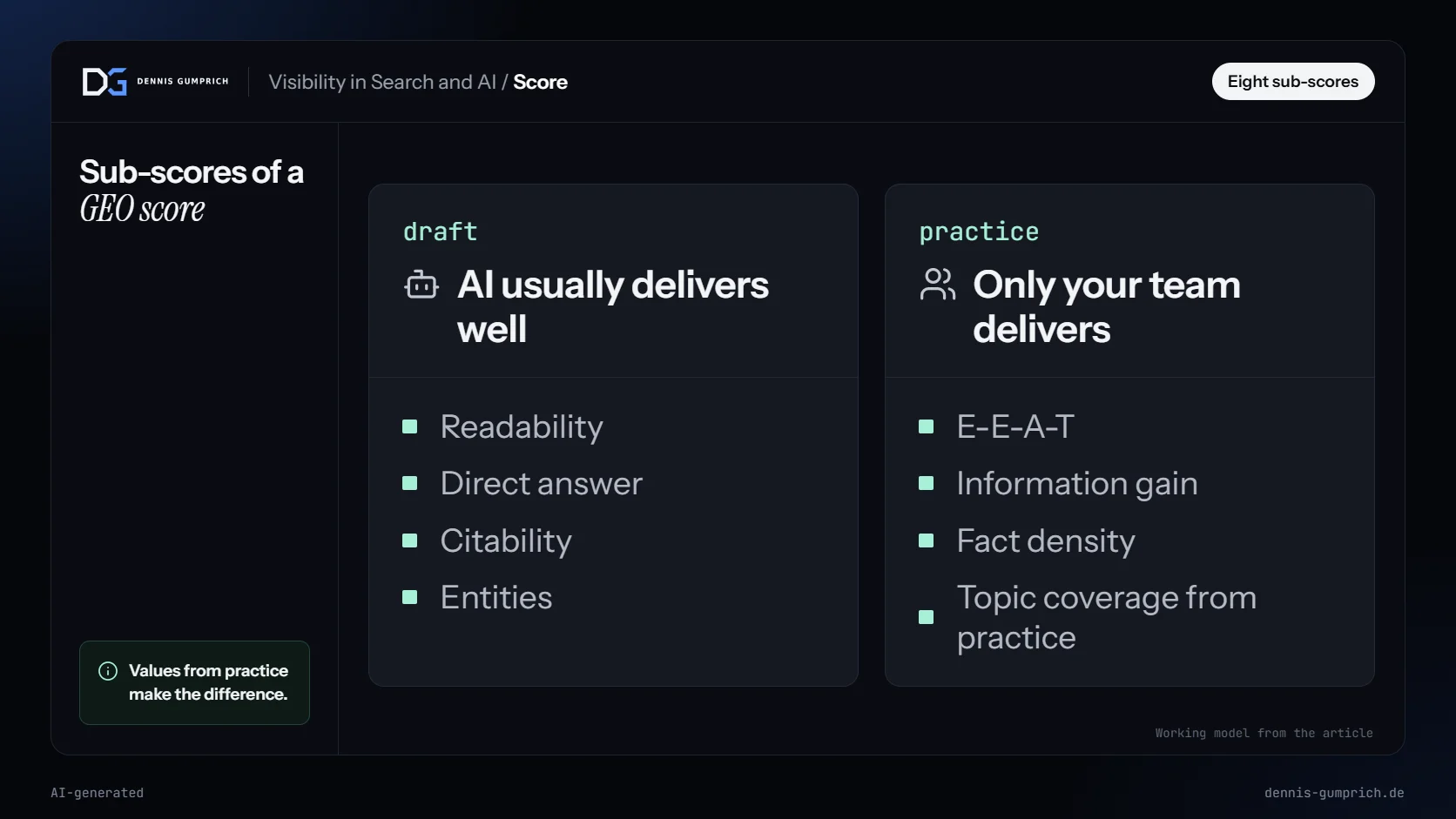
The pattern is typical and says more than the number. The sub-scores that depend on language and structure are high. The sub-scores that depend on experience and evidence are low. The conclusion is clear: this text doesn't need another rewrite by AI, but material from the team. Three patterns help with reading.
Many tools also list the questions a reader asks about the topic and mark whether the text covers them, partly covers them or leaves them out. For the revision, this list is often more valuable than the score itself. In the example, mandatory building blocks of a brief, the process up to the finished article and typical mistakes were fully covered. Channel differences and a concrete example were only partly covered. One question was missing entirely: how are roles, approvals and responsibilities organized in the team? For a head of marketing, that is often exactly the most important one.
Which improvements do you implement first?
First the quick improvements the editorial team can do in a few minutes, then the substance, for which you need material from subject matter experts, sales or projects. The quick improvements raise the score visibly. But what makes the difference compared with other sources is almost always the improvements that require research.
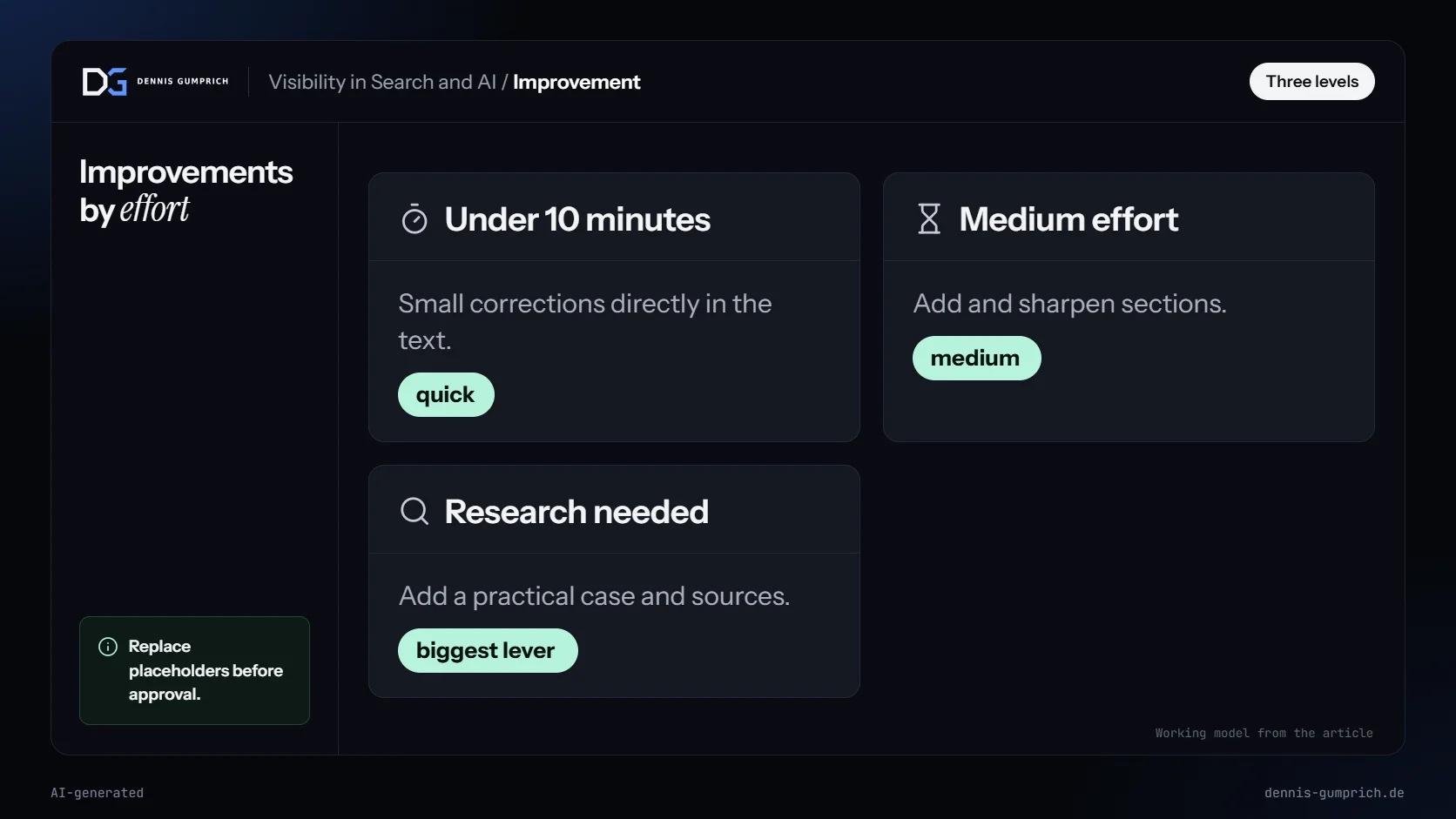
Good GEO tools suggest concrete improvements and state the effort and expected impact on the score for each. That changes the discussion in the team. Instead of arguing about whether a text is good enough, you decide which improvements to implement and who delivers them.
| Effort | Typical improvements | Who delivers them |
|---|---|---|
| Under 10 minutes | Opening as a one-sentence answer, explaining technical terms on first use, author line with name, role and update date; together 3.4 points in the example | Editorial team, often adopted with one click |
| Medium effort | Process as a checklist with a result per step, a separate pattern for opening, length and goal per channel, answering a missing follow-up question | Editorial team with subject knowledge |
| Research needed | Replacing a hypothetical example with a real or anonymized practical case, backing every claim with a named source or your own test; up to 2.6 points per suggestion in the example | Subject matter experts, sales, customer service |
In the example, a total of 13.4 points were on the table from all open suggestions. The three quick improvements accounted for part of this; most of the points lay in information gain and fact density. That is no coincidence. What AI cannot deliver is exactly what makes a text worth citing.
An analysis by the tool vendor SISTRIX fits this pattern. For "GEO myths in a data check: what 96,418 URLs reveal about AI citations" (in German) from October 2026, Johannes Beus and Julia Weißbach examined 96,418 URLs from 17,380 domains in German-speaking countries. They compared cited and non-cited pages of the same domain in ChatGPT, AI Mode and AI Overviews in the second quarter of 2026. The analysis finds a factor of 1.4 for an author box with a photo, and 1.3 each for a visible update date and for at least ten external links, where 1.0 means no difference. Only 5 percent of pages had a visible update date. The AI draft in the example lacked author and external links, and the update date was among the quick improvements. Make all three fixed items in your review before approval. A caveat: this is an analysis by a tool vendor, and it shows correlations, not causes.
Common mistake at this point: adopting suggestions with placeholders unchecked. A suggestion such as "By [name], [role]. Last updated on 2026" is a template, not a finished sentence. If it is adopted with one click and not filled in, the placeholder goes live in the text after approval.
What can only your team deliver?
Everything that only exists with you: documented cases from projects, your own figures with a time period, results of internal tests, the experience of a named expert and sources you have checked. This material rarely sits with the editorial team, but in sales, customer service, project teams and product management. The editorial team's job is to collect it there.
An example of the difference. An AI draft writes: "Let's assume the brief focuses on the problem that marketing teams lose too much time in alignment." A revised version writes what happened in a real or anonymized project: how many fields the brief had, what content came out of it and how the time to approval changed. The second paragraph is not better style. It is information an AI can't find anywhere else.
Google supports this direction in its guide "Optimizing your website for generative AI features on Google Search" from July 2026. There, optimizing for AI answers is part of general search optimization, and Google advises bringing in your own experience and expertise instead of repeating what is known. According to Google, it does not use an llms.txt file, no special schema is needed, and rewriting texts specifically for AI is not necessary. So put your time into material from sales, customer service and projects, not into technical workarounds. A caveat: this is a platform guideline for Google Search and does not automatically apply to ChatGPT or Perplexity.
- Source 1SalesWhich objections and questions come up on this topic? Which customer situations can be described anonymously?
- Source 2Customer serviceWhere do things get stuck in practice? Which mistakes do colleagues see again and again?
- Source 3Projects and product managementWhat values exist for duration, effort or results? Which tests were done internally?
- Source 4Expert as authorWho stands behind the content with name and role? Who checks it at the next update?
So that this doesn't have to be negotiated every time, a simple rule helps: every article on a gap from the question catalog contains at least one piece of information that only exists with you. Who is responsible for this material is stated in the brief. How to relieve your experts instead of burdening them with writing assignments is described in Handovers between marketing and subject matter experts.
Who checks what before approval?
The editorial team checks the GEO score and implements the quick improvements. Subject matter experts confirm figures and statements and deliver the substance. Approval decides whether the text reaches the agreed minimum level or is published below it with a documented reason. That keeps the review fast and still binding.
| Role | Task | Timing |
|---|---|---|
| Editorial team | Set the check question to the question from the catalog, check the score, implement quick improvements, fill in placeholders | after the first draft |
| Subject matter experts | Deliver practical case, figures and sources, confirm technical statements | before the second check |
| Approval | Check minimum level, document exceptions with reasons | before publication |
| GEO responsibility | Define minimum level, measure after publication, feed results back to the editorial team | monthly |
A fixed minimum level sounds strict but saves alignment. Without it, every text triggers a new discussion about whether 62 points is good enough. With it, it is clear what is missing and who delivers it. The exception is important: some texts are not supposed to appear in AI answers at all, such as press releases with a short half-life. The level doesn't apply to them, and that is stated in the brief. How to build review criteria overall so that approvals don't take longer is described in the checklist before approval.
How do you measure whether the text works?
With the same question from the same catalog, monthly and documented with a date. After publication, observe whether mention rate and citation rate for this question rise and whether your page appears among the cited sources. Expect weeks, not days, because revised pages first have to be picked up again.
The baseline before publication is indispensable. Without it, you cannot show later what the text achieved. For each question, record how often you were named before the revision, which sources were cited and what score the text had before and after the revision. These three values are enough to decide in the quarterly review whether the approach holds up.
Don't expect an even curve. AI answers vary from query to query, and individual jumps often have causes that have nothing to do with your text, such as a change in the model or new sources from others. So assess trends over several months, not individual measurement points. How to translate this measurement into reporting for management is described in Proving content impact.
Five mistakes on the way from AI draft to citable text
- Reading the score as a guaranteeA high score makes a text citable, not automatically cited. Only measurement in AI answers shows whether it works.
- Checking against the wrong questionIf the text is assessed against an automatically detected, general question, the score doesn't measure the gap you wanted to close. Set the question from your catalog.
- Only implementing the quick improvementsAuthor line and answer sentence are done quickly and raise the score. What makes the difference compared with other sources is practical cases and evidence.
- Letting AI keep rewordingIf language and structure are already rated highly, another version from AI barely adds points. What is needed is material from the team.
- Starting without a baselineIf you don't document which answers you appear in before the revision, you cannot prove any effect later.
When is the effort not yet worth it for you?
If your audience hardly researches before a decision, if you publish fewer than two or three pieces of content a month or if there is no substance of your own on your core questions yet. In the last case, the first step is not the review, but collecting cases and figures.
With few publications, it is enough to apply the check questions from the table above by hand and measure two or three times a year. A tool with automated scoring and ongoing measurement pays off when several people, agencies and departments deliver content and you need a uniform benchmark. And if it is currently unclear who commissions content and who approves it, that question comes before everything else. How to build such processes is described in Content Operations: what it is and how to build it.
Self-check: How citable are your texts before approval?
Tick everything that applies to you.
a brief note on why our texts are rarely named in ChatGPT and similar tools:
Our AI-assisted drafts are easy to read and answer the right questions. What they lack are our own cases, our own figures, sources and recognizable authorship. That is exactly what AI search uses to choose its sources. As long as we say the same as ten other pages, we won't be cited.
Proposal: for a fixed catalog of customer questions, we measure where we are missing in AI answers, choose the gaps most closely related to our offering and check every text against exactly that question before approval. For each article, subject matter experts deliver at least one practical case or one of our own figures.
The additional effort is a few hours per article. We measure the effect monthly with the same questions and assess it quarterly.
Conclusion: AI writes the text, your team makes it worth citing
An AI draft is a good start. It is readable, structured and answers the question. For a mention in ChatGPT, Perplexity or AI Overviews, that is rarely enough, because many pages say the same thing. The difference arises with experience, evidence and information only you have, and that is exactly where a GEO score shows where your team needs to start.
Together with measurement in AI answers, this creates a cycle: find the gap, plan the right article, check the text before approval, measure the effect. Instead of gut feeling, you have a benchmark before publication; instead of endless feedback loops, a list with clear responsibilities.
Frequently asked questions
Does a high GEO score guarantee that ChatGPT will cite my text?
No. The score measures citability before publication, meaning whether the text has the properties AI systems prefer in sources. Whether it is actually cited also depends on indexing, competition and mentions outside your website. That is why review and measurement belong together.
What is the difference between an SEO score and a GEO score?
An SEO score assesses a text for rankings in the classic results list, for example via search terms, structure and technical features. A GEO score assesses whether an AI understands the text and can adopt individual sections as an answer. The two complement each other, because AI search draws on well-indexed pages.
How many questions does a good question catalog need?
Twenty to forty questions without brand names are a good start. Fewer represents your audience too roughly; significantly more can hardly be analyzed properly every month. Good sources are sales conversations, customer service, search data from Search Console and the questions that come up again and again in webinars and tenders.
Can I also check existing texts?
Yes, and that is often the fastest lever. Existing pages already have rankings and links. Add answer sentences, evidence and author information there and then measure whether mentions change. A content inventory helps you select the pages.
What minimum level should a text reach?
That depends on the tool and topic, so there is no universal number. It has proven effective to set a level after the first ten to twenty checked texts that you can reach with reasonable effort, and to review it after a quarter based on the measurement. More important than the number is that exceptions are justified and documented.
How quickly will I see changes in AI answers?
Expect weeks, not days. Revised pages first have to be picked up again, and AI answers vary from query to query. So measure monthly with the same question catalog, document the date of each measurement and assess the development over a quarter.
Where does your content process lose time today?
In 30 minutes, we look together at where unnecessary coordination, manual tasks, tool switching or repetitive content work cost you time today.
If you want to know where you are missing in AI answers, we look at your most important customer questions and clarify which gaps can be closed with the least effort and what your team needs to deliver.
Analyze your content process in 30 minutes Free of charge. You take away concrete starting points you can use internally right away.
Dennis Gumprich
Dennis helps marketing and communication teams fit generative AI into existing content processes without undermining quality, brand voice and approvals. Focus areas: content operations, AI governance and tool selection in mid-sized companies and corporations.
Transparency note: Dennis works for contentbird, a provider of AI-powered content software. Product mentions are marked in the article. More about Dennis (in German) · LinkedIn
Read more
Sources
- Pranjal Aggarwal, Vishvak Murahari, Tanmay Rajpurohit, Ashwin Kalyan, Karthik Narasimhan, Ameet Deshpande: GEO: Generative Engine Optimization, Proceedings of the 30th ACM SIGKDD Conference on Knowledge Discovery and Data Mining (KDD 2024), version of June 28, 2024: quotations, statistics and source references increased visibility by up to around 40 percent; keyword stuffing performed worse than the unchanged text. Accessed October 31, 2026.
- Google Search Central: AI features and your website, documentation, as of December 10, 2025: description of "query fan-out" in AI Overviews and AI Mode and indexing as a prerequisite. Accessed October 31, 2026.
- Google Search Central: Creating helpful, reliable, people-first content, guide, as of October 5, 2026: definition of E-E-A-T and recommendation on author information. Accessed October 31, 2026.
- Rand Fishkin, SparkToro: NEW Research: AIs are highly inconsistent when recommending brands or products, study of January 27, 2026, around 600 volunteers, 2,961 answers from ChatGPT, Claude and Google: the same list of brands in fewer than one in 100 cases. Accessed October 31, 2026.
- Johannes Beus, Julia Weißbach, SISTRIX: GEO-Mythen im Datencheck: Was 96.418 URLs über AI-Citations verraten (in German), analysis of October 22, 2026, 96,418 URLs from 17,380 domains in Germany, Austria and Switzerland, second quarter of 2026, ChatGPT, AI Mode and AI Overviews, comparison of cited and non-cited pages of the same domain (factor 1.0 means no difference): author box in general 1.3, with photo 1.4, visible update date 1.3 with only 5 percent of pages, at least ten external links 1.3, scientific source 1.2, llms.txt without measurable effect. Analysis by a tool vendor, correlation, not causation. Accessed October 31, 2026.
- Google Search Central: Optimizing your website for generative AI features on Google Search, guide, as of July 15, 2026: optimization for AI features as part of general search optimization, llms.txt is not used, no special schema, no rewriting just for AI, own experience and expertise instead of repetition, many pages for every search variant are considered spam. Platform guideline for Google Search. Accessed October 31, 2026.
How this article was created
This article was created with the help of AI, based on the GEO product masterclass of October 29, 2026. Structure, research and draft wording were developed with AI support. Professional assessment, review of the statements and the final version are the responsibility of Dennis Gumprich. The English version was translated with AI and reviewed. Read the original German version.
How reliable are the statements?
Documented are the effects of quotations, statistics, source references and keyword stuffing by the GEO study, the "query fan-out" process by Google's documentation, the importance of E-E-A-T and author information by Google's guide and the variation of AI answers between queries by the SparkToro study, as well as the correlations between author box, update date, external links and citations by the SISTRIX analysis (analysis by a tool vendor, correlation, not causation) and Google's classification of AI optimization as general search optimization by the guide to generative AI features (platform guideline). The example values come from a live check in October 2026 and refer to one specific text. AI answers vary; your own values may differ significantly. The sub-scores of a GEO score are derived from how AI search works and from studies, not ranking factors confirmed by the providers. The effects from the GEO study were measured under test conditions. Prioritization, roles and minimum level are working models from consulting practice. As of October 31, 2026.


