
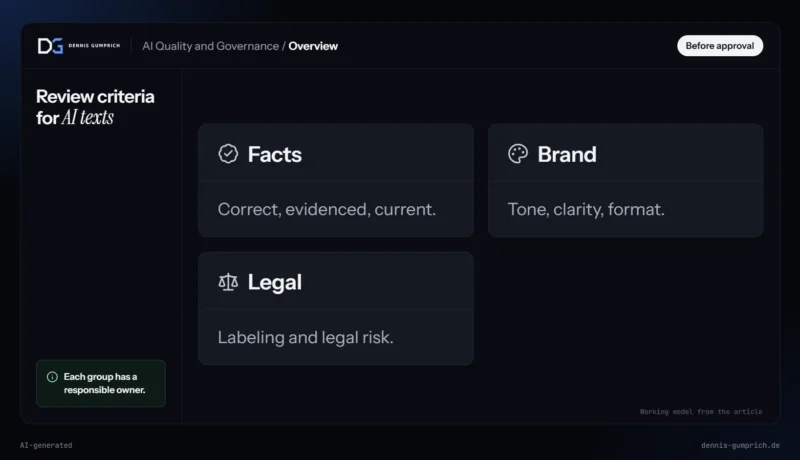

A review checklist for AI texts replaces debates about taste with questions that can be decided. Eight criteria in three groups work well: facts, brand and legal. Each criterion has an owner and a clear result, so a review can be done in under ten minutes.
Why approvals take so long
The most common reason for long approval loops is not a lack of diligence but a lack of clarity about what is being checked. Anyone who receives a text without criteria checks everything at once: content, tone, spelling, legal position, strategy.
This leads to feedback like "not quite right yet". That statement is perfectly adequate for the reviewer, because they know what they mean. For the writer it is worthless, because it does not say which level is affected.
With AI-generated texts, the problem gets worse because an additional suspicion is in the air. Phrases get criticized that nobody would have noticed in a self-written text. A checklist removes the basis for this debate: what is on the list gets checked, regardless of how the text was created.
Which criteria belong on the review checklist for AI texts?
Eight criteria in three groups: facts, with evidenced figures, claims about your own company and currency. Brand, with form of address and tone, exclusion list and distinctiveness. Legal, with advertising claims and approvals for people or customers named. Each criterion has exactly one owner and a yes-or-no result. For environmental and sustainability claims, an additional check applies in the EU from 2026; the requirements are described in EmpCo Directive: what the EU rules on green claims mean from 2026.
| Group | Criterion | Review question | Owner |
|---|---|---|---|
| Facts | Evidenced figures | Is there a verified source behind every figure? | Editorial |
| Facts | Company claims | Are all statements about our company correct? | Specialist department |
| Facts | Currency | Do time-related statements carry a date? | Editorial |
| Brand | Address and tone | Consistently suited to the format, without switching? | Editorial |
| Brand | Exclusion list | Does the text contain banned phrases? | Editorial |
| Brand | Distinctiveness | Could a competitor publish this text in exactly the same way? | Editorial |
| Legal | Advertising claims | Are effect and comparison claims permitted? | Legal department |
| Legal | Personal reference | Have the people and customers named given approval? | Legal department |
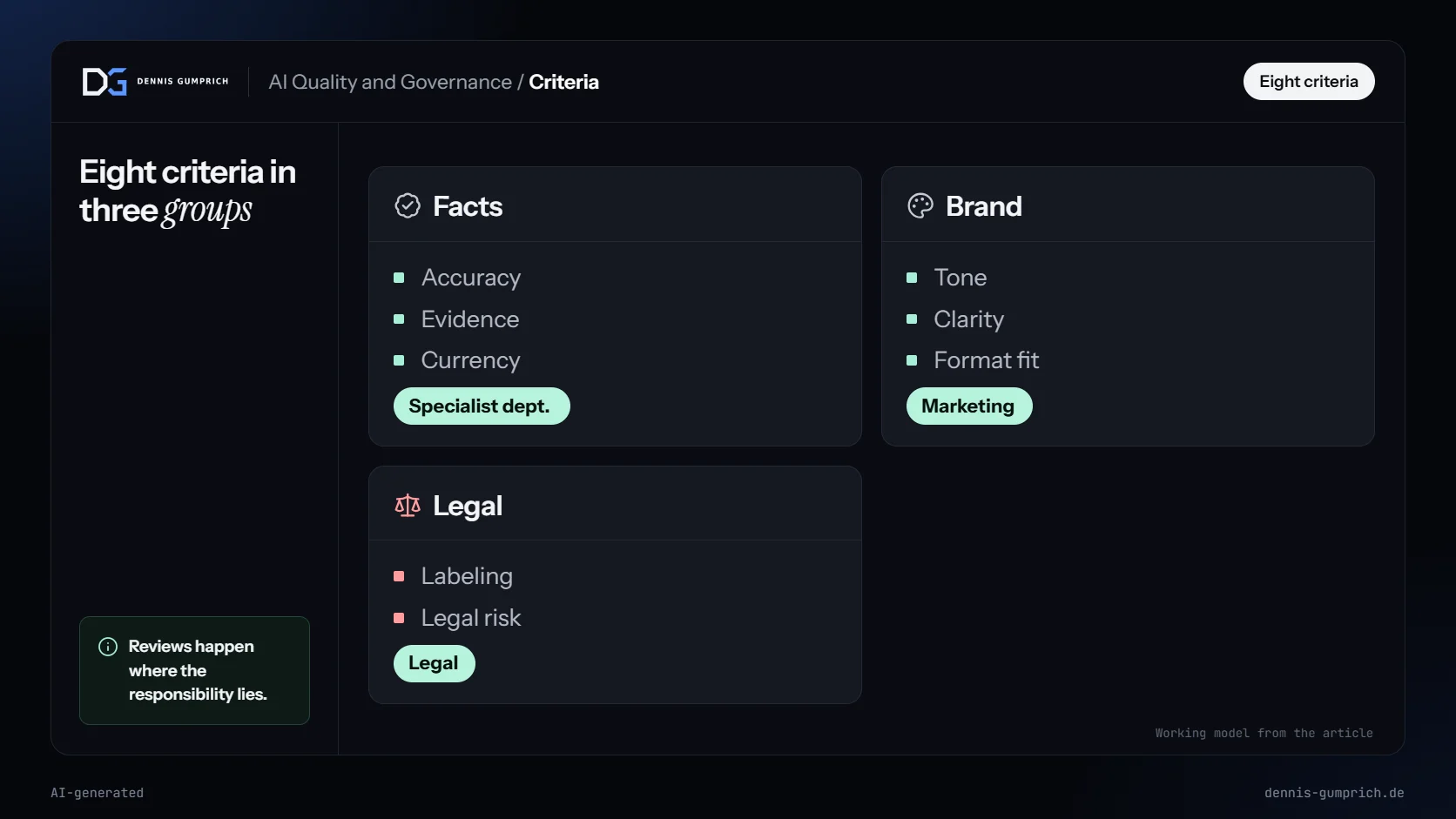
The sixth criterion is the most unusual and the most useful. A text your competitors could publish word for word is correct in content and still worthless. This question catches exactly the arbitrariness most often criticized in AI texts.
For environmental claims, there is also a review path with seven questions and a review prompt in the free work aid EmpCo in practice.
The mistakes I see most often in AI texts: a generic tone without brand identity, missing source references, compliance gaps, for example with health claims, and logos distorted in AI images.
How much time does a fixed checklist save?
Instead of three to five days of approval time with follow-up questions, under ten minutes of review time per piece, and one round instead of two to three coordination loops. The gain does not come from faster reading but from feedback becoming unambiguous.
Working model for illustration, not measured values.
The time gain does not come from faster reading but from feedback becoming unambiguous. Instead of "not quite right", the feedback reads: criterion 5 not met, replace phrase X. That is fixed in minutes.
What should feedback to the author look like?
Criterion-based and without additions: criteria 1 to 4 met, criterion 5 not met, term X is on the exclusion list. A "not quite right yet", by contrast, creates a new round. The key rule is that reviews are made only against the list. Anyone who adds style corrections on top cancels out the time gain.
Not quite right yet, please take another look. Also sounds a bit generic.
Criteria 1 to 4 met. Criterion 5: the term market-leading is on the exclusion list. Criterion 8: customer name not yet approved, please anonymize or obtain approval.
The key rule is that reviews are made only against the list. Anyone who adds style corrections on top cancels out the time gain. Questions of style belong in the brand voice, not in the individual review.
Detecting AI texts: what can AI detectors do?
Less than many expect. AI detectors estimate a probability; they do not provide proof. They miss AI texts and wrongly classify human texts as AI. For approval in marketing, what counts is therefore not whether a text comes from AI, but whether it is correct, fits the brand and serves its purpose. That is exactly what the checklist checks.
Two findings show the limits. OpenAI switched off its own classifier for AI text in July 2023 due to low accuracy: in the provider's own evaluation, it identified only 26 percent of AI texts and wrongly labeled 9 percent of human texts as AI. A Stanford University study published in the journal Patterns in 2023 also showed that common detectors wrongly classified more than half of the essays by non-native speakers examined as AI-generated.
For content teams, this results in a clear division of labor:
- Detection is a question of transparency. What helps here is a fixed rule on when you disclose AI use. How to define it is described in AI labeling: how to arrive at a robust practice.
- Review is a question of quality. What helps here is the checklist above, regardless of who or what wrote the draft.
- Typical patterns are an indication, not proof. Stock phrases, uniform sentence lengths or unsupported statements show a lack of revision. They belong in the style review, not in a verdict about origin.
Five mistakes with review checklists
- Too many criteriaFrom around twelve items onward, reviewers stop checking and start skimming. Eight is a robust upper limit.
- Criteria without a clear answer"Is the text convincing?" cannot be answered with yes or no and leads back to debates about taste.
- No ownershipIf it is not clear who checks which criterion, everyone checks everything or nobody checks anything.
- A list only for AI textsSeparate treatment creates the impression that AI texts are inherently suspect. The list should apply to all texts.
- Not feeding results backIf the same criterion fails three times, the cause belongs in the brand voice or fact sheet, not in the next review.
Five steps to an established review checklist
- Week 1Analyze rejected textsTake the last ten pieces of feedback and assign each to a cause. This gives you your actual criteria.
- Week 2Cut it down to eight itemsKeep only criteria that can be answered with yes or no. Everything else belongs in the brand voice.
- Week 2Define ownershipOne role per criterion, not several. In case of disagreement, the role decides, not the discussion.
- Week 3Agree on a feedback formatCriterion number plus the specific passage. Free text without reference is rejected.
- From week 4Evaluate quarterlyWhich criterion fails most often? That cause needs fixing, not repeated checking.
How do you adapt the criteria for each content type?
Not with a second rulebook but with a selection from the same list. For each content type, you define which of the eight criteria apply. This keeps the list consistent and the effort proportionate, because a social post carries different risks than an expert article with a product reference.
Applying eight criteria to every text sounds clean and fails in daily work because a social post carries different risks than an expert article with a product reference. If you review both in the same way, you review either too much or too little.
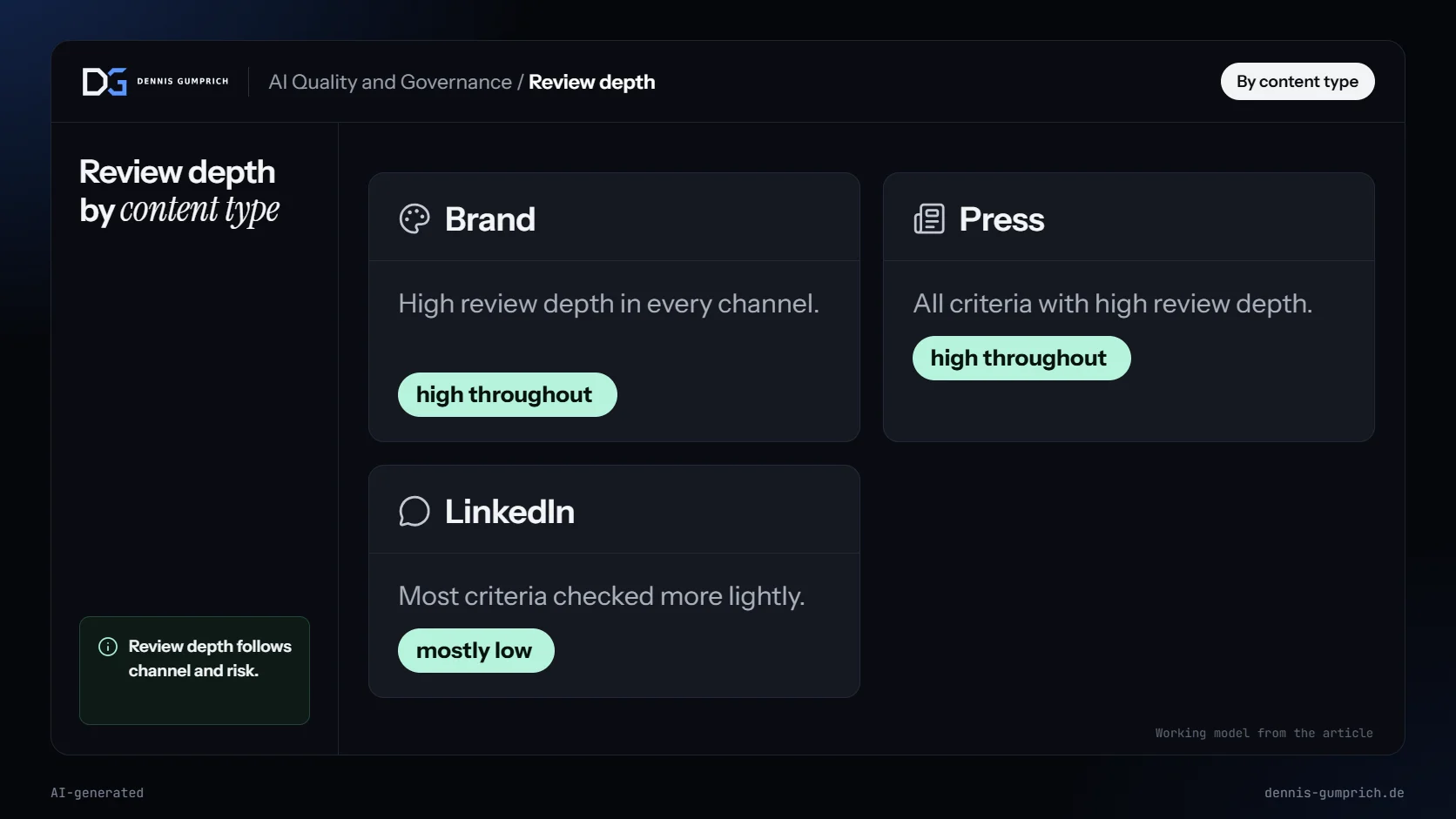
The workable solution is not a second rulebook but a selection from the same list. For each content type, you define which of the eight criteria apply. This keeps the list consistent while keeping the effort proportionate.
| Content type | Applicable criteria | Reasoning |
|---|---|---|
| Derivative of an approved core text | 4, 5 | Facts have already been checked, only the formal level remains |
| Blog post without product reference | 1, 3, 4, 5, 6 | No company claims, no advertising claims |
| Expert article with product reference | all eight | Full risk across all three groups |
| Customer reference or case study | 2, 7, 8 mandatory | Personal reference and customer approval are decisive |
| Internal document | 1, 2, 3 | Only the facts group, style is secondary |
The first row is the biggest lever in daily work. When a channel version is created from an already reviewed piece, checking the facts again is a repetition. Two criteria are enough, and the process takes minutes instead of days. Whether a piece also needs to be labeled as AI-assisted is covered in AI labeling: how to arrive at a robust practice.
What happens when a criterion is not met?
That depends on the severity level defined beforehand. Three levels are enough. Stop means: no publication until the passage is resolved, and it applies to an incorrect company claim, an impermissible advertising claim or a missing approval from a person named. Without this gradation, every comment becomes an emergency brake.
A checklist answers whether something is met. It does not answer what happens next. This is exactly where the delays arise that a list is supposed to prevent.
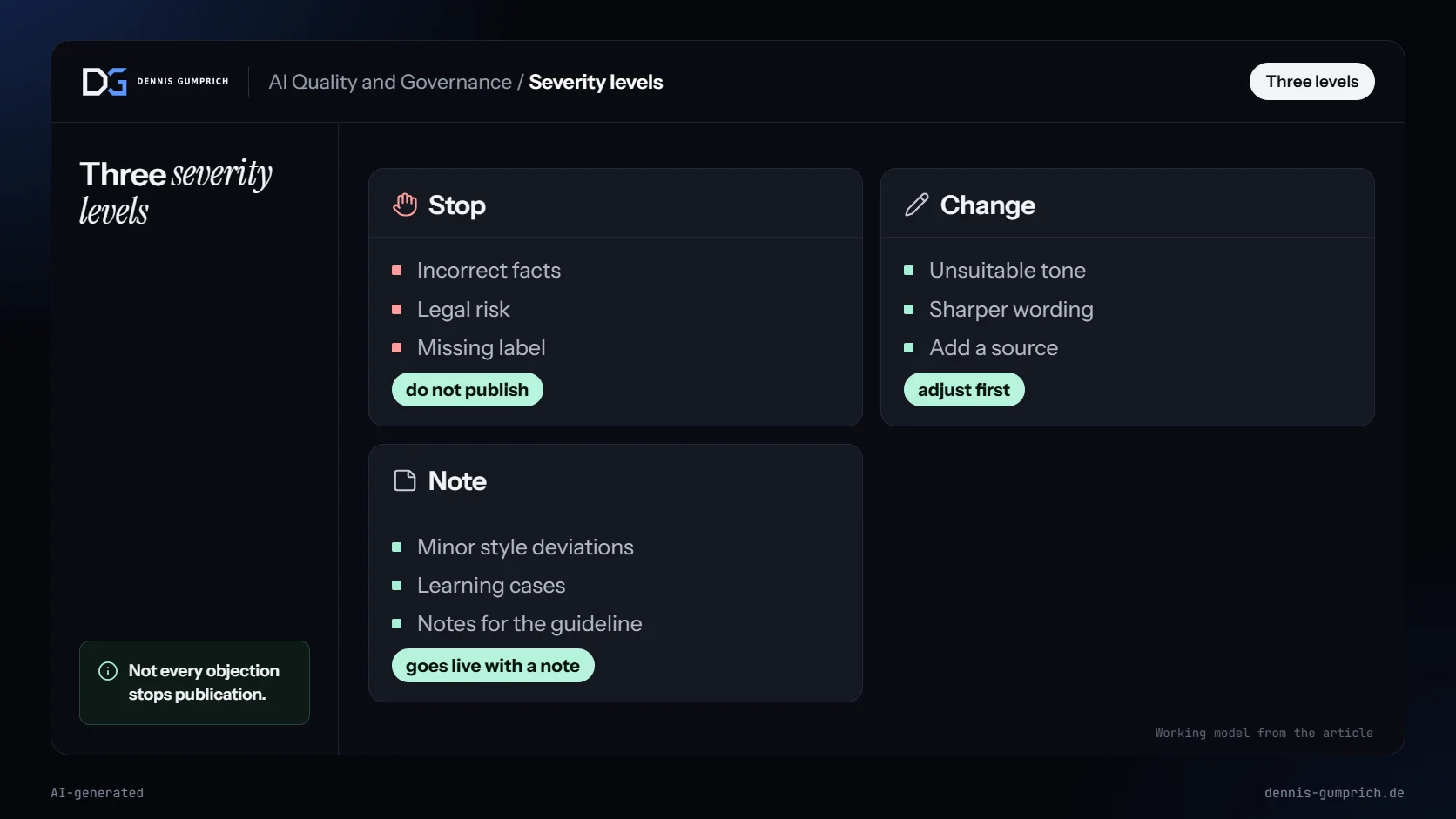
What works is a gradation into three severity levels, defined in advance. Not every objection may stop a publication, and not every objection may be ignored.
This gradation has a second effect that is often underestimated: it relieves reviewers of the worry that a comment might jeopardize a deadline. Anyone who knows that a note does not trigger a block will also report smaller observations. Without gradation, people either block excessively or stay silent out of consideration.
A review run in practice
A typical case shows what this looks like in concrete terms. An expert article with a product reference, around 1,500 words, goes into approval.
The editorial team first checks criteria 1, 3, 4, 5 and 6. Instead of reading the entire text for everything at once, they work through the list: first all figures in the text, then all time-related statements, then form of address, then a comparison with the exclusion list, and finally the question of distinctiveness. Five targeted passes together take less time than one thorough full read and find more.
What remains goes on as a specific request: the two statements about the product to the specialist department, the one comparison claim to the legal department. Neither receives the article with a request to look it over, but two highlighted sentences with a question. In practice, the time difference between these two approaches is days.
Two answers come back. The product statement is correct, the comparison claim is not. Criterion 7 is therefore not met, severity level stop. The sentence is deleted, not rephrased, because a watered-down comparison claim would trigger the same review again. The article goes live the same day.
The evaluation that improves your list
A review checklist is not a static document. It only gets better if you evaluate which criteria actually fail. This evaluation takes about 30 minutes once a quarter and noticeably changes the work.
For each approval, simply note the number of the criterion that was objected to, nothing more. After three months, you have a distribution. This distribution tells you where the cause lies, independently of individual people.
If criterion 1 fails frequently, you are missing a fact sheet with verified figures. If criterion 5 fails, the objected terms belong on the exclusion list instead of being found again every time. If criterion 2 fails, the knowledge base is incomplete. In all three cases, the solution lies before the review, not in it. Which types of error sit behind criterion 1 and how to catch them in advance is described in Catching hallucinations in marketing texts systematically.
The most important finding of this evaluation is usually a different one: one or two criteria never fail. They should be removed. A list that shrinks from eight to six is applied more reliably because it is quicker to work through.
Self-check: how clear is your approval process?
Tick everything that applies to you.
A proposal for how we make text approvals shorter:
From now on, we review against eight fixed criteria in three groups: facts, brand and legal. Every criterion can be answered with yes or no and has exactly one responsible role.
Feedback includes the criterion number and the specific passage in the text. This eliminates questions about what exactly was meant, and we get through in one round instead of two or three.
The list applies to all texts, regardless of whether they were created with or without AI. We handle questions of style through the brand voice, not case by case.
Can AI take over the review itself?
Partly, and exactly this distinction is decisive. Matching against the exclusion list can be checked reliably by machine; it is a search task. Finding time-related statements without a date can also be well supported. Company claims and advertising claims cannot be handed over: whether a statement about your company is true, only your company knows.
The question is obvious when you are already working with AI. The answer differs by criterion, and exactly this distinction decides whether the review becomes faster or less reliable.
Criterion 5, the exclusion list, can be checked reliably by machine. Matching against a fixed word list is a search task and does not need a language model. Criterion 3 can also be well supported: a model reliably finds time-related statements without a date and flags them.
Criteria 2 and 7 cannot be handed over. Whether a statement about your company is correct and whether an advertising claim is permitted is something a model cannot know, only guess plausibly. This is exactly where the most expensive mistakes happen, and exactly where the responsible role is needed.
Criterion 6, distinctiveness, is a special case. A model can certainly assess whether a text sounds generic, and is often stricter in this than the person who wrote it. As a pointer this is useful, as a decision it is not, because the assessment is made without knowledge of your competitors.
There is a second reason not to hand over the decision. Anthropic investigated in constructed tests whether language models disclose in their reasoning what their result is actually based on (Reasoning models don't always say what they think, April 2025). Claude 3.7 Sonnet mentioned a hint it had used in only 25 percent of cases on average, DeepSeek R1 in 39 percent. A plausible-sounding explanation therefore does not prove how an assessment came about. When a model rates a text as distinctive or correct, its explanation does not replace the judgment of the responsible role. One caveat: this is research by a model provider under test conditions, not in everyday editorial work.
In practice, this means: AI takes over the mechanical criteria and flags candidates for the others. The decision stays with the named roles. Anyone who fully automates the review has effectively abolished it without noticing.
This split matches the Generative AI Profile (NIST AI 600-1) of the US National Institute of Standards and Technology. It recommends checking the accuracy of generated content against reference data, combining human oversight with automated evaluation (action MP-2.3-001), and specifically checking sources and citations in AI output (MS-2.5-003). In your process, the fact sheet and knowledge base take on the role of this reference data, which is why you fix recurring errors there and not in the next review. It is a voluntary framework from the US, not an obligation.
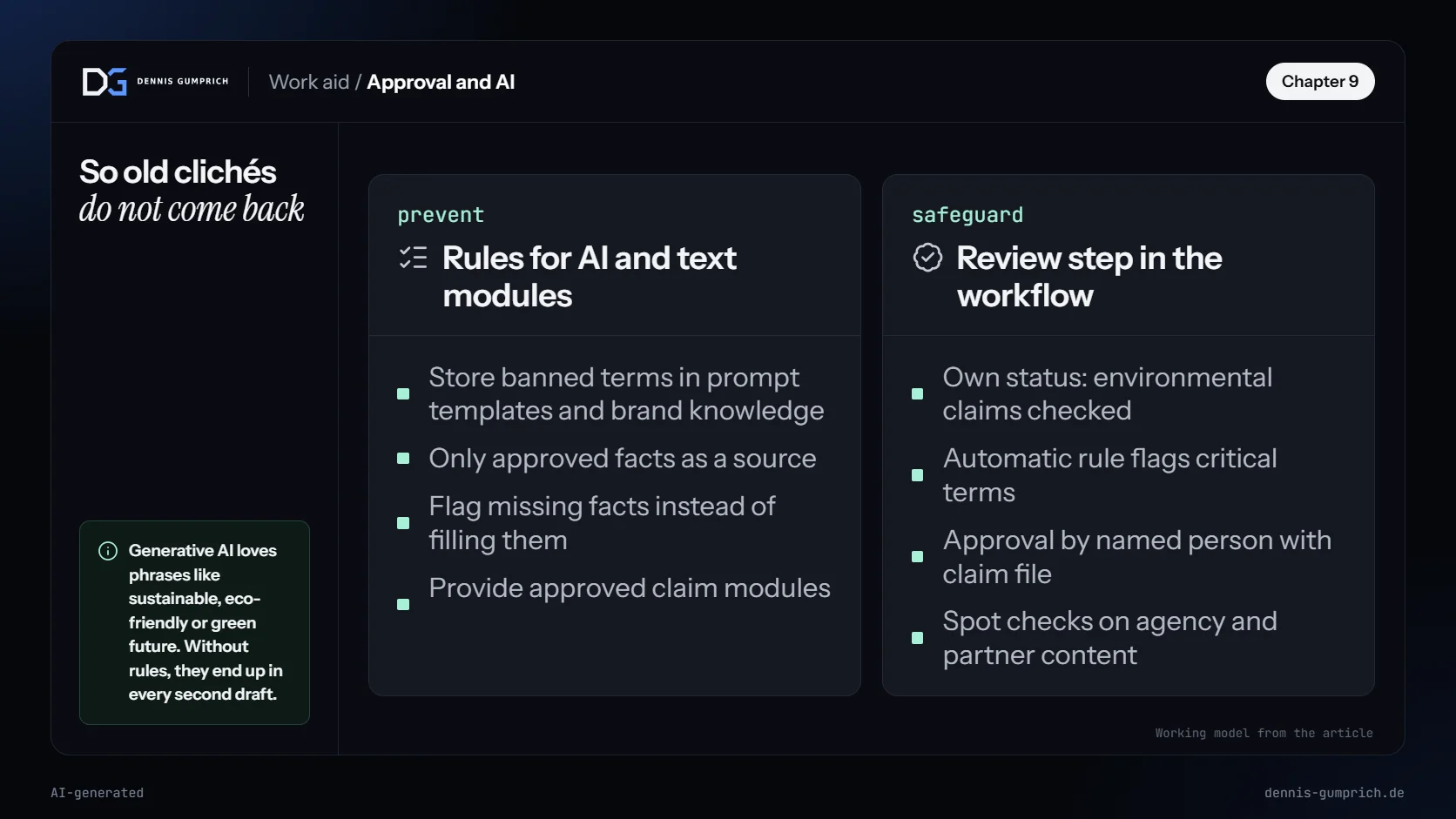
I set up my own AI review rules from uploaded guidelines, for example for the EmpCo Directive or for SEO, and export the result as evidence. This turns the checklist into a review step nobody can forget.
How do you introduce the checklist without creating resistance?
By deriving it from your own rejections, not by announcing it. If the list visibly comes from the team's last ten pieces of feedback, it describes the existing judgment instead of replacing it. That is exactly how you should present it.
A checklist changes how people talk about their own work. Anyone who has so far judged by feel is suddenly presented with a grid. This can be read as distrust, especially by experienced people whose judgment has been sufficient so far.
The introduction therefore rarely succeeds through an announcement. It succeeds by deriving it from your own rejections. If the list visibly comes from the team's last ten pieces of feedback, it describes the existing judgment instead of replacing it. That is exactly how you should present it.
The second point concerns the order of arguments. If you start with quality assurance, you create the impression that quality has been inadequate so far. If you start with approval time, you address a problem that everyone involved suffers from. The list is then a relief, not a control.
Expect a transition phase in the first weeks. At first, more objections will come up than before, because people are searching deliberately where they used to skim. That is not a step backward but the reason for the list. After about two months, the number drops noticeably, because by then the most common causes have moved into the fact sheet and exclusion list.
A final note on authority: the list must be backed by the role that is also responsible for approval. If it is imposed by marketing and experienced by the specialist department as an additional requirement, it will be bypassed. If it is agreed jointly, it replaces discussions both sides find exhausting anyway.
Conclusion: criteria beat diligence
Approvals do not get faster when the people involved try harder. They get faster when it is clear what is being checked and who decides. A list of eight decidable questions achieves more than any call for thoroughness. Which of these checks can be handed to an AI agent and where the decision stays with people is described in AI agents in the content team.
Frequently asked questions
Can AI texts be detected reliably?
No. AI detectors deliver probabilities with high error rates in both directions. OpenAI discontinued its own classifier in 2023 due to low accuracy. For approval, it matters more whether a text is correct and fits the brand than where it comes from.
Should AI texts be reviewed more strictly than others?
For facts, yes, because incorrect statements can arise systematically there. For style and brand, no. Generally stricter treatment leads teams to conceal their use of AI rather than make it transparent.
Who decides in case of disagreement?
The role responsible for the criterion, without discussion. That is exactly why ownership is defined in advance. If a decision is repeatedly perceived as wrong, the criterion needs revising, not the individual case negotiating.
How do we keep the list short?
By not adding recurring objections as new criteria but fixing them at the root. A term that is constantly objected to belongs on the exclusion list of the brand voice, not in the review.
Does this also work with external agencies?
Particularly well, because an agency cannot know your unwritten expectations. The criteria list belongs in the briefing, not only in the sign-off.
How do we sustain the review at high volume?
By reducing the criteria per content type. For derivatives of a reviewed core text, two criteria are enough. If you instead try to apply all eight to every social post, you will give up on the review entirely after a few weeks.
Should we document review results?
Only the number of the criterion objected to, not the process in detail. This one piece of information is enough for the quarterly evaluation and takes seconds. Detailed documentation stops being maintained after a short time and then provides no data at all.
What if an objection remains disputed?
Then the role responsible for the criterion decides, immediately. The time limit is important: a disputed question must not hold up a process for several days. If the same question is disputed repeatedly, the criterion needs to be made more precise, not the individual case negotiated.
How do you check an AI text for errors?
In three separate passes instead of one. First the facts: every figure, every name and every source is checked against the original. How to also close gaps in content so the text becomes citable is described in From AI draft to citable text. Then the statements: is the text professionally correct, and does it claim nothing you cannot stand behind? Finally language and brand. The separation prevents a fluently written text from masking errors in content.
Where does your content process lose time today?
In 30 minutes, we look together at where unnecessary coordination, manual tasks, tool switching or repetitive content work cost you time today.
You get a concrete assessment of which tasks you can simplify, automate or organize better, and where AI and tools actually help instead of adding complexity.
Analyze your content process in 30 minutes Free of charge. You take away concrete starting points you can use internally right away.
Dennis Gumprich
Dennis helps marketing and communication teams fit generative AI into existing content processes without undermining quality, brand voice and approvals. Focus areas: content operations, AI governance and tool selection in mid-sized companies and corporations.
Transparency note: Dennis works for contentbird, a provider of AI-powered content software. Product mentions are marked in the article. More about Dennis (in German) · LinkedIn
Read more
Sources
- European Parliament and Council: Directive (EU) 2024/825 on empowering consumers for the green transition (EmpCo), February 28, 2024, applicable from September 27, 2026; Annex I prohibits, among other things, generic environmental claims without evidence and sustainability labels without a certification scheme. Accessed October 31, 2026.
- German Federal Ministry of Justice: Section 5 UWG, misleading commercial practices (in German), legal text of the German Act Against Unfair Competition as an example of national rules; para. 2 covers, among other things, statements on expected results, approvals and awards. Accessed October 31, 2026.
- German Federal Ministry of Justice: Section 6 UWG, comparative advertising (in German), legal text setting out the conditions under which a comparison with competitors is unfair; based on the EU Directive on misleading and comparative advertising. Accessed October 31, 2026.
- A. B. Haynes, T. G. Weiser, W. R. Berry et al.: A Surgical Safety Checklist to Reduce Morbidity and Mortality in a Global Population, New England Journal of Medicine 360 (5), January 2009, eight hospitals, cited by AHRQ PSNet: study summary: significant decline in mortality and complications after introducing a fixed checklist. Accessed October 31, 2026.
- OpenAI: Why language models hallucinate, research post from September 5, 2025 (Kalai, Nachum, Vempala, Zhang et al.): incorrect statements by language models arise systematically from training and evaluation, not by chance. Accessed October 31, 2026.
- Anthropic: Reasoning models don't always say what they think, research post from April 3, 2025, constructed tests: Claude 3.7 Sonnet mentioned a hint it had used in 25 percent of cases on average, DeepSeek R1 in 39 percent; a plausible explanation does not prove how the result came about. Vendor research under test conditions. Accessed October 31, 2026.
- National Institute of Standards and Technology (NIST): Artificial Intelligence Risk Management Framework: Generative Artificial Intelligence Profile (NIST AI 600-1), July 26, 2024, Chloe Autio, Reva Schwartz, Jesse Dunietz et al., companion profile to the voluntary AI RMF 1.0: actions MP-2.3-001 (check accuracy against reference data, human oversight combined with automated evaluation) and MS-2.5-003 (check sources and citations in AI output). Voluntary framework from the US. Accessed October 31, 2026.
- OpenAI: New AI classifier for indicating AI-written text, note from July 20, 2023: the classifier is no longer available due to low accuracy; in the evaluation, 26 percent of AI texts were identified and 9 percent of human texts were false positives. Accessed November 13, 2026.
- Liang, W. et al.: GPT detectors are biased against non-native English writers, Patterns, July 2023, summarized in the Cell Press press release: more than half of 91 essays by non-native speakers were wrongly classified as AI-generated. Accessed November 13, 2026.
How this article was created
This article was created with the help of AI. Structure, research and draft wording were developed with AI support. Professional assessment, review of the statements and the final version are the responsibility of Dennis Gumprich. The English version was translated with AI and reviewed. Read the original German version.
How reliable are the statements?
Evidence exists for the evidence requirement for environmental claims (EmpCo), the legal limits on effect and comparison claims (using German unfair competition law, Sections 5 and 6 UWG, as an example), the effectiveness of fixed checklists compared with diligence alone, demonstrated in surgery (Haynes et al.), and the systematic origin of incorrect statements in language models (OpenAI), as well as the limited explanatory power of model reasoning (Anthropic, vendor research under test conditions) and the recommendation to combine human review against reference data with automated evaluation (NIST AI 600-1, voluntary framework from the US). The eight criteria, the upper limit of around twelve items, the assignment by content type, the severity levels and the approval and review times given are explicitly marked as working models from consulting practice and are not measured values. As of October 31, 2026. Legal note: this article does not replace legal advice. Which advertising claims are permitted in your industry and market should be clarified with your legal department.


