
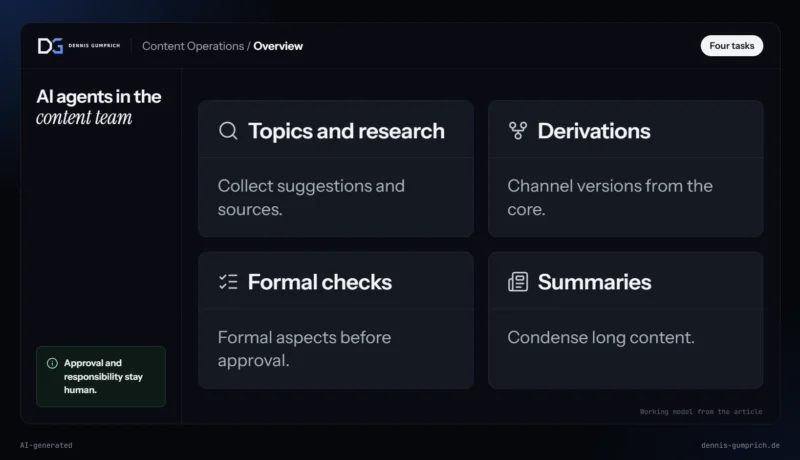

An AI agent works through a chain of tasks on its own instead of responding to individual instructions. In everyday content work, agents today reliably take over research, derivations from approved content, formal checks and summaries. They are unreliable with evidence, with fine differences in tone and wherever knowledge is missing that is not written down anywhere. Decision, approval and responsibility remain with people. Success depends less on the model than on context, rights and checkpoints.
What distinguishes an AI agent from a chat with AI?
In a chat, a person specifies every step and evaluates every answer. An agent gets a goal, plans the steps itself, uses tools such as search, files or a CMS, checks interim results and delivers a result at the end. The person no longer steers every step, but the assignment and the sign-off.
The term is now used for almost everything related to AI. That makes conversations about it difficult, because everyone means something different. A practical distinction helps: what matters is who decides on the next step. If a person does that after every answer, it is a chat, even if it is a very good one. If the system itself decides which step is needed next and uses tools for it, it is an agent.
| Chat | Assistant with templates | Agent | |
|---|---|---|---|
| Who plans the steps | the person | the template | the agent |
| Tools | none or few | fixed | chooses from the approved ones |
| Context | what is in the prompt | stored guidelines | knowledge base, systems, previous results |
| Role of the person | steers every step | starts and reviews | assigns, reviews at fixed points, signs off |
| Typical example | Rephrase this paragraph | Create a LinkedIn post from the template | Derive all channel versions from the approved article and submit them for approval |
The middle level is often overlooked and is the real gain for many teams. If you use fixed templates with stored brand voice, you get a large part of the benefit with much less risk. Agents are worthwhile where the task consists of several steps that a person chains together by hand today.
How differently the two ways of using AI are distributed is shown in the "Anthropic Economic Index report: Economic primitives" from January 2026. Anthropic analyzed one million conversations each on Claude.ai and transcripts from the API from November 2025. On Claude.ai, the report assigns 52 percent of conversations to augmentation, that is, collaboration, and 45 percent to automation. In the API, it is about three quarters automation. For you, this means: as soon as AI no longer works in the chat window but embedded in tools, the person's role shifts from steering every step to signing off, and for that you need fixed checkpoints. One limitation: this is a vendor source that only analyzes the use of Claude, the classification is done by Claude itself, and the values are indicative.
Why agents are arriving in marketing right now
Three developments have come together. Models have become much more reliable at multi-step tasks; they lose sight of the goal less often and more often recognize when an interim result does not fit. With the Model Context Protocol, there is a widespread standard through which agents can access tools, from file storage to the CMS. And content software vendors are building agents directly into their tools, so that they work where content is created anyway.
At the same time, a gap has opened between what is shown in demos and what holds up in everyday work. A demo shows an agent that builds a complete campaign from one sentence. Everyday work shows that this campaign remains generic without context from the company, is factually wrong in two places and comes back from the legal department. Both are true. The task is to find the parts where agents already save time reliably today and to use them there.
Which tasks do AI agents reliably take over today?
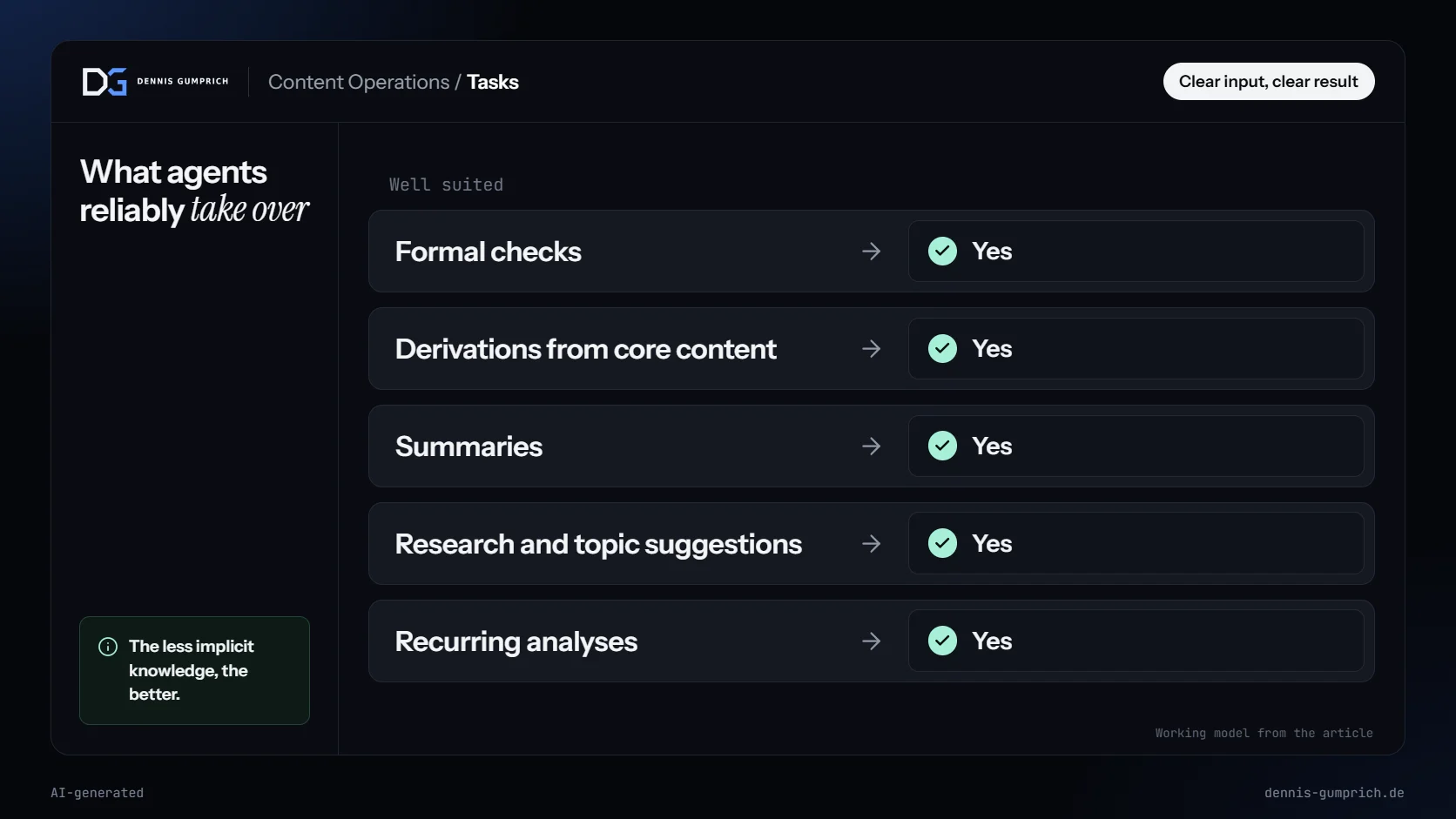
Tasks with a clear input, a clear result and verifiable quality: research and topic suggestions, derivations from content that has already been approved, formal checks against defined rules, summaries of conversations and documents, and recurring analyses. The less implicit knowledge a task needs, the better suited it is.
The following classification is a working model from practice. It describes the situation in autumn 2026 and will shift. The basic logic behind it will remain: agents are strong where rules are explicit and weak where they only exist in people's heads.
| Task | Suitability | Human share |
|---|---|---|
| Formal check against rules (length, structure, metadata, terms) | very high | define rules, decide exceptions |
| Derivations from approved core content | high | formal review per channel |
| Summary of conversations and documents | high | spot check, review weighting |
| Research and topic suggestions | high | check evidence, select |
| Recurring analyses and reports | high | interpretation |
| First version of a translation or localization | medium to high | check technical terms and local specifics |
| First draft of an expert text | medium | add substance, evidence, stance |
| Topic selection and prioritization | low | the decision stays with the team |
| Approval and publication | do not delegate | fully human |
| Communication in crises and sensitive situations | do not delegate | fully human |
The row on derivations stands out. It is one of the most economically interesting areas of use, because the source content has already been reviewed. The agent invents nothing new, but transfers reviewed content into other formats. The risk is correspondingly smaller, and the time gain is large, because derivations in particular cost the most manual work in many teams.
Where do AI agents fail in everyday content work?
In five places: they invent evidence, they mix up tones between brands, they lack knowledge that only exists in people's heads, errors propagate through chains, and with unclear assignments they deliver plausible but wrong results. All five can be contained; none disappears completely.
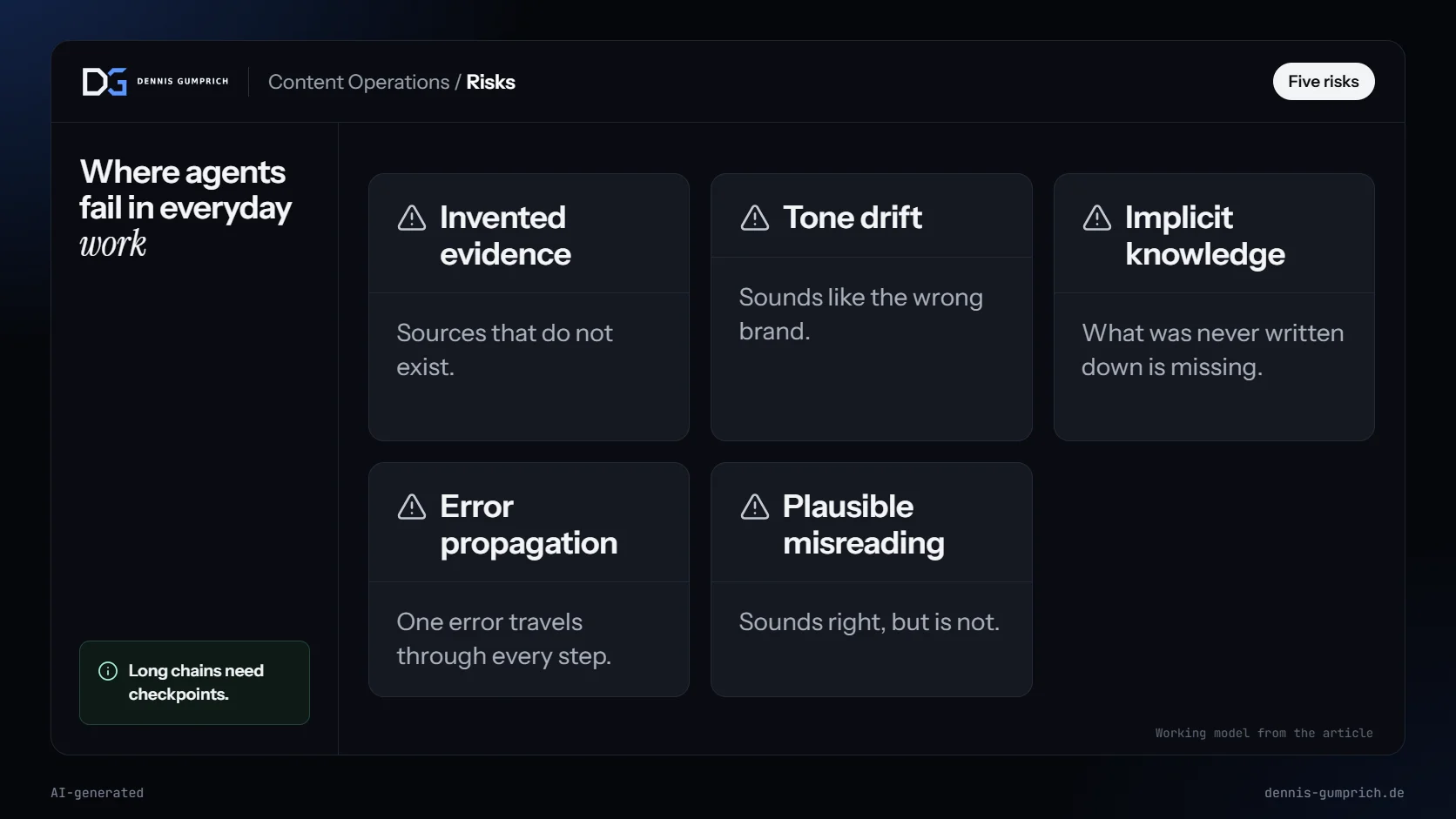
- Invented evidenceAn agent that is supposed to support a statement sometimes finds a source that does not exist, or attributes a wrong figure to a real source. This is more common in multi-step research than in a chat, because nobody reads every interim step. How to catch such errors systematically is described in the article on hallucinations in marketing texts.
- Tone driftWith several brands or senders, agents mix styles as soon as the context is not cleanly separated. The result then sounds right, but like the wrong sender.
- Missing implicit knowledgeThat a certain topic is currently sensitive internally, that a customer may no longer be named, that management dislikes a certain word: an agent cannot know what is not written down anywhere.
- Error propagationA small error in the first step is amplified in every further step. At the end, there is a convincing-looking result on a wrong basis.
- Plausible misinterpretationIf the assignment is ambiguous, the agent decides on one reading and carries it out consistently. The result is internally coherent and still not what was meant.
Why chains fail differently from individual steps
The fourth point deserves its own section, because it explains the most important difference between chat and agent. In a chat, a person sees every interim result and corrects immediately. With an agent, these corrections are dropped, and small error rates add up.
A simple calculation shows this. Suppose an agent completes each individual step correctly in 95 out of 100 cases. That sounds like a high rate. If the task consists of five steps that build on each other, the probability that all five are correct is only about 77 percent. With ten steps, it is around 60 percent. Roughly one in four to almost one in two results then contains an error somewhere, and not necessarily in a place that stands out when skimming.
The consequence is not to do without agents. The consequence is to keep chains short and place checkpoints where an error would be most expensive. An agent that stops after research and presents the sources for review before writing is slower than one that runs straight through. But it is much more reliable, and the review costs minutes instead of hours.
What does a well-built content agent look like?
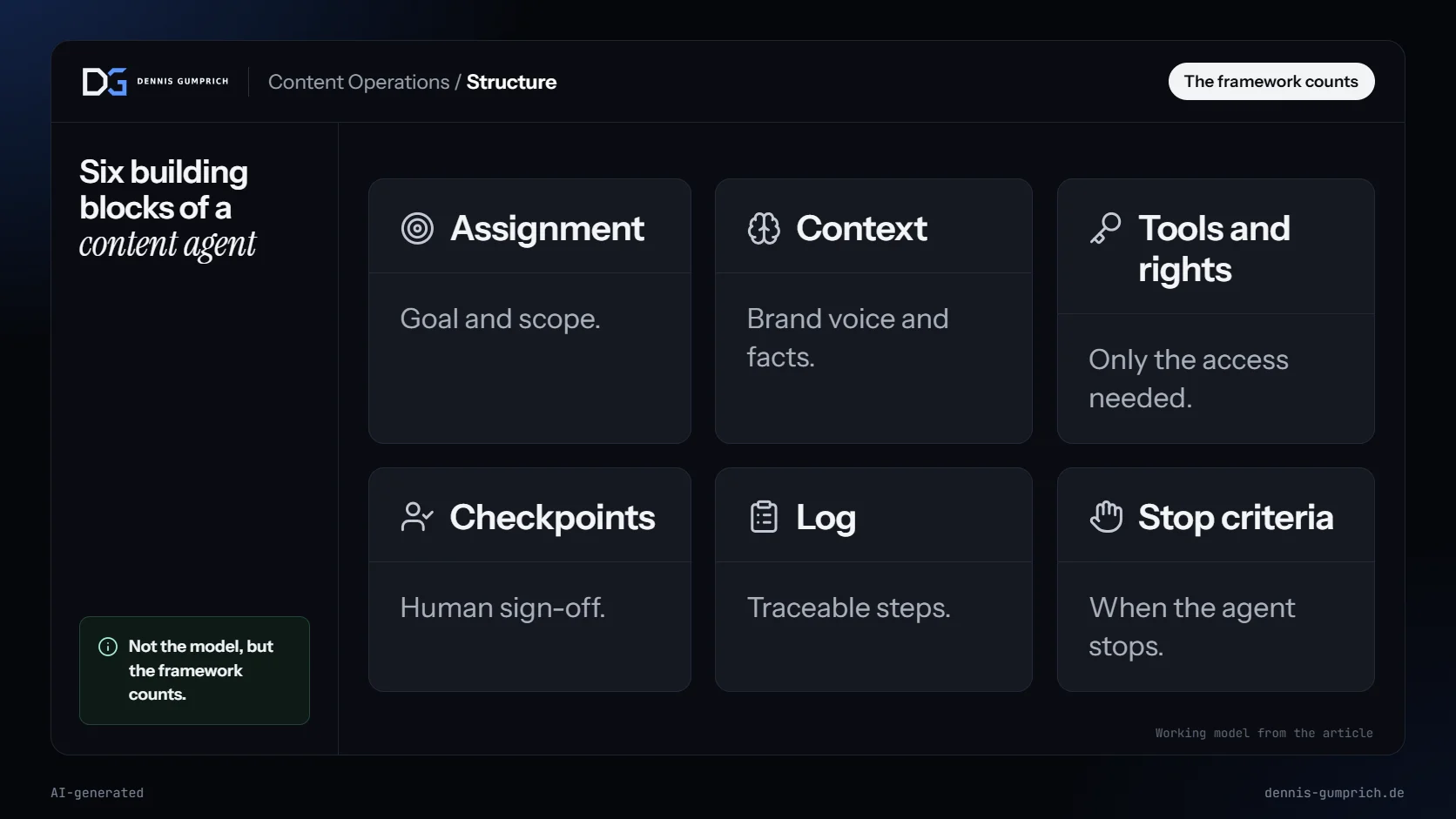
It has six components: a clear assignment, access to the right context, tools with limited rights, fixed checkpoints for people, a traceable log and clear criteria for when it stops and asks.
| Component | What it governs | Typical error if it is missing |
|---|---|---|
| Assignment | Goal, result, scope, what not to do | plausible but wrong reading |
| Context | Brand voice, knowledge base, verified facts, target group | generic results, wrong tone |
| Tools and rights | what it may access and change | unwanted changes in systems |
| Checkpoints | where a person signs off interim results | error propagation across the chain |
| Log | which steps, sources and decisions there were | result not traceable |
| Stop criteria | when it stops and asks | continuing on a wrong basis |
The most important component is context. An agent without access to your brand voice, your verified facts and your previous content produces texts that sound like any company. With this access, it produces texts that sound like you and are based on your statements. How to build this context is described in the articles on the knowledge base and on stored brand voice. If you do not have this foundation, start there and not with the agent.
Five content agents that prove themselves in everyday work
The following examples are deliberately unspectacular. They describe agents that take over a recurring task and hand over to people at a clearly defined point. It is exactly this kind of agent that holds up in everyday work.
- Agent 1The topic radarMonitors defined sources, competitors and questions from sales, and suggests topics weekly with reasoning and sources. Checkpoint: the editorial team checks the sources and decides in the topic meeting. How to make topics comparable is described in the article on topic scoring.
- Agent 2The deriverTakes approved core content and creates the versions for LinkedIn, newsletter, intranet and short news, each according to channel rules. Checkpoint: formal approval per channel, no new expert approval.
- Agent 3The reviewerChecks every draft before approval against brand voice, terminology rules, structure, citability and legal review rules, for example on environmental claims. Checkpoint: the author decides which notes to accept.
- Agent 4From conversation to draftCreates a structured draft with quotes and open questions from the transcript of an expert conversation. Checkpoint: the expert checks her statements, the editorial team the text.
- Agent 5The updaterRegularly searches existing content for outdated figures, dead links and statements that contradict newer content, and creates change suggestions. Checkpoint: the editorial team decides on every change.
What all five have in common is that their result is a suggestion and not a publication. The agent saves the groundwork, the person makes the decision. This is not a lack of trust in technology, but a deliberate distribution of responsibility that still holds when the models get better.
Which role remains with people?
Five tasks remain human: deciding what you talk about, being responsible for what is published, providing context that is not written down anywhere, judging in sensitive situations and maintaining relationships with specialist departments and experts. Work shifts from producing to steering and reviewing.
Many teams view this shift with concern, and the concern is not unfounded. Those who have mainly written texts so far will in future review more texts, formulate assignments and maintain context. That is a different activity, and not everyone wants to do it.
At the same time, a skill that was previously hardly visible becomes more valuable: the judgment of whether a text is good. Anyone who quickly recognizes that a paragraph is correct but wrongly weighted for this target group, who notices that a wording could be misunderstood in the current situation, who knows which expert to call for a topic, has more influence in a team with agents than before, not less.
For managers, this means redefining roles before the agents arrive, not afterwards. Which roles a content team basically needs and how they change with increasing automation is described in the article on the four roles in the content team.
Which content platforms offer AI agents?
As of October 2026, vendors from four categories offer their own agents: marketing suites such as HubSpot with Agent Hub and Salesforce with Agentforce, with Contentful part of Salesforce since September 2026; digital experience platforms such as Adobe Experience Manager; headless CMS such as Contentstack with Agent OS; and content operations platforms such as contentbird*, in which agents work with stored skills, brand voice and scheduled tasks. What an agent may do in each differs considerably.
The name therefore says little. Ask the same four points in every demo: which steps does the agent complete without confirmation? Which context does it access, that is, brand voice, knowledge base and earlier content? Where does it stop before publication? And where is it logged what it has done? An agent that does not answer these questions clearly is an assistant with a new label.
* The author's employer, see transparency note. The information on vendors reflects their own presentation and changes quickly.
A prompt that has already proven itself in everyday work is a good starting point for the first agent. Templates for recurring tasks are in the free collection 100 AI prompts for marketing (in German).
How do you introduce your first agent?
With a single, recurring and well describable task, a clear checkpoint and four weeks of parallel operation. Time saved and correction rate are measured. Only when both values are convincing does the second agent come.
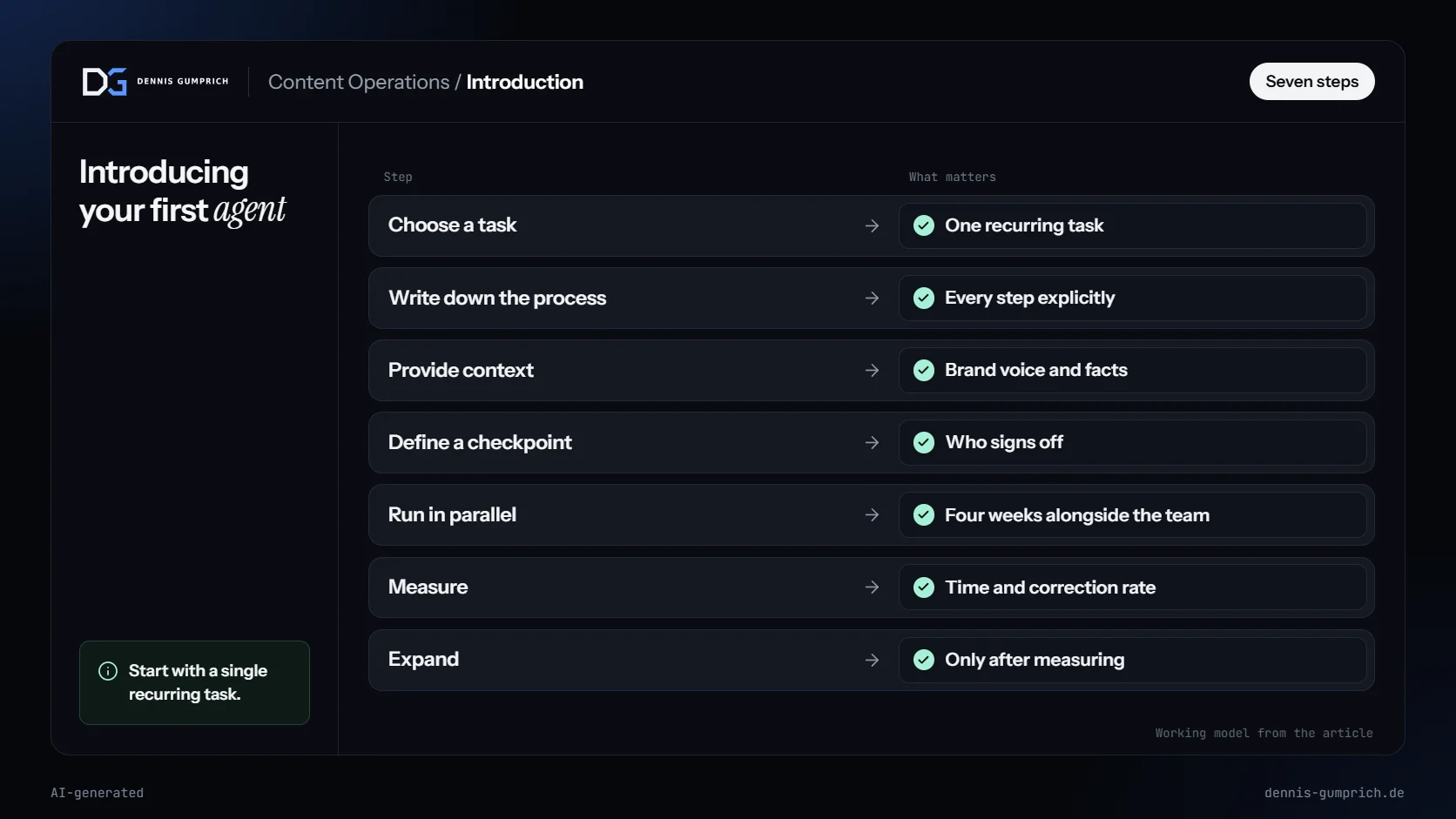
- Step 1Choose a taskA task that occurs at least weekly, consists of several steps and whose result is easy to check. Derivations and formal checks are almost always good candidates.
- Step 2Write down today's processWhich steps does a person take today, in which order, with which sources, according to which rules? This description is the assignment for the agent and, along the way, reveals how many rules previously only existed in people's heads.
- Step 3Provide contextBrand voice, examples of good results, verified facts. Without this foundation, you are not evaluating the agent, but the lack of your context.
- Step 4Define a checkpointWhere does a person sign off, and according to which criteria? Write down the criteria so that sign-off does not depend on the mood of the day.
- Step 5Four weeks in parallelThe agent works while the previous process continues. This way you see where results differ without anything unfinished being published.
- Step 6Measure two figuresTime saved per run and the share of results that had to be reworked. Both figures belong together, because time savings with a high correction rate are not savings.
- Step 7Only then expandThe second agent comes when the first runs stably. If you start with five agents at once, you cannot say in the end which one is responsible for what.
This order matches what applies to every introduction: a short test proves little, a structured pilot with clear criteria a great deal. More on this in the article Pilot and rollout.
Governance: rights, log and labeling
As soon as an agent not only suggests texts but acts in systems, three questions become important that hardly played a role in a chat.
Rights. An agent only gets the rights it needs for its task. A deriver must be able to create drafts, but not publish anything. A reviewer must be able to read and comment, but not change anything. This separation can be mapped via roles in most systems and should be set up this way from the start.
Log. Every action of an agent must be traceable: which sources it used, which decisions it made, which content it changed. This is not only important for IT, but for the editorial team itself. Anyone who finds a faulty result must be able to see at which step it arose.
A framework for this documentation is offered by the NIST Generative AI Profile (NIST AI 600-1) from 2024, a voluntary framework from the US. It recommends human review of generated content (MG-3.2-008) and suggests recording roles and responsibilities for human oversight in an AI inventory, including provenance information and the models and versions used (GV-1.6-003). Applied to your team, this means: keep a short profile for each agent with assignment, model, rights and the person who signs off its results. One limitation: the profile is a recommendation, not a legal obligation.
Labeling. Whether and how you label AI involvement toward readers is a separate decision that you should make once in principle instead of discussing it again for each piece of content. How to define this practice is described in the article on AI labeling.
A note about myself
I work for contentbird. There, agents can be set up for recurring content tasks, such as derivations, research or checks. They work with the stored brand voice and knowledge base and pass their results into the existing workflow with approval instead of publishing themselves. Experience from pilot projects matches this article: when an agent delivers poor results, it is usually not the agent, but missing context or an assignment that is too open.
Five mistakes when introducing AI agents
- Starting with the biggest use caseThe complete campaign at the push of a button is the most impressive example and the worst starting point. Start with a small, frequent task.
- Skipping contextWithout brand voice and verified facts, you are not evaluating the agent, but the lack of your foundations.
- Long chains without a checkpointThe more steps without a human look, the higher the probability that there is an error somewhere.
- Granting publishing rightsAn agent that may publish by itself saves a few minutes and creates a risk out of all proportion to them.
- Measuring only timeIf you only measure time saved, you overlook rework. Measure time and correction rate together.
When are agents not yet sensible for you?
If your processes are not described, if there is no stored brand voice and no verified facts, or if your content consists mainly of one-off pieces without a recurring pattern. In these cases, working on the foundations brings more than an agent.
An agent automates a process. If this process does not exist but is created anew each time, there is nothing to automate. That is not a weakness of the team; many creative tasks are exactly like that. But it means that the benefit of agents is smaller there than in teams with many recurring formats and channels.
Perhaps the most important side effect of introducing agents is therefore that it forces you to describe your own work. Teams that write down for the first time, for an agent, how a derivation is created and according to which rules it is checked, benefit from this even without agents: in onboarding new colleagues, in covering for holidays, in alignment with agencies.
Self-check: are you ready for your first agent?
Tick everything that applies to you.
A quick assessment of AI agents in the content team:
AI agents work through chains of tasks on their own instead of responding to individual instructions. In everyday content work, they are reliable today for research, derivations from approved content, formal checks and summaries. They are unreliable with evidence, fine differences in tone and wherever knowledge is not written down.
What decides success is not the models, but three things on our side: stored context such as brand voice and verified facts, clearly limited rights and fixed checkpoints. Publishing continues to be done by us.
Proposal: we choose a single recurring task, for example deriving channel versions from approved articles, and test an agent for four weeks in parallel with the current process. We measure time saved and correction rate.
Conclusion: agents shift the work, they do not take it away
AI agents have arrived in everyday content work, and they save noticeable time where tasks are recurring, describable and verifiable. They are not the autonomous campaign machines from the demos, and they will not be any time soon, because they lack the knowledge that is not in any file.
If you want to use them successfully, you therefore invest first in what an agent needs: written-down processes, stored brand voice, verified facts, clear rights and fixed checkpoints. That is less exciting than a new tool. But it is the part that decides the benefit, and it makes the team better even when no agent is running. Where agents stand on the way from experiment to AI infrastructure is shown in The AI opportunity 2027.
Frequently asked questions
Will AI agents replace positions in the content team?
They change activities more than positions. Groundwork, derivations and formal checks decrease, while steering, reviewing and maintaining context increase. Teams that redefine their roles early use the time gained for topics that were previously left undone.
Which task is best suited for getting started?
Usually deriving channel versions from content that has already been approved, or a formal check before approval. Both occur frequently, are based on reviewed material and are easy to evaluate. Research is also suitable, but needs a checkpoint for the sources.
How do we prevent an agent from spreading false facts?
With three measures: a collection of verified facts that the agent accesses, a checkpoint for sources in every research task and the principle that the agent does not publish content. Errors cannot be ruled out completely, but they are found before they become public.
Do we need our own developers for this?
Usually not for agents within content software; they are configured there via assignments, templates and rights. Your own development becomes necessary if an agent is to work across many internal systems that do not have a suitable connection.
What about data protection when agents access internal data?
The same questions apply as with any AI use: where the data is processed, whether it is used for training and who has access. In addition, there is the question of which systems the agent may access. Clarify this with IT and data protection before the pilot, as described in the article Involve IT and data protection early.
How do we know that an agent is working well?
By two figures over at least four weeks: time saved per run and the share of results that had to be reworked. If the time saving is clear and the correction rate falls, the agent is running well. If the correction rate remains high, the problem usually lies in the context or the assignment.
Where does your content process lose time today?
In 30 minutes, we look together at where unnecessary coordination, manual tasks, tool switching or repetitive content work cost you time today.
You get a concrete assessment of which tasks you can simplify, automate or organize better, and where AI and tools actually help instead of adding complexity.
Analyze your content process in 30 minutes Free of charge. You take away concrete starting points you can use internally right away.
Dennis Gumprich
Dennis helps marketing and communication teams fit generative AI into existing content processes without undermining quality, brand voice and approvals. Focus areas: content operations, AI governance and tool selection in mid-sized companies and corporations.
Transparency note: Dennis works for contentbird, a provider of AI-powered content software. Product mentions are marked in the article. More about Dennis (in German) · LinkedIn
Read more
Sources
- Anthropic: Introducing the Model Context Protocol, announcement of November 25, 2024: open standard for connecting AI applications to data sources and tools. Accessed October 31, 2026.
- HubSpot: Meet Agent Hub and Agent Builder, company news, as of July 23, 2026: central place for creating and managing AI agents. Accessed October 31, 2026.
- Salesforce: Salesforce Signs Definitive Agreement to Acquire Contentful, press release with update: Agentforce access to Contentful content, acquisition completed on September 1, 2026. Accessed October 31, 2026.
- Adobe: Adobe Experience Platform Agent Orchestrator, product page: agents for Experience Manager and other Adobe applications. Accessed October 31, 2026.
- Contentstack: Contentstack Introduces Its Agentic Experience Platform (AXP) With Agent OS and Agent Accelerator, press release of June 9, 2026. Accessed October 31, 2026.
- Anthropic: Anthropic Economic Index report: Economic primitives, research report of January 15, 2026, sample of one million Claude.ai conversations and API transcripts each from November 13 to 20, 2025: on Claude.ai 52 percent augmentation and 45 percent automation (January 2025: 56 to 41 percent), in the API about three quarters automation. Vendor source, analyzes only the use of Claude, classification by Claude, values indicative. Accessed October 31, 2026.
- National Institute of Standards and Technology, Chloe Autio, Reva Schwartz, Jesse Dunietz et al.: Artificial Intelligence Risk Management Framework: Generative Artificial Intelligence Profile (NIST AI 600-1), framework of July 26, 2024, companion document to the voluntary AI RMF 1.0 of January 2023: action MG-3.2-008 on human review of generated content, action GV-1.6-003 on documenting roles and responsibilities for human oversight in the AI inventory, including provenance information, models used and versions. Voluntary framework from the US, not a legal obligation. Accessed October 31, 2026.
How this article was created
This article was created with the help of AI. Structure, research and draft wording were developed with AI support. Professional assessment, review of the statements and the final version are the responsibility of Dennis Gumprich. The English version was translated with AI and reviewed. Read the original German version.
How reliable are the statements?
Evidence exists for the description of the Model Context Protocol from the Anthropic announcement, for the agent offerings of HubSpot, Salesforce, Adobe and Contentstack from their own announcements as of October 2026, for the distribution of augmentation and automation in chat and API (Anthropic Economic Index, vendor source with values only on the use of Claude) and for the recommendations on human review and AI inventory (NIST AI 600-1, voluntary framework from the US). The suitability table and the example agents are working models from pilot projects and conversations with content teams, as of autumn 2026. The error propagation calculation is a simplified example that assumes independent steps; it shows an order of magnitude, not a measurement. Status: October 31, 2026.


