

The law only answers half of the labeling question. The other half is a decision you have to make yourselves.
Since August 2, 2026, the transparency provisions of the EU AI Act have applied. They hit chatbots, synthetic images, voices and videos much harder than ordinary marketing texts, for which the labeling obligation is narrower than often assumed. The legal minimum therefore only answers part of the question. You answer the rest yourselves, with your own policy: which content types you label, in what form and who decides.
Important note up front: this article summarizes the applicable framework in simplified form and describes a system for handling the topic internally. It is not legal advice. Whether and in what form an obligation applies to a specific piece of content depends on the individual case. Clarify this with your legal department before you define a practice.
Why there is so much uncertainty
The discussion about labeling suffers from three different topics being mixed up. First, the transparency obligations under the European AI Act, which primarily relate to certain systems and to synthetic content. Second, media and competition law requirements that existed independently of AI before. Third, the expectations of your readers, which have little to do with law. In parallel, there is a second transparency regime that concerns environmental claims and brings its own evidence requirements: EmpCo Directive: what the EU rules on green claims mean from 2026.
These three levels have different addressees and different consequences. Anyone who lumps them together inevitably arrives at contradictory statements. In the team meeting, it then sounds as if the legal situation is unclear. In fact, what is usually unclear is which of the three levels is being discussed.
In addition, the requirements for text look different from those for images, audio and video. A fully synthetic video of a real person is treated differently from a blog post whose rough draft was created with AI support and then edited. Anyone who wants to answer both in one sentence will fail.
The practical way out is to separate the levels and then make your own documented decision. The legal framework provides the lower limit, not the answer. A deliberately made and documented decision is defensible even if the interpretation changes later. Doing nothing because you were unsure is not. Which other shifts marketing teams face alongside this is described in The AI opportunity for marketing and communications teams in 2027.
What has applied to AI labeling since August 2, 2026?
Since August 2, 2026, the transparency provisions of Article 50 of the AI Act have applied directly, without any need for national implementation. This has changed the starting point for your internal discussion: the framework is no longer announced but applicable. What this means for an individual piece of content remains a case-by-case question, but the system is much clearer than a year ago.
The first point many teams overlook concerns their role. The regulation distinguishes between providers, who develop and supply a system, and deployers, who use someone else's system in-house. Simply using a tool therefore does not exempt you. Deployers have their own obligations, and that applies to most marketing and communications departments.
| What | Who it affects | What it is about |
|---|---|---|
| Interactive systems | Providers | People must be able to recognize that they are talking to an AI system, unless this is obvious anyway. Affects chatbots and assistants on your pages. |
| Synthetic content | Providers | Generated audio, image, video and text content needs machine-readable marking, for example through watermarks or metadata. |
| Deepfakes | Deployers | Anyone who publishes such content must disclose that it was artificially generated or manipulated. |
| Texts on matters of public interest | Deployers | AI-generated texts that inform about matters of public interest must be disclosed. An important exception applies here, see below. |
The point that makes the difference for marketing texts
The labeling obligation for texts is narrower than presented in many summaries. It targets texts that inform about matters of public interest. A product text, a how-to article or a customer letter generally does not fall under it.
There is also an editorial exception: where a person reviews the content in substance and takes responsibility for it, the labeling obligation does not apply, even for texts on matters of public interest. What is meant is a genuine content review, not a glance at spelling and punctuation.
For most marketing and communications teams, this means: the legal obligation to label text applies less often than the general excitement suggests. The other three points hit you much harder, especially a chatbot on the website and anything involving synthetic images, voices or videos.
What is not covered, or only partly
- Minor editing. Cropping, brightness correction and comparable standard steps.
- Unpublished texts. The disclosure obligation for texts is tied to publication to inform the public. This restriction does not apply to deepfakes, so clarify internal cases separately.
- Evidently artistic, satirical or fictional works. Reduced requirements apply here.
- Existing content before August 2, 2026. The obligations apply from this date. How to deal with content already published that continues to be used or is redistributed should be clarified with your legal department.
Form, deadlines and penalties for violations
The information must be clear, distinguishable and accessible and must be provided at the latest at the first interaction or exposure. A sentence in the terms of use does not meet this requirement.
There is a transition period in one place: for systems placed on the market before August 2, 2026, the obligation for machine-readable marking only applies from December 2, 2026. This is a provider obligation, but for you it is the right question to ask your tool vendors: how does your system mark generated content, and from when?
For violations, fines of up to 15 million euros or 3 percent of worldwide annual turnover are provided for, with the lower value applying to smaller companies. These are upper limits, not standard amounts. In practice, a second route is more relevant for most companies: in several EU countries, competitors can challenge a lack of transparency as an unfair commercial practice. This lever works faster than any supervisory authority.
The practical consequence of all this is unspectacular: the legal minimum is narrower than many assume, and it does not answer the question you are actually asking. Whether you label a how-to article created with AI is in most cases not a legal question but an editorial decision. That is exactly what the next section is about.
What has been clarified since August 2026
Two developments sharpened the framework shortly before the deadline, without changing it fundamentally.
- Commission guidelines of July 20, 2026. The European Commission published guidelines on the transparency obligations and linked a voluntary code of practice on labeling AI-generated content. They confirm the line of this article: the disclosure obligation for texts on matters of public interest applies where there is no human review or editorial control. Guidelines are not legally binding, but they shape how supervisory authorities review.
- Digital Omnibus Regulation (EU) 2026/1744. It has been in force since July 27, 2026 and mainly postpones the obligations for high-risk systems to December 2, 2027 and August 2, 2028 respectively. The disclosure obligations for chatbots and deepfakes remain unchanged. What is newly regulated is the transition period for machine-readable marking: systems that were on the market before August 2, 2026 must implement it by December 2, 2026.
For marketing and communications teams, little changes as a result. Anyone who reviews AI texts in substance and takes responsibility for them is on the safe side. Anyone who publishes deepfakes or synthetic voices must disclose this, regardless of the omnibus.
Which content do you need to label as AI-generated?
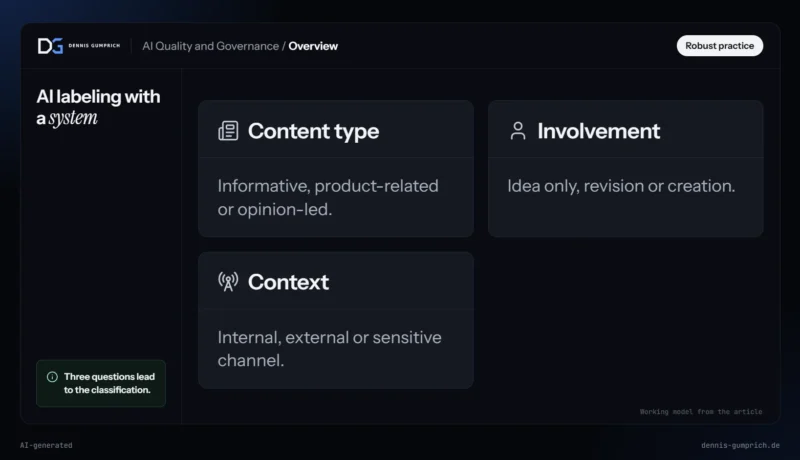
This is not decided by the question AI yes or no, but by three classifications: which content type is involved, that is, text, image, audio or video, how strongly a person was involved, and in what context it is published. The requirements are strictest for photorealistic depictions of people.
Before you discuss wording, you need clarity on three points. This order matters, because the later questions cannot be answered without the earlier ones.
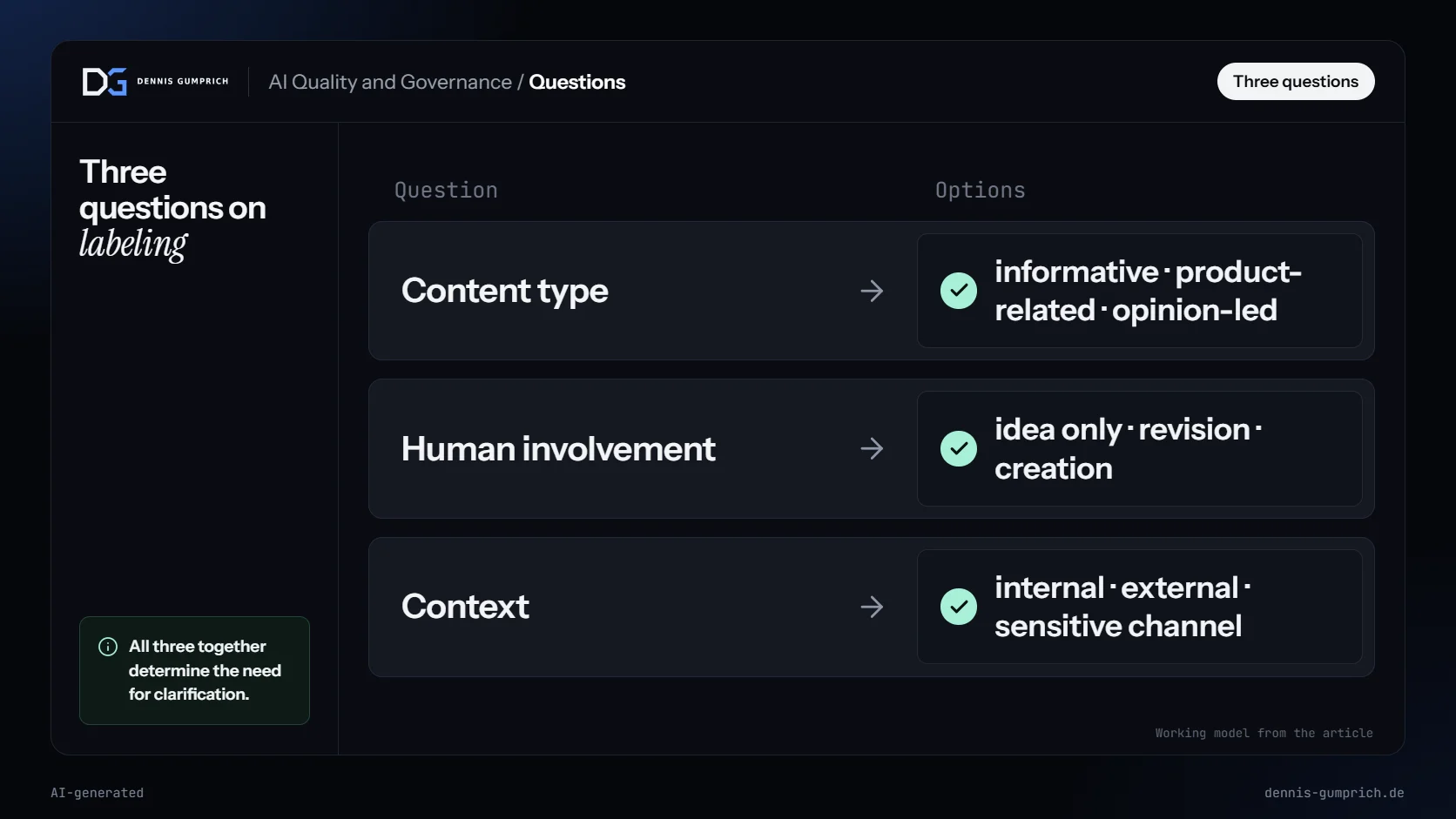
In practice, the second question is the hardest, because it requires a line that can rarely be drawn cleanly. When is a text considered human-authored? A robust answer is based not on the share of changed words but on the assumption of responsibility: has a person checked and corrected the statements and does that person stand behind them? If so, the text is editorially owned, regardless of how the rough draft was created.
A classification grid for the internal discussion
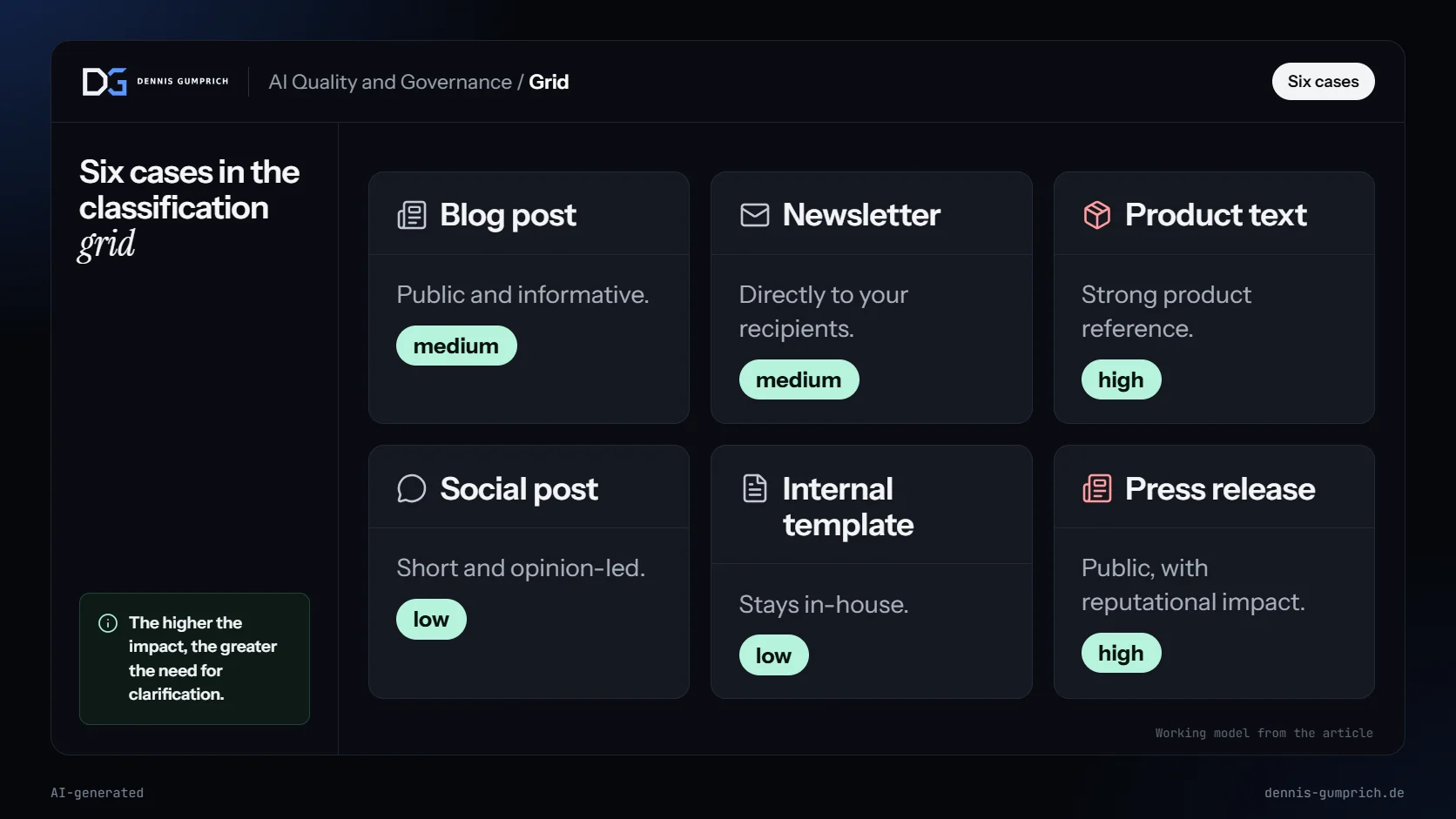
The following grid is not legal advice but a discussion tool. It helps move the discussion from the general to the concrete and separate the cases that actually need to be treated differently. Present it to your legal department instead of asking in general whether you need to label.
| Case | Example | Typical classification in the discussion |
|---|---|---|
| Editorially owned text | Blog post, AI-assisted draft, reviewed and revised | Usually transparency by your own choice, rarely mandatory |
| Text adopted unchanged | Automatically generated product description without review | Greater need for clarification, also because of liability for incorrect statements |
| Illustration without reference to people | Abstract featured image | Little need for clarification |
| Photorealistic depiction of people | Generated portrait that looks real | High need for clarification, separate review required |
| Voice or moving image of real people | Synthetic voice recording | Very high need for clarification, usually regulated separately |
| Automated dialog systems | Chatbot on your website | Disclosing the machine nature is common practice |
The last row is the only one where most companies act without lengthy discussion. A chatbot that does not identify itself as such is already widely considered problematic. For the other rows, opinions differ, and that is exactly why you need your own policy.
How such a weighing can be structured is also described in the Generative AI Profile (NIST AI 600-1) of the US National Institute of Standards and Technology. It recommends considering disclosure of AI use to end users in relevant contexts, weighing purpose, context, risk, audience and frequency (action MP-5.1-003). This adds risk, audience and frequency to the three classification questions above. Include these points as a justification column in your written policy. One caveat: it is a voluntary framework from the US that does not replace the requirements of the AI Act.
How much transparency do readers actually expect?
Less than many fear, but more precise than usual. A blanket "This text was created with AI" sounds defensive. What sounds confident is naming which part was created with AI support and where professional responsibility lies.
Regardless of legal obligations, there is a second motive for labeling that is often underestimated in marketing: credibility. Anyone who openly states how a piece was created takes the heat out of the topic. Anyone who conceals it and is later asked about it loses much more than a label would ever have cost.
This text was created with AI.
This article was created with the help of AI. Structure and draft wording were developed with AI support. Professional assessment, review of the statements and the final version are the responsibility of a named person.
The difference lies in the statement of responsibility. The first version sounds like an admission and raises the question of whether the content can be trusted. The second describes a process and names who stands behind it. It thus answers exactly the question that a label raises among readers.
Google argues similarly in its guidance on using generative AI content: disclosing how content was created helps readers put it into context. In one place, Google makes this an obligation. In Merchant Center, AI-generated images must be labeled via the IPTC value TrainedAlgorithmicMedia, as must AI-generated product titles and product descriptions. If you create product data with AI, add this case to your inventory straight away. One caveat: these are Google platform rules, not legal requirements.
A practical side effect: if you standardize such wording, you do not have to decide anew for every piece. The statement becomes part of the article template, just as the legal notice is part of the website. This removes the recurring discussion from daily work.
Five mistakes in dealing with the topic
- Waiting for final clarityAs long as nothing has been decided, each person effectively decides for themselves. The result is an inconsistent practice that, in case of doubt, looks worse than a deliberately chosen one.
- Treating everything the sameAn abstract featured image and a synthetic voice recording of a real person are different cases. A blanket rule is either excessive or insufficient.
- Making the decision in marketingThe professional preparation belongs with you; the decision belongs with whoever also bears the consequences.
- Hiding the labelA note in light gray at the bottom of the page does not serve the purpose and looks like an attempt at concealment when discovered.
- Not documenting the policyWithout a written justification, you cannot prove later that you made a deliberate decision. This very traceability is decisive in case of doubt.
How do you arrive at a robust labeling practice in five steps?
In four weeks: take stock of which content types you create with AI support and in which publication context, transfer your real cases into a classification grid, request a case-specific legal clarification with this completed grid and record the policy in writing, including who decides cases of doubt.
- Week 1Take stockWhich content types you create with AI support, to what extent and in which publication context. Without this list, every discussion stays abstract.
- Week 2Fill in the gridPlace your actual cases in the rows. It usually turns out that only two or three cases occur at all.
- Week 3Request legal clarificationPresent the completed grid and ask case by case. A general request produces a general answer nobody can work with.
- Week 4Record the policy in writingWhich cases are labeled how, who decides cases of doubt, when the policy will be reviewed.
- From week 5Build it into the templateThe standard wording belongs in the article template, not in an info sheet. Anything people have to remember will be forgotten at some point.
The third step determines the quality of the answer. A legal department asked whether AI content must be labeled will answer cautiously and generally. The same department, given a list of six concrete cases, can classify them case by case and set priorities. The difference lies entirely in your preparation.
Self-check: how robust is your practice?
Tick everything that applies to you.
We would like to define our practice for labeling content created with AI support and ask for a case-specific assessment.
So that you do not have to answer in general terms, we have listed our actual cases, each with content type, degree of human review and publication context. These are a few recurring constellations, not individual cases.
Our proposal would be to add a standardized note on how editorially reviewed text pieces were created, which also names the responsible person. For photorealistic depictions of people and for synthetic voice or video content, we would provide a separate rule.
Please let us know which cases you consider mandatory to label, where we can decide freely for reasons of transparency, and who decides cases of doubt.
Conclusion: your own policy beats waiting
The interpretation will continue to develop, and no policy made today will remain unchanged forever. That is not an argument against a decision but one for a review date. Anyone with a documented, justified and consistently applied practice is in a better position in any discussion than a team in which each person acts at their own discretion. How labeling is embedded in the review before approval is shown in the review criteria for AI texts.
Frequently asked questions
Do we have to label every text in which AI was involved?
Legally, as a rule, no. The labeling obligation for texts targets content on matters of public interest, and even there it does not apply if a person reviews the text in substance and takes responsibility. A product text or how-to article with editorial review therefore usually does not fall under it. It is different for chatbots, synthetic images, voices and videos. Regardless of this, the editorial question of whether you want to label remains. The specific assessment for your case belongs with your legal department.
Doesn't labeling harm the impact of our content?
In our observation, that depends entirely on the wording. A note that only states the use raises questions. A note that describes the process and names a responsible person answers them. We have no robust measurements on this; it is an assessment.
How do we deal with agency work?
Regulate it in the contract. You should know whether and how AI is used, because you publish the content and are responsible for it. An obligation for the agency to provide information belongs in the agreement, not in a later conversation.
Does this also apply to internal documents?
The legal dimension targets publication. For internal documents, labeling is still sensible, because later readers can judge how reliable the information is. That is a question of work quality, not obligation.
When should we review our policy?
Set a fixed date, at least once a year, and additionally when your practice changes significantly, for example when you start using synthetic images or voices. A date in the calendar works more reliably than the intention to keep an eye on the topic.
Where does your content process lose time today?
In 30 minutes, we look together at where unnecessary coordination, manual tasks, tool switching or repetitive content work cost you time today.
You get a concrete assessment of which tasks you can simplify, automate or organize better, and where AI and tools actually help instead of adding complexity.
Analyze your content process in 30 minutes Free of charge. You take away concrete starting points you can use internally right away.
Dennis Gumprich
Dennis helps marketing and communication teams fit generative AI into existing content processes without undermining quality, brand voice and approvals. Focus areas: content operations, AI governance and tool selection in mid-sized companies and corporations.
Transparency note: Dennis works for contentbird, a provider of AI-powered content software. Product mentions are marked in the article. More about Dennis (in German) · LinkedIn
Read more
Sources
- European Parliament and Council: Regulation (EU) 2024/1689 laying down harmonised rules on artificial intelligence (AI Act), June 13, 2024: Article 50 on transparency obligations for providers and deployers, applicable since August 2, 2026, and Article 99(4) and (6) on fines of up to 15 million euros or 3 percent of worldwide annual turnover. Accessed October 31, 2026.
- European Parliament and Council: Directive (EU) 2024/825 on empowering consumers for the green transition (EmpCo), February 28, 2024, applicable from September 27, 2026, with its own evidence requirements for environmental claims. Accessed October 31, 2026.
- European Commission: Commission publishes guidelines on transparency obligations for providers and deployers of certain AI systems, announcement of July 20, 2026, with reference to the voluntary code of practice on transparency of AI-generated content; disclosure of texts on matters of public interest only without human review or editorial control. Accessed October 31, 2026.
- European Parliament and Council: Regulation (EU) 2026/1744 (Digital Omnibus Regulation on AI), July 8, 2026, Official Journal of July 24, 2026, in force since July 27, 2026: high-risk obligations postponed to December 2, 2027 and August 2, 2028; four-month transition period for machine-readable marking under Article 50(2) for systems placed on the market before August 2, 2026. Summary by the Lüneburg-Wolfsburg Chamber of Industry and Commerce (in German) of August 3, 2026 with the deadline of December 2, 2026. Accessed October 31, 2026.
- National Institute of Standards and Technology (NIST): Artificial Intelligence Risk Management Framework: Generative Artificial Intelligence Profile (NIST AI 600-1), July 26, 2024, Chloe Autio, Reva Schwartz, Jesse Dunietz et al., companion profile to the voluntary AI RMF 1.0 of January 2023: action MP-5.1-003, considering disclosure of AI use to end users in relevant contexts, weighing purpose, context, risk, audience and frequency. Voluntary framework from the US. Accessed October 31, 2026.
- Google Search Central: Guidance on using generative AI content, documentation, as of October 7, 2026: disclosure of how content was created as an aid to readers; mandatory labeling in Merchant Center for AI-generated images (IPTC TrainedAlgorithmicMedia) and for AI-generated product titles and product descriptions. Platform policy, not a legal requirement. Accessed October 31, 2026.
How this article was created
This article was created with the help of AI. Structure, research and draft wording were developed with AI support. Professional assessment, selection of sources, review of the statements and the final version are the responsibility of Dennis Gumprich. The English version was translated with AI and reviewed. Read the original German version.
How reliable are the statements?
Evidence exists for the start of application, addressees and exceptions of the transparency obligations under Article 50 and the fine framework under Article 99 of the AI Act, the Commission guidelines of July 20, 2026, the deadlines of the Digital Omnibus Regulation and the EmpCo requirements, as well as the recommendation to weigh disclosure by purpose, context, risk, audience and frequency (NIST AI 600-1, voluntary framework from the US) and Google's labeling rules for Merchant Center (platform policy, not a legal requirement). That competitors can challenge a lack of transparency is an assessment that this article does not back up with court rulings; the rules on this vary by EU member state. The classification grid is explicitly a discussion tool for internal clarification and not a legal assessment. The column on typical classification reflects observations from conversations and not a settled legal opinion. As of October 31, 2026. Legal note: this article does not replace legal advice. The summary of the applicable framework is simplified. Whether and in what form labeling obligations apply to your content depends on the individual case and some aspects of interpretation are not yet fully settled. Your legal department is responsible for assessing your case.


