

You are sitting in the meeting that has been called the newsroom for four months. One by one, each person reports what they are working on. After 45 minutes, everyone knows more than before. Nothing has been decided.
The article you already discussed last week is still with the specialist department. The topic that product communications submitted goes out because product communications submitted it, not because it was weighed against other topics. After the meeting, someone in the hallway says what you are all thinking: this is really still our old weekly status meeting.
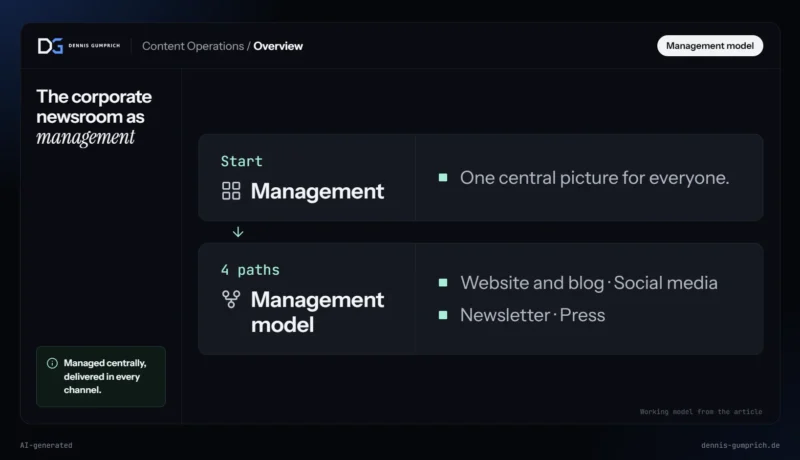
A corporate newsroom is a management model for communications and marketing in which topic responsibility and channel responsibility are separated and brought back together through a coordinating role. What matters is not the seating plan, but whether three things actually exist: a binding shared topic list, an authority with real decision rights and a feedback loop from data into the next planning decision. If one of them is missing, you do not get a newsroom, but a renamed meeting.
What is a corporate newsroom?
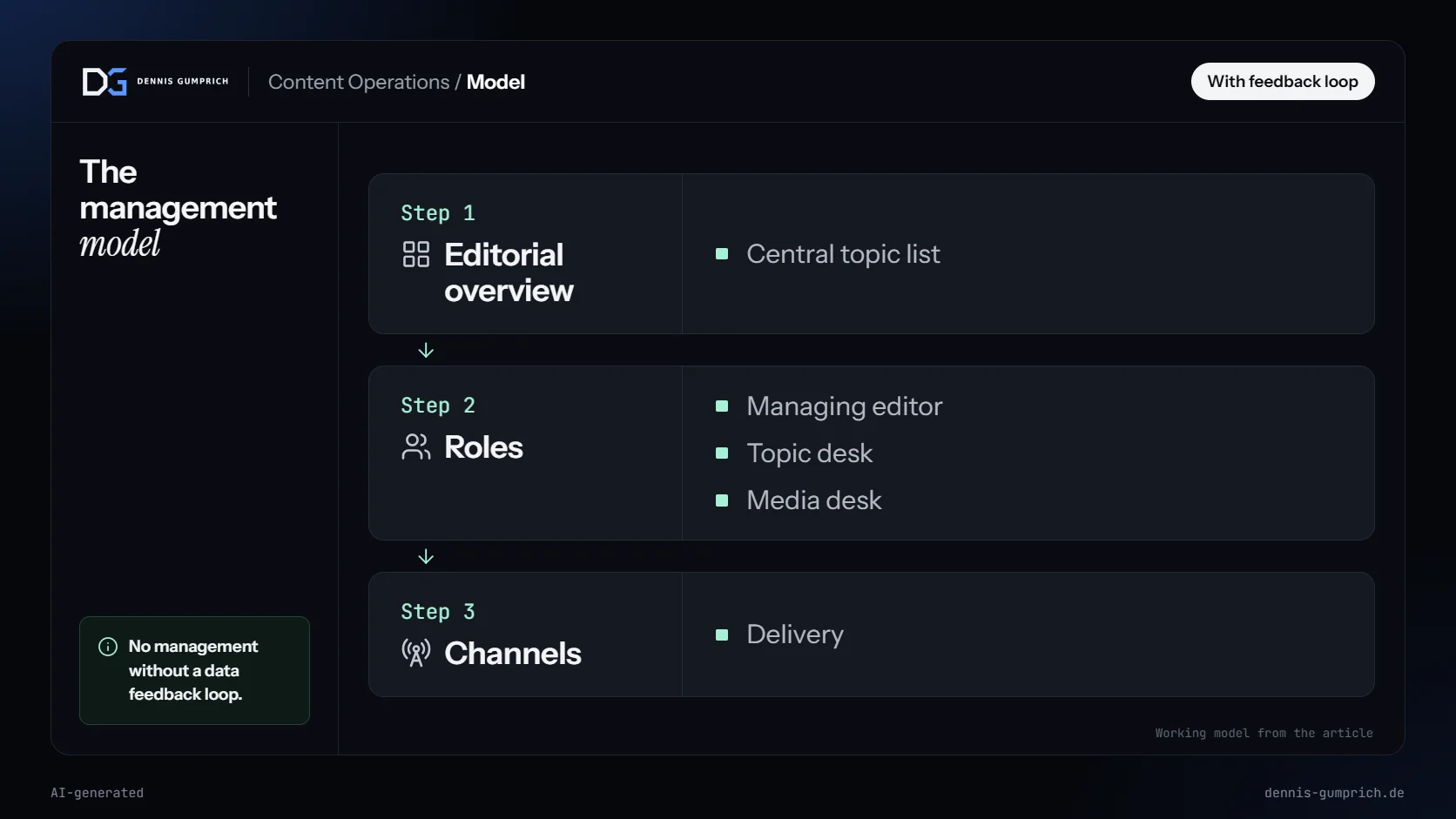
A corporate newsroom is an organizational form for corporate communications and marketing that is structured by topics rather than channels. Topic owners bring in content from the departments, channel owners decide whether it suits their platform, and a coordinating role, usually called the managing editor, balances the two and prioritizes. The purpose is integrated communication based on a coordinated set of topics.
That is the definition the market has essentially agreed on. However, it only describes the organizational structure. The actual model lies in the question of what this structure does to decisions.
Because the separation of topic and channel is not an end in itself. It solves a concrete problem: in channel-oriented organizations, each channel decides for itself what it publishes. This leads to three predictable effects. Topics are prepared several times in parallel because nobody sees that another unit is already working on them. Important topics get too little reach because they only run in their sender's channel. And communications leadership cannot steer because it has no shared list on which topics are weighed against each other.
A newsroom is the attempt to eliminate these three effects. Everything else, the role names, the meeting formats, the shared room, are means. Whether they work depends on whether the decision logic changes.
Corporate newsroom or online newsroom: two meanings of one term
In corporate communications, the term newsroom stands for two different things. It means either the organizational form this article is about, or the area on the company website where press releases, images and contacts are bundled. The two are related, but not the same.
| Feature | Corporate newsroom | Online newsroom |
|---|---|---|
| What it is | Management model for topics, roles and channels | Press area or magazine on the website |
| Who is involved | Communications, marketing, departments | Press office, web editorial team |
| What it solves | Duplicate work, missing prioritization, channel silos | Findability of news for media and the public |
| Typical tools | Shared topic planning, editorial system, meetings | CMS, press distribution list, media database |
An online newsroom can be a delivery channel of a corporate newsroom. But it does not replace it: a well-maintained press page says nothing about whether topics are prioritized together internally.
Why the definitions diverge, and why that affects you
If you read through the available sources, you will find the corporate newsroom described in turn as a room, an organizational unit, an organizational model, an operating form, a concept of collaboration and a mindset. This is not academic hair-splitting. It is the reason why the label can be attached to almost anything.
If you define the newsroom as a room, you have introduced it as soon as the desks are pushed together. If you define it as a mindset, you have introduced it as soon as everyone agrees. Both definitions are irrefutable and therefore worthless for a decision.
It is remarkable which question almost all available definitions avoid: the question of power. Only a few sources assign any role a right to issue instructions. Most stick to phrases like "the managing editor coordinates". But coordination is not a decision right. Someone who only coordinates cannot reject a topic.
For you, this means: before you talk about role names, you need a definition that can be refuted. That is, one where you can check in six months whether it applies. The definition earlier in this article is deliberately built that way.
Where the model comes from, and why that is relevant
In German-speaking countries, the corporate newsroom is often associated with Siemens and the year 2011. This claim should be treated with caution. It goes back to the company's own statement. The specialist literature reports it correctly as such: Siemens was, "according to its own information", the first German company with a newsroom modeled on journalism in 2011. An independent, contemporaneous dating could not be found for this article.
So the only robust statement is: Siemens is considered a pioneer, and the year 2011 is the company's own claim.
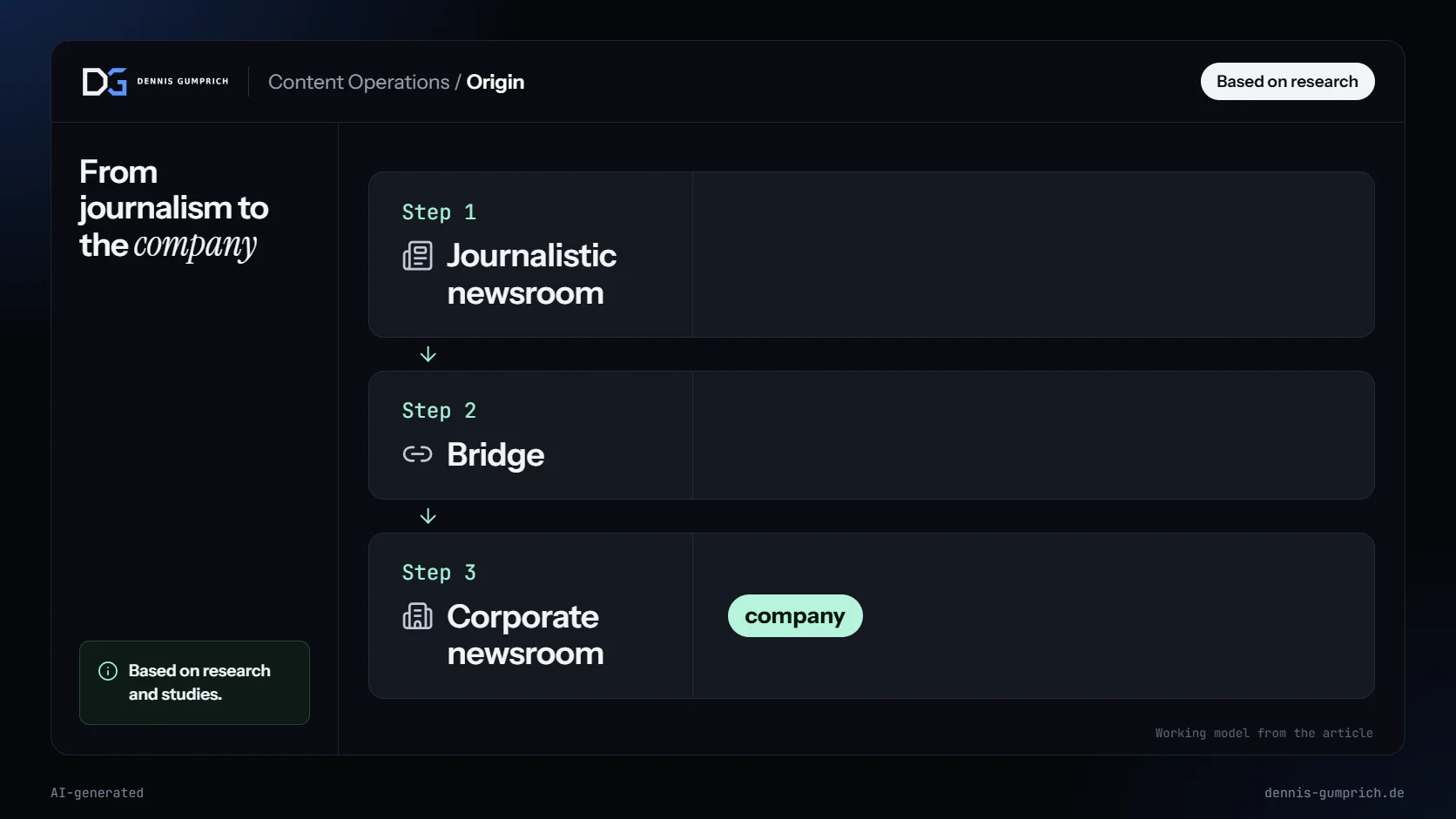
More important than the year is the origin of the principle. The newsroom is not an invention of corporate communications, but an adoption from journalism. The newsroom principle, in which formerly separate desks work together and publish content across several channels, comes from journalism in the 1990s and is standard at German media houses today.
This is practically relevant for one reason: journalism research has accompanied and evaluated these restructurings for years. Its findings anticipate almost everything corporate newsrooms experience today. In a comparative study of newsroom integration in Austria, Germany and Spain, José Alberto García Avilés, Andy Kaltenbrunner and Klaus Meier came to the following conclusions, among others, in 2014:
- There were three integration models (full integration, cross-media collaboration, coordination of separate platforms), and none of them existed in pure form.
- Physically moving teams together did not dissolve the separation between print and online editorial teams in one of the houses studied.
- Multi-skilling, that is, the expectation that everyone can do everything, overloaded roles with technical processes and increased time pressure instead of creating efficiency.
- Initial resistance dissolved where those affected saw a recognizable benefit. In one of the houses, experienced journalists and correspondents were among the best adopters, not the worst.
This leads to the decisive point: the benefit only arises if employees see the point. The central success factor is change management and training, not architecture.
So if you are currently thinking about pushing desks together: this question has been answered for over ten years, just in a body of literature that is hardly cited in the corporate newsroom discourse.
How many companies actually run a newsroom?
Far fewer than the term suggests. In the CommTech Index Report 2024 (n=352), half of the respondents do not want a newsroom or have abandoned its introduction. In the ZHAW survey, ten of twenty self-declared newsrooms met only one or two of five structural criteria. In the German-speaking region, the newsroom is not a standard, but a minority form of organization.
If you only read vendor texts, you get the impression that the newsroom is on its way to becoming standard. The available surveys paint a different picture. Three of them are methodologically independent of each other and come to remarkably consistent results.
ZHAW, Switzerland, 2016
The Institute of Applied Media Studies at ZHAW, a Swiss university of applied sciences, surveyed Swiss companies and public administrations. 77 organizations answered the core question. 20 said they had introduced a corporate newsroom, a further 15 were planning to. The study examined five features: structuring by topics, open-plan office, topic-based responsibilities, at least daily discussion of the news situation and a topic overview for the whole team. The decisive result: ten organizations called themselves a newsroom but showed only one or two of these features. Conversely, six organizations without the newsroom label met four or all five criteria.
Mediamoss and ISM, DACH, 2025
A long-term study led by Prof. Dr. Christoph Moss evaluated the working methods of 209 communications departments between January 2018 and June 2025, based on 743 interviews. Result: only around a third of the departments studied met all criteria of the assessment grid used. 51.5 percent of respondents said the process in their department was not right. No statistical relationship between newsroom quality and department size could be found. Context: this study is a publication of a consultancy that sells newsroom introductions and is not peer-reviewed. The methodological effort is considerable, but the conflict of interest still needs to be stated.
CommTech Index Report 2024/25, DACH
AG CommTech, the German and Austrian PR associations DPRG and PRVA, and ComImpact surveyed a total of 352 communications managers from June to August 2024. The result clearly contradicts the growth narrative: 50 percent of the communications departments surveyed do not want to set up a newsroom or have abandoned the attempt. Compared to 2023, this share has risen by 12 percent according to the report. In departments with more than 20 employees, 36 percent reject a newsroom, compared to 21 percent the previous year. At the same time, the newsroom is established in larger organizations at 56 percent. The editors' conclusion: the newsroom is increasingly polarizing.
Rejection rate in departments with more than 20 employees
Share that does not want a newsroom or has abandoned its introduction
Two statements can be derived from these three surveys that appear in practically no guide.
First: there are far more newsroom signs than newsroom organizations. Two methodologically independent surveys nine years apart come to the same finding.
Second: the rate of abandonment and rejection is rising, and most strongly where the model should actually fit best, namely in larger departments. This speaks against explaining abandonment by a lack of size or resources. It suggests that something about the implementation is systematically difficult.
Current figures come from the Corporate Newsroom Study 2026 (in German) by the universities of Fribourg and Bern and the Lucerne University of Applied Sciences. Of 216 communications managers surveyed in Switzerland, around 70 percent work in organizations with a newsroom or a comparable structure: 46.1 percent report a clearly established newsroom structure, 23.6 percent a partial implementation. The newsrooms are on average only 4.4 years old and comprise an estimated eleven full-time positions. A physical room hardly matters: only 13.2 percent name it as part of the implementation.
What newsroom models are there?
Three basic forms help with classification. They differ in where management sits, not in how modern they look. Which model fits depends mainly on how distributed your communications already are today.
| Model | How it works | Fits | Typical risk |
|---|---|---|---|
| Central | One team with shared topic planning, often in one place | A communications department with a manageable number of channels | Departments feel left behind and stop supplying topics |
| Virtual | Roles stay in their departments, management via a shared topic list and fixed meetings | Distributed or hybrid teams without a shared location | The meeting becomes an exchange without decisions |
| Hub and spoke | Headquarters sets topics and guardrails, countries, brands or locations deliver independently | Corporate groups, associations and companies with several brands or countries | Headquarters plans, the units keep producing in parallel |
The same test applies to all three models, as the next section shows. A virtual newsroom with real decision rights manages better than a central room without them. How central planning and local delivery work together is shown in the article Create content centrally, deliver it locally. Which requirements newsroom software must meet for this is in the requirements catalog for newsroom software.
The management core: three conditions without which a newsroom does not manage
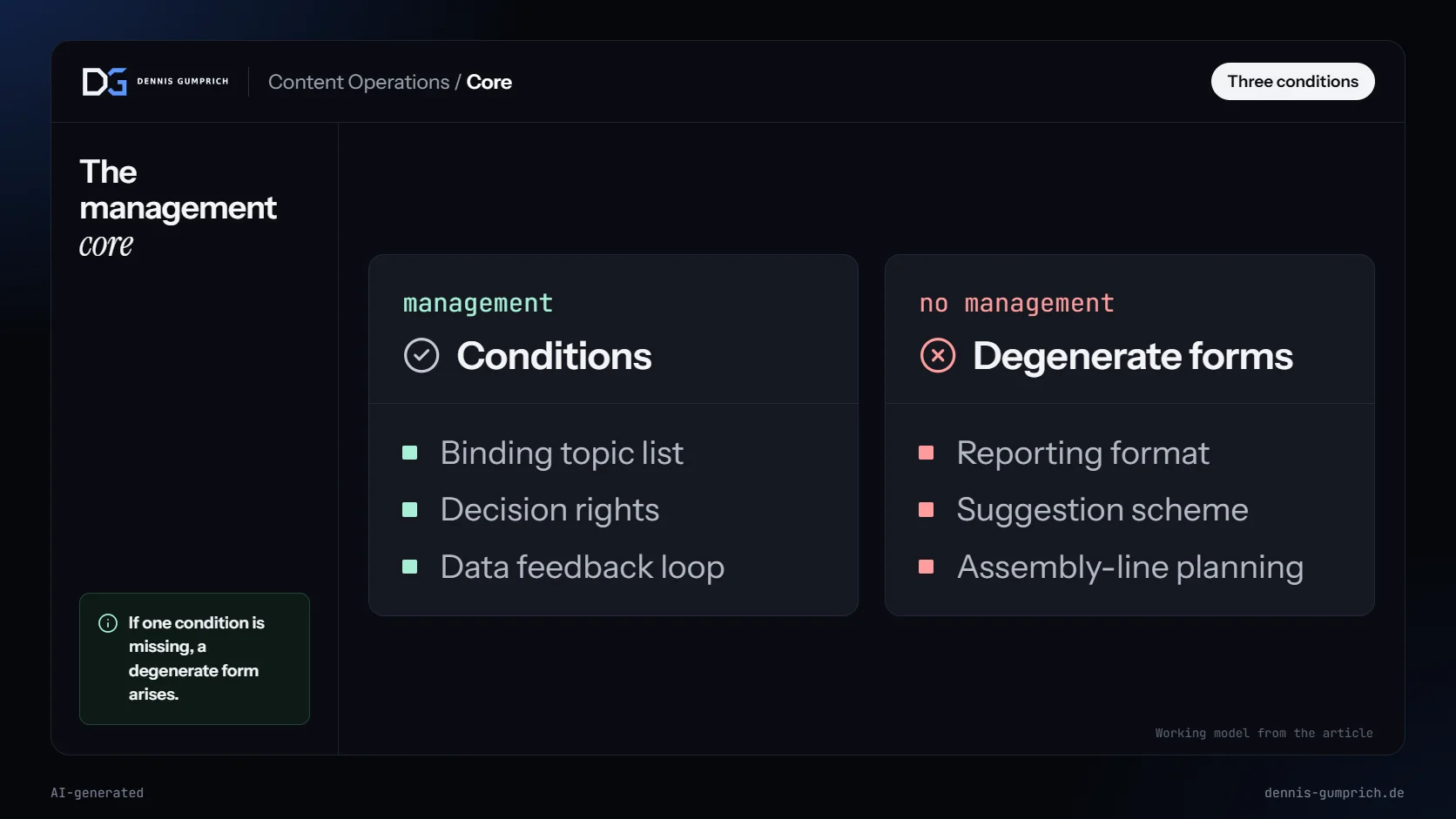
A simple core can be derived from the research and the reports of failure. A newsroom manages if and only if three conditions are met at the same time. They are not additive but multiplicative: if one is missing, the management effect is lost altogether.
1. A binding shared topic list
There is exactly one place where all planned and ongoing topics are listed, regardless of which unit brought them in. Binding means: what is not on it is not produced. A list kept in parallel to the departments' real plans does not meet this condition.
2. An authority with real decision rights
There is a named role that can reject, postpone or downgrade a topic without needing the consent of the department that brought it in. Without this right, the topic meeting is a registration procedure. Which criteria make rejection and prioritization traceable, instead of depending on who is loudest, is described in Topic scoring: the criteria that make topics comparable.
3. A feedback loop from data into the next decision
Results from the evaluation demonstrably change the next planning round. Not in the form of a quarterly report that everyone takes note of, but in the form of concrete decisions: this topic area gets less, that one more.
The value of this breakdown is that each missing condition produces a typical, recognizable degenerate form.
| Missing condition | What it turns into | How you recognize it |
|---|---|---|
| No binding topic list | Reporting format. The newsroom becomes a status meeting. | The meeting reports what is running anyway. Topics appear at short notice without having been on the list before. |
| No decision rights | Suggestion scheme. Topics are discussed, but departments continue to decide for themselves. | No topic is ever rejected. Prioritization takes place but has no consequence for the order of production. |
| No data feedback loop | Assembly-line planning. The newsroom produces reliably but does not learn. | Reporting runs, but nobody can name an example of an evaluation that changed the planning. |
This breakdown is also the reason why the question of space yields little in the end. A shared room makes all three conditions easier but does not fulfill any of them. An exploratory study by the University of Bern with 13 interviews, ten of them with people responsible for corporate newsrooms at large Swiss companies, accordingly found that physical location is not a mandatory criterion and that hybrid or virtual models work. Respondents understood the newsroom mainly as an attitude and organizational model, less as a room.
What changes compared to a traditional communications department?
The starting point of planning switches from channel to topic. This shifts decision-making authority: it is no longer the channel owner alone who decides on publication, but the managing editor on priority and the media desk on channel fit. Many bilateral agreements turn into a fixed meeting effort with documented decisions.
The benefit of the model is easiest to understand when you compare it point by point with the starting situation. The left column describes the channel-oriented organization as it has grown historically in most communications departments.
| Channel-oriented organization | Corporate newsroom | |
|---|---|---|
| Starting point of planning | Channel and its editorial plan | Topic, regardless of channel |
| Who decides on publication | The respective channel owner, usually in agreement with the department bringing in the topic | Managing editor decides on priority, media desk on channel fit |
| Topic overview | Complete per channel, not available organization-wide | One shared list across all channels |
| Handling duplicate work | Often only noticed at publication | Becomes visible when the topic is added |
| Reaction to unplanned topics | Each channel reacts independently | One assessment, then coordinated delivery |
| Alignment | Bilateral between department and channel | Via the meeting, documented |
| Consistency of messages | Result of agreements | Result of the shared topic situation |
| Additional effort | Low in individual cases, high overall due to repeated alignment | Fixed meeting effort, but less bilateral alignment |
This results in the four effects that have to justify the effort: less parallel preparation of the same subject, planned rather than accidental reuse of content, consistent messages without constant individual agreements and prioritization that communications leadership can actually influence.
However, the right-hand column is only reality if the three conditions of the management core are met. Otherwise, the meeting comes on top of bilateral alignment, not instead of it. That is the most common reason why a newsroom feels like more work rather than less.
Separating topic management and channel management cleanly
The separation of topic and channel is the heart of the model and at the same time the point where most things go wrong in practice. The reason: both sides have different logics of success, and these logics must remain different.
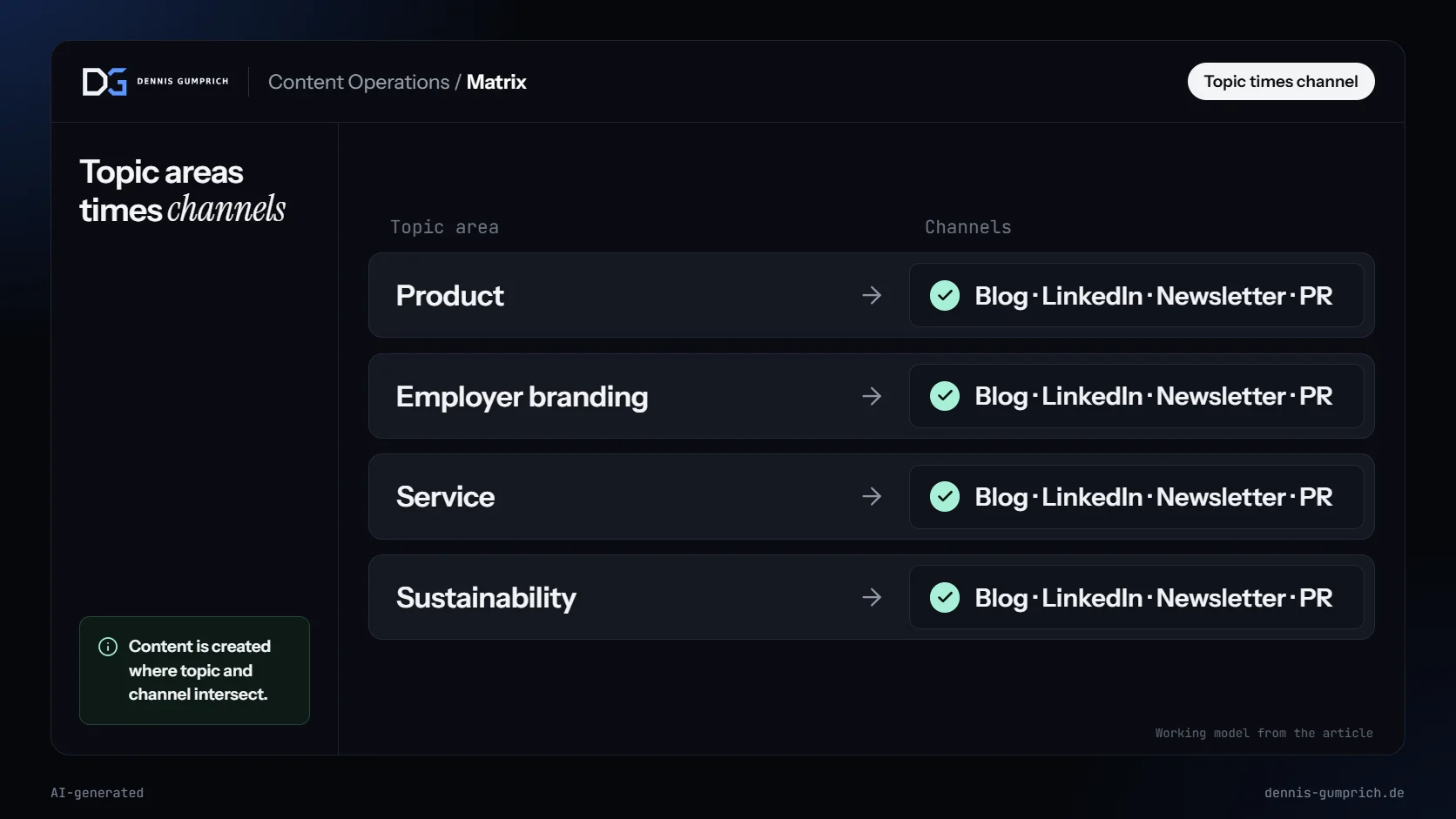
The topic side is responsible for ensuring that a subject is prepared correctly, up to date and completely. It is the link to the departments. Its measure of success is content quality and relevance, not the reach of a single channel.
The channel side is responsible for ensuring that content works for its platform: format, length, tone, timing, target group. Its measure of success is impact in the channel. It knows the community, the format and the mechanics. This also includes reliably answering comments and messages, for example via a social inbox.
The classic mistake is to implement this separation on paper and undo it in practice by staffing both roles with the same people. Then the same person sits in the meeting as topic owner in the morning and as channel owner in the afternoon, negotiating with themselves.
A second, subtler mistake is the all-rounder principle: the assumption that in a newsroom every person must be able to serve every channel. Swiss Federal Railways (SBB) found that exactly this did not work because not everyone had the necessary know-how for every channel, and after a process review in autumn 2023 defined clearer role profiles. The Bern study points in the same direction: decision-making power is tied to the expertise of certain roles. This matches the multi-skilling findings from journalism research.
In practice, this means: the separation needs at least two different people per axis, otherwise it does not exist. That is the first hard size filter for the question of whether a newsroom fits you.
What this role separation looks like on a smaller scale is described in Who does what in the content team. The roles named there are the minimal version of what a newsroom differentiates on a larger scale.
The Corporate Newsroom Study 2026 shows where the biggest gap lies: topics are usually planned according to priorities, but even newsrooms rarely use an elaborated management instrument such as a topic house. The researchers see this as a central potential for professionalization. They locate the strongest lever for impact in agile role models, not in formal structural changes.
The four roles, and the question that usually remains open
The role model most widespread in German-speaking countries goes back to Christoph Moss and can be found in almost identical form in nearly all available texts. It comprises four levels.
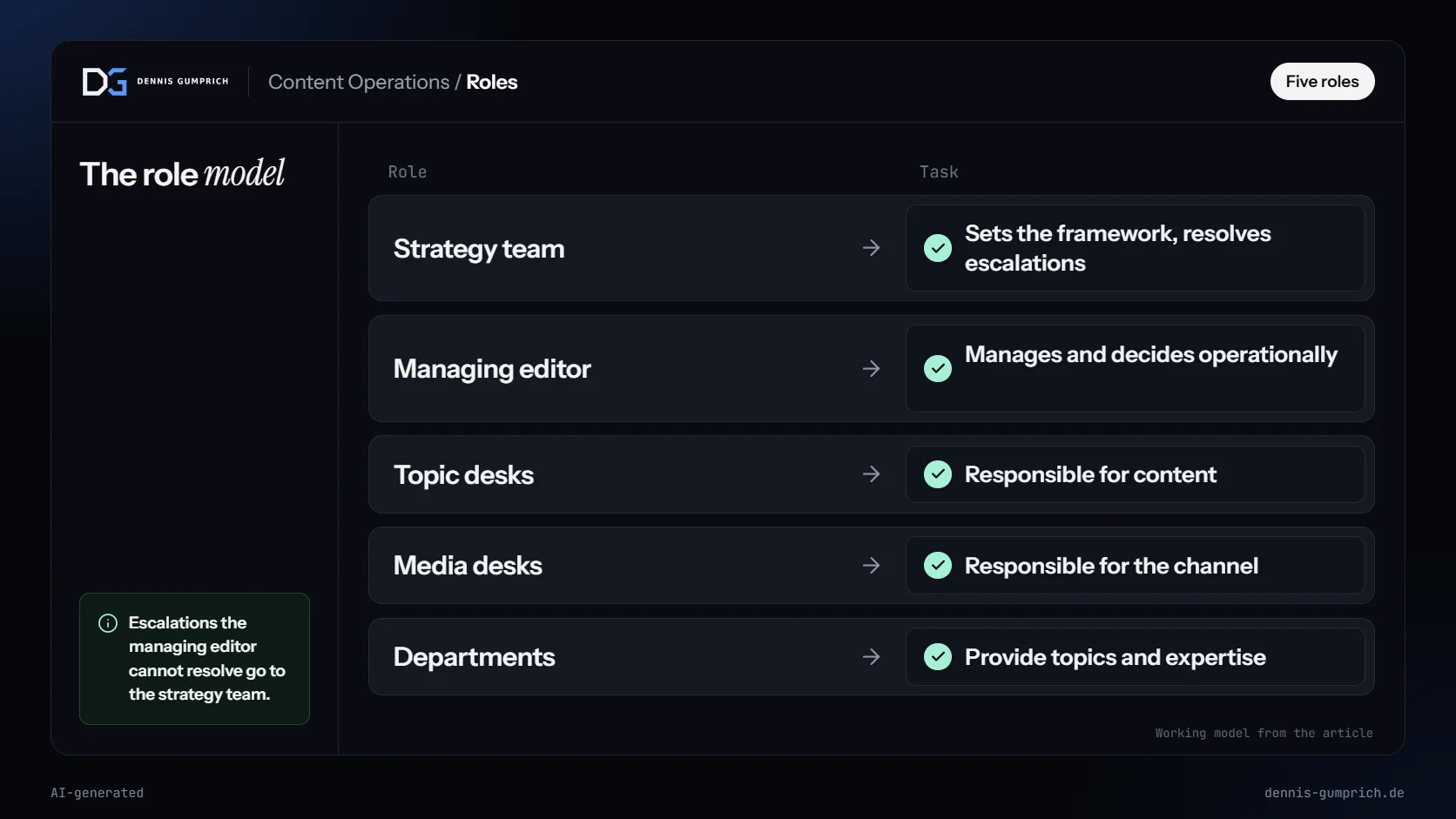
Strategy team. Works like an editor-in-chief's office, is responsible for planning, managing and controlling topics, has personnel and budget responsibility and has the final say on content in case of conflict.
Managing editor. The operational hub between topic and media desks. Assigns work, leads the editorial meetings, decides on order and assignment in day-to-day business.
Topic management (topic desks). The link to the specialist departments. Finds, researches and prepares topics and ensures expert alignment.
Media management (media desks). Represents the channels and platforms. Has a right to propose on the question of whether a topic is suitable for a channel.
Depending on the organization, additional roles are created for monitoring and data analysis, for creative production (video, photo, audio) and for stakeholder management.
What these four roles do concretely over the course of a week, what each of them decides alone, how much time they take up and which two role combinations undermine the model is described in detail in Newsroom roles: what managing editor, topic desk and media desk actually do.
The model is sensible and well tested. However, it does not answer one question, and newsroom projects fail on exactly this question in practice: what happens if the managing editor rejects a topic that comes from the HR board division and the head of HR does not agree?
This is not a theoretical construct. It is the normal case. And the answer is not found in any organizational chart, but in the governance.
Who decides what in the newsroom?
In short: the topic desk decides on the relevance and preparation of a topic, the media desk on channel fit, the managing editor on priority and order in day-to-day business, and the strategy team on the framework.
A newsroom does not change who does the work. It changes who decides about the work. This is rarely made explicit in introduction projects because it is the uncomfortable part. The following matrix is a proposal for a written-out version. It is intended as a basis for discussion, not as a norm: every organization has to adapt it to its reporting lines.
| Decision | Decides | Consulted | Escalates to |
|---|---|---|---|
| Adding a topic to the topic list | Managing editor | Topic desk, department bringing in the topic | Strategy team |
| Priority of a topic in the current week | Managing editor | Media desks | Strategy team |
| Rejecting or postponing a topic | Managing editor | Department bringing in the topic | Strategy team, for board topics a documented proposal |
| Suitability of a topic for a specific channel | Media desk | Managing editor | Managing editor decides in case of disagreement |
| Factual accuracy of content | Department | Topic desk | No escalation path, the department has a veto |
| Legal and regulatory approval | Legal, compliance | Topic desk | No escalation path, the veto remains |
| Brand compliance and tone | Strategy team or brand owner | Media desks | Strategy team |
| Topic priorities for the quarter | Strategy team | Managing editor, topic desks, departments | Head of communications |
| Crisis communication | Defined crisis team | Managing editor | Existing crisis process, not the newsroom |
| Shifting resources between topic areas | Strategy team | Managing editor | Head of communications |
Three points about this matrix are more important than its specific design.
Vetoes stay where they belong. Factual accuracy and legal approval are not up for negotiation in the newsroom. Trying to pull these rights into the editorial meeting creates conflicts you cannot win. How to make such approval chains faster without abolishing them is described in Shortening approval processes.
The crisis process does not run through the newsroom. Crises need their own predefined decision path with different participants and different speeds. The newsroom informs and executes, it does not decide.
The escalation path must exist before the first conflict arises. If the first rejection of a board topic is negotiated ad hoc, hierarchy wins, and the managing editor permanently loses authority. After that, nothing is ever rejected again. This is the mechanism by which condition two of the management core typically disappears.
Which meetings does a newsroom need?
Five routines are enough: a 15-minute daily alignment for current matters, a weekly topic meeting for adding and prioritizing, a monthly planning round for lead time, a quarterly strategy round and a retrospective. The daily alignment is only worthwhile if you actually publish daily or have to react to current events.
Newsrooms tend to multiply meetings. That is the point where a management model turns into coordination effort. A helpful rule is that each routine carries exactly one type of decision. Anything that does not fall into one of these categories does not need a recurring meeting.
| Routine | Frequency | Decides on | Duration | Participants |
|---|---|---|---|---|
| Daily alignment | daily, two to three times a week with lower volume | What goes out today and tomorrow, reaction to current events | 15 minutes | Managing editor, media desks, affected topic desks if needed |
| Topic meeting | weekly | Adding new topics, prioritization, rejection | 45 to 60 minutes | Managing editor, all topic desks, all media desks |
| Planning round | monthly | Lead time for the coming four to eight weeks, resource allocation | 60 minutes | Managing editor, topic desks, strategy team |
| Strategy round | quarterly | Topic priorities, shifts between topic areas, evaluation | half a day | Strategy team, managing editor, head of communications |
| Retrospective | quarterly | Adjusting the process and decision matrix | 90 minutes | everyone involved |
The daily alignment only makes sense if you actually publish daily or have to react to current events. With a publishing rhythm of two pieces of content per week, it is pure overhead. The research shows an interesting picture here: in the ZHAW survey, 56 percent of organizations with a newsroom discussed the news situation at least daily, compared to 35 percent without a newsroom. So the daily meeting is a common feature, but not a mandatory one.
The retrospective is missing from almost all model descriptions and is nevertheless the most important routine in the first year. Your decision matrix will not be right in the first draft. Without a fixed date on which it is revised, it stays as it is and is quietly bypassed.
Self-check: newsroom or renamed status meeting?
The diagnosis "we just renamed a meeting" is often made but rarely made verifiable. These six points do not describe intentions, but evidence. Tick everything that applies to you.
Point four deserves special attention. If decisions stall while the key person is on holiday, the role is not institutionalized but tied to a person. Why that is more than a holiday problem is described in Content operations without a key person.
Why do corporate newsrooms fail?
Not because of a lack of acceptance, but because of incentives that have not changed. Anyone who continues to be measured by the visibility of their own channel will not give up topic management. The usual explanations such as missing management support or unclear roles confuse cause and symptom. What switching from channel to topic management means in everyday planning is described in From editorial calendar to topic plan: what concretely changes.
The available literature almost always cites soft factors as reasons for failure: lack of management support, unclear roles, lack of acceptance, too little change communication. That is true and still unsatisfactory, because it confuses the cause with the symptom. "Lack of acceptance" is rarely an attitude. Usually it is a rational reaction to incentives that have not changed.
The following four causes are structural and can be checked before the introduction.
The departments' incentive system remains unchanged
If the head of a department continues to be measured by how visibly their area communicates, they will continue to want to push topics through. In doing so, they act correctly according to their own target agreement. The newsroom cannot resolve this conflict with better meetings. It is resolved by changing the target agreements, or it is not resolved.
Budget authority still lies with the departments
Whoever has the budget for a campaign effectively decides on its implementation, regardless of what the topic meeting prioritized. As long as budgets flow by department, prioritization in the newsroom is a recommendation.
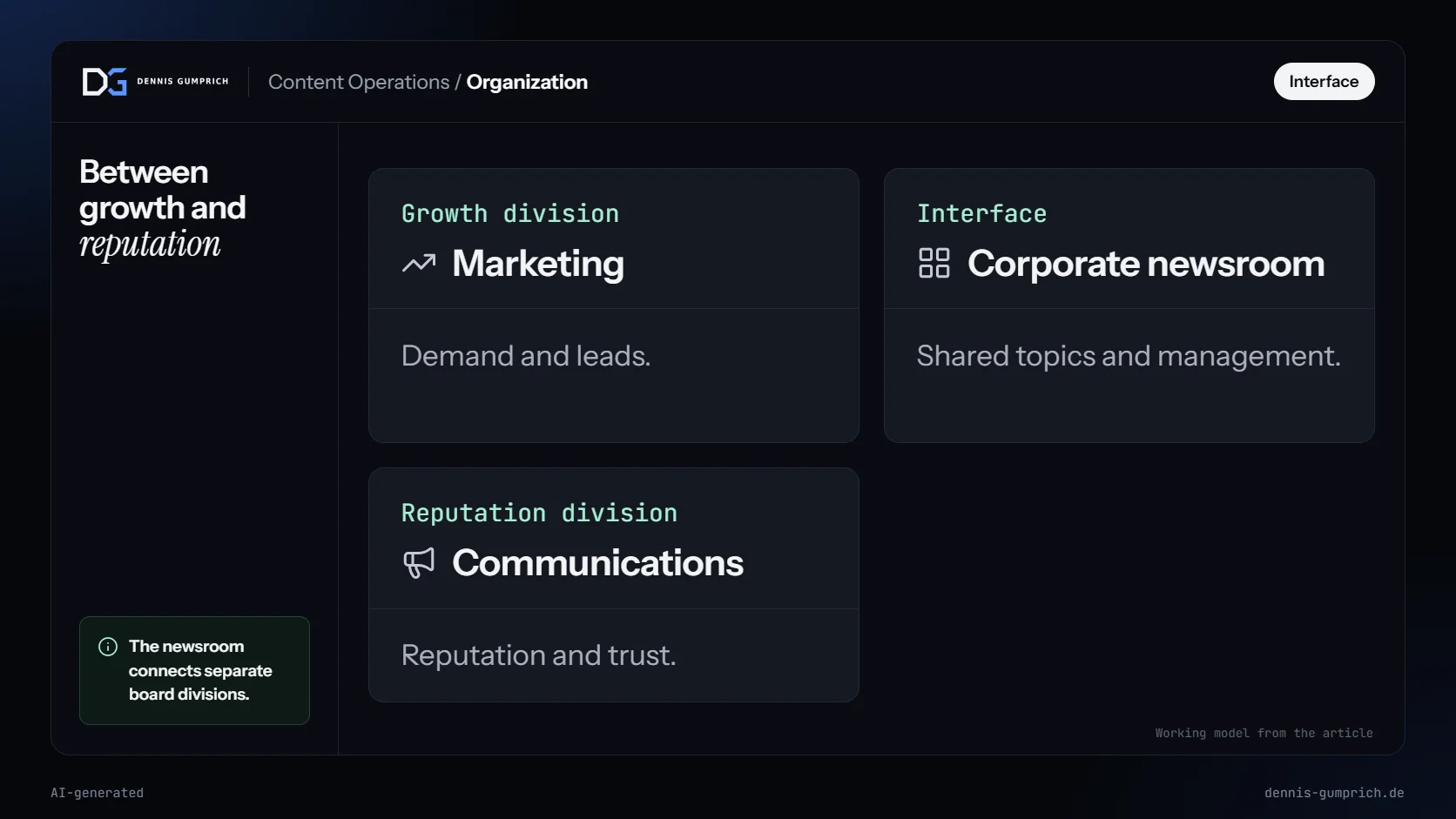
Marketing and communications report to different board divisions
A newsroom that is supposed to integrate both functions but has to bridge two reporting lines has no shared escalation authority below the board. Every conflict therefore lands at a level that cannot resolve it on a weekly basis. This is doable, but it has to be considered in advance and backed up with a clear approach.
The conception phase is planned too short
In "Corporate Newsroom 4.0" (Springer VS, 2025), Seidenglanz and Klockhaus devote a chapter of their own to causes of success and failure. According to a review, the factors named include too little time for the conception phase, rigid rather than iterative project planning and too little involvement of stakeholders outside communications.
Added to this is an observation from the practice of large organizations that is rarely discussed: the newsroom has a structural bias toward the short term. Andreas Bartels, head of corporate communications at the Lufthansa Group, pointed out in 2025 that working amid news tickers and real-time monitoring is not ideal for planning over several years, and that you have to discipline yourself to step out deliberately from time to time. If you think only in weeks in the newsroom, you lose the topics that need 18 months of lead time.
The Corporate Newsroom Study 2026 provides data on the reasons. Respondents with a newsroom rate responsiveness to trends and crises, media presence, cost efficiency and topic management significantly better than respondents without a newsroom. When it comes to silo thinking, however, there is hardly any difference, and newsroom teams even rate collaboration between departments slightly worse. The researchers conclude that structural integration alone does not lead to better collaboration, but requires targeted change and culture measures.
I support newsrooms mainly in the selection and test phase, currently including a health insurer, a medical technology group with locations in four countries, a business association, a trade fair company and a public housing company.
- It works when you start small and tailored. The housing company puts it like this: not a group-level newsroom, but one that fits its own team. The test starts with exactly two use cases: the weekly meeting and managing press inquiries.
- It works when fewer tools remain. The corporate communications team of a retail group felt one thing above all in the test: less switching between tools, with press releases and LinkedIn posts from one system.
- It stalls when only the structure is in place. The business association has topic managers, a newsdesk and weekly meetings, but two systems and no overall overview. The organization is finished, the management is not.
- It stalls when the tool is too big. At the health insurer, marketing already uses a planning tool. For the press office, it is too complex, so it continues to plan in Excel.
When a newsroom is not the right answer
This question is almost never answered in the available literature, which is not surprising given who writes it. It is nevertheless the most important question, because a wrong introduction is more expensive than none.
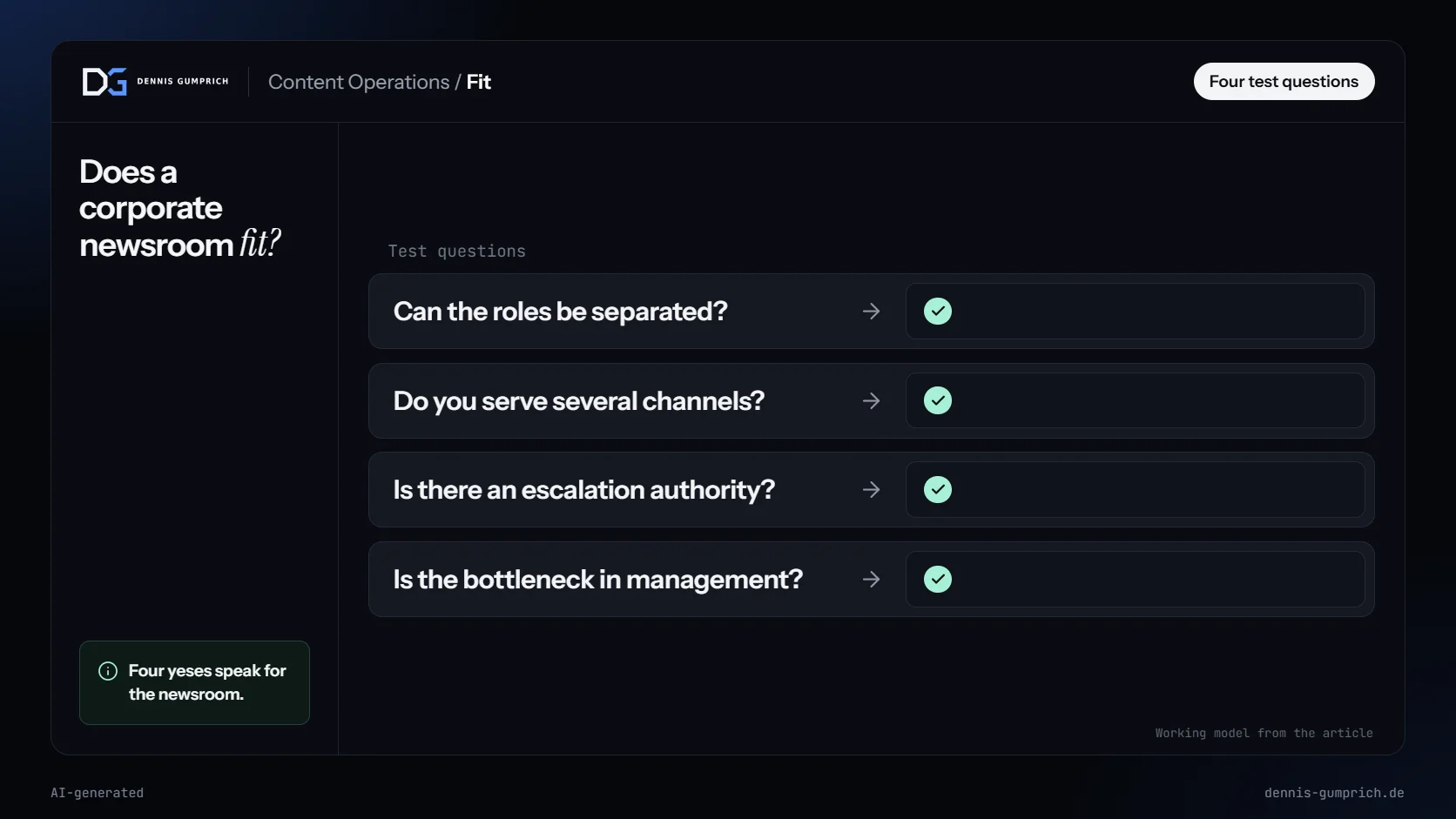
A newsroom is probably not the right answer if one of the following points applies.
- You cannot staff the role separation. If the same people have to carry topic and channel responsibility, the central separation exists only on paper. A shared, well-run editorial plan then achieves more than a role model with labels.
- Your real problem is production capacity, not management. If you know exactly which topics are important but simply do not have enough people to produce them, a management model solves nothing. It adds coordination effort.
- There is no second authority above the departments. Without an escalation authority that decides when in doubt, every conflict between newsroom and department will be resolved in favor of the department. Then the role construct is a burden without effect.
- You essentially serve one channel. Separating topic and channel makes sense when a topic is delivered differently across several channels. With one or two channels, the overhead is greater than the benefit.
- You are in the middle of another major change. System change, reorganization, merger. A newsroom is an organizational and cultural project. Two of them at the same time rarely go well.
Incidentally, a size threshold that is often expected cannot be derived from the data. The Mediamoss/ISM study found no statistical relationship between department size and newsroom quality. The relevant threshold is not headcount but operational maturity: do you even have documented processes that something can change? A self-test for this is in Measuring process maturity.
And one more note from practice: if you are just starting out, do not call it a newsroom. The term is burdened in parts of the market, and a failed newsroom project makes a second attempt much harder than an unspectacularly introduced shared topic process.
How do you measure the success of a newsroom?
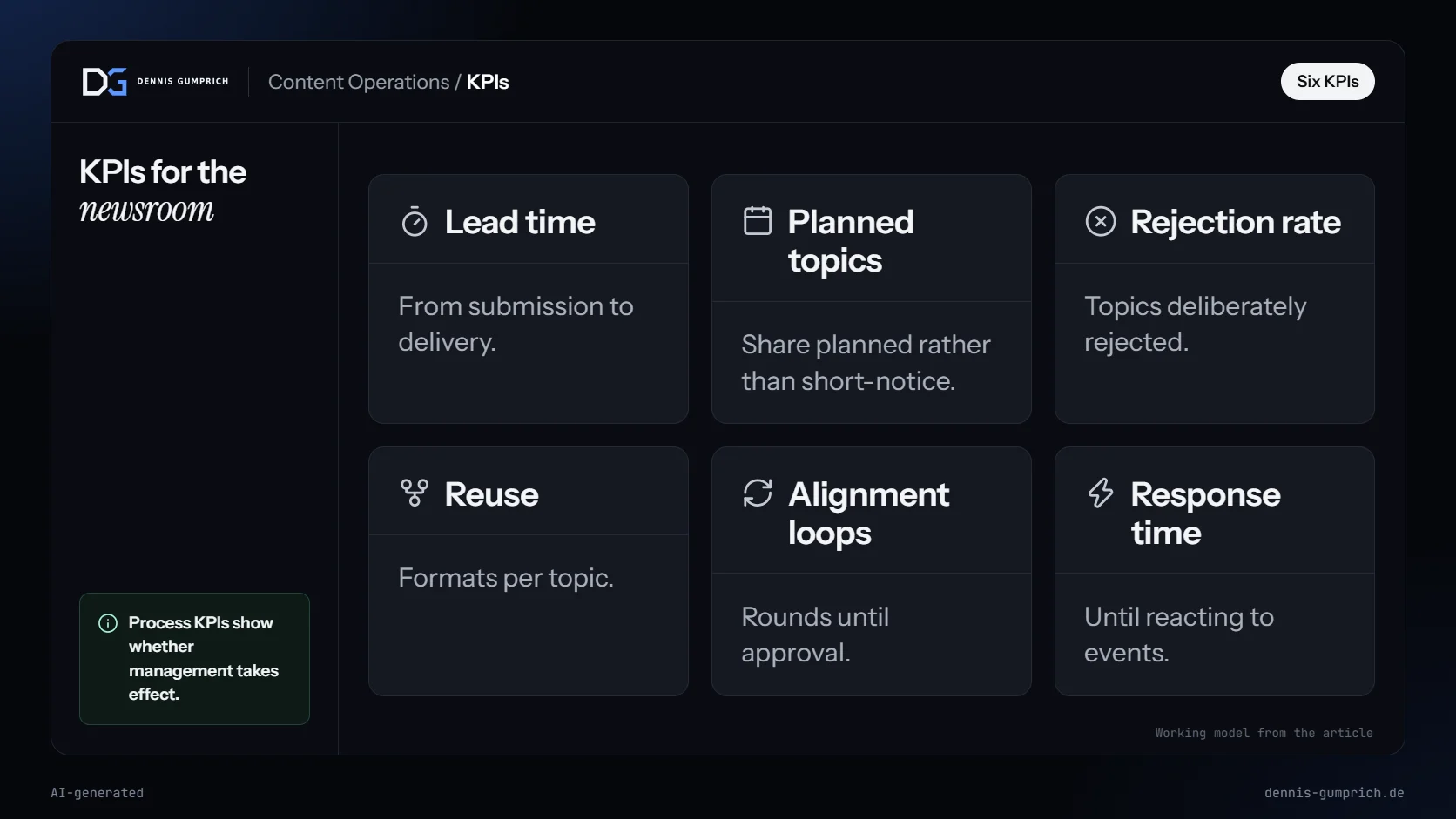
With process KPIs, not with reach. Meaningful measures are the median lead time from adding a topic to publication, the share of planned topics among all publications, the rejection rate in the topic meeting and the degree of reuse per topic. These measures capture the operating model, not the chance success of a campaign.
If you look for newsroom KPIs in the available literature, you find reach, share of voice, sentiment, interactions and pickup rates. These figures measure the impact of content. They say nothing about whether your operating model works.
That is a practical problem. If management asks after a year what the newsroom has achieved and you answer with increased reach, you have delivered a figure that a lucky campaign could also explain. You need KPIs that measure the organizational form.
How large the effect of a switch can be is shown by the Mediamoss study "The corporate newsroom effect" (in German) from October 2026. Before and after values of the Corporate Newsroom Score are available for 76 institutions. On average, it rises after the introduction from 2.73 to 7.32 points on a scale of 1 to 10. It is revealing where development remains weak: in planning and data. Insights from performance measurement often do not yet flow back into topic selection. This is exactly the gap the process KPIs below close. One limitation: Mediamoss itself advises on newsroom introductions and measures with its own assessment model, and the study does not mention a control group.
| KPI | What it answers | How you collect it |
|---|---|---|
| Lead time from adding a topic to publication, median | Is the process getting faster or only more formal? | Two date fields in the planning tool, median instead of mean because of outliers |
| Share of planned topics among all published content | Are you managing or reacting? | Share of publications that were on the topic list at least 14 days earlier |
| Rejection rate in the topic meeting | Does prioritization take place? | Rejected or postponed topics relative to those submitted |
| Degree of reuse | Does the topic logic pay off in efficiency? | Average number of channels per topic, over time |
| Alignment loops per piece of content | Where does the effort really arise? | Number of rejections in the approval process, per content type |
| Response time to unplanned topics | Is the structure fast or sluggish? | Time from occasion to first publication, for ad hoc topics |
Two notes on application. First: measure a baseline before you change anything. Without a before value, each of these figures is worthless. The best time for the baseline measurement is the conception phase, not go-live.
Second: these KPIs are management measures, not targets for individuals. If the rejection rate becomes a target for the managing editor, topics will be rejected to reach the quota. Use them as a diagnosis in the team, not as a performance measure.
If you combine these figures with the actual effort per piece of content, you have the basis for a business case that goes beyond "we are better aligned". How this effort can be broken down robustly is described in Nine hours per article, and how it becomes a template for the conversation with management in Calculating the business case for content software.
According to the Corporate Newsroom Study 2026, newsrooms measure their success significantly more systematically than traditional communications departments, especially in terms of output, that is, number, regularity and diversity of topics. In terms of contribution to business success and resource efficiency, however, there are hardly any differences. Impact-oriented KPIs are therefore still the exception, even in newsrooms.
How do you introduce a corporate newsroom?
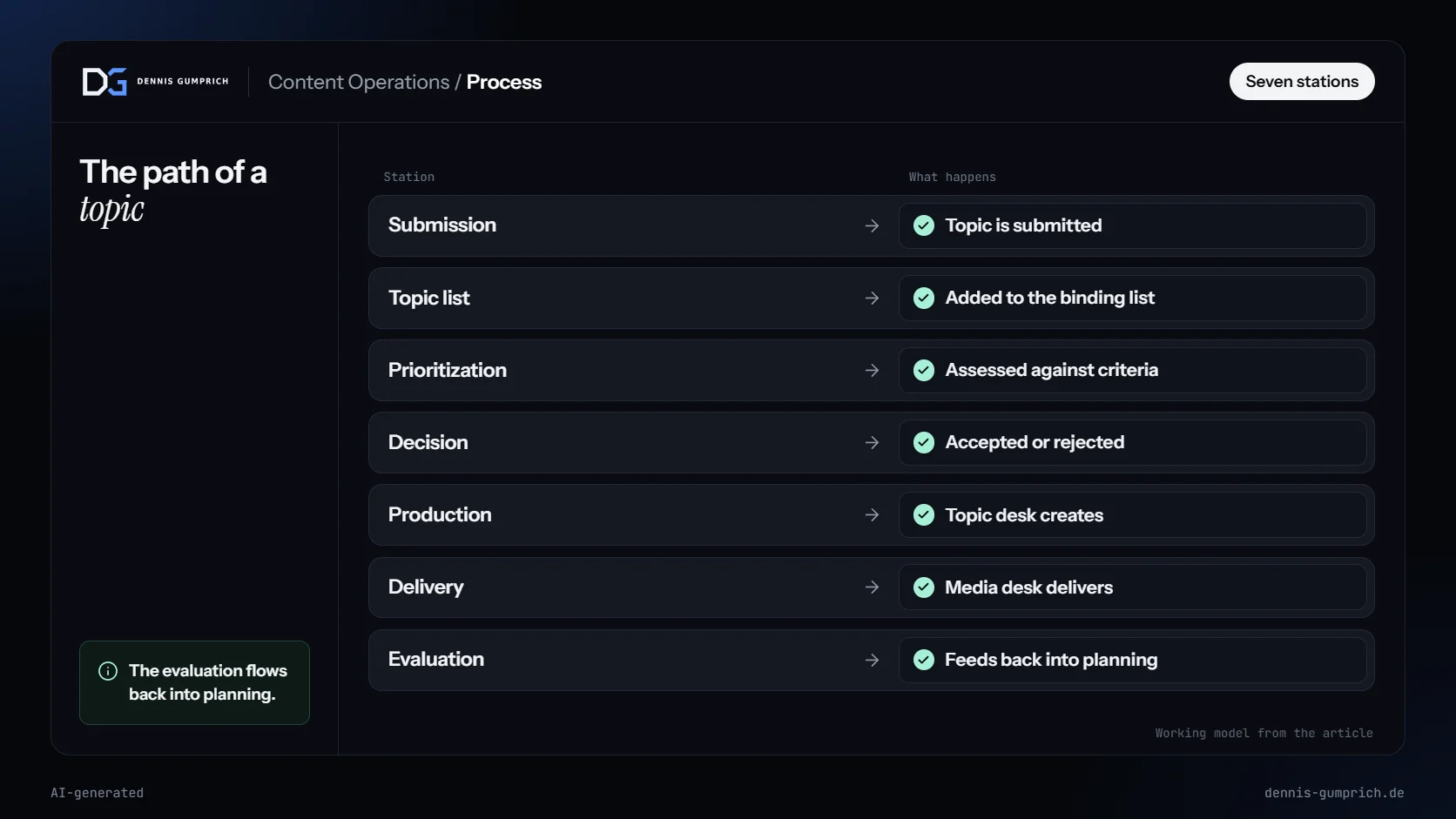
In this order: an inventory over two to three weeks, then define the target picture and decision rights together with the departments, then check the incentives, and only at the end test processes and name roles. The logic behind it: decisions that are hard to reverse come late and build on collected data.
The order of the following steps is not arbitrary. It is chosen so that the decisions that are hardest to reverse come as late as possible and build on data.
- Inventory before anything is named. Which topics are currently running, who brings them in, through which channels do they go out, how long does it take? Two to three weeks are enough. The purpose is not completeness, but a baseline for the KPIs above. If you cut corners here, you cannot prove later that anything has improved. How to include your existing content in this is described in Content inventory.
- Define the target picture and decision rights together. This is the step most often skipped because it is uncomfortable. Use the decision matrix from this article as a basis for discussion and work through it with the departments, not just within the communications team. If resistance arises here, that is a valuable signal, not a problem. Resistance that becomes visible now costs weeks. Resistance that only becomes visible after go-live costs the project.
- Check whether the incentives fit. Specifically: how are department heads measured? Where are the budgets? Who do marketing and communications report to? If structural conflicts become visible here, they must either be resolved or explicitly accepted. What does not work is overlooking them.
- Test processes before announcing roles. Take three to five real topics and run the planned process with them, including one deliberate rejection. This reveals the points where responsibility is unclear. In my experience, the most difficult ones lie at the interface with the specialist departments; on this, see Handovers between marketing and specialist departments.
- Only then decide on tools. A planning tool maps processes, it does not create them. If you introduce software before the decision logic is in place, you preserve the previous state in a new system. When a spreadsheet is no longer enough is described in Content planning in Excel, and the trade-off between point tools and platform in Point tools or platform. Which requirements a tool for newsroom management must meet is summarized in the requirements catalog for newsroom software.
- Roll out step by step and refine. Start with one topic area and two channels, not with everything at once. And plan a review meeting after about three months from the start, in which the decision matrix is revised. It will not be right the first time. What a pilot can and cannot prove is described in Pilot and rollout.
On duration: the available field reports suggest a period of several months for analysis, target picture and testing for medium-sized organizations before operations start. If you want to push this through in four weeks, you skip steps two and three, and those are exactly the two where it later fails.
- The effort surrounding the introduction. A trade fair company first has to get resources approved internally for around six months of introduction: IT, data protection, purchasing, project management. Earlier software projects there failed because of delayed interfaces.
- The people outside communications. The board, HR, IT, legal or specialist departments have to read along and approve, but do not want to learn another tool. At the health insurer, the board currently receives approvals as a Word file on the iPad.
- The knowledge alongside the editorial plan. The housing company keeps press and stakeholder inquiries in several Excel lists. The question "What did outlet X ask about topic Y last year?" cannot be answered.
- Procurement in the public sector. Public companies need at least three offers or an EU tender. A test there is not a purchase commitment and extends the timeline.
- Change fatigue. If you have just switched to the newsroom model, you do not want to put the team through the next change right away.
Newsroom and content operations: where one ends and the other begins
In my view, this is the biggest conceptual gap in the newsroom discourse in German-speaking countries. It describes almost exclusively the organizational structure: which roles exist, who supports whom, what the organizational chart looks like. What has to happen operationally in these boxes remains open.
That is exactly what content operations is about. The term comes from the English-speaking world and is centered on processes, workflows and systems. It does not ask who is responsible, but: how is content structured so that it can be reused? Which metadata does it need? What does its life cycle look like? Where are the assets? How does content get from draft to channel without anyone copying and pasting? A compact introduction to the term is given in the article Content operations: definition, building blocks and getting started.
| Newsroom perspective | Content operations perspective | |
|---|---|---|
| Central question | Who decides and who is responsible? | How does the work actually run? |
| Subject | Roles, meetings, prioritization | Workflows, metadata, templates, reuse, assets |
| Typical result | Organizational chart and meeting plan | Process documentation and system landscape |
| Blind spot without the other side | The roles are filled, but work continues via email and shared folders | The processes are clean, but nobody decides which topics go into them at all |
In practice, this means: a newsroom without content operations produces clear responsibilities for work that continues to run manually and error-prone. Content operations without a newsroom produces clean processes for topics nobody has prioritized.
If you are deciding where to start: start where your recognizable bottleneck lies. If topics flow into the channels uncoordinated and nobody can say no, it is management. If it is clear what is important but implementation gets bogged down in alignment loops, it is the process. Tackling both at the same time is possible, but considerably more demanding.
Newsroom and AI: what can be automated and what remains a decision
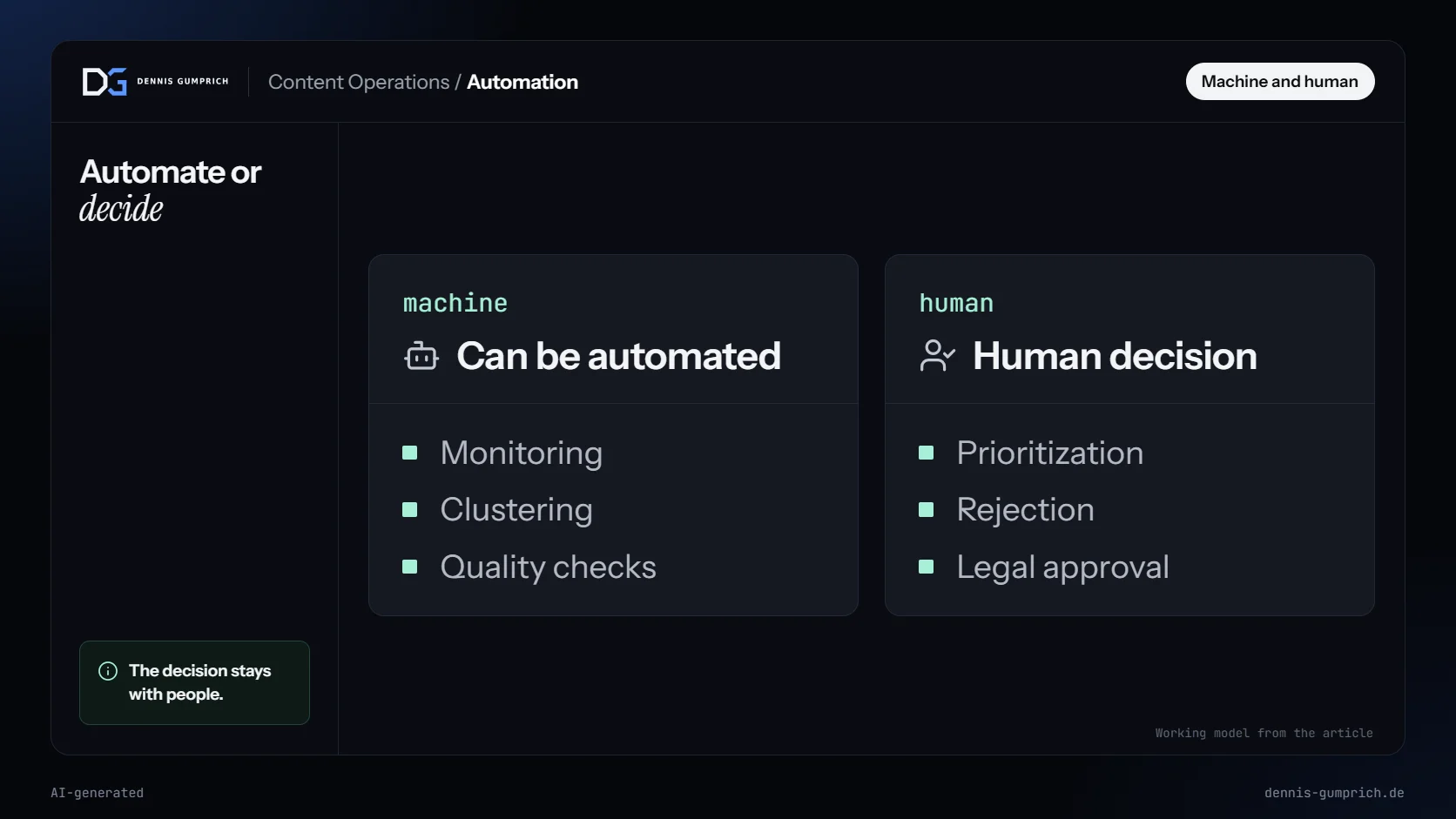
So far, the discussion about AI in the newsroom has largely stopped at text production. That is the least interesting part. Much more relevant for a management model is the question of which steps of the management chain AI can take over and which it cannot. A useful dividing line runs along the question of whether a step contains a decision that carries responsibility.
What AI sensibly takes over today
- Topic research and monitoring. Observing sources, competitors and search demand at a frequency that cannot be achieved manually.
- Clustering and duplicate detection. Checking whether a newly submitted topic already exists in substance. This directly addresses one of the three initial problems the newsroom is meant to solve.
- Briefing preparation. Generating a structured briefing with target group, core message and channel suggestions from a topic submission.
- Creating variants. Deriving channel-specific versions from approved core content. This is the step with the highest immediate time gain.
- Quality checks against stored rules. Tone, brand voice, terminology, completeness. How to build the necessary foundation is described in Building a knowledge base and Storing brand voice.
- Evaluation and pattern recognition. Making connections between topic areas and impact visible.
What remains a decision
- Prioritization between topics. A model can calculate a recommendation. Whether a politically sensitive topic takes precedence is a trade-off with responsibility.
- Rejecting a topic toward a department. That is a process between people with consequences for relationships.
- Expert and legal approval. This involves liability. It cannot be delegated.
- Crisis communication. Costs of errors too high, too much context that is not in the system.
The interesting consequence: AI considerably amplifies a functioning management model, and a non-functioning one too, just in the wrong direction. Producing more content faster without anyone prioritizing exacerbates exactly the problem the newsroom was supposed to solve. The order is therefore not optional: management first, then acceleration.
How individual AI experiments become a robust process is described in more detail in AI content operations. How to manage the use of AI in the newsroom with rules, roles and a knowledge base is described in AI in the newsroom: governance instead of ad hoc use.
Conclusion: the question is not whether you need a newsroom
It is whether you are prepared to shift decision rights.
Everything else about the model, the role names, the meetings, the shared room, is comparatively easy to introduce, which explains why there are so many newsroom signs and so few newsroom organizations. The difficult part is that someone has to be able to reject a topic, and that this rejection holds.
If you cannot or do not want to push through this shift, that is a legitimate decision. Then it is better to invest the energy in a shared topic list, shorter approval paths and clean handovers. That delivers measurably more than a model whose core you cannot implement.
If you can push it through, the rest is craft.
Frequently asked questions
What is the difference between a newsroom and a newsdesk?
Newsdesk originally refers to the central control point in a journalistic editorial office where the news situation comes together and placement is decided. Newsroom refers to the editorial office as a whole or, in a corporate context, the entire organizational model. In practice, the two terms are often used synonymously. If you distinguish them, the newsdesk is the place of daily decisions, the newsroom the model around it.
Does a corporate newsroom need a shared room?
No. A shared room makes alignment easier but does not replace any of the three management conditions. The Bern study with 13 interviews found that physical location is not a mandatory criterion and that hybrid models work. Journalism research has also shown that physically moving teams together does not by itself dissolve the existing separation between units.
From what team size is a newsroom worthwhile?
There is no robust headcount. The Mediamoss/ISM study found no statistical relationship between department size and newsroom quality. The practically relevant lower limit results from the role separation: you need at least different people for topic and channel responsibility, otherwise the central mechanism does not exist.
How long does the introduction take?
That depends heavily on the size of the organization and its decision paths. Several months for analysis, target picture and testing before operations start are realistic. Too little time for the conception phase is explicitly named in the specialist literature as a cause of failure.
What does a newsroom cost?
The relevant costs are rarely software costs. They lie in the working time for conception and testing, in the meeting time of everyone involved in ongoing operation and in onboarding. Calculate the meeting effort concretely: a weekly meeting with ten people at 45 minutes each adds up to around 32 person-hours per month. The management gain has to exceed this time.
Does a newsroom replace the content strategy?
No. The newsroom is the operating model, and the content strategy provides the criteria by which the newsroom prioritizes. Without a strategy, the newsroom prioritizes by how loud those bringing in topics are.
We introduced a newsroom and it does not work. What now?
First check the three conditions of the management core individually instead of questioning the whole model. In most cases, exactly one of them is missing, usually decision rights. That can be repaired without rebuilding the structure. A restart under the same name, on the other hand, is difficult because the term is then already burdened internally.
Where does your content process lose time today?
In 30 minutes, we look together at where unnecessary coordination, manual tasks, tool switching or repetitive content work cost you time today.
You get a concrete assessment of which tasks you can simplify, automate or organize better, and where AI and tools actually help instead of adding complexity.
Analyze your content process in 30 minutes Free of charge. You take away concrete starting points you can use internally right away.
Dennis Gumprich
Dennis helps marketing and communication teams fit generative AI into existing content processes without undermining quality, brand voice and approvals. Focus areas: content operations, AI governance and tool selection in mid-sized companies and corporations.
Transparency note: Dennis works for contentbird, a provider of AI-powered content software. Product mentions are marked in the article. More about Dennis (in German) · LinkedIn
Read more
Sources
- Florian Stadel: Unterwegs in den Newsrooms von Siemens und der Telekom (On the road in the newsrooms of Siemens and Telekom, in German), book chapter in Pranz, Heidbrink, Stadel and Wagner (eds.): Journalismus und Unternehmenskommunikation, Springer 2022, pp. 137 to 145, abstract at IDEAS/RePEc: Siemens newsroom in 2011 "according to its own information", origin of the newsroom principle in 1990s journalism. Accessed October 31, 2026.
- José A. García Avilés, Andy Kaltenbrunner, Klaus Meier: Media Convergence Revisited: Lessons learned on newsroom integration in Austria, Germany and Spain, Journalism Practice, 2014, case studies at El Mundo, Die Welt and Der Standard, three integration models. Accessed October 31, 2026.
- PR Report: CommTech-Report: Der Newsroom polarisiert zunehmend (CommTech report: the newsroom is increasingly polarizing, in German), report of November 29, 2024 on the CommTech Index Report 2024/25 by AG CommTech, DPRG, PRVA and ComImpact, 352 respondents in DACH, online survey June to August 2024. Accessed October 31, 2026.
- ZHAW, Institute of Applied Media Studies (Guido Keel, Markus Niederhäuser): Corporate Newsrooms in der Schweiz (Corporate newsrooms in Switzerland, in German), survey of Swiss companies and public administrations, June 2016, 77 organizations answering the core question, 20 of them with a newsroom. Accessed October 31, 2026.
- Mediamoss: Langzeitstudie Status quo Corporate Newsroom (Long-term study: status quo of the corporate newsroom, in German), study report of September 15, 2025, led by Prof. Dr. Christoph Moss, 209 communications departments, 743 interviews, January 2018 to June 2025, publication of a consultancy. Accessed October 31, 2026.
- Tobias Rohrbach, Mykola Makhortykh, University of Bern: A Matter of Mindset? Features and Processes of Newsroom-based Corporate Communication in Times of Artificial Intelligence, preprint on arXiv, July 2024, 13 interviews, ten of them with people responsible for corporate newsrooms at large Swiss companies. Accessed October 31, 2026.
- kom.de, Volker Thoms: So unterschiedlich nutzen Unternehmen das Newsroom-Modell (How differently companies use the newsroom model, in German), article of April 8, 2025 with field reports from SBB and Lufthansa Group, including Andreas Bartels. Accessed October 31, 2026.
- Mediamoss: So bauen Sie einen Corporate Newsroom auf (How to build a corporate newsroom, in German), white paper without date, role model after Christoph Moss with strategy team, managing editor, topic desks and media desks. Accessed October 31, 2026.
- Marie-Christine Schindler: Corporate Newsroom 4.0. Kommunikation effizient organisieren und steuern: eine Buchbesprechung (a book review, in German), review of November 25, 2025 of the book by René Seidenglanz and Eckhard Klockhaus (Springer VS, 2025), final chapter on causes of success and failure. Accessed October 31, 2026.
- Tobias Rohrbach, Diana Ingenhoff (Université de Fribourg), Mykola Makhortykh (University of Bern), Philipp Bachmann (Lucerne University of Applied Sciences): Ein Modell, viele Wege. Corporate Newsrooms in der Schweiz 2026 (One model, many paths, in German; Corporate Newsroom Study 2026), study report supported by Newsroom Communication, Axpo, SBB and Innosuisse. Online survey of 216 communications managers in German- and French-speaking Switzerland, November and December 2025, self-assessments; prevalence, age, size and forms of implementation pp. 13 to 16, topic management and roles pp. 17 to 19, performance and silo thinking pp. 22 to 23, communications controlling pp. 24 to 25. Accessed October 31, 2026.
- Mediamoss: Neue Mediamoss-Studie: Was bringt ein Corporate Newsroom? (New Mediamoss study: what does a corporate newsroom achieve?, in German), blog post of October 23, 2026 on the study "The corporate newsroom effect" by the Mediamoss Institute, continuation of the long-term study, evaluation July and August 2026, complete before and after pairs of the Corporate Newsroom Score for 76 of 179 institutions: average increase from 2.73 to 7.32 points (scale 1 to 10), strongest effect on strategy, weak development in planning and data. Publication of a consultancy with its own assessment model, without a control group. Accessed October 31, 2026.
How this article was created
This article was created with the help of AI. Structure, research and draft wording were developed with AI support. Professional assessment, review of the statements and the final version are the responsibility of Dennis Gumprich. The English version was translated with AI and reviewed. Read the original German version.
How reliable are the statements?
Evidence exists for the results of the Corporate Newsroom Study 2026 (self-assessments of 216 respondents in Switzerland), the Siemens claim about starting its newsroom in 2011 and the origin of the principle in journalism (Stadel), the findings on newsroom integration (García Avilés, Kaltenbrunner, Meier), the results of the ZHAW survey 2016, the CommTech Index Report 2024/25 and the Mediamoss/ISM long-term study 2025, the results of the Bern interview study, the field reports from SBB and Lufthansa Group, the role model after Christoph Moss and the success and failure factors from "Corporate Newsroom 4.0" according to a book review. The Mediamoss studies, the long-term study 2025 and the study on the corporate newsroom effect 2026, are publications of a consultancy that offers newsroom introductions and measures with its own assessment model; this is indicated in the text. The management core, the decision matrix, the meeting overview, the self-check and the six KPIs are explicitly marked as working models. They are not an industry standard and not measured values. The calculation of meeting effort is a worked example. The illustrations were created with AI support. Update history: originally published August 19, 2026; supplemented October 11, 2026 with the distinction from the online newsroom and the three newsroom models; supplemented October 31, 2026 with the results of the Mediamoss study on the corporate newsroom effect. Status: October 31, 2026.


