
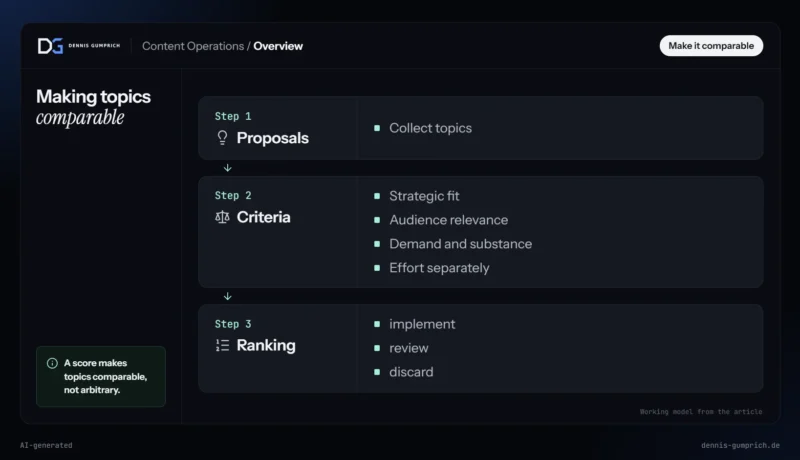

Without criteria, the loudest department's topic wins.
Topic scoring replaces volume with criteria. Five to seven weighted criteria, a rough shared scale and a documented decision that includes rejections. What matters is not the precision of the number, but that the discussion shifts from the topics to the criteria. If you argue about weightings, you argue productively.
The following sections show how to choose criteria, weight them and use them in the topic meeting. First, the underlying problem.
Why the loudest department wins when criteria are missing
Without defined criteria, it is not relevance that decides in the topic meeting, but assertiveness. This is not a reproach to those involved, but an inevitable consequence: if there is no shared benchmark, all that remains is a comparison of opinions, and in that comparison whoever asks more often, sits closer to management or is better prepared wins.
The consequences are familiar. Topics with strong internal advocates go ahead, topics with great external interest are left behind. Rejections are avoided because they would have to be explained, and the list grows until nobody can keep track of it. What was meant as planning becomes a queue.
A second effect only becomes apparent later: without criteria, it can no longer be reconstructed afterwards why a topic went ahead. That also rules out evaluation. You can measure how an article performed, but you cannot learn which kind of topic works for you. The feedback into planning, without which a steering model does not steer, is missing. Why this is the heart of the matter is described in the article on the corporate newsroom as a steering model.
Missing criteria are no isolated case. According to the Corporate Newsroom Study 2026 (in German), topic steering in many communication departments happens implicitly. Formalized instruments such as a topic architecture are rare, even in newsrooms, and that is exactly where the researchers see key potential for professionalization.
How persistent this gap is shown by the Mediamoss study "The Corporate Newsroom Effect" (in German) from October 2026. Before-and-after values of the Corporate Newsroom Score are available for 76 institutions; on average it rises from 2.73 to 7.32 points on a scale of 1 to 10 after a newsroom is introduced. Development remains weak of all things in planning and data: insights from performance measurement often do not flow back into topic selection. For you, this means: plan the comparison between score and result from the start; it does not come automatically with the new structure. A caveat: Mediamoss itself advises on newsroom implementations and measures with its own assessment model; the study does not mention a control group.
What is topic scoring, and what is it not?
Topic scoring is a shared benchmark that structures the topic discussion: few criteria, rough levels, visible weighting. The number ranks the topics; people still decide, but transparently. What topic scoring is not: a score that replaces the decision.
A score that decides automatically. Ten-point scales that feign precision. An assessment form filled in by one person alone. Criteria nobody knows because they are stored in the tool rather than discussed in the meeting.
A shared benchmark that structures the discussion. Few criteria, rough levels, visible weighting. The number ranks the topics; people still decide, but transparently.
The difference matters because scoring models regularly fail due to exaggerated expectations. A score that is meant to replace the decision is immediately manipulated: anyone who wants to get their topic through simply rates it higher. A score that only prepares the decision can withstand this, because the assessment is out in the open and can be challenged.
Topic scoring must also be distinguished from measuring your own way of working. With process maturity, you assess the team; with topic scoring, individual topics. Both use a grid but answer different questions.
Which criteria belong in topic scoring?
Seven criteria recur in practice, six of which form the benefit total. Effort is assessed separately; otherwise the easy option systematically wins. Don't take all of them; five are enough to start. The hardest criterion is strategic fit: if you cannot answer which topic area a topic contributes to, it is not scoring that is missing, but the topic architecture above it.
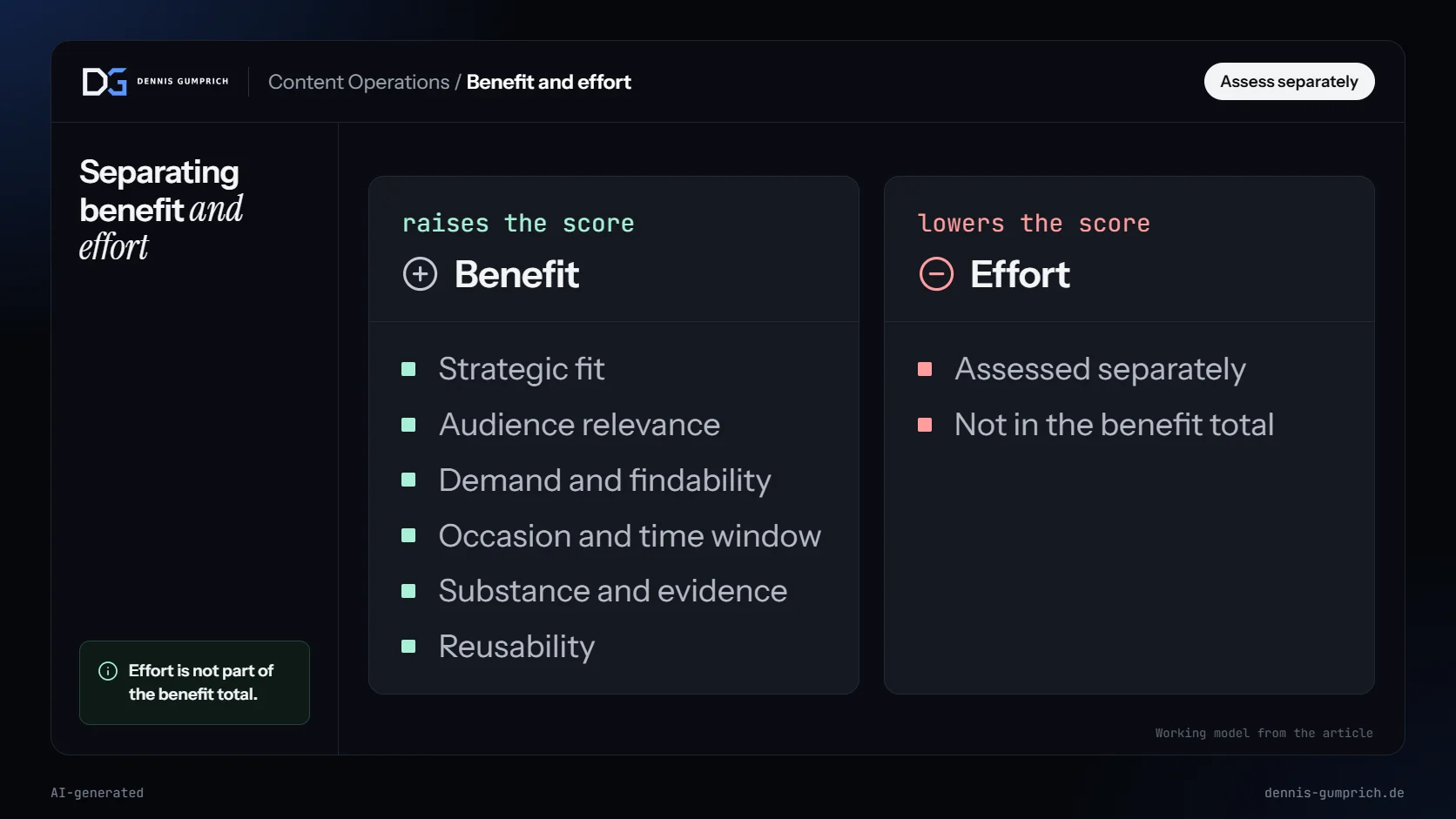
Seven criteria recur in the selection and implementation processes I support. Don't take all of them. Five are enough to start, and the last two belong on the other side of the equation anyway.
1. Strategic fit
Does the topic contribute to a defined topic area or company goal? If you cannot answer this question, it is not scoring that is missing, but the topic architecture above it. That is why this criterion comes first and is the heaviest in almost all models.
2. Audience relevance
For which of your audiences is the topic relevant, and how do you know? Evidence-based means: from inquiries, search data, sales feedback or conversations. Assumed means: gut feeling. Both are permissible, but they should remain distinguishable.
3. Demand and findability
Is there measurable external demand, such as search volume or recurring questions in customer service? This is the only criterion that can be fully backed up externally. That is exactly why it is so valuable in the discussion: it is the criterion internal volume cannot beat.
4. Occasion and time window
Is there a date, a season, a regulatory deadline or an event that gives the topic a window? Topics without an occasion are not worse, but they can be postponed. That is exactly the information you need for planning.
5. Substance and evidence
Do you have something to say that goes beyond what is written everywhere anyway? Are there figures, sources, an expert who stands behind it? This criterion filters out the topics that sound good in the draft and thin out in execution.
6. Reusability
To how many channels and formats can the topic sensibly be adapted? A topic that supports five outputs is superior to an equivalent topic with one. This criterion reflects the newsroom logic directly in the assessment.
7. Effort
Effort is not a benefit criterion; it belongs on the other side. Assess it separately and divide the benefit total by the effort instead of adding it in. Otherwise, high-value topics that take a lot of effort quietly disappear from the plan.
A related grid is described by independent consultant Robert Weller in the article "The critical elements of a content strategy" (in German) from March 2026. He assesses ideas against criteria such as strategic fit, implementation effort, expected impact and portfolio fit. He sees the values as signals, not as rules. This matches two principles of this model: effort stands as a separate quantity next to benefit, and the number prepares the decision instead of replacing it. For you, this means: write down the criteria before the first meeting works with them. A caveat: this is an article from consulting practice without a survey.
How do you weight the criteria correctly?
Weight them by what matters strategically, not evenly. An unweighted model produces mediocrity: topics that reach three out of five everywhere crowd out topics that excel in two criteria. Defining the weighting once together with management is the real strategy meeting.
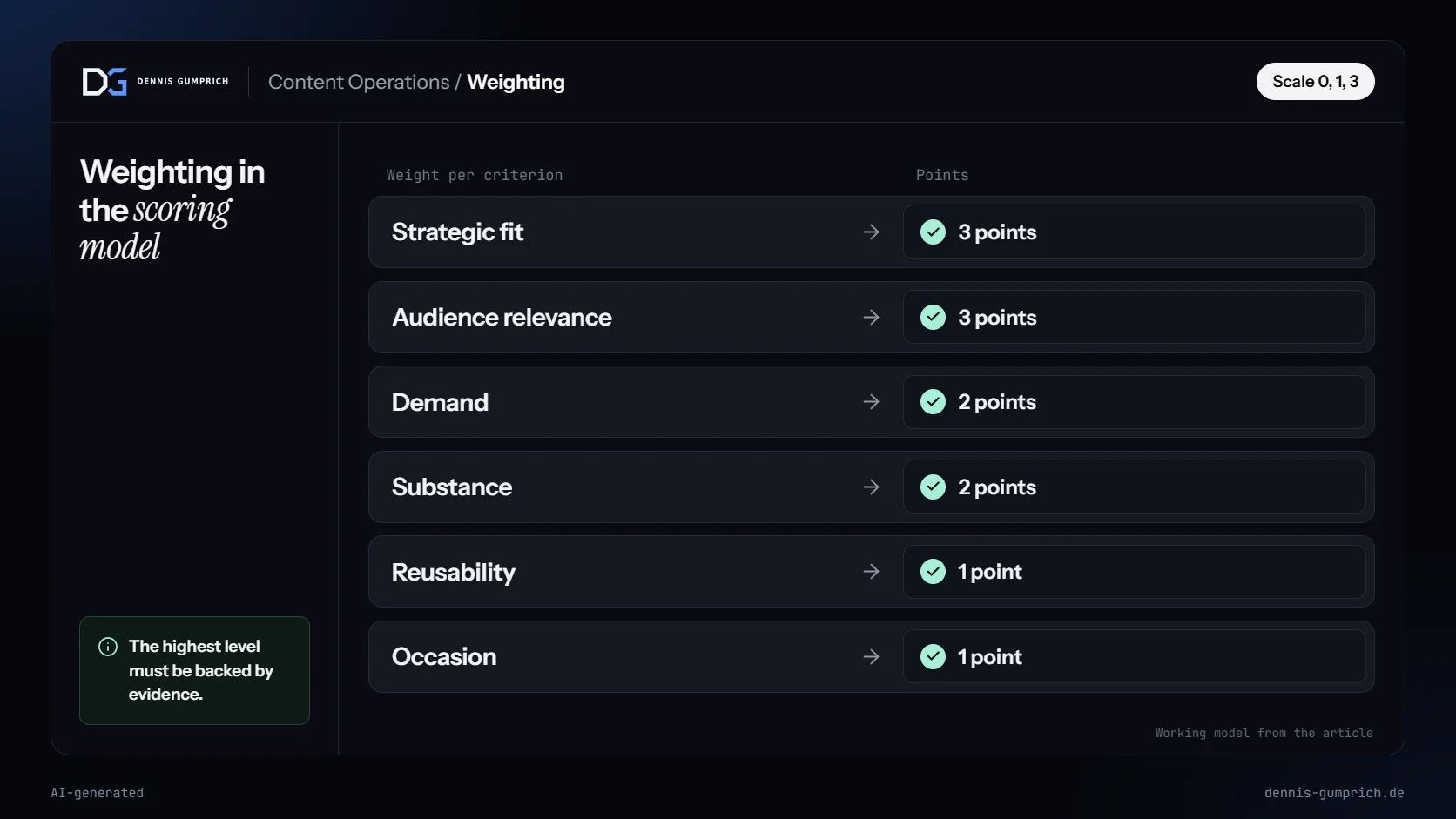
A model with unweighted criteria produces mediocrity. Topics that reach three out of five everywhere crowd out topics that excel in two criteria and are weak in one. But it is usually the second kind that is more interesting.
Weighting is therefore the real strategic act. It makes visible what really matters to you, and it is the point where management should have a say. A suggestion as a starting point, which you adapt to your situation:
| Criterion | Weight | Why |
|---|---|---|
| Strategic fit | 3 | Without strategic fit, everything else is irrelevant |
| Audience relevance | 3 | Decides whether the content reaches anyone |
| Demand and findability | 2 | Can be backed up externally, therefore hard to dispute |
| Substance and evidence | 2 | Separates a point of view from repetition |
| Reusability | 1 | Important for cost-effectiveness, not for relevance |
| Occasion and time window | 1 | Steers the order, not the selection |
Effort is deliberately not in this table. It comes in as a divisor as soon as you turn the ranking into a plan.
How many levels does a scoring scale need?
Three. Rate each criterion with 0 for does not apply, 1 for partly applies and 3 for clearly applies. The jump from 1 to 3 is intentional: a clearly met criterion should prevail in the total instead of getting lost in the middle.
Ten-point scales are the most common beginner's mistake. They feign a precision that does not exist, and they shift the discussion to whether a topic deserves a seven or an eight. That discussion is worthless.
| Level | Meaning | Condition |
|---|---|---|
| 0 | does not apply | No recognizable connection |
| 1 | partly applies | Connection exists, but is not backed up or is weak |
| 3 | clearly applies | Backed by evidence and understandable to outsiders |
The jump from 1 to 3 is intentional. It ensures that a clearly met criterion actually prevails in the total instead of getting lost in the middle. If you prefer 0, 1, 2, you get more even and therefore less meaningful results.
Only one thing matters: level 3 needs a condition that can be shown. As soon as "clearly applies" is a matter of interpretation, you are back to volume.
With the proposed weighting, the maximum benefit total is 36 points. This number is not very intuitive on its own, so converting it to 100 is worthwhile: a topic with 30 of 36 points then reaches 83. This makes topics comparable across quarters, even if you readjust the weighting in between. Effort only comes into play afterwards, when you divide the benefit total by it and derive the priority.
The step that turns a number into a decision
A scoring model only becomes effective when it leads to rejections. As long as all topics eventually go ahead and the score only determines the order, you have sorted a queue, but not steered.
So define in advance what happens to the bottom of the list. Two variants work in practice: a fixed capacity limit below which topics are rejected rather than postponed, or a minimum score a topic must reach to be scheduled at all. How the plan behind it differs from the classic editorial calendar is described in From editorial calendar to topic plan: what concretely changes.
Both feel harsher at first than they are. A reasoned rejection is better for the requesting department than an open-ended postponement, because it can be planned around. Whoever rejects can also explain what the topic would need to get through next time.
The rejection rate is therefore one of the most meaningful metrics for your operation. If it is zero, you are not steering but administering. If it is very high, something is wrong at the preliminary stage, because evidently topics are being submitted in droves that never stood a chance.
How do you introduce topic scoring without bureaucracy?
In four steps: retrospectively score twelve topics from recent months, drop every criterion that doesn't differentiate, define the weighting once with management and build the assessment firmly into the topic meeting. A design from scratch is not needed.
- Step 1Review instead of redesignTake twelve topics from recent months, six successful and six disappointing, and score them retrospectively. This shows whether your criteria differentiate before you apply them to new topics.
- Step 2Cut criteriaDrop every criterion that had the same value for all twelve topics. It distinguishes nothing and only costs time.
- Step 3Define the weighting togetherOnce, with management, in a meeting of at most one hour. This session is the real strategy meeting, even if it isn't called that.
- Step 4Build it into the meetingThe assessment belongs before the meeting, not in it. Whoever submits a topic rates it themselves and gives reasons. The group checks the reasoning instead of awarding the points.
- Step 5Readjust after one quarterCompare the scores with the actual results. If highly rated topics regularly perform poorly, the weighting is wrong, not the idea.
Five mistakes in topic scoring
- Too many criteriaFrom eight criteria on, participation drops, because filling in the form takes longer than thinking about the topic. Five well-chosen ones beat ten complete ones.
- Treating effort as a benefit criterionIf you add effort into the total, you systematically favor the easy option. Effort belongs on the other side as a divisor.
- The score decides aloneAs soon as the number replaces the decision, it gets manipulated. It should structure the discussion, not replace it.
- Assessing without rejectingA model without rejection only sorts the queue. The steering effect only arises at the capacity limit.
- Defining it once and never checkingWithout comparing score and actual result, the model remains an opinion in numerical form.
Self-check: Does your topic selection hold up?
Tick everything that applies to you.
a brief note on our topic selection:
We currently decide which topics go ahead without defined criteria. As a result, proposals with strong internal advocates prevail, while topics with demonstrable external demand are left behind. It also cannot be reconstructed afterwards why a topic went ahead, so we learn nothing from the results.
Proposal: five to seven weighted criteria, a three-level rating, assessment by whoever submits the topic. We define the weighting once together with management. That is the real strategic step; everything else is implementation.
The model only becomes effective with a capacity limit below which topics are rejected with reasons rather than postponed. A reasoned rejection is easier for the department to plan around than an open-ended queue.
Conclusion: The argument about weightings is the productive one
Topic scoring does not solve the problem that people have different ideas about what is important. It only moves this dispute to the right place. Instead of negotiating every single topic in every meeting, you negotiate the weighting once and then apply it.
The gain lies less in better individual decisions than in transparency. If you can explain why a topic went ahead, you can also evaluate whether the reasoning held up. Without this feedback, any topic planning remains a collection of good intentions. In the bigger picture, topic scoring is the first of six building blocks in Content Operations: the steering on which roles, planning and approvals build.
Frequently asked questions
From what team size is topic scoring worthwhile?
It is not team size that decides, but the number of units submitting topics. As long as two people plan together, a conversation is enough. As soon as proposals come from several departments and more is regularly submitted than you can implement, you need a shared benchmark. That is often already the case with five people.
Who awards the points?
The submitting unit, not the meeting. That sounds like an invitation to self-favoritism at first, but works better in practice: whoever rates must give reasons, and the group checks the reasoning instead of the number. It also saves meeting time, because the preparatory work happens beforehand.
What if management sets a topic?
That is legitimate and should be provided for in the model. It just needs to stay visible: a set topic is marked as such and not rated higher retrospectively, so that the figures keep their meaning. A quota helps, such as at most one set topic per meeting.
Do we need software for this?
Not to start. A model with six criteria can be mapped and tested in a spreadsheet. A system makes sense once the ratings are to stay attached to the topic permanently, so you can later hold them against the results. What to look for in the selection is described in the requirements catalog for newsroom software.
How do we prevent everyone from giving themselves top marks?
Through the condition for the highest level. If a 3 may only be awarded when the evidence can be shown, overrating loses its point. The quarterly comparison helps too: anyone who regularly rates high and delivers weakly stands out.
What distinguishes topic scoring from a maturity assessment?
The subject. With process maturity, you assess your own way of working and derive what you need to work on as a team. With topic scoring, you assess individual topics and derive what to produce next. Both models use a grid, but they are not interchangeable.
Where does your content process lose time today?
In 30 minutes, we look together at where unnecessary coordination, manual tasks, tool switching or repetitive content work cost you time today.
If you are working on your topic selection right now, we go through your criteria and look at which of them actually differentiated in comparable teams.
Analyze your content process in 30 minutes Free of charge. You take away concrete starting points you can use internally right away.
Dennis Gumprich
Dennis helps marketing and communication teams fit generative AI into existing content processes without undermining quality, brand voice and approvals. Focus areas: content operations, AI governance and tool selection in mid-sized companies and corporations.
Transparency note: Dennis works for contentbird, a provider of AI-powered content software. Product mentions are marked in the article. More about Dennis (in German) · LinkedIn
Read more
Sources
- Sean McBride, Intercom: RICE: Simple prioritization for product managers, blog post of January 5, 2018, updated January 3, 2025: priority as impact per effort, effort divides the benefit total, rough levels for impact. Accessed October 31, 2026.
- Scaled Agile Framework: WSJF (Weighted Shortest Job First), as of April 9, 2026: relative cost of delay from business value, time criticality and risk reduction, divided by relative job size. Accessed October 31, 2026.
- Tobias Rohrbach, Diana Ingenhoff (University of Fribourg), Mykola Makhortykh (University of Bern), Philipp Bachmann (Lucerne University of Applied Sciences): Ein Modell, viele Wege. Corporate Newsrooms in der Schweiz 2026 (Corporate Newsroom Study 2026, in German), study report, supported by Newsroom Communication, Axpo, SBB and Innosuisse. Online survey of 216 communication leaders in German- and French-speaking Switzerland, November and December 2025, self-assessments; topic orientation pp. 17 to 19, key takeaways p. 4. Accessed October 31, 2026.
- Mediamoss: Neue Mediamoss-Studie: Was bringt ein Corporate Newsroom? (in German), blog post of October 23, 2026 on the study "The Corporate Newsroom Effect", analysis July and August 2026, before-and-after pairs of the Corporate Newsroom Score for 76 of 179 institutions: average increase from 2.73 to 7.32 points (scale 1 to 10), strongest effect on strategy, weak development in planning and data, because insights from performance measurement often do not flow back into topic selection. Self-publication by a consultancy, own assessment model, no control group mentioned. Accessed October 31, 2026.
- Robert Weller, Toushenne: Die kritischen Elemente einer Content-Strategie (in German), article of March 30, 2026: assessing ideas against criteria such as strategic fit, implementation effort, expected impact and portfolio fit, values as signals, not rules. Opinion and expert article by an independent consultant who names contentbird as a project reference. Accessed October 31, 2026.
How this article was created
This article was created with the help of AI. Structure, research and draft wording were developed with AI support. Professional assessment, review of the statements and the final version are the responsibility of Dennis Gumprich. The English version was translated with AI and reviewed. Read the original German version.
How reliable are the statements?
Documented is the principle of not adding effort as a benefit criterion but dividing the benefit total by it: it corresponds to established prioritization methods such as RICE and WSJF, in which a time window also appears as a separate factor. Also documented are the finding of the Corporate Newsroom Study 2026 that topic steering in many communication departments happens implicitly (self-assessments by 216 respondents in Switzerland), the weak feedback of measurement results into topic selection according to the Mediamoss study of October 2026 (self-publication by a consultancy with its own assessment model, without a control group), and a related assessment grid by Robert Weller (article by an independent consultant, no survey). The list of criteria, weighting and scale are explicitly working models from consulting practice, not measured values. They are intended as a starting point and should be adapted to your topic architecture and capacity. The point values 36 and 83 are sample calculations for the proposed weighting. As of October 31, 2026.


