
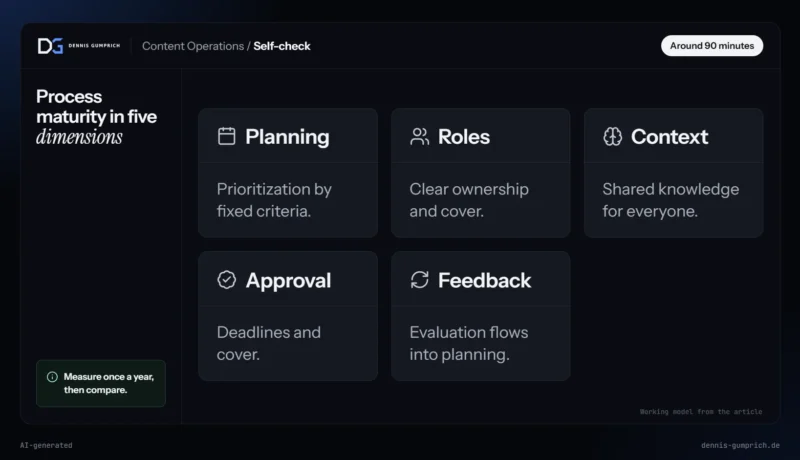

Process maturity in content marketing can be assessed across five dimensions: planning, roles, context, approval and feedback. Each dimension is placed on a stage from one to five, based on observable features rather than opinions. The effort is around 90 minutes and delivers a figure you can collect again next year. How to improve the planning dimension specifically, by prioritizing topics by fixed criteria instead of by arrival, is described in Topic scoring: the criteria that make topics comparable.
Why gut feeling is not enough as an argument
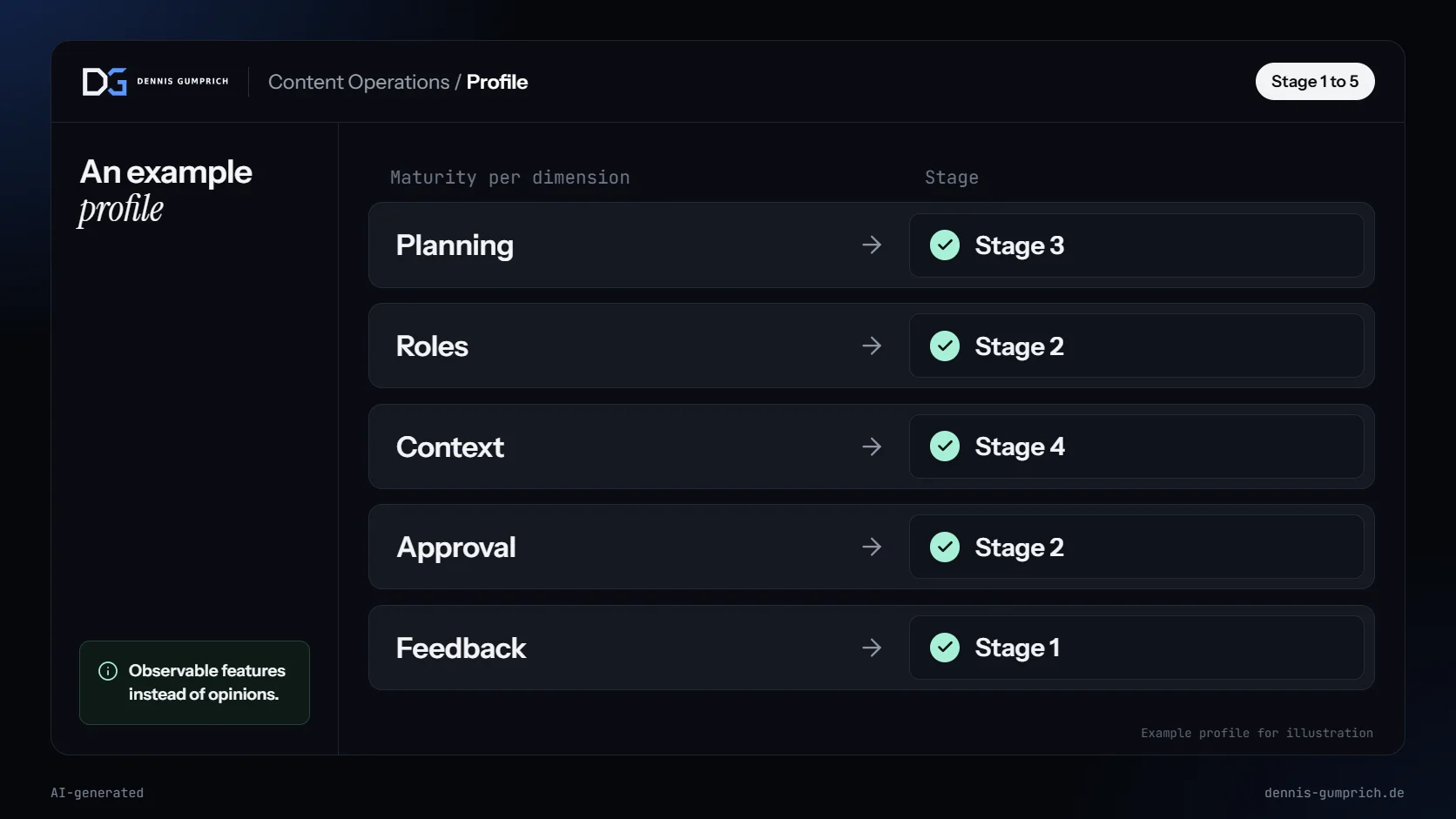
Every content team knows where things get stuck. The problem is not a lack of insight but a lack of evidence. If you say coordination takes too long, your head of department hears an opinion. If you say our approval dimension is at stage two out of five because there are no deadlines and no cover, they hear a finding.
The difference works in both directions. A maturity level shows not only where you are weak, but also where you are better than assumed. Both are useful. Teams that only present deficits are perceived as complaining. Teams that present a differentiated assessment are perceived as capable of steering.
The second benefit lies in repeatability. A snapshot says little. The same assessment a year later shows whether your measures have worked. Exactly this comparability is missing if you discuss afresh every time how bad things currently are. What to work on next along the four levels is described in AI content operations: how AI experiments become a process.
It is important that the assessment is not based on self-assessment. If you ask a team whether its processes are good, you get a mood. If you ask whether every approving role has a named deputy, you get a yes or a no. Only the second type of question can be turned into a robust figure.
Which dimensions determine process maturity in a content team?
Five dimensions: planning, roles, context, approval and feedback. They cover the chain from idea to evaluation without overlapping. Maturity rarely grows evenly: measurement and everyday practice usually lag behind knowledge and strategy.
Content processes can be broken down into any number of aspects. For an assessment that remains feasible in daily work, five dimensions have proven sufficient. They cover the chain from idea to evaluation without overlapping.
Planning
How topics arise, are prioritized and scheduled. Whether the plan reflects the actual status or is a declaration of intent.
Observable by: Is the status in your plan correct without asking?
Roles
Who creates, edits, approves and publishes. Whether ownership depends on people or on roles.
Observable by: Does production continue when a person is absent?
Context
Brand voice, target groups, templates and verified information. Whether this knowledge is at hand or has to be asked for.
Observable by: Does a new person find the brand voice without asking?
Approval
Stages, deadlines, scope of review and cover. Whether approvals can be planned or depend on availability.
Observable by: Is there a deadline per stage and a rule when it expires?
The fifth dimension is feedback: whether evaluation results actually flow back into planning. It deliberately comes last, because in practice it is almost always the weakest. Many teams measure reach and clicks, but few can name which planning decision changed as a result in the last quarter.
An external assessment model comes to a similar finding. The Mediamoss study "The corporate newsroom effect" (in German) from October 2026 measures newsrooms with the Corporate Newsroom Score across seven criteria: strategy, transparency, planning and data, steering, topic management, media management and creative management. Before-and-after values are available for 76 institutions; on average, the score rises from 2.73 to 7.32 points on a scale of 1 to 10. Of all criteria, planning and data develops weakly: insights from performance measurement often do not flow back into topic selection. One caveat: Mediamoss itself advises on newsroom implementations, measures with its own model and names no control group. For your assessment, this means: rate feedback particularly strictly, because it often remains weak even after a newsroom has been introduced.
How do you assess the maturity level in concrete terms?
Each dimension is placed on five stages. What matters is that you can observe the feature in the table without voting on it. If two people assess independently and arrive at different stages, the feature is worded too vaguely.
| Stage | Planning | Roles | Context | Approval |
|---|---|---|---|---|
| 1 | Topics arise spontaneously, no shared plan | Ownership follows availability | Knowledge sits with individuals | Approval by word of mouth or message |
| 2 | A shared plan, status out of date | Roles named, but without cover | A document exists, rarely used | Stages known, no deadlines |
| 3 | Plan mostly correct, maintenance takes effort | Roles with cover, knowledge documented | Context can be found, but separate from the work step | Deadlines agreed, no consequence when they expire |
| 4 | Plan reflects the status, maintenance happens along the way | Roles hold up, independent of people | Context sits where the work happens | Deadlines, cover and consequences settled |
| 5 | Planning responds to evaluation results | Roles are reviewed regularly | Context is maintained and versioned | Scope of review defined per role, objections evaluated |
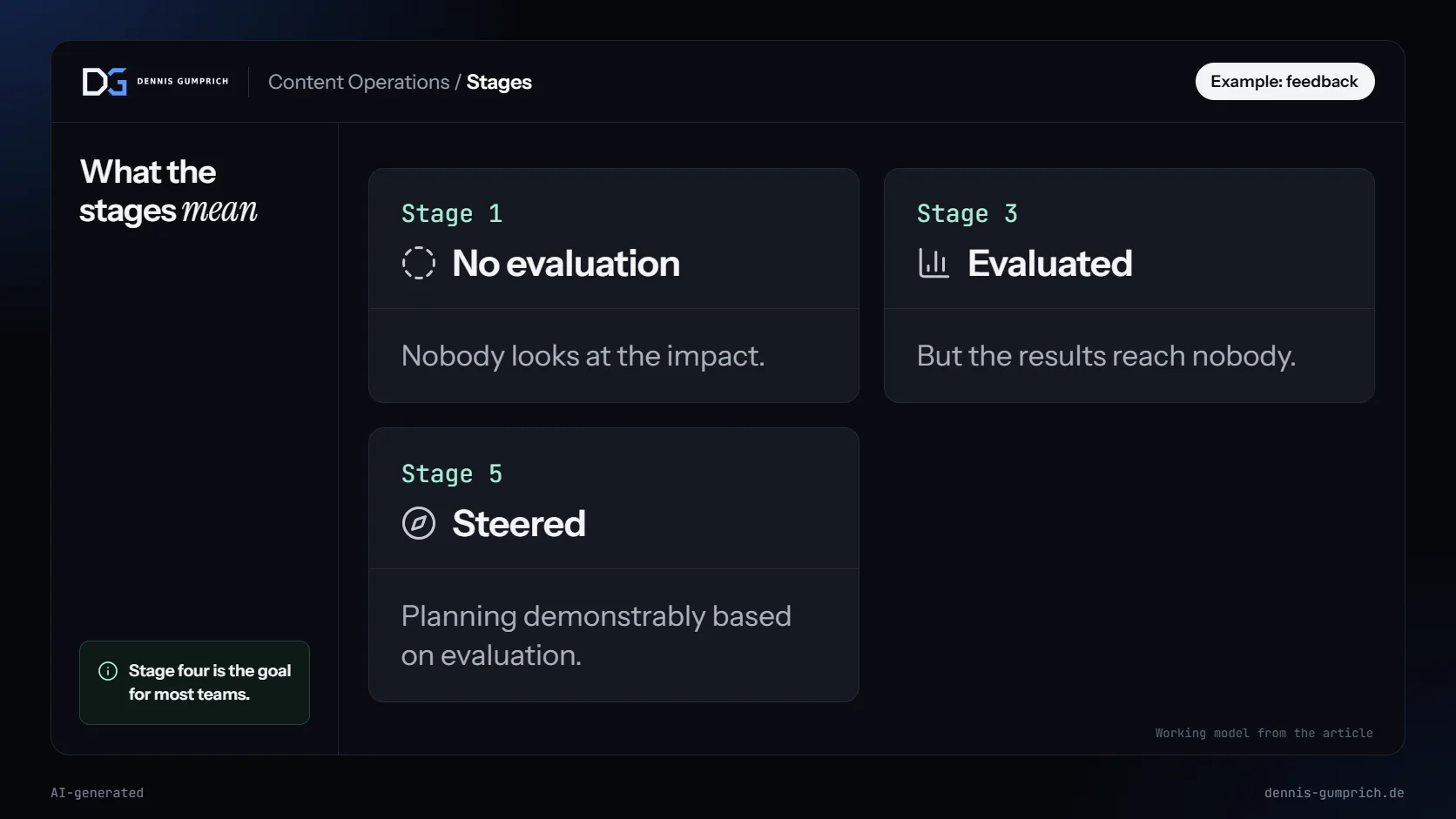
The fifth dimension, feedback, follows the same logic: stage one means no evaluation takes place. Stage three means evaluation takes place but the results reach nobody. Stage five means that at least once a quarter, a planning decision is demonstrably based on an evaluation result.
When in doubt, rate lower. The most common bias is rating your own maturity too high because a process exists on paper. What counts is what actually happens in daily work, not what was agreed. A rule that is bypassed three times a quarter is not considered established.
How do you carry out the assessment with your team?
In 90 minutes, with three to five people from different roles, repeated once a year. The composition is decisive: include at least one person from an approving specialist department, otherwise you get a one-sided picture.
The practical procedure is deliberately kept short, because an assessment that takes a whole day does not get repeated. Ninety minutes are enough if you have the right people in the room and limit yourselves to observable features.
The composition is important. If only the content managers assess, you get a one-sided picture. Include at least one person from an approving specialist department. Their assessment of the approval dimension regularly differs from yours, and exactly this difference is the most valuable information of the whole exercise.
Record the result as five figures, not as an average. An average of 2.8 conceals that you are at stage four in planning and at stage one in approval. Exactly this uneven distribution is the starting point for measures, because it shows where the bottleneck sits.
What do you derive from the result?
A maturity level is not an end in itself. The derivation follows a simple rule: work on the lowest dimension, not the most important one. The bottleneck determines the throughput of the entire chain, regardless of how well the other dimensions are developed.
Our planning is at stage two, that is our biggest issue, so we will introduce a new planning tool.
Our planning is at stage two because the status goes out of date. The status goes out of date because approvals run without deadlines and nobody knows when something will come back. So we start with approval.
The second wording is more useful because it names the cause rather than the symptom. In this example, a new planning tool would have changed nothing, because the reason for the outdated status does not lie in planning.
Is your team ready for an AI rollout?
Only if four conditions are met that follow from the dimensions of context, roles, approval and feedback. AI speeds up a workflow; it does not replace it. Where brand voice, review rules and a measurement baseline are missing, AI produces more, faster, of what has to be reworked anyway.
This is not an isolated case but the norm. In the Gartner 2026 CMO Spend Survey, marketing leaders say they invest 15.3 percent of their marketing budget in AI. At the same time, 70 percent say their internal marketing processes are not yet mature enough to use and scale AI effectively.
| Condition | Dimension | How you recognize it |
|---|---|---|
| Context is stored | Context | Brand voice, target groups and verified information sit where the writing happens, not in a presentation |
| Review rules are defined | Approval | Every reviewer knows what to look for in an AI draft and who approves it |
| Roles do not depend on people | Roles | The workflow continues if the person who has written the best prompts so far is absent |
| There is a measurement baseline | Feedback | Lead time and correction loops were measured before the rollout, otherwise no effect can be proven |
If one of these conditions is missing, the next step is not a broad rollout but a pilot with a small core team in which you close exactly this gap. How to set this up is described in Pilot and rollout.
For the measurement baseline in the pilot, a voluntary framework from the US provides two useful rules. The NIST Generative AI Profile (NIST AI 600-1) advises under MS-2.5-001 against drawing conclusions about general performance from narrow or anecdotal tests. Under MG-4.3-002, it recommends systematically recording errors and near misses. Applied to your pilot, this means: record every objection to an AI draft instead of only asking for an overall impression at the end. This list is also the basis for stage five of the approval dimension.
Five mistakes in measuring maturity
- Rating by gut feelingQuestions like "is our planning going well?" deliver moods. Only observable features produce a figure that is comparable next year.
- Assessing only within marketingWithout the approving departments, you get a picture that leaves out exactly the dimension where the bottleneck usually sits.
- Condensing into an averageAn average conceals the uneven distribution. The differences between dimensions are exactly the information.
- Working on the most important instead of the weakest dimensionThe bottleneck determines throughput. Improvements to already strong dimensions have no effect.
- Assessing only onceWithout repetition, the maturity level remains a snapshot. Only the comparison shows whether measures have worked.
Five steps to your own assessment
- PreparationDefine participantsThree to five people from different roles, including at least one from an approving specialist department.
- Minutes 0 to 20Read the features togetherGo through the grid before rating. People with different ideas of the stages rate differently.
- Minutes 20 to 60Rate individually, then compareFirst silently on your own, then reveal. Differences are the real insight, not a problem.
- Minutes 60 to 80Name the bottleneckRecord the lowest dimension and describe the cause behind it, not the symptom.
- Minutes 80 to 90Define one measureOne single measure with a deadline and owner. Several at once dilute the result of the next measurement.
The third step is the most important. When everyone discusses together, the loudest or most senior voice usually prevails. Separate rating followed by comparison reveals where perceptions differ. An approval dimension that marketing sees at stage two and the specialist department at stage four is a finding in itself.
Self-check: short version of the maturity level
Tick everything that applies to you. These six questions do not replace the full assessment, but give a first classification.
A short assessment of our content production, with figures instead of examples:
We assessed our process maturity across five dimensions: planning, roles, context, approval and feedback. The basis is observable features, not opinions. The approving specialist departments were also involved in the assessment.
The result shows a clear uneven distribution. Our bottleneck is not where we suspected the effort, but in a single dimension that limits the throughput of the entire chain.
We propose implementing exactly one measure at this point next quarter and repeating the assessment in twelve months. This makes it measurable whether the measure has worked, instead of discussing impressions again.
Conclusion: one figure beats five examples
Content teams almost always argue with anecdotes, because they have no other evidence. A structured assessment changes the basis of the conversation: a complaint becomes a finding, a wish becomes a priority. The effort is an hour and a half a year. That is less than a single unnecessary coordination loop costs. When building content operations, the self-check is therefore part of the first step: first see where you stand, then change things. How to prove changes with figures afterwards is described in Proving content impact.
Frequently asked questions
Isn't a maturity model too formal for a small team?
The effort scales with team size. In a team of three, the assessment takes more like 45 than 90 minutes. The benefit stays the same, because small teams also have to justify their needs to management.
What if the specialist department does not take part?
Then you rate the approval dimension from your point of view and mark this explicitly. Then present the assessment to the specialist department. In practice, an external assessment in writing more often triggers a reaction than an invitation to a meeting.
Should we aim for stage five?
In very few cases. Stage four is the economically sensible target state for most teams. Stage five requires maintenance effort that only pays off with high production volumes and several brands. At which maturity level a dedicated steering model with clearly defined decision rights is worthwhile beyond that, and when it is not, I discuss in when a newsroom model makes sense.
How does maturity relate to the tool question?
A change of tool rarely raises maturity by more than one stage, and only where the bottleneck is technical. If the bottleneck lies in roles or approvals, the stage stays the same after the rollout. That is why the assessment belongs before the tool decision, not after it.
How do we document the result?
Five figures, one sentence on the cause of the lowest dimension, one measure with a deadline. One page is enough. Anything more detailed will not be read again next year and makes comparison harder.
Where does your content process lose time today?
In 30 minutes, we look together at where unnecessary coordination, manual tasks, tool switching or repetitive content work cost you time today.
You get a concrete assessment of which tasks you can simplify, automate or organize better, and where AI and tools actually help instead of adding complexity.
Analyze your content process in 30 minutes Free of charge. You take away concrete starting points you can use internally right away.
Dennis Gumprich
Dennis helps marketing and communication teams fit generative AI into existing content processes without undermining quality, brand voice and approvals. Focus areas: content operations, AI governance and tool selection in mid-sized companies and corporations.
Transparency note: Dennis works for contentbird, a provider of AI-powered content software. Product mentions are marked in the article. More about Dennis (in German) · LinkedIn
Read more
Sources
- CMMI Institute: CMMI Levels of Capability and Performance, description of the maturity levels from Initial to Optimizing, the basis for stage-based maturity models. Accessed October 31, 2026.
- Theory of Constraints Institute: The Five Focusing Steps, method description: the bottleneck determines the performance of the overall system; improvements elsewhere have little effect. Accessed October 31, 2026.
- Gartner: 2026 CMO Spend Survey, press release from May 11, 2026, 401 respondents in North America, the UK and Europe, survey January to March 2026: 15.3 percent of the marketing budget for AI, 70 percent consider their marketing processes not yet mature enough. Accessed October 31, 2026.
- Mediamoss: Neue Mediamoss-Studie: Was bringt ein Corporate Newsroom? (in German), blog post from October 23, 2026 on the study "Der Corporate-Newsroom-Effekt", evaluation July and August 2026, complete before-and-after pairs of the Corporate Newsroom Score for 76 of 179 institutions: average increase from 2.73 to 7.32 points (scale 1 to 10), criteria strategy, transparency, planning and data, steering, topic management, media management and creative management, weak development in planning and data. Self-publication by a consultancy with its own assessment model, without a control group. Accessed October 31, 2026.
- NIST: Artificial Intelligence Risk Management Framework: Generative Artificial Intelligence Profile (NIST AI 600-1), framework from July 26, 2024, by Chloe Autio, Reva Schwartz and Jesse Dunietz among others, companion document to the AI RMF 1.0: MS-2.5-001 do not infer general performance from narrow or anecdotal tests, MS-2.3-003 share test results with approval decision-makers, MG-4.3-002 systematically record errors and near misses. Voluntary framework from the US. Accessed October 31, 2026.
How this article was created
This article was created with the help of AI. Structure, research and draft wording were developed with AI support. Professional assessment, review of the statements and the final version are the responsibility of Dennis Gumprich. The English version was translated with AI and reviewed. Read the original German version.
How reliable are the statements?
Evidence exists for the principle of stage-based maturity models (CMMI Institute), the principle that the bottleneck determines the performance of the entire chain (Theory of Constraints) and the figures from the Gartner 2026 CMO Spend Survey, as well as the criteria and before-and-after values of the Corporate Newsroom Score including the weak development in planning and data (Mediamoss study, self-publication by a consultancy without a control group) and the recommendations on test conclusions and error recording (NIST AI 600-1, voluntary framework from the US). The maturity grid, the five dimensions and the time figures given are explicitly marked as working models. They are based on observations from conversations with content teams and are neither an industry standard nor measured values. This also applies to the statement that measurement and everyday practice usually lag behind knowledge and strategy. As of October 31, 2026.


