
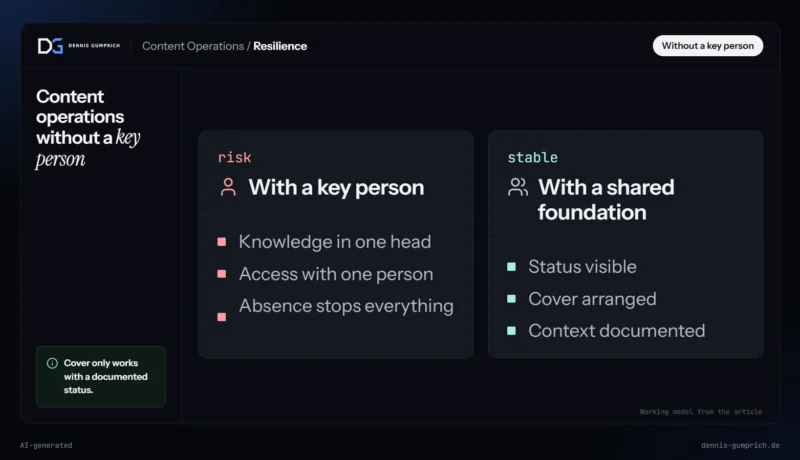

A message early in the morning: the colleague who runs your editorial plan will be out for the next three weeks. No drama, these things happen.
By noon you realize: nobody knows which pieces are planned for this week. Two approvals are sitting in her inbox. The access to two tools is in her name. And the agency is waiting for feedback nobody knew about. Why tools end up on personal accounts in the first place is described in Shadow IT in marketing: what unapproved tools really cost you.
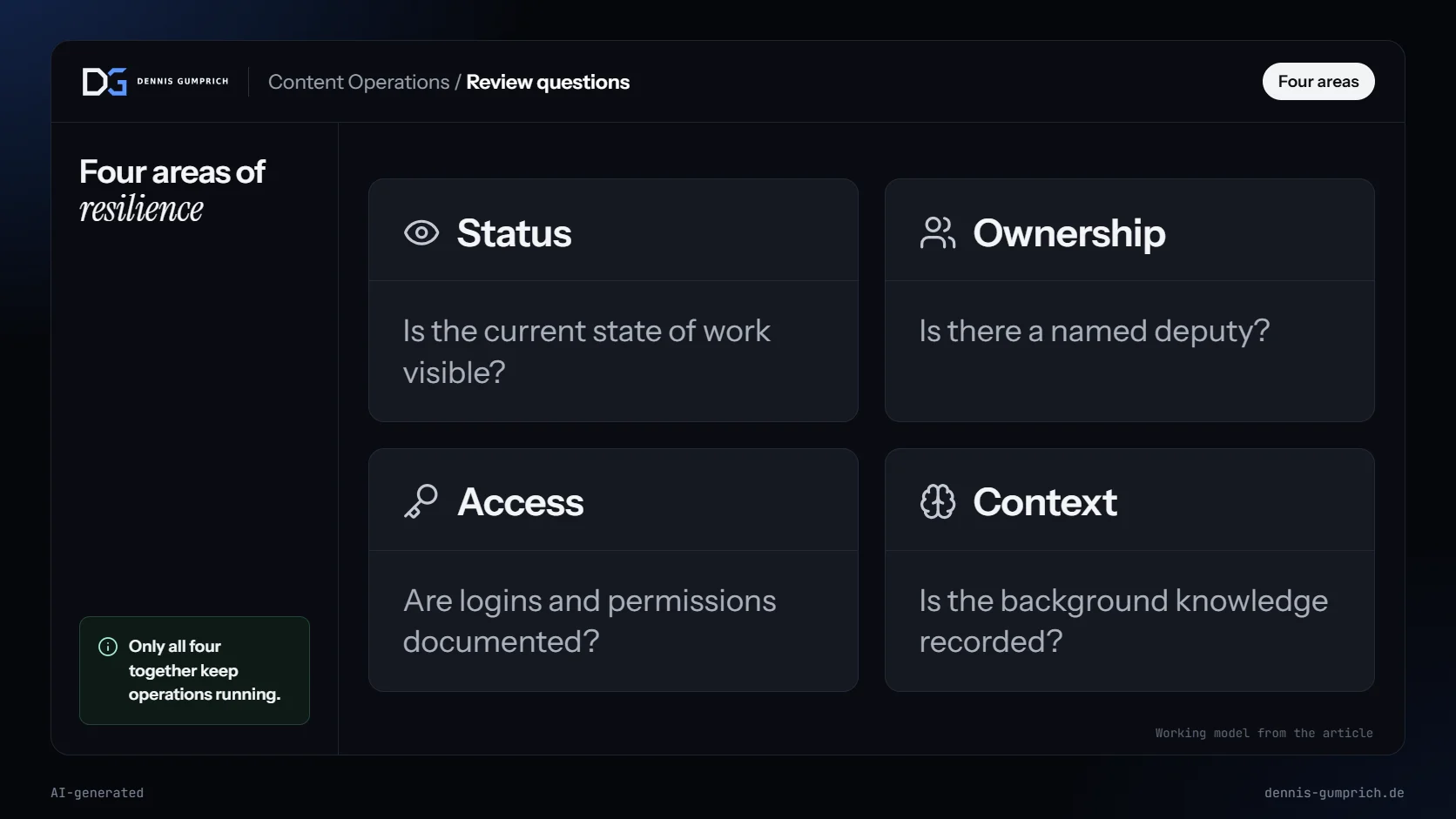
Content operations are resilient when four things exist independently of people: the current status of all ongoing topics, ownership of each process, access to systems and the context you work with. If one of them is missing, part of production goes down with one person.
Why it is almost always the same four things
When a key person is absent, a professional problem rarely arises. Others could take over the tasks. What is missing are the preconditions for this, and they are identical in almost all teams.
First, the status. The editorial plan shows what is planned, but not what has actually happened: who is waiting for whom, which commitment was given verbally, which piece is stuck on an open question. This knowledge exists in one person's head.
Second, ownership. When tasks are distributed by availability, it is not clear who steps in during an absence. Cover is then negotiated at the moment of absence, which is exactly when nobody has time for it.
That ownership belongs to roles rather than people is also a key point of content governance. In his article "The critical elements of a content strategy" (in German), Robert Weller describes governance as defining who decides, explicitly as a role and not a person, and by which process content is reviewed, updated or withdrawn. In his non-representative evaluation of 34 master's theses at FH JOANNEUM Graz from 2022 to 2025, governance appears in only almost half of the theses, whereas competitive analysis appears in over 80 percent. For you, this means: name the deputy as a role before someone is absent, so nobody has to negotiate it in an emergency.
Third, access. Tools that run on a personal account cannot be used during an absence. This particularly affects tools that individuals bought themselves because it was quicker.
Fourth, context. Brand voice, templates and verified information that only one person knows are not available during an absence. The deputy then produces content that sounds different, and that is noticed immediately.
In his article "Topic plan, content plan, editorial plan" (in German), Robert Weller calls this pattern the institutionalization risk: positioning exists only in individual people's heads and is lost when staff change. As a remedy, he recommends a single point of truth, that is, a database with several views. This is a consultant's assessment, not a survey. For you, this means: in the stress test, explicitly check whether positioning and topic logic can be found without the missing person.
What knowledge is missing when a key person is absent?
Almost always the same four things: the status of ongoing processes, a named deputy with the same powers, access on company accounts instead of personal accounts, and context and templates such as brand voice and verified information.
Status of processes
For every ongoing topic, it is clear where it stands, who acts next and what is being waited for.
Review question: Could someone else read out the status tomorrow?
Ownership and cover
A named deputy per role with the same powers, not fewer.
Review question: Does the deputy know they are the deputy?
Access and permissions
Systems run on company accounts with several authorized users, not on personal logins.
Most common problem: tools bought by individuals on a private credit card.
Context and templates
Brand voice, verified information and templates are accessible, not in personal folders.
Review question: Does a new person find the guidelines without asking?
The third area links this topic with another: tools on personal logins were usually created as a quick solution, bypassing procurement. They are therefore both a risk in case of absence and a data protection issue.
How do you test your resilience in one day?
Resilience cannot be assessed theoretically. The fastest way is an announced test: one person does not take part in content work for a day, without handing anything over beforehand. The team works as normal and notes where it gets stuck.
| Observation | Cause | Measure |
|---|---|---|
| Nobody knows the status of a topic | Knowledge sits in someone's head | Record the status visibly per process |
| An approval cannot be given | No deputy with the same rights | Name and authorize a deputy |
| A tool is not accessible | Personal login | Switch to a company account |
| The text sounds different from usual | Context not stored | Make brand voice and templates accessible |
| An external commitment was unknown | Agreements only verbal | Note commitments on the process, not in the inbox |
The test costs one day and delivers a precise list. The announcement is important: an unannounced test feels like a check and creates resistance. An announced one creates attention for exactly the points that matter.
What distinguishes a planned holiday from an unplanned absence?
Teams prepare for holidays. There is a handover, open points are closed beforehand and the deputy is informed. That is exactly why holidays are not a good yardstick for resilience.
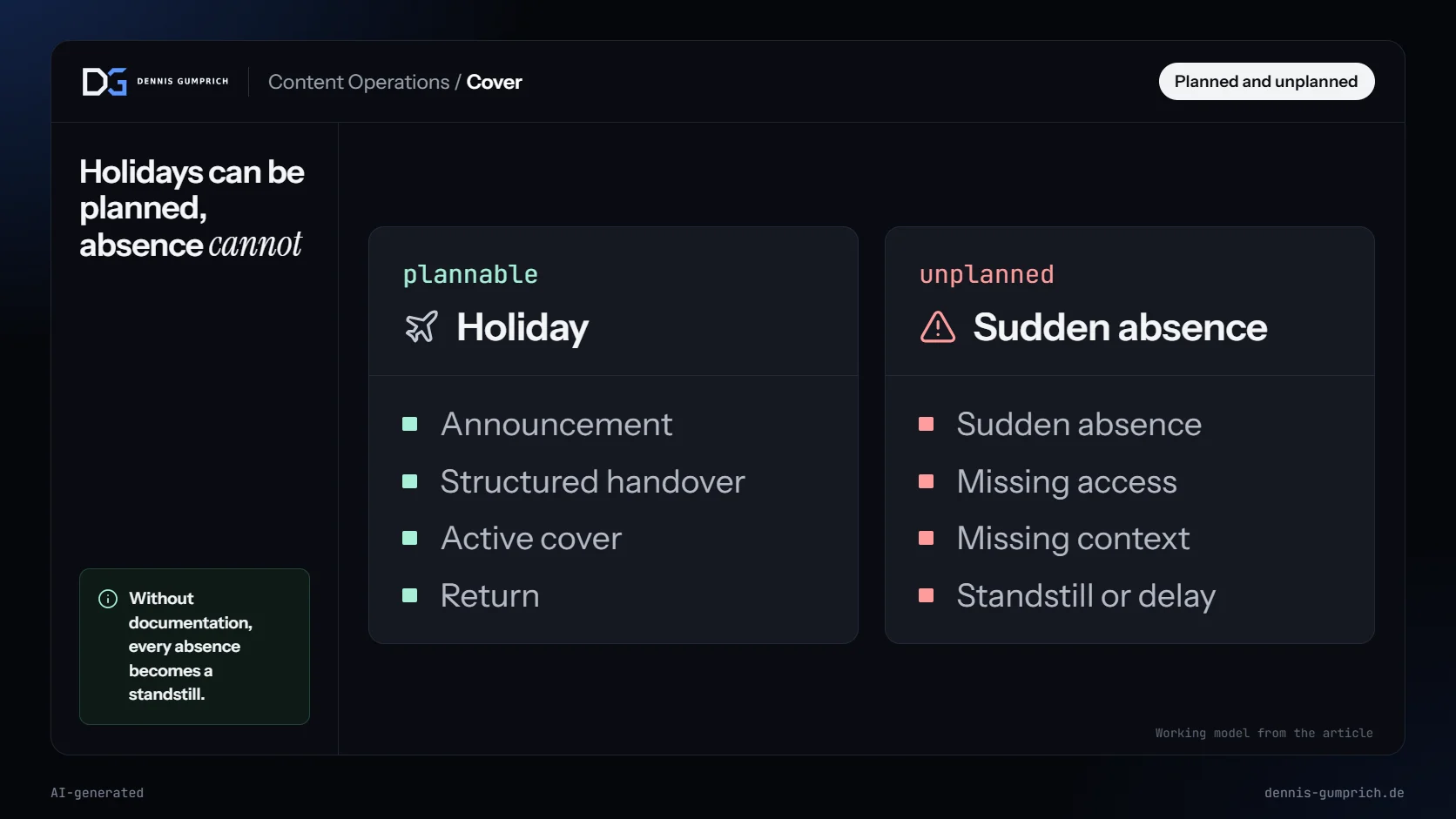
Handover possible, open points clarified beforehand, deputy briefed. Works even in teams without structure.
No handover, open commitments unknown, deputy not prepared. This shows what actually exists independently of people.
The practical consequence: do not orient yourself to the holiday case. The question is what happens if someone cannot be reached tomorrow. If your answer requires a handover, you are not resilient. How handovers between teams become binding is shown in the article on handovers between marketing and specialist departments.
What you do not need
Resilience is often confused with documentation. A detailed process manual helps little in an emergency, because nobody reads it when things are urgent, and because it goes out of date faster than it is maintained. A maintained knowledge base that both the team and AI access is more robust.
What works is something else: information where the work happens. The status on the process instead of in minutes. Ownership as a field instead of in a role description. Access as a permission instead of a password list. Context in the creation step instead of in a folder. Which roles need to be behind this for it to hold up is described in Who does what in the content team: the four roles you really need.
The difference is decisive for the effort. Documentation is additional work that competes in daily life. Visibility on the process arises along the way, because it is part of the work.
What resilience has to do with the use of AI
One connection is often overlooked in practice: the use of AI increases dependency on individual people if the context is not stored. Whoever achieves particularly good results usually does so with their own approaches that nobody else knows.
If this person is absent, output quality drops noticeably and immediately, and more strongly than before AI was used. Previously, everyone was about equally fast; now there is a gap linked to one person's availability.
The way out is the same as for the other areas: whatever sits in someone's head needs to be stored. Brand voice, verified information and proven approaches as shared context work the same for everyone, regardless of who happens to be working.
This also lets you check whether your use of AI is set up robustly. If the results depend on who sets the task, you have not achieved a process improvement but created another dependency.
Five mistakes in preparing for absences
- Relying on handoversA handover requires plannability. Exactly that is missing in an unplanned absence, the only case that counts.
- Cover without powersAnyone who is supposed to cover but may not approve cannot complete the process. The deputy needs the same rights.
- Knowledge in inboxesCommitments, agreements and open questions in a personal inbox are inaccessible during an absence. They belong on the process.
- Tolerating personal loginsA tool on a private account is blocked during an absence and is also a data protection issue.
- Falling back on documentationA manual is reassuring but does not work in an emergency. Visibility on the process does.
How do you make content operations resilient in five steps?
In four weeks: run a stress test, switch access to company accounts with at least two authorized users, name and inform a deputy with the same rights for each role, make the status of each process visible and move context such as brand voice and templates out of personal storage.
- Week 1Run a stress testOne person does not take part for a day, without handing over beforehand. The team notes where it gets stuck.
- Week 2Clean up accessSwitch all tools to company accounts, with at least two authorized people per system.
- Week 2Name and authorize deputiesOne person per role with the same rights. The deputy is informed, not just entered in a list.
- Week 3Make the status visibleFor each process: current step, who has the ball, what is being waited for. Short, but on the process.
- Week 4Store context accessiblyBrand voice, templates and verified information moved from personal folders to a shared place.
The second step regularly brings unpleasant things to light: tools nobody knew about, some paid for with private means of payment. Do not treat this as misconduct. These tools almost always came about because there was a need and the official route would have taken too long.
Self-check: how resilient are you?
Tick everything that applies to you.
A short assessment of a risk we have not addressed so far:
A large part of our content production depends on individual people. In an unplanned absence, the status of ongoing topics, several approvals and access to individual tools would not be available.
We propose a stress test: one person does not take part for an announced day, without handing over beforehand. This produces a concrete list instead of an assumption.
The foreseeable measures require little effort: switch access to company accounts, name and authorize deputies, make the status of each process visible. Effort around four weeks alongside regular work, with no additional budget.
The free RACI matrix template is suitable for assigning roles and deputies; its check column makes unfilled roles visible.
Conclusion: visibility beats handover
Resilience does not come from better handovers but from having less to hand over. What is visible on the process does not need to be passed on. What sits in someone's head or inbox disappears with the person. The difference costs no additional capacity, just a different place to keep things.
Frequently asked questions
Isn't this a sign of distrust?
On the contrary, it is a relief. Anyone who knows that operations continue without them can actually be ill or take holiday. The alternative is that individuals feel obliged to be reachable even when absent.
How detailed should the status be?
Three pieces of information are enough: current step, who has the ball, what is being waited for. More does not get maintained and is not needed in an emergency anyway. What matters is that it sits on the process and not in a separate report.
What do we do with tools on private logins?
Record, assess, transfer. Check whether the tool is needed and switch it to a company account. Sanctions are counterproductive, because further tools will then no longer be reported.
How often should we repeat the stress test?
Once a year is enough, plus after major changes in the team or tools. Change the person who sits out each time. Every role has its own blind spots.
What if we are too small for deputies?
Then cover lies outside the team, for example with the manager or in a specialist department, at least for approvals and access. Above all, it is important that status and context are visible. In small teams, this replaces a large part of the cover arrangement.
Where does your content process lose time today?
In 30 minutes, we look together at where unnecessary coordination, manual tasks, tool switching or repetitive content work cost you time today.
You get a concrete assessment of which tasks you can simplify, automate or organize better, and where AI and tools actually help instead of adding complexity.
Analyze your content process in 30 minutes Free of charge. You take away concrete starting points you can use internally right away.
Dennis Gumprich
Dennis helps marketing and communication teams fit generative AI into existing content processes without undermining quality, brand voice and approvals. Focus areas: content operations, AI governance and tool selection in mid-sized companies and corporations.
Transparency note: Dennis works for contentbird, a provider of AI-powered content software. Product mentions are marked in the article. More about Dennis (in German) · LinkedIn
Read more
Sources
- Microsoft Learn: Manage emergency access admin accounts, documentation on Microsoft Entra ID, as of June 5, 2026: at least two emergency access accounts, not tied to a single person, among other things for the case that the last authorized person leaves. Accessed October 31, 2026.
- Amazon Web Services: REL12-BP05 Conduct game days regularly, AWS Well-Architected Framework: announced, regular simulation of failure events to test people, processes and technology, followed by an evaluation. Accessed October 31, 2026.
- Robert Weller (toushenne.de): Die kritischen Elemente einer Content-Strategie (in German), article from March 30, 2026: content governance defines who decides (as a role, not a person), on what basis and by which process content is reviewed, updated or withdrawn; evaluation of 34 master's theses at FH JOANNEUM Graz from 2022 to 2025: competitive analysis in over 80 percent, content audit in almost 70 percent, content governance in almost half. Article by an independent consultant who names contentbird as a project reference; evaluation not representative. Accessed October 31, 2026.
- Robert Weller (toushenne.de): Themenplan, Content-Plan, Redaktionsplan (in German), article from March 12, 2026: production, strategy and institutionalization risk, the latter describing positioning that exists only in individual people's heads and is lost when staff change; recommendation of a single point of truth as a database with several views. Article by an independent consultant without data collection, who names contentbird as a project reference. Accessed October 31, 2026.
How this article was created
This article was created with the help of AI. Structure, research and draft wording were developed with AI support. Professional assessment, review of the statements and the final version are the responsibility of Dennis Gumprich. The English version was translated with AI and reviewed. Read the original German version.
How reliable are the statements?
Evidence exists for the principle of not tying critical access to a single person and providing at least two authorized users (Microsoft Learn), and the approach of simulating and evaluating failures in an announced and regular way (game days in the AWS Well-Architected Framework), as well as ownership as a role rather than a person in content governance, the institutionalization risk and the recommendation of a single point of truth (both Robert Weller, articles by a consultant; the evaluation of 34 master's theses is not representative). The transfer of both principles to content teams, the four areas, the stress test and the time figures are explicitly marked as working models and are not an industry standard. The statement that AI use without stored context increases dependency on individual people is an observation from consulting practice, not a measured value. As of October 31, 2026.


