

A content team can cope with too few people for a while. It cannot cope with unclear ownership.
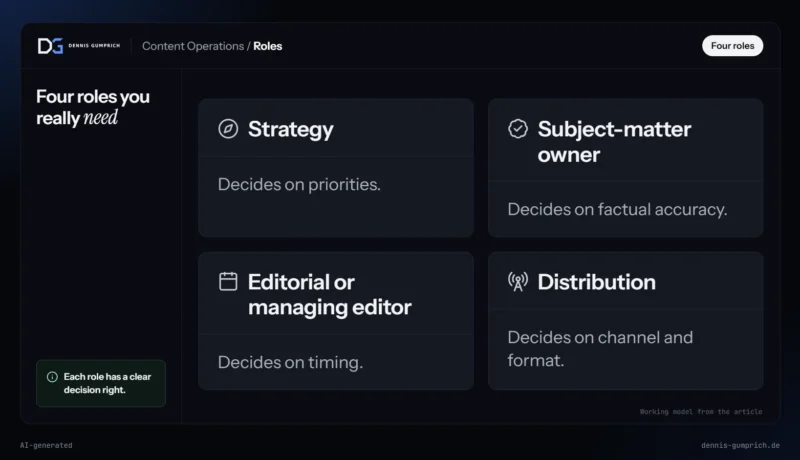
A content team does not need many roles, but four clearly separated ones: responsible for the topic, creating, editorial review and subject-matter approval. What matters is not who does which task, but that exactly one person has the ball at any given time and that this is visible to everyone.
The following sections show which four roles these are and how to fill them even in small teams. The most important principle comes first.
Why ownership belongs to roles, not people
In small teams, work is distributed by availability. Whoever has time does it. This works surprisingly long and creates two problems that only become visible when it stops working.
The first problem is cover. If ownership depends on people, it disappears with the person. Holidays, illness or a job change then do not stall one task but a function for which nobody else is named.
The second problem is the decision. If three people read a text but none of them explicitly decides, the result is not an approval but a collection of comments. The text stays put even though everyone has contributed. Teams experience exactly this as coordination effort, and in truth it is a role problem.
A role is not a position and not a person. It is a named function with decision authority. In small teams, one person takes on several roles, and that is perfectly fine. What is not fine is a role left unfilled, or two people filling the same role at the same time without it being clear who decides.
Which roles does a content team really need?
Four: topic ownership decides whether and when a topic comes. Creation decides how it is implemented. Editorial review decides whether the text can be published as it is. Subject-matter approval confirms that the statements are correct. What gets distributed is decisions, not tasks.
Topic ownership
Decides whether a topic comes, when and with what goal. Responsible for prioritization against other topics.
Decides: whether and when.
Creation
Writes or commissions writing, sources material, implements channel derivatives. Responsible for the draft being complete.
Decides: how the content is implemented.
Editorial review
Checks against brand voice, structure and clarity. Responsible for the quality of presentation.
Decides: whether the text can be published as it is.
Subject-matter approval
Confirms that statements are correct in substance. Often sits outside marketing.
Decides: whether the statements are accurate.
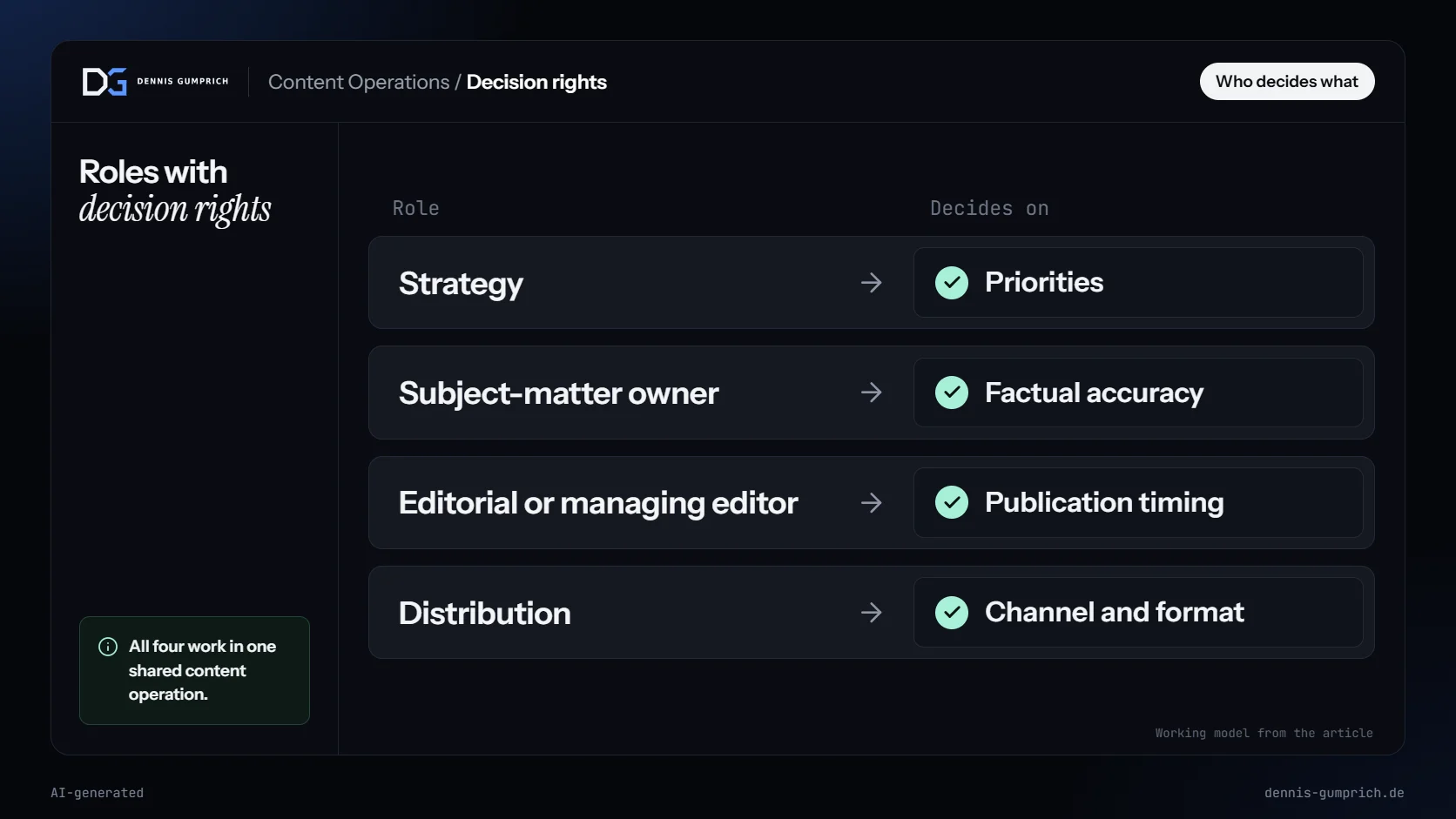
The most important sentence about these four roles is: each one decides something different. If two roles answer the same question, you get duplicated work and, in case of conflict, standstill. If no role answers a question, it stays open until someone asks.
How do you distribute four roles across a team of three?
Roles are not positions. With one or two people, one person takes on roles one to three, and subject-matter approval sits with the specialist department. The critical point is always self-review: editorially reviewing your own creation works poorly. Record the assignment in writing once.
The four roles do not mean four people. In practice, they are distributed differently depending on team size, and you should record exactly this assignment in writing once.
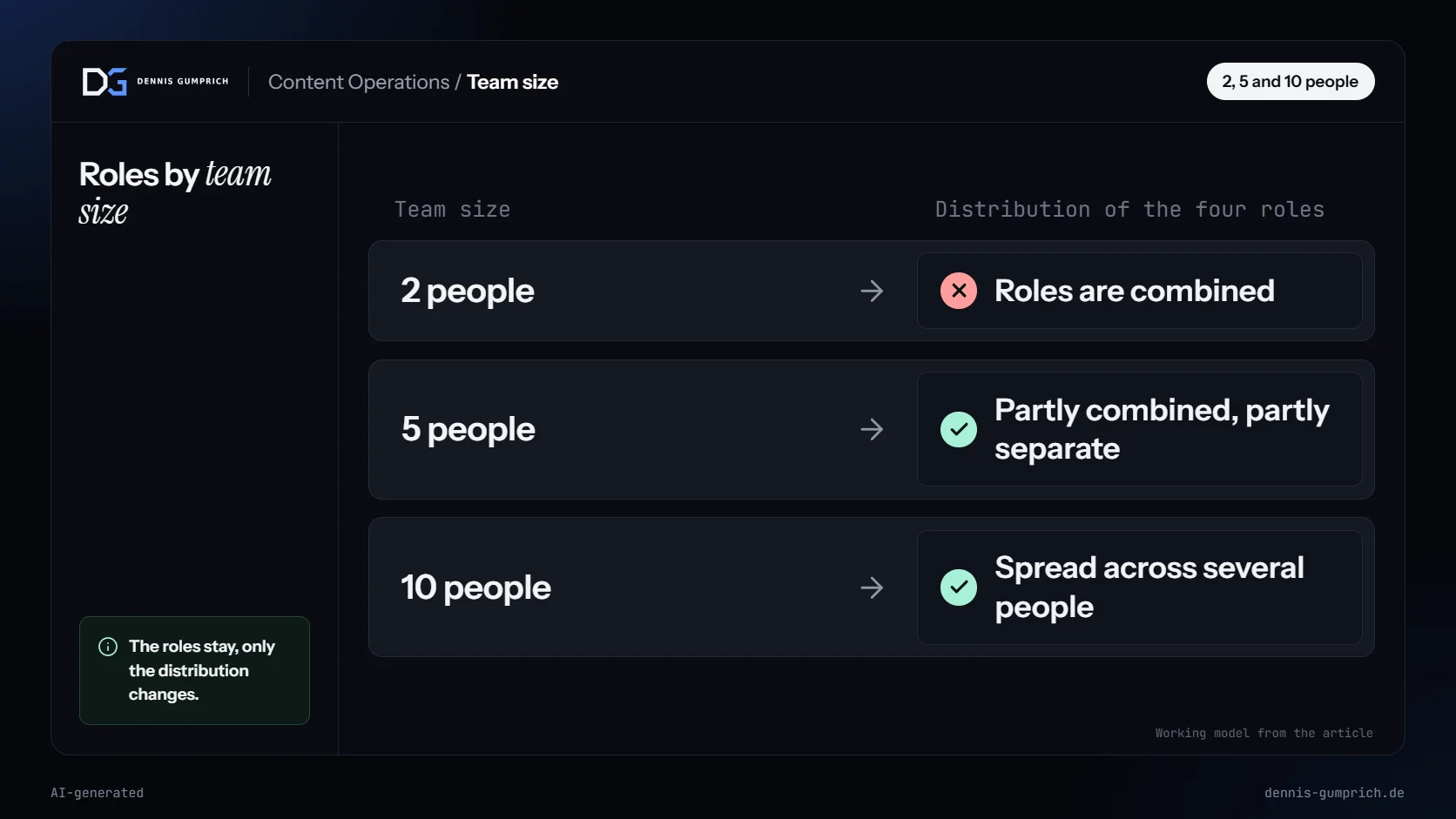
| Team size | Typical distribution | Critical point |
|---|---|---|
| 1 to 2 people | One person takes on roles 1 to 3, role 4 sits with the specialist department | Self-review: editorially reviewing your own creation works poorly |
| 3 to 5 people | Roles 1 and 3 with one person, role 2 rotating, role 4 external | Role 2 rotates without anyone recording it |
| 6 to 10 people | All four roles filled separately, some several times | Two people fill role 3 at the same time |
| Several brands or locations | Roles per brand, coordinating role above | Role 1 is unclear because several areas bring in topics |
The first row deserves attention. In very small teams, separating creation from editorial review is practically impossible, because the same person does both. The workable way out is time distance: a text is not reviewed on the same day it was written. This does not fully replace a second person, but it catches a considerable share of oversights.
Record the assignment in a place where it is visible in everyday work, not in an org chart. Two sentences per role are enough: who fills it, who covers, what it decides.
Which role is missing in most content teams?
In most teams, creation and review are settled. What is regularly missing is topic ownership. Topics then arise from requests: sales needs something, management has an idea, a business unit wants to highlight a product.
Without named topic ownership, every request becomes an order, because nobody is authorized to decline or postpone it. The team then works by arrival rather than by plan. Many content teams experience exactly this as a resource problem, even though it is a decision problem.
How much request pressure marketing teams face is shown by the "B2B Marketing Budgets 2026" study by the German B2B marketing association bvik (in German). Of 115 B2B marketers surveyed, almost all heads of marketing or decision-makers and mostly from industry, 74 percent also see their marketing as an internal service provider, for example for HR or sales. At the same time, the number of employees in marketing and communications has fallen slightly compared with 2025. The sample is small and limited to one market, but the picture is clear: many teams serve internal requests with a headcount that is not growing. For you, this means: the authority of topic ownership to decline is not a nice-to-have but the place where this pressure is managed.
Topic ownership needs three powers to be effective: it may prioritize, it may postpone and it may decline. If one of them is missing, it is a collection point, not a role. The third power in particular is rarely granted explicitly and is exactly the one that makes the difference.
How can you tell that roles are missing?
By five symptoms: texts stall for no apparent reason. Feedback is contradictory. Nobody says no to requests. Production stops when someone is absent. Discussions end without a decision. The third is the most expensive, because a team without the authority to decline works permanently at the limit of its capacity.
Texts stall for no apparent reason. Feedback is contradictory. Nobody says no to requests. Production stops when someone is absent. Discussions end without a decision.
For every process, it is clear who has the ball. Contradictory feedback is resolved by a named role. Requests are prioritized instead of queued.
The third symptom on the left is the most expensive. A team without the authority to decline works permanently at the limit of its capacity and loses the ability to work on its own topics. This rarely shows up as a role problem, but as a staff shortage.
Roles and the use of AI
As soon as AI contributes to creation, the weight shifts between the roles. Creation gets faster, review gets more important. If you leave the role distribution unchanged, you get more drafts with the same review capacity and therefore a new bottleneck. Which competencies the individual roles need for this is described in AI know-how in online marketing.
In practice, this means two things. First, editorial review needs a larger share of time than before, not a smaller one. Second, its content shifts: instead of smoothing wording, it checks statements and evidence more closely, because that is where the typical errors arise.
This does not require a new role. What it requires is an explicit assignment: who decides whether a statement is evidenced, and who decides whether the context is maintained. Both usually fall under editorial review, but are rarely named there and therefore get left undone.
A voluntary framework from the US also recommends this assignment. The NIST Generative AI Profile (NIST AI 600-1) lists human review of generated content under MG-3.2-008 and recommends under GV-1.6-003 recording roles and responsibilities for human oversight in an AI inventory, together with details of the models and versions used. For a content team, a short list is enough: who reviews AI drafts, who maintains the context and which tool is used.
The second point concerns topic ownership. When drafts are created faster, the temptation to produce more grows. Without clear prioritization, the speed gain leads to more content rather than better content, and the review effort grows with it.
Five mistakes in distributing roles
- Tying roles to positionsA role is a function, not a position. If you bind it to a job description, you cannot transfer it during absences.
- Defining too many rolesEight finely cut roles look tidy and are ignored in daily work. Four are enough and get applied.
- Mixing editorial work and creationAnyone reviewing their own text reads past their own assumptions. Where separation is impossible, time distance helps.
- Topic ownership without the authority to declineA role that has to accept everything does not prioritize but manages a queue.
- Not naming a deputyEvery role without a second person stalls part of production during absences.
Five steps to clear roles
- Step 1Trace three processesTake three completed pieces and write down who decided what and when. Not who worked on them, but who decided.
- Step 2Assign decisions to the four rolesIt usually turns out that one role is filled several times and another not at all.
- Step 3Name one person per roleOne person may fill several roles. One role may not have several people at the same time.
- Step 4Define coverA second person per role with the same powers, not fewer.
- Step 5Make it visibleFor every ongoing process, record visibly which role currently has the ball. This replaces most status requests.
The second step regularly delivers the most surprising insight. In many teams it turns out that editorial review is performed by three people, while topic ownership lies with nobody. This explains both contradictory feedback and the overload from requests.
Self-check: are your roles clear?
Tick everything that applies to you.
A proposal for how we reduce idle times and contradictory feedback:
Our delays rarely come from a lack of time, but from it being unclear who decides. We propose four separate roles: topic ownership, creation, editorial review and subject-matter approval. Each decides something different.
It is important to us that topic ownership is explicitly allowed to decline and postpone. Without this power, we work by arrival rather than by priority.
One person may fill several roles. We do not need additional positions, but a written assignment including cover. Effort: one 60-minute meeting based on three traced processes.
In very large teams or across several locations, this structure often grows into a steering model of its own with clearly named decision rights: the corporate newsroom. How these four roles are further differentiated there and who decides in case of conflict is shown in The corporate newsroom as a steering model. What the managing editor, topic desk and media desk actually do day to day is described in Newsroom roles.
Conclusion: distribute decisions, not tasks
The usual role description lists tasks. That does not help much, because tasks get distributed anyway. What does not distribute itself is decisions. Defining which role makes which decision solves a large part of what teams experience as coordination effort. Roles are the second of six building blocks in content operations and the precondition for planning and approvals to work at all.
Frequently asked questions
There are only two of us. Do we even need this?
Yes, but on a smaller scale. Two points matter: topic ownership needs the authority to decline, and editorial review should not take place on the same day as creation. Everything else you can combine.
What if subject-matter approval does not cooperate?
Then the role is not filled, and you should call it that. Clarify with the specialist department who fills it and who covers. An unfilled role is a finding you can escalate, whereas a lack of time remains a permanent state.
How do we handle agencies?
An agency usually takes on role 2. Roles 1, 3 and 4 stay with you, even if the agency works editorially. If you hand over editorial review completely, you lose control over your brand voice.
How often should roles be reviewed?
With every change in the team and at least once a year. The review is particularly important after new hires: new people often take on a role in practice without anyone having recorded it.
What if two roles contradict each other?
Define in advance which role decides in case of conflict, usually topic ownership. It is important that this rule exists before the first conflict. Afterwards, it is read as a question of power rather than a procedure.
How does content marketing work without a dedicated marketing department?
Through clearly distributed roles instead of positions. Even without a dedicated department, you need someone who prioritizes topics and may decline them, someone who writes or commissions texts, and a subject-matter review. In small companies, management, sales and external support often take this on. It is important that these responsibilities are written down, otherwise content marketing remains the task that gets left behind as soon as day-to-day business gets busy.
Where does your content process lose time today?
In 30 minutes, we look together at where unnecessary coordination, manual tasks, tool switching or repetitive content work cost you time today.
You get a concrete assessment of which tasks you can simplify, automate or organize better, and where AI and tools actually help instead of adding complexity.
Analyze your content process in 30 minutes Free of charge. You take away concrete starting points you can use internally right away.
Dennis Gumprich
Dennis helps marketing and communication teams fit generative AI into existing content processes without undermining quality, brand voice and approvals. Focus areas: content operations, AI governance and tool selection in mid-sized companies and corporations.
Transparency note: Dennis works for contentbird, a provider of AI-powered content software. Product mentions are marked in the article. More about Dennis (in German) · LinkedIn
Read more
Sources
- Paul Rogers and Marcia Blenko, Harvard Business Review: Who Has the D? How Clear Decision Roles Enhance Organizational Performance, article, January 2006 issue: decision bottlenecks arise when it is unclear who decides what. The RAPID model explicitly defines decision roles. Accessed October 31, 2026.
- IT@Cornell, Cornell University: RACI and RASCI Definitions, IT service management guide, undated: roles Responsible, Accountable, Consulted and Informed, with only one accountable person with decision authority per task or decision. Accessed October 31, 2026.
- Workday: New Workday Research: Companies Are Leaving AI Gains on the Table, press release from January 14, 2026 on the Beyond Productivity report, 3,200 respondents, conducted by Hanover Research: almost 40 percent of the time saved through AI is lost to rework such as correcting, rewriting and checking. Accessed October 31, 2026.
- bvik: bvik study B2B Marketing Budgets 2026 (in German), results page from September 3, 2026, survey of 115 B2B marketers in Germany (95 percent heads of marketing or decision-makers, mostly industry, 69 percent from companies with more than 500 employees), time series since 2011: number of employees in marketing and communications slightly lower than in 2025, 74 percent also see marketing as an internal service provider, for example for HR and sales. Association survey with a small sample. Accessed October 31, 2026.
- NIST: Artificial Intelligence Risk Management Framework: Generative Artificial Intelligence Profile (NIST AI 600-1), framework from July 26, 2024, by Chloe Autio, Reva Schwartz and Jesse Dunietz among others, companion document to the AI RMF 1.0: MG-3.2-008 human review of generated content, GV-1.6-003 recording roles and responsibilities for human oversight in the AI inventory, including provenance details, models and versions used. Voluntary framework from the US. Accessed October 31, 2026.
How this article was created
This article was created with the help of AI. Structure, research and draft wording were developed with AI support. Professional assessment, review of the statements and the final version are the responsibility of Dennis Gumprich. The English version was translated with AI and reviewed. Read the original German version.
How reliable are the statements?
Evidence exists for the principle that unclear decision roles create bottlenecks (Rogers and Blenko, Harvard Business Review), the rule that exactly one person carries final accountability per decision (RACI definition by IT@Cornell) and Workday's finding that with AI use, a large share of the time saved flows into review and rework, as well as the high share of marketing teams that also work as internal service providers with a slightly reduced headcount (bvik study B2B Marketing Budgets 2026, small sample from Germany) and the recommendation to record roles for human oversight of AI (NIST AI 600-1, voluntary framework from the US). The role model and the distribution table are explicitly marked as working models. They are based on observations from conversations with content teams and are not an industry standard. As of October 31, 2026.


