

The blog article is finished. What is still missing is the LinkedIn post, the newsletter teaser, the Instagram format and the text for the internal employee app. You have exactly one piece of content, but four people are now rewriting it four times.
On Monday, the report shows that the LinkedIn post did well and the newsletter did not. Nobody knows why, because the two texts now differ in substance.
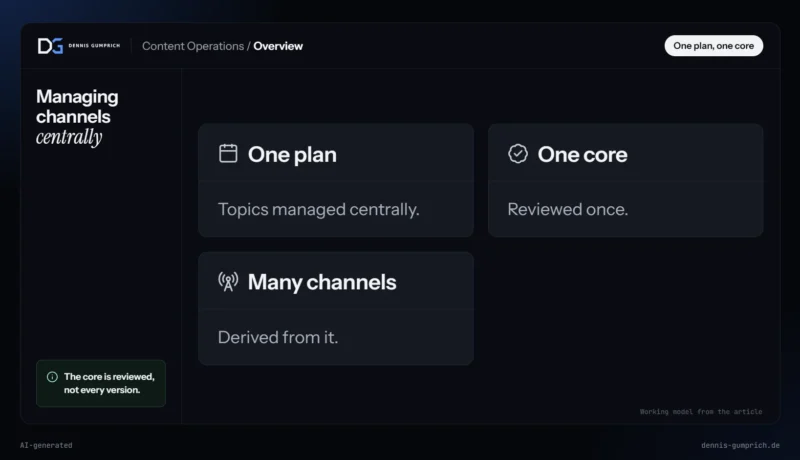
Managing content channels centrally does not mean serving all channels from one tool. It means that four things are in one place: a shared topic plan across all channels, an approved core message per topic, a profile per channel with goal, format and responsibility, and status and evaluation per topic instead of per channel. Channel versions are derived from the approved core, not rewritten. This saves duplicate work and makes results comparable across channels for the first time.
What does it mean to manage content channels centrally?
Managing centrally means: one team decides in one place which topic appears on which channel and when, and sees in the same place where each channel version stands and what it achieved. Creation can remain distributed. What matters is that planning, core, status and evaluation do not fall apart across five tools and three spreadsheets.
Four building blocks make the difference between managed centrally and merely served in parallel:
| Building block | What it governs | How you notice it is missing |
|---|---|---|
| One topic plan for all channels | Which topic appears on which channel and when | Each channel has its own plan, duplicates only become apparent after publication |
| One core message per topic | Statement, evidence and consequence, reviewed and approved once | The same message appears on LinkedIn and in the newsletter with different figures |
| One profile per channel | Goal, target group, format, frequency and responsibility | Nobody can say what a channel is actually for |
| Status and evaluation per topic | Which version is where and how the topic performed across all channels | Reports show channels, but not which topic carries |
How the topic plan that supports all channels is structured is described in From editorial calendar to topic plan. Central channel management is thus a building block of content operations, that is, the question of which roles, processes and tools your content operation runs on.
Do more channels automatically bring more impact?
The usual diagnosis is: we are active on too few channels. The actual cause is usually different. You are active on enough channels, but each channel is treated as a separate project.
This creates three effects that reinforce each other. The effort rises linearly with each channel because nothing is reused. The messages drift apart because four people set four priorities. And the evaluation becomes worthless because in the end you are not comparing the same content, but four different pieces.
The lever is therefore not adding a fifth channel. It lies in deriving the existing content cleanly.
How do you derive several channel formats from one core piece of content?
Every piece of content has a core and a packaging. The core is the one statement you want to prove, together with evidence and consequence. The packaging is everything that changes per channel: length, opening, tone, format, call to action.
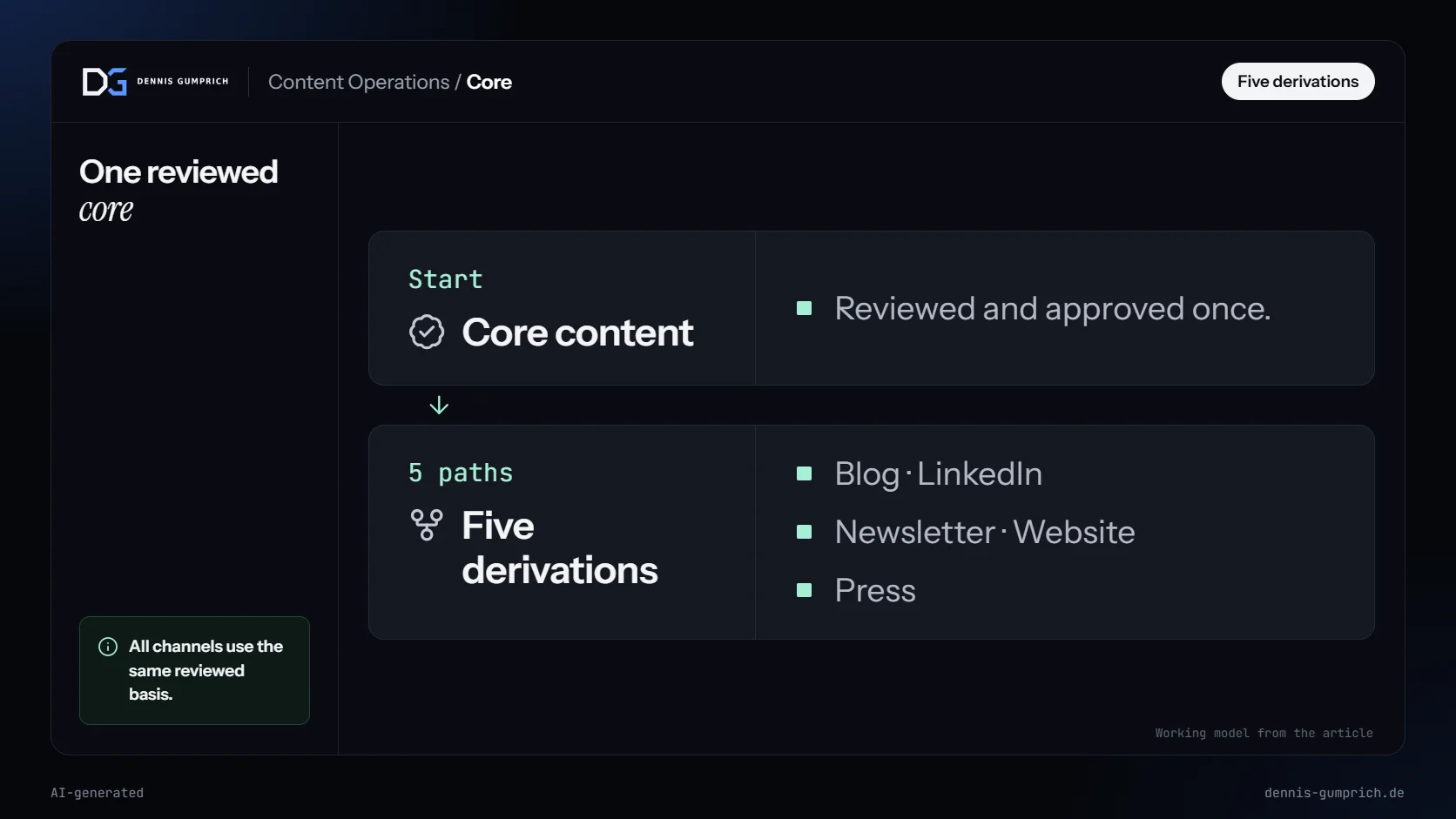
A simple test: if you cannot write down the core message of an article in one sentence, it is not ready for derivation. Then you discuss content again on every channel instead of formats.
| Channel | What changes | What stays the same |
|---|---|---|
| Blog or website | Full line of reasoning, examples, internal links | Core message, evidence, consequence, brand voice, facts |
| Opening with a concrete situation, short paragraphs, a question at the end | ||
| Newsletter | Direct address, one clear reason to click, subject line as a test of its own | |
| Instagram or TikTok | Visual implementation, message condensed into one line | |
| Internal channels | Reference to roles and responsibilities instead of target group benefit |
The practical value of this table lies in the right-hand column. As soon as it is clear what is not negotiable on any channel, derivation becomes a routine task. And this is exactly where AI becomes useful, because converting formats within fixed guardrails is a task that language models handle reliably.
How do you create blog articles and social media posts from one briefing?
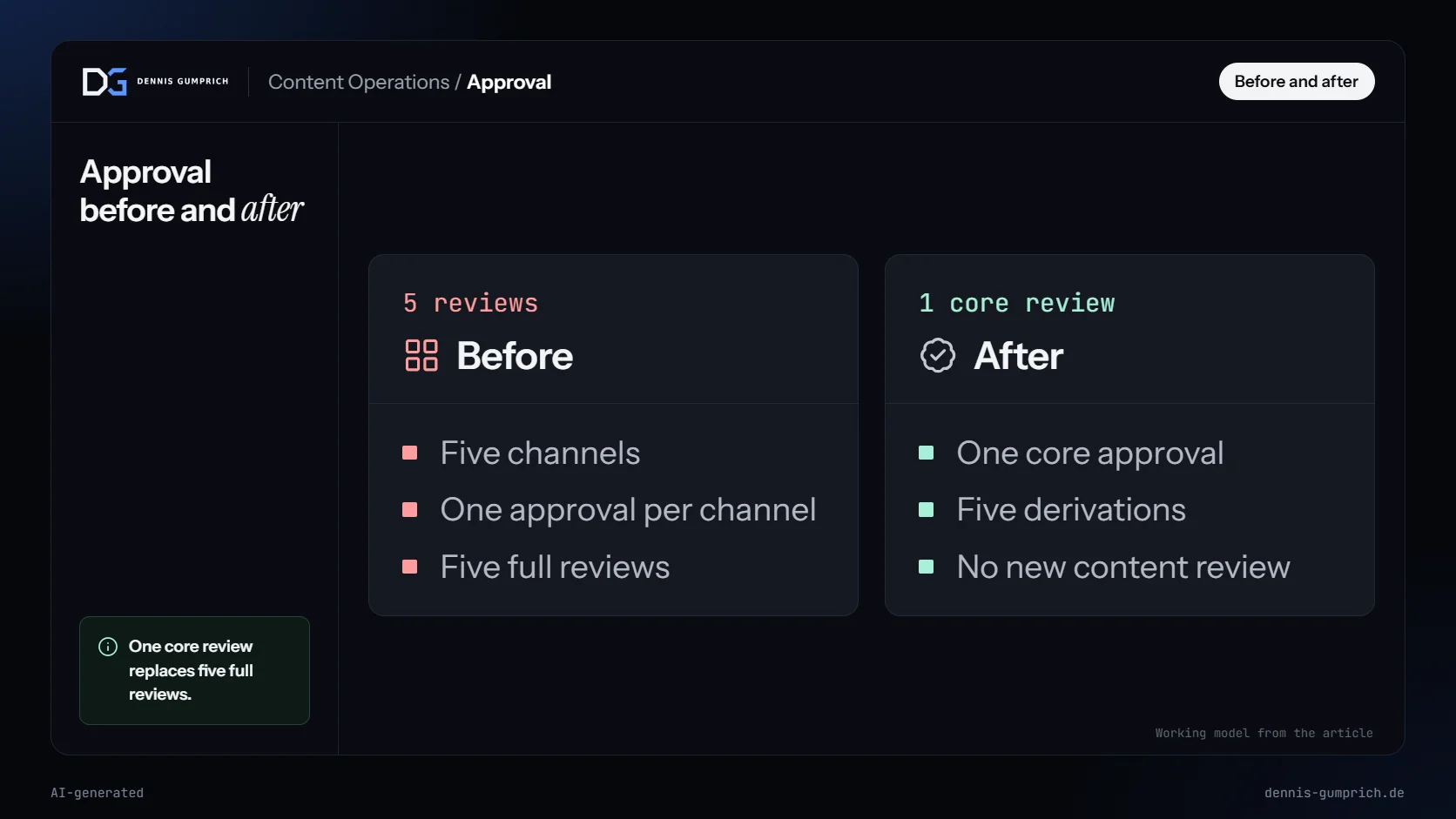
In a fixed order: the briefing includes the derivations from the start, the blog article is written and approved first, and only then are the social media versions created from the approved text. This way you check the facts once instead of five times, and every derivation carries the same core message. How to set this up as a fixed process with briefing, approval rule and measurement is described in One briefing, five formats: content repurposing as a process.
| Field | What it is needed for |
|---|---|
| Core message in one sentence | Common denominator of all formats |
| Evidence and source | Checked once and used everywhere |
| Target group and goal per channel | Blog for search and depth, LinkedIn for discussion, newsletter for retention |
| Planned derivations | Which formats are created, who creates them, by when |
| Call to action | What the reader should do after each format |
For the derivations themselves: each channel version needs its own opening that is understandable without the blog article. A shortened first paragraph is not a social media version. This is where AI takes over most of the work, because it reliably generates variants in length and tone from an approved text. How to define the tone per channel is described in On-brand AI content.
The same order can be found in process models for corporate newsrooms. In the standard process in the corporate newsroom (in German), described in May 2026 by Nils Becker of the consultancy Mediamoss based on a model by Christoph Moss, the specialist department first approves a base document in substance. Only then does media management adapt it for the individual channels. This is a consultancy model in its own publication, not a survey. For you, this means: content approval belongs at the core, not at every single channel version.
What belongs in a channel profile?
Seven items that are fixed in writing for each channel: goal, target group, format, frequency, responsibility, approval and KPI. With this profile, "we should do something on LinkedIn again" becomes a plannable task, and AI can derive the channel version according to fixed rules.
| Item | Example LinkedIn company page | Example newsletter |
|---|---|---|
| Goal | Trust among decision makers, starting discussions | Retaining existing contacts, clicks on expert articles |
| Target group | Marketing leads and executives in mid-sized companies | Customers and prospects with consent |
| Format | Text with image or document, opening with a concrete situation | Three topics with two sentences and one link each |
| Frequency | Two posts per week | Once a month |
| Responsibility | Social media channel owner | Email channel owner |
| Approval | Core centrally, channel version by the channel owner | Core centrally, channel version by the channel owner |
| KPI | Interactions per post and profile visits | Open and click rate per topic |
The profile is also the best template for AI: if you store the goal, format and a successful example for each channel, you get derivations that sound like the channel and not like the blog article. If a channel has no goal, it is a candidate for the cut list.
Where does AI really help in multichannel work?
In format conversion, that is, deriving channel-specific variants from an approved core text. The facts are then fixed, and it is only about length, opening and tone. AI is less suitable wherever the content decision has yet to be made.
It pays to distinguish carefully here. Not every task in the multichannel process is equally suited to AI.
Format conversion
Deriving channel-specific variants from an approved core text. The facts are fixed, it is about length, opening and tone. This is exactly what language models are built for.
Variants for tests
Five subject lines, three openings, two calls to action. You make the selection, but the drafts are created in minutes instead of hours.
Topic suggestions
Useful as a spark for ideas, but often generic without your market knowledge. Use it as a supplement to customer conversations, not as a replacement.
Channel strategy
Which channels you serve and which you cut depends on your target group, your resources and your sales goals. You cannot delegate this decision.
Self-check: how clean is your derivation?
Tick what applies to you. The assessment appears immediately. The more ticks, the cleaner your setup.
The derivation process in five steps
- Before productionRecord the core message in one sentenceFormat: statement, evidence, consequence. Example: "Unapproved tools arise from slow approvals, which costs us traceability, so we are shortening the approval path." Without this sentence, the rest is busywork.
- Before productionAssign channels by goalWhich channel should bring reach, which trust, which inquiries? A channel without an assigned goal is a candidate for the cut list.
- ProductionCreate and approve the core contentApprove first, then derive. If you derive in parallel, you correct every change five times.
- DerivationGenerate variants, provide guardrailsThis is where AI comes in. Provide the core message, target group, channel, length, tone and an example of a successful post. Without an example, you get average.
- After publicationEvaluate per topic, not per channelThe interesting question is not how LinkedIn did, but how this topic did across all channels. Only that shows you which topics carry.
Subject: Bundle channel work instead of multiplying it
We currently serve several channels, but create the content for them largely separately. This costs time and makes our evaluation useless, because in the end we are not comparing the same content.
Proposal in three points:
- For each topic, we will record one core message in one sentence: statement, evidence, consequence. This message is identical on all channels.
- We assign a goal to each channel: reach, trust or inquiries. Channels without a goal are reviewed for removal.
- We derive the channel-specific versions from the approved core text instead of rewriting them.
Expected effect: less duplicate work with the same channel coverage and, for the first time, an evaluation by topic rather than by channel.
Effort for the switch: one 60-minute alignment plus a test run with one topic.
Which software do you use to manage content channels centrally?
The software that closes your gap, and that is rarely a single tool for everything. Social media management tools manage social media centrally, content marketing and content operations platforms manage topics across website, newsletter and social, and a CMS manages delivery to website and app. Check whether topic plan, core approval, status per channel and evaluation per topic are tied to one record.
| Category | Manages centrally | Gap that remains |
|---|---|---|
| Social media management | Planning, publishing, inbox and reporting for social media channels | Website, newsletter and press run elsewhere, the topic core sits outside |
| Content marketing and content operations platform | Topic plan, briefing, creation, approval and status across all channels | Channels without a direct connection need an interface |
| CMS or headless CMS | Delivery of structured content to website, app and other output channels | Topic planning and editorial approval are usually weak |
| Project management | Tasks, deadlines and responsibilities | The content sits next to it as a file, channel versions are not linked |
| Marketing suite | Campaigns, email, CRM and parts of social | Editorial depth in planning and approval |
In teams with five or more channels, the sustainable solution is usually a combination: one platform holds topic, core and status, and the channel tools handle delivery. For this to work without copy and paste, you need connections such as those described in The last mile into the CMS and MCP or API. Comments and messages from all channels are bundled in a social inbox. Which vendors belong to which category is shown in the overview Content marketing software for teams.
Five mistakes that make multichannel expensive
- Adding channels without cutting anyEvery new channel ties up capacity permanently. If you add without cutting, you spread the same working time across more surfaces and become weaker everywhere.
- Publishing the same text everywhereThe other extreme. If you post the blog text unchanged on LinkedIn, you save time and lose impact. The core stays the same, the packaging does not.
- Deriving before the core text is approvedEvery change to the original triggers corrections in all variants. Approval first, always.
- Using AI without an example and without brand voiceA model without context delivers average. Provide a successful post of the same kind, and quality improves noticeably right away.
- Evaluating only per channelChannel reports show you which platform is performing. They do not show you which topic carries. But that is exactly the question your planning needs.
Transparency note: I work as a Senior Consultant at contentbird, a provider of AI-assisted content software. Platforms of this kind can hold core content and derived channel variants in one record, which makes evaluation by topic easier. Whether that is the right answer for you depends on your team size and your approval paths. The criteria for this are in the article on content marketing software for teams.
When fewer channels are the better answer
If your team consists of one or two people, multichannel in the classic sense is not a realistic goal. Two channels served consistently are more effective than five channels with irregular posts.
For B2B products that need explaining and have few relevant decision makers, it is also worth asking whether reach is your bottleneck at all. If your market consists of 300 companies, an additional social channel brings you less than a better sales process.
Conclusion: one core, many packagings
Multichannel does not become manageable because you write faster. It becomes manageable when you stop treating each channel as separate content. The core message is the constant, everything else is format. Your channel work is managed centrally when topic plan, core, channel profiles and evaluation per topic are in one place, even if delivery runs through several tools.
This topic-based rather than channel-based view is essentially the same principle that larger organizations use when they separate topic and channel responsibility organizationally. How this looks in a structured way is described in Topic management in the corporate newsroom.
Frequently asked questions
Which software can I use to manage content channels centrally?
For social media alone, a social media management tool. For website, newsletter, social and press together, a content marketing or content operations platform that bundles topic plan, core approval and status per channel in one record. Channels without a direct connection are connected via interfaces. A tool that serves all channels itself is not a prerequisite.
Who should manage the channels centrally?
A person with topic responsibility, not the sum of the channel owners. They decide which topic appears where and when, and approve the core. The channel owners decide on the form on their channel. In newsroom models, this separation is called topic and channel management; more on this in Newsroom roles.
How many channels make sense?
Less a question of number than of capacity. A practical rule of thumb: about one to two channels per person in the content team that are served regularly. Anything beyond that tends to lead to irregular frequency, and that costs impact: in an analysis by Buffer, accounts that posted in at least 20 of 26 weeks achieved 450 percent more interactions per post than accounts with at most four active weeks. The time for comments and messages also has to be included. How to bundle them is described in Social inbox: answering comments and messages centrally.
What is the difference between multichannel and omnichannel?
Multichannel means that you are present on several channels. Omnichannel additionally means that the channels are connected and a user can switch seamlessly between them, for example from the online shop to the store. For most content teams, multichannel is the realistic goal; omnichannel is a question of IT architecture.
Should we assign separate people to each channel?
Only from a certain size. As long as the core content is created jointly, channel-based responsibility makes sense. It becomes problematic when each person also makes independent content decisions. Then the messages drift apart.
How do we prevent AI variants from all sounding the same?
Provide a separate example for each channel, not a general wish for a tone. A successful LinkedIn post as a template has a much stronger effect than the instruction to write casually. And define what must not be used on any channel, such as certain stock phrases.
Where does your content process lose time today?
In 30 minutes, we look together at where unnecessary coordination, manual tasks, tool switching or repetitive content work cost you time today.
You get a concrete assessment of which tasks you can simplify, automate or organize better, and where AI and tools actually help instead of adding complexity.
Analyze your content process in 30 minutes Free of charge. You take away concrete starting points you can use internally right away.
Dennis Gumprich
Dennis helps marketing and communication teams fit generative AI into existing content processes without undermining quality, brand voice and approvals. Focus areas: content operations, AI governance and tool selection in mid-sized companies and corporations.
Transparency note: Dennis works for contentbird, a provider of AI-powered content software. Product mentions are marked in the article. More about Dennis (in German) · LinkedIn
Read more
Sources
- Anthropic: Prompting best practices, section "Use examples effectively", Claude Platform Docs: examples steer format, tone and structure and improve the accuracy and consistency of results. Accessed October 31, 2026.
- Buffer, Kirsti Lang: Consistent Posting Means 5x More Likes, Comments, and Shares: Study, analysis of January 29, 2025, more than 100,000 Buffer accounts over 26 weeks and ten channels, measuring interactions per post, not reach. Accessed October 31, 2026.
- Gerald Oeser: Omni-Channel-Management (in German), Gabler Wirtschaftslexikon, a German business encyclopedia: multichannel operates the channels separately, omnichannel links them so that customers can switch between them at any time. Accessed October 31, 2026.
- Nils Becker, Mediamoss: Der Standardprozess im Corporate Newsroom (The standard process in the corporate newsroom, in German), blog post of May 21, 2026: process model after Christoph Moss with seven steps from intake to analysis; at approval, topic management has the specialist department approve the base document in substance, and only then does media management adapt it for the channels. Own publication of a consultancy with its own process model. Accessed October 31, 2026.
How this article was created
This article was created with the help of AI. Structure, research and draft wording were developed with AI support. Professional assessment, review of the statements and the final version are the responsibility of Dennis Gumprich. The English version was translated with AI and reviewed. Read the original German version.
How reliable are the statements?
Evidence exists for the effect of examples in prompts from the Anthropic documentation, for the link between regular posting and interactions per post from the Buffer analysis, which shows a correlation, not a cause, for the distinction between multichannel and omnichannel from the Gabler Wirtschaftslexikon, and for the order of content approval and channel adaptation from the Mediamoss standard process (consultancy model). The derivation grid, briefing fields, the five-step process and the rule of thumb of one to two channels per person are working models from consulting practice, not measured values. The four building blocks of central management, the channel profile with its sample values and the classification of software categories are also working models from consulting practice. Update history: originally published December 27, 2024; fully revised August 5, 2026; supplemented October 30 and 31, 2026; realigned to central channel management on November 1, 2026. Next review planned for February 2027. Status: November 1, 2026.


