
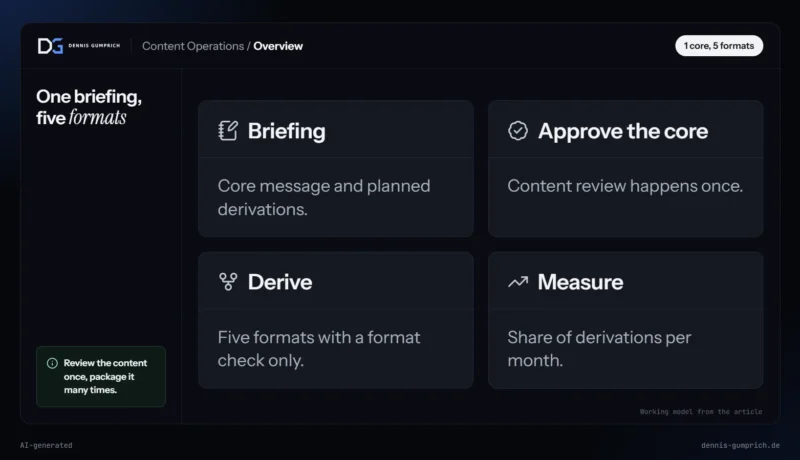

Content repurposing becomes a process when the briefing already defines the derivations: core message in one sentence, evidence, channels with a goal and the planned formats with owner and date. First, the blog article is approved as the core text. After that, LinkedIn post, newsletter paragraph, sales text, intranet note and short video script are derived from it and only need a format check. What you measure is the share of derivations in all published content.
What is content repurposing, and how does it differ from copying?
Content repurposing means deliberately deriving further formats for other channels from a reviewed core piece. Core message, evidence and figures stay the same. Length, opening, tone and call to action change per channel. Copying, by contrast, places the same text unchanged in several places and gives away the effect a fitting format brings.
The idea is older than the AI tools it is usually associated with today. In 2009, Daniel Jacobson described the principle "Create Once, Publish Everywhere" for the US public radio broadcaster NPR: create content once, separate it from presentation and distribute it to many platforms via the same route. For content teams, this translates into a simple distinction. Every piece of content has a core and a packaging. The core is the one statement you want to prove, including evidence and consequence. The packaging is everything that changes per channel.
Why this matters right now is shown by the Content Marketing Institute's B2B research for 2026 with 1,015 B2B marketers surveyed: 39 percent cite scarce resources such as time, staff and budget as a challenge, 28 percent the task of creating enough high-quality content for the organization's needs. More channels with the same team can only be served if not every version starts from zero. A simple test shows whether a piece is ready: can its core message be written down in one sentence? If not, you will discuss the content again on every channel instead of the format.
Why must the core be approved before any derivation?
Because otherwise every correction to the core has to be carried over into all versions. The order is therefore fixed: the briefing defines the derivations from the start, the blog article is created first and approved in terms of content, and only then are social posts and further formats derived from the approved text. That way the subject matter department checks the facts once instead of six times, and every version carries the same core message. Which channels you serve at all is a strategic preliminary question. It is covered in AI and multichannel strategy.
The order is the real lever, not writing speed. Deriving in parallel while the core is still being aligned means carrying every correction into five further texts. A typical result: the LinkedIn post was created from a draft, not from the approved version. That such problems are a matter of process and not of tools is confirmed by Gartner's 2026 CMO Spend Survey: 70 percent of the 401 marketing leaders surveyed say their internal marketing processes are not yet mature enough to use and scale AI effectively.
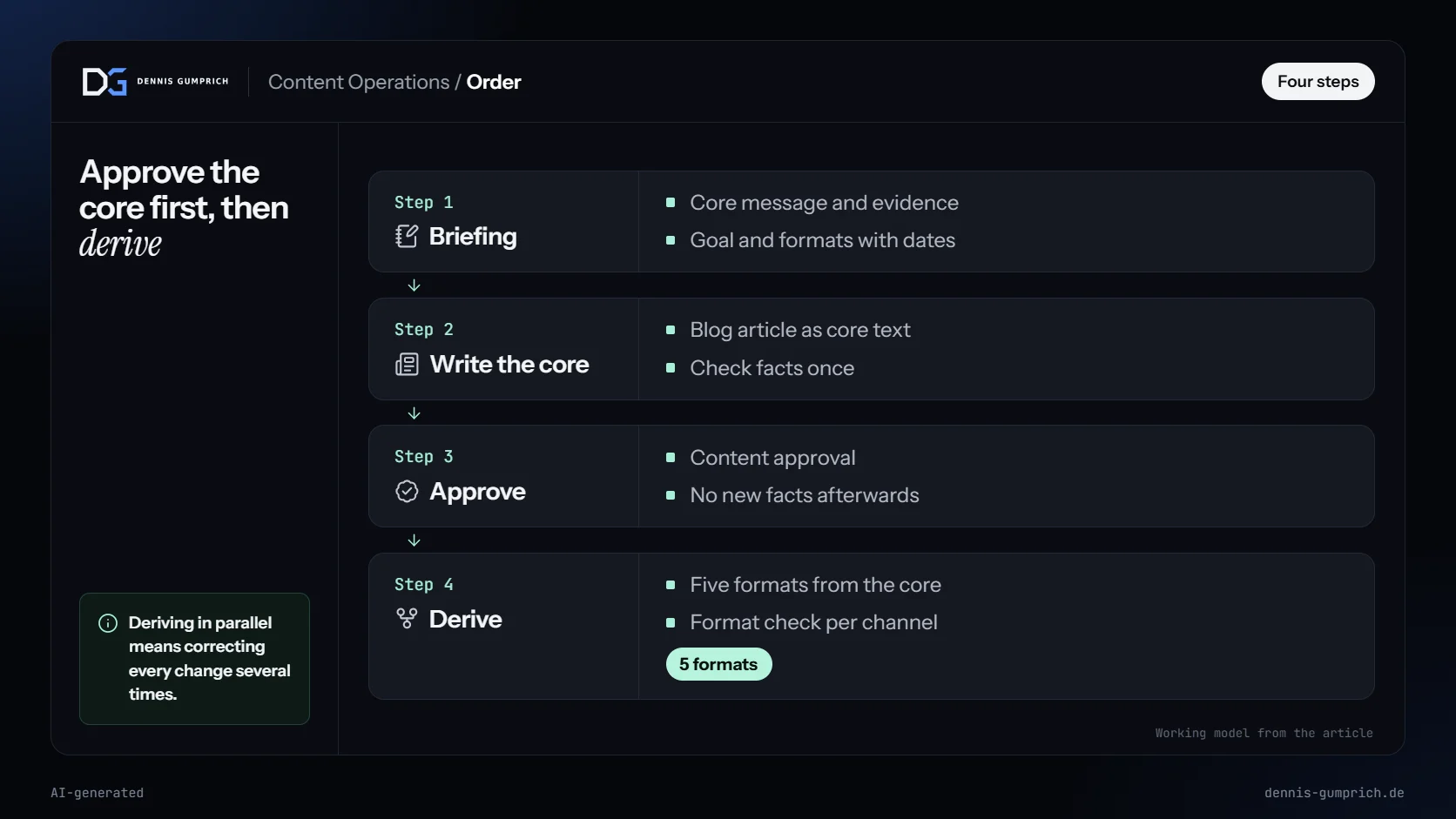
Two rules keep the order stable. First: after the core is approved, no new facts go into the derivations. Anyone who needs a new figure changes the core and has it reviewed again. Second: every derivation needs its own opening that is understandable without the blog article. A shortened first paragraph is not a social media version.
Where the blog article is not the natural core, the same logic applies with a different starting format: a white paper, a study, a press release or a webinar recording. What matters is that there is exactly one approved version from which everything else is created. How to get this core into the CMS afterwards without copying again is described in The last mile: content into the CMS without copy and paste.
Corporate newsrooms work by the same pattern. In the standard process in the corporate newsroom (in German), which Nils Becker of Mediamoss described in May 2026 based on a model by Christoph Moss, adapting to the media is a separate step after approval. First the department signs off the base document in terms of content, then media management creates the versions for its channels. The model is a self-publication of the consultancy. So separate the content sign-off of the core visibly from the work on channel versions in your team too, for example as two separate statuses in the workflow.
What belongs in a briefing that already plans the derivations?
Besides topic, audience and date, four fields many briefings lack: the core message in one sentence with evidence, the channels with one goal each, the planned derivations with owner and date, and guardrails on what must stay the same everywhere. That way everyone involved knows before the first sentence which versions will be created and who delivers them.
| Field | Content | What it is needed for |
|---|---|---|
| Core message | One sentence: statement, evidence, consequence | Common denominator of all formats, yardstick for every review |
| Evidence and sources | Figures, quotes, studies with references | Checked once and taken over unchanged into all derivations |
| Channels and goals | One goal and one audience per channel | Blog for search and depth, LinkedIn for discussion, newsletter for retention, sales for conversations |
| Planned derivations | Format, responsible person, date | Turns derivations into plannable tasks instead of requests after approval |
| Call to action | What the reader should do after each format | Prevents every version from pursuing a different goal |
| Guardrails | Non-negotiable statements, terms, embargo notes | Limit for editors and AI: what is not shortened, not sharpened and not added to |
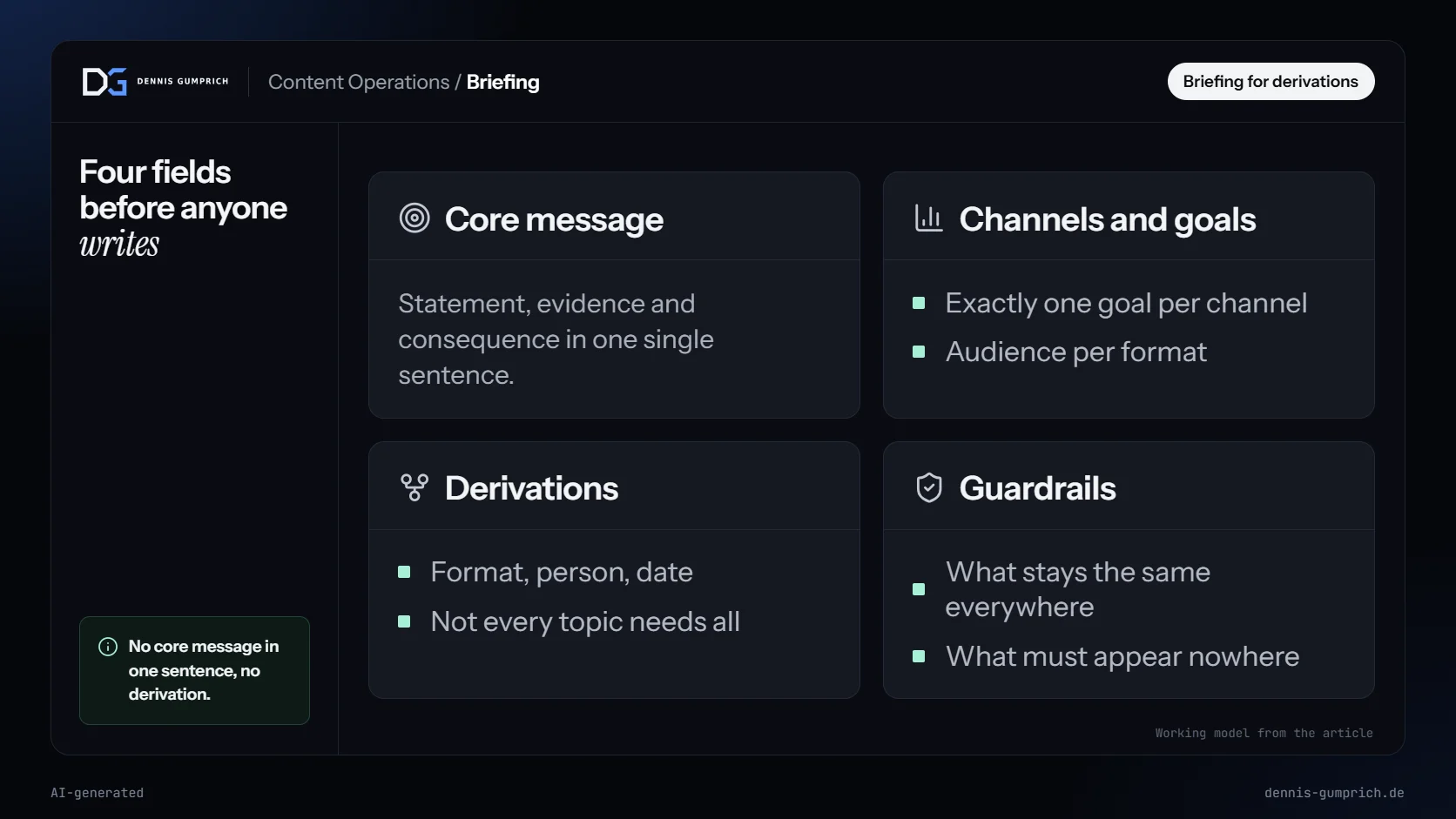
An example of a core message in the format statement, evidence, consequence: "Unapproved AI tools emerge where approvals take a long time. That costs us accountability, so we are shortening the approval path." With this sentence in the briefing, every derivation can be measured against it. Without it, you get five versions with five different focuses.
Not every topic needs all formats. An expert article about a change in standards may carry a LinkedIn post and a sales argument, but no short video. The selection belongs in the briefing, not in the week after publication. Which topics make it into planning at all you decide beforehand, for example with topic scoring.
The independent consultant Robert Weller starts one step earlier, in his article "Themenplan, Content-Plan, Redaktionsplan" (in German) from March 2026. He distinguishes a strategic, a tactical and an operational planning level. On the tactical level, the content plan for three to six months, he also includes revisions, audits and repurposing, while the operational editorial plan covers only a few weeks. The article is an expert opinion. So decide in the quarterly content plan already which topics get derivations, and then carry this selection over into the briefing.
Which format does which channel need?
Every channel has its own goal, and the format follows from it. The blog article provides the complete argument, the LinkedIn post a thought with a reason to discuss, the newsletter a reason to click, the sales text an argument for the conversation, the intranet the link to one's own work and the short video script a single spoken statement. Core message, evidence and figures stay the same.
| Format | Goal | What changes | Scope | Who checks the format |
|---|---|---|---|---|
| Blog article (core) | Search, depth, citability | Complete argument, examples, sources, internal links | Complete | Content approval according to your stages |
| LinkedIn post | Discussion, reach in the network | Opening with a concrete situation, short paragraphs, a question at the end | One thought | Social media owner |
| Newsletter paragraph | Retention, click to the article | Direct address, one clear reason to click, subject line as its own test | One paragraph | Newsletter owner |
| Sales text | Reason for a conversation, argument | Link to customer situations, email text or argument for the one-pager | Three to five sentences | Head of sales, with commitments also the subject matter department |
| Intranet note | Information, internal context | What does it mean for us? Link to roles and responsibilities instead of customer benefit | Short note | Internal communications |
| Short video script | Attention, recognition | Spoken language, statement in the first sentences, think of subtitles | One statement | Social media owner |
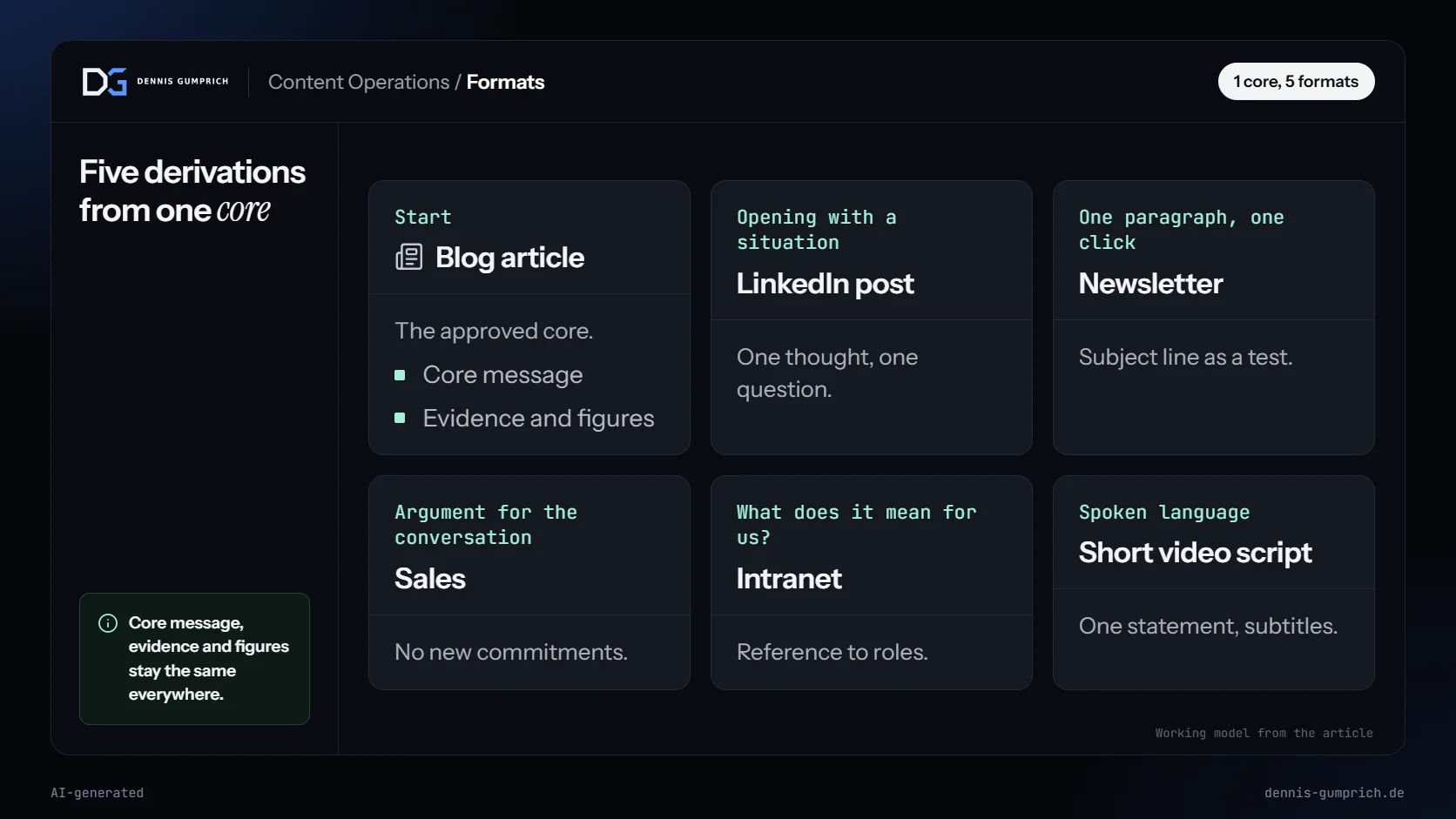
Two formats are often forgotten in marketing teams. In many companies the sales text is not created at all, or only when someone from sales asks, even though it is often the derivation with the shortest path to revenue. And the intranet note is often written separately by internal communications, although it has the same core. In the Trendmonitor Interne Kommunikation 2026 by Staffbase and the School for Communication and Management, 63.5 percent of the 431 professionals and managers surveyed say they pursue an integrated approach between internal and external communications. A shared core version is the practical way there.
The same order applies to translations: approve the core first, then translate, then derive per language. What to distinguish between translation, transcreation and glossary is covered in Marketing content for other markets.
What is AI good at with derivations, and where is review needed?
AI is strong at format conversion: once the facts are set, it reliably creates variants in length, opening and tone from an approved core text. Review is needed wherever the AI adds, condenses or sharpens something: figures, quotes, commitments and statements not in the core. The channel strategy itself remains a team decision.
Shortening to channel length, writing a new opening for LinkedIn or newsletter, adapting tone per channel, spoken version for a short video script, three to five variants for subject lines or openings, first translation draft.
Rounded or generalized figures, shortened quotes, sharpening the evidence does not support, performance or price commitments in the sales text, new claims without basis in the core, the choice of channels.
The research fits this split. In the Content Marketing Institute's B2B research for 2026, among those using AI for content creation, 58 percent report better content quality, 12 percent worse. 39 percent see better content performance. Robert Rose sums this up by saying AI helps marketers type faster, not think better. For derivations that is good news: the thinking has already been done in the approved core.
The quality of AI derivations depends heavily on the examples. In its Claude documentation, Anthropic describes examples as one of the most reliable ways to steer format, tone and structure of the output and recommends three to five of them. For repurposing this means: store three to five successful posts per channel as a template instead of giving the AI a general tone request. How to store brand voice so that it applies in every derivation is described in Storing brand voice.
A derivation brief for the AI contains: the approved core text, the core message in one sentence, channel and audience, desired length, three to five examples of successful posts on this channel and two prohibitions: no figures and no statements that are not in the core text. The format check afterwards follows your review criteria for AI texts.
Ready-made prompts for deriving a briefing into several formats can be found in the free collection 100 AI prompts for marketing.
How do you approve derivations without renegotiating the content?
With a fixed rule: derivations from an approved core run without another content approval. Channel owners only check the format, meaning length, tone, spelling, link and image. A derivation only goes back to content review if a defined trigger applies, such as a new figure or a commitment.
Slow approvals are not a marginal problem. In Cision's Inside PR 2026 report, 53 percent of the almost 600 PR professionals surveyed in the US and the UK cite slow approval processes as a structural obstacle. Every derivation that runs through the subject matter department again extends this wait. A calculation example shows the order of magnitude: with eight topics a month and five derivations each, that is 48 content reviews if every version is approved individually. With the rule, 8 remain, one per core. The subject matter department sees 40 fewer items.
| Trigger | Why | Who reviews |
|---|---|---|
| New figure, new quote, new source | Not covered by the core approval | Subject matter department as for the core |
| Statement not in the core | The derivation is then new content | Approval as for the core |
| Commitment on performance, price or date | Commercial and legal effect | Head of sales, legal if needed |
| Customer name, personal reference, case study | Consent and approval of the person needed | Owner of case studies |
| Competitor comparison, environmental claim | Higher risk when sharpened | Legal or compliance |
The rule only works if it is agreed in advance, ideally in writing and together with the subject matter department. How to slim down approval stages overall and why an approval-by-default rule for derivations holds up is covered in detail in Approval processes: why three weeks is normal and how to halve it.
How do you measure how much reuse actually works?
With three metrics and an evaluation per topic. The share of derivations shows how much of your published content stems from a core. The implementation rate shows whether the derivations planned in the briefing are actually created. The return rate shows how often a derivation has to be discussed in terms of content after all, and therefore how clear the core was.
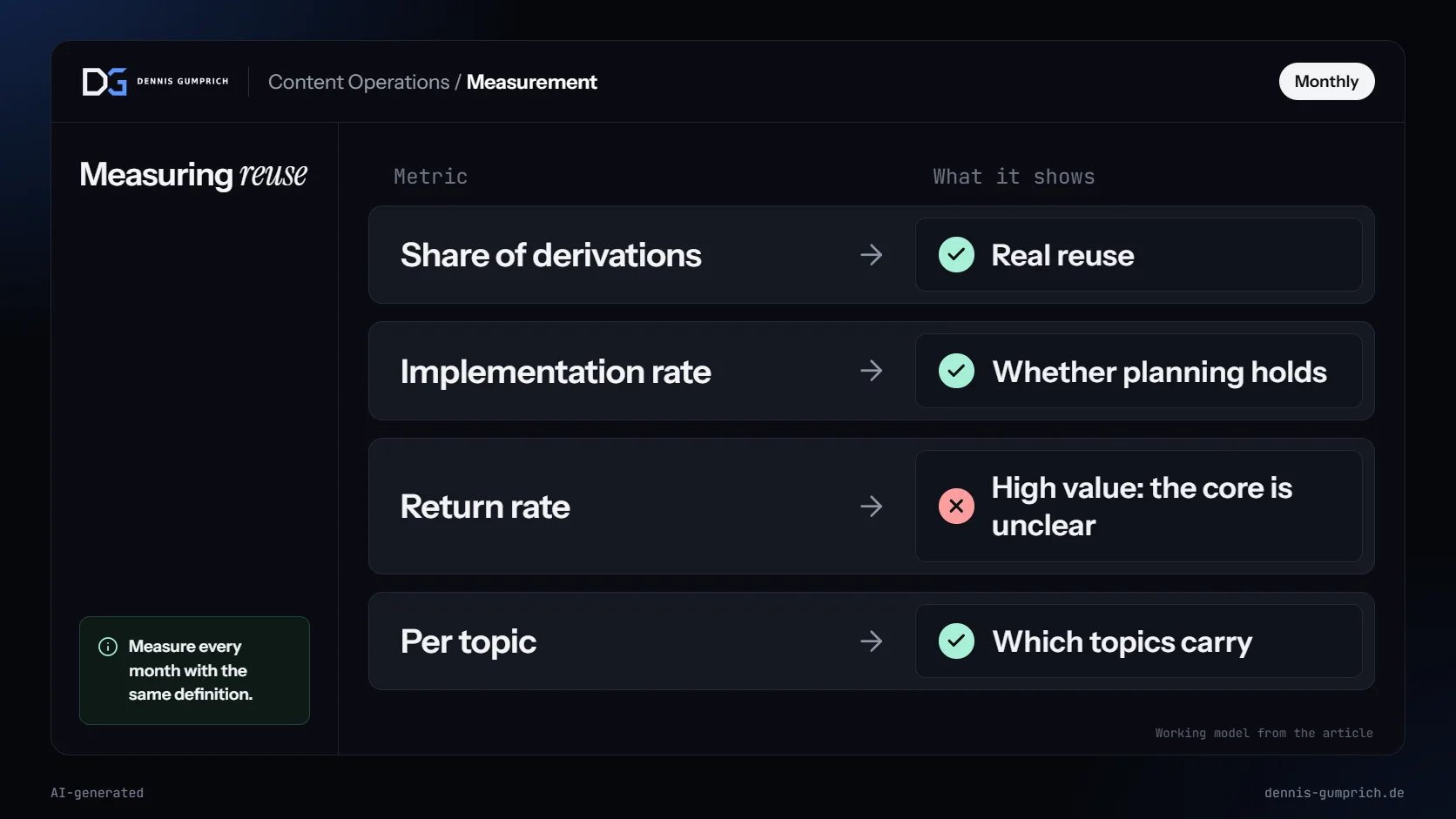
A calculation example for one month: you plan eight core articles with four derivations each, that is 32 planned derivations. 26 are implemented. Add six one-off pieces without a core, for example short-notice posts about a trade fair. That makes 40 published pieces. The share of derivations is 26 out of 40, or 65 percent. The implementation rate is 26 out of 32, rounded 81 percent. Three of the 26 derivations had to go back for content, giving a return rate of rounded 12 percent.
The trend matters more than the individual number. If the return rate rises, the core message in the briefing is usually too vague. If the implementation rate falls, you are planning more derivations than capacity allows. And you evaluate impact per topic across all channels, not per channel. The question is not how LinkedIn did, but how this topic did everywhere. Only that shows which topics carry. That many teams are still at the beginning here is shown by the Trendmonitor Interne Kommunikation 2026: only 32.8 percent of respondents have mechanisms to check whether their communication goals are achieved. How the metrics fit into an overall picture of your content operation is covered in Making content production measurable.
This can only be measured if every derivation is visibly linked to its core. Where that lives is a question of volume and team size.
| Storage | What works well | Where the limit lies |
|---|---|---|
| Documents and folders | Quick start, no introduction | Linking only via file names, measurement by hand |
| Spreadsheet or editorial plan | Derivations as rows under the core, easy counting | Texts live elsewhere, versions drift apart |
| Project management tool | Derivations as subtasks with date and owner | No link to the text itself, no publishing |
| Content platform | Core, derivations, status and publishing in one place, e.g. contentbird* | Introduction effort, only pays off from a certain volume |
When a spreadsheet is no longer enough is described in Content planning in Excel. How much time a tool actually saves on channel derivations per article is calculated step by step in What does a content workflow tool really save? You can work through this with your own values in the ROI calculator (in German).
How do you start with the first topic?
With a single topic and one run over four weeks. You do not need new software for this, but a briefing template with the additional fields, an agreement with the subject matter department on approving derivations and a tally for the three metrics. After the run, you decide what goes into the template for all topics.
- Week 1Choose a topic and record the core messageChoose a topic with clear evidence and at least three fitting channels. Write the core message in the format statement, evidence, consequence in one sentence.
- Week 1Assign channels by goalWhich channel should bring reach, which trust, which inquiries? Enter the planned derivations with person and date in the briefing. A channel without a goal is a candidate for the cut list.
- Week 2Write and approve the coreThe blog article goes through your normal approval. Agree in advance with the subject matter department that derivations only get a format check afterwards.
- Week 3Derive with guardrailsCreate the derivations from the approved text, with AI and three to five examples per channel. Channel owners check the format and note what had to go back and why.
- Week 4Evaluate per topic and adjust the templateCount derivations, implementation and returns, evaluate impact across all channels together and take the proven fields into the briefing template.
Five mistakes in content repurposing
- Deriving before the core is approvedEvery change to the original triggers corrections in all versions, and an outdated figure ends up in a post that is already scheduled. Approval first, without exception.
- Publishing the same text everywherePutting the shortened blog article on LinkedIn saves time and loses impact. The core stays the same, the packaging does not.
- Having every derivation approved for content againThat only shifts the wait and gives away the biggest advantage of the approach. Define triggers instead of reviewing every version anew.
- Using AI without examples and guardrailsA model without examples delivers average output and, when in doubt, adds statements not in the core. Provide successful posts per channel and clear prohibitions.
- Evaluating only per channelChannel reports show which platform performs. They do not show which topic carries. That is exactly what your planning needs.
Self-check: how far is your repurposing already a process?
Tick everything that applies to you.
A short proposal on how we can reliably serve more channels with the same team:
Today a separate text is created for many channels, often in parallel to aligning the expert article. That costs time, leads to diverging statements and sends the same content through approval several times.
Proposal: for each topic we record a core message in one sentence in the briefing and plan the derivations with person and date. The expert article is approved first. We then derive LinkedIn post, newsletter, sales text and intranet note from it, with a format check by channel owners and without another content approval, except for new figures or commitments.
We test this for four weeks with one topic and measure the share of derivations, implementation of the planned formats and the number of returns. Then we decide whether to adopt it for all topics.
Disclosure
I work for contentbird, which is named above as one of several content platforms. In contentbird, content can be assigned to a story and filtered by it, briefings saved as templates, social media posts for LinkedIn, Facebook and Instagram planned and published, and prompt templates created that take over briefing and editor content as placeholders. Reporting on social channels is part of the Social Plus add-on. The process in this article also works with documents and a spreadsheet. Whether a platform pays off depends on your volume and your approval paths.
Conclusion: review the content once, package it many times
Content repurposing rarely fails because of AI and rarely because of writing. It fails because of the order: derivations are created too early, without a shared core message and with a second content approval for every version. Planning derivations in the briefing, approving the core first and only checking the format afterwards lets you serve more channels with the same team and keep the same, evidenced statement on all of them. Repurposing is thus a building block of your content operations: defining briefing, core approval and derivation once means repeating them for every topic without new coordination.
The share of derivations makes this progress visible, and the evaluation per topic shows which content deserves multiple use. Start with one topic, measure for four weeks and then adopt what has proven itself.
Frequently asked questions
Is content repurposing the same as content recycling?
Not quite. Recycling usually means publishing or updating existing content from the archive again. Repurposing plans the derivations while the core is being created. Both complement each other: a content inventory shows which older articles are suitable as a core for new derivations.
Which content is not suitable as a core?
Content with a short shelf life, such as event notices or personnel news, and content without a statement of its own. A good core has an evidenced core message that can be put in one sentence and is relevant for more than one audience. Check that before planning derivations.
How often can a core be reused?
As long as its statement holds. In practice, derivations often end a few weeks after publication, although the core still carries. For cores with a lasting statement, set a date for republishing and check beforehand whether figures and examples are still correct.
How do AI derivations get the right tone per channel?
Provide separate examples per channel, not a general tone request. Three successful LinkedIn posts as templates work better than the instruction to write casually. Also define which phrases should appear on no channel. The rules from On-brand AI content help with this.
How much time does repurposing save compared with new texts?
That depends on how many versions you write from scratch today and how often they go through approval again. The biggest effect usually lies not in writing but in the content reviews and wait times that fall away. So measure before the first run how long a channel version takes today from request to publication, and compare afterwards with the same definition.
Where does your content process lose time today?
In 30 minutes, we look together at where unnecessary coordination, manual tasks, tool switching or repetitive content work cost you time today.
You get a concrete assessment of which tasks you can simplify, automate or organize better, and where AI and tools actually help instead of adding complexity.
Analyze your content process in 30 minutes Free of charge. You take away concrete starting points you can use internally right away.
Dennis Gumprich
Dennis helps marketing and communication teams fit generative AI into existing content processes without undermining quality, brand voice and approvals. Focus areas: content operations, AI governance and tool selection in mid-sized companies and corporations.
Transparency note: Dennis works for contentbird, a provider of AI-powered content software. Product mentions are marked in the article. More about Dennis (in German) · LinkedIn
Read more
Sources
- Content Marketing Institute, Robert Rose: B2B Content and Marketing Trends: Insights for 2026, study from October 8, 2025, survey with MarketingProfs from June 24 to August 14, 2025, 1,015 B2B marketers, mainly from North America: challenges, AI use and effect on quality and performance. Accessed October 31, 2026.
- Daniel Jacobson, NPR: COPE: Create Once, Publish Everywhere, guest post on ProgrammableWeb from October 13, 2009, archived version of the University of North Texas: separating content and presentation as the basis for multiple use. Accessed October 31, 2026.
- Gartner: 2026 CMO Spend Survey, press release from May 11, 2026, 401 marketing leaders in North America, the UK and Europe, survey January to March 2026. Accessed October 31, 2026.
- Staffbase and School for Communication and Management: Trendmonitor Interne Kommunikation 2026 (in German), study, 431 internal communications professionals and managers, survey June to July 2025: integrated approach between internal and external communications (p. 50) and checking goal achievement (p. 28). Accessed October 31, 2026.
- Anthropic: Prompting best practices, Claude Platform Docs, section "Use examples effectively": examples steer format, tone and structure, three to five are recommended. Accessed October 31, 2026.
- Cision: Inside PR 2026 (press release in German), press release from January 6, 2026, almost 600 PR professionals in the US and the UK. Accessed October 31, 2026.
- Nils Becker, Mediamoss: Der Standardprozess im Corporate Newsroom (in German), blog post from May 21, 2026: model after Christoph Moss with seven steps from intake to analysis; the department signs off the base document in terms of content at approval, only then does media management adapt it for the channels in the media adaptation step. Self-publication of a consultancy with its own process model. Accessed October 31, 2026.
- Robert Weller, toushenne: Themenplan, Content-Plan, Redaktionsplan: Drei Tools, die die meisten Content-Teams verwechseln (in German), article from March 12, 2026: three planning levels, strategic, tactical for three to six months including revisions, audits and repurposing, and operational for a few weeks; recommendation of a single point of truth as a database with several views. Opinion and expert article by an independent consultant who names contentbird as a project reference. Accessed October 31, 2026.
How this article was created
This article was created with the help of AI. Structure, research and draft wording were developed with AI support. Professional assessment, review of the statements and the final version are the responsibility of Dennis Gumprich. The English version was translated with AI and reviewed. Read the original German version.
How reliable are the statements?
Backed by sources are the study figures from the Content Marketing Institute, Gartner, Staffbase and SCM, and Cision, the principle "Create Once, Publish Everywhere" by Daniel Jacobson's article, the effect of examples in prompts by Anthropic's documentation, the separation of content sign-off and media adaptation by the Mediamoss standard process (consulting model) and the assignment of repurposing to the tactical planning level by Robert Weller's article (expert opinion of a consultant). Briefing fields, format matrix, triggers for content review, the three metrics and the five-step workflow are working models from consulting practice, not collected measurements. The values on reviews, derivations and rates are calculation examples. As of October 31, 2026.


