
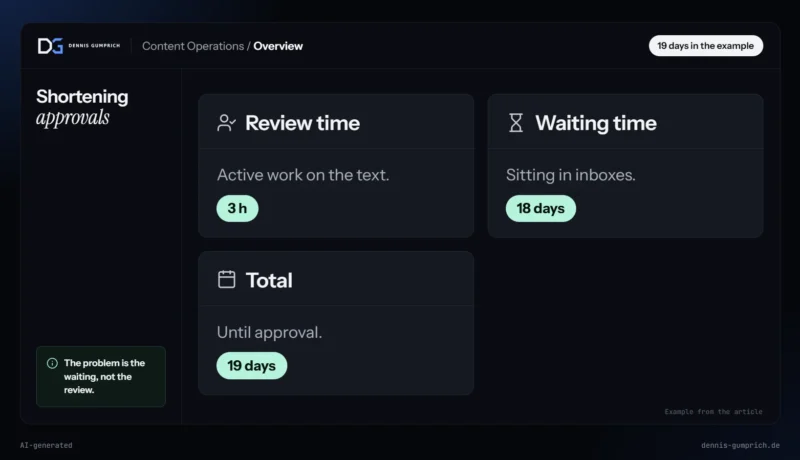

The text has been finished for 19 days. It is with the subject matter experts, specifically with one person who is at a trade fair this week. Her deputy knows nothing about the approval, because the request came by message and is sitting in her inbox.
In the meantime, the occasion the article was meant to appear for has passed. Nobody made a mistake. The process simply has no rule for this case.
Long approvals rarely come from thorough reviewing, but from waiting time between the steps. Three rules reliably shorten them: a deadline per approval stage, a named deputy and a consent rule when the deadline passes. The review itself almost always takes under 20 minutes.
What is an approval process in marketing?
An approval process defines who reviews a piece of content before publication, for what, in what order and by when. It safeguards factual accuracy, brand compliance and legal admissibility. In most marketing and communication teams, it consists of two to four stages.
| Stage | Who reviews | Guiding question |
|---|---|---|
| Subject matter | Subject matter experts, product management | Are facts, figures and technical terms correct? |
| Editorial | Marketing, communications | Does the content fit brand voice, audience and goal? |
| Legal | Legal, data protection, compliance | Are statements, images and advertising promises permissible? |
| Final | Responsible manager | Should this content appear in this form? |
The duration of an approval process arises hardly in the stages themselves, but between them. That is exactly where the following sections come in.
How does a marketing team structure content approvals?
With four definitions before you talk about tools: who has which role, which stages a content type needs, what each stage checks and by when. A RACI grid per content type has proven effective. One person is responsible for completion, exactly one person decides, a few are consulted on the subject matter, everyone else is only informed. This turns a chain of individual requests into a process with a clear end.
| Role | Expert article with product reference | Social derivative from an approved core |
|---|---|---|
| Editorial, author | R: creates and revises | R: creates |
| Head of marketing or communications | A: makes the final decision | A: makes the final decision |
| Product management, subject matter experts | C: checks facts and technical terms | not involved |
| Legal, compliance | C: only for advertising, comparison or price claims | not involved |
| Sales, management | I: is informed | I: is informed |
The most important rule in the grid: exactly one A per content type. Two people with the final say almost always create an extra round, because their feedback contradicts each other and nobody is allowed to resolve the contradiction. The second rule: C means consulted on named criteria, not reading the entire text.
Only once this grid is in place do the deadlines, deputies and consent rule from the following sections take effect. How roles are distributed in the team itself is described in Who does what in the content team.
Where is time actually lost in the approval process?
When teams measure their approval time, almost always the same picture emerges: the pure review time is short, the total duration long. The difference is waiting time, and waiting time arises in four places.
- The request doesn't reach anyone in a binding wayA message to one person is not a task. It competes with everything else in the inbox and has no deadline.
- No deputy definedVacation, illness or appointments bring the process to a halt, because nobody else is responsible.
- Unclear what should be checkedAnyone who doesn't know what to look at postpones the task to a quiet moment, which rarely comes.
- No defined endWithout a deadline, there is no point at which something has to happen. The process stays open until someone asks.
The fastest test: take your last five published articles and count the days between the finished draft and approval. Compare this number with the estimated pure review time. The difference is your real issue. How the total effort per article is distributed is described in Nine hours per article: where the time really goes.
What to do when an approval stage is permanently blocked?
First check whether the cause is capacity rather than prioritization: you can tell because the same stage delays regardless of topic and deadline. Then neither reminders nor escalation help, but three routes in a fixed order: reduce the review scope of this stage, name a second authorized person and decouple content that doesn't strictly need this stage. All three require that you can present the figures from the measurement. Which criteria apply per stage is described in Review criteria for AI texts: the checklist before approval.
The first route is reducing the review scope to what this stage actually has to be responsible for. Often a department checks things that are regulated editorially, simply because nobody has drawn the line.
The second route is a second authorized person. This is rarely a staffing question and usually a permissions question: there are often colleagues with the same expertise who are not formally allowed to approve.
The third route is decoupling: content that doesn't strictly need this stage runs without it. This requires a clear list of which content types are affected. Without this list, uncertainty arises, and in case of doubt everything is submitted again.
The order matters: talk first about scope, then about permissions, and only last about decoupling. If you start with the third route, you signal that the review is dispensable and get resistance instead of a solution.
What should you measure before changing the process?
Three numbers, all collectable from five completed articles: the total duration in calendar days from finished draft to last approval, the estimated pure review time in minutes and the number of alignment rounds. The gap between the first two numbers is your real issue.
Without these numbers, an approval process is judged by feel, and each side has a counterexample ready.

The first number is the total duration in calendar days, from finished draft to last approval. The second is the estimated pure review time, meaning the minutes actually spent reading and assessing. The third is the number of rounds, counted as the number of returns to the person writing.
The first divided by the second gives your ratio of waiting to working. If it is twenty to one or higher, the review is not your bottleneck. This very ratio is the strongest argument with departments that perceive a deadline rule as pressure: it shows that their thoroughness is not the problem.
The third number is the most uncomfortable, because it often points to your own side. Two or more rounds usually mean that the first feedback was unclear or that the review happened without criteria. You don't solve either with deadlines, but with a defined review scope.
If you want to compare the values with other teams: in Content Operations metrics, the first number is called lead time and the third correction loops. From about twenty articles a month, a fourth number is worthwhile: the first-time approval rate. It shows what share of content passes a stage without being returned and reveals whether brief and review criteria fit together.
Collect these three numbers again after the rules have been running for three months. Without a before value, any later improvement is a claim, and that is exactly where process changes fail in internal perception.
How do you halve the duration of approvals?
With three rules: a fixed deadline per stage, usually three working days, stated in the request rather than in a process document. A named deputy with the same rights for each approving role. And the consent rule: if there is no feedback within the deadline, the article is considered approved. The third rule is the most effective single lever.
- Deadline per stageEach approval stage gets a fixed deadline, usually three working days. The deadline is stated in the request, not in a process document.
- Named deputyEvery approving role has a second person with the same rights. Without a deputy, every absence is a standstill.
- Consent rule when the deadline passesIf there is no feedback within the deadline, the article is considered approved. This rule is the most effective single lever.
The third rule almost always triggers resistance, and that resistance is the proof of its effect. Whoever rejects it is saying that the review is important. That is exactly why it then gets a date in the calendar.
Important: the consent rule does not apply to legal approvals or regulated statements. There, the opposite applies: no publication without explicit consent. Define in writing beforehand which content is excluded.
How many stages do you really need?
Fewer than most teams have. A social post derived from an approved core needs no stage of its own, a blog post without product claims one editorial stage, an expert article with product reference two, statements with legal relevance three. Every additional stage lengthens the duration disproportionately.
The reason: waiting time arises again between every stage.
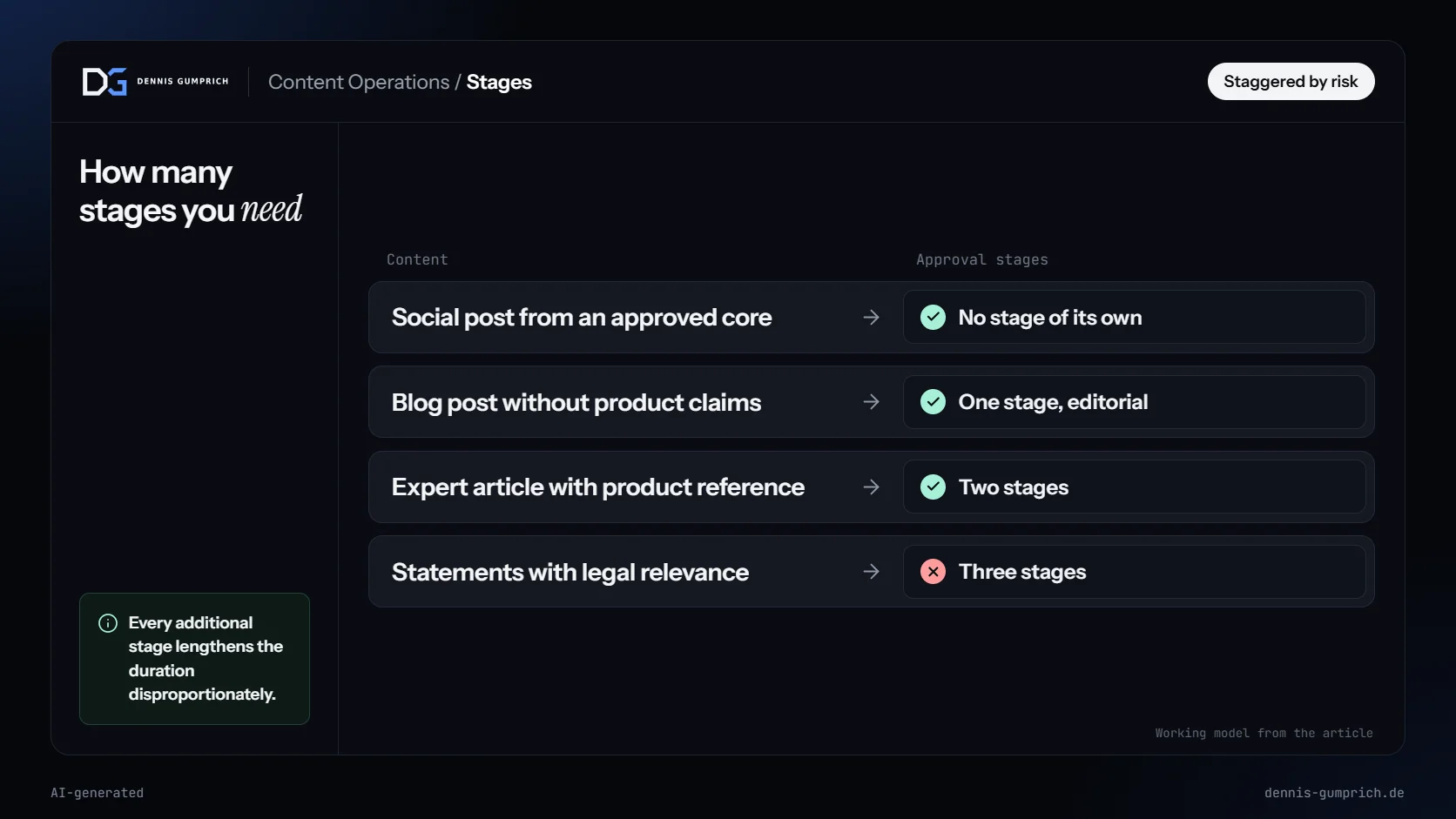
| Content type | Necessary stages | Typical practice |
|---|---|---|
| Social post from an approved core | 0 | 1 to 2 |
| Blog post without product claims | 1, editorial | 2 to 3 |
| Expert article with product reference | 2, editorial and subject matter | 3 |
| Statements with legal relevance | 3, plus legal | 3, and rightly so |
The first row is the biggest lever. When a social post is derived from an already approved text, another content approval is a repetition. In many teams, this very repetition generates half of all approval processes.
The newsroom model that Nils Becker describes in the Mediamoss article "The standard process in the corporate newsroom" (in German) follows the same order. It goes back to Christoph Moss and comprises seven steps from intake to analysis. At approval, topic management has the subject matter department sign off the core document's content; only then does media management adapt it for the channels. Process efficiency, such as the time from brief to publication, is considered the central assessment criterion there. This is a consulting model, not an empirical survey. For you, this means: put the subject matter approval on the core content and let channel versions run afterwards without another content review.
The request determines the duration
Hi, can you take a quick look? Thanks!
Subject matter approval, deadline Thursday 12 noon. Please check only criterion 2 (own claims) and criterion 7 (advertising claims). Without feedback by Friday, the article is considered approved. Deputy: name.
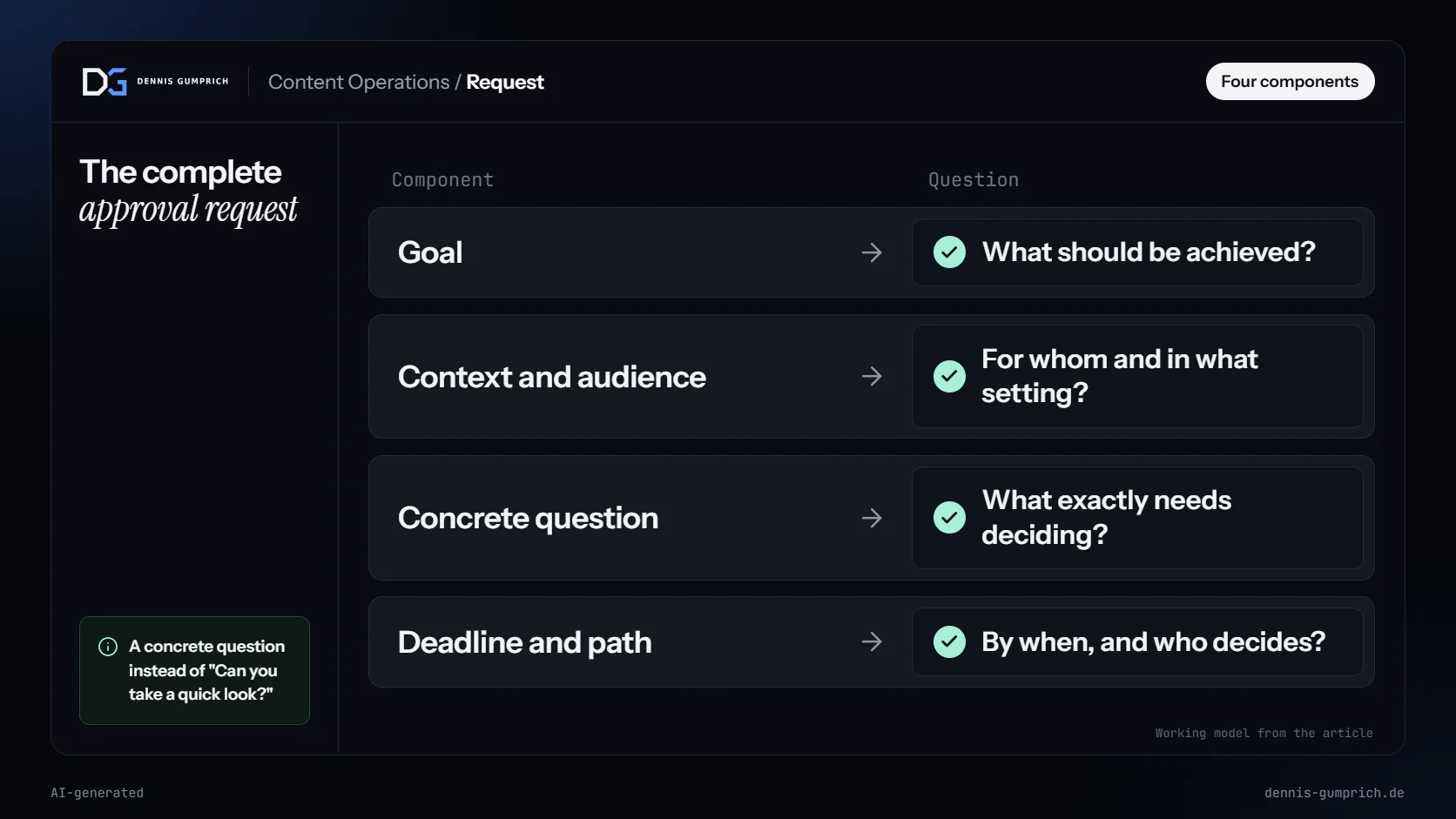
The difference costs 30 seconds when writing and saves days in practice. Four components matter: type of approval, deadline, concrete review scope and the consequence when the deadline passes.
How do you align drafts more easily in the team?
By having exactly one version and all feedback landing there. Most alignment loops arise not from content but from copies: three versions in the inbox, comments in different files, changes without history. The remedy is comments directly on the text, a visible version history, one bundled piece of feedback per stage and feedback that refers to named criteria.
- One version, one placeReviewers get a link to the content, not an attachment. Anyone who edits a copy creates a second truth that someone has to merge later.
- Comment instead of rewriteReviewers comment, the editorial team makes the changes. Anyone who rephrases in the text themselves blurs who is responsible for the version.
- Bundled instead of individualOne piece of feedback per stage. Contradictions within a department are resolved by the department, not the editorial team.
- Mark must or couldEvery comment is either a mandatory correction or a suggestion. In practice, this one distinction saves most second rounds.
How feedback should be phrased so that it can be implemented in one round is described in Review criteria for AI texts: the checklist before approval.
How do you scale content production without more email alignment?
By replacing alignment with status. With ten articles a month, a lot can be clarified by email; with forty, it can't: every message generates queries, and nobody can see where a process stands. Teams that produce more content with the same staff work asynchronously. Every piece of content has a visible status, a responsible person and a deadline. Messages are kept for exceptions.
| Previously by email | Replaced by |
|---|---|
| "Is the text finished yet?" | Status on the content: in progress, in review, approved, published |
| "Can you take a quick look?" | Approval task with deadline, review scope and deputy |
| Attachment with version 3 | Link to the one version with version history |
| Query about goal and audience | Brief attached to the process, visible to everyone involved |
| "Who's doing the LinkedIn post for this?" | Derivatives as separate tasks on the core content |
Two levers from this article have the strongest effect when scaling: derivatives run without another content approval, and subject matter experts review at fixed batch dates rather than on request. You measure the effect with the same numbers as above, lead time and the number of alignment rounds per article. How the handover to subject matter experts works without loops is shown in Handovers between marketing and subject matter experts.
Five mistakes in approval processes
- Everyone checks everythingWhen three people read the same text in full, contradictory feedback and a fourth round arise.
- Approval by messageMessages have no deadline, no status and no deputy. The process is invisible until someone asks.
- Re-approving derived contentWhat arises from an approved core needs no second content review, only a formal one.
- No escalationWithout a defined next step when the deadline passes, all that remains is chasing, and that costs relationships and time.
- Defining the process without the approversA process the reviewing departments didn't help shape gets bypassed.
Five steps to a shorter process
- Week 1Measure durationFor the last five articles, collect the days between draft and approval, separated by stage.
- Week 2Cut stagesJustify every stage. Where there is no separate responsibility behind it, it is dropped.
- Week 2Define the review scope per stageWhich criteria belong to which role. Nobody checks the whole text anymore.
- Week 3Agree deadlines and deputiesTogether with the approving departments, not announced by group email.
- Week 4Fix exceptions in writingWhich content is excluded from the consent rule, especially legally relevant statements.
Why the consent rule works
The rule that an article is considered approved if no feedback comes always triggers discomfort first. This discomfort is the real proof that it works.
The mechanism behind it is simple. A task without consequences competes with tasks that have them, and reliably loses. An approval request with no consequence when the deadline passes is exactly that kind of task. As soon as there is a consequence, prioritization changes, without anyone having more time.
What the rule does not do is important. It does not abolish the review; it schedules it. Whoever objects still prevents publication. Only whoever stays silent no longer blocks indefinitely. This distinction belongs in every communication about it; otherwise the rule is read as devaluing the review.
In practice, it is rarely triggered. After the first weeks, feedback almost always comes within the deadline, because it is clear that it will otherwise no longer be considered. The effect arises from the rule's existence, not its application.
How does approval work at the interface with subject matter experts?
Only as an agreement, not as an expectation. The decisive stage almost always sits outside marketing, in product management, engineering, legal or management. A deadline that marketing decides and announces is the first thing to go at the first bottleneck. It only becomes effective when the approving side gets something out of it.
Every process change is therefore also an alignment across departmental boundaries.
This explains why well-meant rules often don't take hold: an announced deadline is not an agreement, but an expectation.
A deadline rule only becomes effective when the approving side gets something out of it. Two things in return noticeably change willingness. The first is a reduced review scope: whoever only has to check two named criteria instead of an entire text needs minutes instead of half an hour. The second is predictability: requests come bundled at fixed times instead of spread across the week.
A practical route there is a fixed weekly approval slot. All processes received by Tuesday noon are dealt with by Thursday. That seems slower than continuous processing at first, but is faster in practice, because the task gets a place in the calendar instead of competing with others.
Negotiate the deadline explicitly instead of setting it. An agreed deadline of five days that holds is better than any official three-day deadline that is regularly exceeded. The value lies in reliability, not brevity.
How do approvals work with committees, volunteers and many readers?
By strictly separating who decides and who only reads along. A few named people approve and are subject to the deadline. Everyone else sees it, comments if needed and doesn't block the process. Committees get batch dates instead of individual requests, and people without access to your internal systems get an approval link instead of an email attachment.
In associations, foundations, public institutions and large companies, the approval process often looks different from that of a marketing team with one subject matter department. A board of twelve people, several associations under one roof, volunteer experts without a company email address, plus management, works councils or regional heads who want to read along. In conversations with such organizations, I hear the same orders of magnitude again and again: three days to a week for simple cases, up to six weeks for a complex statement.
The cause is the same as in smaller teams, only multiplied: waiting time. Two special features come on top. First, every person who receives a request is treated as an approver, even if they really only need to be informed. Second, alignment runs via email distribution lists, because volunteers and external committees have no access to intranets or collaboration tools. In the end, several versions with contradictory comments circulate, and the editorial team merges them by hand.
| Role | May | Subject to deadline | Access |
|---|---|---|---|
| Approvers | approve or reject | yes, with a named deputy | full access |
| Subject matter reviewers | comment on defined criteria | yes | comment access |
| Committee | decide, via one spokesperson | no, but a fixed batch date | approval link or comment access |
| Readers | read, comment if needed | no, they don't block | observer access without editing rights |
The most important row is the last one. In many organizations, three quarters of those involved are really readers: they want to know what is published and not be surprised. Making them formal approvers extends every process by their response time without improving quality.
- Step 1Separate reading from approvingDefine per content type who decides and who is only informed. Those informed get visibility, but no approval request.
- Step 2One spokesperson per committeeA board or committee gives bundled feedback through a named person instead of sending twelve individual opinions. Contradictions are resolved internally by the committee, not by the editorial team.
- Step 3Batch date instead of circulationCommittees review at fixed dates, for example every two weeks, and everything available by the day before goes on the list. That is more predictable than a circulation procedure that stays open for weeks.
- Step 4Access without switching systemsVolunteers and external reviewers comment directly on the content via an approval link, without an account in the internal system. There is exactly one version, and comments land where the text is.
Two points deserve special attention. Where a committee must decide according to its statutes, the consent rule does not apply. There, the fixed batch date replaces the deadline, and the result is documented as a resolution. And when selecting a tool, the question of whether readers and approvers need their own license often decides more about costs than the price per user. How to correctly account for these roles in a requirements list is described in Newsroom software: requirements catalog instead of vendor list.
Where the rule does not apply
There is content for which silence must not mean consent. These exceptions belong defined in writing beforehand, not discussed case by case.
Editorial approval, subject matter review without a legal dimension, derivatives from already approved content, internal communications.
Claims about effects and comparisons, information on prices and conditions, naming customers, statements in regulated industries, anything involving personal data.
The right-hand column is not a recommendation, but a minimum list. Which content also belongs on it for you depends on your industry and should be clarified with your legal department. It is important that this clarification takes place before introduction. An exception negotiated afterwards undermines the rule as a whole.
What applies to press offices and PR teams?
The same rule, only with less time. In media relations, slow approvals are a recognized obstacle: in the Inside PR 2026 study by Cision (press release in German), 53 percent of the roughly 600 PR professionals surveyed name slow approval processes as a problem. At the same time, 91 percent already use AI. So the draft is created faster, but the approval is not. How press offices use AI without risking errors is described in Media relations with AI.
Three definitions noticeably shorten the route in the press office:
- Approve quotes separately from the text. The management quote goes for approval early as a separate building block. The rest of the release doesn't wait for it.
- Approve holding statements in advance. For recurring topics, such as quarterly results, site questions or product recalls, an approved version with key messages is ready. In an emergency, only the occasion needs to be added.
- Fact-checking before approval, not during it. For AI drafts, the person creating it checks figures, names and quotes before the text goes for approval. Otherwise management becomes the correction instance.
A voluntary framework from the US supports this separation. The NIST Generative AI Profile (NIST AI 600-1) recommends human review of generated content under MG-3.2-008 and recording roles and responsibilities for this oversight under GV-1.6-003. It is not legally binding for you, but it still works as a benchmark. For the press office, this means: whoever checks AI drafts for facts is named as a role before the text goes into approval.
When do you need a fast track for approvals?
Every approval process needs a route for urgent cases. Without one, case-by-case exceptions arise, and exceptions become the norm.
A workable fast track has three features. It is explicitly named, so that nobody has to improvise. It has a shortened deadline, usually four hours instead of three days. And it requires active notification, usually by phone, because a message in the inbox is exactly the problem the fast track is meant to bypass.
Frequency is decisive. A fast track used weekly is no longer a fast track, but your actual process. If that happens, the problem lies not with the approvers, but in planning: topics are initiated too late. So count its use; it is a useful early indicator.
A second point is often forgotten: the fast track needs the same list of exceptions as the normal route. Especially under time pressure, there is a temptation to wave through legally relevant statements. That is exactly where the errors arise that later become expensive.
Self-check: How fast is your approval process?
Tick everything that applies to you.
A proposal for making approvals more reliable without reducing the depth of review:
Our analysis shows that the pure review time is short. The duration comes from waiting time, especially during absences and when there is no deadline.
We propose three rules: a deadline of three working days per stage, a named deputy for each approving role and the rule that an article is considered approved if no feedback comes.
Legally relevant statements are explicitly excluded; there, explicit consent remains required. In addition, every request states exactly which criteria are to be checked, so nobody has to read the entire text.
Which software supports roles, status and approvals?
Any software that can do five things: roles with different rights, a status model per content type, deadlines with deputies, comments on exactly one version with version history and approvals for people without their own license. With several authors, simultaneous work without overwriting and a log of who approved what and when are added. Which category fits depends on what else should happen in the tool besides approval.
| Category | Typical examples | Strong at | Limit |
|---|---|---|---|
| Project management | Asana, monday.com, Airtable, Wrike | Tasks, deadlines, responsibilities | The content usually sits outside, as a file or link. Review on the text itself is limited. |
| Social media approval | Planable, Kontentino | Preview and approval of posts, involving external reviewers | Tailored to social media. Blog, expert article and press release are left out. |
| Content marketing platform | contentbird* | Planning, creation, approval and publishing in one place | Broader scope than a pure approval tool, hence a longer implementation. |
| CMS with workflow | Contentful, Storyblok, TYPO3 | Approval directly before publication on the website | Comes in late. Planning and alignment with subject matter experts take place elsewhere beforehand. |
For teams with many authors, two practical questions matter more than the feature list: do readers and approvers need their own license, and can subject matter experts approve without training? Neither shows in the demo, only with real approval processes in a pilot. The complete requirements catalog is provided by Newsroom software: the requirements catalog instead of a vendor list, and the calculation of whether a dedicated tool pays off by Individual tools or platform.
Conclusion: Waiting time is the bottleneck
Approvals don't take long because of thorough reviewing. They take long because nobody is responsible between the steps and nothing has to happen. Deadlines, deputies and a clear consequence when the deadline passes change that, without anyone working less carefully. Approvals are one of six building blocks in Content Operations, and usually the one where a bottleneck becomes visible first. How the approved content then gets into the CMS without copying again is described in The last mile.
Frequently asked questions
Isn't the consent rule risky?
For editorial and subject matter approvals, it is uncritical in practice, because it enforces a deadline rather than abolishing a review. It is not suitable for legally relevant statements. This exception belongs defined in writing beforehand. When subject matter evidence must be available before approval is shown by the example of environmental claims in EmpCo Directive: what applies to green claims since September 27, 2026.
What if a department fundamentally cannot meet the deadline?
Then the deadline is set wrong or the stage is staffed wrong. Negotiate the deadline instead of ignoring it. An agreed deadline of five days is better than an official three-day one that never holds.
How do we handle urgent content?
With a defined fast track instead of case-by-case exceptions: shortened deadline, notification by phone, fixed deputy. It is important that the fast track is used rarely; otherwise it becomes the norm and loses its effect.
Do we need a tool for this?
The rules work without one. A tool helps where status and deadline should be visible without anyone asking. Start with the rules; otherwise you map an unclear process technically.
What if management wants to approve itself?
Then this stage explicitly belongs in the process, with the same deadline and a named deputy. It becomes problematic when approval happens informally and irregularly, because then nobody can plan. Also clarify whether it is a content review or an acknowledgment; those are different things.
Should we document approvals in writing?
For legally relevant statements, yes; there, traceability is part of the protection. For editorial approvals, the status change on the process is enough. An additional documentation requirement for every step slows down exactly the part you want to speed up.
How do we handle approvals during holiday periods?
Deputies take over automatically, not on request. If the deputy is only appointed when someone goes on holiday, it isn't one. Also plan topics with a long lead time deliberately around known absences; that is more effective than any escalation rule.
Does everyone who reads along also have to approve?
No, and exactly this confusion lengthens many approvals. Separate approvers, who decide and are subject to the deadline, from readers, who are informed and comment if needed. Readers don't block the process. In many tools, they can be added as observers without a full license.
How do we involve volunteers or external committees who have no access to our systems?
Via an approval link directly on the content instead of email attachments. That way there is only one version, comments land in the right place and nobody needs an account in the internal system. For committees, one named person bundles the feedback, and reviews take place at fixed batch dates.
Which tool is suitable for content approvals with several authors?
One that offers roles with different rights, a status per piece of content, deadlines with deputies, comments on exactly one version and an approval log. Project management tools cover tasks and deadlines; content marketing platforms also cover creation and publishing in the same place. What matters is whether readers and subject matter experts can work along without their own license and without training.
How do we reduce email alignment in the content team?
By giving every piece of content a visible status, a responsible person and a deadline. Status queries, approval requests and version attachments then disappear, because the answer is on the content. Emails are kept for exceptions and urgent cases.
Where does your content process lose time today?
In 30 minutes, we look together at where unnecessary coordination, manual tasks, tool switching or repetitive content work cost you time today.
You get a concrete assessment of which tasks you can simplify, automate or organize better, and where AI and tools actually help instead of adding complexity.
Analyze your content process in 30 minutes Free of charge. You take away concrete starting points you can use internally right away.
Dennis Gumprich
Dennis helps marketing and communication teams fit generative AI into existing content processes without undermining quality, brand voice and approvals. Focus areas: content operations, AI governance and tool selection in mid-sized companies and corporations.
Transparency note: Dennis works for contentbird, a provider of AI-powered content software. Product mentions are marked in the article. More about Dennis (in German) · LinkedIn
Read more
Sources
- IT@Cornell, Cornell University: RACI and RASCI Definitions, IT service management guide, undated: definition of the roles responsible, accountable, consulted and informed, and the rule that there is only one A per task or decision. Accessed October 31, 2026.
- Cision: Inside PR 2026 (press release in German), press release of January 6, 2026, almost 600 PR professionals in the US and UK: 91 percent use AI, 53 percent name slow approval processes as an obstacle. Accessed October 31, 2026.
- Planable: How to get Client Approval for content in Planable, help article, undated: preview and approval of posts by invited clients, viewing and commenting via public links without an account. Accessed October 31, 2026.
- Nils Becker, Mediamoss: Der Standardprozess im Corporate Newsroom (in German), blog post of May 21, 2026: model following Christoph Moss with seven steps (intake, assessment and planning, conception, approval, media adaptation, publication and measurement, analysis), content sign-off of the core document by the subject matter department before adaptation for the channels, process efficiency such as the time from brief to publication as the central assessment criterion. Consulting model from a self-publication, not an empirical survey. Accessed October 31, 2026.
- NIST: Artificial Intelligence Risk Management Framework: Generative Artificial Intelligence Profile (NIST AI 600-1), framework of July 26, 2024, by Chloe Autio, Reva Schwartz and Jesse Dunietz, among others, companion document to the AI RMF 1.0: MG-3.2-008 human review of generated content, GV-1.6-003 recording roles and responsibilities for human oversight in the AI inventory. Voluntary framework from the US. Accessed October 31, 2026.
How this article was created
This article was created with the help of AI. Structure, research and draft wording were developed with AI support. Professional assessment, review of the statements and the final version are the responsibility of Dennis Gumprich. The English version was translated with AI and reviewed. Read the original German version.
How reliable are the statements?
Documented are the definition of the RACI grid including the rule that there is exactly one A per task (IT@Cornell), the figures from Cision's Inside PR 2026 study and approval by external reviewers using Planable as an example, as well as the subject matter sign-off of the core content before channel adaptation in the standard process following Christoph Moss (consulting model by Mediamoss, not an empirical survey) and the recommendation of human review with defined roles (NIST AI 600-1, voluntary framework from the US). The deadlines, durations and stage table are explicitly marked as working models, not measured values. The statements on pure review time of under 20 minutes, on the share of readers and on the share of repeated approvals for derived content are experience-based values from consulting practice, not measured values. The classification of software categories is an assessment, not an evaluation of individual products. This article does not replace legal advice; which content requires explicit legal approval in your case should be clarified with your legal department. As of October 31, 2026.


