

The fact sheet on the opening of the new plant is ready. The AI draft of the press release is done after twenty minutes, including a quote from the board, boilerplate and a version for the local press. The embargo ends on Monday at 9 am. The draft goes by email to plant management, the board office and the legal department.
By Friday noon, three versions with contradictory changes are in the inbox. The board office has rewritten the quote, plant management has corrected the headcount: the AI had taken it from a two-year-old release. The legal department only responds on Monday at 8:40 am.
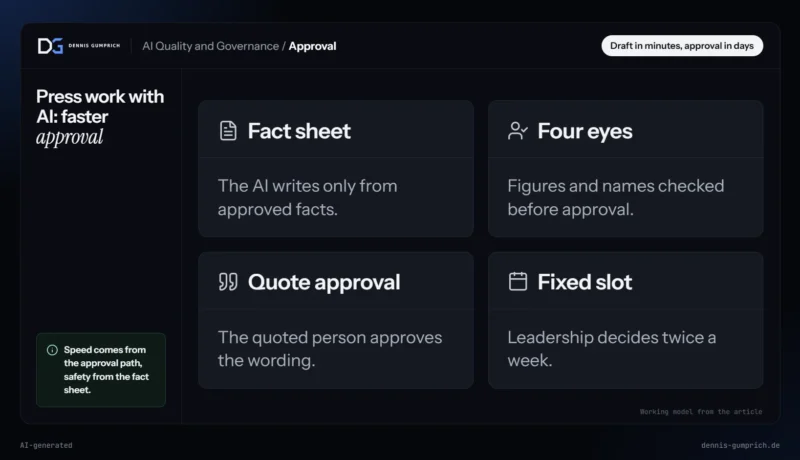
A press office only gets faster with AI if it speeds up the approval path and not just the draft. The basis is an approved fact sheet from which the AI writes. A second person checks figures and names against this fact sheet, the quoted person approves their quote verbatim. Fixed deadlines and a fixed approval slot replace individual emails. Crisis and ad hoc cases follow their own rules.
How does a press office speed up approval with AI without risking errors?
By moving the review ahead of approval and channeling the approval itself into fixed paths. The AI writes exclusively from a fact sheet approved in advance. Figures, names and quotes are checked before the text goes to leadership. Leadership then only decides on message and timing, not on typos and headcounts.
In most press offices, the bottleneck is not writing. In Cision's Inside PR 2026 study, 91 percent of the almost 600 PR professionals surveyed in the US and the UK use generative AI in their work. At the same time, 53 percent cite slow approvals and 63 percent team size and organizational structure as obstacles to more agility. So the draft is created faster, the approval is not.
Using AI only for writing shifts the problem. A draft done in twenty minutes then waits three days in inboxes. Worse: it creates new review work, because AI texts can contain plausible but wrong details. Without a rule, this review lands with management, which has neither the time nor the documents for it. Why approvals generally fail on wait time and not on review time is described in Approval processes: why three weeks is normal and how to halve it. There you also find three basic rules for press offices: approve quotes separately, approve language rules in advance, check facts before approval. This article builds on that and shows what it looks like with AI in concrete terms.
For which press tasks does AI really save time?
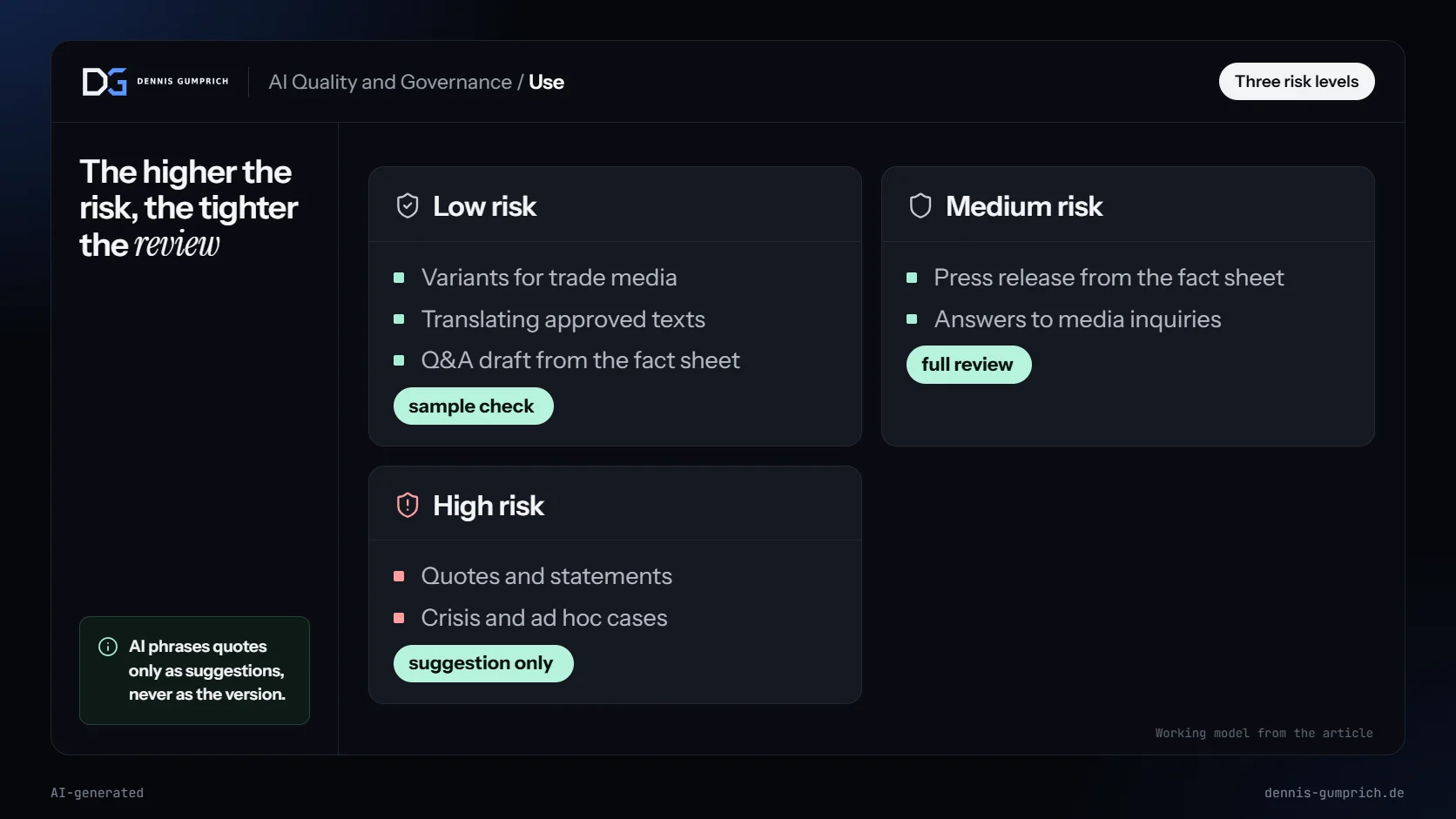
Wherever a new form is created from approved material: press release from a fact sheet, a questions-and-answers catalog, variants for trade media and translations. AI is less suitable where statements are only being formed, meaning quotes, statements and everything said in a crisis. The more a task generates new facts or new positions, the tighter the review has to be.
| Use case | What the AI delivers | Risk | Review step |
|---|---|---|---|
| Press release from a fact sheet | First version with headline, lead, background, boilerplate | Medium | A second person checks every figure and every name against the fact sheet |
| Questions-and-answers catalog | Critical questions the media might ask, with draft answers | Low to medium | The department adds answers, the spokesperson approves |
| Statements and quotes | Several wording suggestions | High | The quoted person chooses, changes and approves the wording in writing |
| Answers to media inquiries | Draft answer from approved language rules | Medium | The spokesperson reviews, new statements go into approval |
| Variants for trade and local media | New opening, different emphasis, shorter version | Low | Sample check: no new facts, no changed quotes |
| Translation | Versions in further languages | Low to medium | A native speaker in the target market checks quotes, number formats and technical terms |
Two use cases are underestimated in many press offices. The first is the questions-and-answers catalog. An AI that knows the fact sheet formulates twenty uncomfortable questions in minutes that a business desk or the local paper would ask. That is not finished communication, but good preparation for the conversation with the department, and it uncovers gaps in the fact sheet before a journalist finds them.
The second is variants. An approved core version can be re-weighted for trade media, local press and your own corporate newsroom without every version going through full approval again. The prerequisite is a clear rule: variants may restructure, shorten and change the opening. They may not contain new facts or changed quotes. Keeping this rule saves the second and third approval round completely.
All figures, names, functions and dates are in one approved document. The AI only gets this document, the boilerplate and the tone rules. Any deviation in the draft is immediately recognizable as an error.
The AI mixes current and outdated information. Headcounts, revenues and job titles come from texts that are two years old. Nobody can say without research which information is correct.
For translations, figures deserve a separate look: in German and many other European languages, a period separates thousands, while English uses a comma. With a careless transfer, 1.200 jobs quickly become 1.2. How to organize translation, transcreation and glossary properly is covered in Marketing content for other markets.
Which errors endanger a press release most?
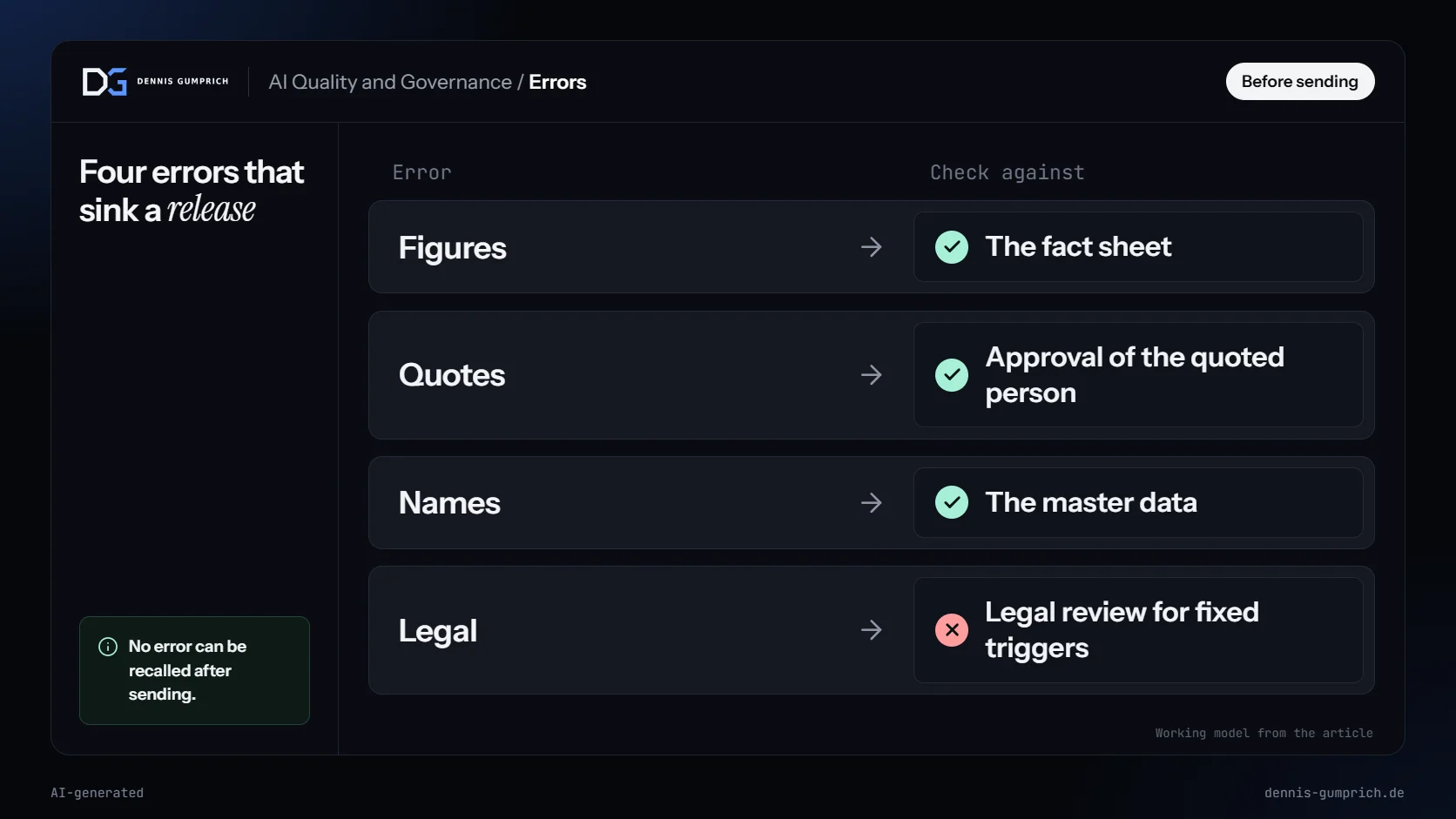
Four types of error cause the greatest damage: wrong figures, wrong or invented quotes, wrong names and functions, and legally sensitive statements. All four have in common that they cannot be recalled after sending. The release then sits in editorial systems, archives and news agency services.
For newsrooms, accuracy is the central topic. In Cision's 2026 State of the Media Report, for which almost 1,900 journalists were surveyed in January and February 2026, accuracy, fact-checking and the fight against misinformation top the list of challenges. 53 percent reject AI-generated pitches, mainly due to concerns about accuracy and personalization. At the same time, 66 percent turn to PR content for story ideas. A faulty release therefore costs not just a correction but trust with exactly the people who are supposed to pick up your content.
Accuracy now matters beyond newsrooms too. Olaf Kopp of the agency Aufgesang describes in "What is Generative Engine Optimization (GEO)? A new definition and differentiation" from July 2026 a separate area called brand context: whether a brand is named or recommended in AI answers, even without a link. He assigns responsibility for GEO to SEO and content, product data and e-commerce, and explicitly to PR, brand and communications. For the press office this means: checked, consistent information in every release also contributes to how your brand is described in AI answers. One caveat: this is a conceptual assessment from an agency perspective, not a measurement.
- FiguresRounded, swapped, taken from an older source or converted incorrectly. Typical are headcounts, investment sums, percentages and year-on-year comparisons. The basis for checking is the fact sheet.
- QuotesFreely phrased by the AI, rewritten afterwards or attributed to the wrong person. A quote only becomes one once the person has approved the wording.
- Names and functionsWrong spelling, outdated title, no longer valid function. The basis for checking is master data from HR or the board office, not the internet.
- LegalForecasts, statements about competitors, environmental and health claims, embargoes and information that may be price-sensitive. The press office does not decide alone here.
Why language models produce such errors and why their rate does not fall to zero is described in Systematically catching hallucinations in marketing texts. For the press office, the practical conclusion is enough: every figure and every name in the draft needs a source in the fact sheet. What is not in it is removed or researched again.
Environmental claims such as "climate neutral" or "environmentally friendly" always belong on the list of triggers for legal review. Why these wordings in particular are sensitive in the EU is described in EmpCo Directive: green claims.
How does the four-eyes principle for figures and quotes work in practice?
Every error type gets a reviewer and a fixed basis for checking. A second person from the press office checks figures and names against the fact sheet. Only the quoted person checks quotes. The legal department checks legally relevant statements, but only when a trigger defined in advance applies. That way nobody reads the whole text, and yet every critical point has been seen twice.
| Element | Who checks | Against what | Evidence |
|---|---|---|---|
| Figures, data, dates | Second person in the press office | Approved fact sheet | Line-by-line comparison, deviations marked |
| Names, titles, functions | Second person in the press office | Master data from board office or HR | Note in the draft |
| Quotes | The quoted person | Wording in the draft | Written approval of the wording |
| Legally relevant statements | Legal department | List of triggers | Approval note with date |
| Translations | Native speaker in the target market | Approved source version | Note by the reviewer |
The fact sheet is the core of this matrix. It contains all information that may appear in the release: figures with source and status, names with function, dates, places, the boilerplate in its valid version and the embargo. The department approves this document before a single sentence is written. That costs half a day more alignment at the start and saves the round at the end in which the department corrects the finished text. How to design the handover between communications and the department so that the fact sheet arrives complete is described in Handovers between marketing and subject matter departments.
For quotes, a simple rule applies: the AI may make suggestions, a version only comes into being through the person the quote is attributed to. A quote approved by an assistant in the board office is not approved. For quotes from partners, customers or politicians, the written approval of the wording belongs in the files, not just a thumbs-up in a chat message.
Why quote approval matters particularly with AI drafts is explained by the Generative AI Profile (NIST AI 600-1) of the US National Institute of Standards and Technology. It describes confabulation, meaning confidently stated false content, as a natural consequence of how generative models are built; outputs can even include invented reasoning and citations (section 2.2). Accordingly, the profile recommends specifically checking sources and citations in AI outputs (action MS-2.5-003). In the press office, the written approval by the quoted person is exactly this check. One caveat: it is a voluntary US framework.
Define the triggers for legal review once together with the legal department and attach them to every template. Typical triggers are forecasts and forward-looking statements, comparisons with competitors, environmental and health claims, information on ongoing proceedings, personnel measures and anything that could affect the share price of a listed company. If no trigger applies, the release goes into approval without the legal department. General review criteria for AI texts, for example on tone, structure and evidence, are covered in Review criteria for AI texts: the checklist before approval.
How do you build an approval path with deadlines and fixed approval slots?
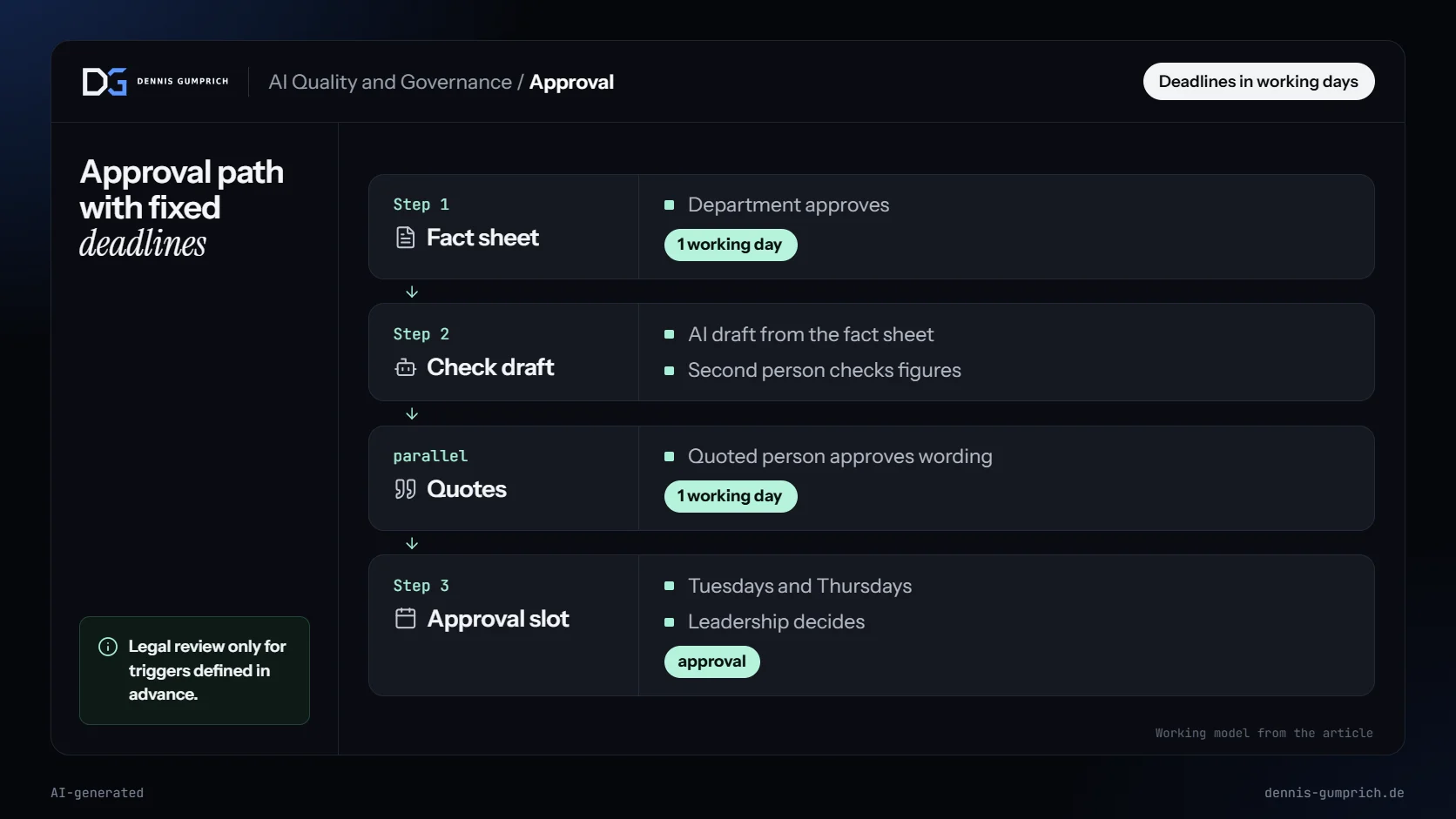
With three building blocks: a deadline for every stage, parallel instead of sequential reviews and a fixed approval slot in which leadership approves. The fixed slot replaces the individual email to management. Anyone who knows that decisions are made on Tuesdays and Thursdays at 10 am plans for it instead of asking every time.
- Step 1Approve the fact sheetThe department confirms all information within one working day. Only then is the draft created.
- Step 2Create and check the draftThe AI writes from the fact sheet. A second person compares figures and names. If triggers apply, the draft goes to the legal department in parallel.
- In parallelHave quotes approvedThe quote goes as a separate building block to the quoted person, deadline one working day. The rest of the text does not wait for it.
- Step 3Approval slotLeadership approves on Tuesdays and Thursdays in a fixed fifteen-minute slot. It decides on message and timing, not on details that have already been checked.
- Step 4Derive variantsTrade media, local and newsroom versions are created from the approved core version, without new facts. A sample check replaces another approval.
A calculation example shows the effect. Suppose a press release currently passes through four stages in sequence: department two working days, quote three, management three, legal two. That adds up to ten working days. In the new path, the fact sheet takes one working day, the draft with fact check another, the quote runs in parallel. Until the next approval slot on Tuesday or Thursday, 1.8 working days pass on average, three at most. Together that is 3.8 working days on average and five at most; the legal department only joins when triggers apply. In this example, average cycle time falls by around 62 percent.
| Occasion | Who approves | Deadline | Special feature |
|---|---|---|---|
| Planned press release | Head of communications in the approval slot | Fact sheet and quote one working day each | Legal only for triggers |
| Media inquiry | Spokesperson | Answer the same working day or by the newsroom's deadline | Answer from approved language rules, new statements separately |
| Reactive statement | Named person with deputy | A few hours | Announced by phone, not just email |
| Crisis | Crisis team | According to the crisis manual | Holding statements approved in advance |
| Ad hoc disclosure | According to the ad hoc process of investor relations and legal | By law: immediately | Not on the standard path, see next section |
For deadlines to work, every approving role needs a named deputy. Who makes which decision in the approval slot and who leads the text beforehand depends on your organization. For teams with a newsroom structure, Newsroom roles: managing editor, topic desk and media desk describes a proven split.
What applies to crises and ad hoc disclosures?
In a crisis and with price-sensitive information, the role of AI shifts. It no longer formulates new statements but only works with texts that are already approved: variants, shortened versions, translations. Ad hoc disclosures of listed companies run in a separate process that the press office is not solely responsible for.
In a crisis, preparation helps more than speed. Holding statements for likely scenarios, such as product recall, IT outage, accident at a site or data breach, can be prepared and approved in quiet times. AI can help play through scenarios and draft questions-and-answers catalogs. In an emergency, the press office only adds occasion, place and time. The general express path for urgent approvals, with named responsibility, shortened deadline and announcement by phone, is described in the article on approval processes.
For ad hoc disclosures, the framework is set by law. Throughout the EU, issuers of financial instruments must disclose inside information that directly concerns them immediately under Article 17 of the Market Abuse Regulation (MAR). The German supervisory authority BaFin, as one example, describes among other things distribution via an electronically operated information distribution system and media with Europe-wide reach, transmission to the authority and keeping the information on the company's own website for at least five years. Whether information is subject to ad hoc disclosure and when it is published is usually decided by investor relations, legal and the board, not the press office.
For the press office, three rules follow that you agree with legal and investor relations: information that could be inside information belongs only in tools explicitly approved for it. The accompanying press release is prepared but not sent before the ad hoc disclosure; order and wording are set by the ad hoc process. And any difference in wording between the two texts goes back to legal and investor relations before sending. This is a process recommendation, not legal advice.
Does a press office have to label AI texts under the EU AI Act?
Usually not, if the approval path works as described above. Article 50(4) of the EU AI Act requires disclosure for AI-generated text published with the purpose of informing the public on matters of public interest. The obligation does not apply if the text has undergone human review or editorial control and a natural or legal person holds editorial responsibility for the publication.
The provision has applied since August 2, 2026. Whether an individual press release informs about a matter of public interest is a question of the individual case. For site decisions, product safety or job cuts this is more likely than for a product launch. For the press office, this distinction is usually secondary, because the exception matches its way of working exactly: a person reviews the text in terms of content, and the company holds responsibility for the publication. The European Commission published guidelines on the transparency obligations on July 20, 2026. In its announcement, it explicitly describes the disclosure obligation for AI-generated content on matters of public interest without human review or editorial control.
This creates a documentation task. A look at spelling and commas will hardly count as review within the meaning of the provision. You are on the safe side with a content review that you record: who checked the draft against the fact sheet, who approved the quote and who is responsible for the publication. The review matrix generates exactly this information anyway. How to arrive at your own labeling practice beyond the legal minimum is described in AI labeling: how to arrive at a robust practice.
On the media side, the picture is similar. The German Press Council, as one example of press self-regulation, confirmed in 2024 that editorial teams bear ethical responsibility for all editorial content, regardless of how it was created. In the same statement, it did not consider a labeling obligation for AI-generated texts necessary. The press code applies to journalistic media, not to your press office. But it explains why newsrooms check your information: whoever adopts your release vouches for its content.
How do you measure whether the press office gets faster and safer?
With four metrics: cycle time from fact sheet to sending, number of approval rounds per release, corrections after sending and response time to media inquiries. The first two show speed, the third safety, the fourth the benefit for media relations. Measure for four weeks before the change, otherwise the comparison is missing.
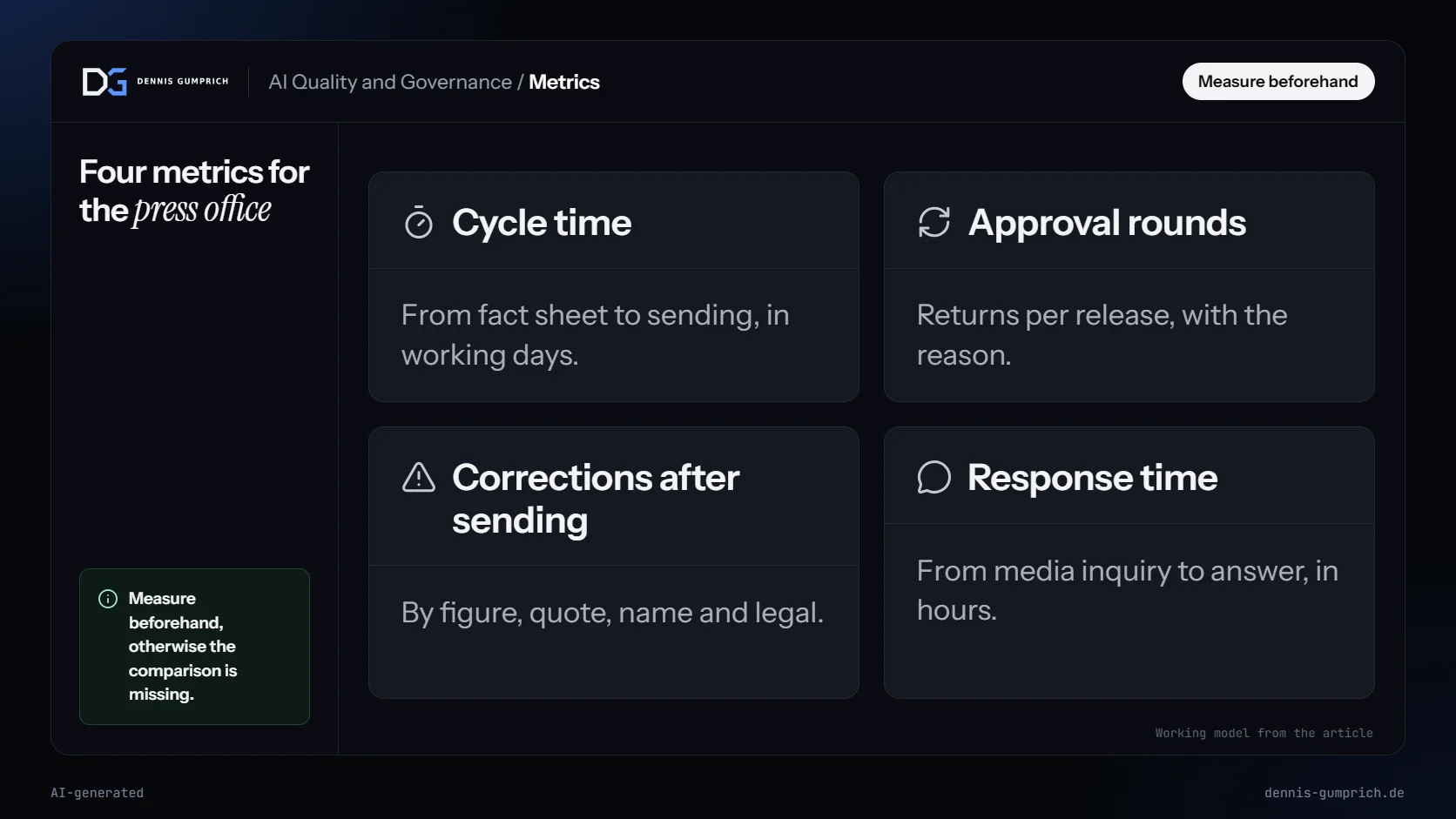
The most important of the four is corrections after sending. Count each one individually and assign it to an error type: figure, quote, name or legal. If one error type rises, the cause almost always lies in a gap in the review matrix, for example a figure that was not in the fact sheet. Approval rounds show whether the fact sheet is complete: if a release comes back from the department twice, something was missing before the AI wrote.
A second calculation example shows the benefit for media inquiries. Suppose a press office answers 30 inquiries a month and currently needs 60 minutes per inquiry for research, draft and alignment. With approved language rules and an AI draft based on them, it takes 35 minutes. That saves 25 minutes per inquiry, 750 minutes or 12.5 hours a month and 150 hours a year. At an internal hourly rate of 75 euros, that corresponds to 11,250 euros per year. How to define metrics for the entire content operation is covered in Making content production measurable. The ROI calculator (in German) calculates it with your own values.
Five mistakes when using AI in the press office
- Letting the AI do the researchA draft from old releases and web sources mixes old and new information. Give the AI only the approved fact sheet, the boilerplate and your tone rules.
- Leaving the fact check to managementChecking figures only in the approval meeting turns leadership into a correction instance and lengthens every round. Checking happens beforehand, by a second person.
- Sending AI quotes as the versionA quote the person has not approved themselves is not a quote. The AI delivers suggestions, the person decides on the wording.
- Approving every variant anewTrade media, local and newsroom versions without new facts do not need full approval. A fixed rule and a sample check are enough.
- Copying confidential information into non-approved toolsEmbargoes, personnel matters and possible inside information belong only in tools approved by IT, data protection and legal. What matters here is described in GDPR-compliant content marketing software.
Disclosure
I work for contentbird. There, approval paths can be set up as a workflow with tasks per status, with due dates, feedback tasks, assigned people or groups and a strict mode in which only the assigned person can complete a task. Comments, versions and DeepL translation are available on the content. The review rules in this article apply regardless of the tool; they also work with a well-kept spreadsheet.
Self-check: how robust is your approval with AI?
Tick everything that applies to you.
A short proposal on how we can approve press releases faster with AI without risking more errors:
AI speeds up our drafts, but approval takes as long as before. At the same time, the risk rises that wrong figures or unapproved quotes slip through, because the review only happens in the last step.
Proposal: every release starts with a fact sheet that the department approves within one working day. The AI writes only from it. A second person in the press office checks figures and names, the quoted person approves quotes directly. We bundle final approval in a fixed fifteen-minute slot on Tuesdays and Thursdays.
We measure cycle time per release and corrections after sending for four weeks before and four weeks after.
Conclusion: speed comes from the approval path, safety from the fact sheet
AI makes drafting a press release faster, but not the approval. Speeding up only the writing shifts the review work to the end and to the wrong people. A press office gets faster and safer when the AI writes from an approved fact sheet, figures, names and quotes are checked by the right people before approval and leadership decides in a fixed slot. The approval path for press releases is one part of your content operations, the roles, workflows and tools with which you manage content overall.
The same review also fulfills the condition for the editorial exception in Article 50(4) of the EU AI Act, provided you document it. Crisis and ad hoc cases remain separate paths with their own responsibilities. Four metrics you can start collecting tomorrow show whether the change works.
Frequently asked questions
May the AI phrase a quote for management?
As a suggestion yes, as a version no. A quote is only published once the quoted person has approved the wording themselves. What works well is presenting two or three variants for the person to choose from and adapt. That is faster than a blank page and ensures the sentence fits the person.
How many approval stages does a press release need?
For a planned release usually three: the department for the fact sheet, the quoted person for the quote and the head of communications for the final version. The legal department only joins for defined triggers. How to recognize and remove surplus stages is described in Shortening approval processes.
Do we have to put an AI notice under press releases?
Legally usually not, if a person reviews the text in terms of content and the company holds editorial responsibility. That follows from the exception in Article 50(4) of the EU AI Act. Whether you label voluntarily is an editorial decision. The specific assessment for your case belongs with the legal department.
What to do if an error is noticed after sending?
Correct quickly and visibly, to the same distribution list, with a clear statement of what has changed. The corrected version replaces the old one in your own newsroom. Then the cause belongs in the evaluation: which review point should have found the error? A procedure for false information that has already been published is covered in Catching hallucinations in marketing texts.
Which documents does the AI need for a good draft?
The approved fact sheet, the valid boilerplate, your tone and writing rules and two or three successful releases as examples of structure and length. Examples serve only as a template for the form, never as a source of facts. How to store such documents permanently is described in Building a knowledge base.
Where does your content process lose time today?
In 30 minutes, we look together at where unnecessary coordination, manual tasks, tool switching or repetitive content work cost you time today.
You get a concrete assessment of which tasks you can simplify, automate or organize better, and where AI and tools actually help instead of adding complexity.
Analyze your content process in 30 minutes Free of charge. You take away concrete starting points you can use internally right away.
Dennis Gumprich
Dennis helps marketing and communication teams fit generative AI into existing content processes without undermining quality, brand voice and approvals. Focus areas: content operations, AI governance and tool selection in mid-sized companies and corporations.
Transparency note: Dennis works for contentbird, a provider of AI-powered content software. Product mentions are marked in the article. More about Dennis (in German) · LinkedIn
Read more
Sources
- Cision: Cision Unveils "Inside PR 2026": The Definitive Report on PR Trends, AI Adoption, and the Future of Communications, press release from January 6, 2026, almost 600 PR professionals in the US and the UK: 91 percent use generative AI, 53 percent cite slow approvals and 63 percent team size and organizational structure as obstacles. Accessed October 31, 2026.
- Cision: PR Emerges as the Primary Source for Journalists in High-Pressure Newsrooms, press release on the 2026 State of the Media Report from May 13, 2026, survey of 1,899 journalists in January and February 2026. Accessed October 31, 2026.
- German Federal Financial Supervisory Authority (BaFin): Ad hoc disclosure, topic page on Article 17 of Regulation (EU) No 596/2014 (MAR), as of June 12, 2025: publication, transmission to BaFin and keeping on the website. Accessed October 31, 2026.
- European Parliament and Council: Regulation (EU) 2024/1689 on artificial intelligence (AI Act), June 13, 2024, Article 50(4) on disclosing AI-generated text on matters of public interest and the editorial exception, applicable since August 2, 2026. Accessed October 31, 2026.
- European Commission: Commission publishes guidelines on transparency obligations for providers and deployers of certain AI systems, announcement from July 20, 2026. Accessed October 31, 2026.
- German Press Council (Deutscher Presserat): Redaktionen auch für KI-generierte Inhalte ethisch verantwortlich (in German), press release from September 18, 2024. Accessed October 31, 2026.
- Olaf Kopp, Kopp Online Marketing: What is Generative Engine Optimization (GEO)? A new definition and differentiation, article from July 30, 2026: GEO as the task of making content, brands and data findable, citable and actionable in AI answers, with the areas LLM readability, brand context and agentic commerce; responsibilities distributed across SEO and content, PR, brand and communications, and product data and e-commerce. Conceptual assessment from an agency perspective (Aufgesang), little data. Accessed October 31, 2026.
- National Institute of Standards and Technology (NIST): Artificial Intelligence Risk Management Framework: Generative Artificial Intelligence Profile (NIST AI 600-1), July 26, 2024, Chloe Autio, Reva Schwartz, Jesse Dunietz et al., companion profile to the voluntary AI RMF 1.0: section 2.2 on confabulation as a consequence of how generative models are built, including invented reasoning and citations, and action MS-2.5-003 (check sources and citations in AI outputs). Voluntary US framework. Accessed October 31, 2026.
How this article was created
This article was created with the help of AI. Structure, research and draft wording were developed with AI support. Professional assessment, review of the statements and the final version are the responsibility of Dennis Gumprich. The English version was translated with AI and reviewed. Read the original German version.
How reliable are the statements?
Backed by sources are the study figures from Cision's Inside PR 2026 and 2026 State of the Media Report, the ad hoc disclosure obligations as described by BaFin, the wording of Article 50(4) of the EU AI Act, the European Commission's announcement of its guidelines and the position of the German Press Council, as well as the assignment of brand context to PR and communications (Kopp, conceptual agency perspective) and the recommendation to check sources and citations in AI outputs (NIST AI 600-1, voluntary US framework). The risk classification of use cases, the review matrix, deadlines, approval slot and the four metrics are working models from consulting practice, not collected measurements. The cycle times and time savings for media inquiries are calculation examples with assumed values. The Cision studies refer to the US, the UK and international markets. The statements on the AI Act and the Market Abuse Regulation reflect the legal status as of October 31, 2026 and are not legal advice. Whether your specific release falls under Article 50(4) or is subject to ad hoc disclosure is clarified by your legal department. As of October 31, 2026.


