
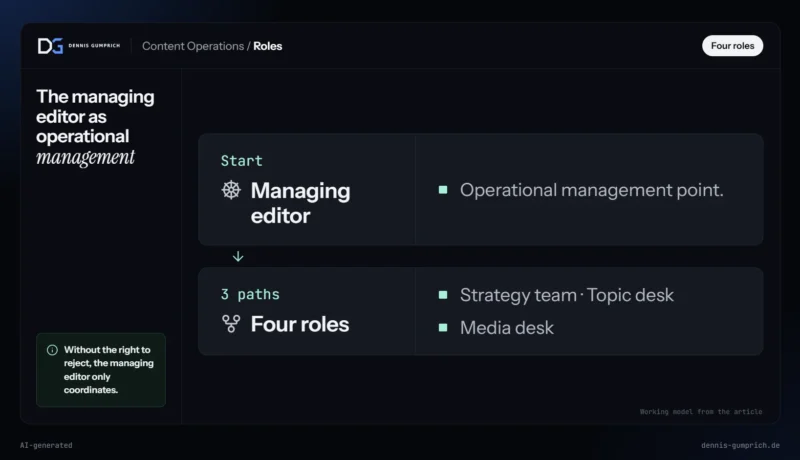

The four newsroom roles are strategy team, managing editor, topic desk and media desk. The strategy team sets the topic priorities, the managing editor decides on order, adding and rejecting topics in day-to-day business, the topic desk is responsible for content and expert alignment, and the media desk decides on suitability for its channel. A role is only filled when three things are fixed: what it decides alone, whom it has to consult beforehand and who stands in during holidays. Everything else is a job description, not a role model.
Which roles are there in a corporate newsroom?
Four: strategy team, managing editor, topic desk and media desk. The model has a single purpose, namely to separate topic responsibility and channel responsibility and still bring them back together in one place.
The role model in the corporate newsroom has a single purpose: it should ensure that topic responsibility and channel responsibility are separated and still converge in one place. Why this separation is the core of the model and where it fails in practice is described in detail in the foundation article Corporate newsroom: the management model behind the seating plan.
The four roles in the newsroom model of corporate communications are named identically in almost all descriptions:
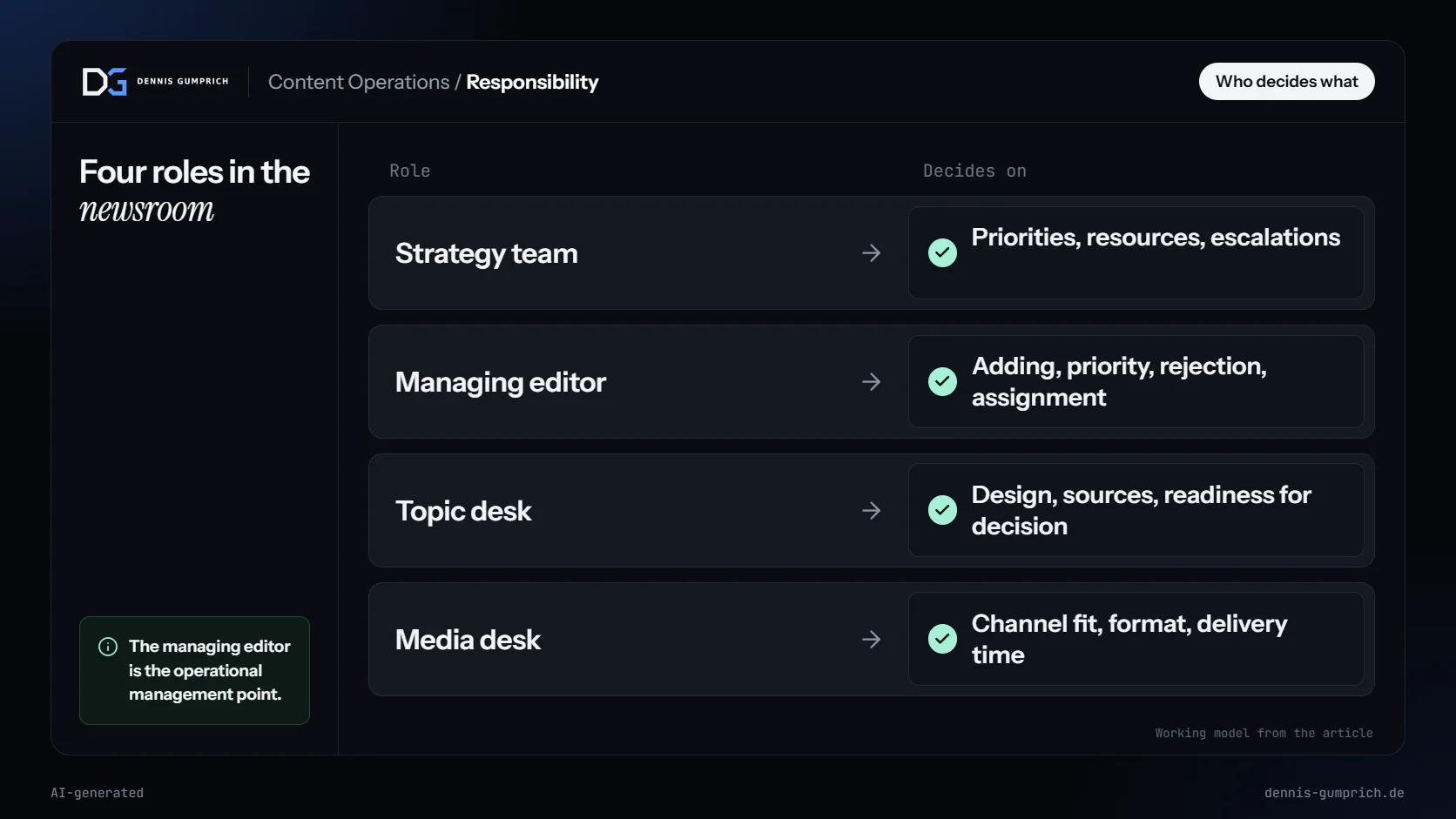
- Strategy team. Works like an editor-in-chief's office, is responsible for topic priorities, resource allocation and the final content decision in case of conflict.
- Managing editor. The operational hub. Adds topics, prioritizes, rejects, distributes work and leads the meetings.
- Topic desk (topic management). The link to the specialist departments. Finds, researches and is responsible for topics in terms of content.
- Media desk (media management). Represents a channel or group of channels and assesses whether a topic is delivered there and in what form. Community management, that is, answering comments and messages, often belongs here too. How to organize it is described in Social inbox.
The model is well tested and has been stable in this form for years. The reason why so many newsroom concepts still become diluted in operation does not lie in the model itself. It lies in the fact that these four terms are usually filled in as task lists during the introduction, not as decision rights.
Why the usual role descriptions are too soft
Take any newsroom role description and highlight the verbs. Usually it says: coordinates, supports, aligns, is responsible for, assists, ensures. These are activities. They describe effort, but not authority.
The difference becomes relevant the moment two roles disagree. Someone who only coordinates cannot reject a topic. Someone who only supports cannot stop a publication. And someone who cannot reject anything does not prioritize either, but works through things in the order they arrive.
A robust role description in the newsroom therefore answers three questions that are missing in box-style organizational charts:
- What does this role decide alone? Without asking back, without approval, in a way that can be documented.
- Whom does it have to consult beforehand? Consultation is mandatory, but not binding. That is an important difference.
- Who decides when this role is absent? A role without a named stand-in is not a role, but a person with a lot of work.
The corresponding decision matrix with ten typical types of decision can be found in the foundation article on the corporate newsroom. This article is about the level below: what the individual roles actually do over the course of a week, what they explicitly do not do and how much time they realistically take up.
What does a managing editor do in the newsroom?
The managing editor runs day-to-day business. They review the topic list and the coming 48 hours, lead the 15-minute daily alignment with the media desks and decide what goes out today and tomorrow. It is the only role that does not exist in this form in the traditional communications organization, and therefore the most vulnerable.
The managing editor is the only role in the newsroom that does not exist in this form in the traditional communications organization. That is exactly why it is the most vulnerable. It is often given to an experienced person from the team without reducing their other tasks, and it often receives a mandate that does not hold up in the first conflict.
The daily routine
A realistic managing editor's day starts with a look at the topic list and the coming 48 hours: what is approved, what is stuck, where input is missing. This is followed by the short daily alignment with the media desks, 15 minutes, with exactly one type of decision: what goes out today and tomorrow. During the day, new topic submissions come in from the departments, which the managing editor either adds, schedules or rejects. In the afternoon, work assignments for the following days are distributed and the weekly topic meeting is prepared.
That the meetings sit with the managing editor also matches the tool model by Mediamoss. In the article "The four tools in the corporate newsroom" (in German) from May 2026, Nils Becker describes meetings across several time horizons, from year to quarter, month and week to the daily morning briefing, moderated by the managing editor team. If one of the four tools is missing, lead times and alignment loops become longer according to this account. For you, this means: define for each meeting rhythm which decision is made there, and anchor moderation in the managing editor role instead of with changing people. One limitation: this is a consulting model based on a consultancy's practical experience, not a survey.
What the managing editor alone is authorized to decide
Adding a topic to the topic list, priority within the current week, rejecting or postponing a topic and assigning topics to topic desks. These four decisions must be possible without asking back. Otherwise, the role exists formally but not functionally. Which standard topic desk and managing editor apply so that these decisions remain traceable is described in Topic scoring: the criteria that make topics comparable.
What the managing editor explicitly does not do
The managing editor does not decide on factual accuracy; that stays with the department. They do not decide on legal approvals; the veto of legal and compliance remains untouched. How to shorten such approval chains without abolishing them is described in Approval processes: why three weeks are normal and how to halve them. And the managing editor does not handle crisis communication. Crises run through the existing crisis process with different participants and different speeds.
The realistic time required
For the managing editor role, with a publishing volume of five to ten pieces of content per week, expect 30 to 50 percent of a full-time position. If you assign this role "on the side", in practice you only get it until the first busy week. After that, prioritization is the first thing to go, because it is the only task nobody demands.
What is the topic desk responsible for?
The topic desk is responsible for content, not the channel. It is usually organized by topic areas, such as product, sustainability or employer topics, translates expert concerns into topic proposals ready for decision, represents them in the topic meeting and handles the expert sign-off.
The topic desk is the role closest to the departments. In practice, it is usually organized by topic areas, such as product, sustainability, employer topics, technology. It is the role with the largest share of translation work: an expert concern becomes a communicable topic.
The weekly routine
Conversations with the assigned departments, preparing submitted topics into a proposal ready for decision, representing these topics in the topic meeting, then content responsibility for production and expert sign-off. The recurring point of friction lies at the interface with the department, which is why a clean handover standard pays off directly. What goes wrong there and how to fix it is described in Handovers between marketing and specialist departments without friction.
Where this interface sits in the process is shown by Nils Becker in the article "The standard process in the corporate newsroom" (in German) from May 2026. The model after Christoph Moss takes a topic through seven steps from intake via assessment and planning, conception, approval and adaptation to the media, publication and measurement to analysis. At approval, topic management first has the department sign off on the base document in substance, and only then does media management adapt it for the channels. For the topic desk, this results in a clear rule: expert sign-off is complete before a media desk starts on the channel version. The article names process efficiency, such as the time from briefing to publication, as the central evaluation criterion. Here too: it is a consultancy's own publication describing a process model.
What the topic desk is authorized to decide
The content design of a topic, the choice of sources and interview partners and the point at which a topic goes to the meeting ready for decision. The topic desk is not authorized to decide on inclusion in weekly planning. That is the most common blurring in the whole model.
The typical mistake
The topic desk becomes the extended arm of its department. This rarely happens on purpose, but because the person has their best contacts there and feels the friction most directly there. You can recognize it by a simple pattern: the topic desk brings in topics but never rejects one from its own department in advance. A topic desk that only passes things on shifts the entire prioritization work to the managing editor.
The hardest role to fill is the topic manager, the person who connects strategy and day-to-day business. They have to link topic areas to company goals and at the same time decide what goes out this week. This requires an overview of all channels and the authority to say no.
- A business association with around 15 communicators introduced topic managers, a newsdesk and weekly meetings long ago. Still, there is no overall overview of topics and status.
- The role often changes in the middle of the process. At the same association, a new person took over newsroom responsibility and set the newsroom up again, immediately under pressure: information overload, tool choice, a skeptical team.
- If the role is missing, everyone takes on a bit. A trade fair company works according to the newsroom model but has too many people with a say and no clear responsibilities. Result: content created twice and open approvals.
Which decisions does the media desk make?
The media desk decides on channel fit: whether a topic runs on its platform, in which format and at what length. It does not decide on the priority of a topic; that is up to the topic desk and managing editor.
The media desk represents a channel or group of channels, such as website and blog, social media, newsletter, internal communications, press. Its core competence is knowledge of target groups and formats: what works on this platform, at what length, with which hook.
The weekly routine
Taking part in the daily alignment and topic meeting, assessing upcoming topics for channel fit, adapting approved content to the respective format, delivery and subsequent evaluation. The evaluation is the part most often dropped, and that is exactly how the model loses its feedback loop.
What the media desk is authorized to decide
The suitability of a topic for its channel, format and preparation, and the specific delivery time within the framework set by the managing editor. The right to select is the core: a media desk that takes every piece of content it receives is a delivery channel, not a role in the management model.
The typical mistake
The media desk becomes a production station. This is probably the most common role erosion in the newsroom, because nobody notices it: the content goes out after all. A simple check: can you name at least one piece of content from the last three months that a media desk deliberately did not deliver even though it was available? If not, the right to select is not being exercised.
Strategy team: sets the framework, not the weekly plan
The strategy team typically consists of the heads of communications and marketing and, where applicable, heads of adjacent areas. It does not meet weekly but quarterly, and it decides on the topic priorities for the quarter, the allocation of resources between topic areas and escalations the managing editor cannot resolve.
The most common mistake at this level is not under-management, but over-management. As soon as the strategy team starts pulling or stopping individual weekly topics, the managing editor loses authority within a few weeks. After that, topics are pushed through via the hierarchy again instead of via the topic list, and the model has effectively been dismantled without anyone having made a decision about it.
The second task of the strategy team is often overlooked: it has to back the managing editor's rejections toward the departments. A rejection that is overturned when in doubt is not a rejection.
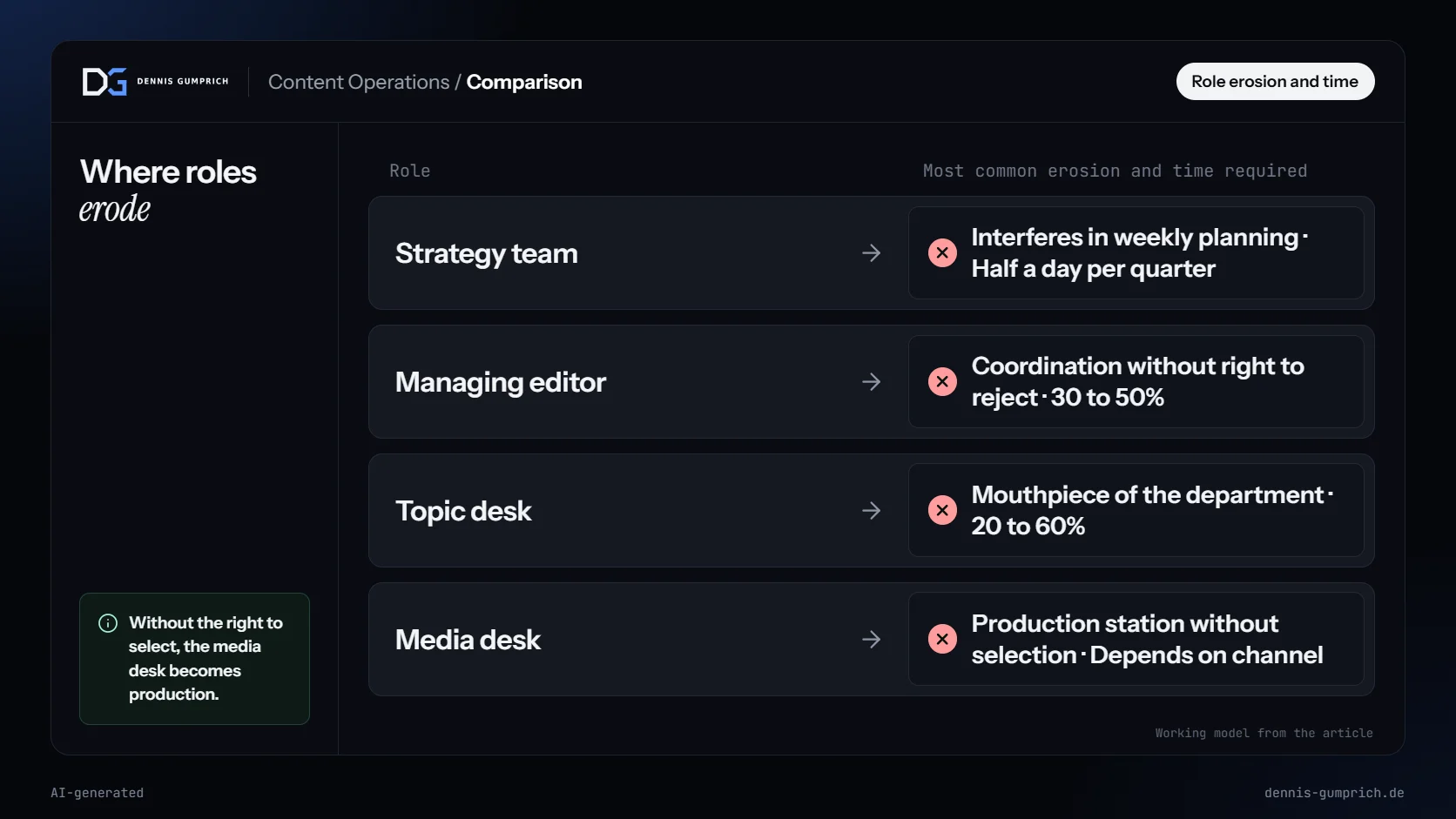
The four newsroom roles in direct comparison
| Role | Decides alone on | Most common role erosion | Time required |
|---|---|---|---|
| Strategy team | Topic priorities for the quarter, resource allocation, escalations | Interferes in weekly planning and undermines the managing editor | half a day per quarter plus escalations |
| Managing editor | Adding, priority, rejection, assignment of topics | Becomes a coordination point without the right to reject | 30 to 50 percent of a position |
| Topic desk | Content design, sources, readiness for decision | Becomes the mouthpiece of its own department | 20 to 60 percent depending on topic area |
| Media desk | Channel fit, format, delivery time | Becomes a production station without the right to select | 20 to 80 percent depending on channel volume |
The column that matters is the third. Each of these four forms of erosion arises not from poor work, but from missing decision rights. They can therefore be repaired without rebuilding the structure.
Who makes which decision, who has a say and who is only informed is easiest to record in the free RACI matrix template (in German). The check column immediately shows where a decision maker is missing.
How do you staff newsroom roles in small teams?
Four roles do not mean four positions. A team of five people can cover all four, as long as two rules apply: topic desk and media desk must not be combined in the same person, and the managing editor must not be responsible for a topic area of their own.
Small teams are the normal case. According to the Corporate Newsroom Study 2026 (in German), newsrooms in Switzerland comprise an estimated average of around eleven full-time positions, most of them ten or fewer. Flexible role changes and multiple roles are considerably more widespread there than in traditional communications departments, with a mean of 4.14 compared to 3.35 on a scale of 1 to 5. The researchers see agile role models as the strongest lever for impact, stronger than formal structural changes.
The most common objection to the role model is that you are too small for it. That is a misunderstanding that arises from how it is shown in the organizational chart. Four roles do not mean four positions. A team of five people can cover all four roles as long as two rules are followed.
Rule one: topic desk and media desk must not be combined in the same person. The mechanism depends precisely on this separation. Someone who brings in a topic and at the same time decides on its delivery does not weigh up, but implements. That is the one combination that undermines the model.
Rule two: the managing editor must not be responsible for a topic area of their own. Otherwise they decide on their own case. They can, however, easily look after a channel or be part of the strategy team.
Unproblematic, on the other hand, are: several topic areas in one person, several channels in one person, managing editor combined with strategy team, and a rotating managing editor on a weekly basis, as long as the decision rules are documented and do not change with the person.
What must never be dropped is the named stand-in. If decisions stall while a person is on holiday, the role is tied to a person instead of institutionalized. What follow-up costs this has and how to set up a stand-in arrangement that holds when it matters is described in When a person drops out: content operations without a key person. For comparison: how to define roles in a content team independently of the newsroom model is described in Who does what in the content team.
Self-check: are your newsroom roles really filled?
These six points do not check whether the roles are named, but whether they hold up in operation. Tick everything that applies to you.
- As a function, not a position. In a press office with around five active people, the managing editor handles quality assurance in the approval path from specialist to managing editor to board. Around 14 other people only read along and give feedback.
- A fixed rhythm replaces permanent duty. Small teams do not need a managing editor sitting at the desk all day, but a daily or weekly meeting with a clear agenda. A public housing company would like a weekly board for this with a single question: "Is this due this week, yes or no?"
- Derive tasks directly from the meeting. A business association wants to assign tasks from the daily meeting without a detour via OneNote. That way, the managing editor's job remains a decision, not follow-up work.
- Automate routine checks. In the press office, the managing editor has stored their review criteria as an automatic check. The software checks the formal aspects, and they only decide on content.
Mapping roles in the tool: what matters
A role model that only exists in a presentation is overwritten in everyday work by the tool landscape. If the topic list sits in a spreadsheet to which everyone has write access, the managing editor effectively has no right to add topics, no matter what the concept says. Why this fails in detail is shown in Content planning in Excel: why it fails from three channels onward.
Three points are practically relevant for mapping roles. First, you need separate rights for creating, prioritizing and approving, otherwise the separation of topic and channel decisions cannot be mapped technically. Second, you need free or low-cost observer roles with an approval function, because in almost every organization the number of people reading along and approving exceeds the number of active editors. Third, the status history must be traceable so that a rejection is documented and does not disappear in a chat history.
These three requirements belong on every requirements list before you go into vendor conversations. How to turn this into a robust investment decision is described in Calculating the business case for content software.
Conclusion
Newsroom roles are not a naming problem, but a decision problem. The four names are in every concept, and yet the organization often behaves exactly as before. The difference arises in three places: the managing editor must be allowed to reject, the media desk must be allowed to select, and the strategy team must back both when in doubt.
If you only want to change one thing about your role description, then this: replace every "coordinates" with a sentence that names what this role decides alone. What remains after that is your actual operating model.
Frequently asked questions
What exactly does a managing editor do in a corporate newsroom?
The managing editor runs day-to-day business: they add topics to the topic list, prioritize them within the current week, reject or postpone them, assign them to a topic desk and lead the daily alignment and the topic meeting. What matters is that these four decisions are possible without prior approval. The managing editor is not responsible for factual accuracy, legal approval or crisis communication.
What is the difference between topic desk and media desk?
The topic desk is responsible for the what: it finds topics in the departments, prepares them and is responsible for their content. The media desk is responsible for the where and how: it decides whether a topic is suitable for its channel, in which format it appears there and when. This separation is the actual mechanism of the newsroom model. If both roles are combined in one person, there is no more weighing up.
How many people does a newsroom need at minimum?
There is no robust minimum number, because volume decides, not headcount. The practically relevant lower limit comes from the role separation: you need at least different people for topic and channel responsibility and a third person who decides in case of conflict. This means a newsroom concept can already be implemented with about four to five people, provided roles are bundled and stand-ins are named.
Can one person take on several newsroom roles?
Yes, with two exceptions. Topic desk and media desk must not be combined in the same person, because otherwise the weighing-up mechanism disappears. And the managing editor should not be responsible for a topic area of their own, because otherwise they decide on their own case. Several topic areas in one person, several channels in one person and the combination of managing editor and strategy team are unproblematic.
How much time does the managing editor role take in everyday work?
With a volume of five to ten published pieces of content per week, you should expect 30 to 50 percent of a full-time position. This time must be freed up from other tasks. If the role is assigned on top, prioritization is the first thing to go in busy weeks, because it is the only task nobody demands.
How do I recognize that a newsroom role only exists on paper?
By three signals. First: there is no named stand-in, and decisions stall during holidays. Second: in the last three months, nothing was rejected and nothing was deliberately not delivered. Third: the time share of the role is not quantified and not agreed with the manager. If one of these applies, the role is a job description without effect.
Do we need dedicated software for the newsroom roles?
Not necessarily, but the tool landscape overrides the role model if it does not map it. You need separate rights for creating, prioritizing and approving, low-cost observer roles with an approval function for stakeholders outside the core team and a traceable status history so that rejections are documented. Where these three points are missing, the decision rights become diluted in everyday work.
Where does your content process lose time today?
In 30 minutes, we look together at where unnecessary coordination, manual tasks, tool switching or repetitive content work cost you time today.
You get a concrete assessment of which tasks you can simplify, automate or organize better, and where AI and tools actually help instead of adding complexity.
Analyze your content process in 30 minutes Free of charge. You take away concrete starting points you can use internally right away.
Dennis Gumprich
Dennis helps marketing and communication teams fit generative AI into existing content processes without undermining quality, brand voice and approvals. Focus areas: content operations, AI governance and tool selection in mid-sized companies and corporations.
Transparency note: Dennis works for contentbird, a provider of AI-powered content software. Product mentions are marked in the article. More about Dennis (in German) · LinkedIn
Read more
Sources
- Christoph Moss: The Corporate Newsroom Model, chapter 4 in: The Corporate Newsroom. Steering Companies Efficiently Through Communication, Springer 2021, pp. 27 to 47, abstract at EconPapers/RePEc: origin of the newsroom model widespread in German-speaking countries. Accessed October 31, 2026.
- Mediamoss: So bauen Sie einen Corporate Newsroom auf (How to build a corporate newsroom, in German), white paper without date, role descriptions of strategy team, managing editor, topic desks and media desks after Christoph Moss. Accessed October 31, 2026.
- kom.de, Volker Thoms: So unterschiedlich nutzen Unternehmen das Newsroom-Modell (How differently companies use the newsroom model, in German), article of April 8, 2025, practical examples from SBB and Lufthansa Group with a weekly rotating managing editor. Accessed October 31, 2026.
- Tobias Rohrbach, Diana Ingenhoff (Université de Fribourg), Mykola Makhortykh (University of Bern), Philipp Bachmann (Lucerne University of Applied Sciences): Ein Modell, viele Wege. Corporate Newsrooms in der Schweiz 2026 (One model, many paths, in German; Corporate Newsroom Study 2026), study report supported by Newsroom Communication, Axpo, SBB and Innosuisse. Online survey of 216 communications managers in German- and French-speaking Switzerland, November and December 2025, self-assessments; size of newsrooms pp. 13 to 14, role models pp. 17 and 19, key takeaways p. 4. Accessed October 31, 2026.
- Nils Becker, Mediamoss: Die vier Werkzeuge im Corporate Newsroom (The four tools in the corporate newsroom, in German), blog post of May 21, 2026: meetings, topic planning tool, content strategy and planning process as tools, meetings across the horizons year, quarter, month, week and daily morning briefing, moderated by the managing editor team; if a tool is missing, lead times and alignment loops become longer; planning tools with several time horizons and links to the topic architecture are considered considerably more efficient than Excel lists or individual calendars. Publication of a consultancy, assessment from consulting experience without figures. Accessed October 31, 2026.
- Nils Becker, Mediamoss: Der Standardprozess im Corporate Newsroom (The standard process in the corporate newsroom, in German), blog post of May 21, 2026: model after Christoph Moss with seven steps (intake, assessment and planning, conception, approval, media adaptation, publication and measurement, analysis); at approval, the department signs off on the base document in substance before media management adapts it for the channels; process efficiency, such as the time from briefing to publication, as the central evaluation criterion. Publication of a consultancy. Accessed October 31, 2026.
How this article was created
This article was created with the help of AI. Structure, research and draft wording were developed with AI support. Professional assessment, review of the statements and the final version are the responsibility of Dennis Gumprich. The English version was translated with AI and reviewed. Read the original German version.
How reliable are the statements?
Evidence exists for the results of the Corporate Newsroom Study 2026 (self-assessments of 216 respondents in Switzerland), the four role names and their basic tasks, which correspond to the newsroom role model after Christoph Moss widespread in German-speaking countries, and the weekly rotating managing editor as lived practice at SBB and Lufthansa Group, as well as the meeting horizons moderated by the managing editor team and the order of expert sign-off by the department and channel adaptation in the standard process (both Mediamoss consulting models from May 2026, publications of a consultancy). In the original model, the media desk has a right to propose on channel fit; the right to select described in this article is a further development from consulting practice. The daily routines, time shares, staffing rules and erosion patterns named in this article are explicitly marked as a working model from consulting practice. They are not an industry standard and not measured values. The illustrations were created with AI support. Status: October 31, 2026.


