

The trial account has been running for four weeks. Four people have opened it, two have tried something out, one has written a text with it. Asked whether the software is any good, each of them says something different.
This result is no coincidence. Without a concrete use case, you click through menus and end up evaluating an interface. That says nothing about whether your work runs better with it.
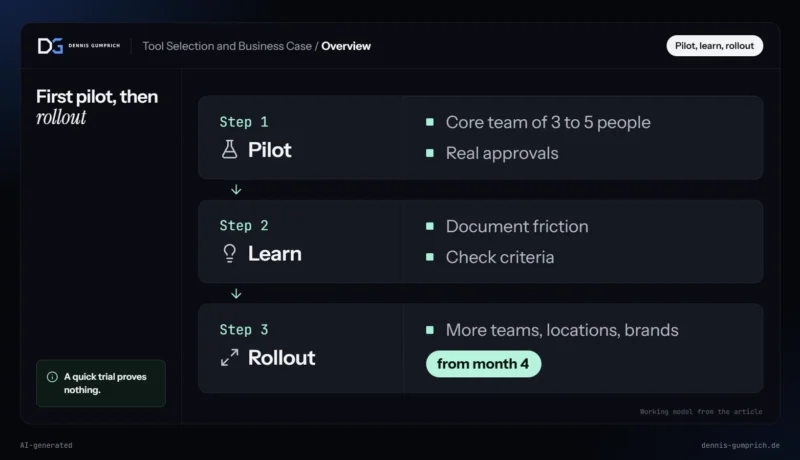
A pilot is not a trial, but real operation with a small core team. Three to five people work productively in the software on their real topics, with stored context and real approvals. Only this operation shows whether your requirements are covered in depth. The rollout to further teams is the second phase and, with good preparation, can start after just two to three months. Before that comes a third, shorter stage that many overlook: the guided test phase over four weeks, which supports the procurement decision but says nothing about ongoing operation.
Why a quick trial proves nothing
An account without a use case produces impressions, not insights. Those involved see the user interface and evaluate it, because that is the only aspect they have actually experienced. Whether the software maps your approval paths, whether your brand voice takes effect, whether the specialist department can work with it, remains untested.
The reason is structural. The questions on which an introduction later fails do not arise when the first text is created. They arise in the third month, when 80 pieces of content are in the system, when a stand-in has to take over during holidays, when a topic is played out across five channels and when someone asks why a version from six weeks ago looks different.
Then there is the context. Software without stored brand voice, without your verified facts and without your templates delivers generic results. Evaluating it in this state means evaluating the missing setup, not the software. This is exactly where most short test phases fail, regardless of the vendor.
The sober consequence is uncomfortable: a robust assessment cannot be had without real operation. If you demand one anyway, you get a snapshot of opinions and then make a decision based on likability.
The same caution is expressed in the NIST Generative AI Profile (NIST AI 600-1), a voluntary framework from the US for risk management of generative AI. It advises against drawing conclusions about general performance from narrow or anecdotal tests and recommends passing test results on to those who decide on approval. It was written for AI systems, but the logic fits the situation after an open trial account exactly. For you, this means: record what was actually tested in the pilot and present exactly that to management, not the snapshot of opinions.
What is a pilot, and what is not?
A pilot is productive operation on a small scale: a small core team, real topics, stored context, real approval paths and a period that reflects a year of operation. An open account for everyone interested without a defined use case is not a pilot. At the end, everyone has an opinion and nobody has insights.
Open access for everyone interested, unspecified duration, no defined use case, no stored guidelines, no real approvals. Result: everyone has an opinion, nobody has insights.
Small core team, real topics, productive operation, stored context, real approval paths, defined requirements and a period long enough to reflect a year of operation.
The decisive difference lies in the word productive. In the pilot, content is created that is actually published. Only then does it go through all steps, only then are those involved seriously engaged, and only then does the friction appear that would affect you later.
The stage in between: the guided test phase
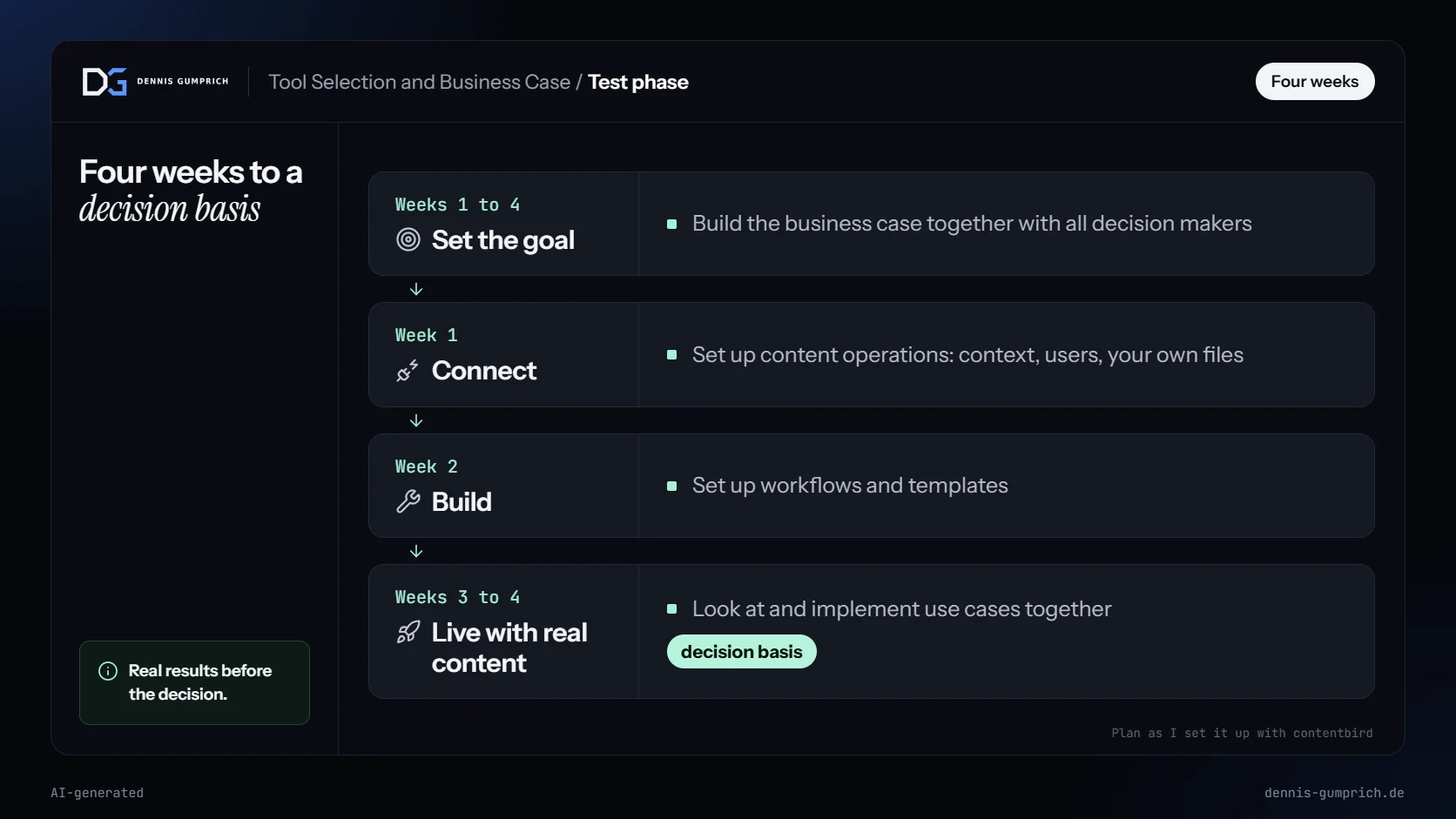
Between the open trial account and the pilot lies a third format that increasingly appears in selection processes and that you should actively ask for: a guided test phase, usually called a proof of concept. It typically lasts four weeks and differs from the trial account in one point that changes everything. You do not do the setup alone.
This removes the reason why short test phases otherwise fail. The problem is not the four weeks, but that in a self-service account three of them are spent on a setup nobody explains. If the context is set up together and your existing editorial plan is imported instead of rebuilt, there is time left for what matters: real content from your own system.
Four points decide whether this becomes a robust basis or just another trial account under a new name. Ask for them in writing before you commit.
- Fixed guidance instead of self-serviceTwo to three sessions of half an hour each with a named contact person, firmly scheduled. Without this rhythm, the phase fizzles out in the second week.
- Your data, not sample dataExisting editorial plan, sample content and, if available, your target group descriptions are imported. If you test in a demo environment, you test the demo.
- A small, committed group of usersTwo to three people who will actually work with it later. Here too, open access for everyone interested produces opinions instead of experience.
- A documented resultAt the end there is an evaluation with measured time savings against your previously measured baseline, plus scope, investment and term in writing. Without this document, you cannot make your case internally.
The boundary is just as important. A guided test phase answers the procurement question, not the operations question. If you expect both from it, you will be disappointed, and if you skip it for that reason, you throw away the only robust basis you can get before signing the contract.
| Question | Guided test phase, 4 weeks | Pilot, several months |
|---|---|---|
| Does the system fit our processes | answered | deepened |
| Can our team work with it | answered | deepened |
| Time savings compared to today | first robust measurement | annual value |
| Scope, investment, term | clarified | already decided |
| Does the setup hold up in daily work | open | answered |
| Does the stand-in arrangement work | open | answered |
| Do context and approvals hold at volume | open | answered |
What exactly you test in the test phase follows from your list of requirements. How to draw it up and weight it is described in the requirements catalog for newsroom software, which can be applied to any planning and editorial software.
In practice, this means: the guided test phase is the step before the decision, the pilot the step after it. If you skip the test phase, you decide on the basis of a demo. If you skip the pilot, you roll out on the basis of an assumption.
- Two use cases, no more, and two fixed testers with time set aside.
- A real occasion instead of sample content, for example the campaign for a new degree program.
- Personal handover plus video, two to four weeks of runtime and a before-and-after comparison.
What phases does a pilot project consist of?
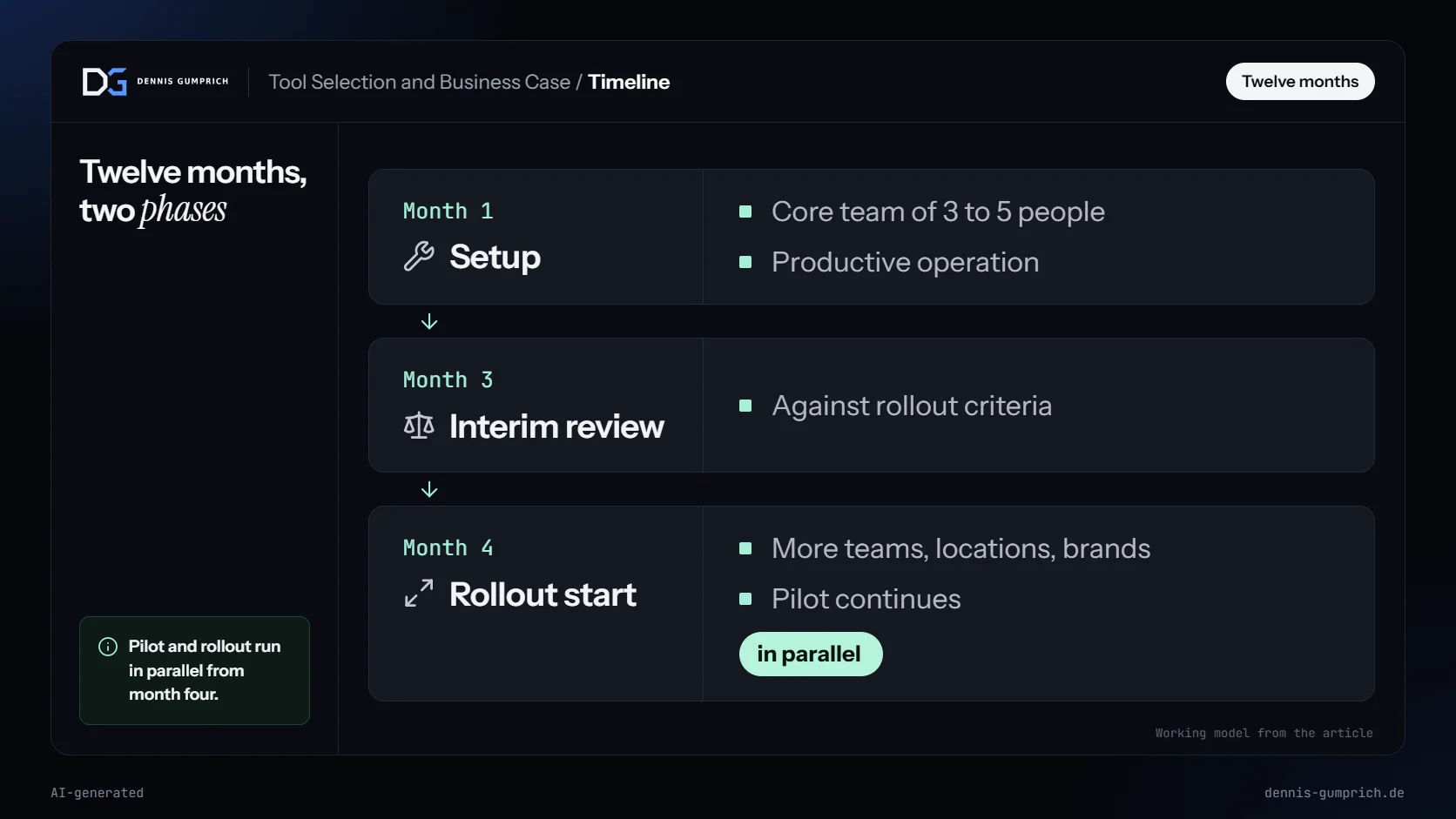
Two. Phase one is the pilot with a core team of three to five people plus an approving role. Phase two is the rollout to further teams, locations or brands while the core team remains stable. Mixing the two either overloads the core team or rolls out something that does not yet hold up. Where pilot and rollout sit in the overall transformation is shown in The 5 phases of AI transformation.
An introduction runs in two clearly separate phases. Mixing them either overloads the core team or rolls out a solution that does not yet hold up.
| Phase 1: pilot | Phase 2: rollout | |
|---|---|---|
| Participants | Core team of 3 to 5 people, plus an approving role | All further teams, locations or brands |
| Goal | Test requirements in depth, set up processes and context | Scale on the basis of a proven setup |
| Way of working | Productive operation with real topics | Adoption of the established structure |
| Typical start of the next phase | possible after two to three months if the criteria are met | step by step, team by team |
| Why it fails | missing use case, no stored context | starting too early, before the setup holds up |
The most important value in this table is in the second-to-last row: the rollout can start after just two to three months. So a pilot does not mean that nothing happens for a year. It means that a small team provides support until the setup holds up, while further teams are already joining.
How long should a pilot last?
A pilot is usually planned for twelve months. This period is irritating if you think of a test phase, and it is regularly misunderstood. It does not stand for the setup, but for gaining insight.
The setup itself takes much less time today than it did two years ago. Knowledge base, brand voice and planning structure can be built from your existing content with AI support instead of being rebuilt by hand. Where this is guided, productive operation is in place after about two weeks. What this does not shorten is the calendar behind it.
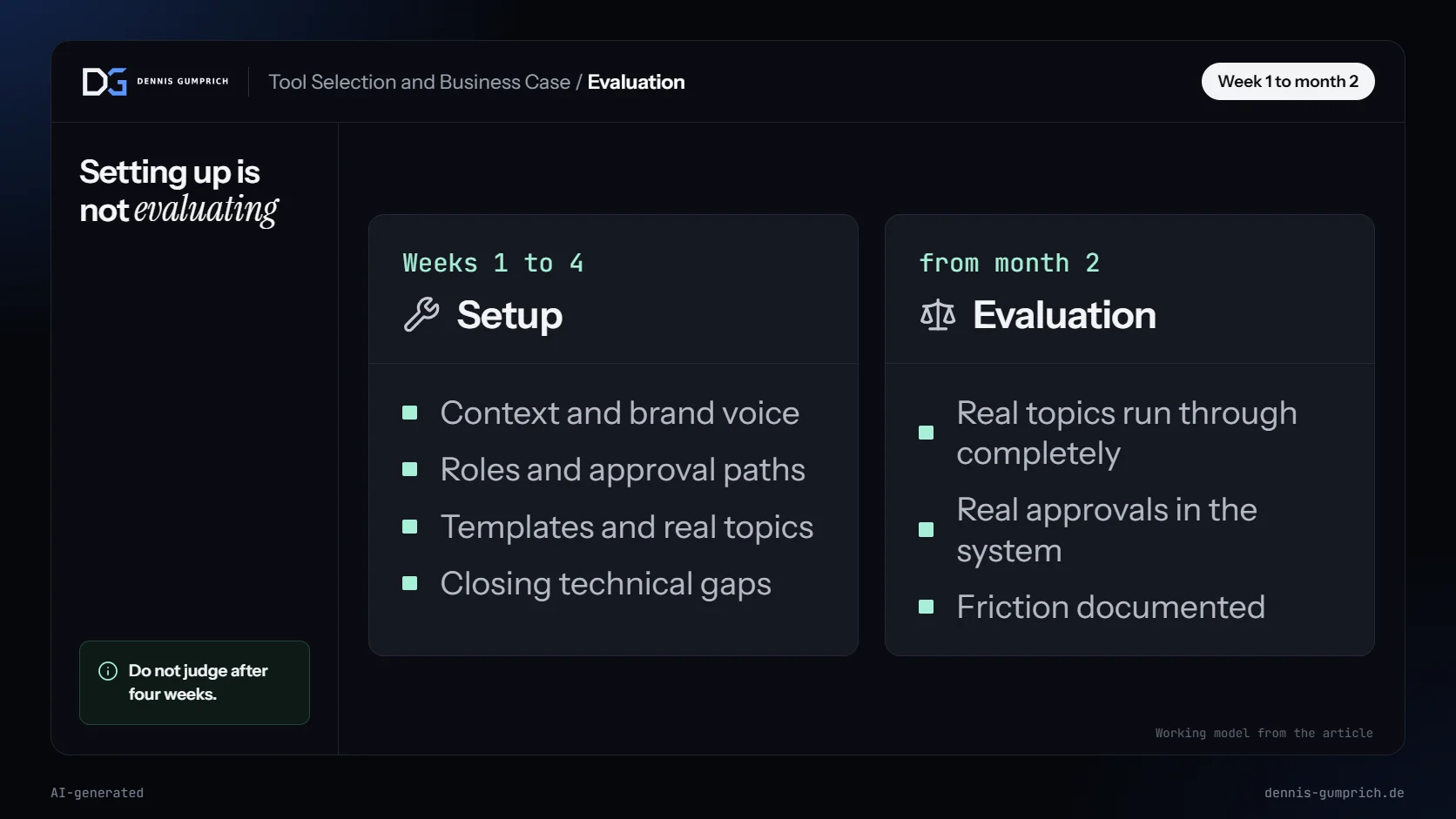
What matters is therefore not the duration, but who does the setup. If it depends on you, after four weeks there is still only a setup state to evaluate. That is exactly why unguided test phases so often deliver a negative result, even though the solution would have fit.
What the faster start does not change is how much it tells you about ongoing operation. Whether stand-ins work and whether context and approval paths hold with eighty pieces of content only becomes clear over months. The annual cycle cannot be shortened, it can only start earlier. That is exactly the gain.
Clarity at this point is part of it: a twelve-month pilot period is usually a contractual commitment, not a free trial. That is a decision you should make consciously. Ask for something in return: guided setup, named contact persons, binding statements on open requirements and a review after three months with a documented result.
Who belongs in the core team of a pilot project?
Three to five people plus an approving role: a topic owner who decides which real topics run in the pilot, two content creators instead of one so that stand-ins and different working styles are reflected, and an editorial review that checks against brand voice and structure.
Topic owner
Decides which real topics run in the pilot. Without this role, practice content is created instead of productive operation.
Indispensable: the pilot needs real topics with a publication date.
Two content creators
Work with it every day. Two instead of one so that stand-ins and different working styles are reflected.
Indispensable: one person alone produces an individual opinion.
Editorial review
Checks against brand voice and structure. Assesses whether the stored context actually takes effect.
Indispensable: without it, the quality question remains unanswered.
Specialist approval
Usually comes from a specialist department. Does not have to be involved daily, but the approval must take place in the system.
Often overlooked: if approvals happen outside, the bottleneck remains untested.
People who only want to observe do not belong in the core team. Anyone who does not work productively with it cannot judge anything and slows down coordination. Interest from other areas is better served with a short interim report after three months.
- Tests run in parallel with high-load projects. As a result, a university could not evaluate anything robustly after the first test phase.
- Permissions block workflow functions because roles and rights in the test are not set up the way they will be in operation.
- IT, data protection and the works council are underestimated, the latter especially at municipal utilities, plus public procurement obligations for public companies and the connection to CMS and SharePoint.
- A company AI policy can stop an introduction completely if it only comes up at the end of the test.
How do you know the rollout can start?
By four criteria, not by the calendar: at least ten pieces of content have been created, reviewed, approved and published entirely in the system, without any step having to take place outside it. The stored context works without additional instructions. The stand-in arrangement has been tested. And open issues have been clarified.
The rollout does not start according to the calendar, but according to criteria. These four have proven robust and should be fixed before the start.
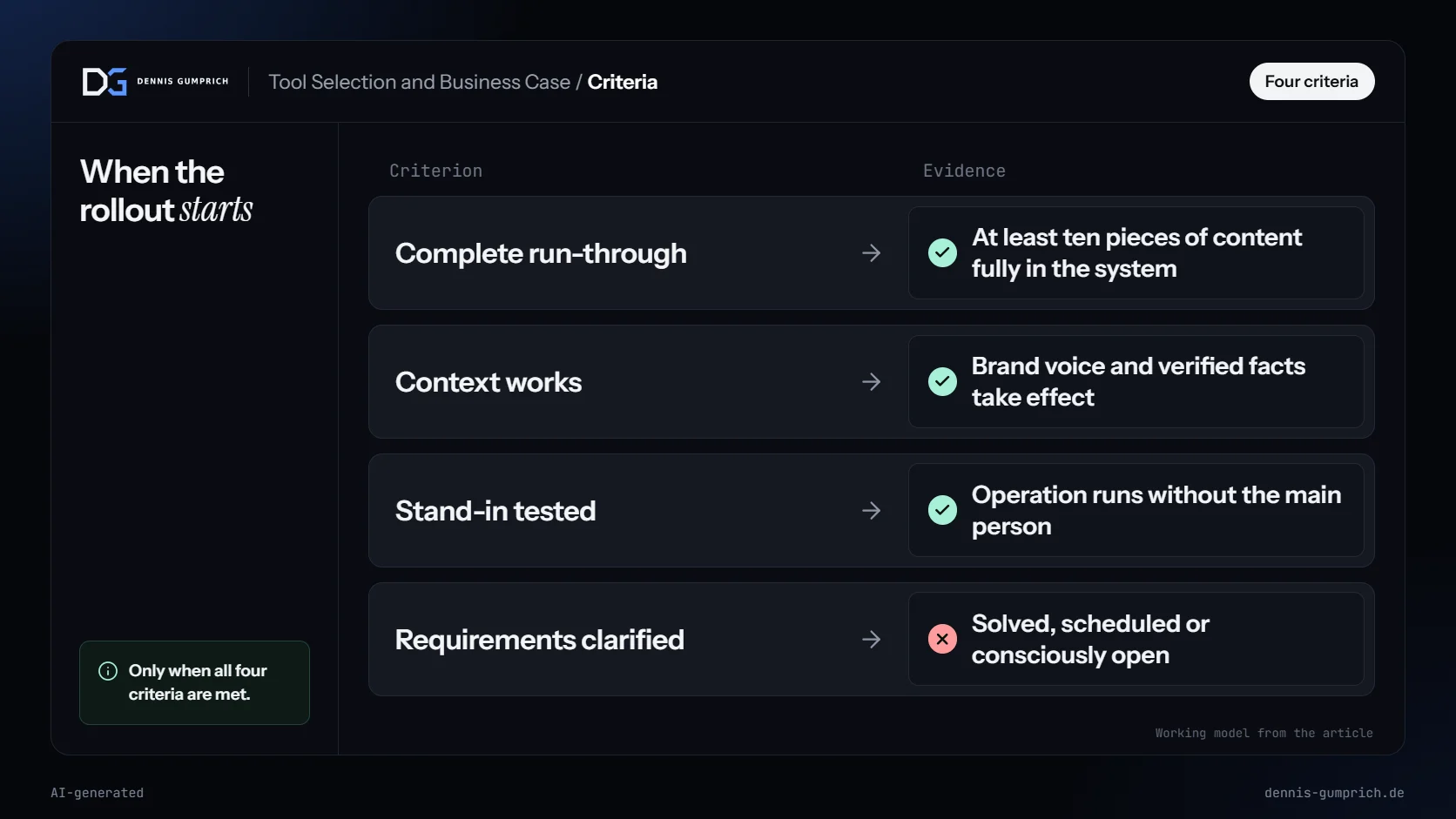
- Complete run-throughAt least ten pieces of content have been created, reviewed, approved and published entirely in the system, without any step having to take place outside it.
- Context worksBrand voice and verified facts are stored, and the editorial review confirms that results fit without additional instructions.
- Stand-in testedOperation has run at least once without the main person, planned or unplanned.
- Open requirements clarifiedFor every gap that appeared in the pilot, there is a binding statement: solved, planned with a date or permanently not covered.
The fourth criterion is the most important and the one most often negotiated softly. A requirement that was not covered in the pilot and for which there is no binding statement becomes a problem in the rollout, only then with three times as many people involved.
The pilot results can be recorded in the free evaluation matrix for content software (in German), so that the rollout decision is based on the same criteria as the selection.
Five mistakes in the pilot phase
- Starting without a use caseAn account without a real topic leads to clicking around. The pilot needs content with a publication date.
- Not storing contextWithout brand voice and verified facts, you evaluate the setup, not the solution.
- Too many participantsOpen access for everyone interested produces opinions instead of experience. Three to five people working productively say more than twenty onlookers.
- Letting approvals run outside the systemIf specialist approval continues by message, exactly the bottleneck you switched for remains untested.
- Evaluating an unguided account after four weeksWithout guidance, the first phase is pure setup, and a verdict then describes the setup state, not the suitability. With guided setup, the procurement question can be answered after four weeks, the operations question still cannot.
Through the pilot phase in five steps
- Before the startRecord requirements and baselineWhich requirements are to be tested, and how high is today's effort for the same process?
- Weeks 1 to 2Set up, do not evaluateStore context, map roles, set up approval paths, guided and with AI support from your existing content. This phase is explicitly not evaluated.
- From week 3Work productivelyRun real topics through completely, document open points continuously instead of collecting them.
- Months 2 to 3Interim reviewCheck against the four criteria. If they are met, the rollout starts with the first additional team.
- Months 3 to 12Operation and expansionThe core team remains the contact for the new teams. After twelve months, robust figures on effort and impact are available.
Self-check: is your project a pilot?
Tick everything that applies to you.
A quick alignment on how we approach the introduction:
We are not starting with an open trial account, but with a pilot: a core team of three to five people works productively on real topics, including stored brand voice and real approvals. This is the only way to test whether our requirements are actually covered.
The first two weeks are setup; we deliberately do not evaluate during this time. They are shorter than used to be common because the vendor guides the setup and creates the knowledge base from our existing content with AI support. After two to three months, we check against four criteria fixed in advance and decide on the rollout to further teams. The pilot continues in parallel, and the core team remains the contact.
What we expect from the vendor: guided setup, named contact persons and a binding statement on every open requirement, that is, solved, planned with a date or permanently not covered.
Conclusion: operation beats trial access
The question of whether a solution fits you cannot be answered by trying it out, because the decisive friction only arises in operation. A pilot with a small core team delivers this answer, but requires a conscious decision upfront. If you shy away from this decision, you do not postpone it, you make it later on a weaker basis. How such a pilot fits into a step-by-step AI introduction is shown in The 5 phases of AI transformation.
Frequently asked questions
Why not a short free trial?
There is nothing against a short test, but there is against an unguided one. If you have to handle the setup alone, after four weeks the context is not stored and no complete approval path has been run through, and you evaluate the interface. Ask instead for a guided test phase with your own files and a documented result. It supports the purchase decision. Whether the setup holds up in daily work is something it does not answer either.
What distinguishes a guided test phase from a pilot?
The purpose. The guided test phase runs for four weeks, works with your imported data and a small group of users and ends with an evaluation including measured time savings. It supports the purchase decision. The pilot starts afterwards, runs for months in productive operation and answers whether the setup holds up in daily work. The test phase does not replace the pilot; it ensures you do not start the pilot with the wrong system.
Twelve months is a long commitment. Is that common?
For software used in ongoing operation, an annual period is widespread, because setup and onboarding would otherwise be out of proportion to use. What matters is what you ask for in return: guided setup, fixed contact persons, a documented interim review and binding statements on open requirements.
What if the pilot shows that it does not fit?
Then you gained this insight with five people instead of fifty, and you have documented your own process. That is exactly why the transition criteria should be set in advance: they turn a no into a result instead of a failure.
Can we speed up the rollout?
Yes, through preparation. If brand voice, verified facts and approval paths are already in order before the start, the setup phase is shortened considerably. The bottleneck is rarely the software, but the state of your own foundations.
Who should lead the pilot?
A person from the team responsible for the process every day, not the person who proposed the vendor. This separation considerably increases the credibility of the result, especially if it turns out positive.
Where does your content process lose time today?
In 30 minutes, we look together at where unnecessary coordination, manual tasks, tool switching or repetitive content work cost you time today.
You get a concrete assessment of which tasks you can simplify, automate or organize better, and where AI and tools actually help instead of adding complexity.
Analyze your content process in 30 minutes Free of charge. You take away concrete starting points you can use internally right away.
Dennis Gumprich
Dennis helps marketing and communication teams fit generative AI into existing content processes without undermining quality, brand voice and approvals. Focus areas: content operations, AI governance and tool selection in mid-sized companies and corporations.
Transparency note: Dennis works for contentbird, a provider of AI-powered content software. Product mentions are marked in the article. More about Dennis (in German) · LinkedIn
Read more
Sources
- Common Paper: Contract Benchmark Report, Q1 2024, analysis of February 6, 2024 based on the contracts of more than 1,000 companies, mainly in the US market: 70 percent of cloud service contracts run annually, 19 percent monthly. Evidence for the prevalence of annual contracts for software used in ongoing operation. Accessed October 31, 2026.
- National Institute of Standards and Technology (NIST): Artificial Intelligence Risk Management Framework: Generative Artificial Intelligence Profile (NIST AI 600-1), published July 26, 2024, Chloe Autio, Reva Schwartz, Jesse Dunietz et al., companion document to the voluntary AI RMF 1.0 of January 2023: MS-2.5-001 warns against drawing conclusions about general performance from narrow or anecdotal tests, MS-2.3-003 provides for passing test results on to approval decision makers, MG-4.3-002 recommends systematically recording errors and near misses. Voluntary framework from the US with no legal force in the EU. Accessed October 31, 2026.
How this article was created
This article was created with the help of AI. Structure, research and draft wording were developed with AI support. Professional assessment, review of the statements and the final version are the responsibility of Dennis Gumprich. The English version was translated with AI and reviewed. Read the original German version.
How reliable are the statements?
Evidence exists for the prevalence of annual contracts for cloud software from the Common Paper Contract Benchmark Report and for the recommendation not to draw general conclusions from narrow tests and to pass test results on to approval decision makers (NIST AI 600-1, voluntary framework from the US). The phase sequence, time frames and criteria are explicitly marked as working models and are not an industry standard. The same applies to the size of the core team, the four-week guided test phase, setup in about two weeks, the rollout start after two to three months and the threshold of ten pieces of content run through completely, which are empirical values from consulting practice. Contract models and pilot conditions differ considerably between vendors. Check the conditions offered to you case by case. Update history: revised on September 1, 2026 with a section on the guided test phase, a refined statement that four weeks are not enough for unguided accounts, and a timeline adjusted to today's setup of about two weeks; supplemented on October 31, 2026 with the NIST recommendations. Next review planned for March 2027. Status: October 31, 2026.


