
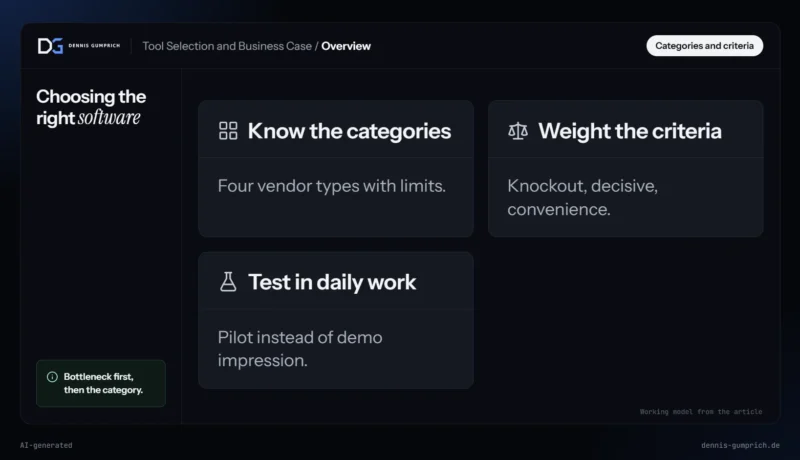

Most bad purchases of content software happen before the first quote is requested: at the question of which problem the software is supposed to solve at all.
In 2026, content marketing software for teams comes in nine categories, from AI writing assistants to content operations platforms to marketing suites. They solve different bottlenecks and cannot be compared sensibly through feature lists. The right category follows from your bottleneck: writing, visibility, coordination or conversion. Within the category, twelve selection criteria decide, of which at most five should be knockout criteria.
Before turning to the nine categories and their selection criteria, it is worth looking at the point where most selection processes take a wrong turn.
Why most tool selections in content marketing go wrong
The most common mistake happens long before the first demo: teams start with the question "Which tool is best?" instead of "What is holding us back right now?".
The result is predictable. You collect feature lists, compare them side by side and in the end decide by sympathy, price or whatever looked most impressive in the demo. Six months later, the team uses 20 percent of the features, and the original bottleneck is still there. Why this is due to the missing process and not the tool is described in AI content operations: how AI experiments become a process.
Teams replacing a tool again after a while is not an isolated case. In the "Degree of digitalization 2023" study by the German B2B marketing association bvik (in German), 60 percent of the 191 companies surveyed said they had already replaced a marketing technology, most often because of insufficient functionality and poor usability. This is a historical value from 2023 from an association survey with a small sample. For you, this means: test functionality and usability on your real workflow instead of the demo, otherwise the next switch is already built in.
The second mistake is just as widespread: software is supposed to solve a process problem. If it is unclear at your company who approves and what a finished piece is, any tool will map this lack of clarity. Just faster and for more money.
A rule of thumb for your internal discussion: software speeds up a process. It does not replace it. If you cannot describe the workflow on one page, tool selection is the wrong next step. How to clarify this workflow first is shown in the article on content operations.
Two things teams most often underestimate in the selection. First, over-sizing: strategy-heavy tools often do not fit the pragmatic way of working that is actually lived. Second, ongoing contracts and notice periods for existing tools, which determine the timeline before the first demo takes place.
Which vendor categories are there in 2026?
For content marketing teams, there are nine categories of software that are often confused because they carry similar feature names. Each covers a part of the content process: from writing through planning, approval and delivery to evaluation. Which category you need is decided by your bottleneck, not by the length of the feature list.
| Category | Mainly solves | Typical vendors | Limit |
|---|---|---|---|
| 1. AI writing assistants | Drafts, rewording, variants | ChatGPT, Claude, Microsoft Copilot, neuroflash, DeepL Write | No shared workflow, knowledge sits in individual chats |
| 2. SEO and visibility tools | Keywords, competition, content gaps, rankings | SISTRIX, Semrush, Ahrefs, Surfer SEO | Deliver insights, not planning and approval |
| 3. Content marketing and content operations platforms | Topic planning, creation, approval, publication and evaluation in one system | contentbird* | Setup only pays off with several people involved |
| 4. Social media approval | Preview and approval of social posts, including by external parties | Planable, Kontentino, Swat.io | Website, newsletter and press stay outside |
| 5. Social media management | Publishing, inbox and reporting across social channels | Hootsuite, Sprout Social, Metricool | No topic core beyond social |
| 6. Headless CMS with workflow | Structured content, multilingual, delivery to website and app | Contentful, Storyblok, Kontent.ai | Topic planning and editorial steering usually weak |
| 7. Digital asset management | Images, videos, usage rights, brand guidelines | Bynder, Frontify, CELUM | Manages media, not the text process |
| 8. Project management | Tasks, dates, ownership | Asana, monday.com, Airtable, Wrike | The content sits alongside as a file |
| 9. Marketing suites | CRM, email, campaigns and lead management with a content module | HubSpot, Adobe Experience Cloud, Salesforce Marketing Cloud | Little editorial depth in planning and approval |
The table explains why comparisons between these categories lead nowhere: a social media approval tool and a content platform have similar feature names but solve different problems. Most teams combine two to three categories. If you do, count the handovers before you decide. How to do that is described in Point tools or platform, and how several channels can still run from one plan in Steering content channels centrally.
Four types: which bottleneck leads to which category?
The nine categories can be condensed into four types, depending on which bottleneck they solve: writing, visibility, coordination or conversion. If you know your bottleneck, you can rule out most categories immediately and then only compare vendors of the same type.
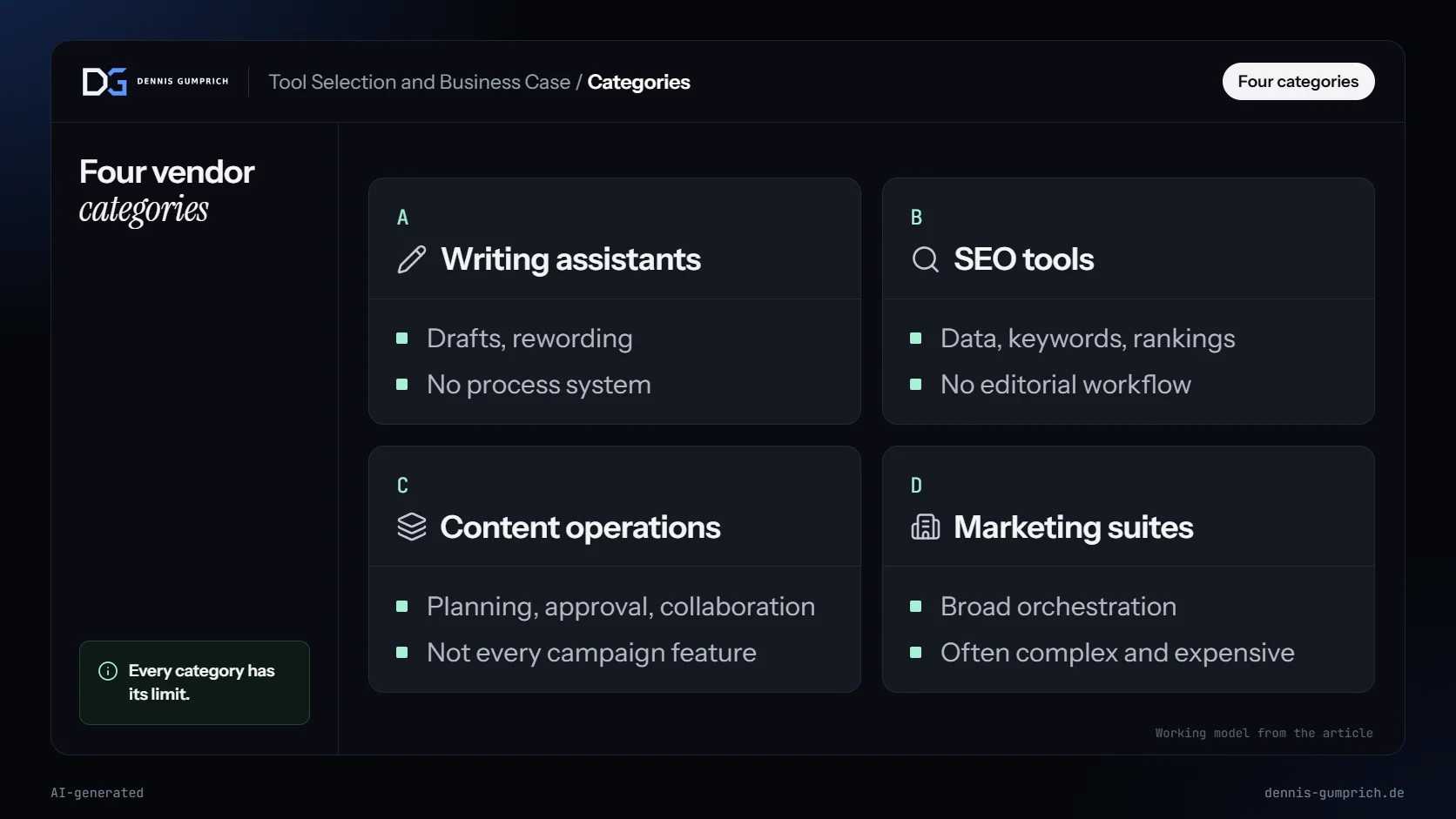
Writing assistants
Pure text tools. You specify a topic and a tone, the system delivers drafts. Examples in this category are general assistants such as ChatGPT, Claude or Microsoft Copilot as well as specialized text tools.
Fits when your planning already works and you only lack writing speed.
Does not fit when several people need to coordinate or brand voice should be binding. The knowledge then sits in individual chats instead of in the system.
SEO and visibility tools
Keyword research, competitor analysis, content scoring, gap analysis. Examples are Sistrix, Ahrefs, Semrush or Surfer SEO.
Fits when your goal is organic visibility and you have a working editorial system that only lacks better data.
Does not fit when you need to map planning, approval and storage. These tools generate insights, not processes.
Content operations platforms
Planning, creation, approval, publication and evaluation in the same system, with stored brand voice and knowledge base. contentbird also belongs here, see the transparency note further down.
Fits when several people work on the same content, approvals cross departmental boundaries and you want to use AI regularly and traceably.
Does not fit when there are two of you or you produce fewer than five pieces a month. The setup effort does not pay off then.
Marketing suites with an AI module
Content is one building block alongside CRM, email, campaigns and lead management. Examples are HubSpot, Salesforce Marketing Cloud or Adobe Experience Cloud.
Fits when content should connect directly to leads and campaign data and the suite is already in place.
Does not fit when you need editorial depth. The content modules are usually functional but rarely strong in planning and approval.
On currency: the vendors named serve to classify categories, as of November 2026. Functionality, prices and positioning change quickly in the AI market. Check the current status directly with the vendor before making a selection.
Distinction from newsroom software: this article covers software for content production in marketing. Newsroom software for corporate communications is something different. There, the focus is not on creation but on steering: which topics are covered at all, who decides on them and how approvals cross departmental boundaries. If you are looking in this direction, the matching criteria are in the requirements catalog for newsroom software.
Which software connects editorial planning, content creation and performance analysis?
Content operations platforms from category C and, with less editorial depth, marketing suites from category D. The simplest test in the demo: ask to be shown a topic that is tied to exactly one record from the topic plan through draft and approval to evaluation. If you have to switch between systems or export to do this, the software does not connect the steps; it only places them side by side.
The same check answers the question of whether you can steer content centrally from strategy to publication. Central does not mean that every channel is served from the same tool. It means that the status, approval and impact of a topic are visible in one place. For channels without a direct connection, a clean interface is enough, for example via MCP or API.
Which AI content operations vendors are there in the DACH region?
In the German-speaking DACH region (Germany, Austria, Switzerland), there are vendors from several of the groups above: content platforms such as contentbird* from Berlin, the headless CMS Storyblok and the asset management system CELUM from Austria, the brand platform Frontify from Switzerland, and AI tools such as neuroflash from Hamburg, Langdock from Berlin and DeepL from Cologne. None of them covers the entire process alone. What matters is which part of the process is your bottleneck.
A European headquarters makes contracts, support and language quality easier, but does not replace checking the data flows. Many vendors use language models from international providers in the background. So always ask for the list of sub-processors and the location of AI processing.
The same check applies to tools that only bring AI as a built-in feature. The NIST Generative AI Profile (NIST AI 600-1), a voluntary framework from the US, recommends extending due diligence in procurement to intellectual property, data protection and security, explicitly also for solutions with embedded AI. It does not bind you legally, but it still works as a structure for your written vendor questions. For you, this means: put every tool with an AI feature through the same check, even if you buy it as a planning or SEO tool.
What is the alternative to strategy-heavy content platforms for mid-sized companies?
That depends on why you are looking for an alternative. Strategy-heavy platforms are designed for comprehensive content planning and do not always fit the pragmatic way of working of mid-sized teams. If you mainly lack AI creation based on stored brand voice, content platforms such as contentbird* are an option. If the focus is on social media, approval tools such as Planable or Swat.io are leaner. If it is about website content, a CMS with workflow is often the shorter route.
For mid-sized companies, five criteria decide in practice: topic planning with traceable prioritization, AI creation based on your brand voice, approvals across departmental boundaries, contract and support in your language, and a pricing model that stays affordable with the second and third group of users. Define these criteria before you schedule demos.
Which category fits your needs?
The answer depends on three variables: team size, the number of coordination boundaries and the main goal. If you mainly lack writing speed and fewer than three people work on content, a writing tool is enough. As soon as more than three people work on the same content and approvals cross departmental boundaries, you need a platform.
Before you compare vendors, determine your type. The following check assigns eight typical situations to the four categories.
Tick what applies to you
The assessment appears immediately and names the matching category.
Selection criteria: how do you measure content marketing software for teams?
With twelve criteria in three groups: security and contract, team collaboration, and connection to your systems. For teams, the second group is decisive above all, because it separates tools for individuals from tools for a shared workflow. The right-hand column is a suggestion for how to weight each criterion. Adapt it to your bottleneck.
| Criterion | Review question | Suggestion |
|---|---|---|
| Security and contract | ||
| 1. Data processing | Is there a data processing agreement, where are the servers, who are the sub-processors? | Knockout |
| 2. Training on your data | Is it excluded in writing that your inputs are used for training? | Knockout |
| 3. Exit | Do you get all content including metadata back in an open format? | Decisive |
| Team collaboration | ||
| 4. Roles and permissions | Can creating, reviewing, approving and reading be assigned separately? | Knockout |
| 5. Approvals | Are there multi-stage approvals, including for specialist departments without their own license? | Decisive |
| 6. Stored AI context | Are brand voice, target groups and product knowledge stored centrally instead of in every prompt? | Decisive |
| 7. Topic planning | Are topics prioritized traceably and planned across channels? | Decisive |
| 8. Traceability | Is it visible who created and approved what, with which AI support? | Decisive |
| Connection to your systems | ||
| 9. CMS and channels | Does approved content reach the CMS and the channels without copy and paste? | Knockout |
| 10. Languages and brands | Can several languages, countries or brands be steered separately? | As needed |
| 11. Evaluation | Can the impact per topic be evaluated across all channels? | Decisive |
| 12. Pricing model and support | What do readers and approvers cost, is there a contract and support in your language? | Decisive |
Criteria 4 to 8 are the reason why a writing assistant is rarely enough for a team: it generates drafts, but no shared workflow. How to check data processing and training in concrete terms is described in GDPR-compliant content marketing software. Whether an existing project management tool already covers criteria 4 to 7 can be checked with Asana, Notion or content platform.
Before every demo, I clarify three possible reasons for exclusion: the budget, the company's AI policy and access to the decision-maker. Only then do we talk about interfaces to the CMS and to Microsoft. I advise against new software when the content volume is very small, for example a marketer with 8,000 small customers and minimal content per customer, or when a team is doing well with its existing lists and no clear efficiency gain is visible.
How do you separate knockout criteria from convenience features?
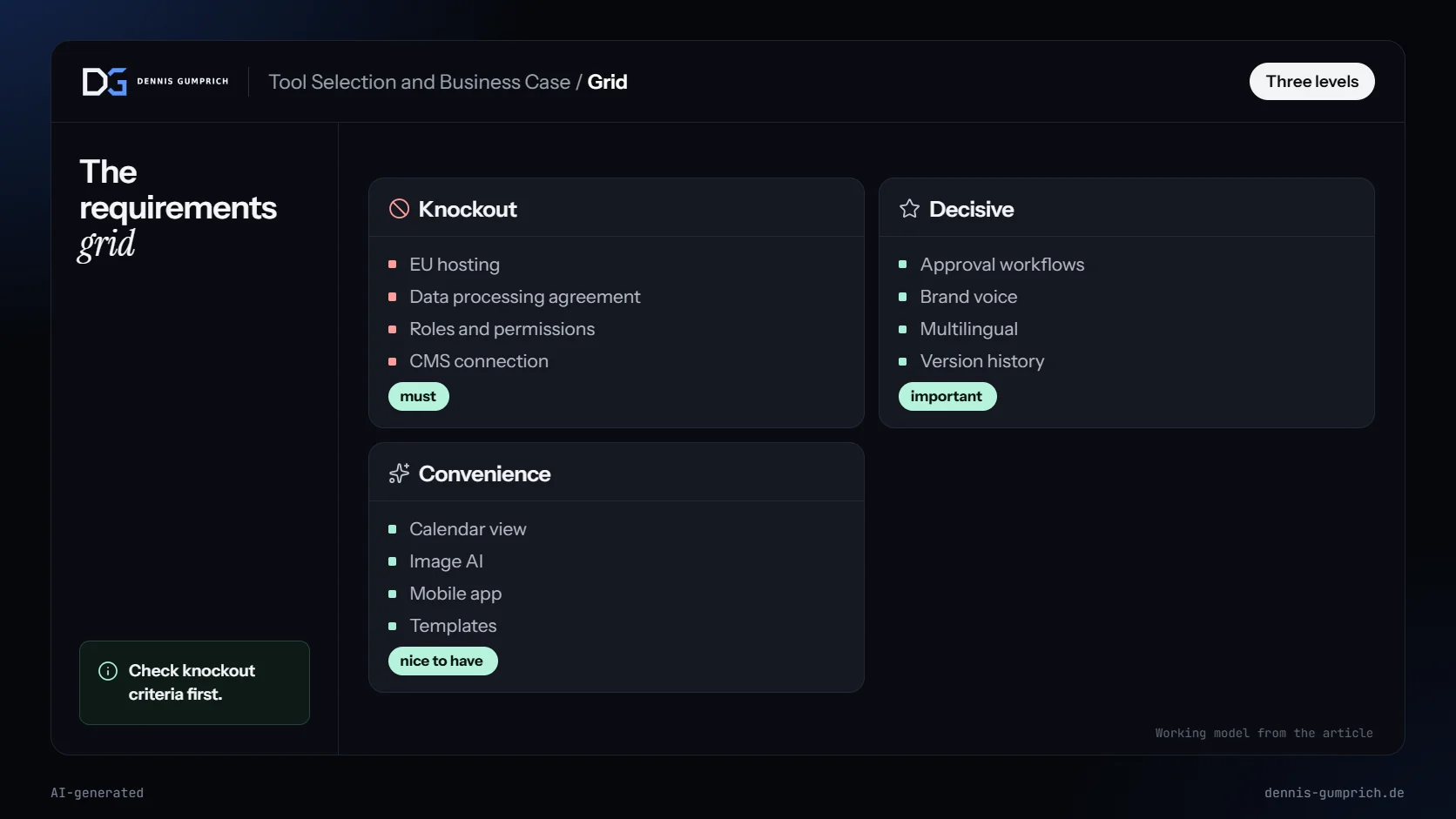
With three levels. Knockout means: if it is missing, the vendor is out, without exception, for example hosting in the EU, a data processing agreement or the connection to your CMS. Decisive means: weighs heavily, but a workaround would be conceivable. Convenience means: pleasant, but not decisive for the purchase. Once the knockout list is in place, pre-selection takes half an hour instead of three weeks.
The second step decides the quality of your selection. Sort each requirement into exactly three levels. Anything you cannot clearly classify belongs in level three.
| Level | Meaning | Typical examples |
|---|---|---|
| Knockout | If it is missing, the vendor is out. No exceptions. | Hosting in the EU, data processing agreement, roles and permissions management, connection to your CMS |
| Decisive | Weighs heavily, but a workaround would be conceivable. | Approval workflows, storable brand voice, multilingual support, version history, SSO |
| Convenience | Pleasant, but not decisive for the purchase. | Image generation, calendar views, mobile app, template library |
The benefit of this separation lies less in the comparison than in the conversation. Once you have the knockout list, pre-selection takes half an hour instead of three weeks. And in the demo, you no longer talk about everything, but about five points.
The five questions every vendor must answer
Regardless of the category, these five points should be available in writing, not just promised verbally in the demo:
- Where is our data? Server location, subcontractors, data processing agreement.
- Are our inputs used for training? If so, under what conditions and how do you object.
- Which models run in the background, and what happens when they change? Model changes alter results; that belongs in the contract.
- How does our content get back out? Export formats and completeness on exit.
- What does the second and third group of users cost? Pricing models scale differently; that determines the total cost.
The business case: calculate before you compare
Most tool decisions do not fail because of the software, but because of a missing business case. Your management does not ask about features but about benefit in relation to cost.
The following calculation is a working model, not a study. Replace the values with your own by asking three colleagues how much time per week goes into coordination, searching and rework.
This figure is not the savings potential. It is the benchmark. If a tool reduces 30 percent of this effort, that is around 13,000 euros of freed-up capacity per year. From this point on, license costs can be discussed sensibly.
Important for credibility: collect the starting value before you introduce anything. Without a before figure, you cannot prove success afterwards, and in the next budget discussion you are again without an argument.
Subject: Selecting content software, proposed approach
We are currently evaluating software for our content processes. To make the decision traceable, I propose the following approach.
1. Name the bottleneck. Our main problem lies in [writing speed / visibility / coordination and approvals / connection to leads]. The tool category follows from that.
2. Collect the starting value. For two weeks, we measure how much time per person goes into coordination, searching and rework. Effort: under one hour per person.
3. Benchmark. With four people involved and an assumed four hours of coordination per week, this adds up to around 736 hours a year. At an internal hourly rate of 60 euros, that corresponds to about 44,000 euros of tied-up capacity.
4. Define knockout criteria. Proposal: hosting in the EU, data processing agreement, roles and permissions management, connection to our CMS. We will not evaluate vendors without these points any further.
5. Pilot instead of full rollout. We test with one brand or format and decide afterwards.
Time required for the decision: about six weeks. We involve IT and data protection from week one, not only at sign-off.
You can run through the business case with your own values in the ROI calculator (in German) and get the result as a PDF for the discussion with management.
How long does a sound tool selection take?
Six weeks are enough for a robust decision. It usually only takes longer when IT and data protection come in too late.
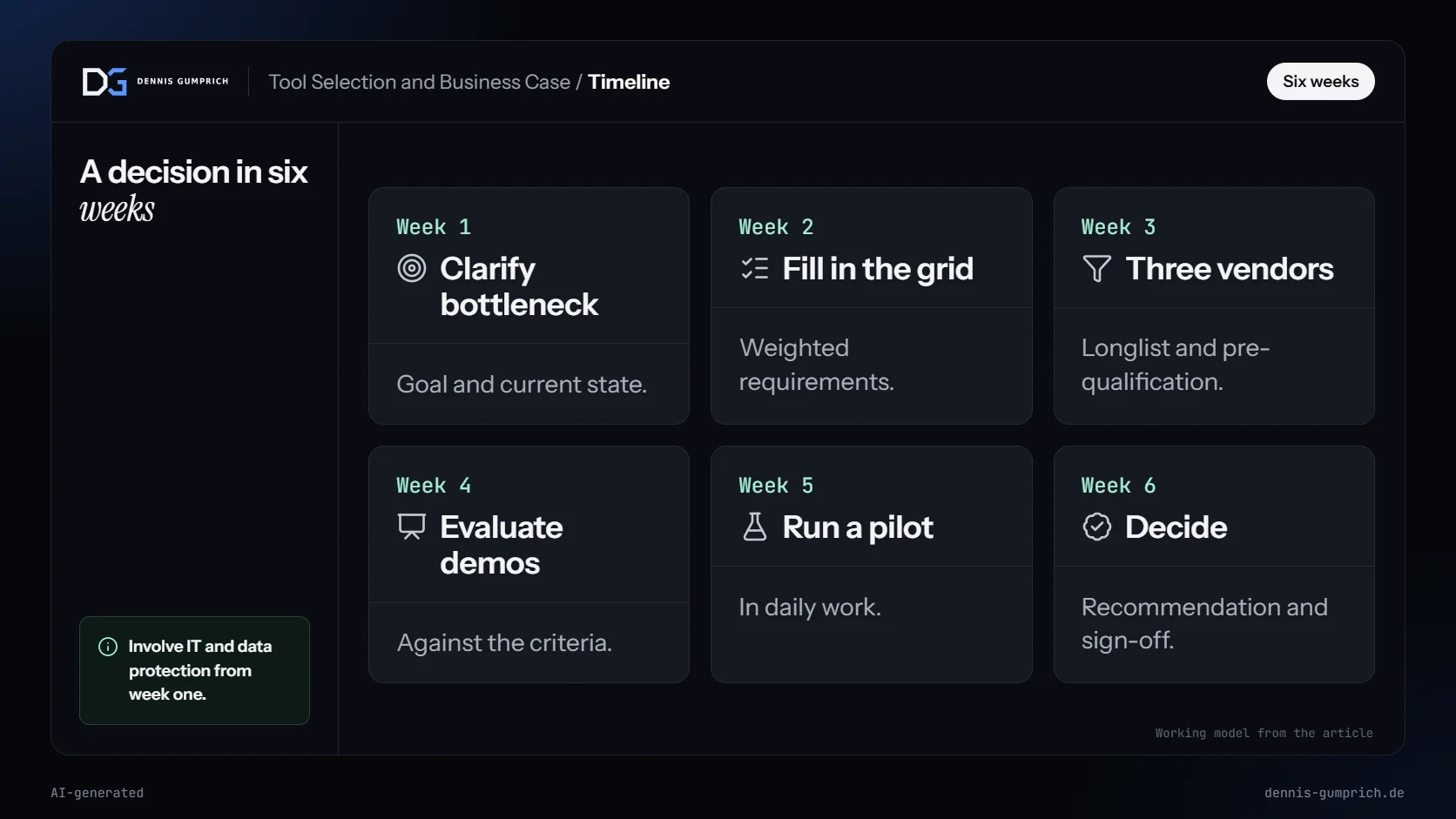
- Week 1Define the bottleneck and collect the starting valueDetermine your category and start measuring time. In parallel, register the project with IT and data protection so their review does not become the bottleneck at the end.
- Week 2Fill in the requirements gridKnockout, decisive, convenience. A maximum of five knockout criteria, otherwise no vendor remains. Have the grid reviewed by the people who will work with it daily later.
- Weeks 2 to 3Pre-select three vendorsAsk the five mandatory questions in writing. Anyone who does not answer within a week is out. Response behavior during pre-selection says a lot about later support.
- Weeks 3 to 4Demos with your own materialSend a real topic that is coming up anyway in advance. A demo with sample data only shows how well the vendor can demonstrate. Pay attention to how the system handles your technical language.
- Weeks 4 to 5Pilot with one format or brandDefine beforehand what success means: for example lead time for three pieces, number of correction loops, satisfaction in the team. Without a success criterion, every pilot becomes gut feeling.
- Week 6Decision with figures and a recommendationThe result is one page: bottleneck, starting value, vendors evaluated, recommendation, costs, expected impact. This page goes to the decision-makers, not the feature comparison.
Seven mistakes that make the selection expensive
- Comparing feature lists instead of clarifying bottlenecksTwo vendors with the same feature list can be built completely differently. Compare workflows, not ticks.
- Too many knockout criteriaFrom around eight exclusion criteria onward, no vendor remains, and you end up softening them anyway. Five is the maximum.
- Demos with sample dataEvery software looks good with the vendor's sample data. Only your own expert text shows whether the quality holds up.
- Not involving the future user groupIf the selection happens in a small circle, resistance arises later. Two people from the operational team belong in every demo.
- Only asking IT and data protection at sign-offThis is the most common reason six weeks turn into six months. Register the project in week one. Which questions come up is shown in GDPR-compliant content marketing software.
- Starting without a baselineWithout a before figure, there is no after argument. Collecting it takes under an hour per person.
- Blaming the tool for poor AI resultsIf drafts sound generic, it is usually due to missing context: no brand voice, no knowledge sources, no precise briefing. Check that before you rule out the vendor.
Which AI tools for content marketing suit European companies?
Those that pass six checks. Whether a vendor is headquartered in your country is not a criterion in itself. What matters is how well the tool handles the technical language of your markets, where your data is processed and whether it works in a team rather than only at an individual workstation.
| Criterion | How to check it | Why it matters |
|---|---|---|
| Language quality in your languages | A test text with your technical terms, your form of address and typical phrasing, proofread by someone on the team who is a native speaker | Texts that sound translated cost more rework than they save |
| Data processing | Data processing agreement, server location, sub-processors and the commitment that your inputs will not be used for training | According to Bitkom, data protection is the biggest hurdle for 66 percent of companies in Germany already using AI |
| Stored context | Can brand voice, target groups and product knowledge be stored permanently, or does everyone have to write them into every prompt? | Without stored context, every model delivers the average |
| Team features | Roles, status, comments and approvals on the same version | Single-user tools generate drafts, but no workflow |
| Connection to your systems | Handover to CMS, social media channels and image database, via interface or MCP | Anything that has to be copied costs time with every publication |
| Cost model | Price per person or per use, and what happens with double the volume | Usage-based models become more expensive with growing success |
The first two criteria are knockout criteria, the other four decide the benefit. How to involve IT and data protection early without losing weeks is described in Involve IT and data protection early.
What do you need to watch for in data protection in the EU?
Four points, and all four should be clarified in writing: a data processing agreement under Article 28 GDPR, an entry in the record of processing activities under Article 30, server location including the chain of subcontractors, and the transparency obligations under the EU AI Act.
In the EU, this point decides the selection more often than functionality. You should clarify four aspects in writing.
- Data processing agreement. Under Article 28 of the General Data Protection Regulation, it is mandatory as soon as a vendor processes personal data on your behalf.
- Record of processing activities. Under Article 30, you must document which processing takes place. A new tool belongs in it before it goes live.
- Server location and subcontractors. Do not only ask about the main location but about the chain. Many vendors use third-party models in the background.
- Labeling AI content. The EU AI Act (Regulation 2024/1689) provides transparency obligations for certain AI-generated content. These provisions have applied since August 2, 2026. For machine-readable labeling by systems that were already on the market before, amending Regulation (EU) 2026/1744 grants a transition period until December 2, 2026. Clarify the status that applies to you with your legal department.
If unapproved tools are already in use at your company, an inventory before the selection is worthwhile. How this works in practice is described in Shadow IT in marketing.
Where contentbird fits and where it does not
Transparency note: I work as a senior consultant at contentbird, a Berlin-based vendor of AI-powered content software. This classification is therefore not a neutral judgment but a disclosed assessment. In any case, evaluate several vendors.
contentbird belongs in category C. The platform brings together topic planning, creation, approval, publication and evaluation in one system and lets you store brand voice, personas and knowledge sources at project level, so that AI drafts are bound to these guidelines.
The platform is worth evaluating when several people work on the same content, when approvals cross departmental boundaries, when you plan for several brands or markets and when you need to prove how AI content was created.
It makes little sense when there are two of you, when your bottleneck is pure writing speed or when your marketing suite is already in place and content is only meant to be a side issue there. In these cases, a tool from category A or D is the more economical choice.
When you do not need a new tool at all
Not every content challenge is a software question. If your team is understaffed, no platform solves the capacity problem. If your strategy is unclear, a tool will just help you produce content faster that still reaches nobody.
Timing also plays a role. If a CMS relaunch, an ERP rollout or a rebrand is currently under way, a parallel tool selection ties up capacity that is missing elsewhere. In this case, set a specific date after completion and then start properly.
And finally: if you produce fewer than five pieces of content a month, a well-kept spreadsheet plus a clear approval route is almost always the more economical solution.
Conclusion: selection starts with your bottleneck, not with the vendor
There is no best content marketing software for teams. There is one that fits your bottleneck, your team size and your approval routes. If you clarify these three things beforehand, you need six weeks for the decision. If you skip them, you compare features for months and still decide by gut feeling in the end.
Frequently asked questions
Which content marketing software is best for teams?
None in general. For teams with several people involved and approvals across departmental boundaries, content marketing and content operations platforms are an option; for pure social media teams, social media management tools; for pure writing support, AI assistants. Which vendor within the category fits is shown by the twelve selection criteria, tested on your own material rather than a demo with sample data.
What distinguishes content marketing software from a CMS?
A CMS manages and publishes content on a website or app. Content marketing software steers the route there: topic planning, briefing, creation, approval and evaluation across several channels. In many teams, both work together, with the platform handing approved content over to the CMS.
What does AI content software cost?
The range is wide and depends mainly on the pricing model. Writing assistants are usually in the double-digit range per user per month, SEO tools in the low to mid three-digit range per month, content operations platforms and marketing suites considerably higher. What matters is less the list price than how costs scale with the second and third group of users. Ask vendors directly for current prices.
Isn't ChatGPT enough?
For individuals with working planning, often yes. As soon as several people coordinate, brand voice should be binding or you need to prove how a piece of content was created, a pure assistant reaches its limits. The knowledge then sits in individual chat histories and leaves the company with the person.
How can I tell in a demo whether the text quality is right?
Send the vendor one of your most technically demanding existing texts and a topic that is coming up anyway in advance. Have them work with it in the demo. Pay attention to whether the system uses your technical terms correctly and sticks to specified sources rather than making things up.
Should we go with a vendor from our own country?
The company headquarters alone says little. What is relevant is the server location, the data processing agreement, the chain of subcontractors and whether your inputs are used for training. A European vendor often makes contract drafting and support in your language easier, but does not replace the substantive review.
How long does implementation take?
Expect days for category A, one to two weeks for category B and four to ten weeks for categories C and D until productive use. The duration depends less on the software than on how clearly your processes, roles and approval routes were defined beforehand.
Which content marketing platform suits larger marketing teams?
One from category C or D with roles and permissions, single sign-on, multi-stage approvals, multilingual support and a log of who approved what. From around ten people involved, the pricing model for readers and approvers also determines the total cost.
Which software lets you steer several content channels centrally?
For social media, a social media management tool; for website, newsletter and social together, a content operations platform that bundles status and approval per topic. Channels without a direct connection are linked via interfaces.
Where does your content process lose time today?
In 30 minutes, we look together at where unnecessary coordination, manual tasks, tool switching or repetitive content work cost you time today.
You get a concrete assessment of which tasks you can simplify, automate or organize better, and where AI and tools actually help instead of adding complexity.
Analyze your content process in 30 minutes Free of charge. You take away concrete starting points you can use internally right away.
Dennis Gumprich
Dennis helps marketing and communication teams fit generative AI into existing content processes without undermining quality, brand voice and approvals. Focus areas: content operations, AI governance and tool selection in mid-sized companies and corporations.
Transparency note: Dennis works for contentbird, a provider of AI-powered content software. Product mentions are marked in the article; contentbird is classified in its own section. More about Dennis (in German) · LinkedIn
Read more
Sources
- Bitkom: Erstmals nutzt die Mehrheit der Unternehmen KI (in German), press release from September 14, 2026, telephone survey of 603 companies with 20 or more employees in Germany, survey calendar weeks 28 to 33 of 2026. Data protection requirements are the most common obstacle, at 66 percent, among companies already using AI. Accessed October 31, 2026.
- European Union: Regulation (EU) 2016/679 (General Data Protection Regulation), Official Journal L 119 of May 4, 2016, Article 28 on the processor and the data processing agreement. Accessed October 31, 2026.
- European Union: Regulation (EU) 2016/679 (General Data Protection Regulation), Article 30 on the record of processing activities. Accessed October 31, 2026.
- European Union: Regulation (EU) 2024/1689 (AI Act), Official Journal of July 12, 2024, Article 50 on transparency obligations for AI-generated content, applicable since August 2, 2026. Accessed October 31, 2026.
- Cooley: Digital AI Omnibus Delays Key Deadlines, Introduces New Rules, law firm article on Regulation (EU) 2026/1744, published in the Official Journal on July 24, 2026: Article 50 remains at August 2, 2026; for machine-readable labeling under Article 50(2), a transition period until December 2, 2026 applies to systems placed on the market before. Accessed October 31, 2026.
- bvik: bvik-Studie Digitalisierungsgrad 2023: Ergebnisse (in German), results page of the association on the survey of 191 companies in 2023: 42 percent used AI in marketing, most often for content creation and translation; around 85 percent use marketing technologies; 60 percent have already replaced a technology, most often due to insufficient functionality and poor usability. Historical value from 2023, association survey with a small sample. Accessed October 31, 2026.
- National Institute of Standards and Technology (NIST): Artificial Intelligence Risk Management Framework: Generative Artificial Intelligence Profile (NIST AI 600-1), published July 26, 2024, Chloe Autio, Reva Schwartz, Jesse Dunietz et al., companion document to the voluntary AI RMF 1.0 of January 2023: action GV-6.1-009 extends due diligence in procurement to intellectual property, data protection and security, explicitly also for solutions with embedded AI. Voluntary framework from the US with no legal force in the EU. Accessed October 31, 2026.
How this article was created
This article was created with the help of AI. Structure, research and draft wording were developed with AI support. Professional assessment, selection of sources, review of the statements and the final version are the responsibility of Dennis Gumprich. The calculation examples given are explicitly marked as working models and are not measured values. The English version was translated with AI and reviewed. Read the original German version.
How reliable are the statements?
Evidence exists for the Bitkom figure on data protection as the most common obstacle (Germany), the obligations under Articles 28 and 30 GDPR and the content and start of application of the transparency obligations under Article 50 of the AI Act, including the transition period under Regulation (EU) 2026/1744, as well as the share of companies that have already replaced a marketing technology (bvik study Degree of digitalization 2023, historical value from 2023, small sample) and the recommendation to extend due diligence in procurement to embedded AI (NIST AI 600-1, voluntary framework from the US). The nine vendor categories, the four types, the twelve selection criteria with weighting suggestion, the three-level requirements grid, the limit of five knockout criteria, the six-week process, the implementation times and price ranges, as well as observations such as low use of functionality after six months, are working models and experience values from consulting practice, not measured values. Coordination time, number of people involved, working weeks, hourly rate and the 30 percent relief are a calculation example. Vendors and headquarters reflect the status of November 2026. As of November 1, 2026. Legal note: this article does not replace legal or data protection advice. Your data protection officers and legal department are responsible for assessing your specific case.


