
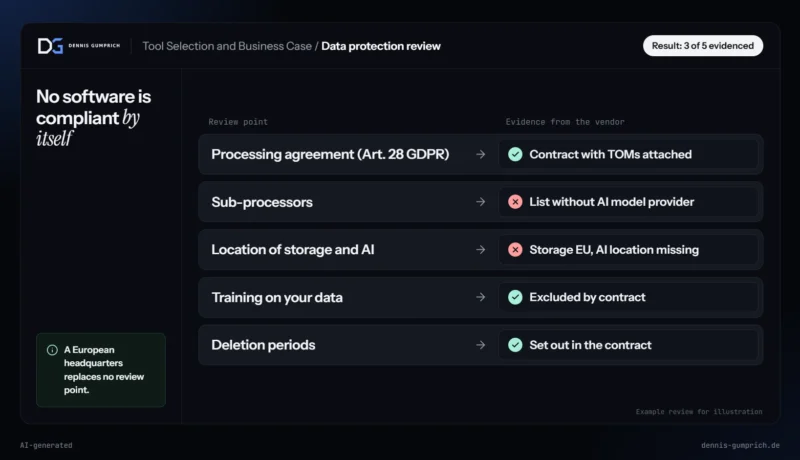

"GDPR-compliant" on a vendor website is a promise, not a review. The review stays with you.
No software is GDPR-compliant by itself. What is compliant is its use, and you remain responsible for that as the controller. Before every pilot, check five points: a data processing agreement under Art. 28 GDPR, the complete list of sub-processors including AI model providers, the location of storage and AI processing including the transfer basis, the contractual exclusion of training on your data, and clear deletion periods. A European headquarters replaces none of these points.
The following sections show what lies behind each of the five points and which evidence you should request. First, the question at the start of almost every vendor search.
Which content marketing software is GDPR-compliant?
Any that gives you the evidence to justify your use, and none simply because of a seal on its website. The GDPR places responsibility with you: under Art. 28(1) GDPR, you may only use processors that provide sufficient guarantees of appropriate technical and organizational measures. So the question is not whether a tool is compliant, but whether you can prove that your use of it is.
In practice, the answer is in contracts and annexes, not on the product page. A vendor that sends a data processing agreement ready for signature, a current list of its sub-processors and a description of its data flows on request makes your review easy. One that answers with marketing phrases extends it by weeks.
The effort is worthwhile not only for liability reasons. In the 2026 study "Marketing in digital transformation" (in German) by Bitkom, Germany's digital industry association, 64 percent of the companies surveyed see data protection as a contribution to strengthening brand trust, while 63 percent also see it as a restriction on personalization and targeting. 180 companies from the digital sector were surveyed; the results are not representative. For you, this means: a cleanly documented review is also an argument for trust in a budget discussion, not just a cost item, even if it limits individual personalization ideas.
Which personal data does content marketing software process?
More than most teams assume. Besides your team's user accounts, there are comments and approval histories, names and quotes in case studies, contact details in briefings, messages from social media inboxes and data from connected analytics and newsletter tools. Drawing up this list before the review shortens the conversation with data protection considerably.
| Data type | Example | What matters |
|---|---|---|
| User accounts and logs | Name, email, role, activity in the tool | Permissions concept, retention period of logs |
| Content with personal reference | Customer quote, interview, contact in a case study | Consent of the person, deletion after use ends |
| Inputs into the AI | Briefing with customer names, pasted email, meeting note | Where the input goes, whether it is stored and whether it is used for training |
| Social media inbox | Messages and comments from users | Access rights in the team, deletion periods |
| Performance and tracking data | Clicks, opens, website visits | Consent under the ePrivacy rules (in Germany Section 25 TDDDG) as soon as information is stored on or read from end devices |
Content without personal reference, that is, pure expert texts, product descriptions and topic plans, does not fall under the GDPR. For it, questions of confidentiality and copyright arise, not data protection. This separation matters, because it shows how much content work is possible without an elaborate review.
What should you watch for regarding data protection in content marketing software?
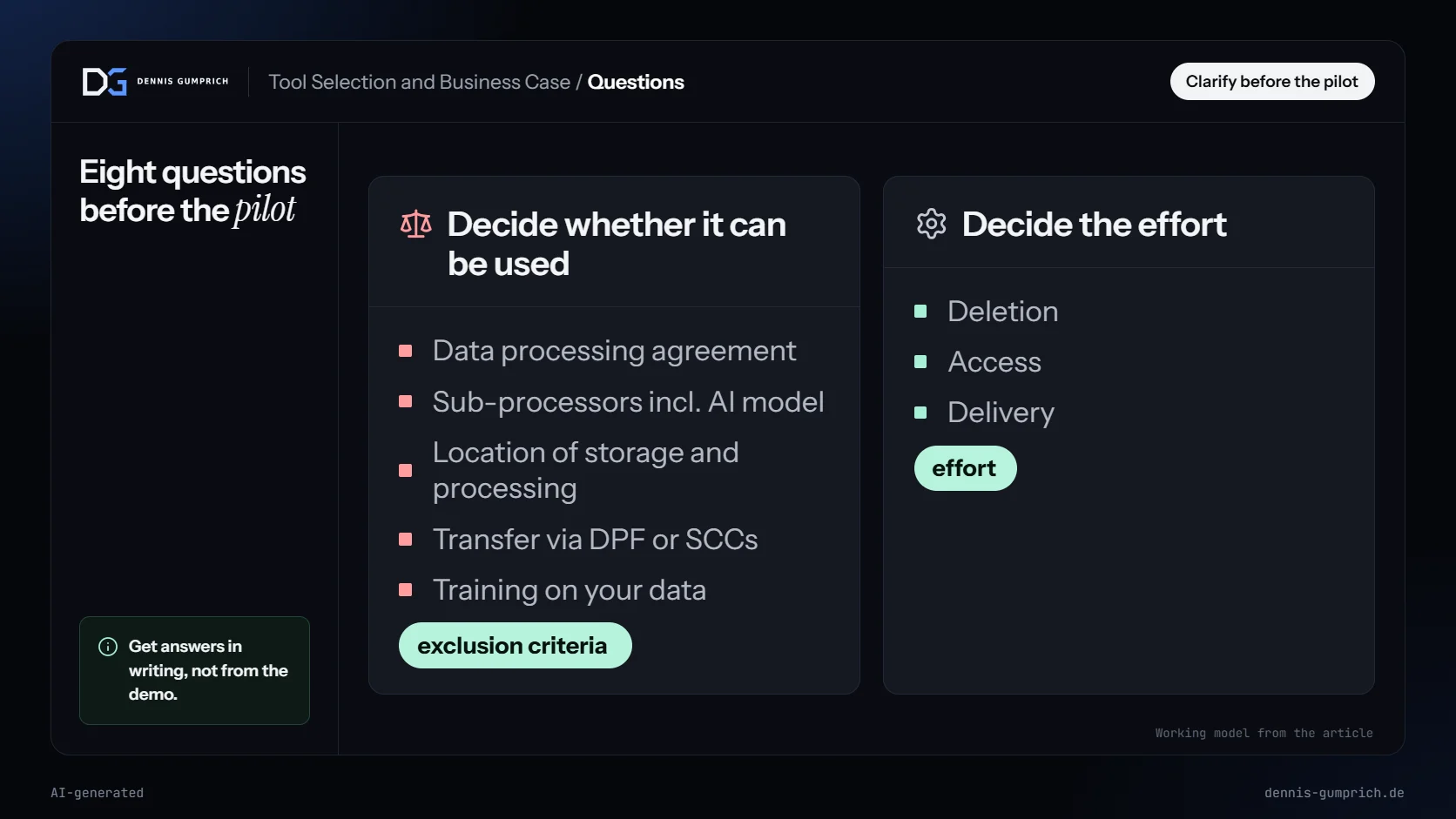
Eight points you put to the vendor in writing before the pilot. The first five decide whether use is possible at all. The last three decide how much effort it takes in daily work. Sending the questions to all vendors on a shortlist at the same time also gives you a reliable impression of how well each support team works.
| Review point | Question to the vendor | How to recognize a good answer |
|---|---|---|
| 1. Data processing | Is there an agreement under Art. 28 GDPR? | Ready for signature, with technical and organizational measures attached |
| 2. Sub-processors | Who else processes our data, where and for what? | Complete list with location and purpose, AI model provider named explicitly, information before changes |
| 3. Location | Where is data stored, and where does the AI process it? | Both locations named separately, EU processing guaranteed by contract if it is advertised |
| 4. Transfer | On what basis does data go to a third country? | Adequacy decision or standard contractual clauses, plus documents for your assessment |
| 5. Training | Are our inputs and outputs used for training? | Excluded by contract, not just mentioned in an FAQ |
| 6. Deletion | How long are inputs, outputs and logs retained? | Fixed periods, including for security and abuse logs |
| 7. Access | How are roles, sign-on and logging regulated? | Graded permissions, single sign-on, traceable log |
| 8. Delivery | Which tracking technology does the tool bring into your website or newsletter? | Documented, can be switched off and combined with your consent management |
Point 2 is the most common reason for delays. Under Art. 28(2) GDPR, a processor may only engage further processors with your prior authorization. With a general authorization, it must inform you of planned changes so you can object. With AI tools, this list changes more often than with classic software, because model providers are switched or added.
What changes when an AI model is involved?
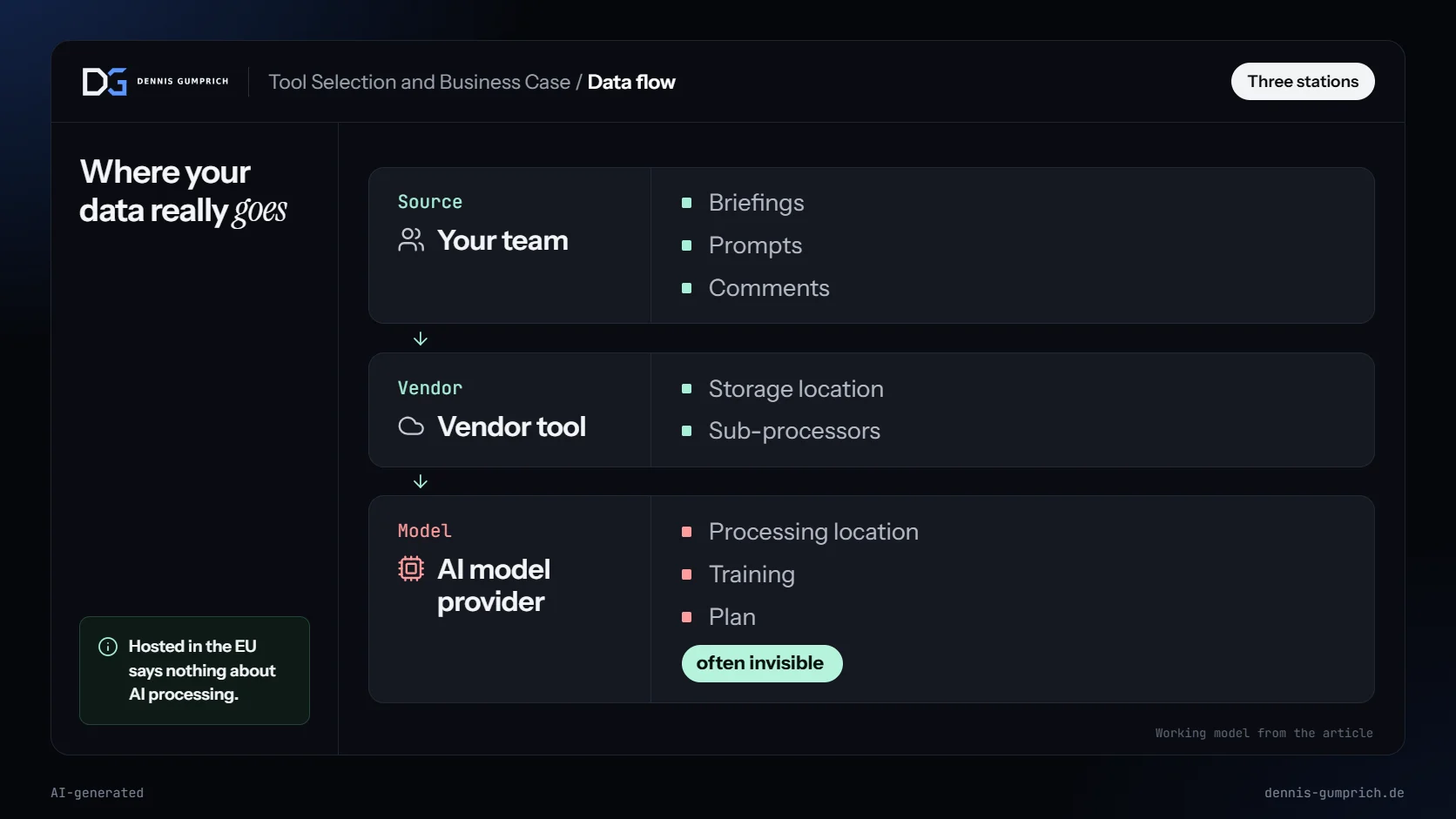
Another party is added that usually stays invisible in product marketing. Many content tools do not develop their own language models but connect models from large providers. There are therefore two locations you need to know: where content is stored and where the model processes it. The two can differ, and the conditions depend on the plan and the configuration, not on the model name.
OpenAI is a good example. The company states that it does not use data from its business plans and from the API for training by default. Storage in Europe, by contrast, is only offered for certain products, for example for eligible Enterprise and API customers. A tool that uses a model via such a contract with EU configuration is something different in data protection terms from one that connects the same model with default settings. So ask not only which model a tool uses, but via which contract and with which setting.
This second party is also addressed by the NIST Generative AI Profile (NIST AI 600-1), a voluntary framework from the US. It recommends extending due diligence in procurement to data protection, security and intellectual property, explicitly also when AI is only embedded as a component of another solution. For you, this means: for every content tool with an AI feature, ask about the connected model provider, even if AI appears only as a secondary feature in the offer.
In May 2024, the German Data Protection Conference (DSK), the body of Germany's data protection authorities, published guidance with criteria for selecting and using AI applications, focusing on large language models. Among other things, it recommends checking whether a system was trained lawfully and documenting the decisions on selection and use. For marketing teams, it is a useful guide for anticipating the questions of their own data protection department, and much of it applies across the EU.
The biggest lever lies with you: if briefings and prompts contain no personal data, a large part of the review shrinks. A short rule in the team, no customer names, no pasted emails, no meeting notes without approval, often works faster than any contract negotiation. How to supply the AI with uncritical context instead is described in Building a knowledge base.
How robust is data transfer to the US?
Currently viable, but not permanently secured. The EU-US Data Privacy Framework applies. On September 3, 2025, the General Court of the European Union dismissed an action against it; an appeal against this judgment is pending before the Court of Justice. The Court of Justice overturned both predecessors, Safe Harbor and Privacy Shield. Anyone using US vendors or US models should therefore provide a fallback by contract.
In concrete terms: make sure the contract contains standard contractual clauses in addition to certification under the Data Privacy Framework, or can switch to them at short notice. Also clarify how quickly you could switch to processing in the EU if necessary, and what that would cost. This question belongs in the selection, not in the crisis.
Which AI tools for content marketing suit European companies?
Those whose data flows you can clarify with the eight questions above and that fit your bottleneck. A classification by category makes sense, because each category raises different data protection questions. A general assistant processes everything someone copies into it. A content platform additionally processes roles, comments and approvals and is often connected to channels.
| Category | Typical vendors | Which data protection question first? |
|---|---|---|
| General AI assistants | ChatGPT Business and Enterprise, Microsoft 365 Copilot, Langdock | Which plan, which data region, and who may copy what into it? |
| Writing and translation AI | Jasper, neuroflash, DeepL Write | Storage of inputs, use for training, management of team accounts |
| SEO tools with AI features | Semrush, SE Ranking, Surfer | Usually little personal reference, focus on account data and tracking |
| Content platforms with AI | contentbird* | Roles, comments, approvals, connected channels and model providers |
The Copilot case deserves a closer look, because in many companies it has already been approved by IT and data protection. What this means for marketing teams and where the limit lies is described in Copilot is approved. Is that enough for marketing?
Is there a European alternative to Jasper and other US AI content tools?
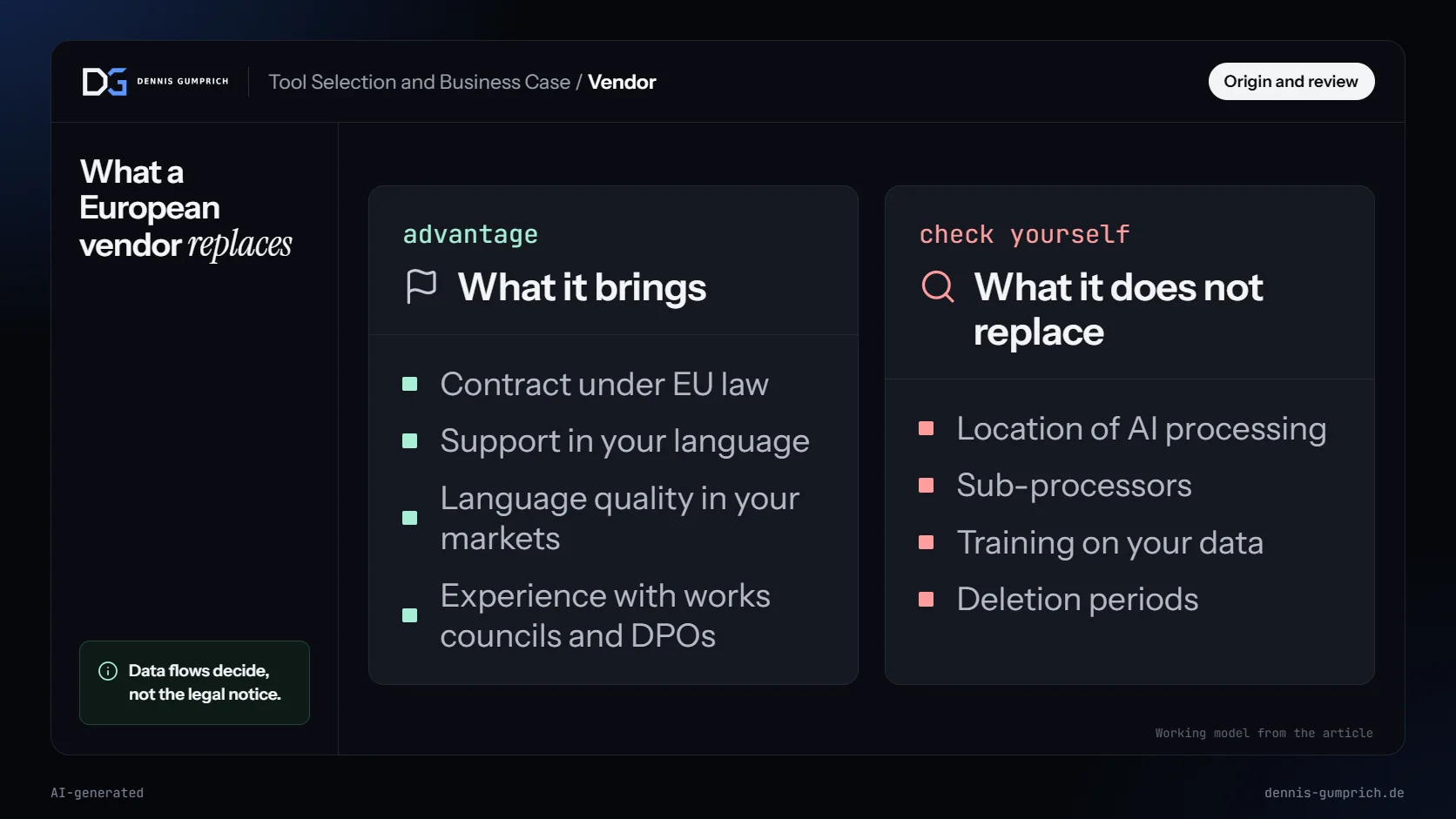
Yes, several: for example neuroflash and DeepL Write from Germany for texts, or content platforms such as contentbird* for the entire content process. But a European vendor is not automatically the more privacy-friendly choice. Many European tools use the same language models as their US competitors. What matters is the data flows, not the address in the legal notice.
Contract under European law, contacts and support in your language and time zone, language quality and tone in European languages, experience with works councils, data protection departments and industry rules.
Location of AI processing, list of sub-processors, use of your data for training, deletion periods for inputs and logs.
Anyone who wants to replace Jasper should first clarify what is actually to be replaced. If it is about better texts in your languages, a different writing tool is often enough. If it is about texts being planned, reviewed and approved as a team, a writing AI is the wrong point of comparison. This trade-off is described in Point tools or platform: when switching pays off.
Why is support in your language a selection criterion?
Because rollouts fail because of open questions, not missing features. Data protection, the works council, IT and the specialist department ask their questions in their own language, often with legal precision, and need answers within a few days. Support that answers in your language and time zone, provides contract and security documents in your language and accompanies onboarding noticeably shortens internal approval.
Test this instead of believing it: in the pilot, ask a real data protection question and a usage question via the regular support channel, not via your sales contact, and measure the response time. Committed response times belong in the contract. How to involve IT and data protection from the start instead of asking them for a signature at the end is described in Involve IT and data protection early.
How do you review a tool without the pilot waiting for weeks?
By starting the data protection review before the pilot and running it in parallel. The pilot starts with content without personal reference, the review works with the vendors' written answers, and real customer data only goes into the tool after approval. This way, you do not lose a week, and the review is based on documents rather than impressions from the demo.
- Week 1Define data typesClarify which of the five data types from the table above occur in the planned use. Everything else is irrelevant to the review.
- Week 1Send the question catalogThe eight questions go in writing to all vendors on the shortlist, with a deadline for answering.
- Week 2Start the pilot without personal referenceTesting is done with expert texts, topic plans and product content. Customer names, quotes and emails stay out.
- Weeks 2 to 3Assess answersData protection and IT review the documents in parallel with the pilot, not afterwards.
- Week 4Document and regulateEntry in the record of processing activities under Art. 30 GDPR, check whether a data protection impact assessment under Art. 35 GDPR is needed, and a short usage rule for the team.

Five mistakes in the data protection review of content software
- Trusting the seal"GDPR-compliant" on the website is a statement by the vendor, not evidence. Ask for the documents the statement is based on.
- Checking only the vendor, not the model behind itThe AI model provider is usually a sub-processor. If it is missing from the list, the most important part of the review is missing.
- Confusing storage location and processing location"Hosted in the EU" can mean that the data is stored there while the AI processes it elsewhere. Ask about both locations.
- Starting the pilot with real customer dataThis makes the review a precondition for the first test day. Without personal reference, you can start immediately.
- Tolerating private accountsAs long as the approved solution is missing, work content moves into private AI accounts. What that costs is shown in Shadow IT in marketing.
On contentbird: I work for contentbird, which is named in this article as a content platform. The same eight questions apply to contentbird as to any other vendor, and the answers belong in your review in writing just the same.
Conclusion: data protection is decided by data flows, not seals
The question of which content marketing software is GDPR-compliant cannot be answered with a list of vendors, but with a catalog of questions. If you know which data occurs in use, where it is stored and processed, who besides the vendor sees it and whether it is used for training, you can assess any tool in a few weeks. A European headquarters and support in your language make this review easier but do not replace it. How the data protection question fits into the overall tool selection is described in Content marketing software for teams 2026. The review questions belong at the beginning of every tool selection and thus in your content operations, not at the end.
Frequently asked questions
Does the server of a content software have to be in my country?
No. The GDPR does not require a server location in a particular country. Storage and processing in the EU or EEA are possible without an additional transfer basis. For third countries, an adequacy decision or appropriate safeguards such as standard contractual clauses are needed. Some companies set stricter internal rules; that is their own decision and not a legal obligation.
Do we need a data processing agreement for every AI tool?
Whenever the vendor processes personal data on your behalf. That is the case with almost every tool with user accounts, and at the latest as soon as names, emails or comments end up in the tool.
May employees use private AI accounts for work content?
That is risky. For private accounts, the terms for individual users apply instead of a business contract with data processing. Regulate use explicitly and offer an approved alternative, otherwise the ban remains ineffective.
Do we need a data protection impact assessment?
Not automatically. Under Art. 35 GDPR, it is required when processing is likely to result in a high risk to the people concerned. For content work without sensitive data, this is rarely the case. You should still document the check and its result.
What additionally applies under the AI Act?
The AI Act regulates different questions from the GDPR, such as transparency for AI-generated content. What applies to marketing texts and how to arrive at a robust practice is described in AI labeling: how to arrive at a robust practice.
Where does your content process lose time today?
In 30 minutes, we look together at where unnecessary coordination, manual tasks, tool switching or repetitive content work cost you time today.
You get a concrete assessment of which tasks you can simplify, automate or organize better, and where AI and tools actually help instead of adding complexity.
Analyze your content process in 30 minutes Free of charge. You take away concrete starting points you can use internally right away.
Dennis Gumprich
Dennis helps marketing and communication teams fit generative AI into existing content processes without undermining quality, brand voice and approvals. Focus areas: content operations, AI governance and tool selection in mid-sized companies and corporations.
Transparency note: Dennis works for contentbird, a provider of AI-powered content software. Product mentions are marked in the article. More about Dennis (in German) · LinkedIn
Read more
Sources
- Regulation (EU) 2016/679 (GDPR), in particular Art. 28, Art. 30, Art. 35 and Art. 44 et seq.
- Section 25 of the German Telecommunications Digital Services Data Protection Act (TDDDG), the German implementation of Art. 5(3) of the ePrivacy Directive.
- German Data Protection Conference (DSK): guidance "Künstliche Intelligenz und Datenschutz" (Artificial intelligence and data protection, in German), version 1.0, May 6, 2024.
- General Court of the European Union, judgment of September 3, 2025, Case T-553/23 (Latombe v Commission); appeal before the Court of Justice, Case C-703/25 P.
- OpenAI: Business data privacy, security, and compliance (openai.com/business-data) and Introducing data residency in Europe, updated January 16, 2026. Accessed October 30, 2026.
- Bitkom: Marketing im digitalen Wandel: Lagebild der Marketingpraxis in deutschen Unternehmen 2026 (in German), study 2026, DOI 10.64022/2026-marketing, online survey of 180 companies from the digital sector in the Bitkom network, calendar weeks 44 to 50 of 2025: 64 percent see data protection as a contribution to strengthening brand trust, 63 percent as a restriction on personalization and targeting; 54 percent name data protection and regulation as an external challenge. Not representative. Accessed October 31, 2026.
- National Institute of Standards and Technology (NIST): Artificial Intelligence Risk Management Framework: Generative Artificial Intelligence Profile (NIST AI 600-1), published July 26, 2024, Chloe Autio, Reva Schwartz, Jesse Dunietz et al., companion document to the voluntary AI RMF 1.0 of January 2023: GV-6.1-009 extends due diligence in procurement to intellectual property, data protection and security, explicitly also for solutions with embedded AI; GV-1.4-002 and GV-3.2-003 provide for transparent acceptable use policies. Voluntary framework from the US with no legal force in the EU. Accessed October 31, 2026.
How this article was created
This article was created with the help of AI. Structure, research and draft wording were developed with AI support. Professional assessment, review of the statements and the final version are the responsibility of Dennis Gumprich. The English version was translated with AI and reviewed. Read the original German version.
How reliable are the statements?
Legal status as of October 30, 2026. Evidence also exists for the Bitkom figures on data protection and brand trust (non-representative survey of 180 companies from the digital sector in Germany) and for the recommendation to extend due diligence in procurement to data protection, security and intellectual property, also for embedded AI (NIST AI 600-1, voluntary framework from the US), both added on October 31, 2026. The review catalog and the timeline are working models from consulting practice, not measured values. Information on vendors reflects their own presentation and may change. Legal note: this article does not replace legal advice. Whether your specific use is permissible should be clarified by your data protection officer.


