

IT announced it on the intranet: Microsoft 365 Copilot is being rolled out to all departments, and data protection and the works council have agreed. At the budget meeting in the afternoon, management asks the head of marketing an obvious question: if Copilot now writes texts, summarizes meetings and searches our files, what do we still need our own content tool for?
The head of content has no quick answer. Copilot does write good drafts. That something is still missing is something she feels every day in her work. Explaining it in two sentences is harder.
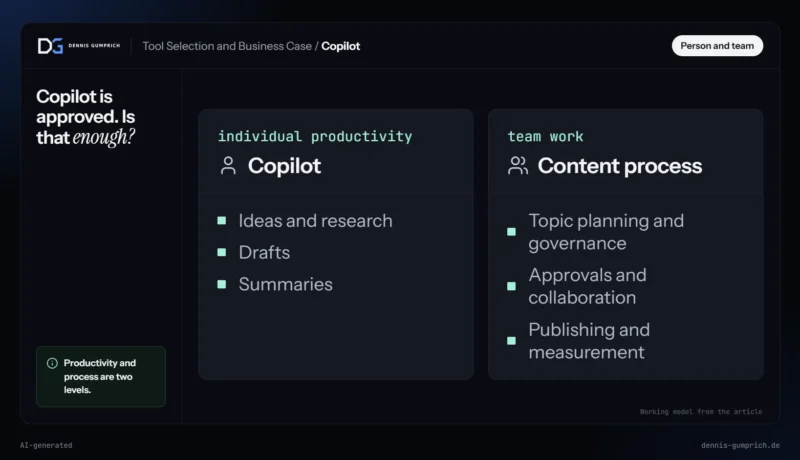
Copilot is a strong personal assistant within Microsoft 365: for drafts, summaries, emails and searching your own files. What it does not map on its own is a team's content process: topic planning across all channels, binding workflows with approval, brand rules that are checked before every approval instead of just recommended, consistent channel derivations, publishing and evaluation per topic. The question is therefore rarely Copilot or content platform, but which level each tool takes over.
What can Copilot do for content teams today?
Copilot helps where people already work in Microsoft 365: drafts and revisions in Word, summaries of Teams meetings, emails in Outlook, presentations in PowerPoint and searching for information in the files the person has access to. With Copilot Studio, you can also build your own agents.
These strengths are real, and if you play them down, you lose credibility in every budget discussion. Copilot sits where the work happens, it respects the existing permissions in the company, and it has already been reviewed and approved in many organizations. The last point in particular is a huge advantage for marketing teams compared to any additional tool that first has to go through purchasing, IT, data protection and the works council.
| Task | Coverage by Copilot | Assessment |
|---|---|---|
| Draft a text to specification | good | comparable to other AI tools |
| Summarize meetings and documents | very good | one of its greatest strengths |
| Research in your own files | good | depends on storage and permissions |
| Emails and internal communication | very good | directly in everyday work |
| Topic planning across channels and months | hardly | no planning structure in the actual sense |
| Binding approval workflows | hardly | only via additional tools or custom builds |
| Check against brand rules before every approval | limited | possible, but depends on someone triggering it |
| Channel versions from a shared core | limited | per request, without a lasting link to the core |
| Publishing and evaluation per topic | hardly | outside its focus |
The table shows a clear pattern. Copilot is strong at tasks one person completes in a moment. It is weak at tasks that connect several people over time. That is not a weakness of the product, but its orientation. Microsoft built Copilot as an assistant for personal productivity in all departments, not as an operating system for content teams.
Why the question in the budget conversation is justified
Before turning to differences, it is worth taking management's perspective. It has just approved a considerable sum for Copilot licenses. It has been through a review process with IT, data protection and the works council. And for years it has seen every department acquire its own tools, whose costs add up and whose functions overlap.
The question about a separate content tool is therefore not a rejection, but a legitimate wish for consolidation. If you answer with a list of functions Copilot supposedly cannot do, you lose the conversation, at the latest when someone from IT shows that half of them can be rebuilt with Copilot Studio. The better answer does not describe functions, but levels of work. How to assess the question of point tools versus platform in principle is described in the article Point tools or platform.
The difference is not in text quality
Copilot uses powerful language models, as do many content tools, in some cases even the same ones. A comparison of text quality therefore rarely leads to a clear result. The robust difference lies in the level: Copilot supports one person with one task, while a content platform organizes how a team plans, creates, reviews, approves and publishes content across channels.
The argument that a specialized tool writes better texts usually does not stand up to a test. If you give both tools the same assignment with the same context, the results are similar. Differences arise almost exclusively from context: which brand voice is stored, which facts are available, which previous content does the system know? But that is a question of structure, not of the model.
A comparison with other areas of the company is more helpful. Sales also works with Outlook and Excel and could theoretically manage its customer relationships there. Nevertheless, almost every company has a CRM, because sales as a team needs a shared status, binding processes and evaluation. Copilot makes the individual salesperson more productive, but does not replace the CRM. The same applies to content.
Five questions Copilot alone does not answer
What do we talk about as a team across all channels? Whose turn is it, and when is something bindingly approved? Are brand rules checked for every piece of content or only when someone remembers? How are channel versions created consistently from a core? And what was published and what had an effect?
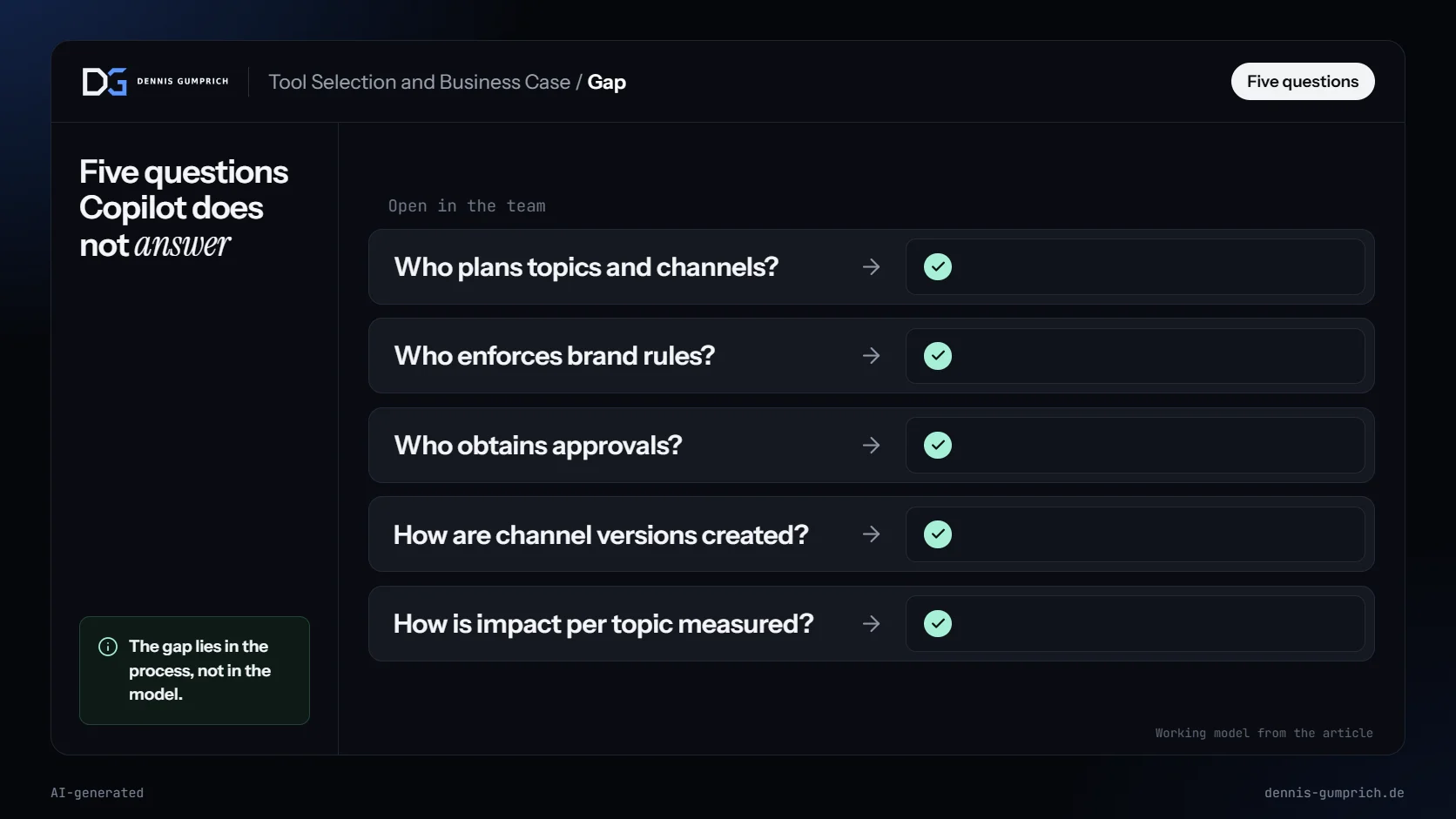
What do we talk about? Topic planning that brings together topics, channels, dates and responsibilities is not a Copilot function. In practice, it therefore ends up in a spreadsheet or a list in SharePoint. The team then has a very good writing assistant and a plan with all the known limits described in the article on planning in Excel.
Whose turn is it? Without a dedicated system, approvals with specialist departments, legal and management run via email, comments in Word and messages in Teams. Copilot can summarize these messages, but it does not turn them into a binding process with deadlines and a clear status.
Are brand rules enforced? More on this in a moment, because this is where the most common misunderstanding lies.
How are channel versions created? Copilot can turn an article into a LinkedIn post if someone asks for it. But the version then no longer has any relation to the article. If the article is corrected, nobody knows which derivations are affected.
What had an effect? Publishing to the website and social media and an evaluation per topic are outside what Copilot is built for. Without this feedback loop, every plan remains a collection of assumptions.
"But Copilot can store our tone too"
Yes, it can, for example via instructions, custom agents or stored documents. The difference is not whether a brand voice can be stored, but whether it is enforced: whether every piece of content is checked against the same rules before approval, regardless of who wrote it and with what.
This objection comes up in almost every conversation, and it is justified. Anyone claiming that only a specialized tool can ensure a consistent brand voice is quickly refuted. A tone description can be stored in Copilot as well, and an agent in Copilot Studio can apply it.
The real difference lies one level deeper. With a personal assistant, each person decides for themselves whether to use the brand agent, which version of the guidelines to use and whether to have the result checked. A text delivered by the agency, written by a colleague without a Copilot license or drafted directly under time pressure does not go through the rules. The brand voice is available, but voluntary.
The brand voice is stored as an instruction or agent. Whoever remembers uses it. Texts from agencies, specialist departments or written under time pressure bypass it. Whether a published text was checked cannot be seen afterwards.
The check against brand voice and mandatory rules is a fixed step in the workflow before approval. Every piece of content goes through it, no matter where it comes from. The result is documented on the content.
For companies with regulated statements, for example on health, finance or environmental impact, this difference is not just a question of quality. Here it must be traceable that content was checked before publication. A voluntary agent does not meet this requirement, a review step in the process does. How to build such review rules is described in the checklist before approval and in the article on the EmpCo Directive.
Costs: license, consumption and allowance
Copilot is licensed per person; custom agents in Copilot Studio are partly billed additionally by consumption, depending on use. Content platforms usually work with licenses per active user and an AI allowance in the package. For a fair comparison, you have to calculate both sides completely, including custom builds, people who only read along and maintenance.
The most common mistake in the cost comparison is to regard the Copilot license as already paid and the content tool as an additional expense. That is true as long as nobody tries to rebuild the content process with Copilot. As soon as that happens, costs arise that are not in any license: development time for agents and processes in Copilot Studio and Power Automate, maintenance of these custom builds with every change, consumption costs for agents and the time the team continues to spend in spreadsheets, emails and alignment.
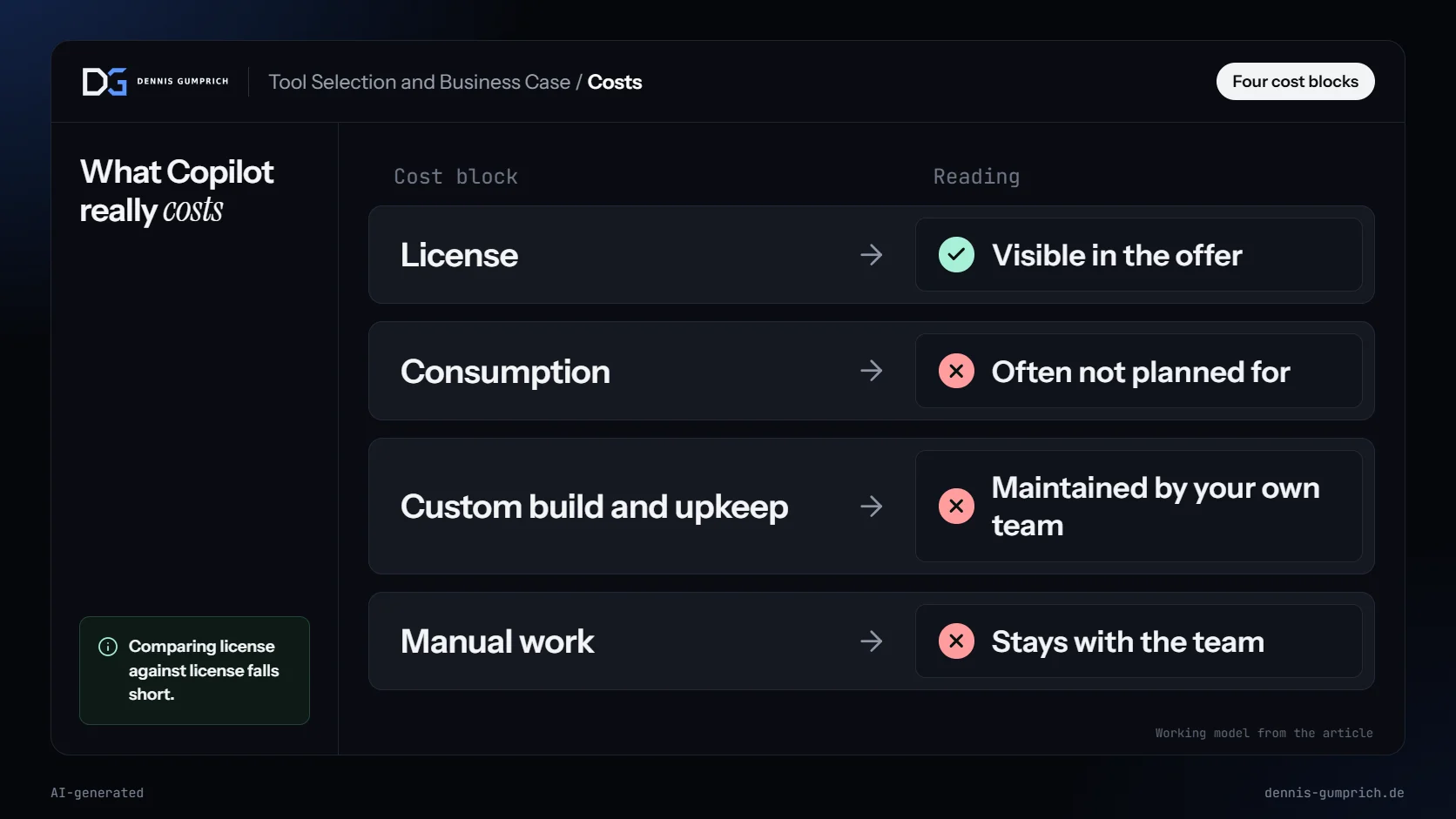
| Item | Copilot only with custom build | Copilot plus content platform |
|---|---|---|
| Licenses | Copilot per person | Copilot per person plus platform per active person |
| AI use | partly consumption-based for custom agents | allowance in the platform package |
| Setup | development of agents, lists, processes | setup and onboarding |
| Maintenance | internal, with every change | by the vendor |
| Readers and approvers | depending on the solution | often as free observers |
| Remaining manual work | planning, status, transfer to the CMS | considerably less |
Which side is cheaper depends heavily on team size and the number of channels. For a team of two people with two channels, Copilot alone is almost always the more economical solution. For a team with expert approvals, several brands or countries and five or more channels, the calculation tips, because the custom build and the remaining manual work become more expensive than the platform. How to prepare this calculation cleanly for the conversation with management is described in the template for the business case.
Data protection and IT approval: Copilot's head start and how to close the gap
Copilot has a real head start because it runs in the Microsoft environment that IT has already reviewed. A content tool needs its own review. This becomes much easier if the tool's AI runs on the same infrastructure, for example via Azure OpenAI in a European region, and if hosting, training use and roles are documented from the start.
For IT, the same questions arise with every AI tool: where is the data processed? Is content used to train models? Which model provider is behind it, and under which contract? Who has access, and how are rights assigned? For Copilot, these questions have been answered. For every additional tool, they must be answered anew.
A strong argument for companies that have already approved Copilot is therefore the question of infrastructure. Copilot works with models that Microsoft operates via Azure OpenAI. Since July 24, 2026, models operated by OpenAI itself as a subprocessor of Microsoft have additionally been enabled by default. Anthropic models are only added after approval by the administration and are currently not covered by the EU Data Boundary. If a content tool can run its AI functions via Azure OpenAI in a European region or the EU data zone, it uses comparable models on an infrastructure your IT knows from the Copilot review. This shortens the review, because processing by the language model does not have to be fundamentally reassessed. IT will still review the tool's own contract, hosting and data flows.
That this model chain deserves attention is consistent with the NIST Generative AI Profile (NIST AI 600-1). The voluntary framework from the US lists the integration of third-party components as a risk category of its own, for example when components are integrated opaquely or suppliers are insufficiently vetted. In addition, the scope of such services changes without your involvement. According to its ChatGPT Release Notes, OpenAI introduced an agent for longer tasks called "ChatGPT Work" on July 9, 2026. For you, this means: an approval applies to a certain state, so Copilot, like any other tool, needs a fixed review date for new models and functions.
How to involve IT and data protection early enough that this does not become a weeks-long loop is described in Involve IT and data protection early. The most important advice from it applies here in particular: ask IT's four questions yourself before IT does, and bring the answers. The review questions for AI software in detail are in GDPR-compliant content marketing software.
The points IT, data protection and the works council check for an additional content tool are summarized in the free AI tool approval checklist (in German).
How do Copilot and a content platform work together?
Copilot remains the tool for personal productivity: emails, meetings, notes, research in your own files. The content platform takes over the team level: topic planning, production with brand rules, review, approval, publishing and evaluation. Both levels are connected via notifications, shared storage and open interfaces.
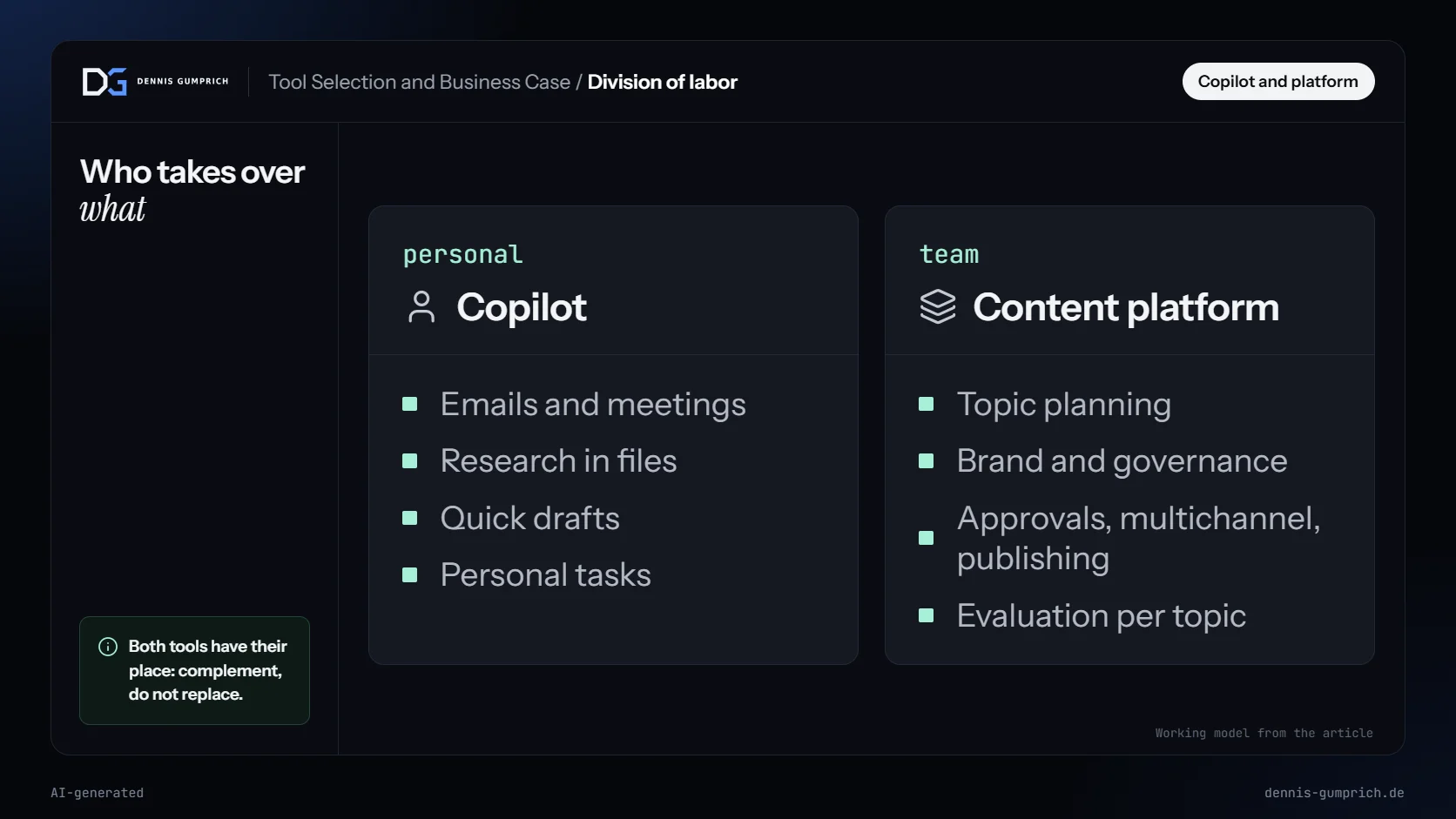
| Level | Copilot | Content platform |
|---|---|---|
| Emails, meetings, notes | yes | |
| Research in your own files | yes | complementary |
| First ideas and quick drafts | yes | yes |
| Topic planning across channels | yes | |
| Production with stored brand voice | voluntary | binding |
| Review and approval | yes | |
| Channel derivations from one core | individually | linked |
| Publishing to CMS and social media | yes | |
| Evaluation per topic | yes |
This division has a side effect that is often convincing in the budget conversation. It makes Copilot more valuable, not superfluous. The summary of an expert conversation from Teams becomes the source material for an article in the platform. Research in your own files delivers facts for the knowledge base. And whoever is waiting for an approval in the platform gets the notification where they work anyway. The investment in Copilot and in a content platform reinforce each other instead of overlapping.
When is Copilot enough, and when not?
Copilot is enough when content is a side task for a few people, with few channels, without expert approvals and without several brands or countries. It is no longer enough as soon as several people collaborate across several channels, approvals outside the team are needed or statements must be demonstrably reviewed.
| Feature | Copilot is usually enough | Content platform usually pays off |
|---|---|---|
| People involved | one to two | three or more plus approvers |
| Channels | one to two | three or more |
| Expert or legal approvals | rare | regular |
| Brands, countries, locations | one brand, one market | several |
| Regulated statements | none | health, finance, environment, technology |
| Agencies and freelancers | none or few | regularly involved |
| Visibility in search and AI search | secondary | strategic goal |
The last row deserves a note. If visibility in search engines and AI search is a goal, you need checks for structure, citability and search relevance in the creation process, not afterwards. These checks are among the tasks a content platform maps as part of the process and that are hard to make binding with a personal assistant. What AI search considers when selecting sources is described in the article on AI visibility. How to anchor these checks firmly in the process is shown in Embedding GEO in the content process.
How do you answer the question in the budget conversation?
By acknowledging Copilot instead of playing it down, describing the process instead of functions, backing up the gaps with your own examples, comparing costs completely, showing the interplay instead of setting up competition and proposing a pilot with clear criteria.
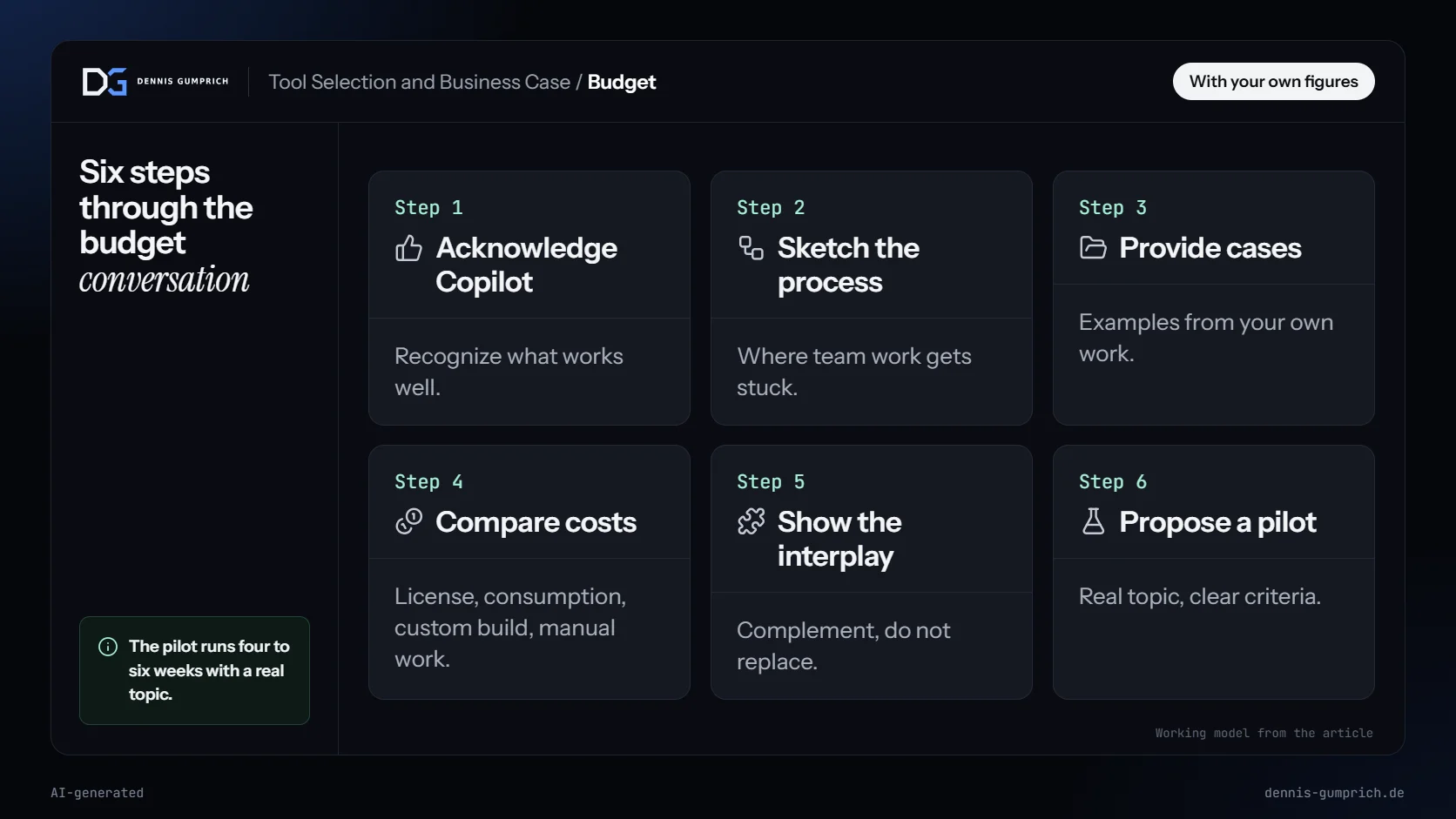
- Step 1Acknowledge CopilotStart with what you already use Copilot for in the team and where it helps. That shows you are not arguing against the decision, but building on it.
- Step 2Describe the processSketch the path of a typical piece of content from topic to evaluation, with everyone involved. The gaps become visible by themselves without you having to claim them.
- Step 3Back it up with your own examplesThe last approval loop that took three weeks. The wrong version that was online. The agency text that did not sound like you. Your own cases weigh more than any argument.
- Step 4Compare costs completelyNot license against license, but all items from the table above, including custom build, maintenance and remaining manual work.
- Step 5Show the interplayMake clear how Copilot and the platform complement each other and which of IT's questions are already answered, for example via a shared Azure infrastructure.
- Step 6Propose a pilotFour to six weeks, one real topic, two measurable criteria such as lead time and number of alignment loops. A decision based on your own figures is easier than one based on promises.
A note about myself
I work for contentbird, a vendor of exactly the kind of content platform this article is about. I have therefore tried to present Copilot fairly and left out the arguments that do not hold up in conversations. Two points concern us directly: contentbird's AI functions can be run via Azure OpenAI, that is, on the infrastructure Microsoft customers have already reviewed for Copilot. And AI use is included as an allowance in the package, not as open-ended consumption. Whether a platform alongside Copilot pays off for you nevertheless depends on the decision aid above and not on this box.
Five mistakes in the Copilot discussion
- Arguing with text qualityThe models are comparable. If you claim your own tool writes better, you lose at the first direct test.
- Playing down CopilotThe decision for Copilot has been made and justified. Arguing against it means arguing against management.
- Only comparing license costsCustom build, maintenance, consumption and remaining manual work are often the bigger items.
- Bringing in IT too lateIf you only clarify the questions on hosting, training and rights after the decision, you lose weeks and sometimes the whole project.
- Setting up an either-orThe question is not Copilot or platform, but which level each tool takes over. If you offer an either-or, you usually get the answer that has already been paid for.
Self-check: is Copilot enough for your content team?
Tick everything that applies to you.
A quick assessment of Copilot and our content process:
Copilot already helps us noticeably in everyday work, especially with drafts, meeting summaries and searching our files. It supports each individual person in their tasks.
What it does not map on its own is our process as a team: topic planning across all channels, binding approvals with specialist departments, a check of every piece of content against our brand rules before approval, consistent channel versions, publishing and evaluation per topic. These parts currently run via spreadsheets, emails and manual work.
Proposal: we compare costs completely, that is, including custom build and remaining manual work, and test for four to six weeks with a real topic whether a content platform alongside Copilot measurably reduces lead time and alignment loops. We clarify the data protection questions with IT in advance, ideally based on the same Azure infrastructure already reviewed for Copilot.
Conclusion: Copilot makes people more productive, a platform makes the process reliable
The question of whether Copilot is enough for marketing is justified and deserves a clear answer. For small teams with few channels, it is often yes. For teams with expert approvals, several brands or countries and many channels, it is no, not because Copilot writes worse texts, but because it is built for a different level.
If you want to get this across convincingly in the budget conversation, do not argue against Copilot, but with it: Copilot for personal productivity, a content platform for the shared process, both connected. The investment in Copilot does not become superfluous, but more effective. How to bring AI as a whole from experiment to infrastructure is described in The AI opportunity for marketing and communications teams 2027.
Frequently asked questions
Can't we rebuild the content process with Copilot Studio and Power Automate?
Partly, yes. Approval processes, lists for planning and agents for specific tasks can be built. But calculate development, maintenance and consumption completely and check who will look after the custom build in the long term. In many cases, it is more expensive and more fragile than a finished solution, especially if the person who built it leaves the company.
Isn't a content tool alongside Copilot shadow IT?
Only if it is introduced without alignment with IT. A reviewed, approved tool is the opposite of shadow IT. Shadow IT tends to arise when the team falls back on private AI accounts for lack of a suitable solution. More on this in the article on shadow IT in marketing.
Does Copilot use the same models as other content tools?
Copilot relies on GPT models that Microsoft operates via Azure OpenAI or that OpenAI itself operates as a subprocessor of Microsoft, and, after approval by the administration, additionally on Anthropic models. Many content tools use comparable or the same models, and some can also be run via Azure. Text quality is therefore rarely the decisive difference, but the context the model works with is.
Does everyone in the content team need an additional platform license?
Only the people who actively plan and create content. Approvers, specialist departments and readers are included as observers without a full license by many vendors. This makes the calculation much cheaper for organizations with many people involved than a headcount comparison would suggest.
How long does the IT review for an additional tool take?
Between a few days and several months, depending on how well the documents are prepared and whether the works council has to be involved. It is fastest when hosting, training use, model provider and roles are documented and the AI runs on an infrastructure that has already been reviewed.
What if management still wants to stick with Copilot alone?
Then it is worth deliberately organizing the remaining gaps: a clear planning structure, fixed approval deadlines, a stored brand voice and a checklist before approval. After a quarter, measure lead time and alignment effort. These figures are the best basis for the next conversation.
Where does your content process lose time today?
In 30 minutes, we look together at where unnecessary coordination, manual tasks, tool switching or repetitive content work cost you time today.
You get a concrete assessment of which tasks you can simplify, automate or organize better, and where AI and tools actually help instead of adding complexity.
Analyze your content process in 30 minutes Free of charge. You take away concrete starting points you can use internally right away.
Dennis Gumprich
Dennis helps marketing and communication teams fit generative AI into existing content processes without undermining quality, brand voice and approvals. Focus areas: content operations, AI governance and tool selection in mid-sized companies and corporations.
Transparency note: Dennis works for contentbird, a provider of AI-powered content software. Product mentions are marked in the article. More about Dennis (in German) · LinkedIn
Read more
Sources
- Microsoft: Microsoft Copilot, Service Descriptions, Microsoft Learn, as of August 5, 2026: Copilot in Word, Excel, PowerPoint, Outlook and Teams including meetings. Accessed October 31, 2026.
- Microsoft: Standard harness licensing, Microsoft Copilot Studio, Microsoft Learn, as of October 15, 2026: custom agents, billing via Copilot Credits as a prepaid package or by consumption, certain agent use is not charged additionally with a Copilot license. Accessed October 31, 2026.
- Microsoft: Data, Privacy, and Security for Microsoft Copilot, Microsoft Learn, as of August 18, 2026: Copilot only shows data to which the person has at least read access, prompts and responses are not used to train the foundation models, Anthropic models are excluded from the EU Data Boundary. Accessed October 31, 2026.
- Microsoft: License Options for Microsoft Copilot, Microsoft Learn, as of October 19, 2026: licenses are assigned to individual people. Accessed October 31, 2026.
- Microsoft: OpenAI as a subprocessor in Microsoft Online Services, Microsoft Learn, as of August 18, 2026: models operated by OpenAI have been enabled by default for eligible commercial customers since July 24, 2026 and are included in the EU Data Boundary. Accessed October 31, 2026.
- Microsoft: Anthropic models in Microsoft Online Services, Microsoft Learn, as of September 18, 2026: disabled by default in the EU, EFTA and the United Kingdom, currently not part of the EU Data Boundary. Accessed October 31, 2026.
- Microsoft: Deployment types for Microsoft Foundry Models, Microsoft Learn, as of September 28, 2026: with data zone deployments in the EU, prompts and responses are only processed within the data zone; with standard deployments, within the selected Azure geography. Accessed October 31, 2026.
- National Institute of Standards and Technology (NIST): Artificial Intelligence Risk Management Framework: Generative Artificial Intelligence Profile (NIST AI 600-1), published July 26, 2024, Chloe Autio, Reva Schwartz, Jesse Dunietz et al., companion document to the voluntary AI RMF 1.0 of January 2023: among twelve risk categories, Value Chain and Component Integration covers opaquely integrated third-party components and insufficiently vetted suppliers, alongside Data Privacy and Intellectual Property among others. Voluntary framework from the US with no legal force in the EU. Accessed October 31, 2026.
- OpenAI: ChatGPT Release Notes, continuously updated help article, entry of July 9, 2026: introduction of ChatGPT Work as an agent for longer tasks. Vendor information, functions change continuously. Accessed October 31, 2026.
How this article was created
This article was created with the help of AI. Structure, research and draft wording were developed with AI support. Professional assessment, review of the statements and the final version are the responsibility of Dennis Gumprich. The English version was translated with AI and reviewed. Read the original German version.
How reliable are the statements?
Evidence exists for the functions of Copilot in the Microsoft 365 applications, custom agents in Copilot Studio and their billing, licensing per person, the handling of permissions and training use, the model providers OpenAI and Anthropic as subprocessors and the processing locations for Azure deployments, each from Microsoft documentation, as well as for the risk category of third-party components in the value chain (NIST AI 600-1, voluntary framework from the US) and, using ChatGPT Work as an example, for the continuous expansion of functions (vendor information in the OpenAI Release Notes of July 9, 2026). The classification of Copilot functions describes the state in autumn 2026 and may change with product updates. License and billing models of Microsoft and other vendors change regularly; check the current conditions before every decision. The decision aid is a working model from conversations with content teams, not a measurement. The same applies to the assessment of coverage per task, the cost items in the comparison and the thresholds for team size and channels, which are empirical values from consulting practice. The information on contentbird is vendor information. Status: October 31, 2026.


