

You have made your decision. The tool fits, the budget is in place, the specialist department is on board. You send the draft contract to the legal department, noting that you want to start on the first of the month.
Six weeks later, you still have not started. A data processing agreement is missing, IT wants to know where the data is stored, and someone asks whether content is used for training. Questions nobody asks out of malice. Just at the latest possible moment.
Involving IT and data protection late usually costs more time than the entire selection process before it. If you involve both areas in the requirements phase, you turn them from blockers into co-decision-makers. Four points are decisive: purpose of processing, data location, data processing agreement and use for training. The complete review questions for AI tools are in GDPR-compliant content marketing software.
Why the review comes so late
In most companies, the search for a tool starts in marketing, because that is where the pain is. IT and data protection hear about it when a signature is due. From their perspective, a finished result with a desired date arrives without them having known the requirements. What happens when teams then buy around IT is described in Shadow IT in marketing: what unapproved tools really cost you.
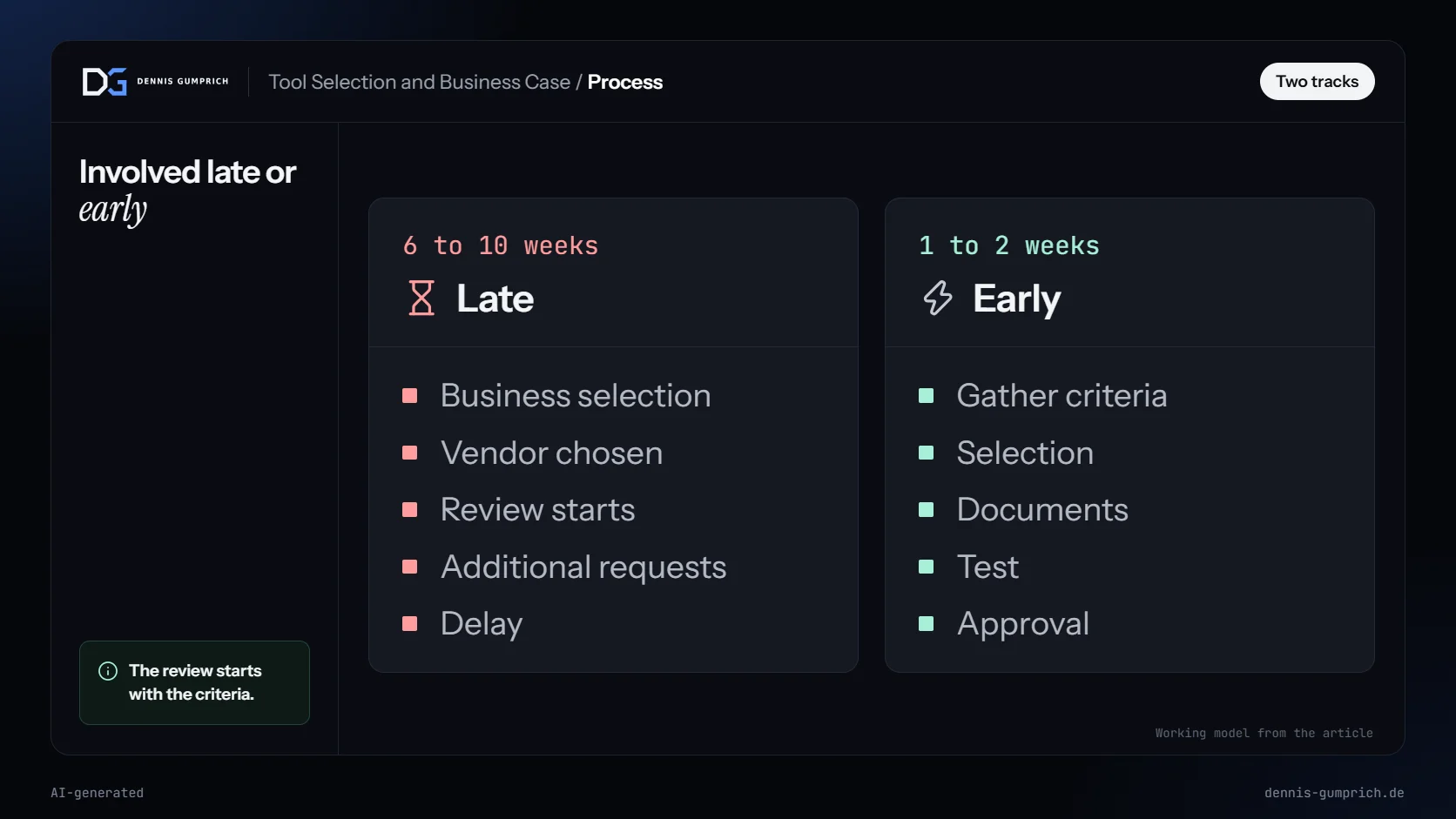
This triggers one of two reactions. Either the review is thorough, and then it takes time. Or it is rejected quickly, because rejection is always the lower-risk outcome when time is short. Both feel like a blockade to you, but are the logical consequence of the timing.
The lever therefore does not lie in reviewing faster. It lies in asking earlier. If you involve IT and data protection in the requirements phase, you get their criteria as part of the selection instead of as an objection afterwards. How to set up the rollout afterwards is described in Pilot and rollout: why a short trial proves nothing.
How much the topic preoccupies marketing itself is shown by the 2026 study "Marketing in digital transformation" (in German) by Bitkom, Germany's digital industry association: 54 percent of the companies surveyed name data protection and regulation as an external challenge, ahead of economic uncertainty at 48 percent. 180 companies from the digital sector in the Bitkom network were surveyed; the results are not representative. For you, this means: data protection is not a special request from the review office, but one of the biggest hurdles in marketing itself, and therefore belongs on your requirements list from the start.
What does IT review, and what does data protection review?
Both areas are often mentioned in the same breath in daily work, and they review different things. Mixing them up leads either to an incomplete approval or to puzzlement about contradictory feedback.
Data protection asks whether personal data is processed lawfully: which data, for what purpose, on what legal basis, for how long, and who has access. IT security asks whether operation is secure: access management, permissions, encryption, interfaces, failure behavior and connection to your existing sign-on. Which data a tool can reach at all also depends on the connection route, see MCP or API.
These questions only partly overlap. A tool can be unproblematic in terms of data protection and still fail on IT security, for example because it does not support central sign-on or has no role management. Conversely, a technically cleanly connected system can fail because the purpose of processing is not covered.
A common denominator for both reviews is provided by the NIST Generative AI Profile (NIST AI 600-1), a voluntary framework from the US. It recommends extending the usual due diligence in procurement to intellectual property, data protection and security, explicitly also for solutions in which AI is only embedded. For you, this means: include data protection and security questions in the same request, even for tools whose AI feature is only an add-on.
In practice, this means: two requests, two contacts, two results. A joint request to both at the same time still makes sense, so the areas know about each other. But the approvals must be documented separately, otherwise it will later be unclear what was actually approved.
A frequently overlooked point concerns sign-on. If your IT relies on central access management, ask early whether this is supported. With many tools, it is tied to higher pricing tiers, which changes a price comparison you may already have made.
Which questions do IT and data protection always ask?
The reviews come down to four points, regardless of industry and company size. First: which personal data is processed at all? With content software, often more than expected, for example names in interviews, customer quotes or contacts in case studies. Second: where is the data stored and who has access, including subcontractors and possible transfers to third countries. Plus two more on use for training and the processing agreement.
Regardless of industry and company size, the reviews come down to the same four points. If you can answer them in advance, the process shortens considerably.
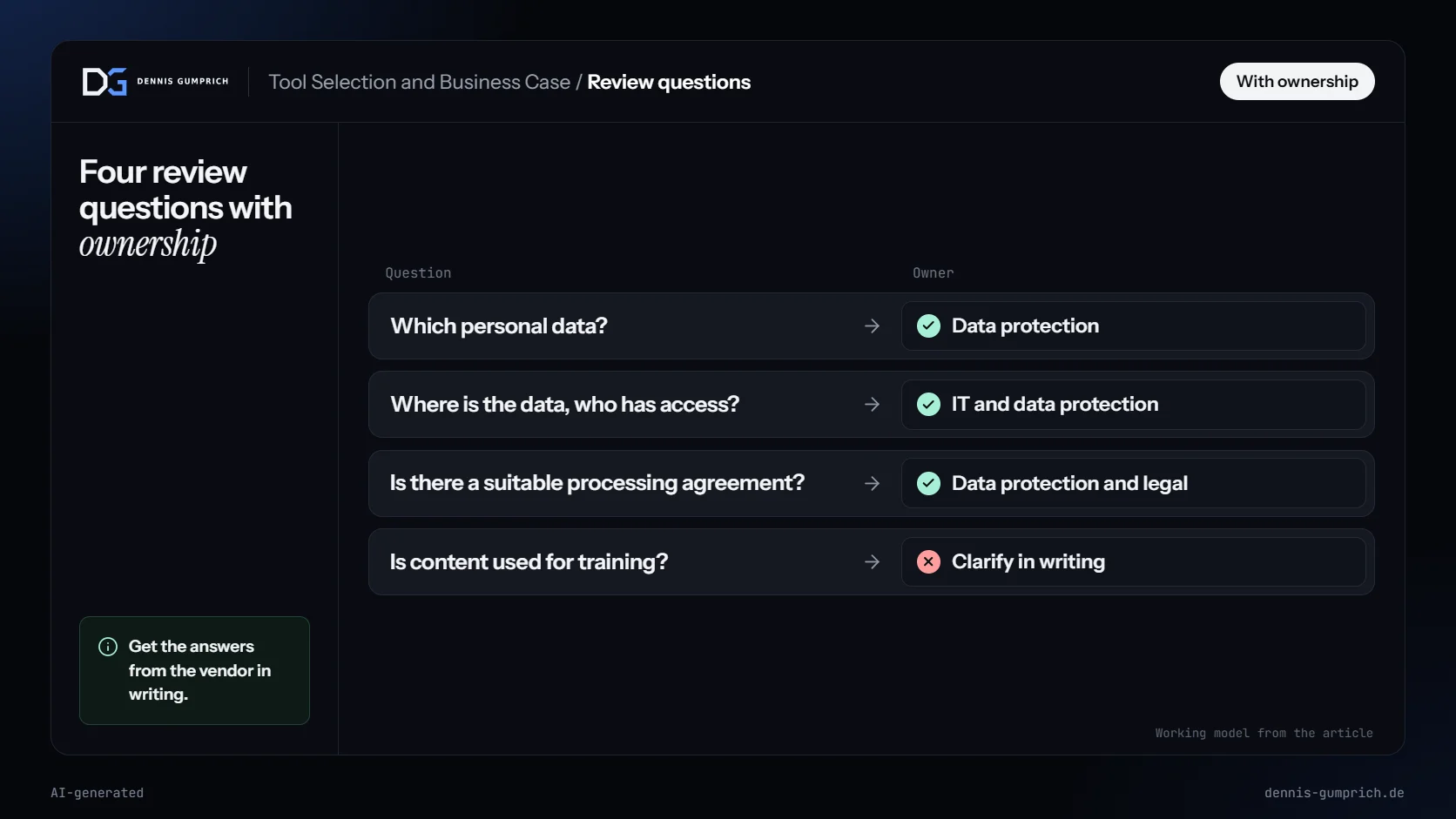
In practice, the fourth question decides approval or rejection more often than all the others. Clarify it in writing, not in conversation, and attach the answer to the review.
What a request that gets answered quickly looks like
The biggest difference in processing time does not arise in the review office but in your request. A general question produces a general answer nobody can work with.
We would like to introduce an AI tool for content. Could you please review it? Here is the link to the vendor.
Purpose: creating blog posts and social posts. Data processed: our own texts, product information, in individual cases customer names from approved references. No applicant, HR or health data. Users: four named people. Attached: data processing agreement, information on server location and subcontractors, written statement on use for training. Open question to you: is this framework enough for approval, and which documents are missing?
The difference costs ten minutes to write. In processing, it regularly saves two to three rounds, because exactly the information that would otherwise have to be requested is available.
The last sentence is particularly effective. An open question about missing documents turns a review into a collaboration. Without this question, you often get a rejection with reasons instead of a list of what is still needed.
What happens to your data with AI tools?
The question breaks down into several levels, and only separately do you get usable answers. Are your inputs used to train the models? Often excluded for business plans, often not for free accounts. How long are inputs stored and for what purpose? A vendor that answers clearly on all levels makes the review considerably easier.
The question of use for training is often asked and rarely answered precisely, because it mixes several levels. Breaking it down gets you usable answers.
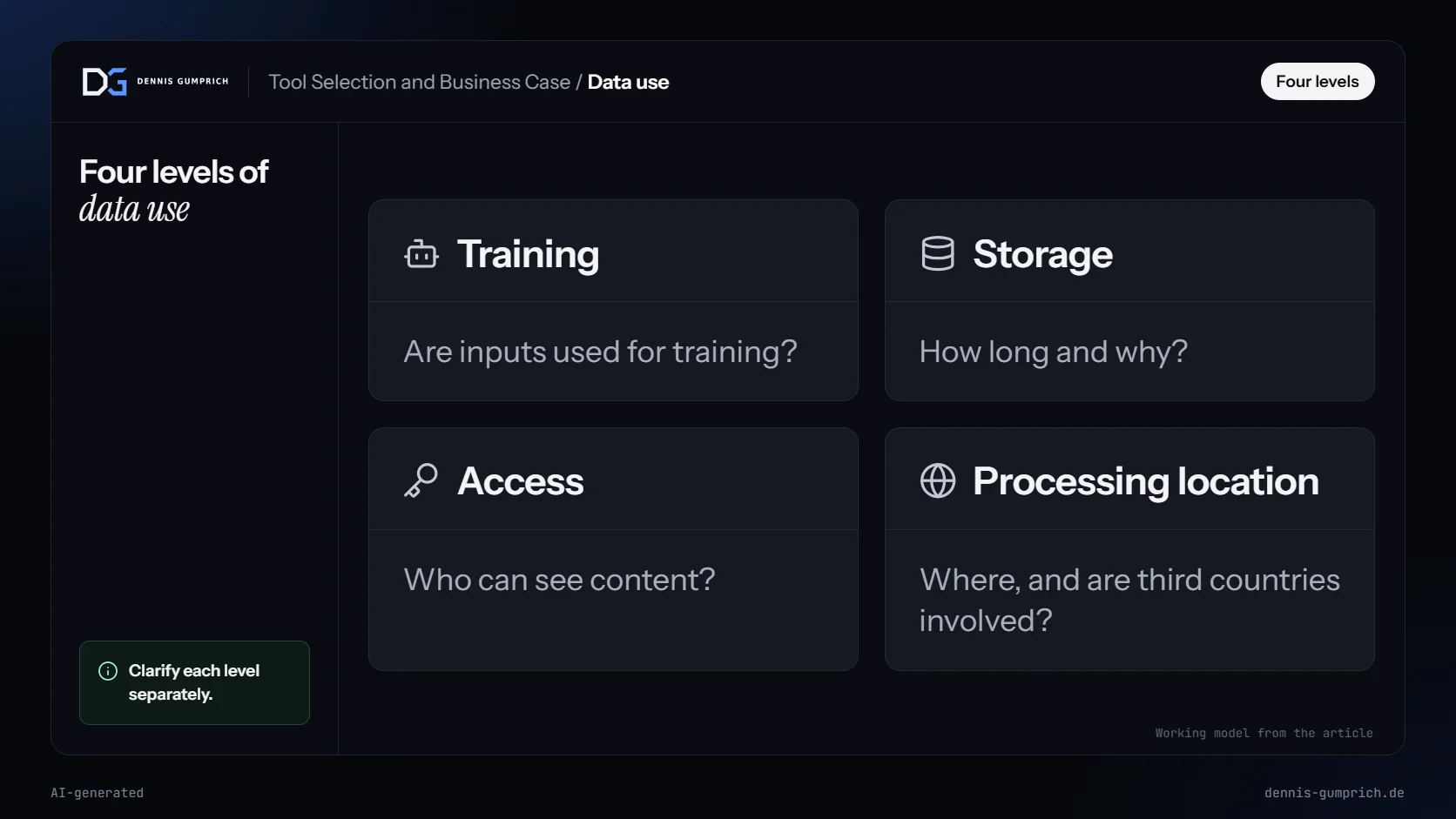
Ask these four questions individually and in writing. A vendor that answers clearly on all four levels makes your review considerably easier. Evasive answers are information in themselves and belong in the documents for the review office.
The distinction between commitment and default setting is important. Some vendors exclude use for training contractually, others only via a setting that has to be actively configured. In the second case, your documentation should record who configured this setting and when it was last checked.
What does involving IT and data protection late cost?
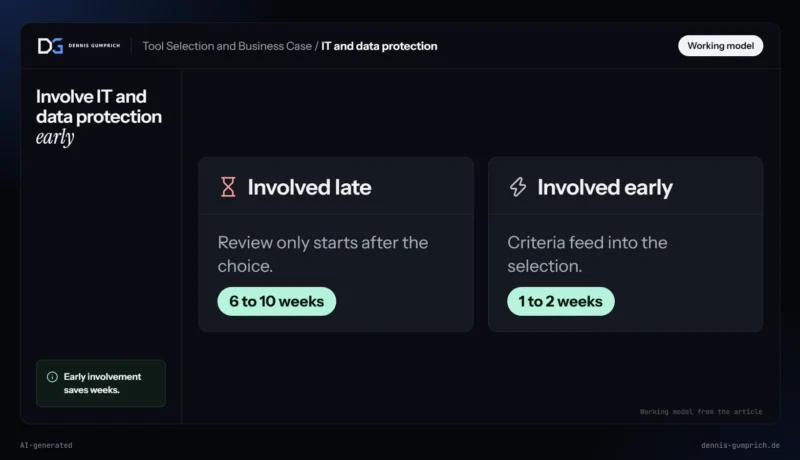
Six to ten weeks of delay if the review only starts after the selection, compared with one to two weeks if the criteria were part of the requirements list. The difference does not come from faster reviewing but from no additional requests being needed. Every additional request costs a complete cycle.
The following values are a working model for illustration and not measured values. Insert your own experience values.
The difference does not come from faster reviewing but from no additional requests being needed. Every additional request costs a complete cycle, because the documents go back into the queue.
| Step | Late involvement | Early involvement |
|---|---|---|
| Define requirements | without IT and data protection | jointly, criteria feed in |
| Vendor selection | purely business-driven | business plus exclusion criteria |
| Review | starts from zero, several follow-up questions | confirms what is known |
| Result | delay or rejection | approval or early rejection |
The last point is the underestimated one. An early rejection is unpleasant but much cheaper than a late one. If a vendor is out of the question for fundamental reasons, you want to know that before the test, not afterwards.
The test framework that relieves the review
Between interest and approval there is usually a test. This is exactly where the greatest uncertainty arises on the review side, because it is unclear what actually happens during this time.
A written test framework solves this in a few sentences. It describes five points: which content is used, which is explicitly not, who has access, how long the test runs and what happens to the data entered afterwards.
The second point is the most important. An explicit negative list, for example no personal data, no customer names, no unpublished figures, removes most of the uncertainty from the review. It turns an open risk question into a clearly bounded process.
The last point is almost always forgotten. Before the test, clarify how you will have the content entered deleted after the end and whether you will receive confirmation of this. A test account that quietly expires leaves data with the vendor that nobody talks about anymore.
Keep the framework short and present it to the review office before the test phase, not afterwards. A retrospective description of what has already happened creates exactly the follow-up questions you wanted to avoid.
What do you need to document?
An approval granted is not a permanent state. It relates to a described use, and this use changes. New features are added, the user group grows, content types change.
So record four pieces of information compactly in one place: what the approval relates to, who granted it, when, and which conditions are attached to it. Half a page is enough.
The practical benefit shows at the next step. If you later want to use another feature, you can ask specifically instead of going through the entire procedure again. Without documentation, every extension starts from zero, because nobody knows what was originally reviewed.
Also set an annual review date. Not as a formality, but because vendor terms change. A tool approved two years ago may now work with different subcontractors or different default settings.
Five mistakes in involving them
- Announcing the review as a formalityAnyone who signals that the decision has already been made gets a more thorough review, not a faster one.
- Only asking the legal departmentData protection and IT security are different perspectives with different criteria. Both belong at the table.
- Submitting documents piecemealEvery additional submission restarts the cycle. One complete package at once is faster than three quick partial deliveries.
- Glossing over the actual useIf the review request says no personal data is processed and customer quotes appear later, the approval is void.
- Working without a named contactA fixed person on both sides shortens coordination more than any form.
Five steps to a smooth approval
- Before the searchGather the criteriaA 30-minute meeting with IT and data protection in which you ask which points would be exclusion criteria for them. The result is a list, not a discussion.
- During selectionCriteria into the requirements listThe points named are added on an equal footing with the business requirements and asked of every vendor.
- Before the testObtain complete documentsData processing agreement, information on server location and subcontractors, and a written statement on use for training.
- At the start of the testRecord the test framework in writingWhich data is used in the test and which explicitly is not. This removes most of the uncertainty from the review.
- Before signingJoint approvalA short meeting with everyone involved instead of a circulation procedure. Open points are clarified in conversation, not by message.
Self-check: how well prepared are you?
Tick everything that applies to you.
We are currently evaluating software for our content production and want to involve you deliberately early, not just before signing.
So that you do not have to review blindly: we would like to know which points are exclusion criteria for you. We will add these to our selection list on an equal footing with the business requirements.
From the vendors, we will obtain in advance: a data processing agreement, information on server location and subcontractors, and a written statement on whether content is used to train models.
For the test, we will record in writing which data is used and which explicitly is not. Would a joint 30-minute meeting in the next two weeks work for you?
What to do if the answer is no?
In marketing, a rejection is often experienced as a blockade. It is usually an incompletely answered question. The difference decides whether you move forward or end up in a debate of principle.
So always ask about the type of rejection. Is it fundamental, that is, independent of documents and purpose? Or is it conditional, that is, resolvable through missing evidence, a smaller user group or a different processing location? In practice, the second case is much more common.
With a conditional rejection, you need exactly one piece of information: which condition must be met. Ask for this condition in writing and in one sentence. You then have a task instead of a verdict, and it can be passed on to the vendor.
With a fundamental rejection, the decision has been made, and that is valuable. An early no saves you the test phase, coordination and internal effort. Document the reason so the same discussion is not held again in a year, and check whether another vendor solves the same point differently.
In both cases, avoid trying to overturn the rejection via a higher level. It occasionally works and permanently damages the collaboration. With the next project, the same office will review much more thoroughly.
Conclusion: asking early is faster than reviewing quickly
IT and data protection are not a hurdle at the end of the process but a source of selection criteria at the beginning. If you treat them that way, you occasionally lose a vendor earlier, but gain weeks and make the decision with those involved rather than against them. If an AI assistant has already been approved in the company, it is worth checking first whether Copilot is enough for marketing.
Frequently asked questions
What if we do not process any personal data at all?
Check this carefully before you commit to it. In content processes, personal data appears more often than expected, for example in interviews, customer references, author names or contacts in case studies. A false assurance is a common reason why an approval already granted is later withdrawn.
Is a data processing agreement enough as evidence?
It is the basis, but rarely enough on its own. Information on subcontractors, server location and technical safeguards is usually expected in addition. Ask your data protection office which documents it regularly requests and obtain them straight away.
How do we handle a test account before the review is complete?
With a test framework recorded in writing: only uncritical content, no personal data, a limited user group, a fixed end date. This turns the test into a clearly bounded process instead of an unresolved permanent state.
Who decides in the end?
The business decision stays with you, the approval lies with the responsible offices. That is exactly why early involvement pays off: it separates the question of whether a tool fits professionally from the question of whether it may be used, and answers both in good time.
Who decides whether personal data is affected?
Your data protection office makes the classification; the description of the facts comes from you. It is important that you describe completely what is actually processed, including edge cases such as interview quotes or contacts in case studies. An incomplete description makes the approval worthless.
Do we need a data protection impact assessment?
That depends on the risk of the processing and is a case-by-case assessment by your data protection office. Ask explicitly instead of assuming or ruling it out. If one is required, it noticeably extends your timeline, and you should know that beforehand.
What if IT suggests its own solution?
Take the suggestion seriously and test it against your workflow, not the feature list. An existing solution often covers one part and not another. If you can name which step of your chain cannot be mapped with it, a debate of principle becomes an objective clarification.
Where does your content process lose time today?
In 30 minutes, we look together at where unnecessary coordination, manual tasks, tool switching or repetitive content work cost you time today.
You get a concrete assessment of which tasks you can simplify, automate or organize better, and where AI and tools actually help instead of adding complexity.
Analyze your content process in 30 minutes Free of charge. You take away concrete starting points you can use internally right away.
Dennis Gumprich
Dennis helps marketing and communication teams fit generative AI into existing content processes without undermining quality, brand voice and approvals. Focus areas: content operations, AI governance and tool selection in mid-sized companies and corporations.
Transparency note: Dennis works for contentbird, a provider of AI-powered content software. Product mentions are marked in the article. More about Dennis (in German) · LinkedIn
Read more
Sources
- European Union: Regulation (EU) 2016/679 (General Data Protection Regulation), Official Journal L 119 of May 4, 2016, Article 28 on the processor, authorization of further processors and the data processing agreement. Accessed October 31, 2026.
- European Union: Regulation (EU) 2016/679 (General Data Protection Regulation), Chapter V (Articles 44 to 49) on transfers of personal data to third countries, including appropriate safeguards under Article 46. Accessed October 31, 2026.
- OpenAI: How your data is used to improve model performance, help article: content from offerings for individuals may be used for training unless the user opts out; content from ChatGPT Team, ChatGPT Enterprise and the API platform is not. Example of the difference between individual and business plans. Accessed October 31, 2026.
- European Union: Regulation (EU) 2016/679 (General Data Protection Regulation), Article 35(1): data protection impact assessment where processing is likely to result in a high risk to the rights and freedoms of natural persons, to be carried out before processing begins. Accessed October 31, 2026.
- Bitkom: Marketing im digitalen Wandel: Lagebild der Marketingpraxis in deutschen Unternehmen 2026 (in German), study 2026, DOI 10.64022/2026-marketing, online survey of 180 companies from the digital sector in the Bitkom network, calendar weeks 44 to 50 of 2025: as external challenges, 54 percent name data protection and regulation, 48 percent economic uncertainty, 47 percent the difficulty of measuring marketing activities and 46 percent complexity in data management. Not representative. Accessed October 31, 2026.
- National Institute of Standards and Technology (NIST): Artificial Intelligence Risk Management Framework: Generative Artificial Intelligence Profile (NIST AI 600-1), published July 26, 2024, Chloe Autio, Reva Schwartz, Jesse Dunietz et al., companion document to the voluntary AI RMF 1.0 of January 2023: GV-6.1-009 recommends extending due diligence in procurement to intellectual property, data protection and security, explicitly also for solutions with embedded AI. Voluntary framework from the US with no legal force in the EU. Accessed October 31, 2026.
How this article was created
This article was created with the help of AI. Structure, research and draft wording were developed with AI support. Professional assessment, selection of sources, review of the statements and the final version are the responsibility of Dennis Gumprich. The time figures given are explicitly marked as working models and are not measured values. The English version was translated with AI and reviewed. Read the original German version.
How reliable are the statements?
Evidence exists for the obligation to have a data processing agreement under Article 28 GDPR, the rules on third-country transfers under Chapter V GDPR, the risk dependency of the data protection impact assessment under Article 35 GDPR and, using OpenAI as an example, the difference in use for training between offerings for individuals and business plans, as well as the share of companies naming data protection and regulation as an external challenge (Bitkom study 2026, non-representative survey in Germany) and the recommendation to extend due diligence in procurement to data protection and security, also for embedded AI (NIST AI 600-1, voluntary framework from the US). The four review questions, the four levels of the training question, the test framework, the five steps to approval and assessments of frequency, such as that the training question is asked most often, that conditional rejections are more common than fundamental ones or that central sign-on is often tied to higher tiers, are working models and experience values from consulting practice, not measured values. The time figures of six to ten weeks, one to two weeks and two cycles are a working model for illustration. As of October 31, 2026. Legal note: this article does not replace legal or data protection advice. Your data protection officers and legal department are responsible for assessing your specific case.


