
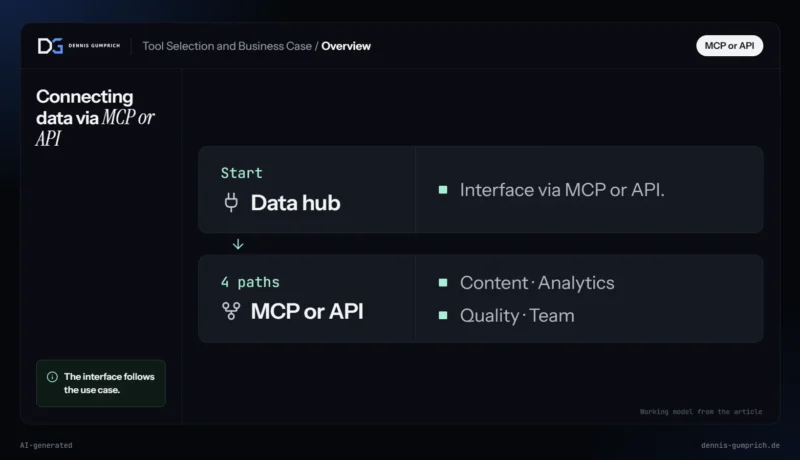

An API is the right choice for recurring, uniform data transfers: set it up once, and afterwards it runs without ongoing costs per transaction. MCP is suitable when an AI should decide for itself, in the moment of work, which data it needs. Then costs arise per use, but programming for each individual case is no longer needed.
What is the difference between MCP and API?
An application programming interface, or API, is a firmly defined route on which two systems exchange data. Someone specifies once: when this event occurs, that data record is transferred, in this format. Afterwards, the process runs identically every time, without anyone deciding.
MCP stands for Model Context Protocol. It is a standard for how an AI assistant can access external systems. The difference lies in who decides: not a previously programmed sequence determines which data is fetched, but the language model decides at the moment of the task which query makes sense. AI agents that plan several work steps independently are also built on this principle. What they reliably take on in content teams today is described in AI agents in the content team.
This results in the most important practical difference. An API is predictable: same input, same result, regardless of who triggers it. An MCP access is flexible but not predictable in the same way, because the model formulates the query. For recurring bulk data that is a disadvantage, for changing research tasks an advantage.
The two are not mutually exclusive. In practice, both routes often run side by side: the API for regular synchronization, MCP for the question in the moment of work.
What does an API connection cost compared with MCP?
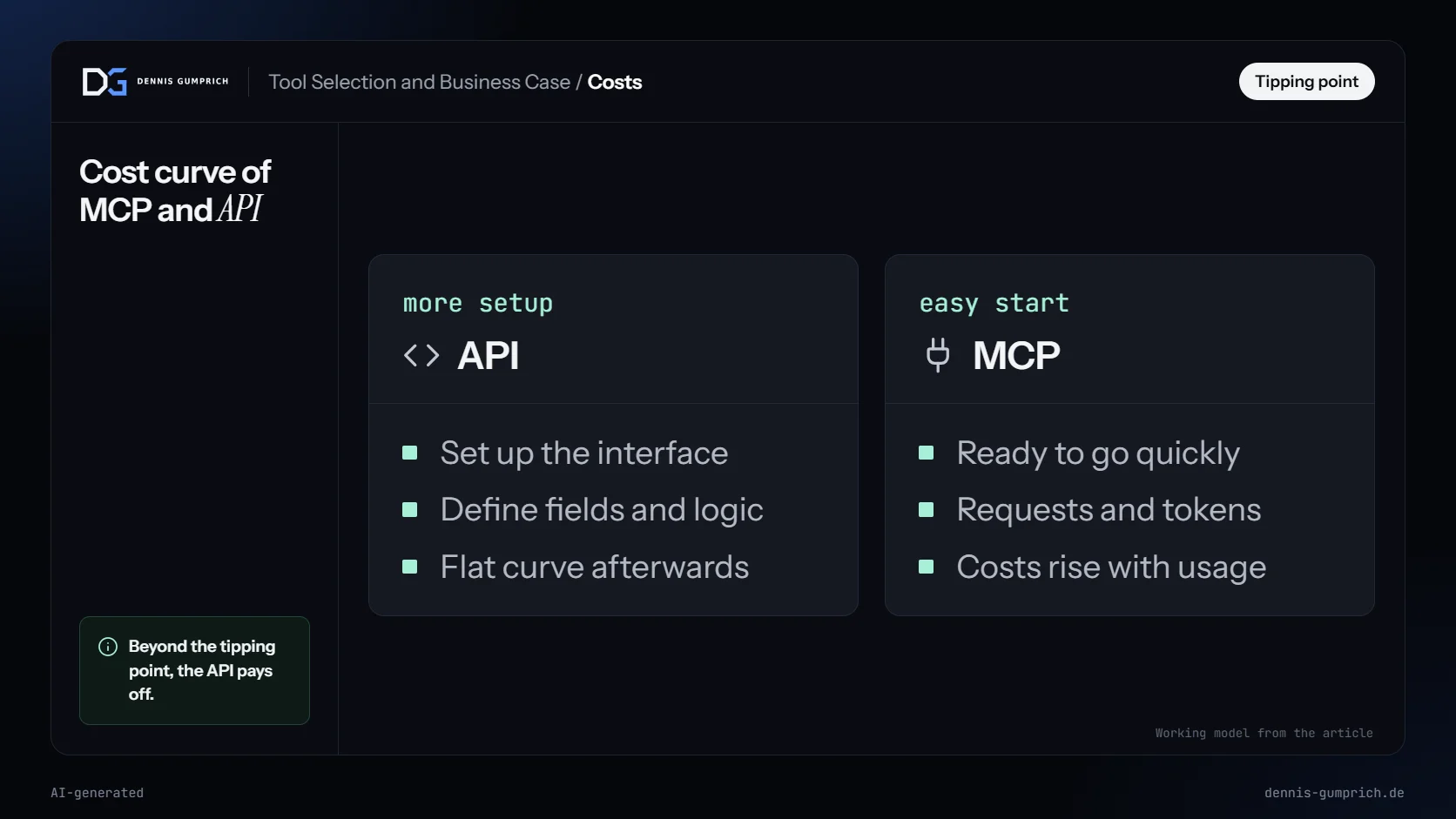
The API causes noticeable one-off costs for setup and development, and afterwards practically no costs per transaction. MCP is cheap to start with, because the connection is configured rather than programmed, but costs tokens for every query and every response. Which route is cheaper depends on volume, not on the entry point.
The economic difference is greater than the technical one and is regularly overlooked in discussions. The following comparison is a working model and not a price statement, because effort and rates vary widely.
| API | MCP | |
|---|---|---|
| One-off costs | Setup and development, noticeable depending on scope | low, the connection is configured rather than programmed |
| Ongoing costs per transaction | practically none | token costs for every query and every response |
| Cost curve as volume grows | flat, volume changes little | rises with usage |
| Effort for changes | adjustment by development needed | usually possible without development |
| Predictability of the result | high, deterministic | dependent on the model and the wording |
This results in a simple rule of thumb: the higher the volume and the more uniform the process, the more clearly the API wins. The rarer and more varied the task, the more MCP pays off, because the setup costs of a dedicated interface would be out of all proportion.
When is MCP the right choice, and when an API?
An API when the process always runs the same way and happens in volume, for example regular product data synchronization or publishing approved content to the CMS. MCP when the query looks different every time and cannot be programmed in advance, for example research in the moment of work.
Regular synchronization of large volumes
Product data from the shop, prices, availability, entire catalogs. Same structure, high volume, fixed cadence.
API fits: Set up once, then no costs per record.
Publishing to the CMS
Transferring finished, approved content automatically to WordPress, Shopware or another system.
API fits: The process is always the same, runs in large numbers and without human review.
MCP fits: Content is handed over as a draft to differently structured systems and reviewed before going live.
Research in the moment of work
Looking up data while writing, for example rankings, competitor information or existing content.
MCP fits: The query is different every time and cannot be programmed in advance.
Rare or changing sources
A system you query twice a month, or a source needed for only one project.
MCP fits: A dedicated interface would not pay for itself.
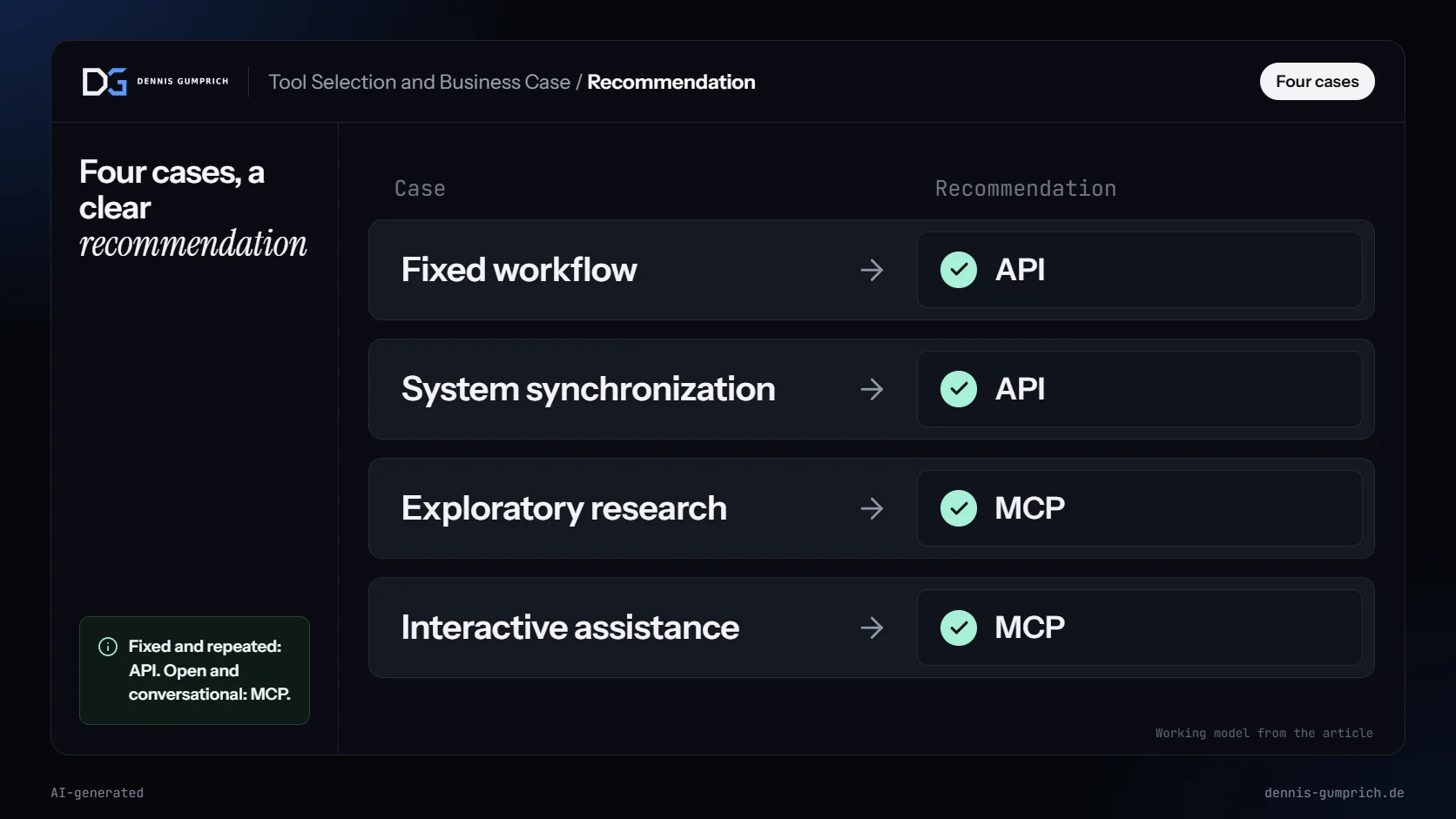
The split does not follow a technical ranking but the question of repetition. Anything that always runs the same way belongs in a fixed connection. Anything that looks different every time is better handled by an assistant that formulates the query itself. What to feed this assistant so its queries suit you is described in Building a knowledge base: what to feed AI so it sounds like you.
How much depends on this connection is suggested by the Anthropic Economic Index report from September 2025. The authors suggest that for complex enterprise deployments, a lack of access to context and well-prepared data holds things back more than model performance. This is the model provider's interpretation based on the use of its own model Claude, not a causal finding. For you, this means: first make sure your data is clean and accessible, whether via API or MCP, before you discuss the more powerful model.
Moving data into and out of a content platform
The difference becomes tangible with a concrete process. Suppose you want to bring product data into your content platform, create texts there and then publish them.
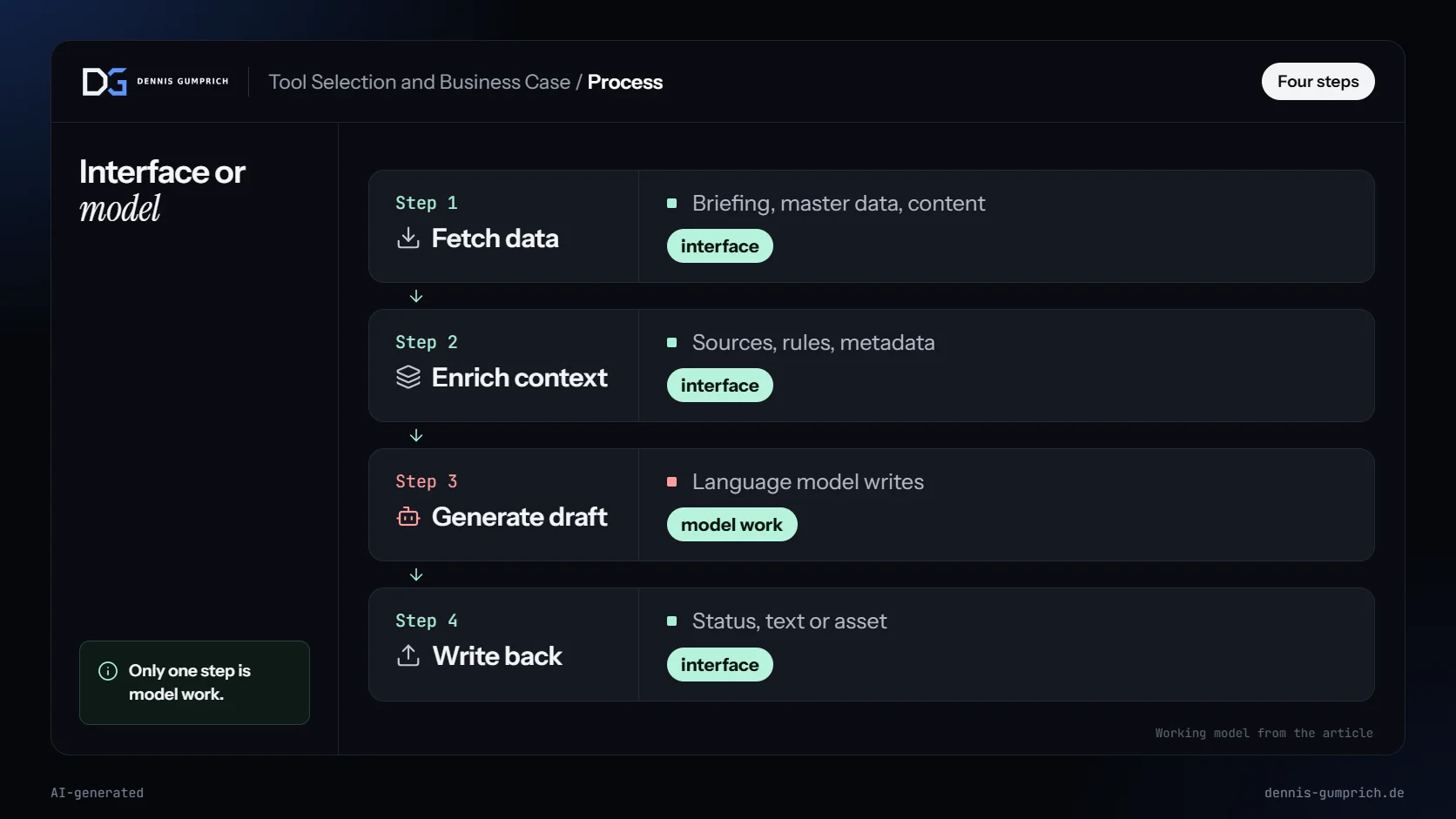
In this process, MCP makes sense in at least one place and the API in up to three. That is a typical ratio. Anyone who uses MCP for all four steps pays token costs for processes that require no decision.
The third step deserves a distinction. In everyday editorial work with a few to a few dozen publications a month and a human review before going live, a handover via MCP also makes sense. It can read the structure of the respective CMS and create content as a draft matching fields, categories and components. This is particularly worthwhile when several differently structured systems are served, because no separate integration project is needed per system. What this route looks like in daily work and what to clarify with IT beforehand is described in The last mile: content into the CMS without copy and paste.
If you want to check specifically which processes can be mapped via an interface, the technical documentation of the respective platform is the right starting point. For contentbird, you can find it at api.docs.mycontentbird.io. Which connections are actually available and useful for you is best clarified directly with the respective vendor.
Five mistakes in this decision
- Deciding by noveltyMCP is newer, but not fundamentally better. For uniform bulk data, an interface remains the more economical route.
- Not extrapolating ongoing costsToken costs seem small per transaction and add up with volume. Calculate with your expected annual volume, not with a sample call.
- Underestimating predictabilityWhere a process must always run identically, for example publishing, a deterministic route is more valuable than flexibility.
- Underestimating API setup effortAn interface is more expensive one-off than many expect, especially when data formats need aligning. That belongs in the calculation.
- Checking data protection only at the endWith both routes, data leaves your system. Clarify beforehand which content may be transferred, especially for AI-supported access.
Five steps to a decision
- Step 1List the processesWhich data should flow where, in which direction, how often. Without this list, the discussion stays abstract.
- Step 2Sort by repetitionEach process gets a classification: always the same or different every time. This already decides most cases.
- Step 3Estimate volumesHow many transactions per month. With high volumes, the decision almost always goes in favor of the interface.
- Step 4Calculate both sidesOne-off setup effort against ongoing costs per transaction, extrapolated over twelve months.
- Step 5Clarify data protectionWhich content may be transferred and which may not. This clarification belongs before the technical implementation.
In practice, the second step resolves most discussions. As soon as the processes are in two columns, it is usually obvious which route belongs where. The only real point of contention afterwards is whether the setup effort is worthwhile for the remaining borderline cases.
Self-check: do you know what you need?
Tick everything that applies to you.
A short alignment on connecting our content platform:
We have listed the planned data flows and sorted them by repetition. Processes that always run the same way, such as importing product data and publishing approved content, we would map via the interface. One-off effort, then no costs per transaction.
For queries that arise in the moment of work and look different every time, AI-supported access would make more sense, because fixed programming is not worthwhile for them. However, costs arise per query there, which we should extrapolate over twelve months.
Before implementation, let us clarify which content may be transferred, especially for the AI-supported access.
Conclusion: repetition decides, not technology
The question MCP or API is not a fundamental decision but one per process. Anything that repeats and stays the same belongs in a fixed connection, because after setup it generates hardly any follow-up costs. Anything that arises in the moment of work and looks different every time is better handled by AI-supported access. In most content processes, you need both. Before a fixed connection is built, IT and data protection belong at the table. How to manage this without losing time is shown in Involve IT and data protection early.
Frequently asked questions
Will MCP replace classic interfaces in the long run?
It does not currently look that way. Both solve different problems. As long as processes are deterministic and high-volume, an interface remains more economical and reliable. MCP adds value where no connection was possible before, because development would not have paid off.
How high are token costs in practice?
That depends on the model, the amount of data passed and the number of queries, and changes with vendors' rates. Only your own extrapolation is reliable: expected queries per month times average data volume. Use values from a real period for this, not from a single test.
Do we need development capacity for MCP?
Usually less than for a dedicated interface, because connections are configured rather than programmed. Still, it rarely works entirely without technical support, especially regarding access rights and the question of which data is released.
What about reliability?
A firmly programmed process delivers the same result for the same input. AI-supported access formulates the query itself and can deviate if the task is unclear. For processes with a publishing character, that is an argument for the interface.
Where should we start?
With the process that causes the most manual effort today, usually copying data between two systems. This process is almost always uniform and therefore an interface case with a clearly calculable benefit.
Where does your content process lose time today?
In 30 minutes, we look together at where unnecessary coordination, manual tasks, tool switching or repetitive content work cost you time today.
You get a concrete assessment of which tasks you can simplify, automate or organize better, and where AI and tools actually help instead of adding complexity.
Analyze your content process in 30 minutes Free of charge. You take away concrete starting points you can use internally right away.
Dennis Gumprich
Dennis helps marketing and communication teams fit generative AI into existing content processes without undermining quality, brand voice and approvals. Focus areas: content operations, AI governance and tool selection in mid-sized companies and corporations.
Transparency note: Dennis works for contentbird, a provider of AI-powered content software. Product mentions are marked in the article. More about Dennis (in German) · LinkedIn
Read more
Sources
- Model Context Protocol: Specification, Server Features: Tools, current protocol revision 2026-07-28: tools are "model-controlled", the language model discovers and calls them itself based on context; for security, a human should be able to deny calls. Accessed October 31, 2026.
- contentbird: contentbird Integration API, technical documentation of the interface. Accessed October 31, 2026.
- European Union: Regulation (EU) 2016/679 (General Data Protection Regulation), Official Journal L 119 of May 4, 2016, Article 28 on the data processing agreement for external processing. Accessed October 31, 2026.
- Anthropic: Anthropic Economic Index report: Uneven geographic and enterprise AI adoption, research report from September 15, 2025: the authors suggest that for complex enterprise deployments, a lack of access to context and well-prepared data holds things back more than model performance. Vendor source that only evaluates the use of Claude, the authors' interpretation and not a causal finding. Accessed October 31, 2026.
How this article was created
This article was created with the help of AI. Structure, research and draft wording were developed with AI support. Professional assessment, review of the statements and the final version are the responsibility of Dennis Gumprich. The English version was translated with AI and reviewed. Read the original German version.
How reliable are the statements?
Evidence exists for how MCP works, with the language model selecting and calling tools itself, from the Model Context Protocol specification, and for the obligation to have a data processing agreement under Article 28 GDPR, as well as the assessment that a lack of access to context and prepared data holds back complex enterprise deployments more than model performance (Anthropic Economic Index, vendor source, interpretation without a causal finding). The cost comparison describes the cost logic and explicitly contains no prices. Rates, model costs and setup efforts vary considerably and change constantly. The assignment of the four cases, the example process in four steps and the ratio of three API cases to one MCP case are working models from consulting practice, not measured values. Which connections a vendor actually offers should be clarified directly with them. As of October 31, 2026. Legal note: this article does not replace legal or data protection advice. Which data you may transfer via interfaces or AI-supported access should be clarified with your data protection officer.


