
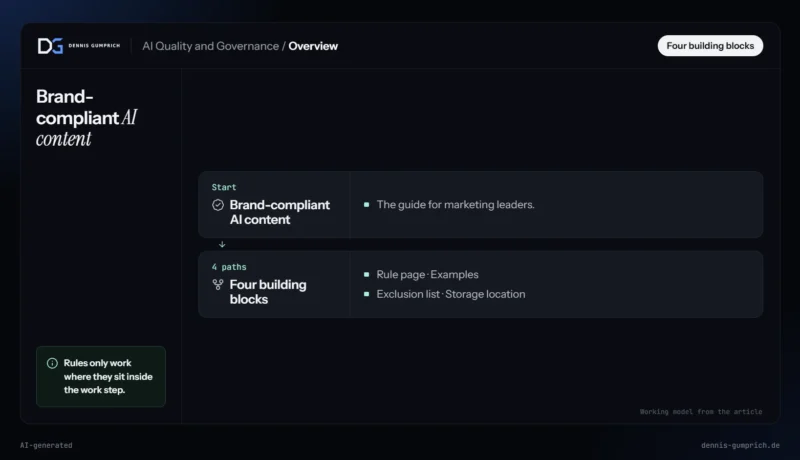

A better prompt makes one text better. Stored context makes every text better.
Brand-compliant AI content does not come from better instructions but from stored context. It takes four building blocks: a described brand voice, approved example texts, binding dos and don'ts, and a review step before approval. Without this foundation, every result is a matter of chance. What this review step looks like in practice is covered in Review criteria for AI texts: the checklist before approval.
This guide walks you through the four building blocks in order. It starts with a point that is often missing from discussions about AI governance.
Why brand voice is the real governance issue
Discussions about AI governance usually revolve around data protection and legal certainty. Both matter, and both can be solved. The issue that actually shapes everyday work is a different one: whether a text sounds like your company or like any company.
As long as only one person works with AI, this hardly shows, because that person carries the tone in their head and corrects it. As soon as five people work with their own instructions, you get five tones of voice. The result is not bad text but inconsistent text, and inconsistency erodes recognition over months.
The difference between a team that uses AI successfully and one that is constantly correcting almost always lies here: one team has its brand voice available as usable context, the other only as a feeling.
Why inconsistency costs more than poor style
A single mediocre text hardly stands out. Ten texts in five different tones do, even if each one is fine on its own. The damage builds up through volume and is therefore rarely attributed to any specific piece.
Recognition comes from repetition. If your readers experience a different form of address, a different sentence length and a different handling of technical terms with every piece, no impression forms. This affects not only how you are perceived externally but also internal usefulness: a sales team that never knows how a piece will sound links to it less often.
The second effect concerns the editorial team itself. Without a binding standard, every phrase becomes negotiable. Debates about taste take time and lead nowhere, because there is no yardstick to settle them.
That is exactly why brand voice is a governance issue and not a question of style. It does not govern what is beautiful but what applies. This distinction decides whether a description is applied in daily work or read as a mere recommendation.
How do you measure how inconsistent your texts are?
The impression that texts sound different can be checked without anyone having to voice an opinion. Take five published pieces from recent months and check four characteristics.
The analysis takes half an hour and replaces a discussion that would otherwise go round in circles. It also provides the basis for the rule page, because every deviation you find requires a decision.
Repeat the measurement after six months with five new pieces. That is the only way to prove that stored context actually works, rather than just claiming it.
What does brand-compliant AI content consist of?
Four building blocks, three of which are preparatory: a described brand voice with concrete decisions instead of three adjectives, approved example texts, five to ten per format, and dos and don'ts in the form of an exclusion list. On top of that comes the review step before approval.
Described brand voice
Not three adjectives but concrete decisions: form of address, sentence length, handling of technical terms, stance on superlatives.
Good when: Two people derive the same wording from it.
Approved example texts
Five to ten approved texts per format that show what is meant. Examples work better than descriptions.
Good when: The examples are from the last year.
Dos and don'ts
Phrases you do not use, and statements that are not permitted for legal or professional reasons.
Good when: The list contains concrete words, not principles.
Review step before approval
A named step with clear criteria, not a general read-through.
Good when: The review can be done in under ten minutes.
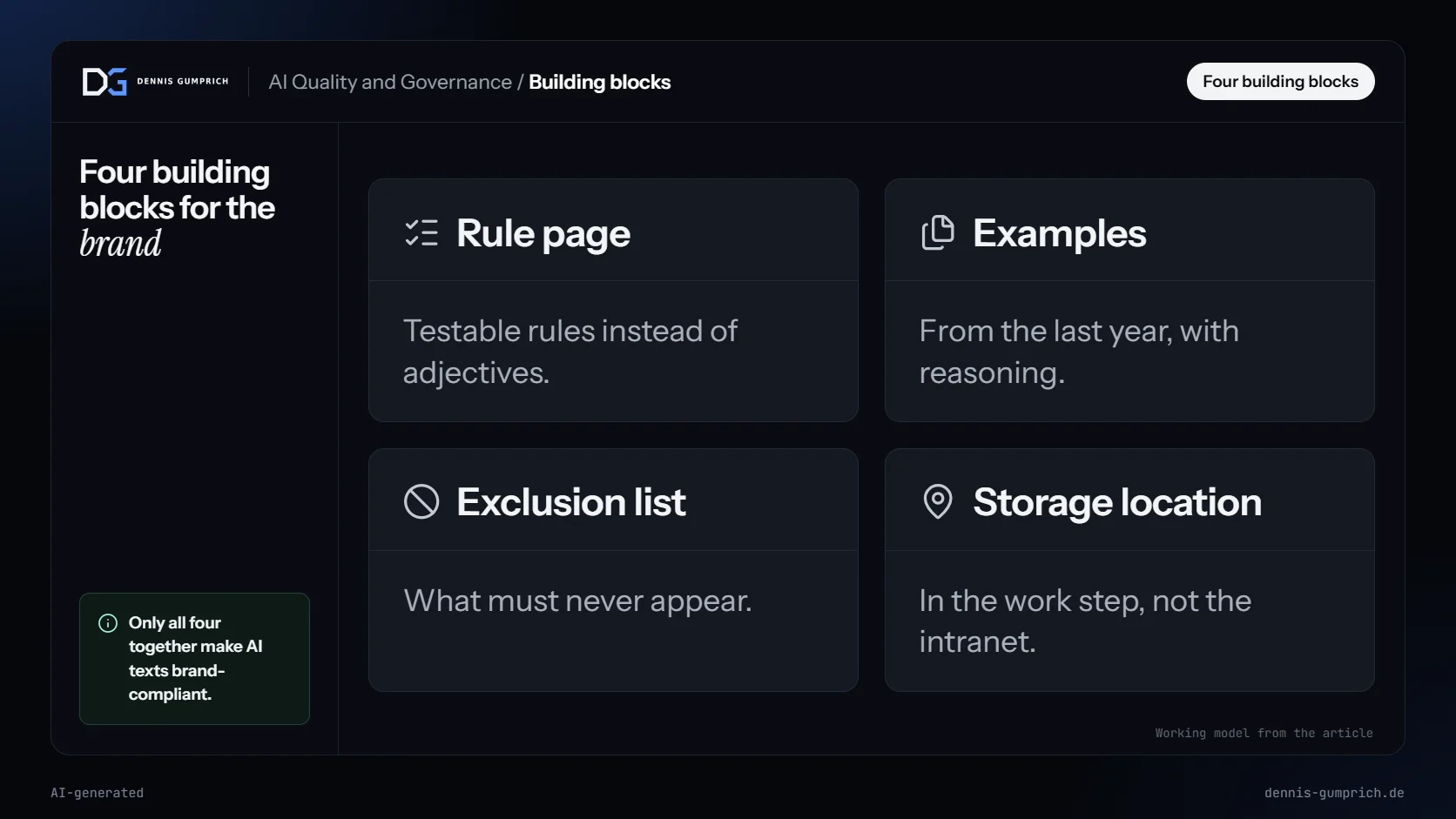
The order is not arbitrary. If you start with the review step without having the first three building blocks, you review against a feeling. That is exactly where the discussions come from that nobody can resolve. The same principle applies to factual accuracy, described in Catching hallucinations in marketing texts systematically.
Describing a brand voice that is actually usable
Most tone-of-voice descriptions are useless because they name qualities instead of decisions. You cannot derive a single sentence from modern, competent and approachable.
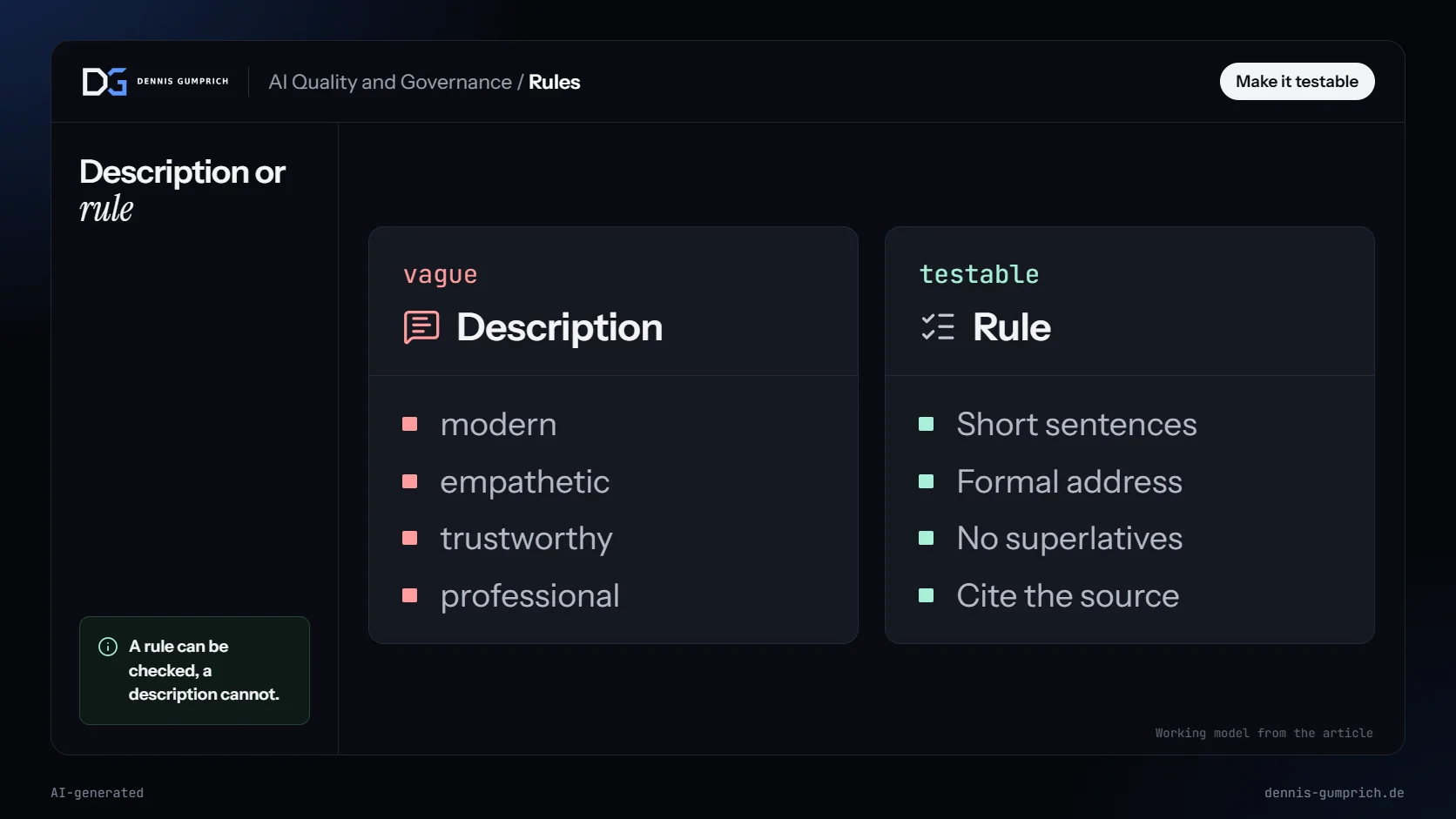
Our language is professional but approachable. We communicate as equals and avoid jargon.
We use formal address in sales and informal address on the blog. Sentences under 20 words. We use technical terms and explain them in a subordinate clause the first time they appear. No superlatives without evidence. No rhetorical questions as an opening.
The difference is not detail but decidability. Every line in the right-hand column can be checked: either a sentence has 30 words or it does not. A language model can follow exactly these kinds of rules too.
A practical way to write the description: take five texts the team considers typical and five that were rejected. Write down how they differ in concrete terms. This list is worth more than any brand workshop starting from a blank page.
How do you keep your brand voice consistent across channels?
By separating voice and tone. The voice stays the same in every channel: stance, form of address, terminology, the obligation to provide evidence and the things you never say. The tone may change by channel and occasion, for example more relaxed on LinkedIn and more factual in a press release. If you mix the two, you either write equally stiffly everywhere or sound like a different brand in every channel. What applies when employees post in their own voice is described in Corporate influencers without losing control.
This separation is well established in practice. Mailchimp's style guide explicitly distinguishes between a consistent voice and a situational tone, and the Nielsen Norman Group describes tone of voice along four dimensions: funny or serious, formal or casual, respectful or irreverent, enthusiastic or matter-of-fact. Define where each channel sits on these axes.
| Channel | Stays the same | May change |
|---|---|---|
| Expert article on the website | Form of address, core terms, evidence obligation, exclusion list | Factual, detailed, with sources |
| Personal opening, short paragraphs, one thesis | ||
| Newsletter | Direct address, one benefit per issue | |
| Press release | Formal, quote, no superlatives without evidence |
For AI drafts to follow this grid, it belongs where the writing happens, not in a presentation. Derivatives of an already approved core text work most reliably: the facts are fixed, and the AI only adapts the tone.
This consistency also pays off beyond your own channels. Olaf Kopp, Head of SEO & AI Search at the agency Aufgesang, describes the principle of co-occurrence in his guide "Brand Context Optimization" from February 2026: a brand should appear consistently in as many authoritative sources as possible together with the right attributes, topics and category terms, so that AI systems describe it correctly. So add the attributes you use to describe your company and offering to the "Stays the same" column of your channel grid. One caveat: this is a conceptual classification from an agency perspective, and the article provides little measurement data.
How do you handle brand voice across several brands and languages?
Through a shared foundation with a few deviations per brand, not through a separate rule page for each brand. The evidence obligation, the handling of technical terms and the exclusion list stay shared. Separate versions are cleanly conceived but rarely maintained, and after a year they also differ in how up to date they are.
As soon as several brands, countries or business units are involved, the question of structure arises. Two approaches are common, and both have clear limits. How the division of work between headquarters and countries works in everyday practice is described in One headquarters, many countries.
The first approach is one rule page per brand. It is clean and rarely maintained in practice, because the effort grows with every brand. After a year, the versions differ not only in tone but also in how up to date they are.
The second approach is a shared foundation with a few deviations per brand. Shared elements are the evidence obligation, the handling of technical terms and the exclusion list for legally problematic statements. Brand-specific elements are form of address, sentence length and the use of examples. This keeps maintenance concentrated in one place.
Languages add a point of their own. A translated rule page is not enough, because tone cannot be translated. Forms of address work differently from language to language, for instance the formal and informal "you" in French, German or Spanish compared with English, and expectations of directness vary considerably between markets such as the Netherlands, France, Scandinavia or Italy. If you need several languages, each language needs its own collection of examples, not just a translation of the rules.
In both cases, define who decides in the event of conflict. Without this, the brand with the largest volume tends to prevail, and that is rarely a deliberate decision.
How do you choose the right example texts?
Do not pick the representative texts but the ones you want to be measured against in future. Five to ten per format are enough. Whatever goes in gets reproduced: if you store the average of your past output, you get average back.
Examples work better than rules because they show patterns nobody has described: rhythm, stance, how objections are handled. New team members and language models alike learn from them faster than from a description.
That is why the selection is an editorial decision and not a collecting exercise. Whatever goes in gets reproduced. If you store the average of your past output, you get average back.
So do not pick the representative texts but the ones you want to be measured against in future. Five to ten per format are enough. Make sure they are from the last year, because examples visibly age, while rules stay valid longer.
A practical tip: for each example, note in one sentence why it was included. Without this reasoning, the next revision will no longer show which quality was actually meant, and the collection loses its function as a benchmark.
Where the context needs to live
The most common implementation mistake is the storage location. A brand voice on the intranet, in a presentation or in a shared document does not get used, because it is not at hand in the work step.
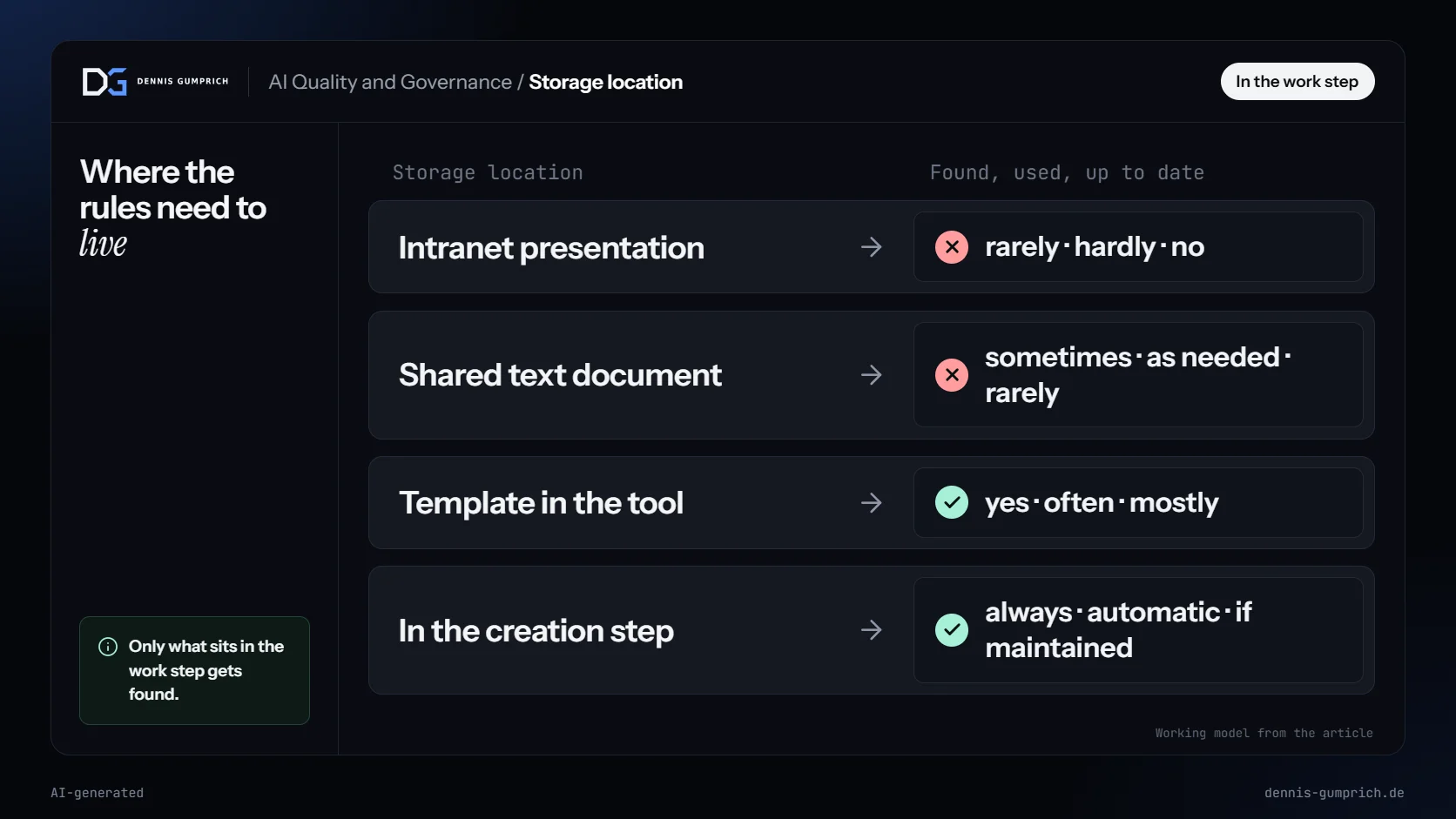
| Storage location | Gets found | Gets used | Stays up to date |
|---|---|---|---|
| Intranet presentation | rarely | hardly | no |
| Shared text document | sometimes | as needed | rarely |
| Template in the editorial tool | yes | often | mostly |
| Stored in the creation step | always | automatically | yes, if maintained |
The last row describes the state you are aiming for: brand voice as stored context that shapes every piece of content without anyone having to think about it. Whether you solve this with templates, a knowledge base or a platform is secondary. What matters is that nobody has to actively look for it.
How do you check whether a text is brand-compliant?
With five questions that can be answered in a few minutes: Does the form of address match the format throughout? Is there verified information behind every superlative and every figure? Does the text contain words from the exclusion list? Can every paragraph be traced back to a statement your competitors could not write in the same way? And does the text fit the environment in which it appears?
A review step only works if it can be done in a few minutes and delivers a clear result. These five questions have proven robust.
- Form of address and perspectiveDoes the way readers are addressed match the format, consistently and without switching?
- Evidenced statementsIs there verified information behind every superlative and every figure?
- Banned phrasesDoes the text contain words or expressions from the exclusion list?
- SpecificityCan every paragraph be traced back to a statement your competitors could not write in the same way?
- FitDoes the text sit alongside your last three published pieces without standing out?
Criterion four is the strictest and the most useful. A text that any competitor could publish in the same form is brand-neutral, regardless of whether it was written by a person or a model.
This criterion now pays off twice. AI search engines such as ChatGPT, Perplexity or Google's AI Overviews prefer to use paragraphs that answer a question concretely and on their own. Interchangeable wording has a hard time there, because it contains nothing that is not also on many other pages. What makes a paragraph citable and how you measure whether your content appears in AI answers is described in Visible in ChatGPT, Perplexity and AI Overviews.
That interchangeable texts are more than a style problem is shown by the Generative AI Profile (NIST AI 600-1) of the US National Institute of Standards and Technology. Among its twelve risk categories for generative AI is "Harmful Bias or Homogenization", that is, harmful bias or the convergence of content. Criterion four is therefore also where you catch this risk in daily work. One caveat: it is a voluntary framework from the US, not a requirement for your company.
How to record brand voice, data rules and approval for AI content in a binding way is shown in the free template for an AI policy in marketing (in German).
Who owns the brand voice in the company?
A rule page without a named owner becomes outdated within a year. This is not a question of diligence but of ownership logic: what belongs to everyone is maintained by no one.
Responsibility belongs to a role, not a person, and it covers three tasks. First, maintaining the rule page when positioning or target groups change. Second, replacing the example texts once a year. Third, deciding in cases of doubt when the editorial team and the specialist department disagree.
The third task is the most important and the one least often assigned. Without defined decision authority, every case of doubt becomes a discussion, and discussions about tone rarely end with a result. With authority, the same question takes one sentence.
In smaller teams, this role usually sits with editorial review, in larger ones with corporate communications. What matters is less where it sits than that it is named and that everyone knows it.
Also set a fixed review date each year. A date in the calendar works more reliably than the intention to keep an eye on the topic. At this review, the examples in particular need to be scrutinized, because they age faster than the rules.
Five mistakes in implementation
- Adjectives instead of rulesQualities cannot be checked. Only decisions about address, length, terms and evidence can be applied.
- Writing the description once and filing it awayBrand voice changes with positioning and target group. Without a maintenance interval, it becomes outdated within a year.
- Examples from the glory daysIf you store texts from five years ago as a model, you get texts from five years ago.
- Review without criteriaReading through creates discussions about taste. Criteria create decisions.
- Everyone with their own instructionsFive personal approaches produce five tones of voice. The common context has to be shared, not individual.
Five steps to brand-compliant production
- Week 1Build the comparisonPut five typical and five rejected texts side by side and write down the concrete differences.
- Week 2Formulate rulesTurn the differences into testable rules. The goal is one page, not a handbook.
- Week 3Create the exclusion listConcrete words and expressions you do not use, plus statements that are not legally permitted in your industry.
- Week 4Store the contextBring rules, examples and the exclusion list to the place where the writing actually happens.
- From week 5Introduce the review stepThe five criteria as a fixed step before approval, with a named owner.
Self-check: how brand-proof are you?
Tick everything that applies to you.
A proposal for how we tackle brand-compliant texts:
Our problem is not text quality in individual cases but inconsistency. The reason: our brand voice exists as a shared feeling, but not as an applicable rule.
I suggest we put five typical and five rejected texts side by side and derive testable rules from them. The goal is one page with decisions on form of address, sentence length, handling of technical terms and evidence, plus an exclusion list.
Effort: around four weeks alongside regular work. Result: we can check texts instead of debating taste, regardless of whether they were created with or without AI.
Conclusion: context beats instruction
If you want better AI texts, you usually start by improving the instruction. That works in the short term and stays tied to individual people. If you instead store brand voice, examples and exclusions as shared context, you improve every result on the team at the same time, including the work of people who do not want to deal with AI.
Frequently asked questions
How detailed does the brand voice description need to be?
One page of testable decisions is more effective than twenty pages of description. The test: two people independently phrase the same facts. If the results sound similar, the description is sufficient.
Do we need different tones for each channel?
Usually a basic stance with a few channel-specific deviations, such as form of address and length, is enough. If you maintain a separate rulebook for every channel, you cannot keep up with updates and end up with inconsistency again.
What if our example texts are themselves inconsistent?
Then that is your first insight. Deliberately choose which texts should serve as the benchmark in future instead of reflecting the average. Examples set the norm, so only include texts you would publish the same way again.
How often should the brand voice be reviewed?
Once a year as a fixed date, and additionally when positioning or target groups change. More important than the interval is a named owner. Without ownership, the description becomes outdated regardless of the interval.
Does stored context replace editorial review?
No, it shortens it. The context ensures the basics are right, so the review can focus on content and evidence rather than tone. The review step remains necessary, especially for statements about your company.
How do we prevent the rule page from being seen as patronizing?
By making it visibly derived from your own texts. A rule that comes from comparing typical and rejected pieces describes the team's existing judgment. A rule imposed from outside replaces it, and that is exactly what creates resistance.
What about texts from agencies or freelancers?
The rule page and the exclusion list belong in the briefing, not only in the sign-off. External writers cannot know your unwritten expectations. If you hand over both in advance, you significantly reduce correction loops and can justify sign-off decisions objectively.
Should we publish our brand voice?
The rule page itself usually not, it is a working document. It can make sense to describe the stance behind it publicly, for example in a transparency note on your use of AI. That is something different from the rulebook and addresses a different audience.
How can you tell that a brand is not communicating consistently?
By three signals. Texts from different departments or channels sound so different that you would not attribute them to the same sender. The same products or services carry different names. And approvals regularly involve debates about wording rather than content. All three indicate that the brand voice is not recorded anywhere as a testable rule.
How do you make sure AI-generated content is brand-compliant?
By giving the AI the right context before writing and following up with a fixed review after writing. Before: store brand voice, approved facts and example texts as a knowledge base. After: include review criteria on tone, facts and mandatory information in the approval. Without both, you get texts that sound correct but like nobody in particular.
How do I prevent AI content from diluting the quality of our brand communication?
Use AI where you can provide context, and do not let it write without guidelines. Define which types of content AI may prepare, who approves and how you measure quality. A regular sample of published texts checked against the brand rules helps catch deviations early. Why context determines quality is described in Avoiding AI slop.
Where does your content process lose time today?
In 30 minutes, we look together at where unnecessary coordination, manual tasks, tool switching or repetitive content work cost you time today.
You get a concrete assessment of which tasks you can simplify, automate or organize better, and where AI and tools actually help instead of adding complexity.
Analyze your content process in 30 minutes Free of charge. You take away concrete starting points you can use internally right away.
Dennis Gumprich
Dennis helps marketing and communication teams fit generative AI into existing content processes without undermining quality, brand voice and approvals. Focus areas: content operations, AI governance and tool selection in mid-sized companies and corporations.
Transparency note: Dennis works for contentbird, a provider of AI-powered content software. Product mentions are marked in the article. More about Dennis (in German) · LinkedIn
Read more
Sources
- Anthropic: Prompt engineering documentation, section Use examples effectively, vendor documentation: examples are one of the most reliable ways to steer format, tone and structure; also notes that models pick up unintended patterns from examples. Accessed October 31, 2026.
- Mailchimp: Content Style Guide, Voice and Tone, distinction between a consistent voice and a situationally changing tone. Accessed October 31, 2026.
- Kate Moran, Nielsen Norman Group: The Four Dimensions of Tone of Voice, article from July 17, 2016, last reviewed August 16, 2023: formal or casual, serious or funny, respectful or irreverent, matter-of-fact or enthusiastic. Accessed October 31, 2026.
- Google Search Central (John Mueller), blog post from May 21, 2025 on content in Google's AI features, cited by Hobo Web: What is Non-Commodity Content? Meet The New Helpful Content: recommendation to focus on unique, non-commodity content. Accessed October 31, 2026.
- Olaf Kopp, Kopp Online Marketing: Brand Context Optimization: A Practical Step-by-Step Guide, article from February 26, 2026: principle of co-occurrence, placing the brand consistently in as many authoritative sources as possible together with the right attributes, topics and category terms so that AI systems describe it correctly. Conceptual classification from an agency perspective (Aufgesang), little data. Accessed October 31, 2026.
- National Institute of Standards and Technology (NIST): Artificial Intelligence Risk Management Framework: Generative Artificial Intelligence Profile (NIST AI 600-1), July 26, 2024, Chloe Autio, Reva Schwartz, Jesse Dunietz et al., companion profile to the voluntary AI RMF 1.0 from January 2023: twelve risk categories for generative AI, including Harmful Bias or Homogenization, Intellectual Property and Confabulation. Voluntary framework from the US. Accessed October 31, 2026.
How this article was created
This article was created with the help of AI. Structure, research and draft wording were developed with AI support. Professional assessment, review of the statements and the final version are the responsibility of Dennis Gumprich. The English version was translated with AI and reviewed. Read the original German version.
How reliable are the statements?
Evidence exists for the effect of examples on the tone and structure of AI output (Anthropic), the separation of voice and tone (Mailchimp), the four tone-of-voice dimensions (Nielsen Norman Group) and Google's recommendation to focus on unique, non-commodity content for AI features, as well as the principle of mentioning a brand consistently with the right attributes in authoritative sources (Kopp, conceptual agency perspective) and homogenization as a risk category of generative AI (NIST AI 600-1, voluntary framework from the US). The four building blocks, the five review criteria, the channel grid, the rating of storage locations and the time and quantity figures given are explicitly marked as working models. They are based on observations from conversations with content teams and are not an industry standard. As of October 31, 2026.


