
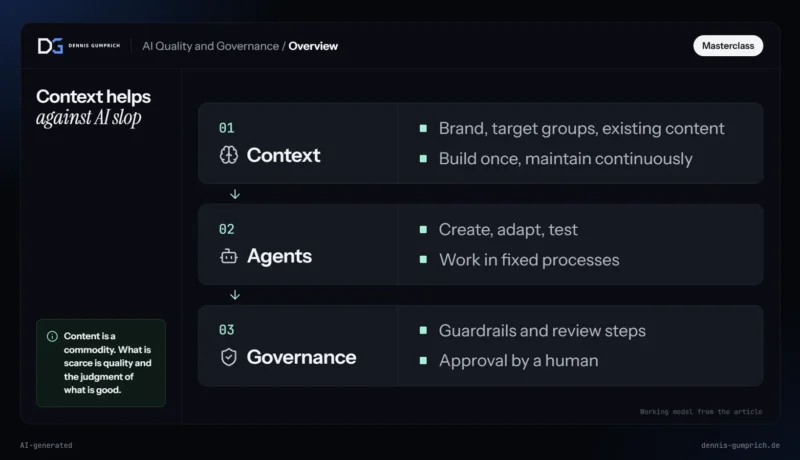

Thanks to AI, producing content costs almost nothing anymore. What is scarce is the judgment of what is good, and the context that separates AI content from AI slop.
AI slop is low-quality AI content produced in bulk: generic, overloaded, interchangeable. The cause rarely lies in the model, but in missing context and a missing process. In the contentbird masterclass "Content as a commodity", Simon Schulte, Senior Manager MarTech, SEO & Content at adesso, showed how AI content agents create, check and publish content while strategy and approval stay with humans. Three building blocks prevent AI slop: centrally maintained context on brand, target groups and existing content; agents that work with it in fixed processes; and AI governance with review steps and human approval.
Why content has become a commodity, what an agentic process looks like and which tasks in the marketing team become more important as a result is shown in the following sections. First, the question of what AI slop means.
What is AI slop?
AI slop refers to low-quality content produced in large quantities with generative AI. Merriam-Webster chose "slop" in this sense as its word of the year 2025, and the Australian Macquarie Dictionary chose "AI slop". It means texts, images and videos that are produced quickly but are neither relevant nor carefully made.
Merriam-Webster describes slop as digital content of low quality that is usually produced in quantity by means of AI. The Macquarie Dictionary adds two characteristics: such content often contains errors, and nobody asked for it. For marketing, one distinction matters. Not every AI text is slop. A well-steered, carefully reviewed AI draft is hardly distinguishable from a human-written text. You don't recognize slop by its origin, but by its effect: the content could come from anyone, says nothing of its own and costs the reader more time than it gives her.
You encounter examples all the time. Flyers for parent evenings that all look the same, are overloaded and leave no white space, plus an AI phrase like "Together we are stronger". Menus at a snack bar that look like anything but fresh fries. People have developed a sixth sense for such content very quickly. For companies, this is more than a style problem: AI slop can seriously damage a brand.
Why has content become a commodity?
A commodity is an interchangeable mass product whose production hardly costs anything anymore. That is exactly what has happened to content: with generative AI, a text, an image or a variant is created in seconds. That shifts the bottleneck from production to quality and to the decision about which content is relevant for whom.
Four points in content work have taken particular effort so far:
- Asset creation. More and more formats, the same number of hands or fewer, plus text, design and approval loops.
- Quality assurance. Some content goes live untested or is only checked by the person who created it.
- Distribution. A piece of content stays on the website even though other channels, times or variants would be much more effective.
- Impact. Analysis and reporting across individual pieces, campaigns and quarters rarely happen because they take a lot of time.
AI can now take over all of this. The decisive counter-question is: should it do all of it autonomously? Healthy skepticism is appropriate, but the opportunities are still great when efficiency and quality come together. That leads to the guiding question of this article: if AI turns content into a commodity, how is quality content still created, and who decides that in the first place?
In conversations with marketing teams, I hardly hear the question anymore whether AI can write. What people ask is why the results still don't sound like their own company. The answer is almost always the same: the AI gets a prompt, but no context. If you request content like a mass product, you get a mass product back. The difference doesn't arise in the model, but in what you give it about your brand, your target groups and your standards.
What are AI content agents?
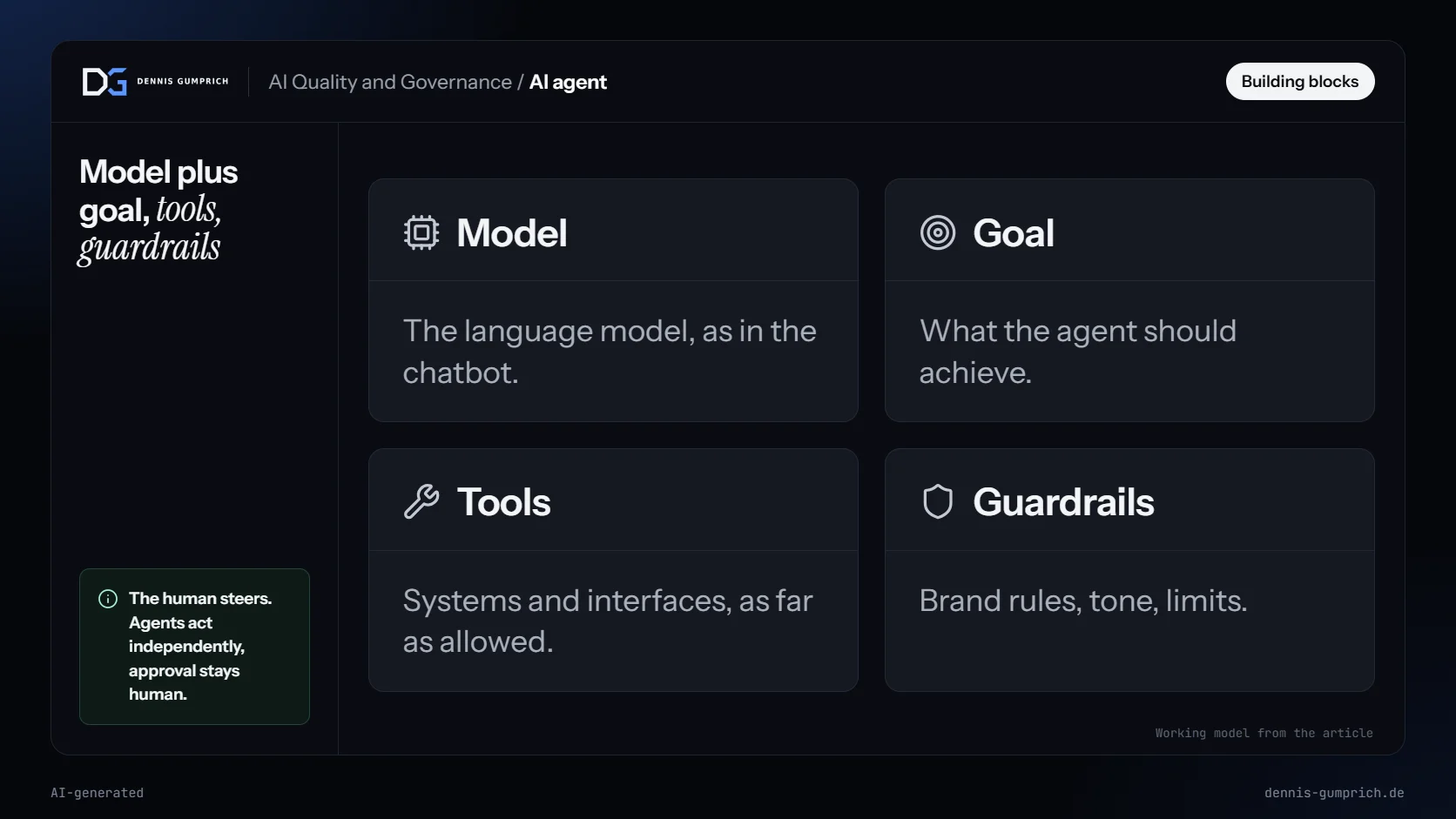
AI content agents are AI agents that carry out tasks in content marketing on their own. Simon Schulte's formula: an AI agent is an AI model plus a goal, plus tools it is allowed to use itself, plus guardrails within which it operates. It plans the necessary steps itself, works in multiple stages and checks its result. Steering and approval stay with the human.
Everyone knows the difference from a chatbot from everyday life. A chatbot reacts to individual prompts. Every further step needs a new input, and anyone who has tried to correct an image prompt by prompt in detail knows that the result doesn't necessarily get better. In addition, chatbots are trained on public general knowledge, not on your brand, your processes or your tone.
An agent, on the other hand, gets a goal and a briefing. It knows brand rules and tone of voice, falls back on them at every step and tests itself. If permitted, it uses tools and systems to create, test and publish content. The guardrails are decisive: what the agent may and may not do. That becomes all the more important the more independently agents work.
| Characteristic | Chatbot | AI agent |
|---|---|---|
| Trigger | Single prompt | Goal and briefing |
| Process | Step by step, each with a new input | Plans steps itself, works in multiple stages |
| Knowledge | Public general knowledge | Plus brand rules, tone, existing content |
| Tools | None or few | Systems and interfaces, as far as permitted |
| Role of the human | Assembles results themselves | Steers, checks and approves |
What agents reliably take over in the content team today and where the human stays is described in detail in AI agents in the content team.
What does an agentic content workflow look like?
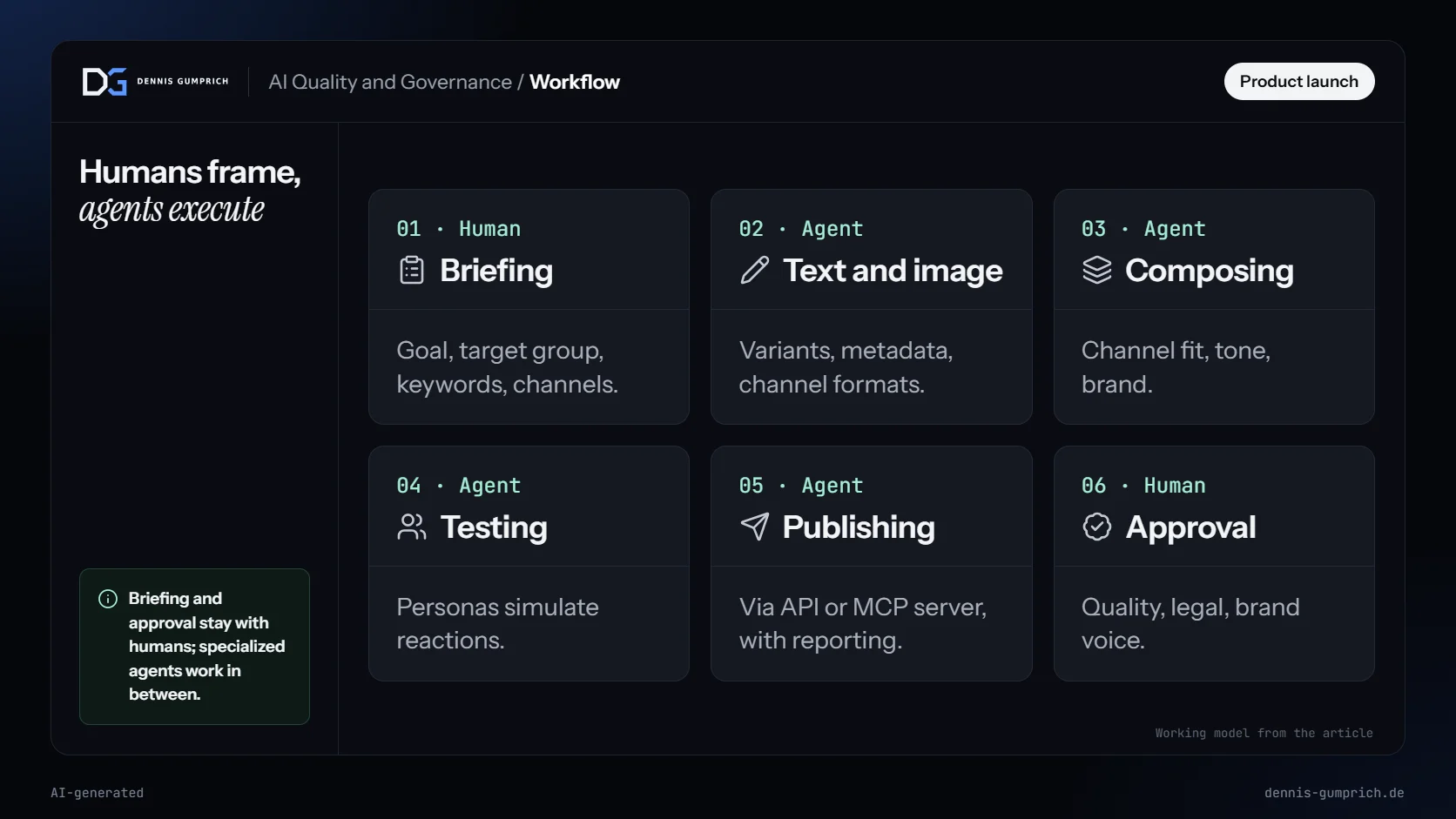
Simon Schulte showed this using the example of a product launch. The human sets the strategy, i.e. goals, brand, budget and guardrails, and configures the processes. Several specialized agents take over creation, adaptation, testing, publishing and reporting. Before going live, the human decides again.
With a chatbot, launch content is created prompt by prompt: first a LinkedIn post, then a version for Instagram, then a paragraph for the newsletter. In the end, a human puts everything together, adds images, pays attention to brand rules and format limits and enters each piece of content individually. In the agentic process, there is one briefing from which the agents derive all formats. That is faster and, if set up correctly, also better in quality.
- Briefing by the human. Goal, target group, topic, keywords, tone, channels and calls to action are recorded so that machines can read them. Agents enrich the briefing: with an analysis of who is visible for the topic and keyword in Google and in AI search systems, with existing content in the CMS so that nothing is created twice, and with brand guidelines, for example from Frontify or a pattern lab.
- Text and image. Agents create headlines, text variants, long form and teasers, including metadata and a call to action. Images are created on brand and in the format the target channel expects. Variants for A/B tests or individual target groups come along, and placeholders mark places where a human should add something.
- Composing. A dedicated agent checks channel fit and target group fit, readability, structure, brand compliance and tone. On one channel the address is informal, on another formal, and that is part of the rules too.
- Synthetic testing. Using stored personas, an agent simulates which questions a target group would ask and how it reacts to a piece of content. Variants can be compared before they go live.
- Publishing. Via standard interfaces or MCP servers, the content lands in the CMS, social media planning, newsletter, marketing automation, intranet or ad accounts. The target systems keep the administration, and the agent reports back whether everything worked.
- Reporting. An agent evaluates reach, engagement and conversion per piece of content and compares channels, without anyone compiling numbers in a spreadsheet.
- Approval by the human. Quality, brand voice, legal, compliance and strategic fit are checked by a human. Only after their okay does a piece of content go out.
One limitation belongs here: automatic publishing already works very well with some target systems, but not yet with others. Which connection suits your systems is clarified in MCP or API. How a briefing must be structured so that it steers people and machines alike is shown in Content briefing: the template that saves loops.
Which context protects against AI slop?
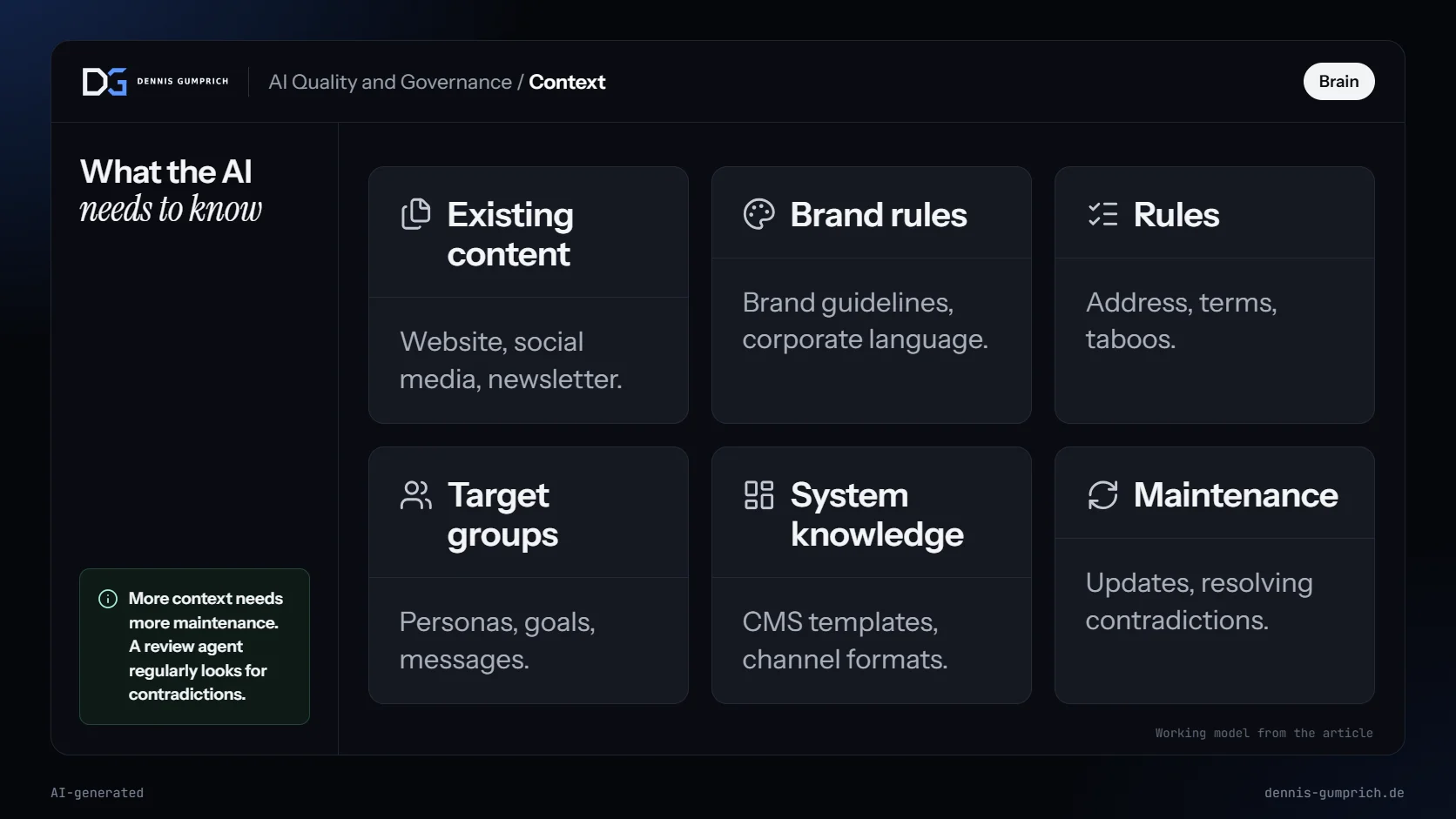
A centrally maintained context that applies to all agents. It is often called a brain: a structured collection of what experienced editors have in mind when they write. It is built carefully once and updated selectively, not explained anew with every prompt.
This context includes everything that makes your content unmistakable:
- Your existing content. Website, LinkedIn, other social media channels and newsletters, so the AI knows what you have already published and how you sound.
- Brand rules. Brand guidelines from the brand kit, corporate language, colors and formats.
- Content rules. How you address people, which terms you use and which you don't. An example from practice: a food retailer addresses customers informally in the store and formally outside of it.
- Target groups and strategy. Personas, goals and messages against which an agent can check every draft.
- System knowledge. For example, the paragraph templates of your CMS, so that content is created in the right structure from the start.
In the discussion after the talk, the point was sharpened: that a chatbot delivers average when asked to "write a blog post on topic X" is not because of the models, but because too little context and too little process are provided. Without this starting point, you mainly scale one thing with AI: chaos. How to build such a foundation is described in Building a knowledge base and Storing your brand voice.
Why too much context also leads to AI slop
A sore point: what happens when rules in the context contradict each other over time? Then even a lot of context produces slop again. The solution: build a review agent that regularly reads the context and reports what is ambiguous and what contradicts itself. The more context you create, the more context management you need.
A comparison from email marketing makes this tangible. Many companies use a preference center to ask what their recipients are interested in, and then consider the answer permanently true. Someone who said ten years ago they weren't interested in family offers may have two children today. It's the same with context: a website that was ingested once years ago and never updated doesn't help the AI. Context management is a new, permanent task, and it is one of the most effective measures against AI slop.
How does AI governance secure quality?
AI governance defines what agents may do, which checks every piece of content goes through and who approves. It works on three levels: guardrails before creation, review steps in the process and human approval before going live.
- Guardrails. What may an agent do, and what not? This includes legal requirements such as the GDPR, brand risks and the ethical standards that also shape your brand.
- Review steps in the workflow. A dedicated agent does a review or checks against the brand guidelines. Each agent can take over a single step, such as proofreading, style polishing, corporate language or localization at the end of a process.
- Human approval. Compliance, legal, strategic fit, quality and brand voice remain a human decision.
One rule is worthwhile for many companies: the AI doesn't have to write the master content. For technical products with characteristic curves and certificates, the product description is still created by a human, for example in the product team. Agents only derive the channel-specific variants from it, from text, product images, graphics or animations. That way, the factual truth stays in human hands, and the multiplication runs automatically. How to check AI drafts before approval is shown in Review criteria for AI texts and Catching hallucinations in marketing texts.
How do AI content agents change roles in marketing?
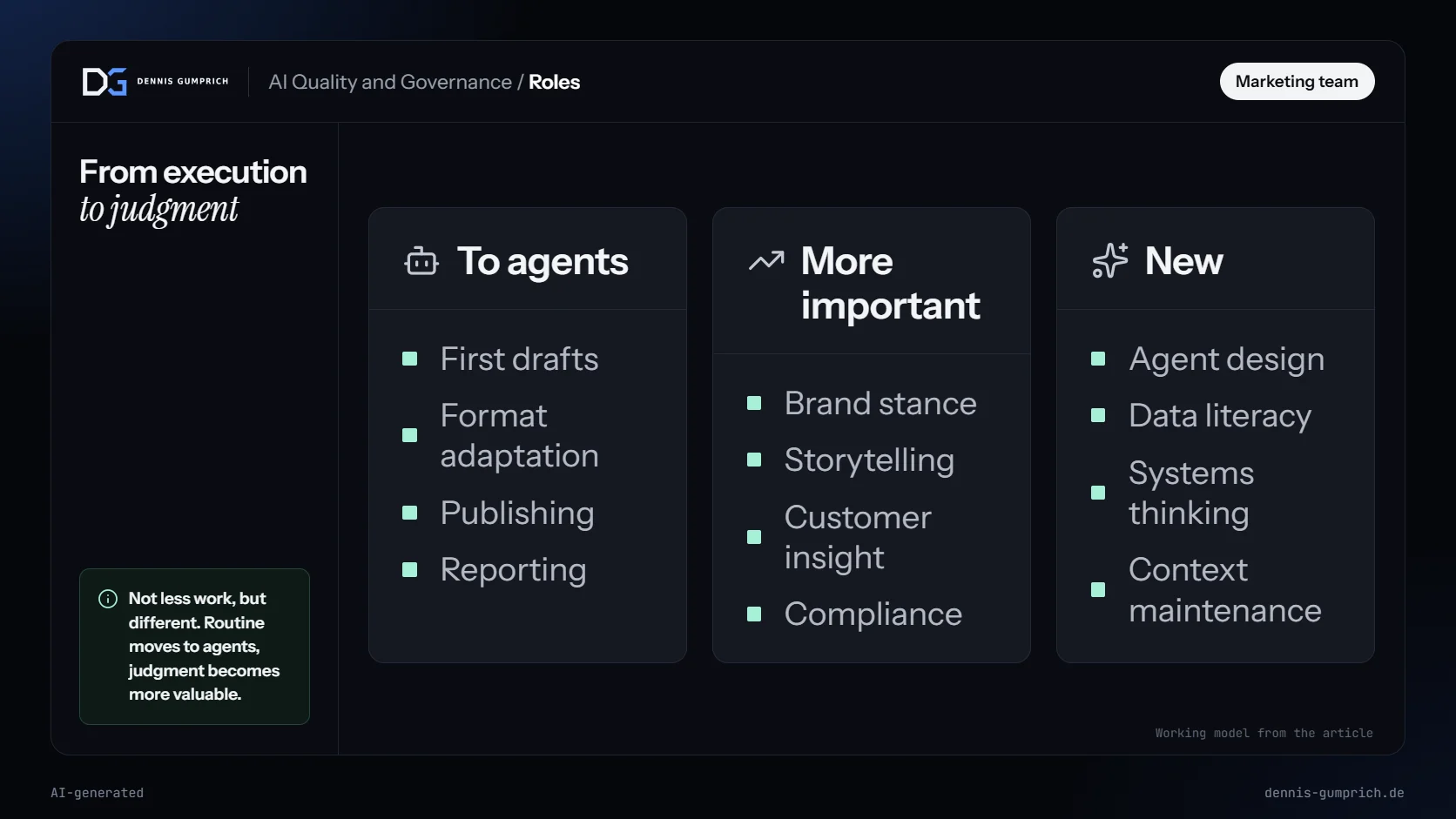
The execution of routine tasks moves to agents, and the team's judgment counts for more. The fear of job loss is unfounded nonetheless: editorial teams don't get less to do, but the content of their work shifts. AI doesn't have experience, training and expertise, and that is exactly what it takes to work well with it.
Four human skills are becoming more important than ever:
- Brand stance. The values and tone reflected in every piece of content.
- Strategic storytelling. No agent decides the direction in which a brand tells its story, no matter how much context it has.
- Customer understanding. Motives and fine nuances can't always be read from data. People can put themselves in other people's shoes better than agents.
- Ethics and compliance. What AI may do is decided by the company, not the model.
Added to this are activities that hardly existed before. Agent design means briefing and steering agents in a structured way, almost like team members. Prompt engineering in the narrow sense, on the other hand, becomes less important, because models understand better and better what is meant, much as Google Search learned to recognize search intent. You still have to phrase things precisely so that agents deliver reliably. As the saying goes: be careful what you wish for. Then there is data literacy, i.e. being able to read results and judge quality, and systems thinking: looking at the whole content process instead of individual tasks.
That this is not a future scenario is something Simon observes in his own company. As a digital agency with its own content management unit, adesso creates content for clients and their campaigns. Pure content creation is noticeably less in demand there, while judgment and AI competence are becoming more important. Not overnight, but step by step. Which roles a content team fundamentally needs is described in Who does what in the content team, and the consequences for agencies in AI agency 2027.
What is AI content demand?
AI content demand describes what agents make possible beyond speeding up existing processes. An agent checks your own visibility against the competition, derives gaps in your content offering from it and develops ideas. The human decides what gets implemented.
The idea behind it: opening the first ten search results for every keyword, comparing their content, keyword usage, structured data and metadata, and doing that for a whole keyword and prompt set, is something no team can manage by hand. An agent can. The process looks like this:
- Check the competition. The agent analyzes who is visible for your main and secondary keywords in search and for your prompts in AI answers.
- Derive content gaps. It shows which topics you are missing and why you are probably not on the first results page.
- Condense ideas. Not every gap needs to be closed. A human selects what fits the strategy.
- Develop and test. Agents create texts and assets and check the effect in advance with synthetic testing.
- Publish and approve. The responsible person finds new drafts in the CMS together with a report: which competitors rank, which gap tipped the balance, why this idea was chosen. Then they approve or send it back.
Here, too, the answer to the guiding question remains the same. Who decides what good content is? The human, but with the help of agents. How to measure your visibility in AI answers in the first place is covered in Measuring AI visibility.
Which tools can be used to implement AI content agents?
There are three ways: agents in general AI assistants such as Microsoft Copilot, your own processes with automation platforms such as n8n or Make, or a content platform in which agents work directly in the content process. The bigger task lies not in setting them up, but in the question of what you really want to automate.
If you have access to a Copilot instance in your company, you can build simple agents there via prompt and schedule them. If you need more control, you build your own framework. One tip for all routes: you don't have to write the instructions for an agent yourself. A chatbot can draft them with you.
When asked which tool he recommends, Simon was clear. adesso looked at various tools, built its own content workflows with n8n and relies on contentbird. His reasoning: the tool is designed for content management and content creation, comes with basic workflows and, with the addition of agentic AI, is in his view a really good tool for setting up such processes. For context: adesso is a contentbird partner, and the masterclass was a joint event.
The three building blocks from this article appear there as features. The AI Content Brain holds the context: website and channels, brand guidelines, strategy, target groups and rules on how you speak. Chat, agents and workflows access it for every piece of content.
The agents work in three ways: in chat as a sparring partner, as a step in a workflow, for example to enter strategy information after publication or notify the team, and with recurring tasks, for example deriving missing prompts for GEO monitoring from new content once a week. If you don't want to start from scratch, you begin with ready-made agents from a marketplace.
The AI governance secures quality: AI checks test content against brand voice and other criteria, skills such as proofreading, style polishing or corporate language send agents back in a targeted way, and workflows with approvals ensure that nothing is published without a human okay.
Whether an approved assistant in the company is enough for marketing is clarified in Copilot is approved. Is that enough for marketing?
How do you start with AI content agents without scaling AI slop?
Step by step, as with any implementation project. Define which goals you want to achieve first, which process comes first and for which channels. That determines the context and interfaces needed.
- Choose a use case. Channel-appropriate variants from human-created master content, or reporting across all content that nobody manages today, are well suited.
- Build the context. Capture existing content, brand rules, content rules and personas cleanly once.
- Define the process with approval. Who briefs, which steps do agents take over, who approves?
- Build in review steps. A review agent against brand guidelines and corporate language belongs there from the start.
- Connect systems step by step. Standard integration, API or MCP server, depending on what your target systems offer.
- Maintain context and measure. A review agent regularly looks for contradictions, and reporting shows whether quality holds.
Not everything has to run autonomously from the start. Sparring and division of labor between team and agents are a good first step. The right attitude: neither "AI does everything now" nor "AI does nothing", but a hybrid middle way with common sense and plenty of pragmatism. How individual AI experiments become a permanent process is shown in AI content operations: how AI experiments become a process.
Five mistakes that produce AI slop
- A chatbot without context as the production routeA prompt without knowledge of brand and target group delivers average, and in series.
- Dumping context once and forgetting itOutdated or contradictory rules lead to slop just as much as missing ones.
- Handing approval to agentsLegal, compliance, brand voice and strategic fit remain a human decision.
- Starting with the tool instead of the goalIf you don't know what you want to automate, you automate the wrong thing.
- Having technical content generatedCharacteristic curves, certificates and product truths belong in human-created master content; agents only derive from it.
Self-check: how well protected are you against AI slop?
Tick everything that applies to you.
a short note on how we use AI in content production without losing quality:
With AI, creating content is hardly a bottleneck anymore. The bottleneck is quality. Low-quality AI content, often called AI slop, arises above all when the AI has no context about our brand, our target groups and our existing content.
I suggest building this context centrally, testing a first process with AI agents for a clearly defined use case, and building in review steps and our approval. After four weeks, we evaluate time and quality.
Conclusion: quality comes from context, process and judgment
Content has become a commodity. That is not a threat, but a shift: production becomes cheap, judgment becomes valuable. AI slop arises where companies use AI like a vending machine for mass goods. If you instead build maintained context, integrate agents into fixed processes and secure quality with review steps and human approval, you get both: more content and better content. The technology for this is ready. The real work lies in deciding what you want to automate and how you measure good content.
Frequently asked questions
What is AI slop?
AI slop is low-quality content produced in large quantities with generative AI: generic, overloaded, often flawed and without a point of view of its own. Merriam-Webster chose "slop" in this sense as its word of the year 2025, and the Macquarie Dictionary chose "AI slop".
What does "slop" mean?
In English, "slop" originally means something like mush or waste food. Applied to AI, it means content that is produced quickly and cheaply but offers no added value. In German, the term is often adopted as "KI-Slop".
What are AI content agents?
AI agents that carry out tasks in content marketing on their own: creating content, adapting it for channels, checking, publishing and evaluating it. They consist of an AI model, a goal, tools and guardrails. Strategy and approval stay with the human.
How do you avoid AI slop?
With three building blocks: centrally maintained context on brand, target groups and existing content; processes with briefing and review steps instead of single prompts; and human approval before every publication. A review agent that regularly checks the context for contradictions prevents outdated rules from producing new slop.
Do AI content agents replace editors?
No, but they change their work. Routine tasks such as first drafts, format adaptations and reporting move to agents. Brand stance, storytelling, customer understanding, ethics and compliance become more important, and tasks such as agent design and context management are added.
Where does your content process lose time today?
In 30 minutes, we look together at where unnecessary coordination, manual tasks, tool switching or repetitive content work cost you time today.
If you want to introduce AI content agents, we look at a concrete process: which context is missing today, where quality gets lost and which step can be handed to an agent first.
Analyze your content process in 30 minutes Free of charge. You take away concrete starting points you can use internally right away.
Dennis Gumprich
Dennis helps marketing and communication teams fit generative AI into existing content processes without undermining quality, brand voice and approvals. Focus areas: content operations, AI governance and tool selection in mid-sized companies and corporations.
Transparency note: Dennis works for contentbird, a provider of AI-powered content software. The product mention is marked in the article. More about Dennis (in German) · LinkedIn
Read more
Sources
- contentbird GmbH: Masterclass "Content als Commodity: Effiziente und qualitative Inhalte dank AI Content Agents" (in German) with Simon Schulte, Senior Manager MarTech, SEO & Content at adesso, online event on November 12, 2026. Statements in the article are paraphrased from my own notes.
- Merriam-Webster: 2025 Word of the Year: Slop, definition: digital content of low quality that is produced usually in quantity by means of artificial intelligence. Accessed November 13, 2026.
- Euronews: "AI slop": Macquarie Dictionary's word of the year, November 26, 2025, with the Macquarie Dictionary definition: low-quality content created with generative AI, often containing errors and not requested. Accessed November 13, 2026.
- Keyword data: search volume for Germany from the contentbird Keywordhunter, accessed November 13, 2026.
How this article was created
This article was created with the help of AI. It is based on my own notes from the masterclass. Structure and draft wording were developed with AI support. Professional assessment, review of the statements and the final version are the responsibility of Dennis Gumprich. The English version was translated with AI and reviewed. Read the original German version.
How reliable are the statements?
The workflow, role model and AI content demand paraphrase content from the masterclass based on my own notes and rest on practical experience, not on a study. adesso is a contentbird partner, and the masterclass was a joint event. The description of the contentbird features is based on the live demo in the masterclass. The self-check and list of mistakes are working models from consulting practice. Transparency note: I work for contentbird.


