
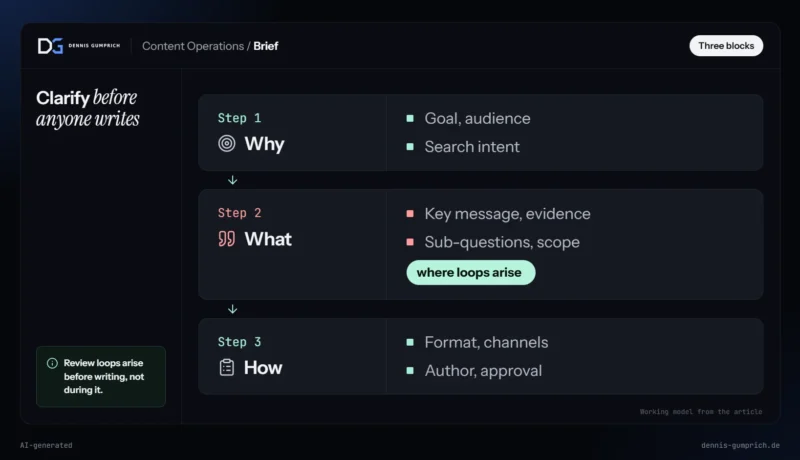

The expert article goes back for the third time. The subject matter experts write: "That's not what we wanted to say." The editorial team replies that it stuck to the brief.
The brief consisted of one line in the editorial plan: "Blog post on predictive maintenance, 1,500 words, SEO." Nobody had written down what the key message should be, which figures could be used or who the text was for. It was clarified now, in three review loops.
A content brief defines, before writing begins, what a piece of content should achieve: goal, audience, search intent, key message, evidence, sub-questions, scope, format, author and approval. Most review loops do not arise during writing, but because it was not clarified beforehand what should be said. With AI, the brief becomes even more important, because it is the substantive core of every task given to a language model. The template in this article has eleven fields in three blocks and can be copied directly.
What is a content brief?
A content brief is the written specification for a single piece of content: what it is for, who it is for, what it should say, what evidence supports it and who approves it. It is the contract between the requester, editorial team and subject matter experts before any work begins.
It differs from an entry in the editorial plan by working at the level of content. The plan says when which topic appears in which channel. The brief says what the result should be. A topic plus a word count is not a brief, but a reminder that one is missing.
Why does a good brief save review loops?
Because it moves the decisions that otherwise get fought over during approval to the beginning. If you clarify key message and evidence with the subject matter experts before writing, you don't have to negotiate them afterwards.
In most teams, rework arises in three places: the message doesn't match the experts' view, figures are missing or not approved, and the text addresses the wrong audience. All three can be avoided with a few minutes of alignment before writing instead of days afterwards. Why approvals often take weeks and how to shorten them is described in Approval processes. Where the time per article actually goes is shown in Nine hours per article.
In the briefs I see at companies, three details are missing most often: reference content, brand tone and target channel. A group with many brands named exactly that as its problem. Timing matters too: a trade fair company briefed its video and asset teams so late that bottlenecks arose.
Where many people review, every gap becomes expensive. A dietary supplement manufacturer with around ten people involved, including legal and quality assurance, regularly has extra review loops because of health claims.
What belongs in a content brief?
Eleven fields in three blocks: Why (goal, audience, search intent), What (key message, evidence, sub-questions, scope) and How (format, channels, author, approval). The "What" block is the most important, because that is where review loops arise.
| Block | Field | Guiding question |
|---|---|---|
| Why | Goal | What should the content achieve, and how will we know? |
| Why | Audience | Who reads this, in what situation, with what prior knowledge? |
| Why | Search intent | What does the person want to know, do or decide? |
| What | Key message | Which one sentence should stick? |
| What | Evidence and original input | Which figures, examples and experiences do only we have? |
| What | Sub-questions | Which questions must also be answered? |
| What | Scope | What explicitly does not belong in it? |
| How | Format and length | Guide, comparison, case study, approximate length |
| How | Channels | Which derivatives for which channels? |
| How | Author | Who puts their name to it? |
| How | Approval and deadline | Who approves what, by when? |
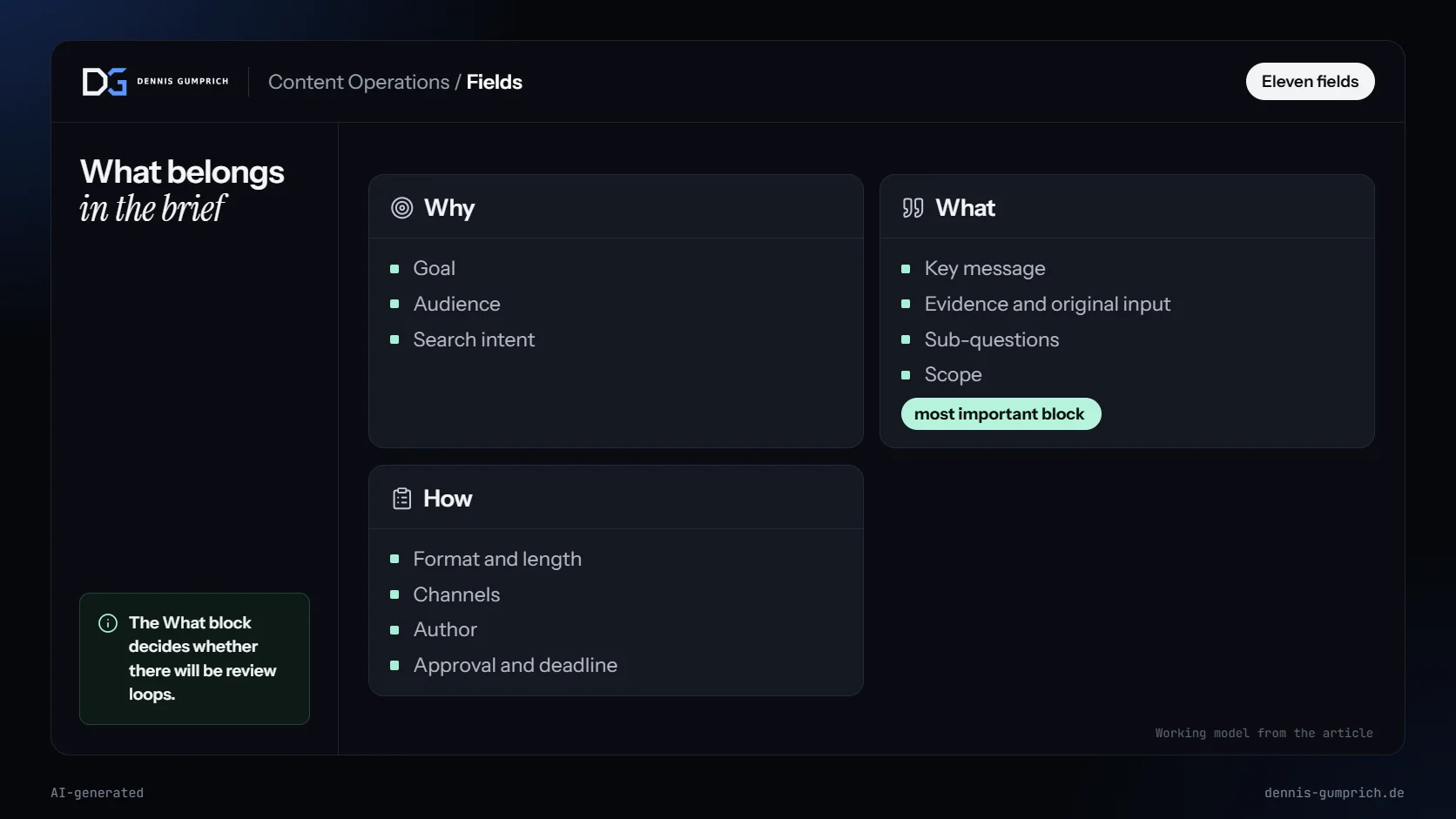
Two fields deserve special attention. Search intent determines format and opening; more on this in Understanding search intent. And "evidence and original input" decides whether the content becomes interchangeable. In its guidance on helpful content, Google explicitly asks whether content provides original information, research or analysis and whether it comes from someone who demonstrably knows the topic.
Brief template to copy
The template below contains all eleven fields with short instructions. Copy it into your tool and fill it in for your next piece of content. The first time takes longer; from the third brief on, it goes quickly.
Title (working title):
1. Goal: What should the content achieve? How do we measure it?
2. Audience: Role, situation, prior knowledge.
3. Search intent: Know, do or decide? What is at the top of the search results today?
4. Key message (one sentence):
5. Evidence and original input: Figures with source, examples, experiences. Who provides them?
6. Sub-questions: Three to five questions that are answered as well.
7. Scope: What does not belong in it?
8. Format and length:
9. Channels and derivatives:
10. Author: Name and role.
11. Approval: Who approves key message and evidence, by when? Who approves the finished text?
I use the story as the brief: topic area, topic, story. The story contains the brief for all channels, so that blog post, LinkedIn post and newsletter are created from the same specification.
Who writes the brief, and who approves it?
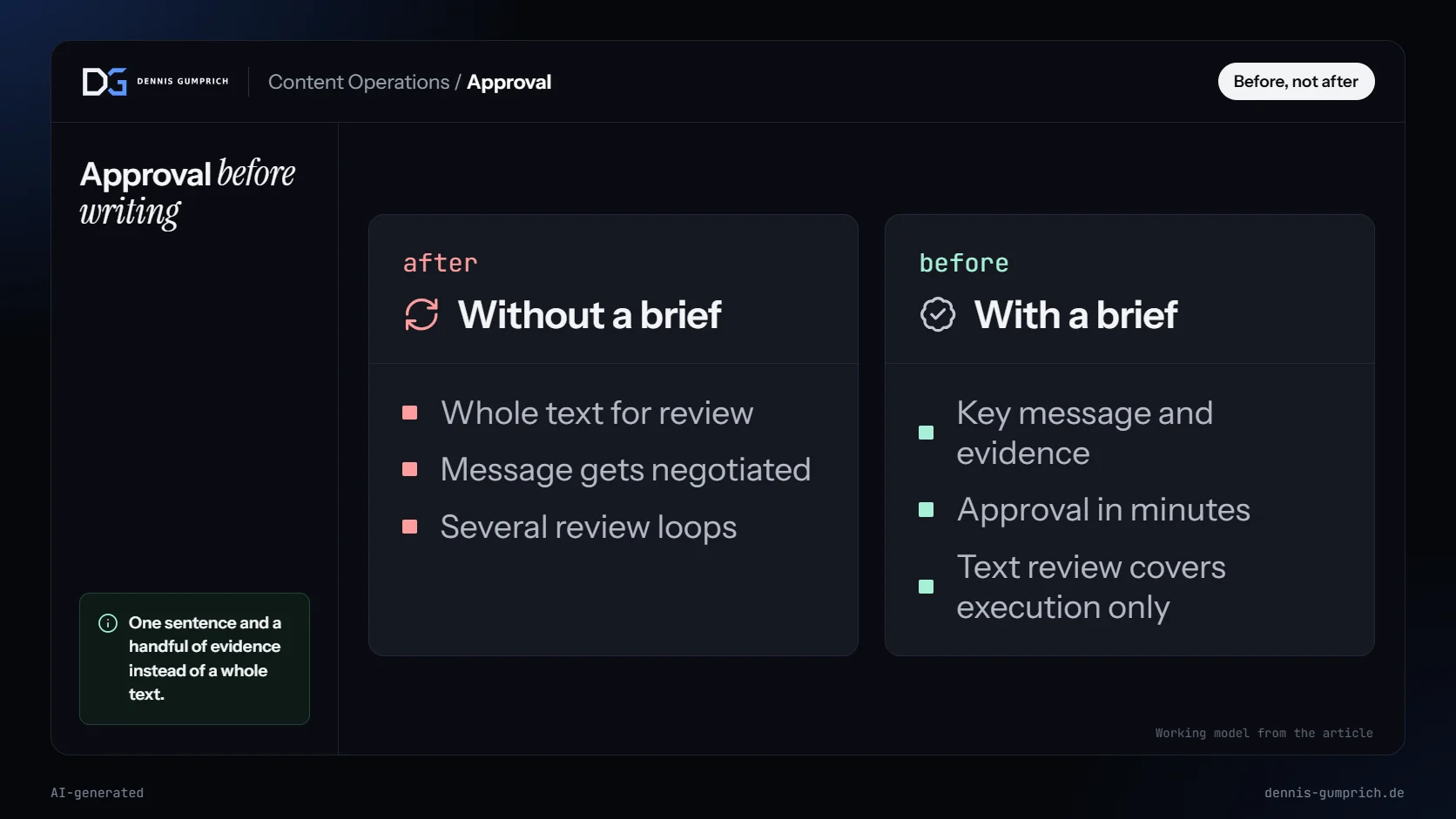
The editorial team writes the brief, the subject matter expert approves key message and evidence before writing begins. Approval of the finished text is then limited to whether the brief was implemented.
This division of labor is the real lever. The experts no longer review a long text sentence by sentence, but one sentence and a handful of evidence. That is quick and creates commitment. If the key message is to change later, that is a new decision and not a correction. How handovers between marketing and subject matter experts become smoother overall is described in Handovers between marketing and subject matter experts.
How do you use the brief with AI?
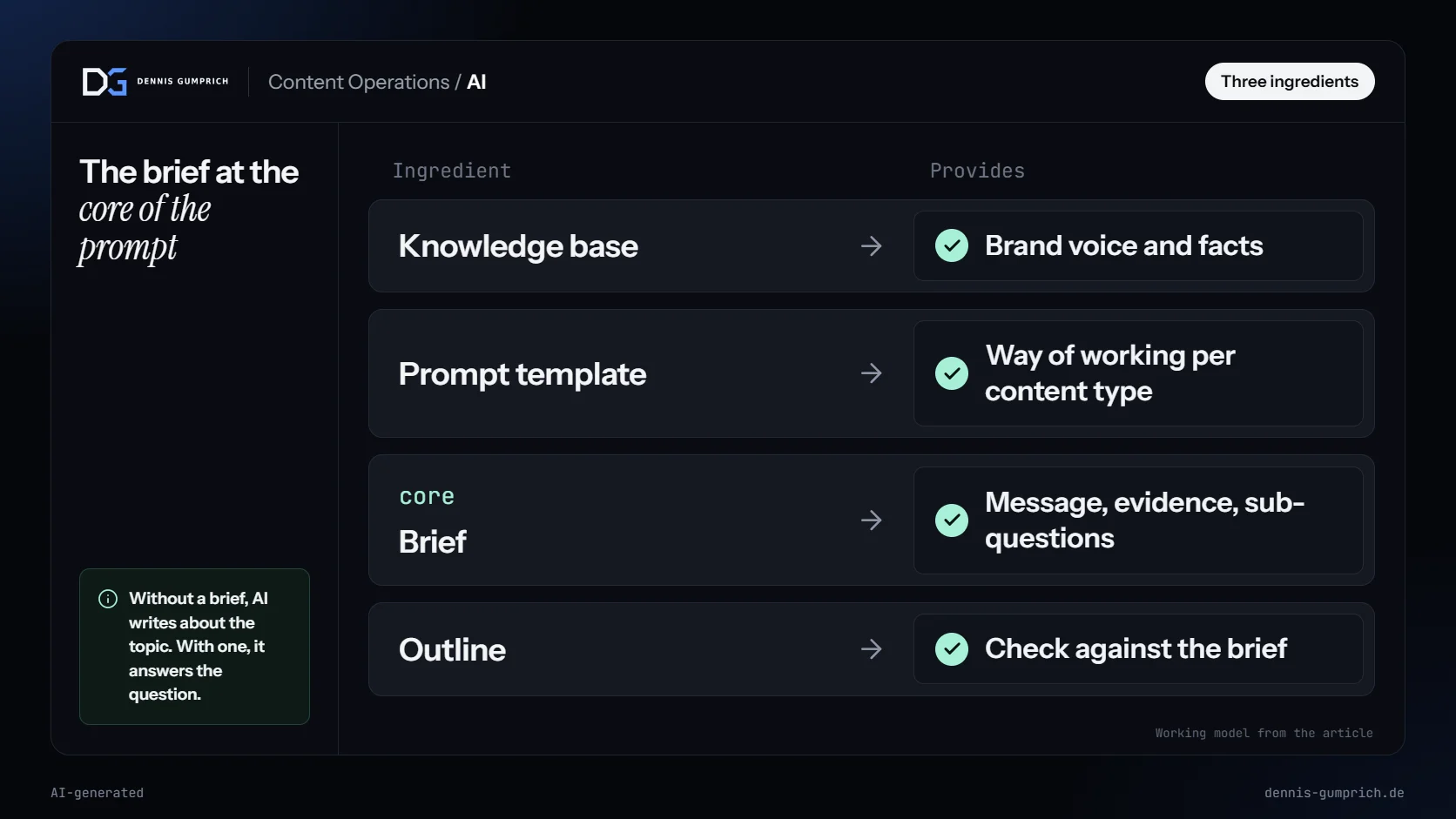
As the substantive core of every task you give a language model. The knowledge base provides brand voice and facts, the prompt template the way of working, the brief the message. Without a brief, the AI writes about the topic; with a brief, it answers the question.
In practice, this means: the completed brief is handed to the AI in full, together with the matching template from your prompt library. The AI first creates an outline, which you check against the brief, and then the text. It adopts the evidence in the brief instead of inventing its own figures. What the whole process looks like is described in Having AI write texts that sound like your brand. How one brief becomes several formats is shown in One brief, five formats.
Five mistakes with content briefs
- Topic plus word countA line in the editorial plan is not a brief. The key message is missing, and it gets fought over later.
- No evidence up frontIf you only look for figures while writing, you find none or invent them. Evidence belongs in the brief.
- Subject matter experts only at the endApproving the finished text is the most expensive moment for fundamental questions.
- No scopeWithout "what does not belong in it", every text gets longer and fuzzier.
- Briefs only for external partnersInternal editorial teams and AI need them too. The brief is not a form for agencies, but the start of every piece of content.
Self-check: How good are your briefs?
Tick everything that applies to you.
Conclusion: Save the review loop before it happens
A content brief costs time before writing and saves significantly more afterwards. It defines key message, evidence and audience while changes are still cheap, and gives editorial, subject matter experts and AI the same foundation. With eleven fields in three blocks and up-front approval of key message and evidence, three review loops usually become one.
Frequently asked questions
What is a content brief?
The written specification for a piece of content: goal, audience, search intent, key message, evidence, sub-questions, scope, format, channels, author and approval. It clarifies before writing what the result should be.
Is a content brief the same as an SEO content brief?
Not quite. In SEO tools, "content brief" often means only keywords and an outline. A complete brief also covers key message, evidence and approval.
How long should a content brief be?
One page is enough. What matters is not the length, but that key message, evidence and audience are clear.
Who should write a content brief?
The editorial team, with input from subject matter experts and sales. The expert approves key message and evidence before writing begins.
Can AI create a content brief?
AI can prepare fields, such as collecting sub-questions from search results or suggesting an outline. Key message, evidence and scope must come from people who know the topic and the company.
Where does your content process lose time today?
In 30 minutes, we look together at where unnecessary coordination, manual tasks, tool switching or repetitive content work cost you time today.
If your content ends up in review loops too often, we look at brief and approval together and find the step that costs the most time.
Analyze your content process in 30 minutes Free of charge. You take away concrete starting points you can use internally right away.
Dennis Gumprich
Dennis helps marketing and communication teams fit generative AI into existing content processes without undermining quality, brand voice and approvals. Focus areas: content operations, AI governance and tool selection in mid-sized companies and corporations.
Transparency note: Dennis works for contentbird, a provider of AI-powered content software. Product mentions are marked in the article. More about Dennis (in German) · LinkedIn
Read more
Sources
- Google Search Central: Creating helpful, reliable, people-first content, documentation, as of October 5, 2026: questions about original research and analysis, demonstrable expertise, clear authorship and the who, how and why of content, note on disclosing automation. Accessed November 7, 2026.
How this article was created
This article was created with the help of AI. Structure, research and draft wording were developed with AI support. Professional assessment, review of the statements and the final version are the responsibility of Dennis Gumprich. The English version was translated with AI and reviewed. Read the original German version.
How reliable are the statements?
The statements on helpful content come from Google Search Central documentation. Brief fields, template, division of labor and list of mistakes are working models from consulting practice with marketing and communication teams in 2026, not measured values. The assessment of the number of review loops is based on observations from projects, not on a survey.


