
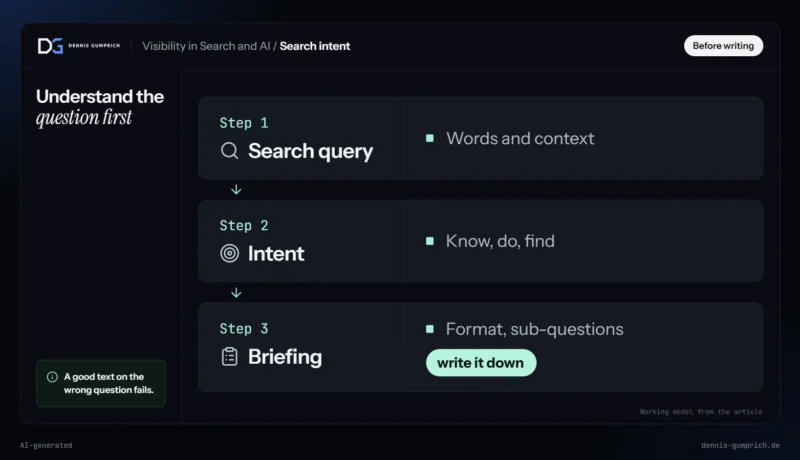

Search intent is what someone wants to achieve with a search: learn something, do something, find a specific website or visit a place. Google distinguishes these intents in its guidelines for quality raters and evaluates results by how well they fulfill the intent. A piece of content can be high quality and still fail if it answers a different question. In AI search, questions get longer and often contain several intents. That is why search intent, together with the expected sub-questions, belongs in every brief.
What is search intent?
Search intent describes the goal behind a search query: what the person wants to know, do or find. It decides which type of content answers the query best.
The same words can carry different intents. "Content software" can mean that someone wants to understand what it is, wants to compare vendors or is looking for a specific solution. If you misjudge the intent, you write the right text for the wrong question.
What types of search intent are there?
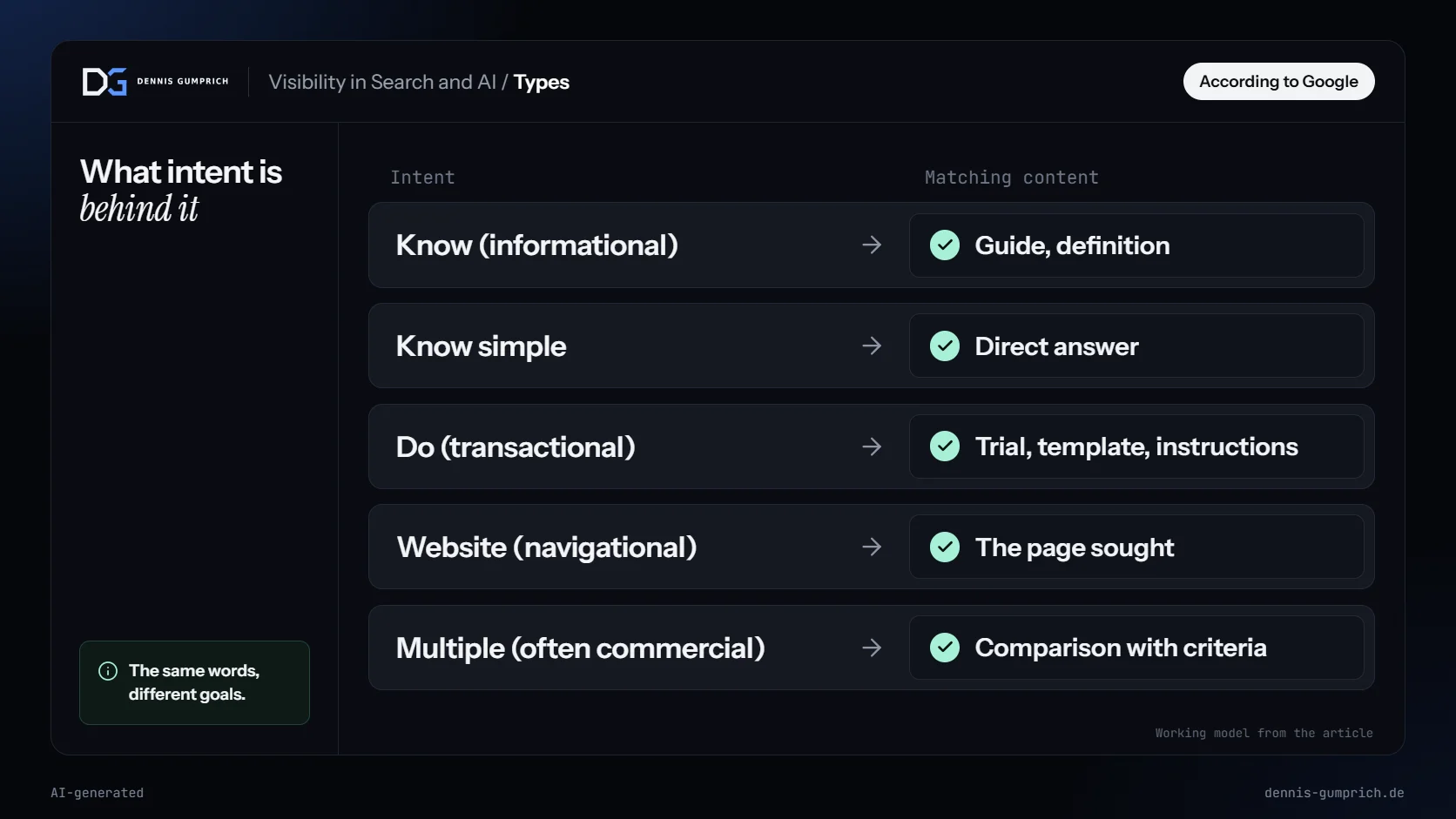
In its guidelines for quality raters, Google distinguishes five groups: know, do, find a website, visit in person and queries with multiple intents. In marketing, four terms are also common: informational, commercial, transactional and navigational.
| Intent according to Google | Marketing term | Example | Matching content |
|---|---|---|---|
| Know | Informational | What is a content audit? | Guide, definition |
| Know Simple | Informational | When did AI Mode launch in Germany? | Short, direct answer |
| Do | Transactional | Try content software | Trial access, instructions, template |
| Website | Navigational | Brand name plus login | The page sought |
| Visit-in-Person | Local | Agency near me | Location page |
| Multiple intents | Commercial | Best content software for mid-sized companies | Comparison with criteria |
The guidelines also describe how raters assess whether a result fulfills the intent: on a scale from "Fails to Meet" to "Fully Meets". According to Google, no single rating influences rankings directly. But the scale shows what matters: a page can be high quality and still fail if it answers a different question than the one asked.
How do you recognize search intent?
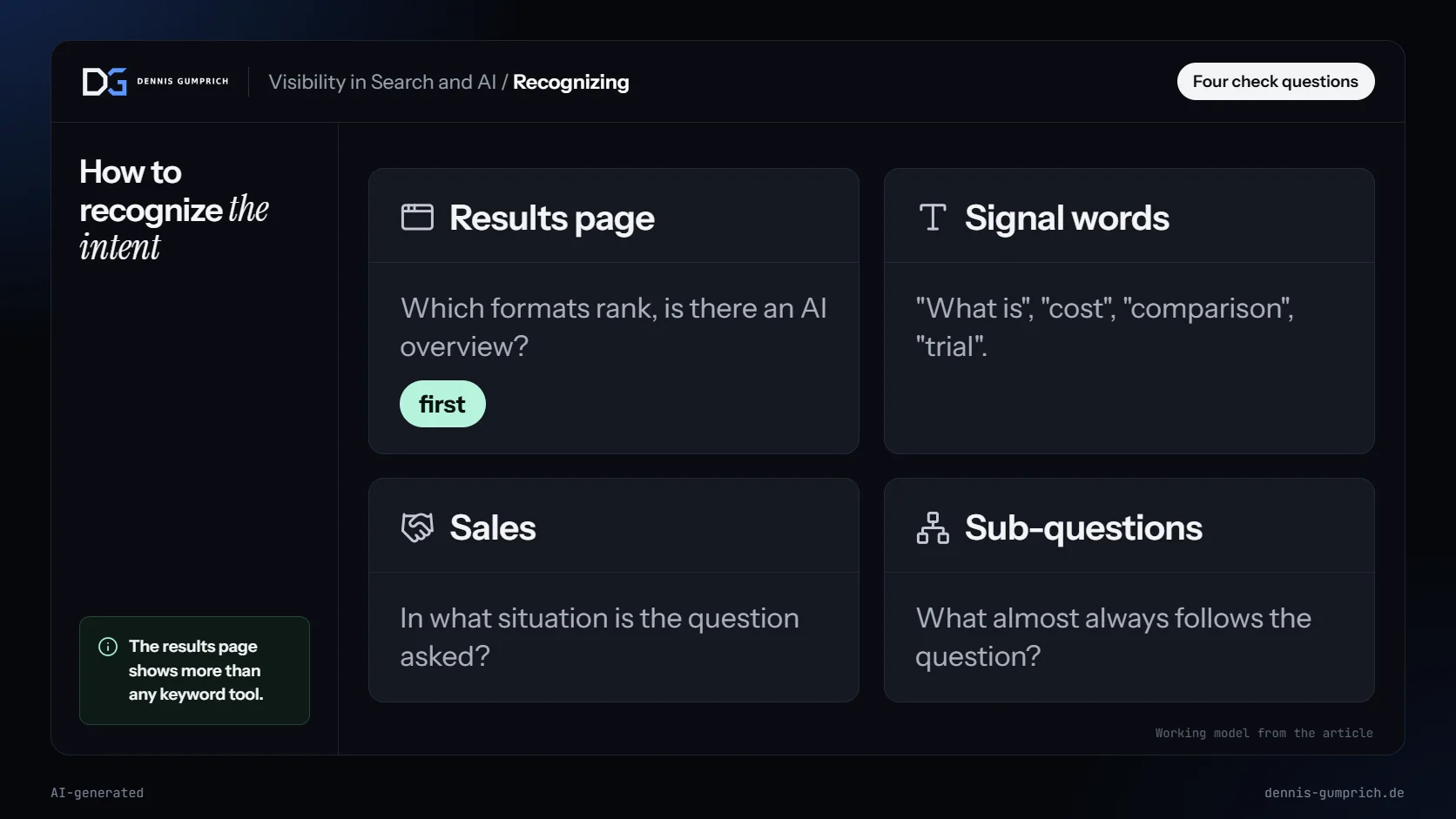
With four check questions: What ranks at the top of the search results today? Which signal words does the query contain? What do customers ask sales in the same situation? And which sub-questions are attached to it?
- Check question 1Look at the results pageWhich formats rank: guides, comparisons, product pages, videos? Does an AI overview appear? The results show what Google considers the intent to be.
- Check question 2Read the signal words"What is" and "how" point to knowing, "cost", "comparison" and "best" to a purchase intent, "trial" and "template" to doing.
- Check question 3Ask salesIn what situation do customers ask this question, and what do they want to do next?
- Check question 4Collect sub-questionsWhich questions almost always follow: cost, effort, distinction, typical mistakes?
A keyword tool shows how often people search. It rarely shows the intent. That is why it pays to look at the results before every brief. How to prioritize topics overall is described in topic scoring.
What changes about search intent in AI search?
Questions get longer and state the intent more explicitly, often several at once. AI systems break such questions down into sub-questions and look for a source for each one. Content therefore has to cover the typical sub-questions as well as the main intent.
For AI Mode, Google reports questions that are two to three times as long as typical search queries. Instead of "content software cost", someone asks: "What does content software cost for a team of five at a mid-sized company, and is it worth it compared to Excel?" This question contains a purchase intent, a knowledge question and a comparison. A page that answers only one part is used for that part, but not for the rest. More on this in GEO (Generative Engine Optimization) and Answer Engine Optimization.
How does search intent fit into the brief?
With five fields: main intent, matching format, opening answer, expected sub-questions and a distinction stating what the content does not answer. Editorial teams and AI tools need these fields equally.
| Field | Example |
|---|---|
| Main intent | Purchase intent: understand price ranges, classify vendors |
| Format | Comparison with a table and a sample calculation |
| Opening answer | Range in two sentences, what the price depends on |
| Sub-questions | Cost per user, implementation effort, comparison with Excel |
| Distinction | No product presentation, no feature catalog |
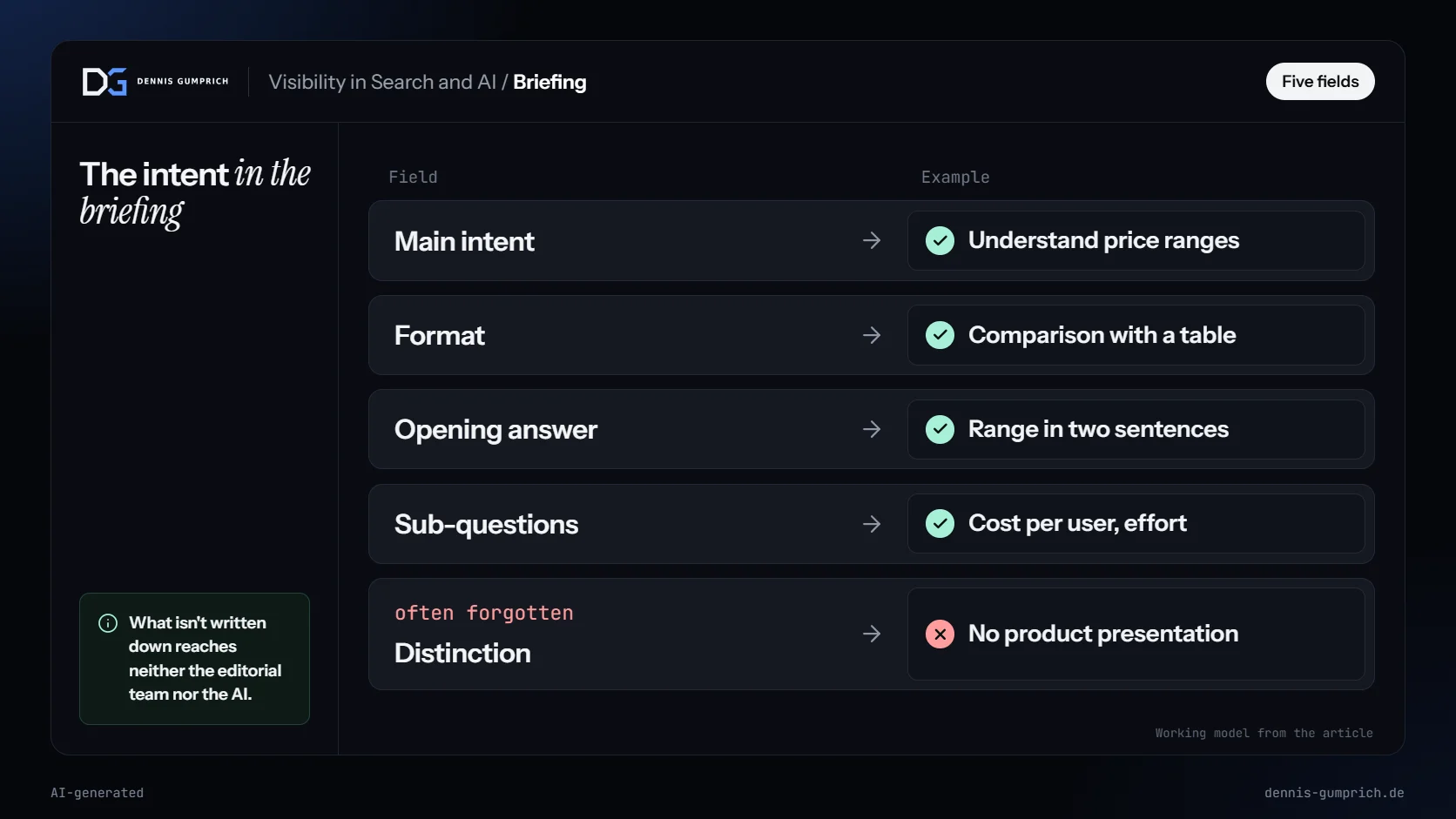
The "distinction" field prevents the most common mistake: content that tips into a product presentation where the audience expects a neutral overview. What a complete brief looks like is shown in Content brief: the template that saves review loops.
Five mistakes with search intent
- Inferring the intent from the keywordThe same word can carry different intents. Only the results page shows which one is meant.
- Answering a purchase intent with a product textPeople who compare want criteria and ranges, not self-promotion.
- Serving only the main intentAI search systems break questions down. Missing sub-questions cost you mentions.
- Intent in your head, not in the briefWhat isn't written down reaches neither the editorial team nor the AI tool.
- Defining it once, never checking againResults pages change. Check the intent again with every revision.
Self-check: Do you match search intent?
Tick everything that applies to you.
a brief note on why some of our content doesn't rank:
Some articles are well made but answer a different question than the one searchers ask. Google evaluates results by how well they fulfill the intent behind the search. In AI search, longer questions with several intents add to this.
I suggest adding search intent with expected sub-questions as a fixed field in every brief and checking the current search results before every revision.
Conclusion: Understand the question first, then write
Search intent decides which content answers a query best. Google evaluates results accordingly, and AI search systems break questions down into sub-questions with their own intents. If you check the intent before writing and record it in the brief with format, opening answer, sub-questions and distinction, you miss the need less often, with or without AI.
Frequently asked questions
What is search intent?
The goal behind a search query: what the person wants to know, do or find. It determines which type of content answers the query best.
What types of search intent are there?
Google distinguishes know, do, find a website, visit in person and queries with multiple intents. In marketing, people usually speak of informational, commercial, transactional and navigational search intent.
How do I find out the search intent of a keyword?
Most reliably through the current search results: Which formats are at the top, does an AI overview appear, which questions are answered there? Signal words and conversations with sales help as well.
Why is search intent important for SEO?
Because Google evaluates results by how well they fulfill the intent. Content that answers a different question rarely ranks, even if it is high quality.
Does search intent also apply to ChatGPT and other AI systems?
Yes, even more so. Questions to AI systems are longer and often contain several intents. The systems break them down into sub-questions and look for sources for each one.
Where does your content process lose time today?
In 30 minutes, we look together at where unnecessary coordination, manual tasks, tool switching or repetitive content work cost you time today.
If your content is good but isn't being found, we check together whether it answers your audience's questions.
Analyze your content process in 30 minutes Free of charge. You take away concrete starting points you can use internally right away.
Dennis Gumprich
Dennis helps marketing and communication teams fit generative AI into existing content processes without undermining quality, brand voice and approvals. Focus areas: content operations, AI governance and tool selection in mid-sized companies and corporations.
Transparency note: Dennis works for contentbird, a provider of AI-powered content software. Product mentions are marked in the article. More about Dennis (in German) · LinkedIn
Read more
Sources
- PPC Land: Search Quality Rater Guidelines, overview of Google's guidelines for quality raters in the version of September 11, 2025: user intents know and know simple, do, website, visit-in-person and multiple intents, Needs Met scale from Fails to Meet to Fully Meets, no direct effect of individual ratings on rankings. Trade publication. Accessed November 7, 2026.
- Hema Budaraju, Google: AI Mode launches in Germany, Austria and Switzerland (in German), blog post of October 8, 2025: questions in AI Mode two to three times as long as typical search queries. Accessed November 7, 2026.
- Google Search Central: AI features and your website, documentation, as of December 10, 2025: query fan-out with several related searches on subtopics. Accessed November 7, 2026.
How this article was created
This article was created with the help of AI. Structure, research and draft wording were developed with AI support. Professional assessment, review of the statements and the final version are the responsibility of Dennis Gumprich. The English version was translated with AI and reviewed. Read the original German version.
How reliable are the statements?
The types of search intent and the rating scale come from Google's guidelines for quality raters, as reported by a trade publication. The mapping to marketing terms is simplified. Check questions, brief fields and the list of mistakes are working models from consulting practice, not measured values.


