

The best answer is useless if it sits in the fifth paragraph.
Answer engine optimization (AEO) is the work of making your content appear as the answer in answer systems: in featured snippets, voice assistants, Google AI Overviews, AI Mode or ChatGPT. The core is simple: answer every important question directly in its own place on your website, back up the answer and keep it current. What most guides leave out decides success in a company: who approves answer sentences, who maintains them and how you check whether AI answers about you are correct.
What this means for the structure, wording and maintenance of your content is shown in the following sections, starting with a precise definition.
What is answer engine optimization (AEO)?
Answer engine optimization, AEO for short, covers all measures that turn content into the direct answer to a question. Answer engines are systems that don't just list links, but answer themselves: featured snippets, voice assistants, Google AI Overviews, AI Mode and assistants such as ChatGPT or Perplexity.
The term is older than GEO. It came up when Google showed answers in boxes above the search results and voice assistants read out answers to questions. For featured snippets, according to its own documentation, Google automatically selects which page best answers a question. There is no special markup for this, and website owners cannot mark a page as a featured snippet themselves. With generative systems, AEO has taken on a second meaning: the answer is assembled from several sources, and you want to be one of them.
How do AEO, GEO and SEO differ?
The terms overlap heavily and are often used interchangeably. SEO aims at positions in result lists, AEO at the direct answer, GEO at being named in the answers of generative systems. Google assigns all three to search engine optimization.
| Term | Goal | Typical formats | KPI |
|---|---|---|---|
| SEO | Position in the search results | Organic results | Rankings, clicks |
| AEO | Direct answer to a question | Featured snippets, voice assistants, AI answers | Answer share, correctness |
| GEO | Being named in generated answers | AI Overviews, AI Mode, ChatGPT, Perplexity | Mention and citation rate |
In practice, the distinction matters less than the shared consequence: your content must answer questions clearly. More on the other two terms in GEO (Generative Engine Optimization) and GEO vs. SEO.
How does content become an answer?
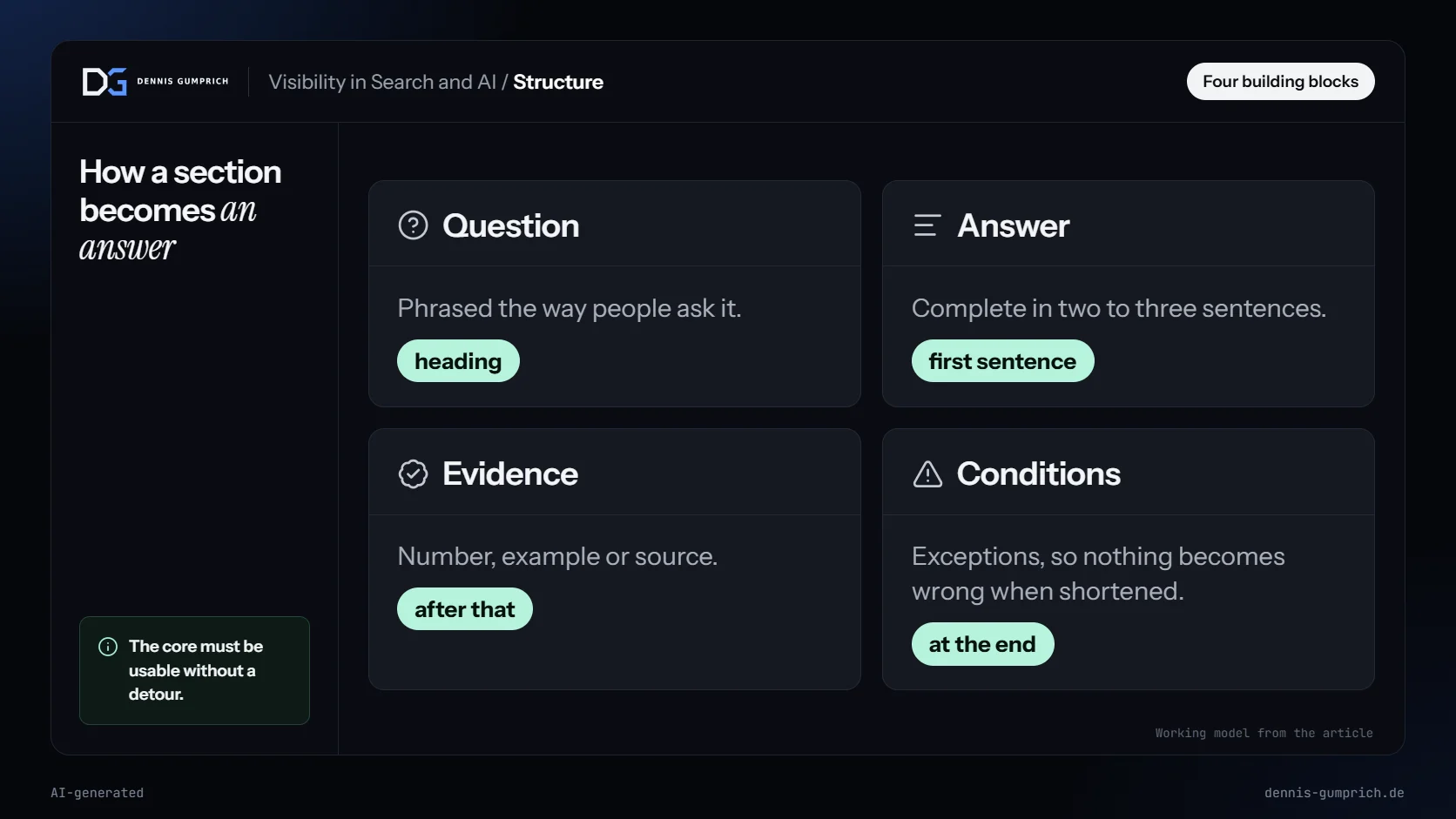
By answering the question completely in exactly one place: the question as a heading, the answer in two to three sentences directly below, followed by reasoning, evidence and limitations. That way, a system can take over the core without piecing it together from several paragraphs.
Four building blocks make a section answer-ready. The question appears in the heading the way people ask it. The first sentence answers it completely and without an introduction. Then comes evidence, such as a number, an example or a source. Finally come conditions and exceptions, so that the answer doesn't become wrong when shortened. Present processes and comparisons as a list or table.
In its guide to generative search, Google writes that no special style of writing is needed for AI systems. That doesn't contradict this structure. A section that answers a question in its first sentence is just as helpful for people as for machines. How to check AI drafts for these points before approval is described in From AI draft to citable text.
Which questions should AEO cover?
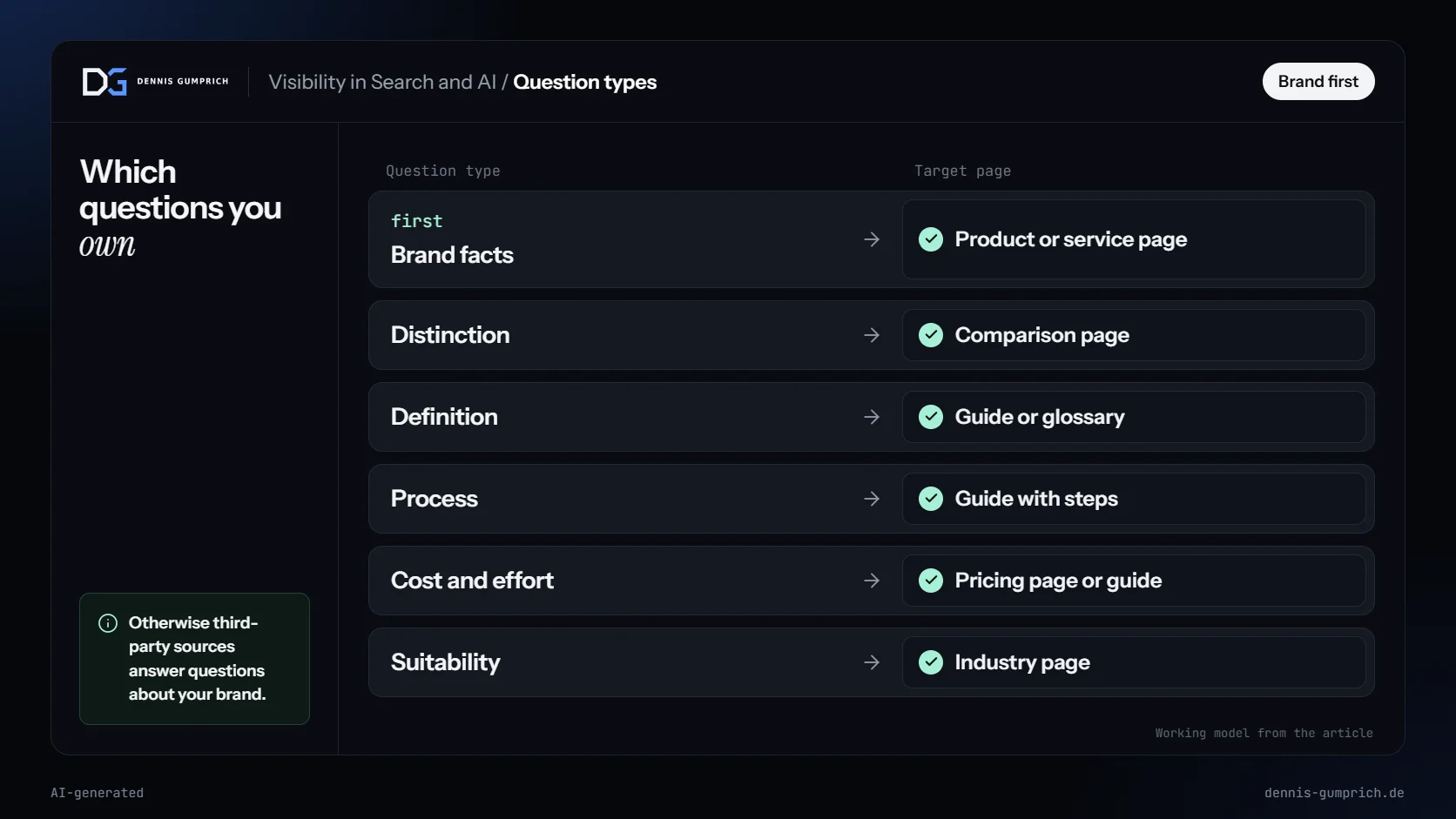
First the questions about your own brand and offerings, then the expert questions of your target group. Otherwise, questions about your brand are answered from third-party sources, and expert questions decide whether you are perceived as an expert.
| Question type | Example | Where the answer sits |
|---|---|---|
| Brand facts | Do you offer maintenance contracts? | Product or service page |
| Distinction | What distinguishes A from B? | Comparison page or guide |
| Definition | What is a content audit? | Guide or glossary |
| Process | How does an implementation work? | Guide with steps |
| Cost and effort | Roughly what does it cost? | Pricing page or guide |
| Suitability | Who is it worthwhile for? | Product or industry page |
The best place to collect the questions is where they are asked: in sales, in service, in demos and in tenders. A question set of 30 to 50 questions is enough to start. Each question gets a target page and a person who is responsible for the answer's content.
How concretely the topic has arrived in companies is shown by a staffing group I work with: it wants to specifically address the sub-questions into which Google breaks down a search during query fan-out, and appear in AI Overviews.
How do you organize approval and maintenance of answers?
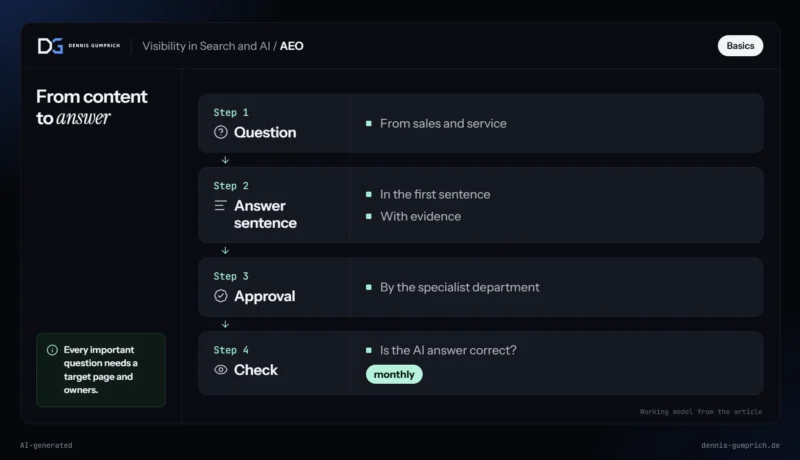
Approve answer sentences, not entire texts. Each answer to an important question gets a responsible person from the specialist department and a review date. That keeps the effort small, and outdated answers are noticed before AI systems pass them on.
- Step 1Define question and target pageThe head of content assigns exactly one page to each question in the question set. Two pages with different answers to the same question are the biggest risk.
- Step 2Write the answer sentenceThe editorial team phrases the answer in two to three sentences and adds evidence and conditions.
- Step 3Approve the statementThe specialist department only checks the answer sentence and the evidence. That takes minutes instead of days, as described in Shortening approval processes.
- Step 4Set a review dateAnswers about prices, services and rules get a review date, for example every six months. The visible update date shows readers and machines that the page is maintained.
How do you measure AEO?
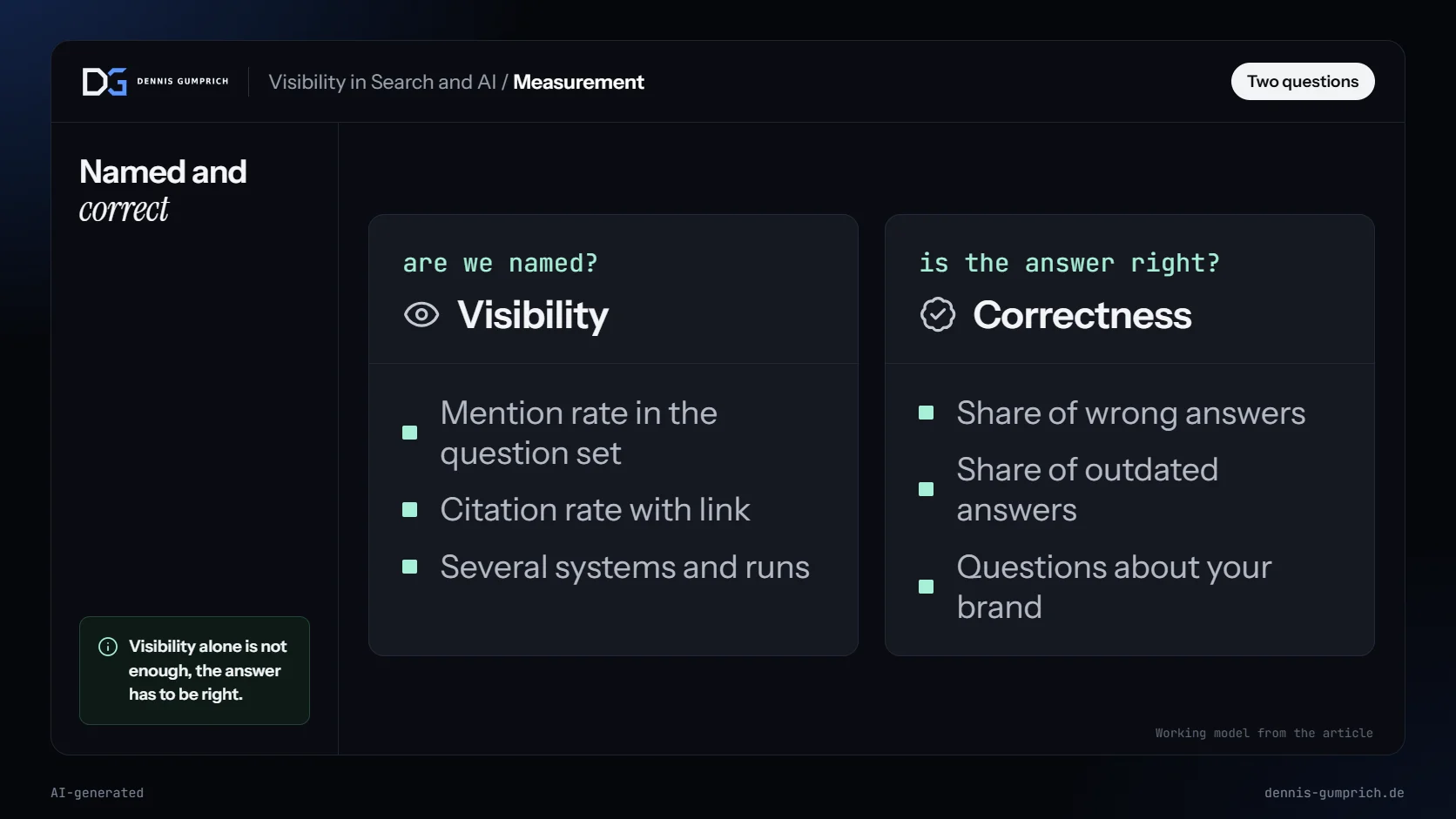
With two questions for your question set: are you named in the answer, and is what the answer says about you correct? The first question measures visibility, the second correctness. You collect both monthly across several systems and several runs.
The mention and citation rate is described in detail in Visibility without clicks. What's new with AEO is correctness: for questions about your brand, you count how many answers are factually wrong or outdated. This figure is often more convincing for sales and management than any reach KPI, because it shows a tangible risk.
Does FAQ markup help with AEO?
Not visibly in Google Search anymore. Google has not shown FAQ rich results since May 7, 2026. According to Google, structured data is not required for generative search. FAQ sections are still worthwhile, because they answer questions clearly.
The development took years. Back in August 2023, Google had restricted FAQ rich results to well-known government and health websites. In May 2026, the display ended, and by August 2026 reports and interfaces were removed. Existing markup does no harm. But put the effort into the visible text: into clear questions and good first sentences.
What do you do when AI answers say something wrong about you?
Check your own sources first, then third-party ones. In most cases, a clear answer is missing on your own website, or old pages contradict new ones. A clear, current answer page is the most effective lever.
- CheckLook for your own contradictionsSearch your website, PDFs and press releases for old statements on the topic. Update, merge or redirect outdated pages.
- AnswerCreate one clear answer pageAnswer the question on one page in the first sentence, with a date and a responsible unit.
- SupplementCorrect third-party sourcesCheck profiles, directories and partner pages that describe your offerings. Ask for corrections where information is wrong.
- MonitorMeasure again monthlyAI systems don't adopt corrections immediately. Track the question in your question set over several months.
Five mistakes in answer engine optimization
- Hiding the answer behind an introductionIf you explain the context first and answer in the third paragraph, you will rarely be picked up. The answer belongs in the first sentence.
- Answering the same question differently on several pagesContradictions make you unreliable. Each question needs one target page.
- Only covering expert questionsQuestions about your own brand are then left to other sources. Start with facts about your offerings.
- Relying on markup instead of textFAQ rich results no longer exist. A clear first sentence achieves more than any schema.
- Never checking answers againPrices, services and rules change. Without a review date, AI systems pass on outdated answers.
Self-check: does your content become the answer?
Tick everything that applies to you.
a short note on answers about us in AI systems:
Prospects increasingly ask ChatGPT or Google's AI features about vendors. What it says about us there comes from our website and from third-party sources. Where we don't answer questions clearly, other sources fill the gap, sometimes with wrong information.
I suggest collecting the 30 most important questions about our offerings, assigning each question a target page and a person responsible for its content, and checking monthly whether AI answers about us are correct.
Conclusion: good answers need owners
Answer engine optimization is simple craftsmanship: the question as a heading, the answer in the first sentence, evidence and conditions behind it. The organization is the hard part. Every important question needs a target page, a responsible person and a review date. If you get that right, you will not only be named more often, but also correctly.
Frequently asked questions
What does AEO mean?
AEO stands for answer engine optimization. It means optimizing content so that answer systems such as featured snippets, voice assistants, Google AI Overviews or ChatGPT use it as the direct answer.
What is the difference between AEO and SEO?
SEO aims at positions in the search results, AEO at the direct answer to a question. Technically, both build on the same foundations. Google explicitly assigns optimization for its AI features to SEO.
Is AEO the same as GEO?
The terms are often used interchangeably. AEO emphasizes the direct answer and is older. GEO emphasizes generative systems that assemble answers from several sources. In practice, the measures are largely the same.
Do we need FAQ schema for AEO?
No. Google has not shown FAQ rich results since May 2026 and says structured data is not required for generative search. Existing markup does no harm. Clear questions and good first sentences in the visible text matter more.
How long does it take for corrections to reach AI answers?
That cannot be predicted precisely. Revised pages must first be recrawled, and answers fluctuate. So track the affected questions in your question set over several months.
What is the answer-first approach and why does it matter for AEO?
Answer first means: the answer to the question is in the first sentence or paragraph, and explanation and evidence follow. AI systems and search engines prefer passages that fully answer a question on their own. If you only deliver the answer at the end of a long text, you make it hard for them to use the passage as a source.
How do mid-sized companies organize AEO without their own SEO department?
By building AEO into the existing content process instead of creating a new department. One person from marketing is responsible for the prompt set and measurement, the editorial team writes according to the answer-first principle, and the specialist departments provide facts and examples. Checkpoints for citability belong in the brief and in the approval.
How do I run an AEO pilot with a 90-day plan?
Choose a topic area with a clear business link and first measure the baseline with a fixed prompt set. In the first 30 days, revise the most important pages according to the answer-first principle and correct wrong information, then build missing content and external mentions. After 90 days, compare mentions and sources with the baseline. A measurement sheet for this is included in the AI visibility check.
Where does your content process lose time today?
In 30 minutes, we look together at where unnecessary coordination, manual tasks, tool switching or repetitive content work cost you time today.
If you are starting with AEO, we go through the most important questions about your offerings together and clarify who is responsible for which answer.
Analyze your content process in 30 minutes Free of charge. You take away concrete starting points you can use internally right away.
Dennis Gumprich
Dennis helps marketing and communication teams fit generative AI into existing content processes without undermining quality, brand voice and approvals. Focus areas: content operations, AI governance and tool selection in mid-sized companies and corporations.
Transparency note: Dennis works for contentbird, a provider of AI-powered content software. Product mentions are marked in the article. More about Dennis (in German) · LinkedIn
Read more
Sources
- Google Search Central: Featured snippets and your website, documentation, as of December 10, 2025: automatic selection, no special markup, no self-marking possible, control via nosnippet and max-snippet. Accessed November 7, 2026.
- Google Search Central: Optimizing your website for generative AI features on Google Search, guide, as of July 10, 2026: optimization for generative AI search is still SEO, no special writing style for AI needed, structured data not required. Accessed November 7, 2026.
- Matt G. Southern, Search Engine Journal: Google Drops FAQ Rich Results, article of May 10, 2026: no display of FAQ rich results since May 7, 2026, removal of report and test in June 2026, end of API support in August 2026, restriction to government and health websites since August 2023. Trade medium, not an original announcement by Google. Accessed November 7, 2026.
How this article was created
This article was created with the help of AI. Structure, research and draft wording were developed with AI support. Professional assessment, review of the statements and the final version are the responsibility of Dennis Gumprich. The English version was translated with AI and reviewed. Read the original German version.
How reliable are the statements?
The statements on featured snippets, generative search and FAQ rich results come from Google Search Central documentation and a trade medium. The terms AEO, GEO and SEO are not formally defined, and the distinction is a simplified classification. Question types, approval process, correction process and list of mistakes are working models from consulting practice with marketing and communication teams in 2026, not measured values.


