

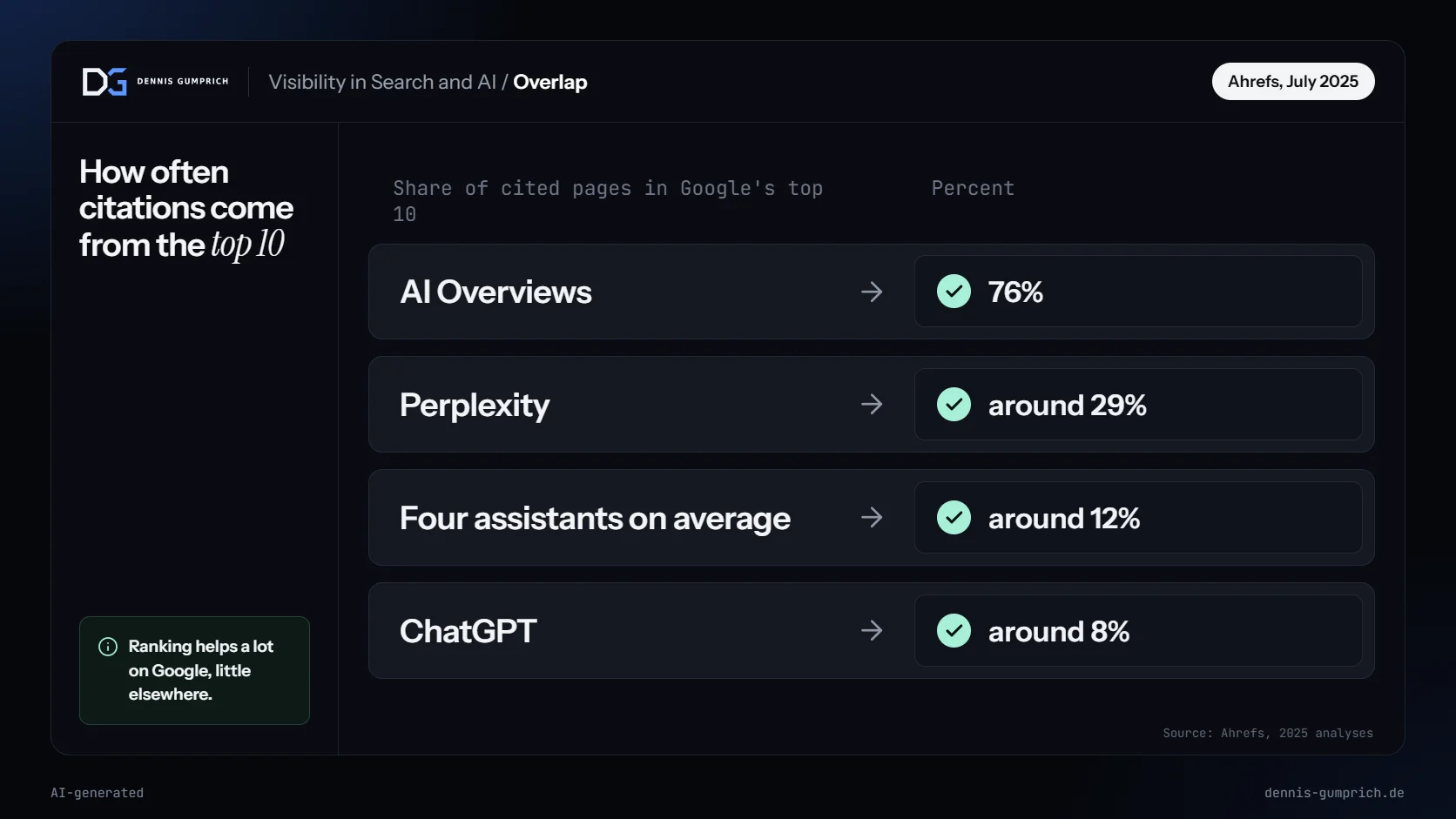
of the pages cited in AI Overviews come from Google's top 10. With other AI assistants, the overlap is much smaller.Source: Ahrefs, 2025 analyses
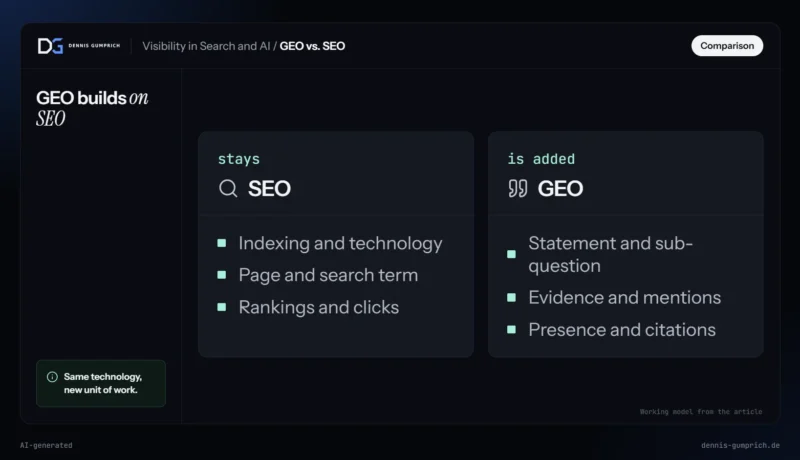
GEO does not replace SEO, it builds on it. Google itself says that optimizing for its AI features is still SEO, and according to an Ahrefs analysis, most pages cited in AI Overviews come from the top 10. With ChatGPT, Gemini, Copilot and Perplexity, by contrast, only around 12 percent of cited pages ranked in Google's top 10 in July 2025. Three things are therefore new: statements instead of pages as the unit of work, mentions instead of clicks as the metric and more people involved in the process.
Is GEO the new SEO?
No. GEO is an extension of SEO for systems that generate answers instead of listing links. If you cut SEO, you lose the foundation on which AI search systems also find their sources.
Google has set out its position in the guide "Optimizing your website for generative AI features on Google Search": optimizing for generative AI search is optimizing for the search experience and therefore still SEO. According to Google, AI Overviews and AI Mode rely on the same ranking and quality systems as classic search. For the Google world, "GEO instead of SEO" is simply wrong.
It is different with assistants such as ChatGPT, Perplexity, Gemini or Copilot. Some of them use their own search indexes and search for variants of a question rather than its exact wording. A good Google ranking helps there, but it is no guarantee. What GEO covers as a whole is explained in What is GEO? Generative Engine Optimization and how marketing teams organize it.
Reactions to GEO vary widely in my conversations. In-house SEO leads usually respond with curiosity: a marketing lead in print e-commerce is actively looking for alternatives to her current SEO tools. Small SEO agencies tend to respond defensively: their share of SEO work is shrinking, and content barely seems to work as a lever in the current Google environment.
What stays the same with GEO as with SEO?
Everything that makes a page findable and understandable: crawlability, indexing, internal linking, a clear structure, fast load times and content that matches search intent. Without these basics, a page will neither rank nor be cited.
- Technology: Pages must be crawlable and indexable. For Google, they must also be allowed to show a snippet.
- Structure: Clear headings, meaningful sections and internal links help people and machines alike.
- Search intent: If you don't understand what is behind a question, you won't answer it well. That applies to rankings and to citations. More on this in Understanding search intent.
- Quality: Google prefers content with first-hand experience and expertise over interchangeable texts based on general knowledge. That was true before AI answers and is even more true now.
What changes with GEO compared to SEO?
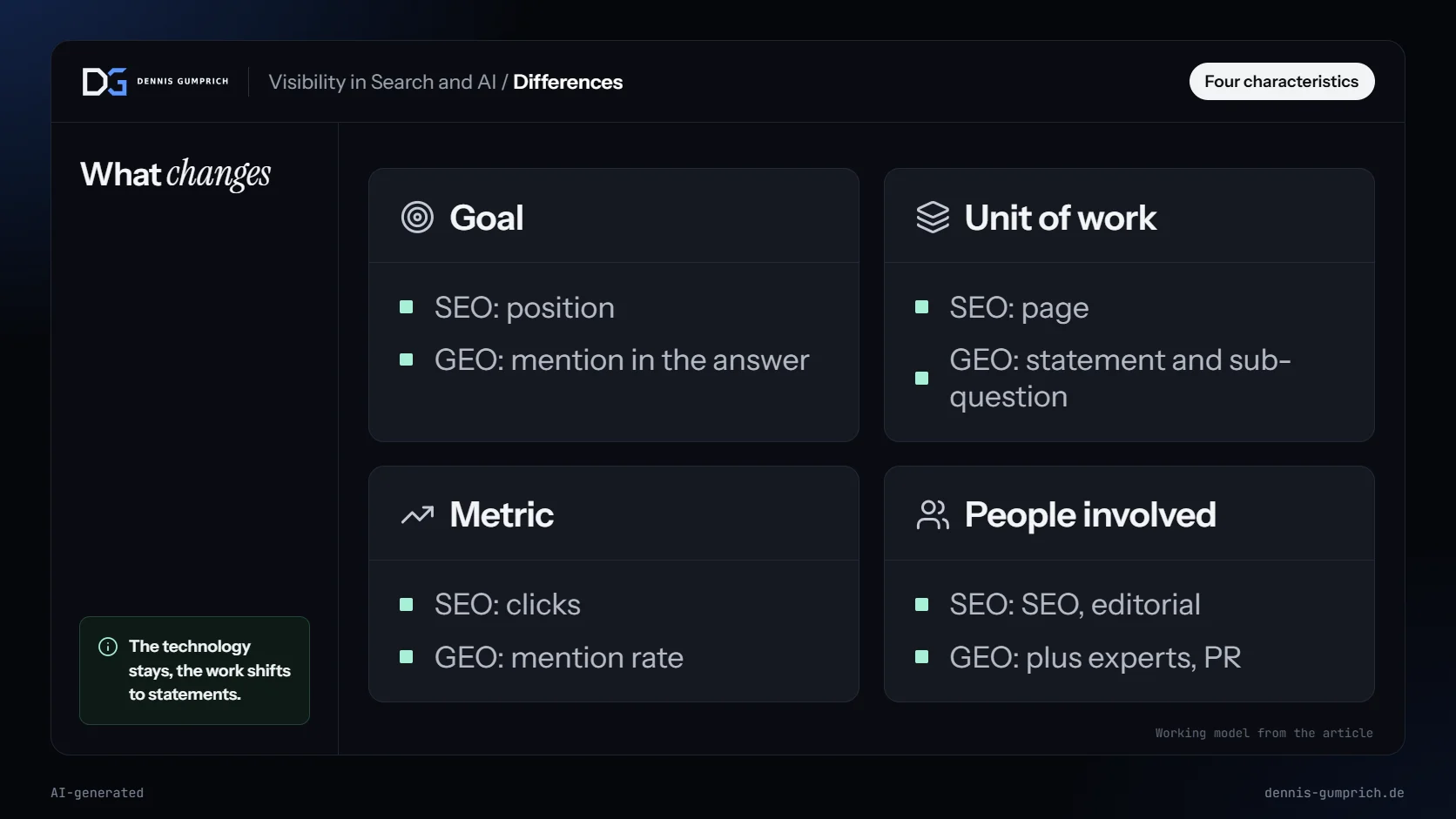
Goal, unit of work, metrics and people involved. SEO works on pages and positions. GEO works on statements that a system adopts and attributes to a source, and measures how often that succeeds.
| Characteristic | SEO | GEO |
|---|---|---|
| Goal | Position in the search results | Mention or link in the AI answer |
| Unit of work | Page and search term | Statement and sub-question |
| Research basis | Keyword research | Question set from sales and service |
| Main metric | Rankings, clicks, click-through rate | Presence, mention rate, citation rate |
| Key signals | Relevance, links, user signals | Clear answers, evidence, mentions |
| People involved | SEO, editorial, development | Plus subject matter experts and PR |
The research basis deserves special attention. Keyword tools show what people type into search engines. In AI assistants, they ask longer questions: for AI Mode, Google reports questions that are two to three times as long as typical search queries. Your sales team often knows these questions better than any tool. Keyword research still matters, because it shows which topics have demand at all.
How much do Google rankings and AI citations overlap?
A lot on Google, little with other assistants. According to Ahrefs, 76 percent of the pages cited in AI Overviews come from the top 10. With ChatGPT, Gemini, Copilot and Perplexity, only around 12 percent of cited pages ranked in Google's top 10 for the same question in July 2025 on average.
The second figure comes from an analysis of 15,000 longer questions that Ahrefs asked in parallel in Google, Bing and four assistants in July 2025. Perplexity led with around 29 percent overlap, the other assistants were at about 8 percent. The authors attribute the gap to query fan-out, that is, searching for many variants of a question, to personalization and to different search indexes. The 76 percent for AI Overviews comes from an earlier Ahrefs analysis, not from the same survey.
For your planning, this means: good rankings are the best basis for visibility in Google's AI features. For other assistants, that is not enough. There, what counts is whether your pages answer the many sub-questions a system asks in the background, and whether other sources mention you. The figures are snapshots. Providers change their search constantly, so it pays to run your own measurement with your question set.
I disagree with the statement "GEO is just SEO" where the numbers say otherwise. A media sales house I work with measures around three times as many visits for GEO-optimized texts.
How do SEO and GEO work together in the team?
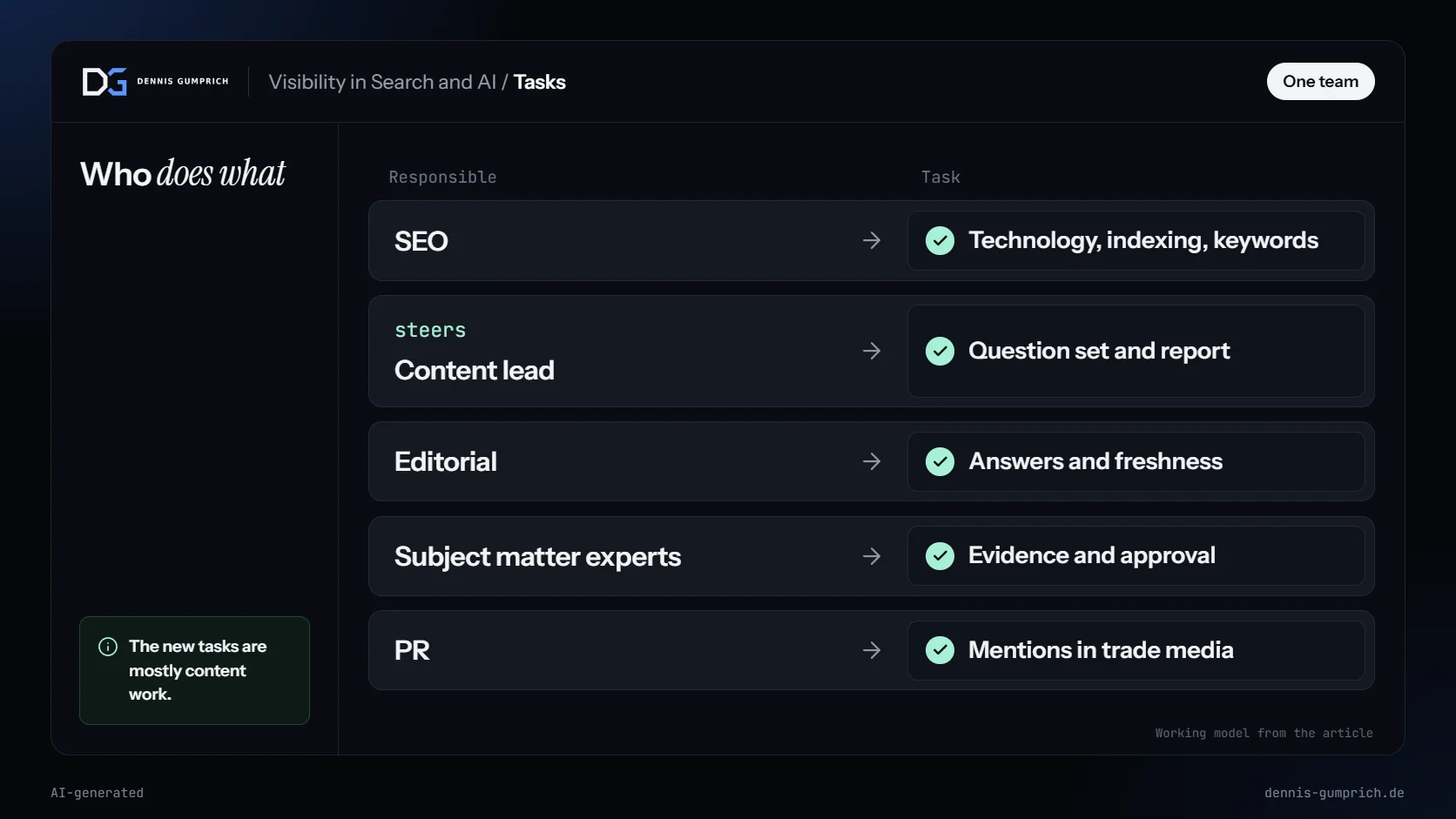
SEO keeps technology, indexing and keyword research. Editorial takes on the question set, answers and updates. Subject matter experts provide evidence, PR provides mentions. One person should steer, usually the content lead.
| Task | Responsible | Applies to |
|---|---|---|
| Crawling, indexing, load time | SEO with development | SEO and GEO |
| Keyword research | SEO | SEO and GEO |
| Question set from sales and service | Content lead | GEO |
| Answer first, structure, freshness | Editorial | SEO and GEO |
| Data, examples, expert approval | Subject matter experts | GEO |
| Mentions in trade media | PR | GEO |
| Report with presence and mentions | Content lead with SEO | GEO |
The list shows why GEO should rarely rest on a single person. Most of the new tasks are content work. How to organize responsibilities in the team in general is described in Who does what in the content team.
Does the SEO budget need to shift?
Part of it, yes, but not from technology to tricks. From volume to substance: fewer interchangeable texts, more time for evidence, updates and expert approval. The technical SEO budget is still needed.
In practice, a simple rule works well: create new content only for questions that are in the question set and to which you can contribute something of your own. The rest of the budget goes into revising existing pages that already rank. For them, the path into AI Overviews is shortest. Which content to tackle first is shown by a content inventory.
Five mistakes when dealing with GEO and SEO
- Cutting SEO basicsWithout indexing and clean technology, there are no citations either. GEO builds on SEO.
- Treating rankings as a guarantee for AI visibilityThat is largely true for Google, but not for other assistants. Measure both separately.
- Building two separate teamsA GEO team next to the SEO team creates duplicate work. Both work on the same pages.
- Using only keyword toolsThe long questions from AI assistants barely show up there. Add questions from sales and service to your research.
- Keeping clicks as the only metricWhen answers appear directly in AI search, clicks drop even though you are seen. Add presence and mentions.
Self-check: Do SEO and GEO work together in your team?
Tick everything that applies to you.
a brief note on "GEO instead of SEO":
Google itself says that optimizing for its AI features is still SEO. In AI Overviews, most cited pages come from the top 10. With ChatGPT and other assistants, however, the overlap with Google rankings is small.
I suggest not cutting the SEO budget but reallocating it: fewer new standard texts, more revision of existing pages with evidence from subject matter experts. We should also measure how often we are named in AI answers.
Conclusion: GEO builds on SEO and widens the circle of people involved
GEO vs. SEO is not an either-or question. The technical foundations stay the same, and for Google's AI features, good rankings remain the most important way in. For other assistants, a second layer is added: answers to many sub-questions, evidence-backed statements and mentions by others. The biggest change is organizational. More people contribute to visibility, and someone has to steer it.
Frequently asked questions
What is the difference between GEO and SEO?
SEO optimizes pages for positions in search results. GEO optimizes content so that AI search systems adopt its statements and name the source. Technically, the two overlap heavily; the metrics and people involved differ.
GEO instead of SEO: does GEO replace search engine optimization?
No. Google explicitly classifies optimization for AI Overviews and AI Mode as SEO. Other assistants also find their sources through search indexes. Without SEO basics, there are no citations.
Does a good Google ranking help with ChatGPT?
It helps, but it guarantees nothing. In an Ahrefs analysis from July 2025, only around 8 percent of the pages cited by ChatGPT came from Google's top 10 for the same question. ChatGPT searches for many variants of a question and uses other sources.
Do we need separate teams for SEO and GEO?
No. Both work on the same pages. What makes sense is one shared team with clear contributions from SEO, editorial, subject matter experts and PR, and one person who steers.
How are SEO and GEO connected?
SEO ensures that pages are found, crawled and classified as trustworthy. GEO builds on that and ensures that individual statements are phrased so clearly, with evidence and so self-contained that AI search systems adopt them and name the source. SEO and GEO are two stages of the same work, not alternatives.
Which metrics show the success of GEO?
Presence in AI features according to Search Console, the mention rate of your brand in a fixed question set and the citation rate, meaning how often a link to you appears in the answers. Follow-on signals such as brand searches add to this.
Where does your content process lose time today?
In 30 minutes, we look together at where unnecessary coordination, manual tasks, tool switching or repetitive content work cost you time today.
If you want to bring SEO and GEO together, we clarify which tasks stay, which are added and who takes them on.
Analyze your content process in 30 minutes Free of charge. You take away concrete starting points you can use internally right away.
Dennis Gumprich
Dennis helps marketing and communication teams fit generative AI into existing content processes without undermining quality, brand voice and approvals. Focus areas: content operations, AI governance and tool selection in mid-sized companies and corporations.
Transparency note: Dennis works for contentbird, a provider of AI-powered content software. Product mentions are marked in the article. More about Dennis (in German) · LinkedIn
Read more
Sources
- Google Search Central: Optimizing your website for generative AI features on Google Search, guide, as of July 10, 2026: optimizing for generative AI search is still SEO, AI features rely on the ranking and quality systems of Search, distinction between interchangeable and non-interchangeable content. Accessed November 7, 2026.
- Louise Linehan, Xibeijia Guan, Ahrefs: Only 12% of AI Cited URLs Rank in Google's Top 10 for the Original Prompt, analysis of August 11, 2025, based on 15,000 questions collected in early July 2025: around 12 percent overlap with Google's top 10 on average, Perplexity around 28.6 percent, other assistants around 8 percent, reference to an earlier Ahrefs analysis with a 76 percent top 10 share for AI Overviews, explanation via query fan-out, personalization and separate indexes. Vendor analysis by an SEO tool provider. Accessed November 7, 2026.
- Google Search Central: AI features and your website, documentation, as of December 10, 2025: query fan-out, prerequisites of indexing and snippet eligibility. Accessed November 7, 2026.
- Hema Budaraju, Google: AI Mode launches in Germany, Austria and Switzerland (in German), blog post of October 8, 2025: questions in AI Mode two to three times as long as typical search queries. Accessed November 7, 2026.
How this article was created
This article was created with the help of AI. Structure, research and draft wording were developed with AI support. Professional assessment, review of the statements and the final version are the responsibility of Dennis Gumprich. The English version was translated with AI and reviewed. Read the original German version.
How reliable are the statements?
The statements about Google come from the official Google Search Central documentation. The overlap figures come from analyses by an SEO tool vendor with data from July 2025 and may shift as providers make changes. Comparison table, division of tasks and list of mistakes are working models from consulting practice, not measured values.


