
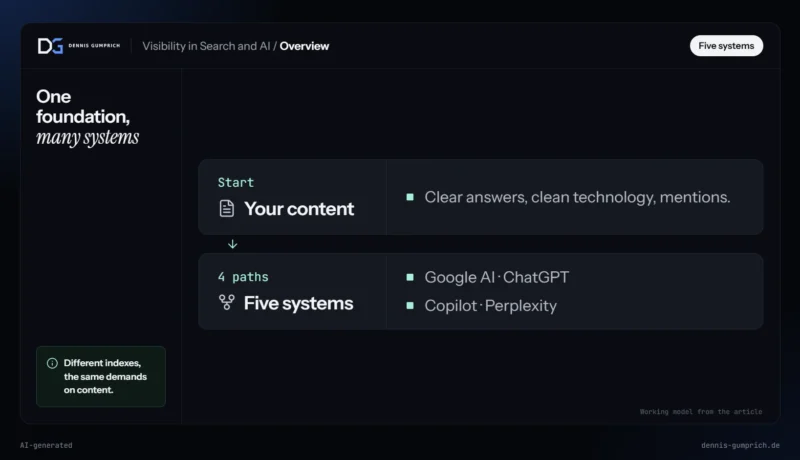

AI search engines answer questions directly and cite sources from the web. The most important ones are Google's AI Overviews and AI Mode, ChatGPT with its web search, Gemini, Microsoft Copilot and Perplexity. They draw on different search indexes: Google on its own, Copilot on Bing, Perplexity and ChatGPT on their own methods. That is why their sources only partially overlap. For you, this means one shared foundation for all of them, namely good content, clean technology and mentions, plus a few system-specific points such as indexing in Bing and the right crawlers in robots.txt.
What are AI search engines?
AI search engines are systems that answer a question with generated text while using and linking content from the web as a source. They differ from chatbots without web search, which answer only from their training knowledge.
Three forms can be distinguished. Classic search engines with AI features, such as Google with AI Overviews and AI Mode. Assistants with web search, such as ChatGPT, Gemini or Microsoft Copilot, which decide for themselves depending on the question whether to search the web. And answer engines like Perplexity, which always answer with sources. For your content, the same thing counts with all of them: whether you are found, understood and named.
Which AI search engines matter for companies?
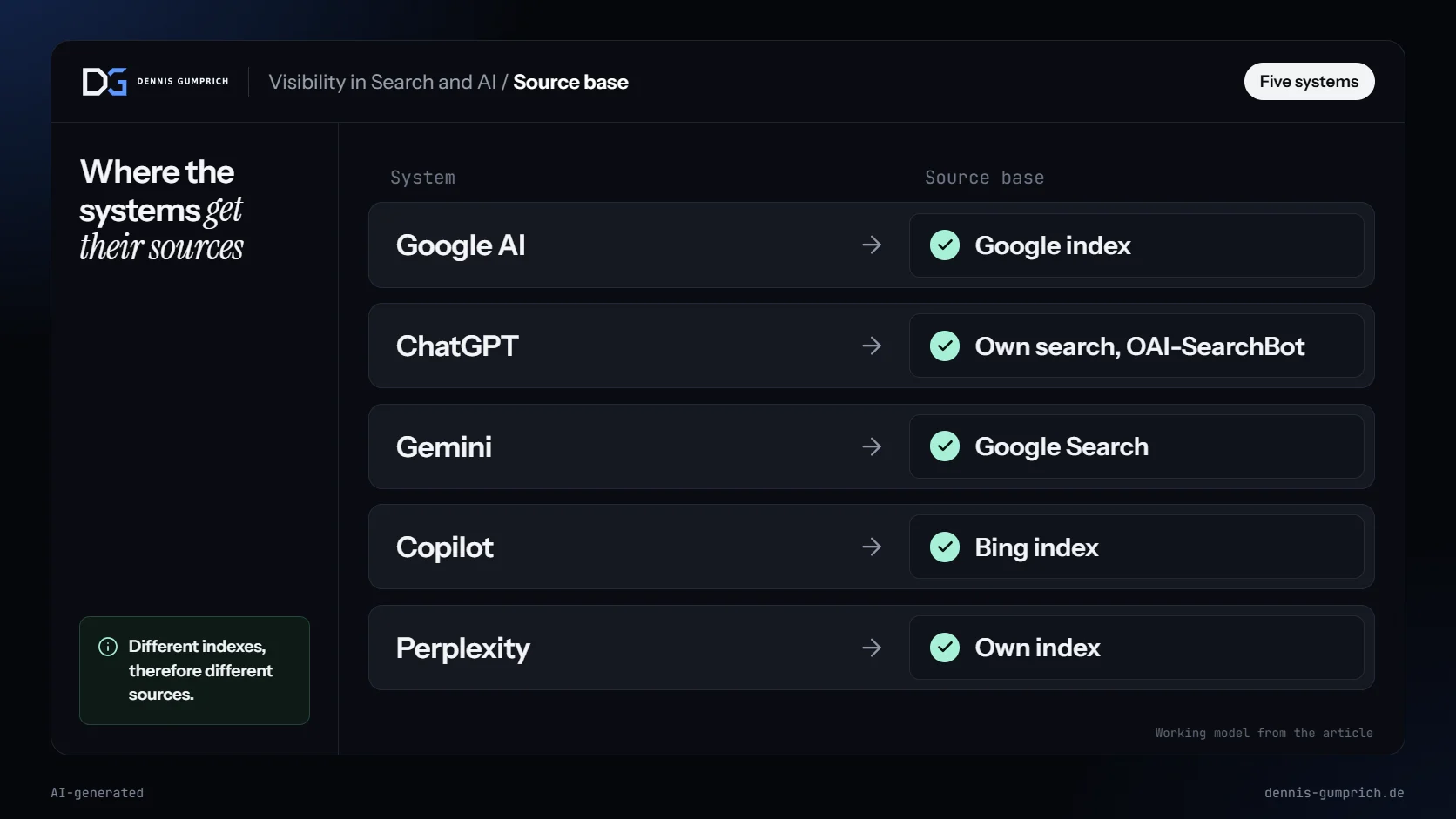
Five systems cover most of the usage: Google's AI Overviews and AI Mode, ChatGPT, Gemini, Microsoft Copilot and Perplexity. They differ mainly in where they get their sources from.
| System | Provider | Source base | What to watch |
|---|---|---|---|
| AI Overviews and AI Mode | Google index, query fan-out | Rankings, indexing, snippets allowed | |
| ChatGPT | OpenAI | Own web search with its own crawler | Allow OAI-SearchBot in robots.txt |
| Gemini | Google Search as the foundation | Same as Google | |
| Copilot | Microsoft | Bing index | Check indexing in Bing |
| Perplexity | Perplexity AI | Own index | Allow its crawler, clear answers |
Reach is distributed very unevenly. Google reaches the most people through search; according to OpenAI, ChatGPT had around 900 million weekly users in February 2026. Copilot is available in many companies through Microsoft 365, and Perplexity is used mainly for in-depth research. Which systems your target group actually uses is most reliably learned from sales and from the "how did you hear about us" question in forms.
In the marketing and communication teams I work with, ChatGPT is clearly ahead, often already with a business license. In Microsoft environments, Copilot is often the established solution: a specialist publisher and several industrial companies explicitly want to stick with it. Teams use Claude for brand voice and text drafts, while Perplexity is mostly still being tested.
The systems are almost always used for writing and research, hardly ever to check their own visibility. Accordingly, the most common question is: "We use ChatGPT and Copilot and we're happy. Why do we need anything else?" Usually two more follow: What does this add compared to Asana plus Claude? And where is our data stored, is it used for training?
How do AI search engines differ in their sources?
Significantly. With Google, most cited pages come from the top 10 of classic search. With ChatGPT, Gemini, Copilot and Perplexity, an Ahrefs analysis from July 2025 found that on average only around 12 percent of cited pages ranked in Google's top 10 for the same question.
Perplexity led with around 29 percent overlap, ChatGPT was at about 8 percent. Copilot showed the greatest overlap with Bing's results, which fits its connection to the Bing index. The authors explain the differences with separate search indexes, personalization and the fact that assistants search for many variants of a question rather than the exact wording.
This does not call for a separate strategy per system, but it is an important hint: if you only watch Google rankings, you only see part of your AI visibility. How GEO and classic SEO complement each other is described in GEO vs. SEO.
Which crawlers should you allow?
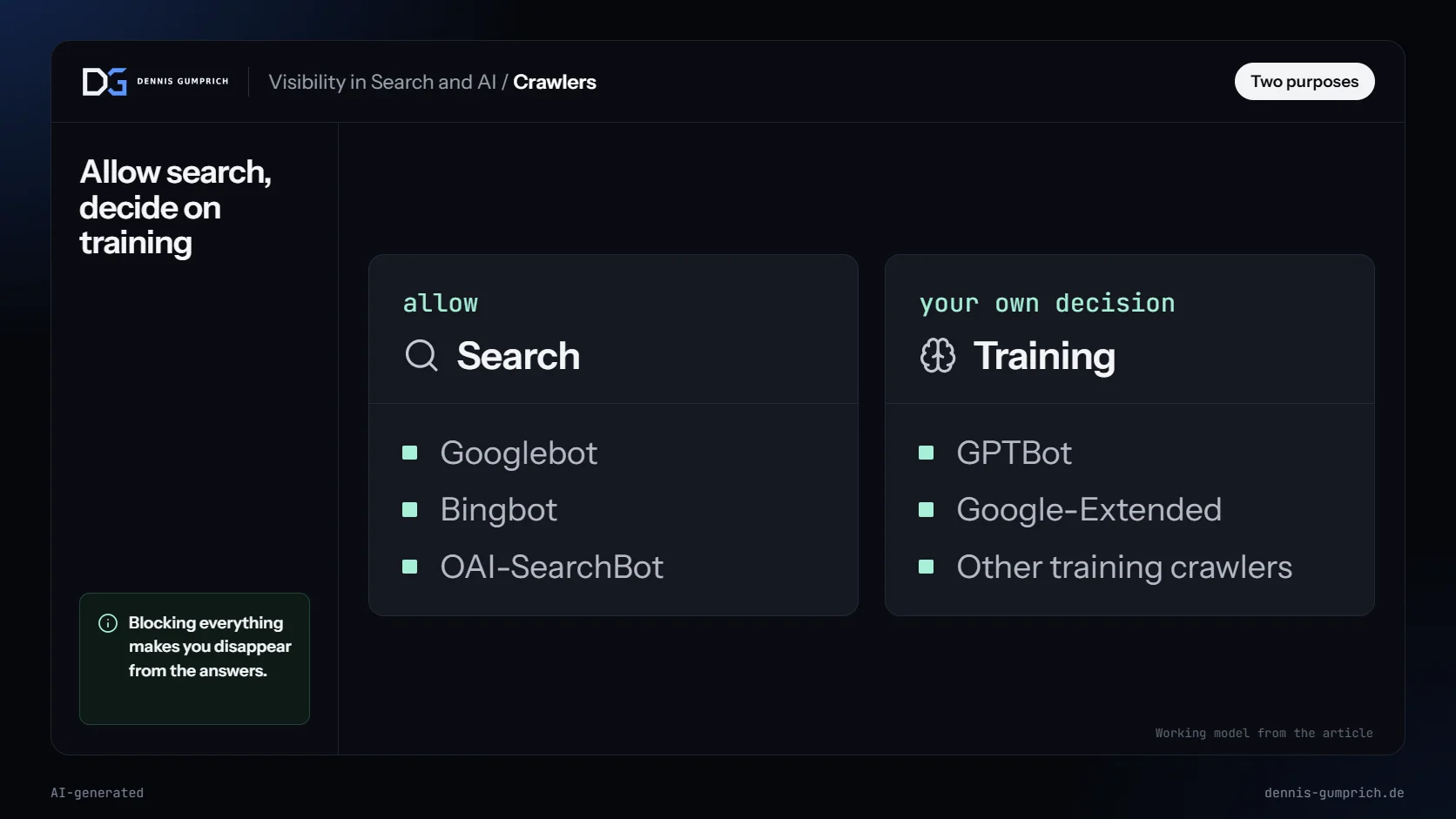
The crawlers responsible for search and answers: Googlebot, Bingbot, OpenAI's OAI-SearchBot and Perplexity's crawler. Whether you allow crawlers for training AI models is a separate decision.
OpenAI explicitly separates its crawlers. OAI-SearchBot surfaces websites in ChatGPT search. According to OpenAI, if you block it in robots.txt, you no longer appear in search answers, and changes take effect after about 24 hours. GPTBot, on the other hand, collects content for training models, and ChatGPT-User fetches pages when users trigger it. At Google, Google-Extended controls training and use in other Google systems, not the display in search.
| Crawler | Provider | Purpose | Recommendation |
|---|---|---|---|
| Googlebot | Search, AI Overviews, AI Mode | Allow | |
| Bingbot | Microsoft | Bing search, Copilot | Allow |
| OAI-SearchBot | OpenAI | ChatGPT search | Allow |
| GPTBot | OpenAI | Model training | Your own decision |
| Google-Extended | Training, other Google systems | Your own decision |
Review your robots.txt together with IT. In 2023 and 2024, many companies blocked all AI crawlers across the board to prevent training, and in doing so unknowingly excluded search as well.
What should a marketing team focus on?
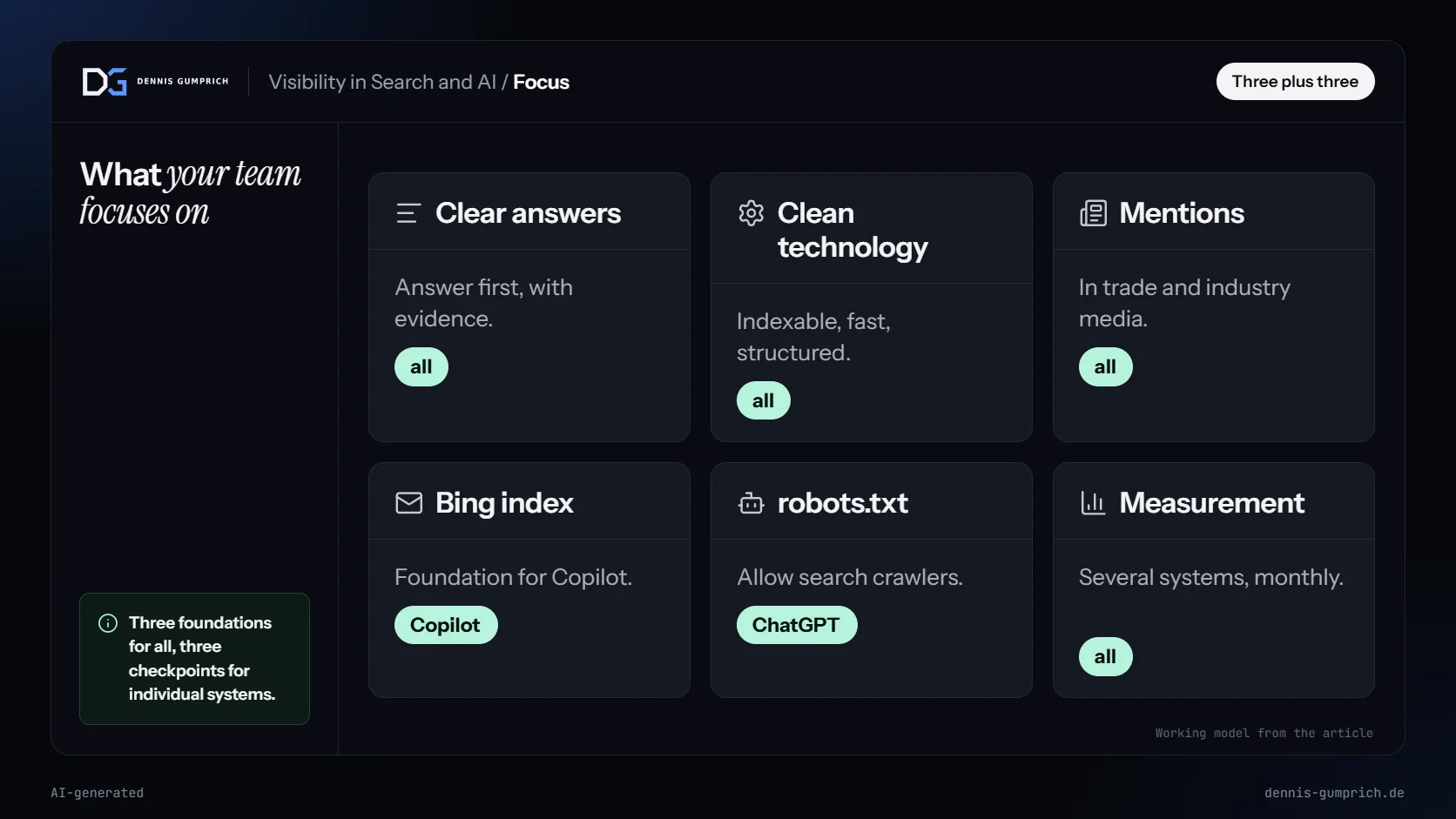
On a shared foundation that works for all systems, and on a few system-specific checkpoints. Separate measures per assistant are not worthwhile for most companies.
- FoundationContent that answers questions clearlyAnswer in the first sentence, evidence, your own experience. This works in every system, as described in GEO.
- FoundationClean technologyIndexable pages, fast loading, clear structure. Without this, no system will find you.
- FoundationMentions in trade mediaAll systems like to cite independent sources. More in Digital PR for AI visibility.
- CheckpointIndexing in BingCopilot relies on Bing. Check your pages in Bing Webmaster Tools.
- CheckpointCrawlers in robots.txtAllow search, decide deliberately on training.
- CheckpointMeasurement across several systemsOne prompt set, several systems, monthly. See Measuring AI visibility.
What is AI search engine optimization?
AI search engine optimization is another name for what goes by GEO, AEO or "SEO for AI": the work of being named and linked in AI answers. The terms are not strictly delineated.
For the Google world, Google explicitly assigns this work to classic SEO. For other systems, the checkpoints mentioned above are added. More important than the term is that you have one person who steers the work, and a prompt set against which you measure progress.
Five mistakes in dealing with AI search engines
- Blocking all AI crawlers across the boardIf you want to prevent training and block the search crawlers along with it, you disappear from the answers.
- Watching only GoogleThe sources of other assistants overlap little with Google rankings. Measure several systems.
- Ignoring BingCopilot uses the Bing index. Pages missing there hardly show up in Copilot.
- Building separate content for each systemThe foundation is the same. Separate variants per assistant cost a lot and achieve little.
- Drawing conclusions about all answers from single onesAnswers fluctuate heavily. Only judge after many queries over several weeks.
Self-check: are you set up for AI search engines?
Tick everything that applies to you.
a short note on AI search engines like ChatGPT, Perplexity and Copilot:
Prospects increasingly research with several AI systems. These systems use different sources, and their results only partially overlap with Google rankings. Still, one shared foundation works for all of them: clear answers, clean technology and mentions in trade media.
I suggest that we check our robots.txt in the short term to see whether we are accidentally blocking search crawlers, and that we measure our visibility in several systems from now on instead of only in Google.
Where to go next in this topic area?
This overview is the entry point into the topic area visibility in search and AI. Depending on your question, these articles go deeper:
- Basics: GEO, what it is and how teams organize it, plus GEO vs. SEO for the distinction.
- Shaping answers: Answer Engine Optimization and search intent as the basis of every brief.
- Google: how AI Overviews and AI Mode select their sources.
- ChatGPT and others: what makes content citable and how to write SEO texts with ChatGPT.
- Implementation in the team: anchoring GEO in the content process, from AI draft to citable text and digital PR for mentions in trade media.
- Technology: llms.txt, what the file does and doesn't do.
- Measuring: visibility without clicks for the KPIs, measuring AI visibility for tools and prompt sets.
Conclusion: one foundation, few differences
AI search engines differ in provider, index and crawler, but not in what they want to cite: clear, evidence-based answers from trustworthy sources. If you lay this foundation, you are well positioned for all systems. The system-specific work is limited to a few checkpoints: crawlers in robots.txt, indexing in Bing and measurement that covers more than Google.
Frequently asked questions
What AI search engines are there?
The most important ones are Google's AI Overviews and AI Mode, ChatGPT with web search, Gemini, Microsoft Copilot and Perplexity. In addition, there are assistants like Claude that can also search the web.
Is ChatGPT a search engine?
ChatGPT is an assistant that searches the web when needed and links sources. For search, OpenAI uses its own crawler called OAI-SearchBot. According to OpenAI, websites that block it do not appear in search answers.
Which sources does Microsoft Copilot use?
Copilot relies on the Bing index. In an Ahrefs analysis, Copilot showed the greatest overlap with Bing results. So check whether your most important pages are indexed in Bing.
Should we block AI crawlers in robots.txt?
You should allow search crawlers like Googlebot, Bingbot and OAI-SearchBot, otherwise you won't appear in AI answers. Whether you allow crawlers for training models, such as GPTBot or Google-Extended, is a separate decision.
What is AI search engine optimization?
The work of being named and linked in the answers of AI search engines. It is also called GEO, AEO or SEO for AI, and it builds on classic search engine optimization.
Where does your content process lose time today?
In 30 minutes, we look together at where unnecessary coordination, manual tasks, tool switching or repetitive content work cost you time today.
If you want to know which AI systems your target group searches in and how visible you are there, we look at your most important questions together.
Analyze your content process in 30 minutes Free of charge. You take away concrete starting points you can use internally right away.
Dennis Gumprich
Dennis helps marketing and communication teams fit generative AI into existing content processes without undermining quality, brand voice and approvals. Focus areas: content operations, AI governance and tool selection in mid-sized companies and corporations.
Transparency note: Dennis works for contentbird, a provider of AI-powered content software. Product mentions are marked in the article. More about Dennis (in German) · LinkedIn
Read more
Sources
- OpenAI: Overview of OpenAI Crawlers, documentation: OAI-SearchBot for ChatGPT search, blocked websites do not appear in search answers, changes after about 24 hours, GPTBot for training, ChatGPT-User for user-triggered fetches. Accessed November 7, 2026.
- Louise Linehan, Xibeijia Guan, Ahrefs: Only 12% of AI Cited URLs Rank in Google’s Top 10 for the Original Prompt, analysis of August 11, 2025, 15,000 questions, July 2025: around 12 percent overlap with Google's top 10, Perplexity around 28.6 percent, ChatGPT around 8 percent, Copilot with the greatest overlap with Bing, Perplexity with its own index. Vendor analysis by an SEO tool provider. Accessed November 7, 2026.
- Google Search Central: AI features and your website, documentation, as of December 10, 2025: query fan-out, control via snippet directives, Google-Extended for training and other Google systems. Accessed November 7, 2026.
- eWEEK: ChatGPT Nears 1 Billion Weekly Users, article of February 27, 2026 based on a blog post by OpenAI: around 900 million weekly active users. Accessed November 7, 2026.
How this article was created
This article was created with the help of AI. Structure, research and draft wording were developed with AI support. Professional assessment, review of the statements and the final version are the responsibility of Dennis Gumprich. The English version was translated with AI and reviewed. Read the original German version.
How reliable are the statements?
The crawler information comes from the documentation of OpenAI and Google, the overlap figures from a vendor analysis with data as of July 2025, the user figure from a company statement by OpenAI. The classification of the source base per system is simplified and may shift due to changes by the providers. Priorities and the list of mistakes are working models from consulting practice.


