
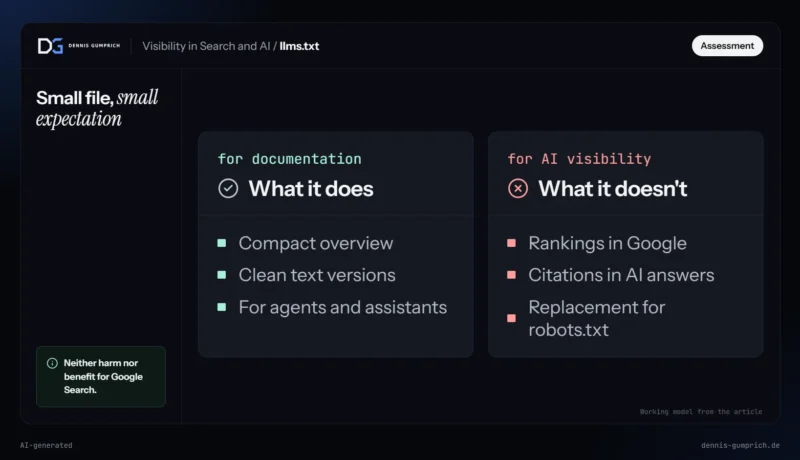

An llms.txt is quickly set up. If you expect more visibility from it, you are investing your time in the wrong place.
The llms.txt is a Markdown file at yourdomain.com/llms.txt with a short description and links to important content. Jeremy Howard proposed it on September 3, 2024, so that language models can grasp websites faster. In its guide to generative search, Google writes that an llms.txt neither harms nor helps visibility in Google Search. Major AI providers have not announced any use so far. It is therefore no lever for visibility in AI answers. It can make sense if you provide developer documentation or content for AI agents.
When the file can still be worthwhile and how to set it up in a few minutes is shown in the following sections. First, the structure of the file.
What is an llms.txt?
An llms.txt is a text file in Markdown format that sits in the root directory of a website. In a few lines, it describes what the website is about and links to the most important content, ideally as lean Markdown versions without navigation and ads.
Jeremy Howard published the proposal on September 3, 2024; the project is run by Answer.AI. The idea: language models have only limited space for context, and HTML pages contain a lot of clutter. A compact overview with links to clean text versions is meant to help them grasp a website quickly. A revised version of the proposal dates from August 2026. To this day, the file is not a binding standard.
How is an llms.txt structured?
The only mandatory part is a first-level heading with the name of the website or project. Recommended after that are a summary as a blockquote, explanatory paragraphs and sections with link lists. A section called "Optional" contains content that a system can skip when space is tight.

Each list item in the sections consists of a link in the format [Name](URL) and an optional note after it. Some websites add a second file called llms-full.txt with the complete text. Generators create both files from a sitemap. That saves work, but it does not replace deciding which content really belongs in it.
Do Google, ChatGPT and other AI systems use llms.txt?
Google does not. In its guide to generative search, Google writes that Google Search does not use such files and that an llms.txt neither harms nor helps visibility. No announcement is known from OpenAI, Anthropic or other major providers that they evaluate the file for their search.
Back in April 2025, Google's John Mueller wrote in an expert discussion that he was not aware of any AI service that had stated it uses the file. He compared it to the keywords meta tag, a self-declaration by website owners that search engines have long ignored. Server logs that website owners described in the same discussion showed hardly any fetches by AI crawlers.
At the same time, the file is spreading. A survey from September 2026 found a working llms.txt at 34 of 100 cybersecurity companies examined. But adoption is not proof of impact. Only your own server logs show whether a file is fetched and used.
How does llms.txt differ from robots.txt and the sitemap?
robots.txt controls who may crawl what. The sitemap lists all pages for search engines. llms.txt is a curated summary for language models. Only the first two are established standards with a clear effect.
| File | Purpose | Status | Effect on AI search |
|---|---|---|---|
| robots.txt | Allow or block crawling | Established standard | Direct: blocked content cannot be used |
| XML sitemap | List all pages for search engines | Established standard | Indirect through faster indexing |
| llms.txt | Summary with links for language models | Proposal | None for Google, not proven for others |
For your visibility in AI answers, robots.txt is far more important than llms.txt. If you block AI crawlers there across the board, you lose the chance to appear as a source. So first check which crawlers your robots.txt allows before you think about new files.
When is an llms.txt worthwhile?
When people specifically read your content with AI tools, for example developer documentation, API descriptions or knowledge areas that customers load into assistants or agents. For marketing websites that want to become visible in AI answers, it is no lever.
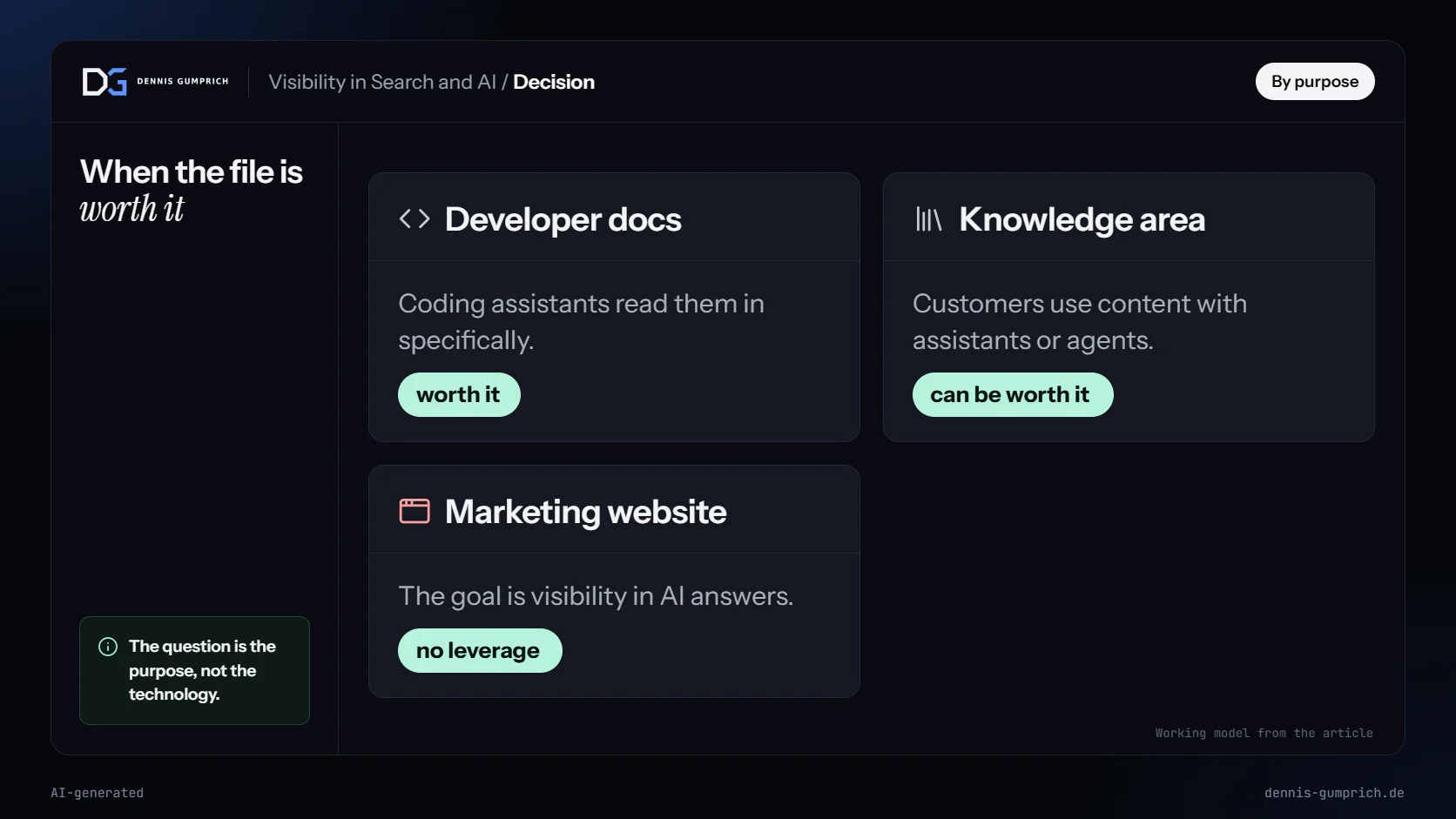
The decision depends less on the technology than on the purpose. Software vendors often provide their documentation so that coding assistants can read it in directly. There, a compact overview with clean text versions is useful, regardless of whether search engines evaluate it. A company website with service and product pages usually lacks this use case. There, the same working time achieves more if it goes into clear answers and evidence, as described in GEO (Generative Engine Optimization).
How do you create an llms.txt if you want one?
In five steps and with a fixed maintenance date. The effort is small as long as the file stays short and contains the same statements as your website.
- Step 1Define the purposeWho should use the file: developers, customers with assistants or internal agents? Without a purpose, it becomes a useless collection of links.
- Step 2Select contentChoose 10 to 30 pages that carry the purpose. More does not make the file better.
- Step 3Approve the short descriptionThe summary is a self-declaration. It must match your website and press texts and be approved like any key statement.
- Step 4Create the fileA generator provides the draft, the editorial team shortens it. Place the file at /llms.txt.
- Step 5Maintenance and logsCheck the file at every relaunch and at least every six months. Evaluate whether and by whom it is fetched.

Five mistakes in dealing with llms.txt
- Selling or buying it as a GEO measureIt has no effect for Google and is unproven for other providers. Budget for visibility belongs in content and evidence.
- Making different statements than on the websiteMueller warns about misuse of the file. Contradictions between the file and the pages do more harm than the file does good.
- Including the entire websiteA file with hundreds of links misses the purpose of a compact overview.
- Forgetting robots.txtIf you block AI crawlers there, llms.txt won't win anything back.
- Never touching it againAn outdated short description is worse than none. Set a maintenance date.
Self-check: do you need an llms.txt?
Tick everything that applies to you.
a short note on the offer of an llms.txt:
The llms.txt is a proposal for a file that gives language models a summary of our website. Google explicitly writes that it neither harms nor helps visibility in Google Search. Major AI providers have not announced any use.
I suggest not planning any budget for it. It is more important that our robots.txt does not block AI crawlers unnecessarily and that our most important pages answer customer questions clearly.
Conclusion: small file, small expectation
The llms.txt is a reasonable proposal for a specific purpose: providing content in a way that language models can read it in specifically. It can be useful for developer documentation and knowledge areas. As a lever for visibility in AI answers, it is of no use as things stand. Google says so explicitly, other providers remain silent. If you create one, keep it short, approve it like any key statement and use logs to check whether it is read at all.
Frequently asked questions
What is an llms.txt?
A Markdown file in the root directory of a website that gives language models a short description and links to the most important content. It was proposed by Jeremy Howard in September 2024 and is not a binding standard.
Does an llms.txt improve rankings in Google?
No. In its guide to generative search, Google writes that an llms.txt neither harms nor helps visibility and rankings in Google Search.
Does ChatGPT read the llms.txt?
OpenAI has not announced any use for search. Only your server logs show whether individual tools fetch the file. Don't rely on it for visibility in ChatGPT.
How do I create an llms.txt?
Create a Markdown file at /llms.txt: a heading with the name, a short summary as a blockquote, then sections with links to the most important pages. A generator provides a draft; check the selection and the short description yourself.
What is the difference between llms.txt and robots.txt?
robots.txt bindingly controls which crawlers may fetch which areas. llms.txt is a voluntary summary for language models without any controlling effect.
Where does your content process lose time today?
In 30 minutes, we look together at where unnecessary coordination, manual tasks, tool switching or repetitive content work cost you time today.
If you need to evaluate offers around AI visibility, we sort out together what works and what you can skip.
Analyze your content process in 30 minutes Free of charge. You take away concrete starting points you can use internally right away.
Dennis Gumprich
Dennis helps marketing and communication teams fit generative AI into existing content processes without undermining quality, brand voice and approvals. Focus areas: content operations, AI governance and tool selection in mid-sized companies and corporations.
Transparency note: Dennis works for contentbird, a provider of AI-powered content software. Product mentions are marked in the article. More about Dennis (in German) · LinkedIn
Read more
Sources
- Jeremy Howard, Answer.AI: llms-txt, project description of the proposal of September 3, 2024, version of August 2026, documentation at llmstxt.org: purpose, placement at /llms.txt, structure with mandatory heading, blockquote, link lists and "Optional" section. Accessed November 7, 2026.
- Google Search Central: Optimizing your website for generative AI features on Google Search, guide, as of July 10, 2026: Google Search does not use llms.txt and similar files, an llms.txt neither harms nor helps visibility. Accessed November 7, 2026.
- Roger Montti, Search Engine Journal: Google Says LLMs.Txt Comparable To Keywords Meta Tag, article of April 17, 2025: statement by John Mueller that no AI service has stated it uses the file, comparison with the keywords meta tag, notes on server logs and risk of misuse. Accessed November 7, 2026.
- hrbrmstr, ai.rud.is: Cyber100 llms.txt census, survey of September 4, 2026: working llms.txt at 34 of 100 cybersecurity companies examined, no evaluation of actual fetches. Private expert blog. Accessed November 7, 2026.
How this article was created
This article was created with the help of AI. Structure, research and draft wording were developed with AI support. Professional assessment, review of the statements and the final version are the responsibility of Dennis Gumprich. The English version was translated with AI and reviewed. Read the original German version.
How reliable are the statements?
The structure and origin of the file come from the proposal's project description, the statements on Google from the official documentation and a trade medium. The adoption figure comes from a small sample and is not representative. The decision aid, process and list of mistakes are working models from consulting practice. The situation may change if AI providers announce use.


