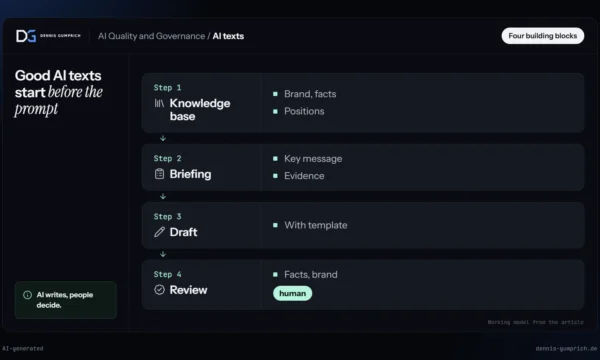

The agency that grows in 2027 no longer sells texts but judgment: it decides, reviews and takes responsibility for what AI produces for its clients.
An AI agency in the sense of this article uses AI in its own operations so that standard services largely run automatically and the team has more time for consulting, quality and client relationships. The pressure is real: in the GWA spring monitor 2026, a survey by the German association of communications agencies, 49 percent of agency heads see the replacement of services by AI as a barrier to growth. The entry point is usually an AI wrapper such as Langdock, which bundles models, agents and data protection for the whole team. The next stage is a content operations platform that brings knowledge, planning, production and approval together in a fixed process for each client.
How the agency business is shifting, which new tasks are emerging and what the route from AI wrapper to fully orchestrated production looks like is shown in the following sections. First, the question of what an AI agency actually means.
What is an AI agency?
The term has two meanings. It refers to agencies that sell AI projects as a service, and to agencies that use AI in their own operations to deliver their services to clients faster and better. This article deals with the second meaning: the communications, PR and content agency that converts its business model to AI.
For these agencies, AI is not an additional product but a shift in the work. Research, drafts, channel adaptations and routine posts are increasingly created automatically. What remains and gains value is the work before and after: understanding the client, deciding what gets published, reviewing, and personal relationships with media and contacts.
How is AI changing the agency business through 2027?
Standard services lose price, consulting and quality assurance gain. Clients expect AI competence from their agency and at the same time do part of the work themselves. Agencies that automate routine and invest the time gained in judgment and client care are growing. Agencies that keep selling hours for standard texts come under pressure.
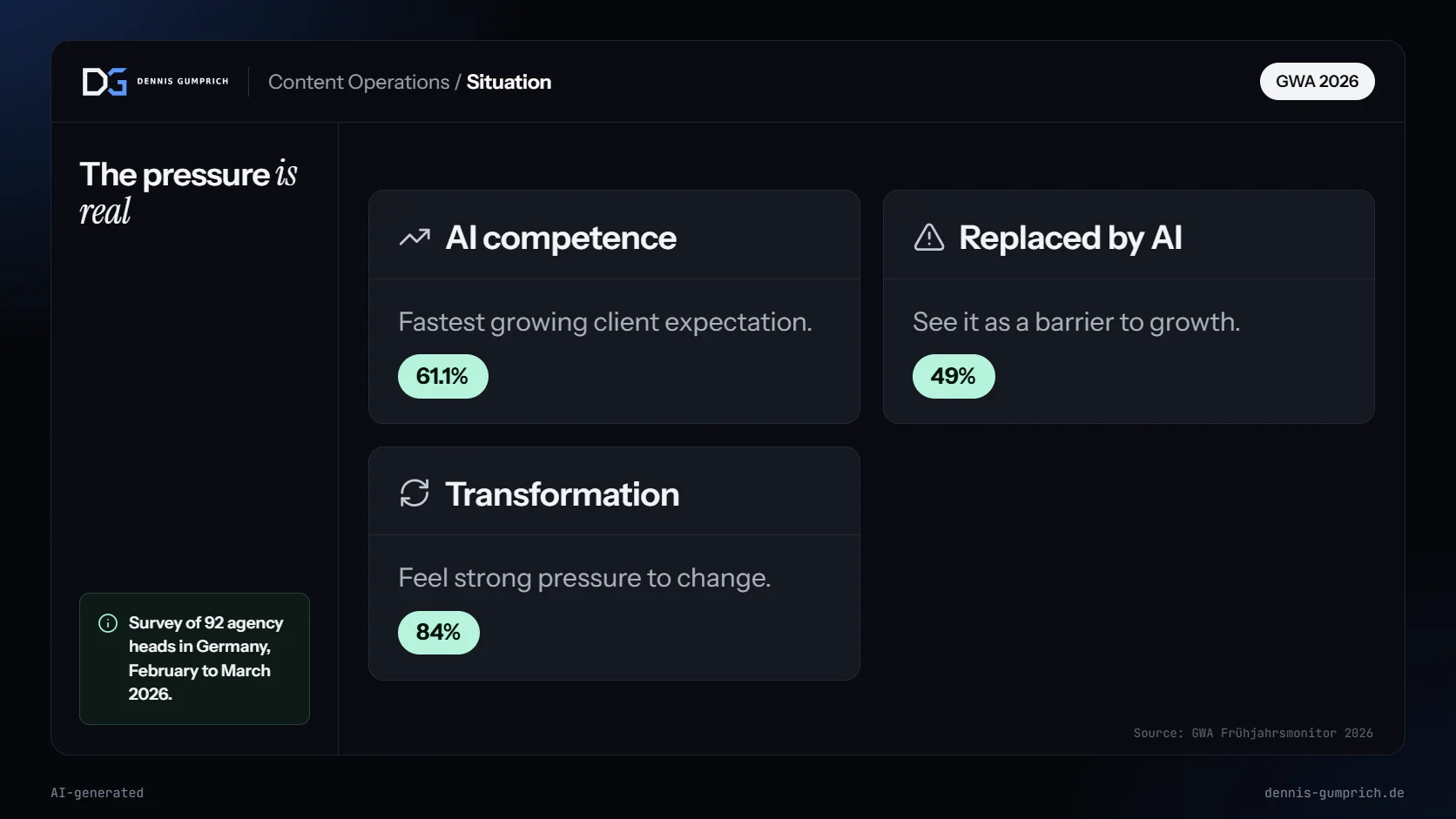
The GWA spring monitor 2026 shows the direction. It surveyed 92 owners and managing directors of agencies in the Gesamtverband Kommunikationsagenturen, the German association of communications agencies. 61.1 percent name AI competence as the client expectation that is growing fastest. 49 percent see the replacement of services by AI as a barrier to growth. 84 percent feel strong or very strong pressure to transform, and around 27 percent plan to cut jobs in 2026.
One reason for the pressure: clients can now do some things themselves. With AI-assisted programming, often called vibe coding, they build simple websites without an agency. With chat tools, they write standard texts themselves. The business of pure execution is shrinking. What clients continue to buy is orientation: strategy, the assessment of whether something is right, and execution that runs reliably across many channels.
Where does an agency owner see the future of his agency work?
In quality, not volume. The agency of the future automates standard tasks so that people have time for review, improvement and client care. AI takes over production, people stay in the loop and are responsible for the result.
An agency owner I recently got to know in a conversation runs a communications agency with an editorial team of six. Each person looks after around five clients on average. The agency has just repositioned itself and made a deliberate decision: not AI first, but AI driven with humans in the loop.
In the editorial team, the team already works well with Langdock, including its own agents for researching journalists and press topics and for topic suggestions. His assessment: the tools are there, but the work is not yet orchestrated end to end. For him, that is the next stage.
His picture of the future is clear. Clients ask less "Make me a poster" and more "Tell me whether what I am doing is right". Automation is meant to free him up for quality assurance: an editor reviews an AI draft for LinkedIn based on an AI-supported editorial plan, sharpens it and then has time to look after the client.
This view matches what I hear in many conversations with agencies: serving more clients with the same team is a welcome effect. The real driver is a different one. Agencies want to earn money where they are better than AI, and that is judgment about content, not its production.
Which tasks emerge when clients downsize their communications?
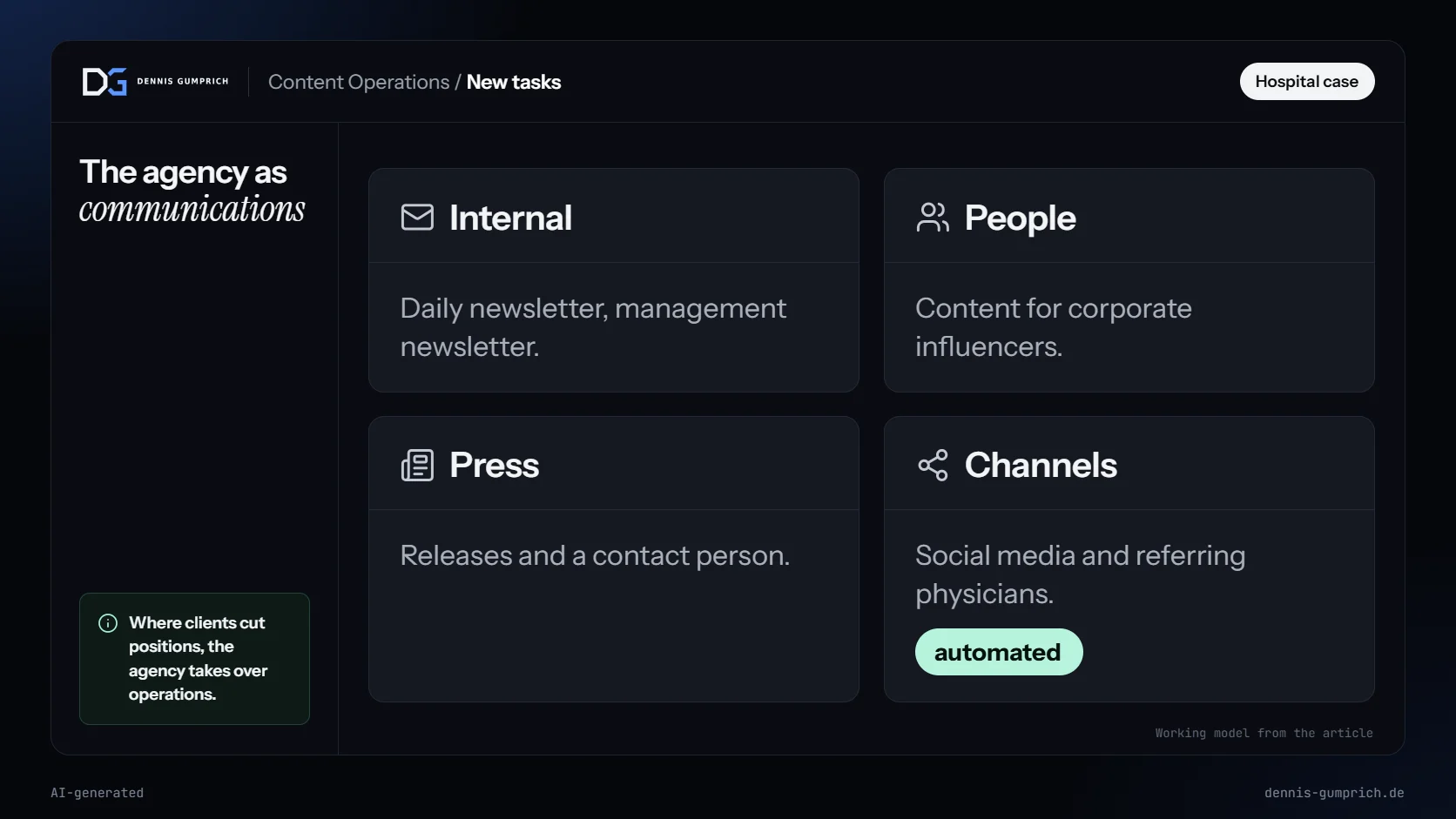
Where companies cut communications positions, the agency takes on the role of the internal communications department. That ranges from the daily employee newsletter to content for corporate influencers to press work. It only becomes economically viable if routine runs automatically and people are free for conversations and review.
The same agency owner is seeing large private hospital groups shrink their communications departments massively. One hospital no longer has its own communications department. His agency is the in-house communications there: a daily newsletter to employees, a management newsletter published weekly to monthly, content for internal corporate influencers, press releases, social media and communication with referring general practitioners.
His principle: routine such as social media posts for recruiting runs automatically. The time gained flows into what counts for the press: a contact person who answers the phone and can respond to questions. For retainer clients, time is still on the timesheet, but for the same time they get considerably more.
| Task | What AI can take over | What stays with people |
|---|---|---|
| Daily employee newsletter | Collect news, summarize, draft in the house tone | Selection, weighting, approval |
| Management newsletter | Draft from bullet points and dates | Message, tone, alignment with management |
| Content for corporate influencers | Post suggestions per person from a central topic | Alignment with the people, personal touch |
| Press releases | Draft, variants, adaptation for social media | Fact check, approval, contact person for media |
| Social media | Series, for example for recruiting, planning and publishing | Topic selection, responding to comments |
| Communication with referrers | Prepare specialist information for referring physicians | Professional review, personal contact |
How internal communications works with AI in the process is described in AI in internal communications. For employee content there is Corporate influencers: brand voice and approval, for press work Press work with AI.
What does an AI wrapper such as Langdock do for agencies?
An AI wrapper bundles several AI models under one interface with permission management and data protection. For agencies, this is the sensible first step: the whole team works with the same models, custom agents take over recurring tasks, and client data stays in a vetted environment.
For agencies, Langdock is in my view a first-class AI wrapper. The Berlin-based platform offers a model-agnostic chat, agents for recurring tasks, workflows and integrations into existing tools. According to the vendor, it is hosted in the EU, certified to ISO 27001 and SOC 2 Type II and used by more than 15,000 companies. Especially for agencies that process client data, this is a solid basis for letting the whole team work safely with AI.
For the daily work of individual editors and consultants, an AI wrapper is a big step forward compared with private chat accounts. If you want to check whether an approved assistant in the company is enough for marketing, you will find the trade-offs in Copilot is approved. Is that enough for marketing?
Where does an AI wrapper reach its limits in everyday agency work?
Where many individual AI results are supposed to become reliable production for many clients. An AI wrapper is built for working with models, not for steering content across clients, channels, deadlines and approvals.
Four gaps are typical and become noticeable in everyday agency work as soon as more than a handful of clients are served:
- Client knowledge per account. Brand voice, target groups, strategy and metrics of each client need to sit permanently in one place and apply automatically to every piece of content, not be scattered across individual chats or assistants.
- A shared pipeline. Who can see which content for which client is in which status, what is published this week and where something is stuck?
- Approvals with clients. Clients and experts need to be able to comment and approve without learning yet another tool.
- Review and publishing. Review rules per client, for example on brand voice or mandatory information, and publishing to CMS, newsletter and social media from the same process.
These gaps are not a shortcoming of the wrapper but a question of the stage of development. How individual tools and a platform compare financially is shown in Individual tools or platform.
What is the next stage after the AI wrapper?
A content operations platform that connects knowledge, strategy, planning, production, review and publishing in a fixed process for each client. The agency sets up each client as its own project, produces content for all channels from one central briefing and steers approvals and quality in one place.
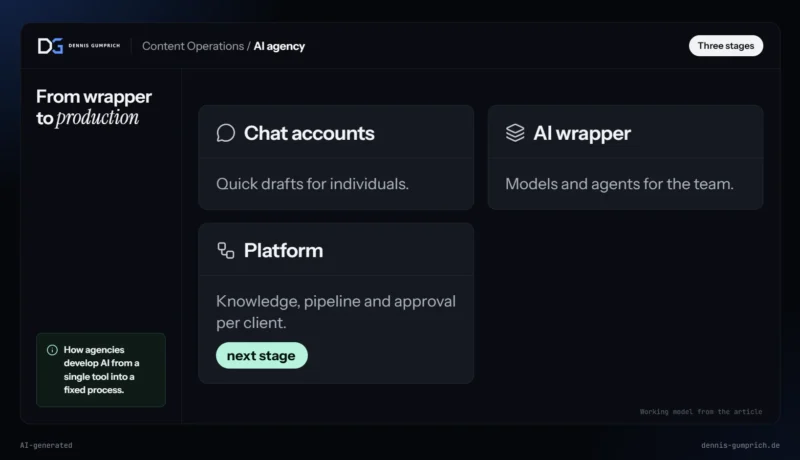
| Stage | Typical tool | What it solves | What remains open |
|---|---|---|---|
| 1. Individual chat accounts | Private or individual licenses | Quick drafts for individuals | Data protection, consistent quality, knowledge |
| 2. AI wrapper | Langdock | Models, agents and data protection for the whole team | Steering across clients, channels and approvals |
| 3. Content operations platform | contentbird* | Client knowledge, pipeline, approvals, review and publishing per client | Rollout needs a pilot client and clear responsibilities |
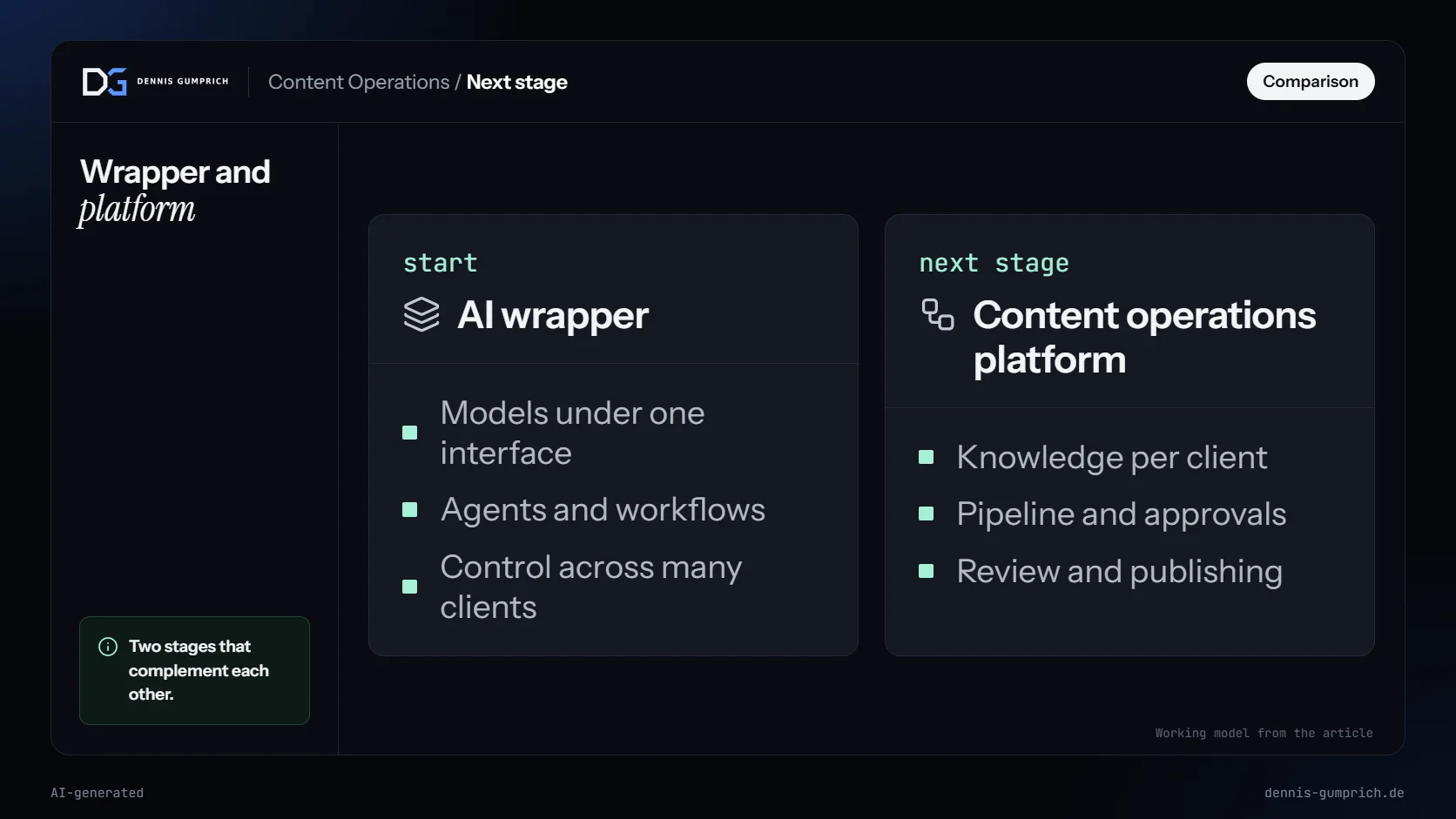
In contentbird, which I work for, it looks like this: each client is a project with a stored strategy, target groups and brand voice that the AI draws on for every piece of content. Jobs run through a shared content pipeline with workflows. AI checks review content against corporate identity, SEO or GEO criteria. AI campaigns derive the content for each channel from one central briefing, and publishing happens from the same platform. The two stages are not mutually exclusive: many teams continue to use the AI wrapper for free work with models and the platform for production for clients.
How such a process is generally structured is described in AI content operations: building the process. Which tasks can be handed over to agents is covered in AI agents in the content team.
How does an AI agency bill when AI saves time?
Many agencies keep selling time but deliver considerably more in that time. In the medium term, billing for recurring services shifts to flat fees and retainers oriented towards results. What matters is to visibly redirect the time gained into consulting and quality instead of just pricing it in.
With retainer clients, the switch is easiest: the client buys a budget and gets more for it, and the discussion about individual hours disappears. It is harder with project business, which in the GWA spring monitor 2026 still accounts for around 62 percent of gross income. Here it helps to offer standard services as packages with a fixed scope and to show consulting, strategy and review separately. How to set up the calculation for an investment in software is shown in Calculating the business case for content software.
How does an agency start the transformation?
With a pilot client, not with the whole portfolio. A client for whom the agency serves many channels shows fastest where time is lost and what can be automated.
- Sort the portfolio. Clients served holistically, with strategy, several channels and ongoing production, are best suited. One-off jobs such as an annual magazine come later.
- Choose a pilot client. Ideal is a client for whom you handle website, social media, press and internal communications. The people who serve this client day to day belong in the test from the start.
- Store client knowledge. Brand voice, target groups, strategy, contacts and good example texts should be captured cleanly once in one place.
- Define process and approvals. Who writes the briefing, who reviews, who approves on the client side? Only then does automating individual steps pay off.
- Measure and bill. Record beforehand how long a piece of content per channel takes today, and compare after four weeks. With these figures, billing can be adjusted on solid grounds.
Five mistakes when transforming into an AI agency
- Selling AI as a cost-cutting programIf you only translate time gained into lower prices, you lose margin without gaining quality.
- Everyone with their own toolWithout a shared wrapper or shared platform, quality depends on who prompts how.
- Spreading client knowledge across chatsBrand voice and strategy belong in a fixed place per client, not in individual chat histories.
- Handing over the reviewFacts, approvals and responsibility stay with people. This is exactly what clients will pay for in the future.
- Starting with the whole portfolioOne pilot client with many channels shows more than a half-hearted start with everyone.
Self-check: how far along is your agency on the way to becoming an AI agency?
Tick everything that applies to you.
A short assessment of how we develop our agency business with AI:
Clients increasingly expect AI competence and partly handle standard services themselves. In the GWA spring monitor 2026, 49 percent of agency heads see the replacement of services by AI as a barrier to growth. Our value will lie in consulting, review and client care.
I suggest we automate standard tasks for one pilot client with many channels, store the client knowledge centrally and measure after four weeks how much time we gain. On this basis we decide on tools and billing.
Conclusion: the agency becomes the authority for judgment and quality
AI takes standard production off agencies' hands and shifts their value to where people are better than models: in decisions, review and relationships with clients and media. An AI wrapper such as Langdock is the right first step because it lets the whole team work safely with AI. The next stage brings order to production for many clients: knowledge per client, a shared process, approvals and publishing in one place. Agencies that combine both serve more clients with the same team and invest the time gained in what clients keep paying for.
Frequently asked questions
What is an AI agency?
The term means either an agency that sells AI projects or an agency that uses AI in its own operations. For communications and content agencies, the second meaning is decisive: routine runs automatically, and the team concentrates on consulting, review and client care.
Will agencies be replaced by AI?
Individual services yes, agencies as a whole no. In the GWA spring monitor 2026, 49 percent of agency heads see the replacement of services by AI as a barrier to growth. At the same time, demand for AI competence, consulting and reliable execution across many channels is rising.
Is Langdock an AI wrapper?
Yes. Langdock bundles various AI models under one interface and adds agents, workflows, integrations and permission management. According to the vendor, the platform is hosted in the EU and certified to ISO 27001 and SOC 2 Type II.
Do agencies need an AI wrapper and a content platform?
Not necessarily both from the start. An AI wrapper is enough to begin with. As soon as many clients, channels and approvals need to be steered, a content operations platform pays off. Many teams then use both: the wrapper for free work with models, the platform for production for clients.
How is the role of editors in agencies changing?
They write fewer first drafts and review, improve and steer more. An editor reviews an AI draft, sharpens it and uses the time gained for conversations with the client and new ideas.
Where does your content process lose time today?
In 30 minutes, we look together at where unnecessary coordination, manual tasks, tool switching or repetitive content work cost you time today.
You get a concrete assessment of which tasks you can simplify, automate or organize better, and where AI and tools actually help instead of adding complexity.
Analyze your content process in 30 minutes Free of charge. You take away concrete starting points you can use internally right away.
Dennis Gumprich
Dennis helps marketing and communication teams fit generative AI into existing content processes without undermining quality, brand voice and approvals. Focus areas: content operations, AI governance and tool selection in mid-sized companies and corporations.
Transparency note: Dennis works for contentbird, a provider of AI-powered content software. Product mentions are marked in the article. More about Dennis (in German) · LinkedIn
Read more
Sources
- Gesamtverband Kommunikationsagenturen GWA: GWA Frühjahrsmonitor 2026 (in German), online survey by the German association of communications agencies among 92 owners and managing directors of GWA agencies, field period February 2 to March 2, 2026: 61.1 percent name AI competence as the fastest growing client expectation, 49 percent see the replacement of services by AI as a barrier to growth, 84 percent see strong or very strong pressure to transform, around 27 percent plan job cuts for 2026, around 62 percent of gross income from project fees. Accessed November 9, 2026.
- Langdock GmbH: Website, vendor information on features (model-agnostic chat, agents, workflows, integrations), hosting in the EU, certifications to ISO 27001 and SOC 2 Type II and more than 15,000 companies using it. Accessed November 9, 2026.
How this article was created
This article was created with the help of AI. Structure, research and draft wording were developed with AI support. Professional assessment, review of the statements and the final version are the responsibility of Dennis Gumprich. The English version was translated with AI and reviewed. Read the original German version.
How reliable are the statements?
The figures on the agency market come from an association survey among 92 agency heads in Germany and are not representative of all agencies or other markets. The information on Langdock is vendor information. The account of the agency owner is based on a conversation in November 2026 and is anonymized. Stages, task table and list of mistakes are working models from consulting practice. Transparency note: I work for contentbird, which is named in the article as a content operations platform.