

Internal communications keeps control if it defines three things before the first prompt: which content may go into which approved tool, who checks and approves every text for facts, tone and confidentiality, and how you measure whether a communication occasion has reached its goal. Add a knowledge base with sender profiles and approved facts, and the early involvement of the works council or employee representatives and data protection.
How does internal communications use AI without losing control?
By treating AI not as a writing aid for individuals but as part of a fixed workflow with rules, roles and measurement. Use has long been routine in internal communications. What is usually missing is the framework: who may put what into which tool, who is responsible for the text and whether the communication works in the end.
The figures from the Trendmonitor Interne Kommunikation 2026 by SCM and Staffbase show this gap clearly. Of 431 respondents from internal communications in Germany, Austria and Switzerland, 85.6 percent already use AI in their daily work. Among users, 93.9 percent use text tools such as ChatGPT and 72.4 percent translation tools such as DeepL. At the same time, only 32.8 percent say they have mechanisms to check whether the goals of internal communications have been achieved. Use is broad, steering is narrow.
The pattern is not limited to internal communications. In Gartner's 2026 CMO Spend Survey, 70 percent of the marketing leaders surveyed say their internal processes are not yet mature enough to use and scale AI effectively. The workflow makes the difference, not the tool.
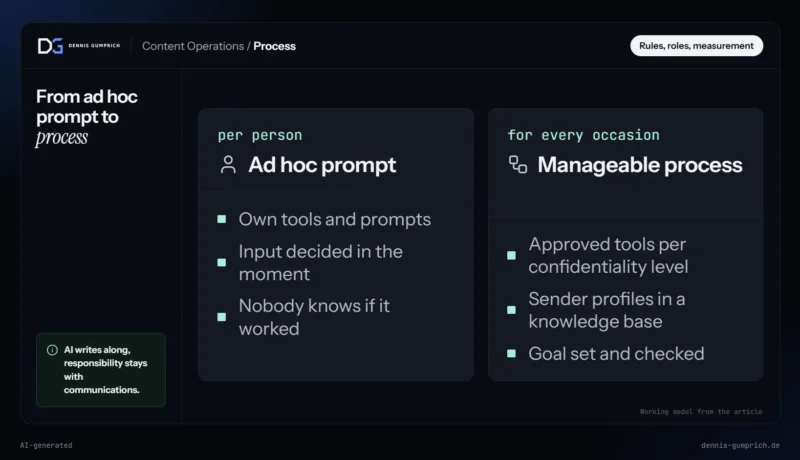
Everyone uses their own tool and prompts. What goes in is decided in the moment. Tone and facts are checked by whoever has time. Nobody knows whether the text worked.
Approved tools with clear rules for confidential content, a shared knowledge base with sender profiles, a named person for review and approval and, before every important occasion, a goal you check afterwards.
How AI experiments in the content team generally become a process is described in AI content operations: from experiments to a process. This article is about what is different in internal communications.
For which internal communications tasks is AI worthwhile?
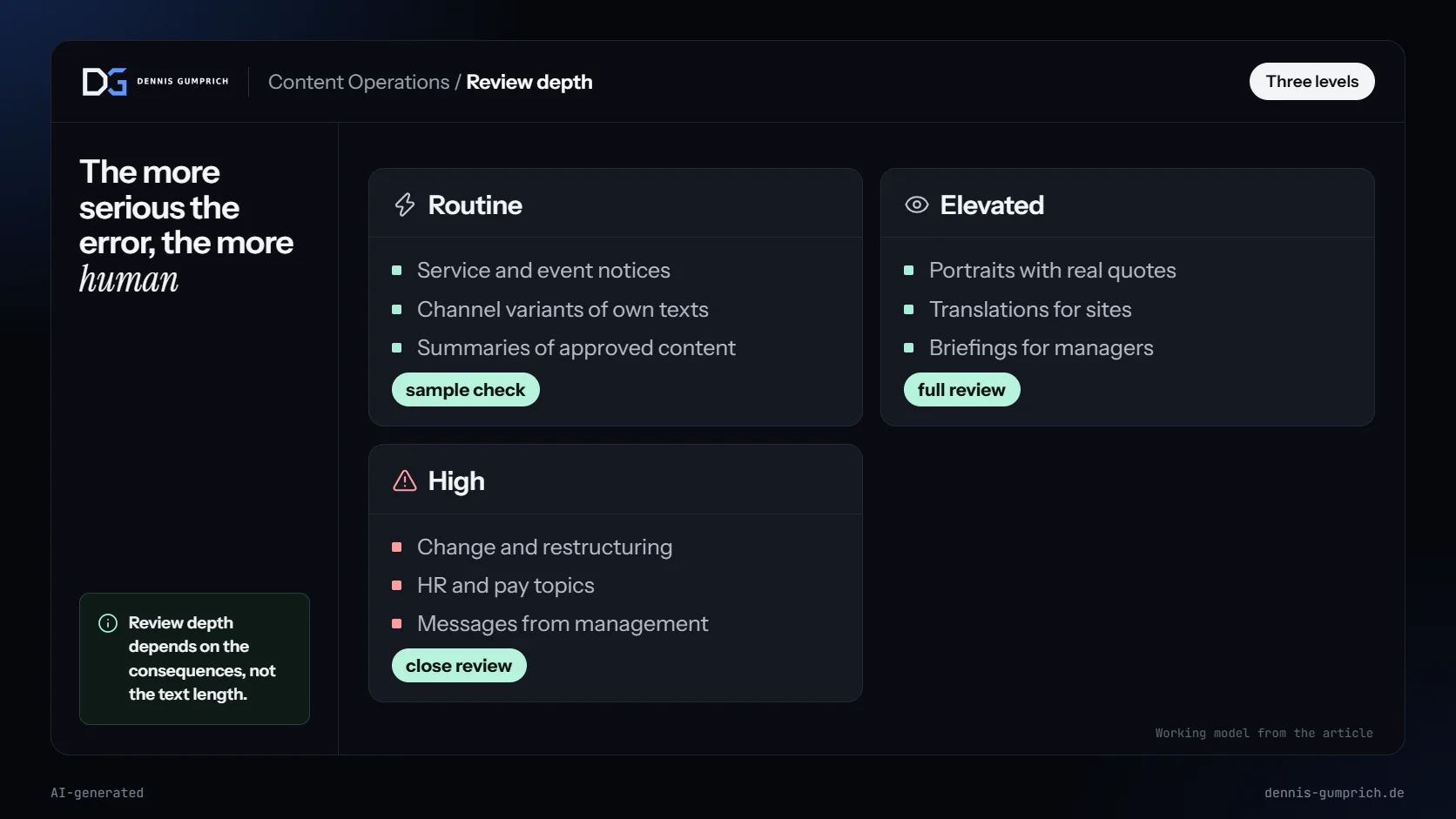
For all tasks where a good draft, a variant or a translation should be available quickly and a person can check the result in reasonable time. Review depth does not depend on text length but on the consequences of an error. A canteen notice can take a quick look, a notice on restructuring cannot.
| Use case | What AI handles well | What stays with people | Review depth |
|---|---|---|---|
| Intranet news | First draft from bullet points, headlines, teasers, variants for app and newsletter | Facts, dates, contacts | Routine to elevated |
| Employee magazine | Outline, interview questions, first draft from interview notes, shortening | Agreeing quotes with the person, choice of story, image rights | Elevated |
| Manager communications | Key messages, questions and answers for team meetings, short versions for the opening | Message, approval by the sender, context for the team | Elevated |
| Change communications | Question catalog from the workforce's perspective, variants per audience, plain language | Content, timing, alignment with management, legal and employee representatives | High |
| Translation for sites | Raw translation, applying a glossary | Review by someone with language and local knowledge, form of address per country | Elevated |
| Summaries | Short version of long documents, policies and approved presentations | Comparison with the original, no attributions without evidence | Routine to elevated |
Manager communications is especially worthwhile. According to the Trendmonitor, managers most often receive information and briefings from corporate communications (43.3 percent) or use guides, templates and editorial aids (41.5 percent). Almost 18 percent of respondents say their managers receive no support at all. As the biggest hurdle in involving managers, almost three quarters cite a lack of understanding of communication, around 63 percent lack of time. An AI-supported briefing package of key message, expected questions and a proposal for the team meeting saves time on both sides here, provided it is approved before distribution.
What makes internal communications different from marketing when using AI?
Three things: the sender is the employer, readers know the reality behind every message, and much content is confidential before it is published. An error in marketing costs reach. An error in internal communications costs trust, and that cannot be won back with the next campaign.
The workforce compares every message with what they experience at work. A smooth, interchangeable tone is therefore noticed more quickly. At the same time, internal communications is the most important source for many: in the Trendmonitor, 62.6 percent name management or internal communications as their first source of relevant information in the company, 14.4 percent their direct manager and 11.1 percent the grapevine. Keeping this role requires texts that sound like their sender and whose facts are right.
Then there is the topic profile. In the Trendmonitor 2026, change and transformation topics rank first among topics for the first time at 51.5 percent, ahead of HR topics at 49.2 percent. These very topics are confidential before announcement and affect jobs. That is why the question of what may go into an AI tool matters here at least as much as the quality of the text.
Which information does not belong in an AI tool?
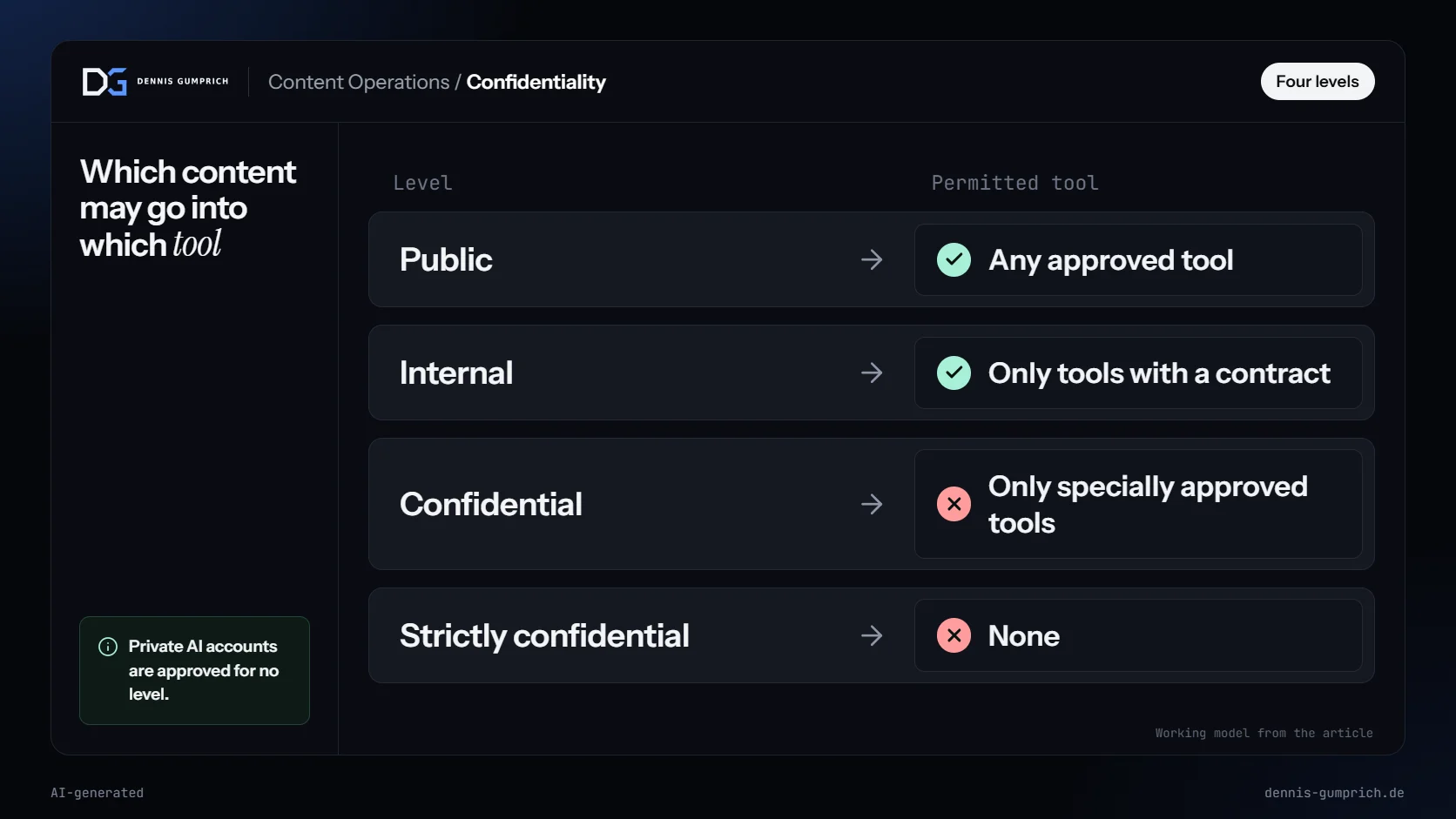
Everything whose disclosure before the official announcement would cause damage, and everything with personal data for which your tool is not approved. This includes personnel data, plans on sites and jobs before announcement, figures from board papers and anything that may count as inside information. The simplest rule: every confidentiality level gets a list of approved tools, and private accounts are on none of them.
In practice, a four-level grid is enough. If you already have a classification for documents, add one column: which AI tool is approved for which level.
| Level | Examples from internal communications | Approved AI tools |
|---|---|---|
| Public | Press releases, published website content, job ads | Any tool approved by the company |
| Internal | Intranet news, guides, event notices | Only tools with a business contract and data processing agreement |
| Confidential | Plans before announcement, drafts for change notices, results before publication | Only an environment specially approved for this, access limited to named people |
| Strictly confidential | Personnel data, individual cases, possible inside information, negotiation status | None |
The concern is widespread. In Bitkom's AI study from September 2026, a representative survey of companies in Germany, companies already using AI cite data protection requirements as the biggest hurdle at 66 percent. 45 percent fear that company data could fall into the wrong hands. And in the Trendmonitor, 42.4 percent of those who do not use AI in internal communications say they are not allowed to. A ban without an approved alternative, however, often only shifts use into private accounts. What that costs is covered in Shadow IT in marketing.
Which questions to ask a vendor about data processing, sub-processors, processing location and training is described in detail in GDPR-compliant content marketing software. For internal communications, the most important addition: clarify not only whether a tool is secure, but also which content stays out anyway.
The Generative AI Profile (NIST AI 600-1) of the US National Institute of Standards and Technology addresses exactly these two points. It recommends transparent acceptable use policies (actions GV-1.4-002 and GV-3.2-003) and advises extending due diligence in procurement to intellectual property, data privacy and security, explicitly also for solutions with embedded AI (GV-6.1-009). So also ask about intranet, employee app and translation service whether AI features are embedded there, and assign them to the confidentiality grid. One caveat: it is a voluntary US framework that replaces neither labor law nor data protection law.
How does tone stay credible when AI helps write?
By storing a separate profile for each sender and letting the AI work with real examples rather than general style rules. Management sounds different from HR, and a plant manager different from group communications. Without this distinction, the AI writes every text in the same friendly-neutral tone, and that is exactly what the workforce notices.
A sender profile includes a few elements: how the person addresses people, whether they use formal or informal address, which terms they use and which not, how long their sentences are, and two or three texts they wrote themselves or explicitly approved. Add an exclusion list of worn-out phrases and terms that come across as misleading during an ongoing change.
Ghostwriting for managers existed long before AI. What is new is the volume, and that is noticed. So agree that the sender reads every text themselves and adds at least one sentence in their own words when the message is personal. Personal occasions such as a farewell, a bereavement or a difficult personnel decision do not belong in the AI. How to transfer tone into a knowledge base in general is described in Storing brand voice.
What do you need to clarify with employee representatives before an AI tool starts?
Purpose, functionality and above all what the tool logs about users and whether anyone can evaluate this data. In many European countries, works councils or other employee representatives have rights to information, consultation or co-determination when technical systems are introduced. In Germany, for example, under § 87(1) no. 6 of the Works Constitution Act (BetrVG), the works council has a right of co-determination in the introduction and use of technical equipment designed to monitor employees' behavior or performance. Whether a specific AI tool falls under this depends on its functions and is a question for your legal department.
Regardless of that, § 90 BetrVG obliges the employer in Germany to inform the works council in good time about the planning of work procedures and workflows, including the use of artificial intelligence, and to provide the necessary documents. The planned measures and their effects on employees must be discussed early enough for the works council's suggestions and concerns to be taken into account in planning. Similar consultation duties exist in other countries. For practice this means: employee representatives belong at the beginning of the introduction, not at the end.
| Document | What it contains |
|---|---|
| Purpose description | Which tasks internal communications uses the tool for and which not |
| User group | Who has access, with which roles and permissions |
| Logs | Which usage data the tool stores, for how long and who can access it |
| Evaluations | Which evaluations of individuals are technically possible and which are excluded |
| Content rules | The confidentiality grid and the approved tools |
| Vendor documents | Data processing agreement, sub-processors, processing location |
How to involve IT, data protection and employee representatives in tool selection without the pilot waiting for weeks is covered in Involving IT and data protection early.
What does Article 50 of the EU AI Act mean for intranet and employee app?
Less than often assumed for texts, more for images, voices and videos of real people. The disclosure obligation for AI-generated text under Article 50(4) of the EU AI Act concerns texts published with the purpose of informing the public on matters of public interest, and it does not apply if a person has reviewed the content and someone holds editorial responsibility. For deepfakes, the wording provides no such limitation.
The transparency obligations under Article 50 have applied since August 2, 2026. Whether an intranet message informs the public at all is questionable, since it is aimed at the workforce. Even if you assume it does, a reviewed process with named responsibility usually falls under the editorial exception. Human review is therefore not only quality assurance but also legally relevant.
The case is different for image, audio and video content that counts as a deepfake. Under Article 50(4), deployers must disclose that such content has been artificially generated or manipulated. In internal communications this concerns, for example, a video in which an avatar of the CEO speaks, or a synthetic voice of a board member in an internal podcast. Under Article 50(5), the information must be provided clearly and distinguishably at the latest at the time of first exposure. Regardless of the legal situation, labeling is advisable here for reasons of trust alone.
For the weighing beyond the obligation, another recommendation from the NIST profile helps: whether and how you disclose AI use to end users should depend on goal, context, risk and audience (action MP-5.1-003), not on a blanket rule. For internal communications the audience is the workforce, and the risk lies mainly in trust. So record the result of this weighing once in writing instead of deciding anew for every message.
Providers of AI systems must additionally mark generated content in a machine-readable way, with a transition period until December 2, 2026 for systems placed on the market before August 2, 2026. That is a question for your tool vendors, not an obligation of internal communications. How to arrive at your own labeling practice overall is covered in AI labeling: how to arrive at a robust practice.
What does a manageable AI process in internal communications look like?
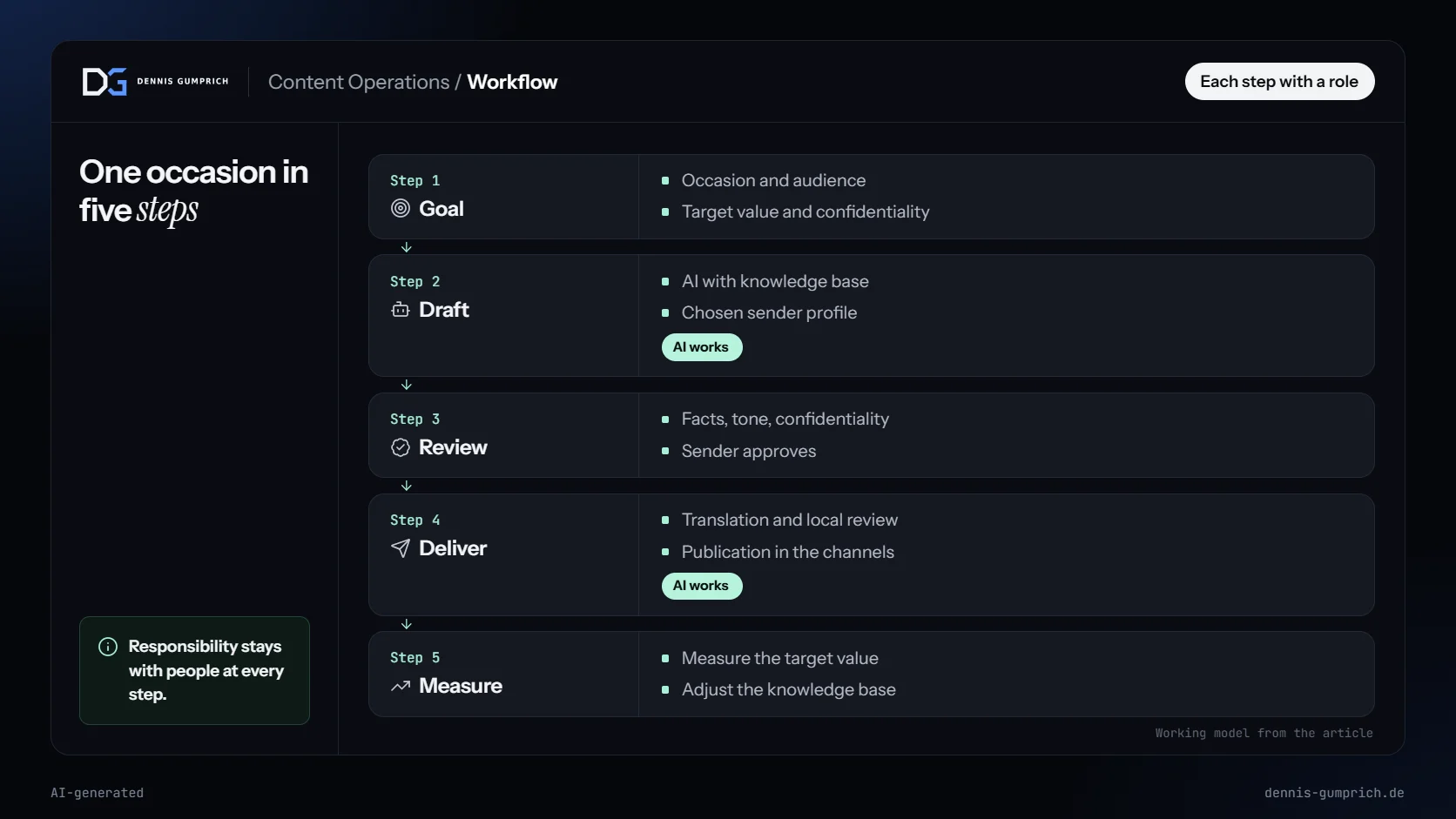
Like an editorial process with five steps, in which AI works at two points and every step has a responsible role. AI creates drafts and translations. Goal, review, approval and measurement stay with people. What matters is that the workflow is the same for every occasion and does not depend on the person currently working on the text.
- Step 1Define goal and confidentialityFor every important occasion: what should employees know, understand or do afterwards? Which audience, which target value, which confidentiality level? This determines which tool may be used.
- Step 2Draft with the knowledge baseThe AI works with the matching sender profile, the glossary and the approved facts, not with whatever someone just copied into the chat.
- Step 3Review and approveA named person checks facts, tone and confidentiality. The department confirms the content, the sender approves. For high review depth, legal or HR join.
- Step 4Translate and deliverRaw translation with glossary, review by a person at the site, then delivery via intranet, app, newsletter or notice board.
- Step 5Measure and refineCheck the target value after the defined period. What the review in step 3 had to correct flows back into the knowledge base.
The roles behind this usually already exist. What is new is that they are explicitly named for AI use.
| Role | Responsibility | Link to AI |
|---|---|---|
| Internal communications editorial team | Goal, draft, review, coordination | Maintains knowledge base and sender profiles, chooses the tool per confidentiality level |
| Sender | Approval of the message | Reads every text before sending, adds personal elements themselves |
| Department | Correctness of content | Confirms facts the AI has taken from documents |
| Contact at the site | Language and local relevance | Reviews AI translations, reports glossary terms |
| Employee representatives, data protection, IT | Framework for tool and data | Once at introduction and when things change, not for every text |
Those who want to organize roles and approvals in a content team in general will find the basics in Who does what in the content team. Why approvals take three weeks in many companies and how to halve that time is covered in Shortening approval processes. For internal communications, one rule is especially effective: one person approves, at a fixed time, instead of a text going to five inboxes in parallel.
What belongs in the internal communications knowledge base?
Everything the AI needs to write the way your company speaks internally, and everything it must not guess. That means sender profiles, a glossary with internal terms and abbreviations, approved facts on organization and sites, language rules for ongoing changes and rules for addressing people per country. Without this basis, the AI invents plausible details and review turns into error hunting.
- Sender profiles. One profile per regular sender with form of address, sentence length, typical phrases, exclusions and two or three example texts.
- Glossary. Internal names of units, programs and tools, abbreviations and their meaning, terms that should not be translated.
- Approved facts. Sites, headcounts, org chart with status, recurring dates. Each with a date and a person responsible for updating.
- Language rules. For ongoing change projects: what has already been communicated, which wordings are agreed and what may not yet be said.
- Country rules. Formal or informal address per country and language, date formats, public holidays, particularities of address.
- Good examples. Messages that were well received, with one sentence on why.
How to build and maintain a knowledge base for AI in general is described in Building a knowledge base. For translations, glossary and country rules are the most important part. How to combine AI translation with native-speaker review is covered in Marketing content for other markets. The principles described there apply to sites just as to markets.
So that the knowledge base does not become outdated, it needs a person who maintains it. After every correction in step 3, ask whether a better guideline would have prevented the error, and add it. That way review gets shorter over time instead of longer.
How do you measure whether AI-supported internal communications reaches its goal?
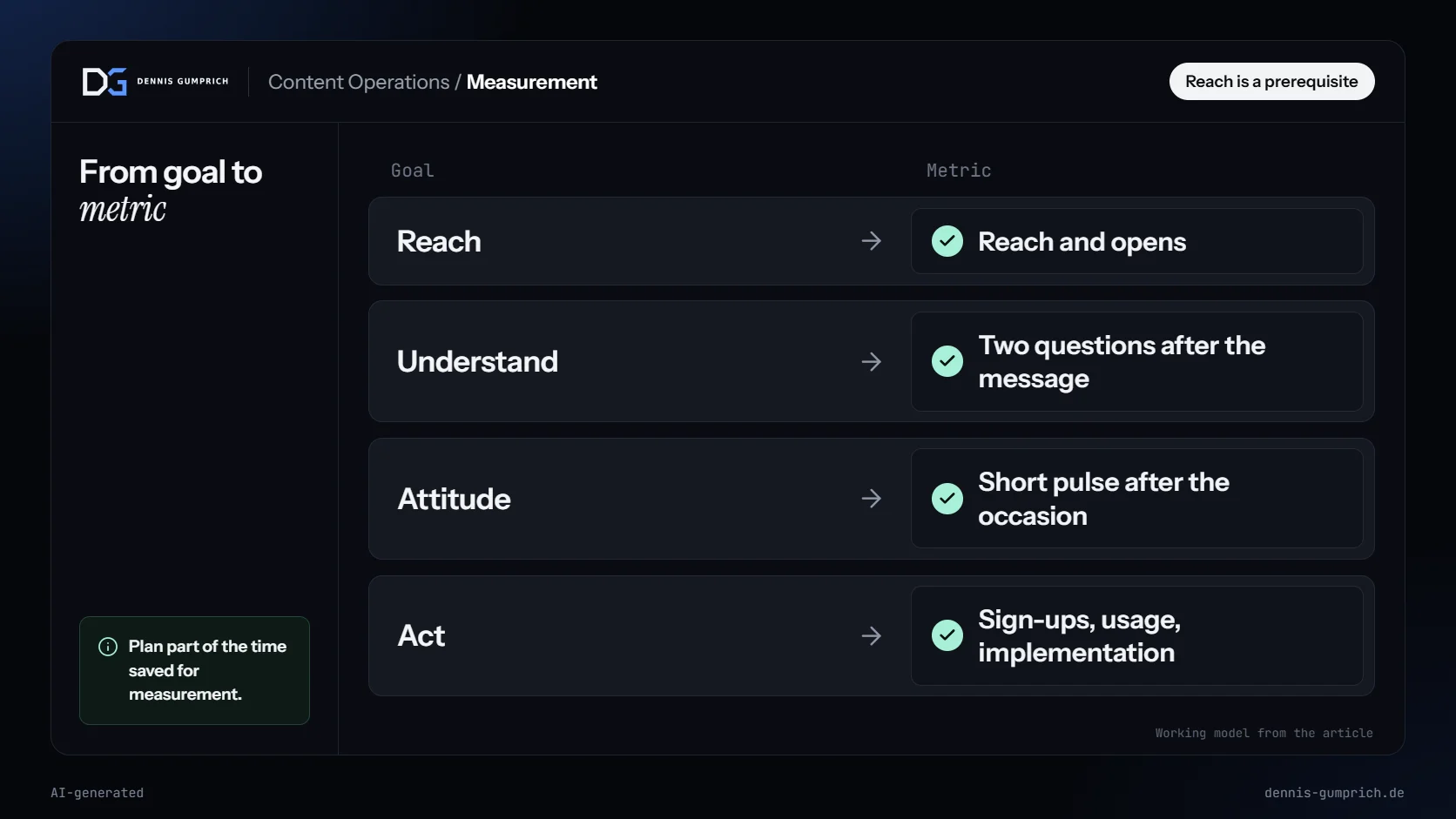
By the goal you defined before the occasion, and not only by reach. A message being read is the prerequisite. Whether employees understood the content and act accordingly is the result. AI does not fundamentally change this measurement, but it can free up the time that has so far been missing for it.
The Trendmonitor shows where the gap is. Of those without mechanisms to check goals, 49.4 percent cite lack of capacity as the reason. Those who measure mainly measure engagement and participation (77.2 percent) and employee sentiment (47.5 percent). 20.8 percent capture understanding of content, 14.9 percent a change in behavior. Yet especially with change topics, that is exactly the question management asks.
| Goal | Metric | How you collect it |
|---|---|---|
| Reach | Reach and opens per site and group | Statistics from intranet, app or newsletter |
| Understand | Share of correct answers to two questions on the content, type of follow-up questions | Short poll below the message, evaluation of comments and Q&A |
| Attitude | Change compared with the previous value | Short pulse with the same questions before and after the occasion |
| Act | Sign-ups, usage, implementation | Data from the department, such as sign-ups for a training |
A calculation example shows why this pays off. Suppose your team publishes 20 messages a month and saves 1.5 hours per message with the process. That is 30 hours a month or 360 hours a year. If you set aside a quarter of that for measurement, 90 hours a year are available, around 7.5 hours a month. That is enough for a short poll on every important occasion and a quarterly report. You can recalculate this with your own numbers in the ROI calculator (in German).
Besides impact, it pays to look at operations themselves: how long a text takes from idea to approval, how often it goes back and how long translations take. Which metrics are suitable for this is covered in Making content production measurable. How to prove the impact of communication to management is described in Proving content impact.
Five mistakes when using AI in internal communications
- Banning without an alternativeA ban without an approved tool shifts use into private accounts. There you have neither a contract nor an overview.
- Copying confidential content for phrasing helpThe most common way plans end up in third-party systems before announcement. The confidentiality grid therefore belongs in every onboarding.
- One tone for all sendersWithout sender profiles, management sounds like HR. The workforce notices that faster than any external audience.
- Publishing translations unreviewedA wrong form of address or a mistranslated technical term comes across at the site as indifference from headquarters. A short local review prevents that.
- Informing employee representatives only when problems ariseReacting only when a question comes puts you under pressure to justify. Presenting documents early lets you shape the framework together.
Disclosure
I work for contentbird, a vendor of content software with AI features. A content platform can map part of the process described here, for example workflows with review and approval tasks per status, stored AI personalities for different senders and DeepL translation on the content. The same applies similarly to other platforms. No tool takes over confidentiality rules, alignment with employee representatives and measuring impact for you.
Self-check: how manageable is your AI use in internal communications?
Tick everything that applies to you.
A short assessment of our AI use in internal communications:
We already use AI for drafts, translations and summaries. What is missing is a fixed framework: which content may go into which tool, who checks and approves every text and how we measure whether a message reaches its goal. Without this framework, quality and confidentiality depend on individuals.
Proposal: we define a grid with four confidentiality levels and approved tools, present the documents on our tool to employee representatives and data protection, store profiles for our regular senders and name a reviewer for every text.
For the next three important occasions we define a goal beforehand and measure afterwards. We cover the effort from the time AI saves us in writing.
Conclusion: AI writes along, responsibility stays with communications
AI has arrived in internal communications, in drafts, translations and summaries. To keep it from becoming a risk for confidentiality and trust, you do not need a major overhaul, but a few clear definitions: a grid of which content may go into which tool, sender profiles in a maintained knowledge base, a named person for review and approval and early involvement of employee representatives and data protection. These are the same building blocks that content operations describes for the entire content operation: roles, workflows, rules and tools.
The biggest lever lies at the end of the process. If part of the time AI saves in writing flows into measurement, internal communications can show what it achieves. That is the question that has mostly remained open so far, and answering it strengthens your position in the company more than any text written faster.
Frequently asked questions
May we use Copilot or ChatGPT for internal texts?
That depends on which version your company has approved and under which contract. Business plans with a data processing agreement are something different from private accounts. Also check which confidentiality level the tool is approved for. What an approved Copilot does for communications teams and where its limits lie is covered in Copilot is approved. Is that enough for marketing?
Do employee representatives have to agree to every AI-supported text?
Typically not. In Germany, for example, the wording of § 87(1) no. 6 BetrVG concerns the introduction and use of technical equipment, not the content of individual texts. Whether and in what form your tool is subject to co-determination is clarified by your legal department under the law of your country. For daily work, an agreement on the tool makes more sense than a vote per text.
May managers send AI texts under their name?
Yes, if they have read the text and stand behind its content. Ghostwriting is common in corporate communications. For personal occasions such as farewells, bereavements or difficult personnel decisions, the text should come from the person themselves. For video or audio content with an artificially generated image or voice of a real person, check the disclosure obligation for deepfakes under Article 50(4) of the EU AI Act.
May we summarize recordings of staff meetings or town halls with AI?
Caution is needed here. Recordings contain personal data and contributions by individual employees. Clarify beforehand with data protection and employee representatives whether and how recording is allowed and which tool is approved. Check every summary against the original, especially when statements are attributed to individuals.
Where does your content process lose time today?
In 30 minutes, we look together at where unnecessary coordination, manual tasks, tool switching or repetitive content work cost you time today.
You get a concrete assessment of which tasks you can simplify, automate or organize better, and where AI and tools actually help instead of adding complexity.
Analyze your content process in 30 minutes Free of charge. You take away concrete starting points you can use internally right away.
Dennis Gumprich
Dennis helps marketing and communication teams fit generative AI into existing content processes without undermining quality, brand voice and approvals. Focus areas: content operations, AI governance and tool selection in mid-sized companies and corporations.
Transparency note: Dennis works for contentbird, a provider of AI-powered content software. Product mentions are marked in the article. More about Dennis (in German) · LinkedIn
Read more
Sources
- SCM School for Communication and Management and Staffbase: Trendmonitor Interne Kommunikation 2026 (in German), study, 431 internal communications professionals and managers in Germany, Austria and Switzerland, survey June to July 2025: AI use, tools used, success measurement, topics and manager communications. Accessed October 31, 2026.
- Gartner: 2026 CMO Spend Survey, press release from May 11, 2026, 401 marketing leaders in North America, the UK and Europe, survey January to March 2026. Accessed October 31, 2026.
- Bitkom: Erstmals nutzt die Mehrheit der Unternehmen KI (in German), press release from September 14, 2026 by the German digital association, 603 companies with 20 or more employees in Germany, representative, telephone survey by Bitkom Research. Accessed October 31, 2026.
- German Federal Ministry of Justice: § 87 Works Constitution Act (BetrVG), co-determination rights (in German), in particular paragraph 1 no. 6, as an example of national law. Accessed October 31, 2026.
- German Federal Ministry of Justice: § 90 Works Constitution Act (BetrVG), information and consultation rights (in German), in particular paragraph 1 no. 3 on the use of artificial intelligence and paragraph 2. Accessed October 31, 2026.
- European Commission, AI Act Service Desk: Article 50: Transparency obligations for providers and deployers of certain AI systems, wording of Regulation (EU) 2024/1689 in the consolidated version of July 27, 2026 including the amendments by Regulation (EU) 2026/1744. Accessed October 31, 2026.
- European Commission: Commission publishes guidelines on transparency obligations for providers and deployers of certain AI systems, announcement from July 20, 2026, transparency obligations applicable from August 2, 2026. Accessed October 31, 2026.
- National Institute of Standards and Technology (NIST): Artificial Intelligence Risk Management Framework: Generative Artificial Intelligence Profile (NIST AI 600-1), July 26, 2024, Chloe Autio, Reva Schwartz, Jesse Dunietz et al., companion profile to the voluntary AI RMF 1.0: actions GV-1.4-002 and GV-3.2-003 (transparent acceptable use policies), GV-6.1-009 (extend procurement due diligence to intellectual property, data privacy and security, including solutions with embedded AI) and MP-5.1-003 (weigh disclosure of AI use by goal, context, risk and audience). Voluntary US framework. Accessed October 31, 2026.
How this article was created
This article was created with the help of AI. Structure, research and draft wording were developed with AI support. Professional assessment, review of the statements and the final version are the responsibility of Dennis Gumprich. The English version was translated with AI and reviewed. Read the original German version.
How reliable are the statements?
Backed by sources are the study figures from the Trendmonitor Interne Kommunikation 2026, Gartner's 2026 CMO Spend Survey and the Bitkom survey from September 2026, the wording of § 87 and § 90 of the German Works Constitution Act as an example of national law and of Article 50 of the EU AI Act, as well as the recommendations on use policies, procurement review and weighing disclosure from NIST AI 600-1 (voluntary US framework). The classification of use cases by review depth, the confidentiality grid, the list of documents for employee representatives and data protection, the five-step process, the role split and the mapping of goals to metrics are working models from consulting practice, not collected measurements. The time saving of 1.5 hours per message and the hours derived from it are a calculation example. The Trendmonitor was collected in summer 2025 and covers Germany, Austria and Switzerland. The remarks on labor law and the AI Act are simplified and are not legal advice; co-determination rules differ by country. Legal and data status October 31, 2026.


