
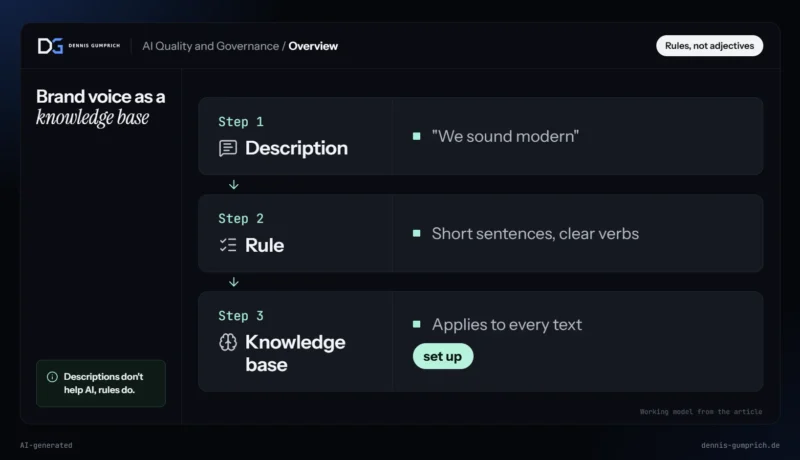

"Approachable, competent, modern" describes almost every brand and therefore helps none of them.
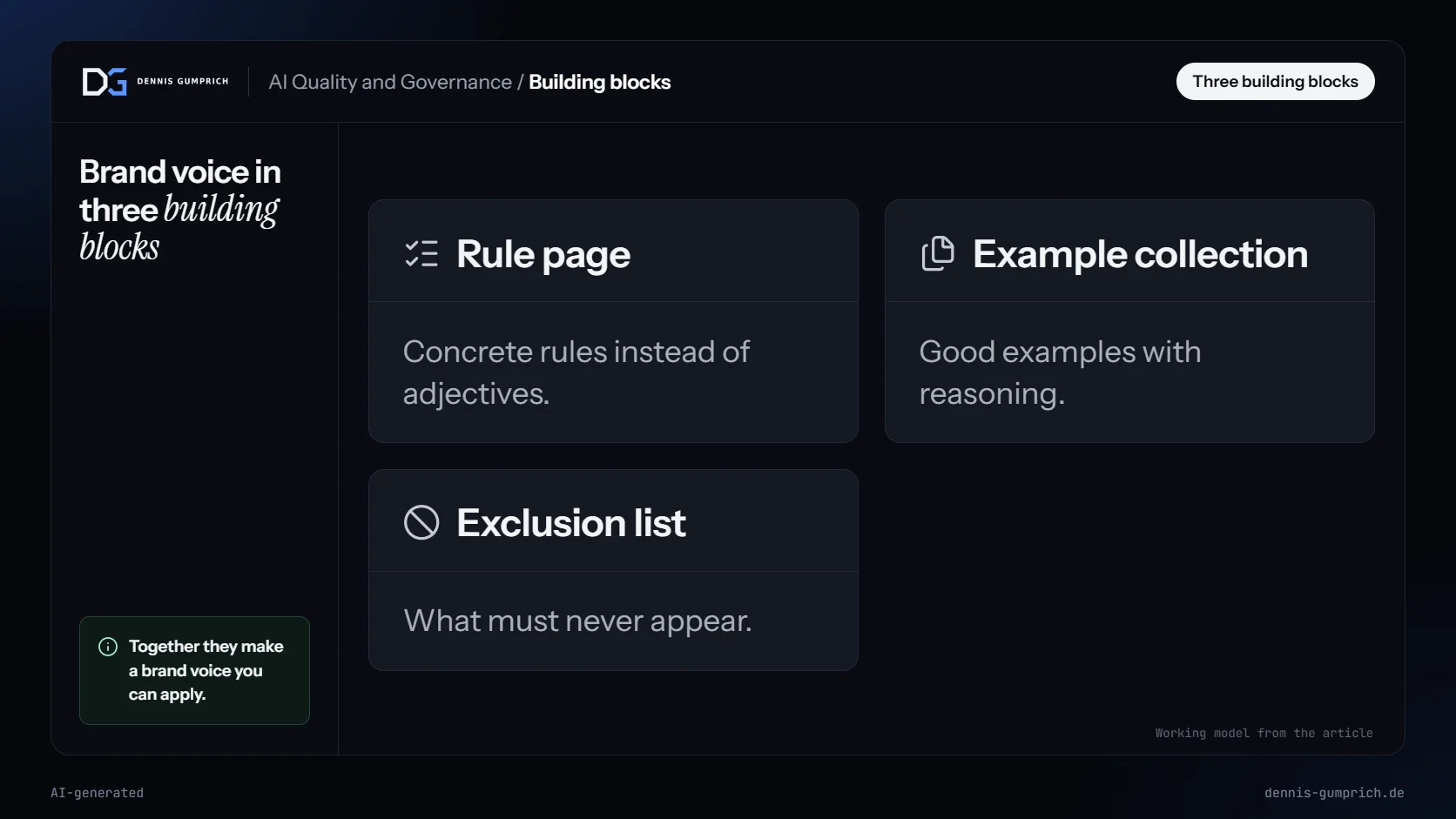
A tone of voice description only becomes usable when it consists of decisions rather than attributes. The way there leads through three building blocks: a rule page with checkable specifications, a collection of approved example texts and an exclusion list of concrete phrases. Only together do they form a knowledge base that people and language models can work with equally.
To turn attributes into decisions, you first need a shared understanding of what brand voice actually covers.
What is brand voice?
Brand voice is the defined way a company writes: word choice, sentence structure, form of address, handling of technical terms and tone across all channels. It makes texts recognizable as yours, no matter who writes them. For teams and for AI, brand voice only becomes usable when it exists as checkable rules, examples and exclusions rather than as a description.
Examples: one message, three brand voices
How strongly brand voice works becomes clear when the same information appears in different voices. The three examples are invented, but the patterns are typical: a delivery is delayed by two days.
| Brand profile | Characteristics of the brand voice | Example sentence |
|---|---|---|
| Industrial manufacturer, technical and precise | Formal, factual, facts before adjectives | "Your order will be delivered on November 18, two days later than planned. The reason is a delay at one of our suppliers." |
| Lifestyle brand, approachable | Casual, short sentences, emotion allowed | "Sorry, your package needs two more days. We're on it and will let you know as soon as it's on its way." |
| Family business, personal | Polite, "we" voice, takes responsibility | "Unfortunately, your delivery will arrive two days late. That annoys us too, and we will get in touch personally as soon as it's on its way." |
The information is identical, the effect is not. A brand voice must describe exactly these differences in a way that people and AI reliably hit them. The following sections show how.
Why do brand manuals fail in everyday writing?
Most brand manuals are written for design, not for language. They regulate logo spacing to the millimeter and devote half a page with three adjectives to tone of voice. Not a single sentence can be derived from modern, competent and approachable, and that is exactly why this part is ignored in daily work.
The second reason is location. A document on the intranet is not present while writing. Nobody opens a 34-page manual to check whether a phrase fits. The decision is made in seconds, and it is made by gut feeling.
The third reason lies in the form. Descriptions say how something should come across. When writing, however, you need instructions on how something is done. The difference between "we communicate as equals" and "we use first names on the blog and formal address in sales" is the difference between an intention and a rule.
With the use of language models, this shortcoming becomes measurable. A model cannot interpret an intention; it needs specifications. If your brand voice only exists as a feeling, every person with their own instructions produces their own variant of it. One brand becomes five.
The Anthropic Economic Index report: Cadences from June 2026 hints at how much back-and-forth this creates. For the report, Anthropic analyzed samples of Chat and Cowork conversations from consumer accounts between April and June 2026. There, a blog post or article takes a median of 13 rounds of back-and-forth, and marketing content is 80 percent work-related. The study does not say which of these rounds concern tone of voice. But whatever concerns form of address, sentence length or word choice belongs on the rule page once, not in every single round. A caveat: this is a vendor source that only analyzes the use of Claude; the values show a direction.
What does a usable brand voice knowledge base consist of?
Three building blocks: a rule page with checkable specifications for form of address, sentence length, technical terms, evidence requirements and openings, without adjectives. An example collection of five to ten approved texts per format, selected as a benchmark rather than as an average of your output. And an exclusion list with concrete words and phrases you don't use.
The rule page
One page with checkable specifications for form of address, sentence length, technical terms, evidence requirements and openings. No adjectives, only decisions.
Done when: Two people independently write similar sentences from it.
The example collection
Five to ten approved texts per format, deliberately chosen as a benchmark and not as an average of your output.
Done when: You would publish every text in it again today exactly as it is.
The exclusion list
Concrete words and phrases you don't use, plus statements that are legally or professionally inadmissible.
Done when: The list contains words, not principles.
The location
All three building blocks where the writing happens. Not next to it, not on the intranet, not in a presentation.
Not met when: Someone has to actively search for it.
How does a tone of voice description become an applicable rule?
The path from an attribute to an applicable rule follows a simple question: how would I recognize in the finished text whether this has been met? Anything that cannot answer this question does not belong on the rule page. How the rule page fits into the overall production process is described in On-brand AI content: the guide for marketing leaders.
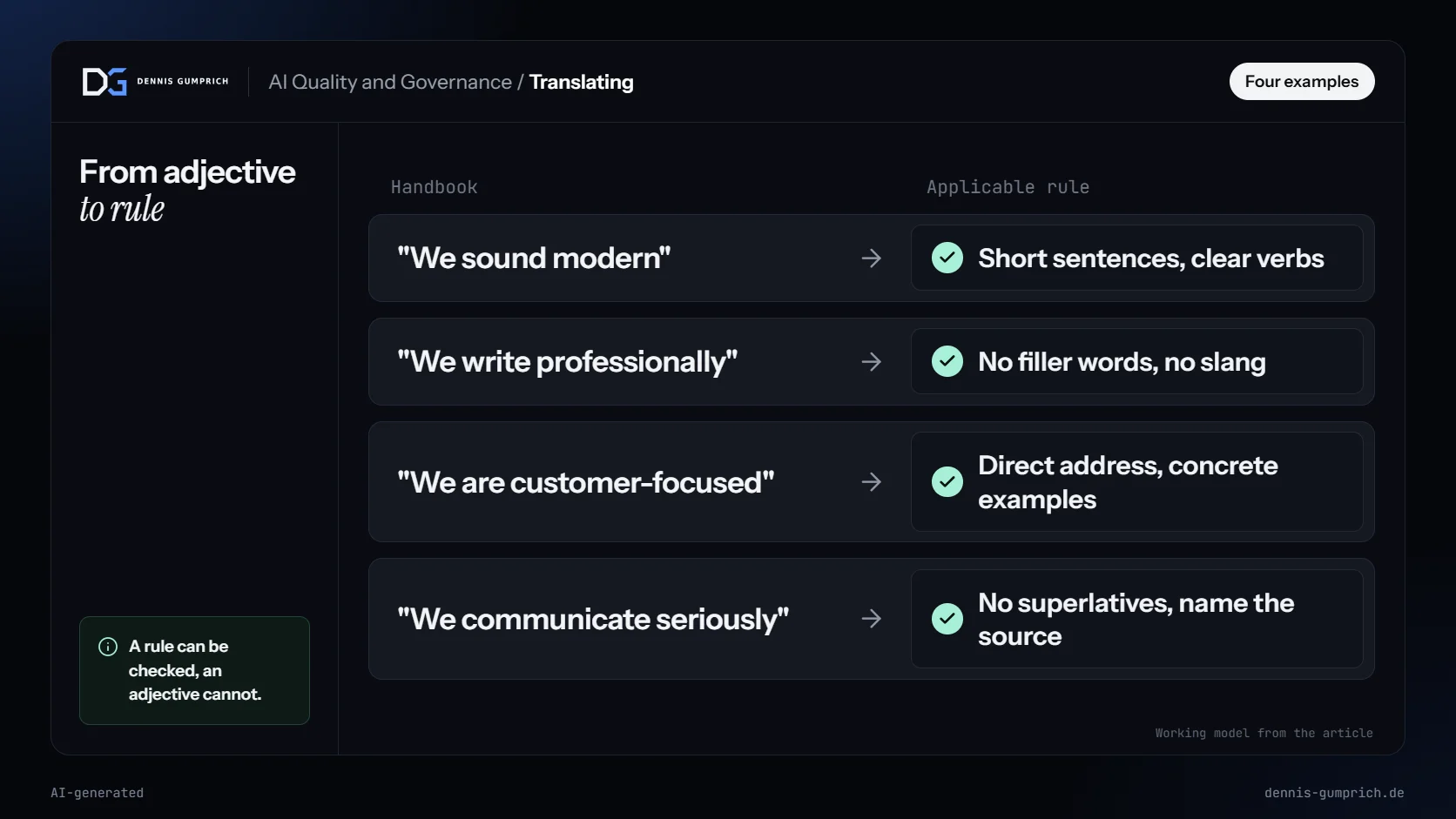
| Description in the manual | Applicable rule |
|---|---|
| We communicate as equals | Informal tone on the blog and in social media, formal tone in proposals and tenders |
| We avoid jargon | We use technical terms, but explain them in a subordinate clause the first time they appear |
| We are clear and direct | Sentences under 20 words, no rhetorical questions as openers, no filler words such as actually or basically |
| We are credible | No superlatives without evidence. Every figure with a source or time period |
| We are approachable | Articles start with a concrete situation, not with a definition or market figure |
The right-hand column has a property the left lacks: it can be checked without anyone having to state an opinion. A sentence has 30 words or it doesn't. A superlative is backed up or it isn't. That removes the debate about taste from the editorial team. The same principle applies to factual statements, as the article on hallucinations in marketing copy shows.
The fastest way to these rules is not a workshop, but your archive. Put five texts the team considers typical next to five that were rejected. Write down how exactly they differ. That list is your rule page, and it takes one morning.
Why examples work better than rules
Rules cover what can be named. But much of your brand voice cannot be captured in rules: rhythm, attitude, the way you handle objections. That is exactly what examples are for.
Language models work particularly effectively with examples, because they recognize patterns nobody has described. Three good example texts in context change the output more than two pages of description. The same applies to new team members, who also learn faster from examples than from manuals.
When selecting them, one decision matters that many find difficult: examples set the standard. Whatever goes in gets reproduced. That is why the texts that belong there are not those representative of your previous output, but those you want to measure yourselves against in future. An average produces an average.
What belongs on the exclusion list?
Three kinds of entries: phrases you reject for stylistic reasons, such as worn-out advertising terms or certain buzzwords. Statements that are legally problematic, especially promises of effect and comparisons with competitors. And terms that are used incorrectly or misleadingly in your industry.
While rules and examples describe what you want, the exclusion list names what you don't want. That is often easier to formulate and quicker to check in daily work. Searching for a word takes seconds; assessing a tone takes minutes.
The benefit shows especially with AI support. Language models tend to fall back on common marketing phrases, because these appear frequently in training data. Without an exclusion list, you get exactly this language, reliably, in every text.
Ready-made prompts into which you insert your stored brand voice as context can be found in the free collection 100 AI prompts for marketing.
Five mistakes when setting it up
- Copying the brand manualWhat was written for design rarely works for language. The rule page is created from scratch, not as an excerpt.
- Too many rulesBeyond about twelve specifications, adoption drops. One page is not a cost-saving measure, but a condition for use.
- Choosing examples for representativenessExamples set a standard. If you store the average, you get the average back.
- Exclusion list as a list of principles"Avoid promotional language" cannot be checked. A list of concrete words can.
- Storing it without an ownerWithout a named person, the knowledge base goes out of date within a year and is then bypassed again.
Five steps to a stored brand voice
- Week 1Create a side-by-side comparisonPut five typical and five rejected texts next to each other and note the differences concretely. The result is a raw list, not a finished document.
- Week 2Translate the raw list into rulesCheck every line: how do I recognize in the finished text whether this has been met? Whatever fails this question is dropped.
- Week 2Select and approve examplesDeliberately as a benchmark, not as a cross-section. In case of disagreement, the person responsible for brand voice decides.
- Week 3Collect the exclusion listFrom rejected texts, from legal feedback and from what bothers you in other people's texts.
- Week 4Bring it to where the work happensAll three building blocks go where the writing happens. Then name a person who maintains them, with a fixed review date.
The second step is where most initiatives fail. It is uncomfortable to delete a nice-sounding description because it cannot be checked. But exactly this rigor makes the difference between a document that gets read and one people work with.
Self-check: Is your brand voice usable?
Tick everything that applies to you.
A proposal for making our brand voice usable:
Our brand manual describes how we want to come across. When writing, however, we need specifications that can be checked: form of address per format, sentence length, handling of technical terms, evidence requirements for figures and superlatives.
On top of that come five to ten approved example texts per format and a list of concrete phrases we don't use. Both work better than any description, for new colleagues as well as when using AI.
Effort: around four weeks alongside regular work, based on our own archive. Result: we can check texts instead of debating taste, and our content sounds consistent no matter who wrote it.
Conclusion: Applicable beats complete
A brand voice that covers everything on 34 pages but is out of reach at the moment of writing has no effect. One page with twelve checkable specifications, ten examples and a word list works immediately, for every text and every person. The difference lies not in diligence, but in form. Where these specifications should live so that people and AI can access them equally is described in Building a knowledge base. If you work across several countries, One headquarters, many countries shows how central specifications and local adaptation fit together.
Frequently asked questions
Does this replace our brand manual?
No, it complements it. The manual remains the basis for design and positioning. The rule page is the working version for language and is derived from it without repeating it.
How many rules are right?
Between eight and twelve works best in practice. Fewer leaves too much open, more won't be applied. If you want to add a thirteenth, first check whether an existing one has become unnecessary.
What if our example texts are themselves inconsistent?
That is the normal case and at the same time the first insight. Deliberately choose which texts will serve as the benchmark in future. This selection is a content decision and should not be delegated.
Do we need this separately per brand or per channel?
For several brands, yes, a separate version per brand. Per channel, a few deviations from a common foundation are usually enough, typically form of address and length. Separate rule sets per channel go out of date faster than they can be maintained.
How often should the knowledge base be reviewed?
Once a year as a fixed date, plus whenever positioning or audience changes. Above all, swap out the examples. Rules stay valid longer; examples visibly age.
What is the best way to manage brand voice guidelines for the whole team?
They belong where content is created, not in a PDF on a shared drive. A central knowledge base with rules, examples and unwanted phrases that the team, agencies and AI tools can all access has proven effective. Appoint a responsible person who approves changes, and record when the rules were last reviewed.
How do I define my brand voice for AI-generated content?
Describe the brand voice so concretely that an AI can apply it: form of address, sentence length, technical terms, taboos and a good and a bad example for each rule. Add a few approved example texts as templates. General adjectives such as "modern" or "approachable" barely help an AI, whereas concrete examples help a lot.
How do I ensure a consistent brand voice across all content?
With three levers: a shared source for rules and examples, brand voice criteria in every approval and regular spot checks across all channels. If AI drafts texts, it should access the same knowledge base as the team. How to check AI texts before approval is shown in the checklist for AI texts.
Where does your content process lose time today?
In 30 minutes, we look together at where unnecessary coordination, manual tasks, tool switching or repetitive content work cost you time today.
You get a concrete assessment of which tasks you can simplify, automate or organize better, and where AI and tools actually help instead of adding complexity.
Analyze your content process in 30 minutes Free of charge. You take away concrete starting points you can use internally right away.
Dennis Gumprich
Dennis helps marketing and communication teams fit generative AI into existing content processes without undermining quality, brand voice and approvals. Focus areas: content operations, AI governance and tool selection in mid-sized companies and corporations.
Transparency note: Dennis works for contentbird, a provider of AI-powered content software. Product mentions are marked in the article. More about Dennis (in German) · LinkedIn
Read more
Sources
- Tom B. Brown et al.: Language Models are Few-Shot Learners, arXiv, May 2020, revised July 2020: language models take on tasks from a few examples in the prompt, without retraining. Accessed October 31, 2026.
- Anthropic: Prompt engineering documentation, section Use examples effectively, vendor documentation: examples as one of the most reliable ways to steer format, tone and structure; three to five examples are recommended. Accessed October 31, 2026.
- German Federal Ministry of Justice: Section 5 UWG, misleading commercial practices (German law, in German), statutory text; para. 2 no. 1 covers, among other things, the results to be expected from use. Accessed October 31, 2026.
- German Federal Ministry of Justice: Section 6 UWG, comparative advertising (German law, in German), statutory text with the conditions under which a comparison with competitors is unfair. Accessed October 31, 2026.
- Dmitry Kobak, Rita González-Márquez, Emőke-Ágnes Horvát, Jan Lause: Delving into LLM-assisted writing in biomedical publications through excess vocabulary, Science Advances, 2025 (preprint version of July 3, 2025): sharp increase in typical style words in over 15 million PubMed abstracts since the emergence of language models. Accessed October 31, 2026.
- Anthropic: Anthropic Economic Index report: Cadences, research report of June 26, 2026, samples of Chat and Cowork conversations from April 10 to June 10, 2026, consumer accounts only: a blog post or article takes a median of 13 rounds of back-and-forth in Chat and Cowork conversations, marketing content is 80 percent work-related. Vendor source, analyzes only the use of Claude, classification by Claude, values indicative. Accessed October 31, 2026.
How this article was created
This article was created with the help of AI. Structure, research and draft wording were developed with AI support. Professional assessment, review of the statements and the final version are the responsibility of Dennis Gumprich. The English version was translated with AI and reviewed. Read the original German version.
How reliable are the statements?
Documented are how language models learn from examples in the prompt (Brown et al., Anthropic), the legal limits on promises of effect and comparative advertising in Germany (Sections 5 and 6 UWG), the recurring, typical vocabulary of AI-assisted texts (Kobak et al.), and the median of 13 rounds to a blog post or article in Chat and Cowork conversations (Anthropic Economic Index, vendor source, Claude usage only). The three building blocks, the rule examples and the stated quantities, such as eight to twelve specifications and five to ten example texts per format, are explicitly marked as working models. They are based on observations from conversations with content teams and are not an industry standard. As of October 31, 2026.


