
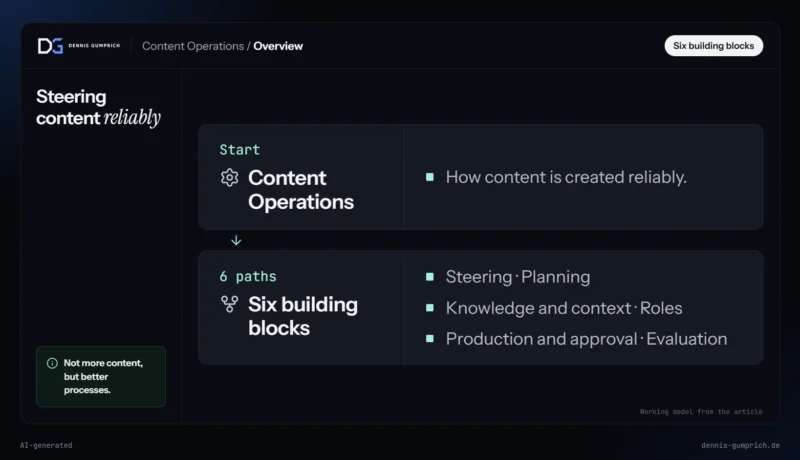

Content Operations is the organization a team uses to plan, produce, approve, publish and evaluate content reliably. It includes roles and decision rights, processes, rules, knowledge and tools. Content strategy answers what you publish and why. Content Operations answers who implements it, when and how, and does so repeatably rather than case by case.
What is Content Operations?
Content Operations, often shortened to Content Ops, refers to all the processes, roles and tools that lie between a topic idea and a published, evaluated piece of content. The term comes from operations management: it is not about the individual text, but about the system that produces texts.
A team always has Content Operations, even without the term. The only question is whether they have been designed deliberately or have grown by chance. You recognize processes that have grown by chance when the result depends on individual people and cannot be planned.
| Term | Guiding question | Result |
|---|---|---|
| Content strategy | What do we publish, for whom and with what goal? | Audiences, topic areas, goals, channels |
| Content marketing | How do we reach customers with content? | Activities, campaigns, content |
| Editorial planning | What appears when on which channel? | Editorial or topic plan |
| Content Operations | Who decides, who produces, how does it flow, and how do we measure it? | Roles, processes, rules, knowledge base, tools, metrics |
How closely strategy and operations are connected is shown by a model from independent consultant Robert Weller. His observation: a resource problem is usually a decision problem. In the article "The critical elements of a content strategy" (in German) from March 2026, he assigns five elements to three levels: analysis, synthesis and Content Operations, with content governance belonging to the last level. It defines who, as a role, decides, on what basis and by what process content is reviewed, updated or withdrawn. In 34 master's theses analyzed from FH JOANNEUM Graz from 2022 to 2025, content governance appeared in almost half, while competitive analysis appeared in over 80 percent. For your team, this means: record decision rights first, before commissioning further analyses. A caveat: the analysis is not representative.
What does Content Operations consist of?
Six building blocks that build on one another. If one is missing, it shows in a typical symptom. The table helps you find the bottleneck before you start in the wrong place.
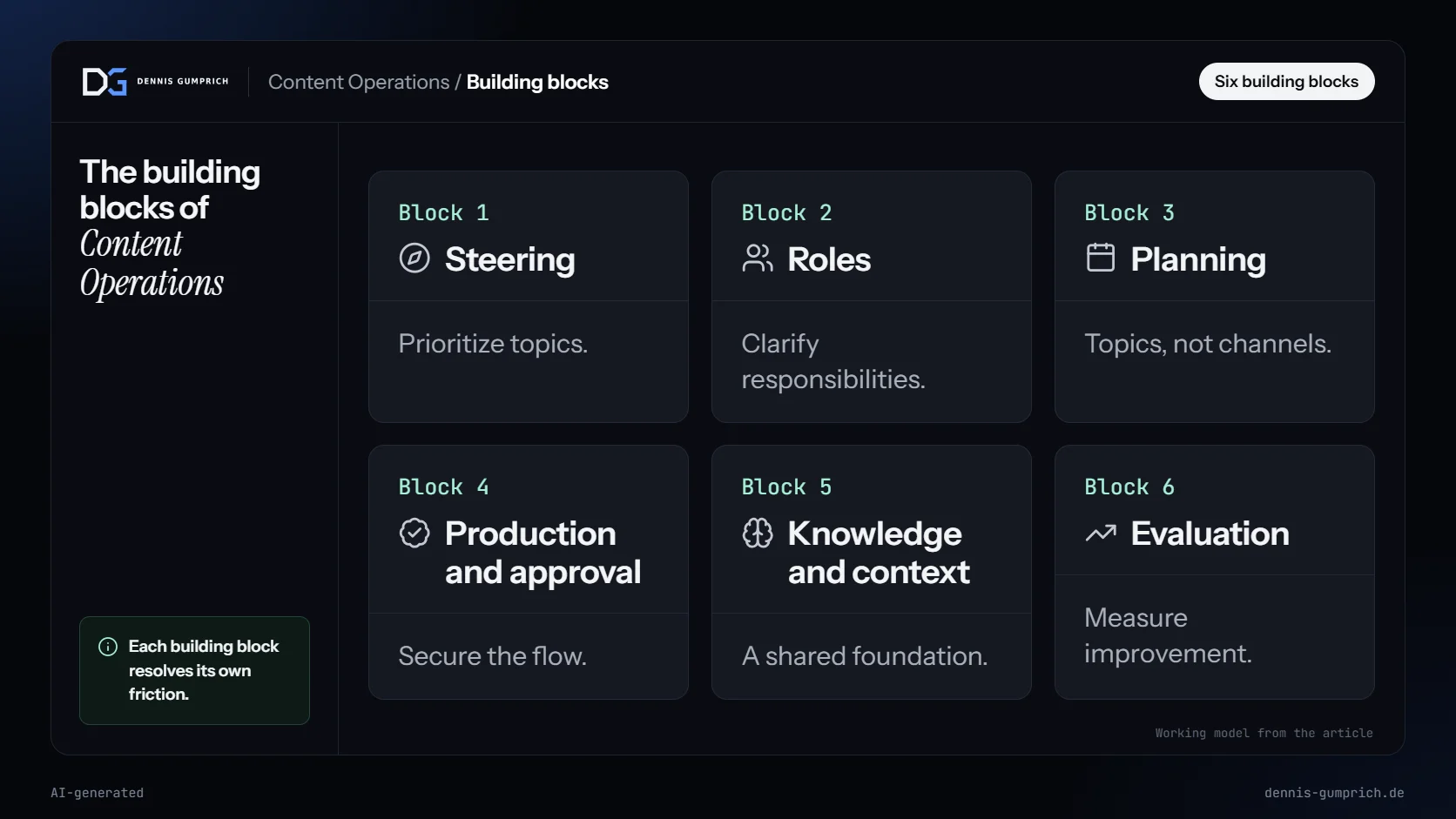
| Building block | Guiding question | Symptom if missing | Deep dive |
|---|---|---|---|
| 1 Steering | By which criteria do we decide on topics? | Topics arise on request, the loudest voice wins | Topic scoring |
| 2 Roles | Who decides what, who implements? | Everyone is involved, nobody is responsible | Roles in the content team |
| 3 Planning | Do we plan by channels or by topics? | The plan goes out of date faster than it is maintained | From editorial calendar to topic plan |
| 4 Production and approval | How does content move from draft to publication? | Review takes minutes, approval takes weeks | Approval processes |
| 5 Knowledge and context | Where is the knowledge people and AI work with? | AI texts sound interchangeable, knowledge sits in individual heads | Building a knowledge base |
| 6 Evaluation | How do we know whether the process is improving? | Success is claimed but not proven | Measuring process maturity |
The order is no coincidence. Without clear steering and roles, a better plan only improves the documentation of the chaos. Without stored knowledge, AI mainly speeds up the production of texts you then rewrite.
How do you notice that you lack Content Operations?
Through recurring friction, not through individual mishaps. If three or more of the following statements apply to you, the bottleneck is not the amount of content but its organization:
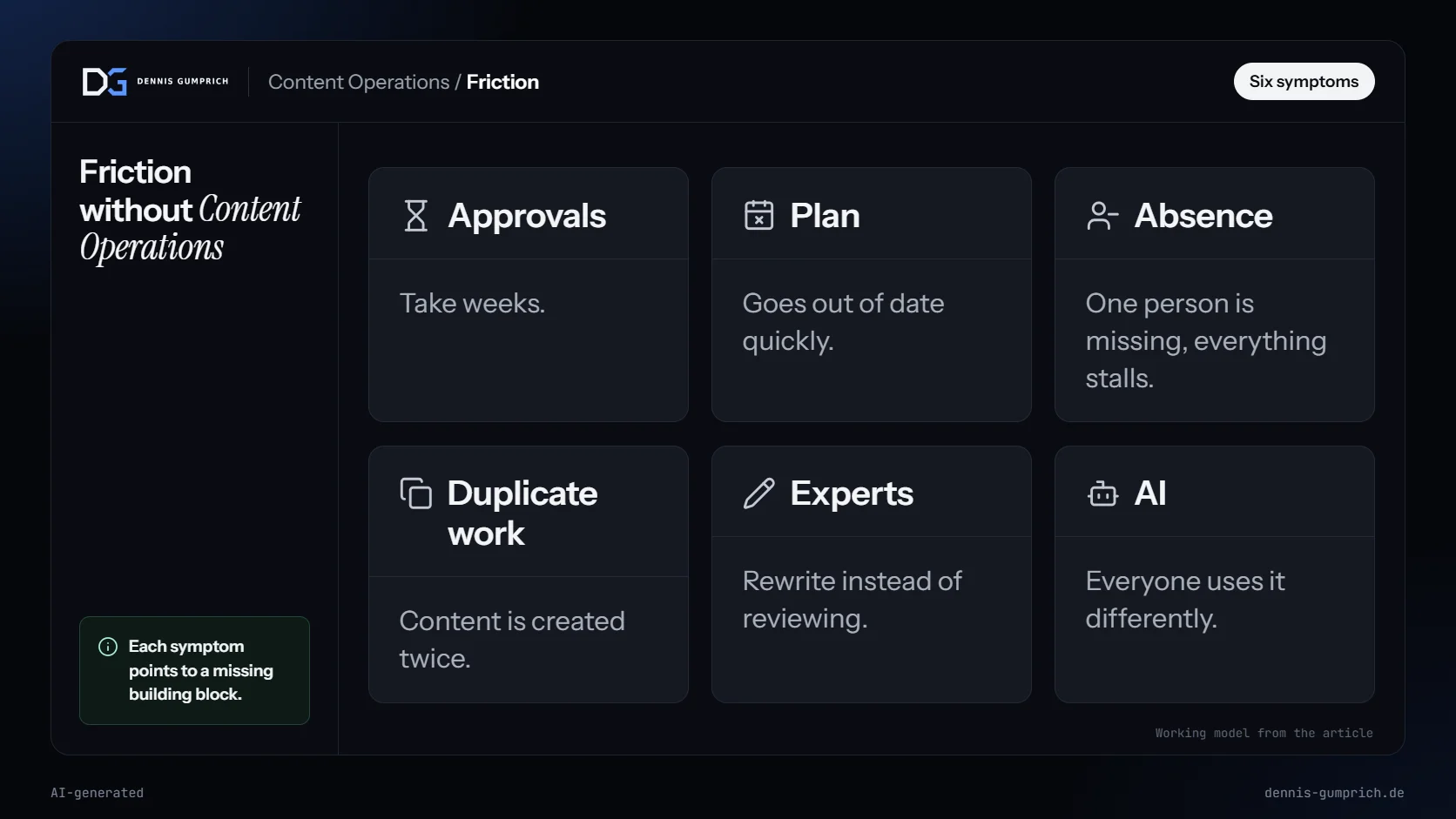
- Approvals take weeks. The text is finished, but nobody knows who has it. How to change this is shown in the article on approval processes.
- The plan is out of date after two weeks. The planning file is maintained but no longer believed. Where the limit lies is described in Content planning with Excel.
- One person is absent, and production stops. Access, context and open commitments depend on individual people. More on this in Content operations without a key person.
- Content is created twice. Nobody knows what already exists. A content inventory creates clarity here first.
- Subject matter experts rewrite texts instead of checking facts. The loops cost more time than the writing. The article on handovers between marketing and subject matter experts describes the remedy.
- AI is used, but everyone does it differently. Results vary, prompts sit in private chat histories. The path to a shared process is shown in AI Content Operations.
That these bottlenecks are widespread is suggested by the Bitkom study "Marketing in digital transformation" (in German) from 2026. In the online survey of 180 companies in the German digital industry, 54 percent each name cost pressure and the automation of marketing processes as internal challenges, 43 percent a growing need for resources for content creation and 37 percent the coordination of marketing processes. 35 percent lack an AI strategy. Before you request more capacity, it therefore pays to look at coordination and processes, because that is exactly where Content Operations comes in. A caveat: the survey is not representative and reflects companies from the Bitkom network.
For a first assessment of maturity, one question is usually enough for me: "Where is your editorial calendar?" If the answer is Excel, Word by email, or Trello or Asana alongside four other tools, maturity is low. Another typical signal is a board member who receives approvals as a Word file on an iPad.
The building block overlooked most often is knowledge: brand voice and personas exist, but they are scattered. Roles come next: who approves, who decides?
How do you build Content Operations?
In five steps, using what you already have. None of the steps requires new software. The order follows the principle: first see, then decide, then switch over.
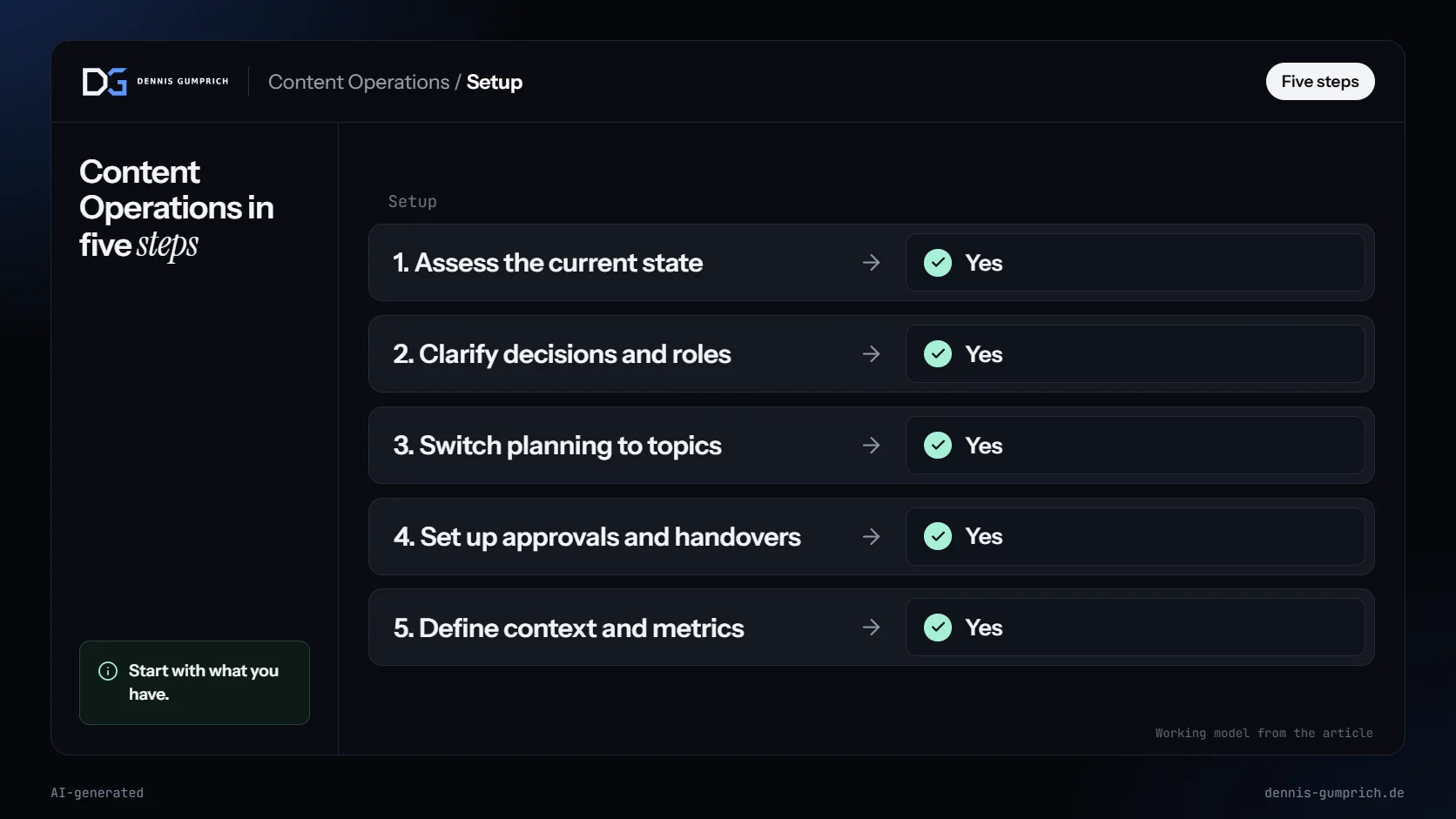
- Step 1Assess the current stateWhat already exists, and how mature are your processes? An inventory of your content and an honest self-check prevent you from working on symptoms. Tools for this: content inventory and measuring process maturity.
- Step 2Clarify decisions and rolesWho decides on topics, who on approvals, who implements? Write it down, with names. Four roles are enough in most teams, as Roles in the content team shows.
- Step 3Switch planning to topicsPlan topics instead of channel posts and decide by fixed criteria. A topic is developed once and then adapted for several channels instead of being rewritten several times.
- Step 4Set up approvals and handoversDefine who checks what and by when. The subject matter side checks accuracy, marketing is responsible for the wording. Deadlines apply even if nobody follows up.
- Step 5Store context and define evaluationBrand voice, technical terms and approved examples belong in one shared place that people and AI can access. Add two or three metrics you look at monthly.
Common mistake at this point: starting with step 5 because AI is the most visible topic. Without clarified roles and approvals, AI mainly produces drafts faster, which then sit longer in alignment.
Is a corporate newsroom the same as Content Operations?
No. A corporate newsroom is one possible organizational model within Content Operations, especially for larger communication departments. It separates topics from channels and gives individual roles such as managing editor, topic desk and channel desk fixed decision rights. Content Operations is the overarching framework and applies equally to a two-person team without a newsroom.
When the newsroom model pays off and why it fails is described in the article Corporate newsroom: concept, roles and implementation.
What role does software play in Content Operations?
A supporting one, not a triggering one. Software reflects processes that have been clarified beforehand. It does not replace a missing decision on who approves or by which criteria topics are selected.
A spreadsheet holds up as long as few people plan and few channels are served. A Content Operations platform becomes relevant when planning, production, approval and context for AI are meant to come together in one place and the number of people involved makes coordination by message impractical.
| Situation | What is usually enough |
|---|---|
| Up to three people planning, one or two channels | Well-maintained spreadsheet with fixed columns and clear responsibility |
| Several departments, approvals across organizational boundaries | Tool with status, responsibilities and deadlines per piece of content |
| Regular AI use with requirements for brand voice and traceability | Platform in which context, planning and production sit together |
How to approach the selection in a structured way is shown in Choosing content marketing software for teams, Individual tools or platform and the template for the business case. If you use Microsoft 365, Copilot has been approved. Is that enough for marketing? offers an assessment. How approved content gets into the CMS without copy and paste is shown in The last mile, and what AI agents can reliably take on today is described in AI agents in the content team.
What is an AI Content Operations Platform?
An AI Content Operations Platform is software that maps the entire content operation in one place and integrates AI into every step: planning, briefing, creation, approval, publication and evaluation. The difference from an AI writing tool lies in the context. Brand voice, audiences, product knowledge and approval rules are permanently stored, and the AI works with this knowledge rather than with whatever someone happens to type into a prompt.
The category is young, and many tools use the term. Distinguishing it from the systems you probably already have helps with orientation:
| Category | Core task | What is missing for Content Operations |
|---|---|---|
| Project management (such as Asana, monday.com) | Tasks, deadlines, responsibilities | No connection to the content itself, no brand voice, no AI with company knowledge |
| CMS | Publishing and delivering content | Planning, briefing and alignment take place beforehand, usually outside it |
| DAM | Managing images, videos and files | Texts, topic planning and content approval are not the core |
| AI writing tool | Generating drafts | Single-user logic, no shared status, context per prompt instead of permanent |
| AI Content Operations Platform | Steering the flow from idea to evaluation, with AI based on stored knowledge | Replaces neither CMS nor DAM, but connects them |
Three questions show whether a tool deserves the label: does your context remain stored across all content? Do all participants see the same status of a piece of content without asking? Does approved content reach your channels without copying? If you answer no three times, you have an AI tool, but not a platform. Whether switching pays off for you is shown in the article Individual tools or platform.
Transparency note: I work for contentbird, a vendor in this category. The distinction above applies regardless of vendor.
The corporate communications team of a retail group, seven people, managed press releases, LinkedIn and an online magazine across several tools. After a proof of concept with contentbird, which I work for, there were significantly fewer tool switches: LinkedIn posts are created directly in the platform, PR posts are derived from press releases.
How do you measure whether Content Operations works?
With a few metrics that show the process rather than just the result. Reach and leads tell you whether content works. Whether the organization behind it holds up is shown by other values:
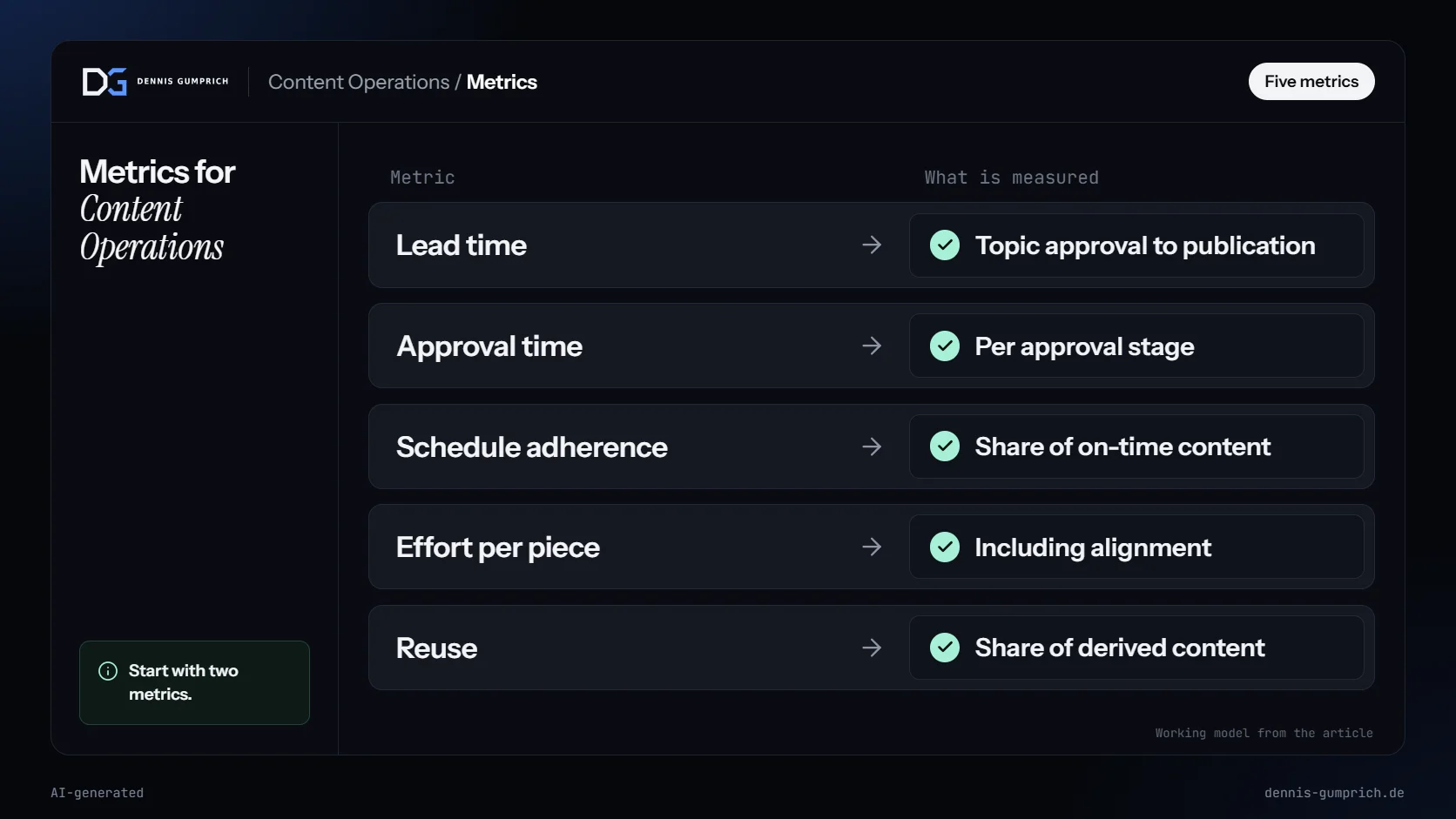
| Metric | What it shows |
|---|---|
| Lead time from topic approval to publication | Where content waits instead of being worked on |
| Approval time per stage | Which stage slows the process |
| Schedule adherence: share of content published on time | Whether the plan is reliable |
| Effort per piece of content in hours, including alignment | Where the time actually goes, see Nine hours per article |
| Reuse: share of derived content | Whether topics are used multiple times or rewritten multiple times |
Start with two of these values. Collect them by hand for one month before you change anything. Without a baseline, no improvement can be proven. How this becomes reporting that also convinces management is described in Proving content impact.
Who is responsible for Content Operations in the team?
Content Operations needs a person who is responsible for the process, not for individual pieces of content. In larger teams, this role is called Content Operations Manager. In smaller teams, the team lead often takes it on with a fixed share of their time.
The role is often confused with project management. The difference: a project ends, Content Operations does not. The responsible person makes sure the operation still runs as agreed three weeks after the kickoff. Typical tasks are:
- Maintaining the process: keeping status, handovers and approval paths up to date and tightening them where content regularly gets stuck.
- Managing capacity: seeing who is working on what and flagging bottlenecks before a deadline is missed.
- Securing knowledge: keeping templates, brand voice, review criteria and sources in one place so that not everyone maintains their own version.
- Looking after tools: access, configuration and onboarding new colleagues.
- Feeding back evaluation: not just reporting metrics, but carrying them into the next planning round.
The distinction from the editor-in-chief or team lead is important. One role decides what is published. The other ensures that it happens smoothly. If both sit with the same person, the process almost always loses out to day-to-day business at peak times. Which other roles a content team needs is described in the article on the four roles in the content team.
Who executes, decides, is consulted or is informed in the content process can be defined in the free RACI matrix template. A completed example from topic plan to evaluation is included.
How does Content Operations differ in small and large teams?
The building blocks are the same, their form is not. A team of three needs clear agreements and a shared storage location. An organization with several locations, languages and brands needs binding rules, permissions and a technical foundation that reflects all of this.
| Building block | Small team (up to 5 people) | Mid-sized team (5 to 15 people) | Large organization (several teams, countries or brands) |
|---|---|---|---|
| Steering | Weekly topic meeting | Topic plan with priorities and scoring | Central steering, decentralized execution |
| Roles | People wear several hats | Fixed roles, some part-time | Dedicated role for Content Operations |
| Approval | One person approves | Approval stages per content type | Approval rules per country, brand and risk |
| Knowledge | Shared folder | Central knowledge base with templates | Knowledge base with country and brand variants |
| Tools | Existing standard tools | Central platform instead of individual tools | Platform with interfaces to CMS, DAM and PIM |
The most common mistake lies in the transition between stages. Teams grow but keep the working style of the smaller stage. What works on request with three people creates queries, duplicate work and lost versions with ten. A good occasion to review your own stage is any change in team size of more than a third. For organizations with several countries, the model create centrally, publish locally is worth a look. If you manage several brands, the article on brand architecture shows how the umbrella brand and individual brands share content.
What role does AI play in Content Operations?
AI speeds up individual work steps but does not replace processes. Where roles, approvals and knowledge are unclear, AI mainly produces more drafts that nobody reviews. Where Content Operations is in place, AI becomes a lever for speed and consistency.
In many teams, AI currently runs alongside the actual process: individuals use their own prompts and accounts, results end up in documents via copy and paste, and nobody knows which text was created with what support. This saves time in places, but shifts the effort into review and correction. AI is integrated sensibly when three conditions are met:
- Context instead of individual prompts: brand voice, audiences, product knowledge and sources are available centrally and feed into every work step. How to achieve this is shown in the guide to on-brand AI content.
- Fixed checkpoints: the same or stricter approval rules apply to AI-assisted content, with clear review criteria before approval.
- In the process, not beside it: AI works where the content is created anyway, and not in a separate window from which results are copied out.
With AI agents, the question shifts once more. When software takes over entire work steps such as research, briefing or the handover to the CMS, the process must be described so clearly that a machine can follow it. Content Operations is therefore not a preliminary stage to AI, but its prerequisite. What 2026 showed about this and what follows for the coming year is assessed in the article The AI opportunity 2027. This also includes creating content so that AI search systems can cite it. How teams make this standard is described in the article on GEO in the content process.
Which mistakes slow down building Content Operations?
Most initiatives don't fail for lack of will, but because of the order. Five patterns come up again and again:
- Starting with the toolNew software only maps unclear processes faster. Clarify roles and approvals first, and then choose the tool that supports exactly these processes.
- Changing everything at onceNew roles, a new plan, new approvals and a new tool in the same quarter overwhelm any team. Start with the biggest bottleneck and expand in stages.
- Processes on paper instead of in daily workA process diagram in the wiki changes nothing if work continues by email and chat. A process only exists once it is mapped where the work happens.
- Forgetting the subject matter expertsA large part of the waiting time arises with contributions and approvals outside marketing. If you don't involve these people, you only optimize your own part of the route.
- Starting without a baselineIf you don't know how long a piece of content takes today, you cannot prove progress later. That costs support at the latest in the next budget round.
The same applies to IT and data protection. If you involve both early, you shorten every later implementation by weeks, because the review runs in parallel and does not become a bottleneck at the end.
When is the effort not yet worth it?
Content Operations as a dedicated initiative pays off as soon as several people, channels or approval stages come together. Before that, clear agreements are usually enough.
A team of two people looking after a blog and one social media channel does not need a formal operating framework. A shared plan, a storage location and an agreed approval are enough here. The timing is also unfavorable during a fundamental realignment of the strategy: optimizing processes for content that will no longer exist in three months ties up energy in the wrong place.
At the latest with one of these signals, however, building it pays off: more than three channels, more than two approval stages, content in several languages, an upcoming website relaunch or the moment when the absence of a single person stops publications.
Self-check: How mature is your Content Operations?
Tick everything that applies to you.
a brief note on our content organization:
We don't produce too little content, but too much gets stuck between idea and publication: in alignment loops, in approvals or because knowledge depends on individual people. There is a term for this, Content Operations: organizing steering, roles, planning, approval, knowledge and evaluation.
I suggest we assess the current state over the next four weeks: our existing content, lead time per piece and the points where things regularly get stuck. Then we decide whether to clarify roles and approvals first or start with planning.
A software decision deliberately does not come first. Only once it is clear which processes we want to map is it worth looking at tools.
Conclusion: More content is rarely the answer
Most teams don't have an idea problem and increasingly no capacity problem when it comes to writing either. They have an organizational problem between idea and publication. Content Operations makes this problem visible and workable. The first step is not software and not a new process, but an honest look at the current state.
If you start today, start small: assess the current state, choose one bottleneck, name a responsible person and take stock after 90 days. That is unspectacular, but it creates the foundation on which AI, new channels and new tools can deliver their value in the first place.
Frequently asked questions
What is the difference between Content Operations and content strategy?
Content strategy defines what you publish, for whom and with what goal. Content Operations governs who implements it, when and how. A good strategy regularly fails because of missing processes, and good processes achieve little without a clear strategy. The two belong together.
Do small teams need Content Operations too?
Yes, just on a smaller scale. Especially in teams of two or three people, a lot depends on individuals. Clear responsibilities, a shared place for knowledge and fixed approval deadlines make small teams more resilient and faster too.
Who is responsible for Content Operations?
In larger organizations there are dedicated roles for this, such as Content Operations Manager or managing editor. In smaller teams, the head of marketing or communications takes on this task. What matters is that one named person is responsible for the process, not just for individual pieces of content.
What is AI Content Operations?
AI Content Operations means Content Operations in which AI is firmly integrated into the processes instead of running in individual experiments. AI is then not a separate work step, but a function within planning, production and review. The path there is described in the article AI Content Operations: from experiment to process.
How long does it take to build Content Operations?
First noticeable improvements are realistic after about 90 days if you focus on one bottleneck. A complete operating framework with roles, approval rules, knowledge base and evaluation usually takes six to twelve months. What matters is to proceed in stages and measure after each stage.
Is Content Operations worth it for small teams?
Yes, in a reduced form. Small teams don't need a dedicated role or a platform, but they do need clear responsibilities, a shared storage location and an agreed approval. Small teams in particular are vulnerable when one person is absent, because knowledge often sits in just one head. How to prevent this is described in the article Content operations without a key person.
What does Content Operations software do?
It brings planning, creation, approval and publishing together in one system, so that the status, responsibility and history of every piece of content are visible. Typical components are shared topic planning, workflows with approval stages, a central place for brand voice and templates, and connections to CMS and social media. Whether you need such software depends less on team size than on how much alignment currently takes place outside your tools. When a project management tool is still enough is shown in Asana, Notion or content platform. What matters in the selection is described in the article Individual tools or platform.
Where does your content process lose time today?
In 30 minutes, we look together at where unnecessary coordination, manual tasks, tool switching or repetitive content work cost you time today.
You get a concrete assessment of which tasks you can simplify, automate or organize better, and where AI and tools actually help instead of adding complexity.
Analyze your content process in 30 minutes Free of charge. You take away concrete starting points you can use internally right away.
Dennis Gumprich
Dennis helps marketing and communication teams fit generative AI into existing content processes without undermining quality, brand voice and approvals. Focus areas: content operations, AI governance and tool selection in mid-sized companies and corporations.
Transparency note: Dennis works for contentbird, a provider of AI-powered content software. Product mentions are marked in the article. More about Dennis (in German) · LinkedIn
Read more
Sources
- Content Marketing Institute, Cathy McKnight: Don't Avoid Content Ops: Use This Helpful Framework Now, article of February 1, 2023: Content Operations as an overall view of everything to do with content in an organization, with the building blocks team, governance, processes and workflows, and technology. Accessed October 31, 2026.
- ISM International School of Management, distributed via pressetext: ISM und mediamoss bilden Chef vom Dienst im Newsroom aus (in German), press release of April 9, 2019: Christoph Moss's newsroom model separates topics and channels, with the managing editor as the central role. Accessed October 31, 2026.
- The Kanban Guide, version 2025.5 of May 1, 2025: flow metrics WIP, throughput, work item age and cycle time; the team itself defines the start and end of a work step. Accessed October 31, 2026.
- Robert Weller, Toushenne: Die kritischen Elemente einer Content-Strategie (in German), article of March 30, 2026: resource problem usually a decision problem, five elements on three levels (analysis with content audit, competitive analysis and customer journey; synthesis with strategic positioning; Content Operations with content governance), governance defines the deciding role, basis and process for reviewing, updating and withdrawing content; analysis of 34 master's theses from FH JOANNEUM Graz (2022 to 2025): competitive analysis in over 80 percent, content audit almost 70 percent, content governance almost half. Article by an independent consultant who names contentbird as a project reference; analysis not representative. Accessed October 31, 2026.
- Bitkom: Marketing im digitalen Wandel: Zwischen Effizienz, Automatisierung & Wettbewerb. Lagebild der Marketingpraxis in deutschen Unternehmen 2026 (in German), study 2026, DOI 10.64022/2026-marketing, online survey of 180 companies in the digital industry from the Bitkom network, calendar weeks 44 to 50 of 2025: internal challenges 54 percent each cost pressure and automation of marketing processes, 43 percent growing need for resources for content creation, 37 percent coordination of marketing processes, 35 percent missing AI strategy. Not representative, published under CC BY 4.0. Accessed October 31, 2026.
How this article was created
This article was created with the help of AI. Structure, research and draft wording were developed with AI support. Professional assessment, review of the statements and the final version are the responsibility of Dennis Gumprich. The English version was translated with AI and reviewed. Read the original German version.
How reliable are the statements?
Documented are the term Content Operations as an overall view of team, governance, processes and technology by the Content Marketing Institute, the separation of topics and channels in the newsroom model by the ISM announcement on Christoph Moss, and the definition of lead time by the Kanban Guide. Also documented are the classification of content governance as part of the Content Operations level (article by Robert Weller, analysis of 34 master's theses not representative) and the frequency of internal challenges such as coordination and resource needs for content (Bitkom study 2026, non-representative survey of 180 companies in the digital industry). The building blocks, the distinction of terms and the orientation grids are marked as working models. They are based on observations from conversations with content teams and are neither an industry standard nor measured values. This also applies to the timeframes of around 90 days and six to twelve months for building it. As of October 31, 2026.


